AC Power
For
Business-Critical Continuity™
Liebert
®
GXT3
™
208V, 5000-10,000VA, 6000RTL630
TABLE OF CONTENTS
1.0
I
NTRODUCTION. . . .4
2.0
S
YSTEMD
ESCRIPTION. . . .5
2.1
Transient Voltage Surge Suppression (TVSS) and EMI/RFI Filters. . . 5
2.2
Rectifier/Power Factor Correction (PFC) Circuit . . . 5
2.3
Inverter . . . 5
2.4
Battery Charger . . . 5
2.5
DC-to-DC Converter . . . 5
2.6
Battery . . . 6
2.7
Dynamic Bypass . . . 6
3.0
M
AJORC
OMPONENTS. . . .7
3.1
Main Frame and Electronics . . . 7
3.2
Removable Power Distribution Box. . . 9
3.3
Internal Battery Packs. . . 10
4.0
W
HAT’
SI
NCLUDED. . . 11
5.0
I
NSTALLATIONANDC
ONFIGURATION. . . .12
5.1
Install the Main Cabinet . . . 12
5.1.1 Tower UPS Installation . . . 12
5.1.2 Rack-Mount UPS Installation . . . 13
5.1.3 Installing the Adjustable Rack-Mount Kit—Sold Separately . . . 13
5.2
External Battery Cabinet Installation . . . 16
5.3
Connect Input/Output Power. . . 17
5.3.1 Remove the Power Distribution Box from 5000 and 6000VA Models . . . 17
5.3.2 Remove the Power Distribution Cover from 8000 and 10,000VA Models . . . 18
5.3.3 Install the Power Distribution Box on 5000 and 6000VA Models . . . 18
5.3.4 Install the Power Distribution Box on 8000 and 10,000VA Models . . . 19
5.3.5 Distribution Box Electrical Connections . . . 19
5.4
IT Power System Configuration—Liebert
®GXT3-6000RTL630
™Only . . . 21
6.0
C
ONFIGURATIONP
ROGRAM. . . .22
6.1
Configuration Program Features . . . 22
6.1.1 What You Will Need . . . 22
7.0
C
ONTROLSANDI
NDICATORS. . . .23
7.1
ON/Alarm Silence/Manual Battery Test Button . . . 23
7.2
Standby/Manual Bypass Button . . . 23
7.3
Load Level Indicators (4 Green, 1 Amber) . . . 24
7.4
Battery Level Indicators (5 Green) . . . 24
7.5
UPS Status Indicators . . . 25
8.0
O
PERATION. . . .26
8.1
Startup Checklist for the Liebert GXT3
™. . . 26
8.2
Initial Startup and Electrical Checks . . . 26
8.4
Put the Liebert
®GXT3
™in Manual Bypass. . . 27
8.5
Shut Down the Liebert GXT3 . . . 27
8.6
Disconnecting Input Power from the Liebert GXT3. . . 27
8.7
Maintenance Bypass . . . 27
9.0
C
OMMUNICATION. . . .28
9.1
Communication Interface Port . . . 28
9.2
Terminal Block . . . 28
9.2.1 Any-Mode Shutdown . . . 28
9.2.2 Battery Mode Shutdown . . . 28
9.2.3 On Battery . . . 29
9.2.4 Low Battery . . . 29
9.3
Liebert IntelliSlot
®Communication Cards. . . 29
9.3.1 Liebert® MultiLink®. . . 30
9.4
Remote Emergency Power Off . . . 30
10.0 M
AINTENANCE. . . .31
10.1
Replacing the Internal Battery Pack. . . 31
10.1.1 Battery Replacement Procedures . . . 31
10.2
Battery Charging . . . 32
10.3
Precautions . . . 32
10.4
Checking UPS Status . . . 33
10.5
Checking UPS Functions . . . 33
10.6
Replacing the Power Module on 8000 and 10,000VA models . . . 33
11.0 T
ROUBLESHOOTING. . . .35
11.1
UPS Symptoms. . . 35
11.1.1 Indicators . . . 35
11.1.2 Audible Alarm. . . 36
11.2
Troubleshooting . . . 36
12.0 S
PECIFICATIONS. . . .38
FIGURES
Figure 1 Liebert GXT3 front view—rack-mount and tower configurations . . . 7
Figure 2 Liebert GXT3 5000VA and 6000VA rear view . . . 7
Figure 3 Input power hardwire boxes—5000 and 6000VA models . . . 7
Figure 4 Liebert® GXT3-6000RTL630™, rear view . . . 8
Figure 5 Liebert GXT3 8000VA and 10,000VA rear view . . . 8
Figure 6 Power distribution models for 5000VA and 6000VA models of Liebert® GXT3™. . . 9
Figure 7 Power distribution models for 8000VA and 10,000VA models of Liebert® GXT3™ . . . 10
Figure 8 Internal battery pack features . . . 10
Figure 9 Support bases . . . 12
Figure 10 Remove the front plastic bezel cover . . . 12
Figure 11 Rotate the operation and display panel . . . 13
Figure 12 External battery cabinets connected to 6000VA Liebert GXT3 . . . 16
Figure 13 Power distribution box removal from 5000 and 6000VA models . . . 17
Figure 14 Power distribution box removal from 8000 and 10,000VA models . . . 18
Figure 15 Distribution box electrical connections diagram . . . 19
Figure 16 Terminal block connections . . . 20
Figure 17 Remove cover from IT Power System Connectors compartment . . . 21
Figure 18 Liebert® GXT3™ control panel . . . 23
Figure 19 Load level indicators . . . 24
Figure 20 Battery level indicators. . . 24
Figure 21 Terminal block communication pin layout . . . 28
Figure 22 Removing the front plastic bezel cover and battery door . . . 31
Figure 23 Disconnecting the battery plug and battery receptacle (front view) . . . 31
Figure 24 Pulling out the battery packs . . . 32
Figure 25 Removing power module from Liebert® GXT3™ 8000 and 10,000VA models . . . 34
Figure 26 Battery level indicator . . . 35
TABLES
Table 1 Branch circuit breaker ratings . . . 19Table 2 Electrical specifications . . . 20
Table 3 UPS status indicators . . . 25
Table 4 Indicator descriptions . . . 35
Table 5 Audible alarm description . . . 36
Table 6 Troubleshooting table . . . 36
Table 7 UPS specifications—5000, 6000, 8000 and 10,000 models . . . 38
Table 8 UPS specifications—Liebert® GXT3-6000RTL630™. . . 39
Table 9 Operating temperature parameters. . . 40
Table 10 Internal battery cabinet specifications . . . 40
Table 11 External battery cabinet specifications . . . 41
Table 12 Power distribution specifications: GXT3-5000RT208, GXT3-6000RT208 and GXT3-6000RTL630 . . . 41
Table 13 Power distribution box specifications for GXT3-8000RT208 and GXT3-10000RT208 . . . 42
I
MPORTANT
S
AFETY
I
NSTRUCTIONS
SAVE THESE INSTRUCTIONS
This manual contains important safety instructions. Read all safety and operating instructions before operating the uninterruptible power system (UPS). Adhere to all warnings on the unit and in this manual. Follow all operating and user instructions. This equipment can be operated by individuals without previous training.
This product is designed for commercial/industrial use only. It is not intended for use with life support and other designated “critical” devices. Maximum load must not exceed that shown on the UPS rating label. The UPS is designed for data processing equipment. If uncertain, consult your dealer or local Emerson Network Power representative.
This UPS is designed for use on a properly grounded (earthed), 100/200, 110/220, 115/230,
120/208,120/240 or 127/220VAC, 50 or 60Hz supply. The factory default setting is 120/208VAC, 60Hz. Installation instructions and warning notices are in this manual.
The Liebert® GXT3™ 208VAC 5000 - 10000 is designed for use with a four-wire input (L1, L2, N, G). The Liebert GXT3-6000RTL630™ is designed be used with a three-wire, two-phase utility source (L1, L2, G).
!
WARNING
The battery can present a risk of electrical shock and high short circuit current. The following precautions should be observed when replacing the battery pack:• Wear rubber gloves and boots
• Remove rings, watches and other metal objects. • Use tools with insulated handles.
• Do not lay tools or other metal objects on the batteries.
• If the battery kit is damaged in any way or shows signs of leakage, contact your local Emer-son representative immediately.
• Do not dispose of batteries in a fire. The batteries may explode.
• Handle, transport and recycle batteries in accordance with local regulations.
!
WARNING
Although the Liebert GXT3 has been designed and manufactured to ensure personal safety, improper use can result in electrical shock or fire. To ensure safety, observe the following precautions:• Turn Off and unplug the Liebert GXT3 before cleaning it.
• Clean the UPS with a dry cloth. Do not use liquid or aerosol cleaners.
• Never block or insert any objects into the ventilation holes or other openings of the UPS. • Do not place the Liebert GXT3 power cord where it might be damaged.
ELECTROMAGNETIC COMPATIBILITY—The Liebert® GXT3™ complies with the limits for a Class A digital device, pursuant to Part 15 of FCC rules.
Operation is subject to the following conditions: • This device may not cause harmful interference.
• This device must accept any interference received, including interference that may cause unde-sired operation. Operating this device in a residential area is likely to cause harmful interference that users must correct at their own expense.
The Liebert GXT3 series complies with the requirements of EMC Directive 2004/108/EC and the pub-lished technical standards. Continued compliance requires installation in accordance with these instructions and use of accessories approved by Emerson.
NOTICE
This is a product for restricted sales distribution to informed partners. Installation restrictions or additional measures may be needed to prevent radio interference. Operate the UPS in an indoor environment only in an ambient temperature range of 0-40°C
(32-104°F). Install it in a clean environment, free from moisture, flammable liquids, gases and corro-sive substances.
The Liebert GXT3-5000RT208™, Liebert GXT3-6000RT208™ and the Liebert GXT3-6000RTL630™ contain no user-serviceable parts except the internal battery pack. The Liebert GXT3-10000RT208™ and the Liebert GXT3-8000RT208™ contain no user-serviceable parts except the internal battery pack and the Power Module. The UPS On/Off push buttons do not electrically isolate internal parts. Under no circumstances attempt to gain access internally due to the risk of electric shock or burn.
Do not continue to use the UPS if the front panel indications are not in accordance with these operat-ing instructions or the UPS performance alters in use. Refer all faults to your dealer.
Servicing of batteries should be performed or supervised by personnel knowledgeable of batteries and the required precautions. Keep unauthorized personnel away from the batteries. Keep unauthorized personnel away from the batteries. Proper disposal of batteries is required. Refer to your local laws and regulations for disposal requirements.
Never block or insert any object into the ventilation holes or other openings.
DO NOT CONNECT equipment that could overload the UPS or demand DC current from the UPS, for example: electric drills, vacuum cleaners, laser printers, hair dryers or any appliance using half-wave rectification.
Storing magnetic media on top of the UPS may result in data loss or corruption.
Turn Off and isolate the UPS before cleaning it. Use only a soft cloth, never liquid or aerosol cleaners.
Information for the Protection of the Environment
UPS SERVICING—This UPS makes use of components dangerous for the environment (electronic cards, electronic components). The components removed must be taken to specialized collection and disposal centers.
G
LOSSARY
O
F
S
YMBOLS
Risk of electrical shock
Indicates caution followed by important instructions
AC input
AC output
Requests the user to consult the manual
Indicates the unit contains a valve-regulated lead acid battery
Recycle
DC voltage
Equipment grounding conductor
Bonded to ground
AC voltage
ON/Alarm Silence/Manual Battery Test
OFF/Bypass
WEEE
!
i
PbH2SO4
- +
Introduction
1.0
I
NTRODUCTION
Congratulations on your choice of the Liebert® GXT3™ uninterruptible power system (UPS). The Liebert GXT3 comes in nominal power ratings of 5000VA, 6000VA, 8000VA and 10,000VA. It is designed to provide conditioned power to microcomputers and other sensitive electronic equipment. When it is generated, alternating current is clean and stable. However, during transmission and dis-tribution it is subject to voltage sags, spikes and complete power failure that may interrupt computer operations, cause data loss and even damage equipment. The Liebert GXT3 protects equipment from these disturbances.
The Liebert GXT3 is a compact, on-line UPS. An on-line UPS continuously conditions and regulates its output voltage, whether utility power is present or not. It supplies connected equipment with clean, sinewave power. Sensitive electronic equipment operates best from sinewave power.
For ease of use, the Liebert GXT3 features a light-emitting diode (LED) display to indicate both load percentage and battery capacity. It also provides self-diagnostic tests, a combination ON/Alarm Silence/Manual Battery Test button, a Standby/Manual Bypass button and a configuration program. The Liebert GXT3 has a Liebert IntelliSlot® port for communication between the UPS and a network server or other computer systems. This port provides detailed operating information including voltages, currents and alarm status to the host system when used in conjunction with Liebert MultiLink®. Liebert MultiLink can also remotely control UPS operation.
System Description
2.0
S
YSTEM
D
ESCRIPTION
2.1
Transient Voltage Surge Suppression (TVSS) and EMI/RFI Filters
These UPS components provide surge protection and filter both electromagnetic interference (EMI) and radio frequency interference (RFI). They minimize any surges or interference present in the util-ity line and keep the sensitive equipment protected.
2.2
Rectifier/Power Factor Correction (PFC) Circuit
In normal operation, the rectifier/power factor correction (PFC) circuit converts utility AC power to regulated DC power for use by the inverter while ensuring that the waveshape of the input current used by the UPS is near ideal. Extracting this sinewave input current achieves two objectives:
• The utility power is used as efficiently as possible by the UPS. • The amount of distortion reflected on the utility is reduced.
This results in cleaner power being available to other devices in the building not being protected by the Liebert® GXT3™.
2.3
Inverter
In normal operation, the inverter utilizes the DC output of the power factor correction circuit and inverts it into precise, regulated sinewave AC power. Upon a utility power failure, the inverter receives its required energy from the battery through the DC-to-DC converter. In both modes of oper-ation, the UPS inverter is on-line and continuously generating clean, precise, regulated AC output power.
2.4
Battery Charger
The battery charger utilizes energy from the utility power and precisely regulates it to continuously float charge the batteries. The batteries are being charged whenever the Liebert GXT3 is connected to utility power.
2.5
DC-to-DC Converter
The DC-to-DC converter utilizes energy from the battery system and raises the DC voltage to the mum operating voltage for the inverter. This allows the inverter to operate continuously at its opti-mum efficiency and voltage, thus increasing reliability.
Input Output
Inverter
Battery
Rectifier/PFC DC-to-DC Converter TVSS &
EMI/RFI Filters
L1
G G
Static Bypass
L2 N L1
L2 N
Battery Charger
System Description
2.6
Battery
The Liebert® GXT3™ utilizes valve-regulated, nonspillable, lead acid batteries. To maintain battery design life, operate the UPS in an ambient temperature of 15°C to 25°C (59°F to 77°F). Optional external battery cabinets are available to extend battery run times. For run times, see Table 14.
2.7
Dynamic Bypass
The Liebert GXT3 provides an alternate path for utility power to the connected load in the unlikely event of a UPS malfunction. Should the UPS have an overload, overtemperature or any other UPS failure condition, the UPS automatically transfers the connected load to bypass. Bypass operation is indicated by an audible alarm and illuminated amber Bypass LED (other LEDs may be illuminated to indicate the diagnosed problem). To manually transfer the connected load from the inverter to bypass, press the Standby/Manual Bypass button once and hold it for about 2 seconds.
NOTE
The bypass power path does NOT protect the connected equipment from disturbances in the utility supply.
Major Components
3.0
M
AJOR
C
OMPONENTS
The Liebert® GXT3™ is composed of three major assemblies to provide easier handling, installation and versatility.
3.1
Main Frame and Electronics
All models of the Liebert GXT3 are shipped without the internal batteries installed. Power distribu-tion varies by model and rating.
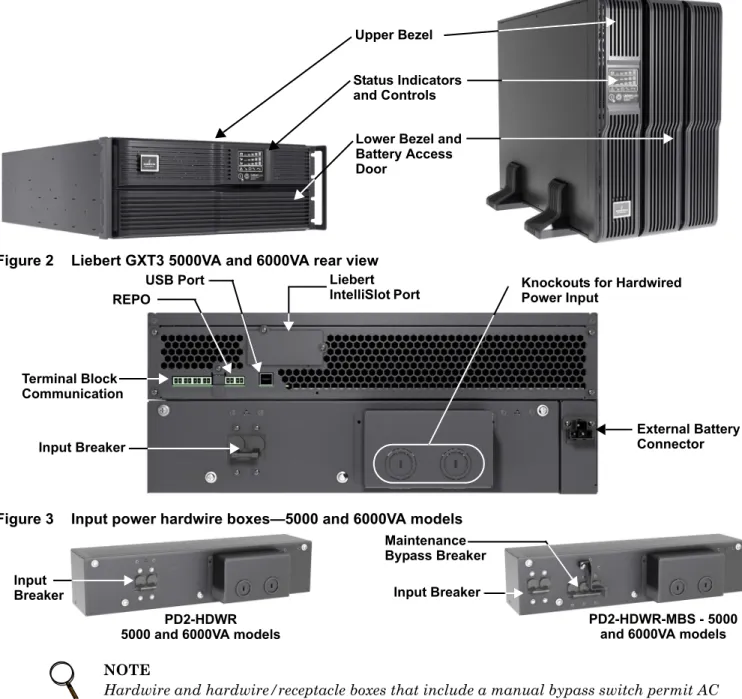
• Liebert GXT3 5000 and 6000VA models ship with a basic hardwire distribution box attached and ready to be connected to the load (see Figure 2).
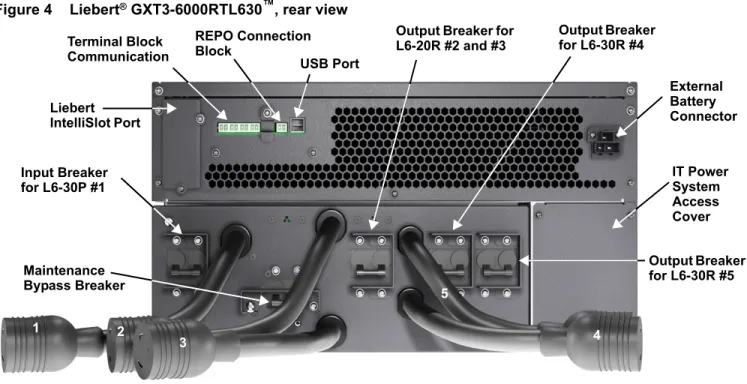
• Liebert GXT3RTL630™ ships with a power distribution box attached (see (Figure 4).
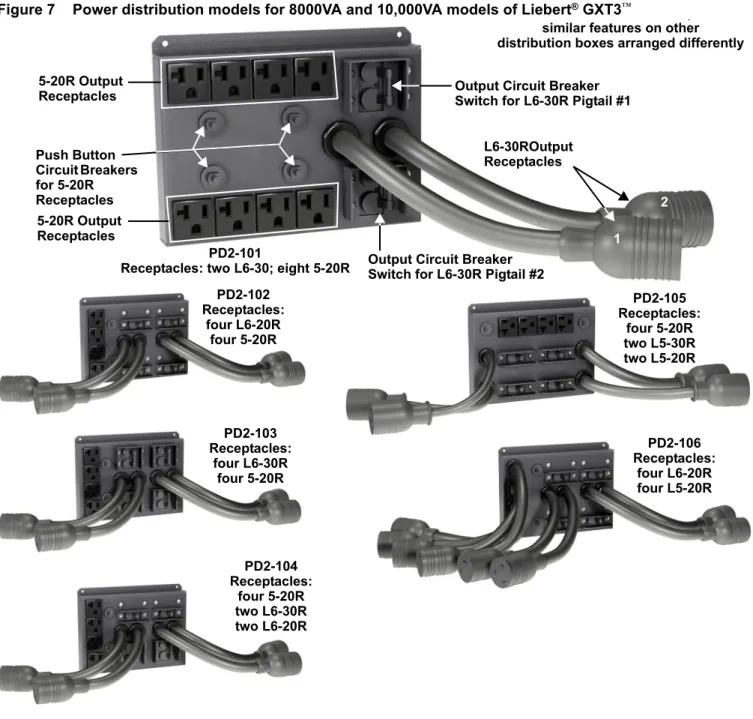
• Liebert GXT3 8000 and 10,000VA models with a cover plate installed over connections for any of several optional power distribution boxes (see Figure 5).
Figure 1 Liebert GXT3 front view—rack-mount and tower configurations
Figure 2 Liebert GXT3 5000VA and 6000VA rear view
Figure 3 Input power hardwire boxes—5000 and 6000VA models
NOTE
Hardwire and hardwire/receptacle boxes that include a manual bypass switch permit AC power to continue to flow from the utility input to the load while the box is removed from the UPS. For details, refer to 3.2 - Removable Power Distribution Box.
Status Indicators and Controls
Lower Bezel and Battery Access Door
Upper Bezel
External Battery Connector Liebert
IntelliSlotPort USB Port
Terminal Block Communication
Input Breaker
Knockouts for Hardwired Power Input
REPO
PD2-HDWR 5000 and 6000VA models
PD2-HDWR-MBS - 5000 and 6000VA models Maintenance
Bypass Breaker Input Breaker Input
Major Components
Figure 4 Liebert® GXT3-6000RTL630™, rear view
Figure 5 Liebert GXT3 8000VA and 10,000VA rear view
External Battery Connector Liebert
IntelliSlotPort
USB Port Terminal Block
Communication
Maintenance Bypass Breaker
REPO Connection Block
Output Breaker for L6-30R #4
Input Breaker for L6-30P #1
1 2
3 4
5
Output Breaker for L6-20R #2 and #3
Output Breaker for L6-30R #5
IT Power System Access Cover
External Battery Connector
Liebert IntelliSlotPort
USB Port Terminal Block
Communication Maintenance
Bypass Switch
Knockouts for Hardwired Power Input REPO Connection Block
Input Breaker Switch Output
Breaker Switch Cover for Power Distribution Box Connections
Major Components
3.2
Removable Power Distribution Box
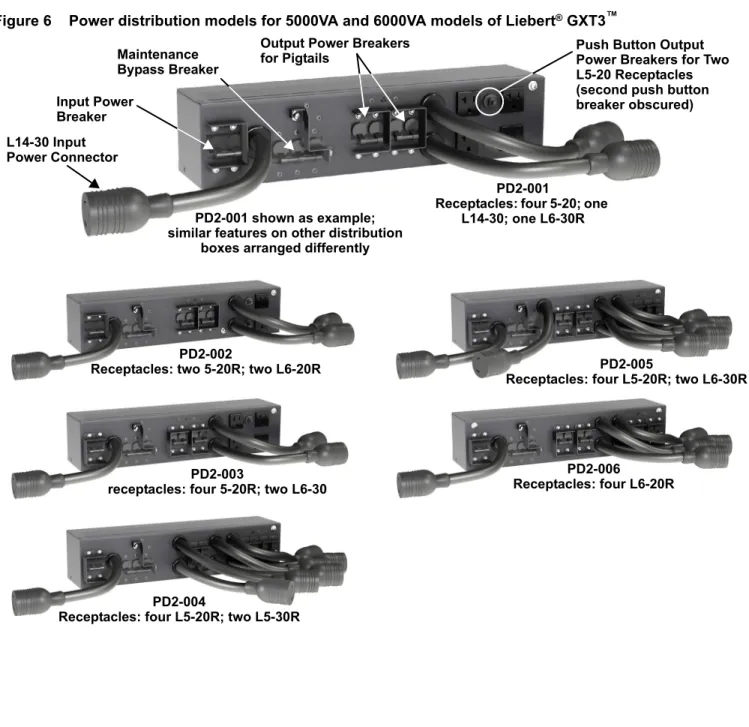
The UPS is shipped with a power distribution pack installed. This box contains the UPS input circuit breaker.
Figure 6 Power distribution models for 5000VA and 6000VA models of Liebert® GXT3™
PD2-001
Receptacles: four 5-20; one L14-30; one L6-30R
PD2-002
Receptacles: two 5-20R; two L6-20R
PD2-003
receptacles: four 5-20R; two L6-30
PD2-005
Receptacles: four L5-20R; two L6-30R
PD2-004
Receptacles: four L5-20R; two L5-30R
PD2-006
Receptacles: four L6-20R L14-30 Input
Power Connector Input Power Breaker
Maintenance Bypass Breaker
Output Power Breakers
for Pigtails Push Button Output Power Breakers for Two L5-20 Receptacles (second push button breaker obscured)
PD2-001 shown as example; similar features on other distribution
Major Components
Figure 7 Power distribution models for 8000VA and 10,000VA models of Liebert® GXT3™
3.3
Internal Battery Packs
The UPS has two internal battery packs behind a battery access door on the front of the unit. Each internal battery pack is fitted with a connector to link to the UPS.
Figure 8 Internal battery pack features
PD2-102 Receptacles:
four L6-20R four 5-20R
PD2-103 Receptacles:
four L6-30R four 5-20R
PD2-104 Receptacles:
four 5-20R two L6-30R two L6-20R
PD2-105 Receptacles:
four 5-20R two L5-30R two L5-20R
PD2-106 Receptacles:
four L6-20R four L5-20R Output Circuit Breaker
Switch for L6-30R Pigtail #1 5-20R Output
Receptacles
5-20R Output Receptacles Push Button Circuit Breakers for 5-20R Receptacles
L6-30ROutput Receptacles
PD2-101
Receptacles: two L6-30; eight 5-20R
p ; similar features on other distribution boxes arranged differently
Output Circuit Breaker Switch for L6-30R Pigtail #2
2
1
Battery Connector
Front of Battery Pack Liebert GXT3 8000 and 10,000VA
battery packs shown;
5000 and 6000VA battery packs have same features
What’s Included
4.0
W
HAT
’
S
I
NCLUDED
The Liebert® GXT3™ is shipped with the following items: • Terminal Block Communication terminals
• Compact disc with: • Liebert MultiLink® • Configuration program
• User manual (electronic version) • USB cable, one; 2m (6-1/2 ft.) long • Rack handles with mounting hardware
• Power Distribution Box, installed on Liebert GXT3 • Plastic tower set, one
• Warnings, safety instructions booklet and WEEE recycling sheet (ISO 14001 compliance)
NOTE
The Liebert GXT3 External Battery Cabinet shipping package includes one battery cabinet, two spacers for the 5000 and 6000VA models and four spacers for the 8000 and 10000VA models for tower configuration and one DC power cable.
Installation and Configuration
5.0
I
NSTALLATION
AND
C
ONFIGURATION
Do NOT attempt to start the UPS, turn on any circuit breaker or energize the input power until instructed to do so in 8.2 - Initial Startup and Electrical Checks.
Visually inspect the UPS for shipping damage. Report any damage to the carrier and your local dealer or Emerson representative.
Install the Liebert® GXT3™ indoors in a controlled environment, where it cannot be accidentally turned off. Place it where air flows unrestricted around the unit. The installation location must be free of water, flammable liquids, gases, corrosives and conductive contaminants. Maintain a mini-mum clearance of 100mm (4 inches) in the front and rear of the UPS. Maintain an ambient tempera-ture range of 0 to 40°C (32 -104°F).
5.1
Install the Main Cabinet
The Liebert GXT3 may be installed in either a tower configuration or in a rack, depending on avail-able space and use considerations. Determine the type of installation and follow the appropriate instructions in either 5.1.1 - Tower UPS Installation or 5.1.2 - Rack-Mount UPS Installation.
5.1.1 Tower UPS Installation
To install the Liebert GXT3 as a tower:
1. Take the support bases out of the accessories bag (see Figure 9).
Figure 9 Support bases
2. If optional Liebert external battery cabinets will be connected to the Liebert GXT3, take out the spacers shipped with the battery cabinet.
3. Connect the spacers and the support bases as shown in Figure 9. Each Liebert GXT3 needs two assembled support bases, one in the front and one in the rear.
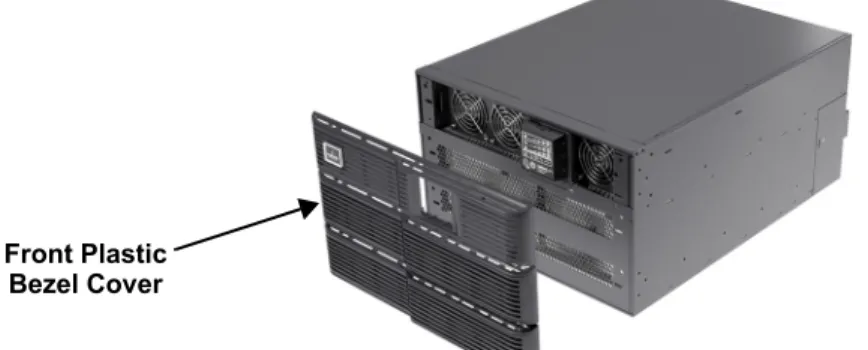
4. Adjust the direction of the operation and display panel and logo on the Liebert GXT3. a. Remove the front plastic bezel cover as shown in Figure 10.
Figure 10 Remove the front plastic bezel cover
!
CAUTION
The UPS is heavy (see 12.0 - Specifications). Take proper precautions when lifting or moving it.NOTE
UPS operation in sustained temperatures outside the range of 15-25°C (59°-77°F) reduces battery life.
Support Bases
Spacers Connectors
Front Plastic Bezel Cover
Installation and Configuration
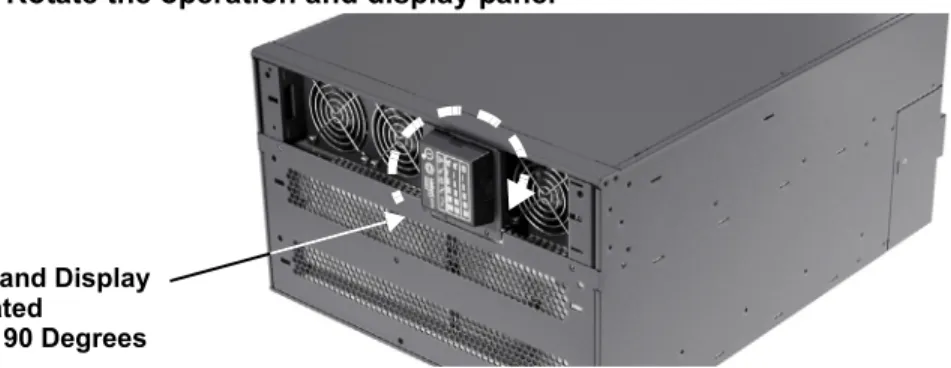
b. Pull the operation and display panel gently, rotate it 90 degrees clockwise and snap it back into position, as shown in Figure 11.
Figure 11 Rotate the operation and display panel
c. Pull the logo on the front plastic bezel cover gently, rotate it 90 degrees clockwise and snap it back into position. The rotated front plastic bezel cover is shown in Figure 11.
d. Replace the front plastic bezel cover on the Liebert® GXT3™. At this point, the UPS operation and display panel and logo have been rotated 90 degrees clockwise, which provides upright viewing for users.
5. Place the Liebert GXT3 and any battery cabinets on the support bases. Each Liebert GXT3 needs two support assemblies, as shown in the lower half of Figure 1.
5.1.2 Rack-Mount UPS Installation
When using the Liebert GXT3 in a rack, the UPS must be supported by a slide kit, fixed rails or a shelf.
When using the optional Adjustable Rack Mount Kit, you will use the following instructions. The fig-ures accompanying 5.1.3 - Installing the Adjustable Rack-Mount Kit—Sold Separately shows the positioning of the rack-mounting brackets. Emerson recommends taking the internal batteries out of the UPS during rack installation. This will make the UPS cabinet lighter and easier to handle.
5.1.3 Installing the Adjustable Rack-Mount Kit—Sold Separately
This kit contains parts needed to mount several different models of UPS and external battery cabi-nets into EIA310-D standard four-post racks that are 18-32" deep (457-813mm). The weight limit per pair of adjustable rack-mounting brackets is 91 kg (200lb).
Parts included are:
Tools needed for installation are: • one Phillips screwdriver • one 7mm wrench
!
CAUTION
The Liebert GXT3 is heavy; see 12.0 - Specifications. The UPS must be installed as near the bottom of a rack as possible. If placed too high, it can make the rack top-heavy and prone to tipping over.Item Quantity
Rear bracket members 2 Front bracket members 2 Inner bracket members 2 M4 machine screws 16 M4 locking hex nuts 8 M5 machine screws 8
Operation and Display Panel Rotated
Installation and Configuration
The adjustable rack-mounting brackets (Part#: RMKIT18-32) feature retaining latches to prevent users from inadvertently sliding the UPS or battery cabinet out of the rack.
To install the rack mount brackets:
1. Unpack two rack-mounting bracket assemblies and mounting hardware from this kit. Bracket assemblies are interchangeable between left-hand or right-hand.
Remove inner member of each bracket assembly as shown at right by extending it to its outermost position, depress-ing the retaindepress-ing latch and then pulldepress-ing the inner member out of the bracket assembly.
2. Determine the height position inside the rack enclosure where you want to mount the UPS or battery cabinet.
3. Install the rear member of each bracket assembly into the rack enclosure with two M5 screws provided in this kit (see figure at right). The return flanges on the bracket assembly fit to the inside of rack mounting rails. Insert screws loosely (finger-tight) into the top and bottom holes of the return flange on the rear member. Extend the bracket assembly by sliding the front member forward until it touches the front rack mounting rail. Insert two M5 screws loosely (finger-tight) into the top and bottom holes of the return flange on each front member. Make sure that the bracket assemblies are at the same mounting height on all four (4) rack mounting rails.
4. Get eight M4 screws and eight M4 nuts from the hardware pack in this kit. Each nut has a locking, nylon insert that begins gripping the screw when it is halfway tight. Make sure to tighten the nut and screw completely to ensure locking action. Fasten the rear member and the front member together using four screws and four nuts per bracket assembly as shown in at right. For maximum support, insert fasteners for each bracket assembly as far apart as possible, depending on rack depth, while still joining both members (see figures at right). Check alignment of bracket assemblies and TIGHTEN ALL SCREWS FROM Steps 2and3.
5. Prepare the UPS or battery cabinet (the “equipment”) for rack mounting by following instructions in the equipment’s user manual. The equipment may require additional parts to be added or parts to be removed for rack mounting. After it is prepared, lay the equipment in rack-mounting
position. Fasten the inner members from Step 1 to the equipment on both sides as shown at right with eight M4 screws provided in the kit. Make sure retaining latch is near the rear of the equipment as shown (see figure at right).
!
CAUTION
Reduce the risk of tipping the rack enclosure by placing the UPS or battery cabinet in the lowest possible rack position.Return flanges Inner members Front members Retaining Latches M5 screws M5 screws Front rack mounting rails 457mm (18") rack depth M4 nuts M4 nuts M4 screws 813mm (32") rack depth M4 nuts M4 nuts M4 screws
UPS or battery cabinet
Front
Installation and Configuration
6. If available, apply a bead of grease 1" (25mm) long at four places inside the bottom, curved tracks of the front members as shown below right. The grease will allow the equipment to slide into the bracket assemblies more easily..
7. Insert the equipment, with inner members attached in Step 5, into the bracket assemblies by inserting the top and bottom edges of the inner members into the top and bottom curved tracks of the front members and sliding the equipment into the rack (see figure at right). Ends of inner members are tapered to allow the rear of the equipment to be angled upward before insertion, if space allows.
Then the rear, bottom edges of the inner members can be placed into the front edge of the bottom tracks and the front of the equipment can be tipped up so they are level to insert the top edges of the inner members before sliding the equipment into the rack (see figure above right). The equip-ment should move smoothly into the bracket assemblies. If it does not, recheck the alignequip-ment of the front and rear members from Steps 2and3.
8. Secure the front of the equipment to the rack mounting rails to prevent the equipment from sliding out of position. If securing holes are provided on the front of the equipment that align with the center holes on the return flange of the front members, you can use the four extra M5 screws provided in the kit to secure the equipment. Otherwise, the equipment should be secured to the front of the rack with four customer-supplied fasteners.
!
CAUTION
Lifting equipment into the rack may be a two-person job, depending on the weight of the equipment. Liebert® recommends taking the internal batteries out of the UPS during rack installation. This will make the UPS cabinet lighter and easier to handle. The Liebert GXT3™ weighs 151 lb. (67kg). For the weight of the UPS, see Table 7; for the battery cabinet’s weight, see Table 11.Factory-supplied rack handles are not intended to be used to lift the UPS. The handles are intended to be used to slide the UPS into and out of the rack.
UPS or battery cabinet
Apply grease (inside) Apply
grease
Insert the UPS into the front members, lift the front and push it into the rack..
Installation and Configuration
5.2
External Battery Cabinet Installation
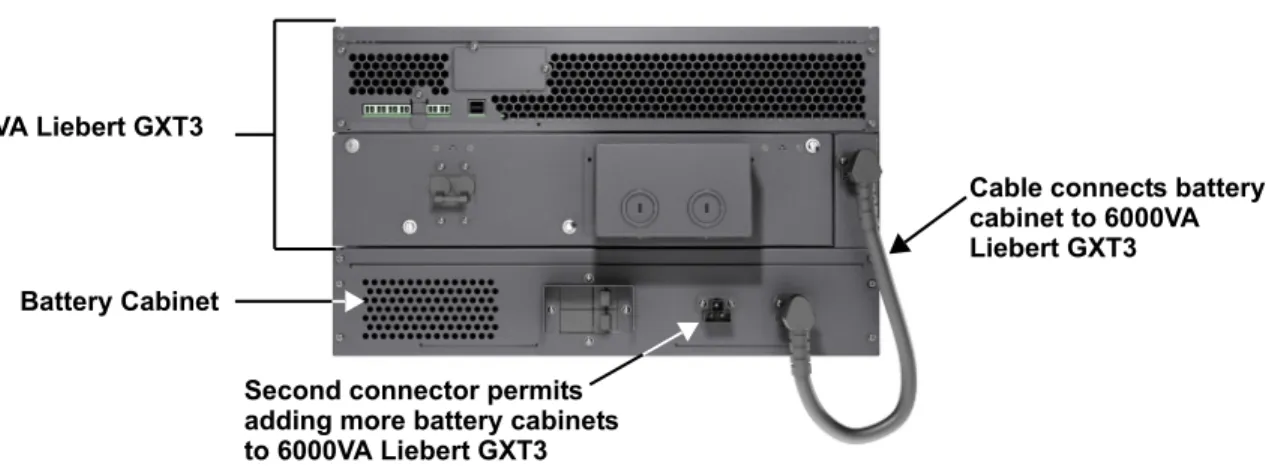
Optional Liebert external battery cabinets may be connected to the UPS to provide additional battery run time. External battery cabinets are designed to be placed on one side of the UPS in a tower config-uration or stacked beneath the UPS in a rack configconfig-uration.
Figure 12 External battery cabinets connected to 6000VA Liebert GXT3
1. Inspect the external battery cabinet for freight damage. Report damage to the carrier and your local dealer or Emerson representative.
2. Optional rack-mount handles are shipped with the external battery cabinet and may be installed at this time if desired.
3. Securing hardware and slide rails are sold separately. Please contact your local dealer or
Emerson representative for these additional options and any assistance needed. Fasten the slides into position with the screws per the instructions included with the slide rails.
4. Use the enclosed support bases for the tower option to prevent tip-over. One additional set of support base extensions ships with each external battery cabinet.
5. Put the UPS in Bypass Mode by pressing the bypass button on the front of the unit and holding it about 2 seconds.
6. Verify the External Battery Cabinet breaker is in the Off position.
7. Connect the supplied external battery cabinet cable to the rear of the external battery cabinet, then to the rear of the UPS.
8. Turn the External Battery Cabinet breaker to the On position.
9. Press the On button on the front of the UPS for 4 seconds to return the unit to Inverter Mode. 10. Verify the circuit breaker on the External Battery Cabinet is in the On position.
11. Use the included configuration program to program the UPS for the number of external battery cabinets connected. Instructions for the configuration program are in 6.0 - Configuration Program.
12. The UPS is now equipped with additional backup battery run time. For approximate battery run times, refer to Table 14.
!
WARNING
Risk of electric shock. Can cause injury or death.Disconnect all local and remote electric power supplies before working within.
Ensure that the Liebert® GXT3™ is shut down and power has been disconnected before beginning any work on or in the unit.
!
CAUTION
The external battery cabinet(s) are heavy (see Table 11). Take proper precautions when lifting them.NOTE
When removing the External Battery Cabinet, the circuit breaker on the rear of the cabinet must be turned off before disconnecting the cable.
Cable connects battery cabinet to 6000VA Liebert GXT3 6000VA Liebert GXT3
Battery Cabinet
Second connector permits adding more battery cabinets to 6000VA Liebert GXT3
Installation and Configuration
5.3
Connect Input/Output Power
The Liebert GXT3-5000RT208™, Liebert GXT3-6000RT208™ and Liebert GXT3-6000RTL630™ are shipped with a power distribution box attached. The Liebert GXT3-8000RT208™ and Liebert GXT3-10000RT208™ are shipped with a cover plate over the power distribution connector. Follow the instructions below for removal and installation.
5.3.1 Remove the Power Distribution Box from 5000 and 6000VA Models
1. Put the Liebert GXT3 in maintenance bypass by pressing the Standby/Manual Bypass button while the UPS is in Utility (AC) Mode and holding the button for about 2 seconds. (For help, refer to 8.4 - Put the Liebert® GXT3™ in Manual Bypass.)
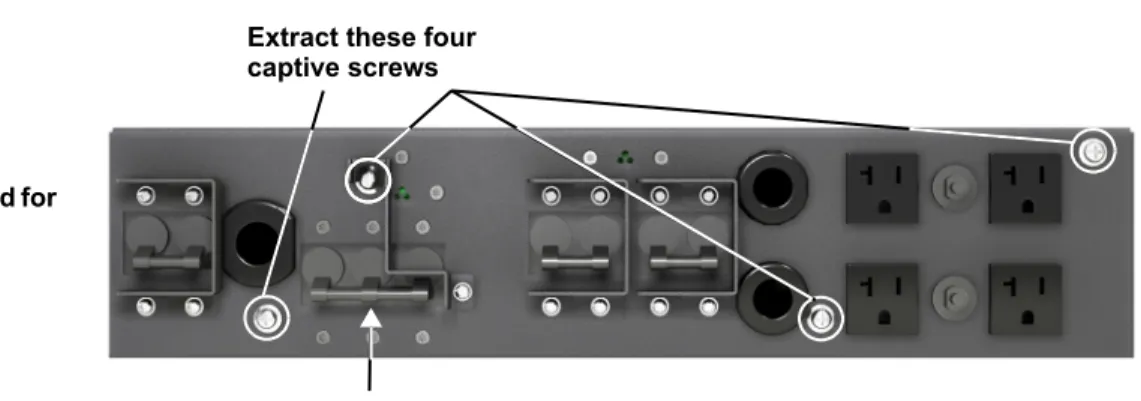
2. Loosen the captive screw over the maintenance bypass breaker (see Figure 13 for the breaker’s location).
3. Turn the maintenance bypass breaker On.
NOTICE
The load is unprotected from disturbances in the power supply while the UPS is on bypass. 4. Turn the output and input breakers Off.
5. Loosen other captive screws until the power distribution box releases. 6. Remove the power distribution box from the UPS and set it aside.
7. Loosen the screws over the plastic cover for the connector on the rear of the panel. 8. Slide the plastic cover over the connector and tighten the screws.
Figure 13 Power distribution box removal from 5000 and 6000VA models
NOTE
If the UPS is to be shipped or stored for an extended time, the connector should be
disconnected. This will minimize any standby current drain on the batteries and help attain their design life.
!
WARNING
Risk of electric shock. Can cause injury or death.Disconnect all local and remote electric power supplies before working within. Ensure that the Liebert® GXT3™ is shut down and power has been disconnected before beginning any work on or in the unit.
NOTE
Do not operate the UPS with the power distribution box removed. To shut off all power to this box and to the load, utility input power must be disconnected.
Maintenance Bypass Breaker Extract these four captive screws
Pigtails removed for clarity
Installation and Configuration
5.3.2 Remove the Power Distribution Cover from 8000 and 10,000VA Models
1. Shut down the Liebert® GXT3™ by pressing the Standby/Manual Bypass button twice while the UPS is in Bypass Mode, each time holding the button down for about 2 seconds. (For help, refer to
8.5 - Shut Down the Liebert GXT3.)
2. Loosen the captive screw over the maintenance bypass breaker (see Figure 5 for the breaker’s location).
3. Turn the maintenance bypass breaker On.
NOTICE
The load is unprotected from disturbances in the power supply while the UPS is on bypass. 4. Turn the output and input breakers Off.
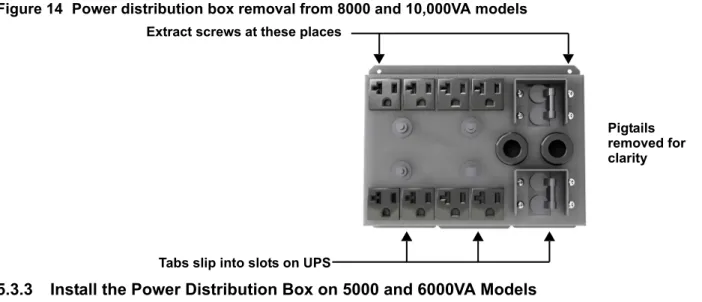
5. Support the power distribution box and remove the two screws at the top of the box. 6. Remove the cover or power distribution box from the UPS and set it aside.
7. If removing a power distribution box, carefully pull apart the power distribution box connector and the UPS connector.
Figure 14 Power distribution box removal from 8000 and 10,000VA models
5.3.3 Install the Power Distribution Box on 5000 and 6000VA Models
1. Align the connectors and press the power distribution box onto the UPS.
2. Hold the box firmly against the UPS and tighten the captive screws except the one over the maintenance bypass breaker.
3. Turn the output and input breakers On.
4. Start the UPS according to startup instructions. 5. Verify that the UPS lamp is illuminated.
6. Turn the maintenance bypass breaker Off.
7. Insert the maintenance bypass cover behind the captive screw and tighten the screw.
NOTE
The maintenance bypass breaker cover must be installed behind the captive screw and the screw must be tightened for the UPS to operate in inverter mode.
Tabs slip into slots on UPS Extract screws at these places
Pigtails removed for clarity
Installation and Configuration
5.3.4 Install the Power Distribution Box on 8000 and 10,000VA Models
1. With the cover or distribution box removed, press the UPS and distribution box connectors together. Ensure that the connectors are fully seated.
2. Align the screw holes and press the power distribution box onto the UPS, making sure that the tabs at the bottom of the box fit into the slots on the UPS.
3. Attach the box to the UPS by installing screws into the two holes at the top of the box. 4. Tighten the screws.
5. Turn the output and input breakers On.
6. Start the UPS according to startup instructions. 7. Verify that the UPS lamp is illuminated.
5.3.5 Distribution Box Electrical Connections
Electrical connections are made through a removable power distribution box that attaches to the rear of the UPS.
• PD2-HDWR, PD2-HDWR-MBS, PD2-001, PD2-002, PD2-003, PD2-004, PD2-005 and PD2-006 models fit the 5000 and 6000VA models of the Liebert® GXT3™
• PD2-L630 fits the GXT3-6000RTL630™
• PD2-101, PD2-102, PD2-103, PD2-104, PD2-105 and PD2-106 models fit the 8000 and 10,000VA models of the Liebert GXT3
The installer must provide an upstream branch circuit breaker. The input circuit breaker on the dis-tribution box and the output circuit breaker on the rear of the power disdis-tribution box disconnect all power between the main cabinet and the distribution box.
Models equipped with a manual bypass breaker pass bypass power directly to the bypass breaker from the input terminal block. The input circuit breaker on the distribution box does not disconnect power from the manual bypass breaker.
Figure 15 Distribution box electrical connections diagram Table 1 Branch circuit breaker ratings
Unit Rating Maximum Breaker Rating
5000VA
D Type 30A Long Delay 6000VA
8000VA
D Type 60A Long Delay 10,000VA Utility Input External Branch CB Output Distribution POD Input CB Output CB Input Indicator Output Indicator Maintenance Bypass Breaker UPS Utility Input External Branch CB Optional Output Distribution Plate Input CB Output CB Input Indicator Output Indicator Maintenance Bypass Breaker UPS Output Terminal Block
Distribution Box Electrical Connections
Installation and Configuration
Terminal Block Connections
Conduit entry holes are provided on the rear and side of the box. Input and output wiring should not share the same conduit. Emerson recommends using strain relief when installing the wire.
Figure 16 Terminal block connections Table 2 Electrical specifications
UPS Model
Recommended (Maximum) External Overcurrent Protection
Recommended Wire (Including ground wire)
(75°C copper wire)
Maximum Wire Accepted by Terminal Block
Terminal Tightening
Torque
GXT3-5000RT208™ GXT3-6000RT208™
GXT3-6000RTL630™ 30A 10AWG (4mm
2) 8AWG (6mm2)
20 in-lb (2.26 Nm) GXT3-8000RT208™
GXT3-10000RT208™ 60A 6AWG (10mm2) 4AWG (16mm2)
NOTE
1. Emerson recommends installing a UL489-approved breaker upstream of unit.
2. The installer must provide circuit breaker protection according to local codes. The utility disconnect should be within sight of the UPS or have appropriate an appropriate lock-out. Maintain service space around the UPS or use flexible conduit.
3. The installer must provide output distribution panels, circuit breaker protection or emergency disconnects according to local codes. Output circuits must not share a common conduit with any other wiring.
L2
N
L1
L2
N
L1
OUTPUT
INPUT
L2
N
L1
L2
N
L1
OUTPUT
INPUT
Liebert GXT3-5000 and 6000RT208
Installation and Configuration
5.4
IT Power System Configuration—Liebert
®GXT3-6000RTL630
™Only
1. Remove screws on the IT Power System Access Cover as shown in Figure 17. 2. Disconnect the connectors as shown in figure.
3. Reinstall IT Power System Access Cover and screws.
Figure 17 Remove cover from IT Power System Connectors compartment
!
WARNING
Risk of electric shock. Can cause injury or death.Disconnect all local and remote electric power supplies before working within. Ensure that the Liebert GXT3 is shut down and power has been disconnected before beginning any work on or in the unit.
Remove Screws IT Power System Connectors
Configuration Program
6.0
C
ONFIGURATION
P
ROGRAM
The final step of installation may require custom configuration of your UPS using the enclosed config-uration program. Some configconfig-uration settings may be changed only while the UPS is off. These should be set before the UPS is put into full-time service powering the critical load.
For most users operating with 230VAC and with no external batteries, the factory default settings will be adequate.
6.1
Configuration Program Features
• Select L-N output voltages to match local voltages. • Enable/Disable Auto-Restart.
• Select frequency converter operation with a fixed output frequency of 50 or 60 Hz. • Set the Low Battery Warning alarm time from 2 to 30 minutes.
• Enable/Disable the Auto-Battery test.
• Set the Auto-Battery test to 7, 14, 21 or 28 days.
• Specify the number of external battery cabinets connected to the UPS to adjust the remaining run time calculations reported by Liebert® software products.
• Modify the shutdown setting of the terminal block (for information on pin assignments, see
Table 2).
6.1.1 What You Will Need
In addition to the Liebert GXT3™ UPS, you will need the configuration program CD and USB cable included in the UPS accessory box. A Windows 95® or later computer, desktop or laptop, is also required to set up and run the configuration program.
Controls and Indicators
7.0
C
ONTROLS
AND
I
NDICATORS
Figure 18 Liebert® GXT3™ control panel
7.1
ON/Alarm Silence/Manual Battery Test Button
This button controls output power to connected load(s) and has three functions: • ON
• Alarm Silence • Manual Battery Test
ON - Pressing this button for four seconds will start the UPS.
Alarm Silence - To silence alarms, press this button for at least one second. After the alarm is silenced, the Liebert GXT3 will reactivate the alarm system to alert of addi-tional problems.
Manual Battery Test - To initiate a manual battery test, press the ON button for at least one second while operating from utility power with no alarm conditions present.
• If only three of the five Battery LEDs illuminate, allow the UPS to recharge the batteries for 24 hours.
• After 24 hours, retest the batteries.
• After the batteries have been retested, if only three of the five Battery LEDs illuminate, contact your local dealer, Emerson representative or Emerson Channel Support.
7.2
Standby/Manual Bypass Button
This button controls output power to connected load(s) and has dual functions: Standby and Manual Bypass.
NOTICE
Pressing the Standby/Manual Bypass button once will transfer the load to bypass power and the load will be unprotected from disturbances in utility supply. Pressing the Standby/Manual Bypass button twice within 4 seconds while on Bypass will cut off power to the output sockets and connected loads. Perform all necessary shutdown procedures on connected loads before pressing this button twice.
NOTE
The LOW BATTERY and BYPASS reminder alarms CANNOT be silenced.
Liebert
®GXT3
AC Power System
10000VA
Battery Level Indicators
Load Level
Indicators
Bypass Indicator
Inverter Indicator
Battery Indicator
Standby/Manual Bypass Button
On/Alarm Silence/Manual
Battery Test Button
AC Input Indicator
Fault Indicator
Upper indicator for L1 Lower for L2
Controls and Indicators
7.3
Load Level Indicators (4 Green, 1 Amber)
The load level indicator is composed of five sets of LED bars that illuminate to indicate the relative load on the UPS output in 25% increments (±5%). The load level indicator will illuminate as shown in
Figure 19.
The load level indicators display the approximate electrical load placed upon the UPS at all times.
Figure 19 Load level indicators
7.4
Battery Level Indicators (5 Green)
The battery level indicator is composed of five sets of LED bars that illuminate and flash to indicate the battery capacity level. The Liebert® GXT3™ battery capacity level is shown in 20% increments (±5%). The battery level indicators will illuminate as shown in Figure 20
The battery level indicators display approximate battery capacity at all times.
The Liebert GXT3 is equipped with automatic and remote battery test features. The default setting is for the automatic test to occur every 14 days (this option is user-configurable) if utility power has not been interrupted. Should the battery fail this test, the red Fault indicator LED along with the A and C diagnostic LEDs will illuminate and an alarm will sound (refer to 11.0 - Troubleshooting). The remote test feature functions with Liebert MultiLink® and can remotely initiate the battery test.
Figure 20 Battery level indicators
0 - 25%
Overload
76 - 100%
51 - 75%
26 - 50%
ON OFF OFF OFF OFF
ON ON OFF OFF OFF
ON ON ON OFF OFF
ON ON ON ON OFF
ON ON ON ON ON
The Liebert® GXT3 has
load level indicators for Line 1 and for Line 2. One set of indicators shown for clarity.
0 - 20%
Fully Charged 81 - 100%
61 - 80% 41 - 60% 21 - 40%
ON ON ON ON ON OFF ON ON ON ON ON ON OFF OFF OFF ON OFF OFF OFF OFF
ON
ON ON OFF OFF
Discharging
Flash OFF OFF OFF OFF
OFF ON ON ON Flash
ON
ON Flash OFF OFF ON Flash OFF OFF OFF
Flash ON ON ON ON
Charging
Controls and Indicators
7.5
UPS Status Indicators
UPS status is indicated by five symbols: fault indicator, AC input indicator, battery indicator, inverter indicator and bypass indicator. Table 3 shows the symbols and their meanings.
Table 3 UPS status indicators
UPS Status
Indicator Icon Color Description
Fault Indicator Red On if the UPS has detected a fault; Off if there is no fault
AC input Indicator Green On when the utility input power is normal; Off during utility failure; flashing when utility power is outside specifications
Battery Indicator Amber On when the battery is supplying power; Off when the battery is not supplying power
Inverter Indicator Green On when the inverter is supplying power; Off when the inverter is not supplying power
Operation
8.0
O
PERATION
This section describes checks to be made before starting the UPS, how to start the UPS, manual bat-tery test, manual bypass, shutting down the UPS and disconnecting the utility power from the UPS.
8.1
Startup Checklist for the Liebert GXT3
™Before starting the UPS, perform these checks:
___ 1. Check that the input plugs and loads are connected properly and reliably. ___ 2. Check that the battery cable is connected properly.
___ 3. Check that the communication cables are connected properly.
8.2
Initial Startup and Electrical Checks
1. Verify that the Input/Output circuit breakers are off.
2. During initial system checks, disconnect all loads (open load disconnects). 3. Inspect all wiring, cables and connection.
4. If external battery cabinets are used, verify that the battery interconnect cables are fully inserted in the sockets.
5. Place the manual bypass breaker in BYPASS position.
6. Turn on the branch circuit disconnect to apply voltage to the input terminal block. 7. Using a voltmeter, verify the expected L1-N (L2) voltage.
Verify that the same voltages appear at the Output terminals. The Bypass lamp by the switch will light.
8. After verifying proper input voltage to the UPS terminal block, turn off the branch circuit power, close all access panels to the distribution box and reapply input power.
9. Close the Input circuit breaker located on the distribution box. The green AC INPUT lamp should illuminate on the front panel.
10. Press the ON button and hold it for four seconds. After several seconds, the UPS ON lamp will turn on continuously. If the batteries are determined to be charged above 80%, an automatic battery test will run for about 15 seconds.
11. Close the Output circuit breaker on the rear of the power distribution box. The light by the input breaker will illuminate.
12. Return the breaker to the Inverter position. The output terminal block will be powered at this time.
13. Connect all loads for normal operation.
NOTE
The Liebert® GXT3’s battery has been fully charged before delivery, but some charge will be lost
during storage and shipping. To ensure that the battery has adequate reserve power to protect the connected load, charge the battery for three hours before putting the UPS into service.
Operation
8.3
Manual Battery Test
To initiate a manual battery test, press the On/Alarm Silence/Manual Battery Test button for at least half a second while the UPS is operating from utility power with no alarm conditions present.
• If only the first two of the five LED segments illuminate, allow the UPS to recharge the batteries for 24 hours.
• Retest the batteries after 24 hours of charging.
• After the batteries have been retested, if only two of the five Battery LEDs illuminate, contact your local Emerson representative or Emerson Network Power Channel Support.
• If none of the five Battery LEDs illuminate during a manual battery test, check the battery con-nection and allow the UPS to recharge the batteries for 1 hour, then initiate a manual battery test again.
• If none of the five Battery LEDs illuminate during the second manual battery test, replace batter-ies and contact your local Emerson representative or Emerson Channel Support.
8.4
Put the Liebert
®GXT3
™in Manual Bypass
Press the Standby/Manual Bypass button and hold it for about 2 seconds while the UPS is in Utility (AC) Mode. The UPS will transfer the connected loads to the internal bypass. If the internal bypass is not available because of utility power problems, pressing this button once will be ignored. Bypass operation is indicated by an audible alarm and illuminated amber Bypass indicator. (If other indica-tors are illuminated, refer to 11.0 - Troubleshooting.)
8.5
Shut Down the Liebert GXT3
1. Transfer the UPS to manual bypass by pressing the Standby/Manual Bypass button and holding it for about 2 seconds.
If manual bypass is not available, disregard the first step.
2. Press the Standby/Manual Bypass button twice within four seconds, each time holding it for about two seconds.
Power to the connected loads is now Off.
8.6
Disconnecting Input Power from the Liebert GXT3
1. After the UPS has been shut down as detailed in 8.5 - Shut Down the Liebert GXT3, turn off the Output Circuit Breaker.
2. Wait 30 seconds and verify that all indicators have turned Off and the fan has stopped; this indicates that the power-off is complete.
3. Turn the external battery cabinet breaker switch to the Off position if the UPS has an external battery cabinet.
After powering off the UPS, the UPS ceases output and the load is powered Off.
8.7
Maintenance Bypass
Maintenance Bypass Mode is used when maintenance or replacement is required. To place the unit in Maintenance Bypass:
1. Place the UPS on internal bypass. This may be done by either of the following methods: a. Press the Off button on the front panel one time.
b. Slide the bracket away from the manual bypass breaker on the rear of the UPS. This requires loosening the captive screw and sliding the bracket up and away from the Manual Bypass breaker.
2. Move the Manual Bypass breaker on the rear of the UPS to the bypass position. This requires loosening the captive screw and sliding the bracket up and away from the Manual Bypass breaker.
Communication
9.0
C
OMMUNICATION
9.1
Communication Interface Port
The Liebert® GXT3™ UPS has a terminal block on the rear of the UPS unit. Several signals are pro-vided on this port and are assigned as follows.
9.2
Terminal Block
The terminal block includes eight pins, as shown in Figure 21.
Figure 21 Terminal block communication pin layout
9.2.1 Any-Mode Shutdown
The purpose of Any Mode Shutdown is to shut down the UPS output by turning Off the rectifier, inverter and static switch so that there is no power to the loads.
Any Mode Shutdown can be operated locally or remotely:
• Local Any Mode Shutdown can be performed by shorting the pins in Set 3.
• Remote Any Mode Shutdown can be performed using a switch connected to the pins in Set 3 and mounted at a remote location.
Activation of the Any Mode Shutdown will be logged as an event in the event history log.
9.2.2 Battery Mode Shutdown
Battery Mode Shutdown permits shutting down the UPS by turning off the rectifier, inverter and static switch so that there is no power to the load when the UPS is On Battery. The auxiliary power for the UPS will still be active.
Battery Mode Shutdown can be performed locally or remotely:
• Local Battery Mode shutdown can be performed by shorting the pins in Set 4.
• Remote Battery Mode Shutdown can be performed using a switch connected to the pins in Set 4 and mounted at remote location.
NOTE
Remote Power Off will be performed either by NO or NC contact of Any Mode Shutdown. The current limited source for the optocoupler (+12VDC, 50mA) will be available from UPS. The connection to UPS for remote connection will be via terminal block connector.
Any Mode Shutdown wiring must conform to all national, regional and local wiring codes and laws.
!
WARNING
When the Auto-enable output option is selected and the UPS output is disabled using the pins in Set 3, the Liebert GXT3’s output can turn On automatically and without warning if the connection of the pins in Set 3 is changed.1
2
3
4
Low Battery
Warning
On-Battery
Warning
Any Mode
Shutdown
Battery Mode
Shutdown
Communication
Activation of the Battery Mode Shutdown will be logged as an event in the event history log.
9.2.3 On Battery
On Battery signal is a Normally Open (NO) dry contact. When the UPS is supplying output power from the battery this dry contact will be closed.
9.2.4 Low Battery
Low Battery signal is a Normally Open (NO) dry contact. When the UPS is supplying output power from the battery and has reached the Low Battery Warning time selected in the configuration pro-gram, this dry contact will be closed.
9.3
Liebert IntelliSlot
®Communication Cards
The Liebert IntelliSlot port accepts three optional cards: • Liebert IntelliSlot SNMP Card
• Liebert IntelliSlot Relay Card • Liebert IntelliSlot 485 Card.
The Liebert IntelliSlot SNMP Card provides SNMP monitoring and control of the UPS across the net-work.
The Liebert IntelliSlot Relay Card provides dry contact relay outputs for custom-wired applications and delivers support for built-in shutdown for AS/400 systems.
The Liebert IntelliSlot 485 Card is used to connect the UPS and computer system.
Follow instructions provided with the Liebert IntelliSlot card to configure Liebert MultiLink®, the UPS or any additional ancillary product for the Liebert GXT3. These instructions are available at
multilink.liebert.com
NOTE
Remote Power Off will be performed by NO contact.
The current limited source for the optocoupler (+12VDC, 50mA) will be available from UPS. The connection to the Liebert® GXT3™ for remote connection will be via terminal block
connector.
Battery Mode Shutdown wiring must conform to all national, regional and local wiring codes and laws.
This signal must last for 1.5 seconds or longer.
A battery shutdown signal will not cause an immediate shutdown. It will start a 2-minute shutdown timer. This timer cannot be stopped once triggered. If the utility power returns during this countdown, the Liebert GXT3 will still shut down and must remain shut down for 10 seconds. Whether the UPS turns back On when the power is restored depends on the auto-restart setting.
NOTE
The rated values for the dry contacts for the On Battery and Low Battery signals are: • Rated Voltage: 30V (AC or DC)
Communication
9.3.1 Liebert
®MultiLink
®Liebert MultiLink monitors the UPS continuously and can shut down a computer or server in the event of an extended power failure.
Liebert MultiLink can also be configured for use without the USB cable when the Liebert IntelliSlot® SNMP/Web card is installed in the UPS. Additionally, Liebert MultiLink can be configured to coordi-nate shutdown across the network with other computers running Liebert MultiLink when you pur-chase a Liebert MultiLink License Kit. For more information about the Liebert IntelliSlot SNMP/Web Card and Liebert MultiLink License Kits, visit our Web site (www.liebert.com) or contact your local dealer or Emerson representative.
Several option cards are available for use in the Liebert IntelliSlot port of the Liebert GXT3™. The Liebert IntelliSlot SNMP/Web Card provides SNMP and Web-based monitoring and control of the UPS across the network.
The Liebert IntelliSlot MultiPort 4 Card allows installing Liebert MultiLink software on four comput-ers and coordinate shutdown in the event of a power failure.
The Liebert IntelliSlot Relay Card provides dry contact relay outputs for custom wired applications and delivers support for built-in shutdown for AS/400 systems.
9.4
Remote Emergency Power Off
The UPS is equipped with a Remote Emergency Power Off (REPO) connector.
The user must supply a means of interfacing with the REPO circuit to allow disconnecting the UPS input feeder breaker to remove all sources of power to the UPS and connected equipment to comply with national and local wiring codes and regulations.
REPO switch connection diagram
!
CAUTION
To maintain safety (SELV) barriers and for electromagnetic compatibility, signal cables should be shielded and run separate from all other power cables, where applicable.!
CAUTION
To maintain safety (SELV) barriers and electromagnetic compatibility, signal cables should be shielded and run separately from power cables.1 2
Normally closed switch system (fail-safe)
UPS ships with REPO jumper installed allowing the UPS to operate
Opening the REPO connection will disable the UPS. Manual restart using the front panel is required after the REPO connection is closed again.
Maintenance
10.0 M
AINTENANCE
This section describes replacing the internal battery pack, precautions, checking the Liebert® GXT3’s status and checking UPS functions.
10.1 Replacing the Internal Battery Pack
The Liebert GXT3™ is designed to allow the user to replace the internal battery pack safely. Read the safety cautions before proceeding. Contact your local dealer or Emerson representative to obtain the part number and pricing of the appropriate replacement battery pack.
10.1.1 Battery Replacement Procedures
1. Gently remove the front plastic bezel cover from the UPS.
2. Loosen and remove the six screws on the battery door, as shown in Figure 22. 3. Lay the battery door and screws aside for reassembly.
Figure 22 Removing the front plastic bezel cover and battery door
4. Gently pull the battery wires out and disconnect the battery plugs and battery receptacles, as shown in Figure 23.
Figure 23 Disconnecting the battery plug and battery receptacle (front view)
5. Grasp the battery handle and pull one of the internal battery packs out of the UPS, as shown in
Figure 24.
Repeat this step if both battery packs will be replaced. Each model has two battery packs
Front Bezel
Battery Door Screws, 6
8000VA / 10,000VA model shown; 5000VA & 6000VA model arrangement is the same except smaller
Battery Connector Battery Receptacle
Battery Connector Battery Receptacle
8000 / 10,000VA model shown; 5000 / 6000VA model arrangement is the same except smaller