Effect of Probiotic Addition in Drinking Water on Body
Weight and Body Measurements of Broiler Chickens
Cyril Hrnčár*
1, Ján Weis
1, Slavomír Mindek
2, Jozef Bujko
3 1Department of Poultry Science and Small Animal Husbandry 2
Department of Veterinary Sciences 3
Department of Genetics and Breeding Biology
Faculty of Agrobiology and Food Resources, Slovak University of Agriculture in Nitra, Slovakia
Abstract
The aim of this study was to determine the effects of probiotic addition in drinking water on body weight and body measurements of broiler chickens. The experiment was carried out in half-operation conditions experimental base of Department of Poultry Science and Small Animal Husbandry of Slovak University of Agriculture in Nitra in three -floor cage system. A total of 180 one day old chickens (Ross 308) were randomly divided to 3 groups: experimental chickens of E1 group received a probiotic in drinking water with concentration of 1x10⁹ colony forming units (CFU) of Lactobacillusfermentum CCM 7158 in 1 g of nutrient medium and experimental, chickens of E2 group concentration of 2x10⁹ CFU of Enterococcus faecium M 74 in 1 g of nutrient medium. The control group of chickens received drinking water without any additives. The fattening period lasted 42 days. Data of body weight and body measurements (body length, body circumference, keel length, thigh length, and shank length) were recording at ages in 42 day. The results of this study showed that body weight was significantly affected (P<0.05) by addition of probiotic strains Lactobacillus fermentum and Enterococcus faecium, between experimental groups we found statistically not significant difference (P>0.05). The body measurements was not significantly affected (P>0.05) by addition of probiotic in drinking water.
Keywords: body measurements, body weight, cage, chicken, probiotic
1. Introduction
The increased pressure on livestock industry to phase out the use of prophylactic dosages of antibacterial growth promoters in the European Union due to microbial resistance in animals and human and the potential to do same in other parts of world has stimulated increased interest in alternative natural growth promoters [1].
Several alternatives to antibiotic growth promoters have been proposed such as for example organic acids [2], probiotics [3], phytogenic feed additives [4], products of bees [5] and enzymes [6].
* Corresponding author: Cyril Hrnčár, + 421 37 6414744, [email protected]
Probiotics are defined as live microbial food supplements, which beneficially influence only not human [7], but also poultry health and performance, chickens [8], hens [9], turkeys [10], pigeons [11] and waterfowl [12,13].
Probiotics in poultry maintaining normal intestinal microflora by competitive exclusion and antagonism [14], alter metabolism by increasing digestive enzyme activity and decreasing bacterial enzyme activity and ammonia production [15], improve feed intake and stimulate the immune system [16]. The selection of bacteria such as Lactobacillus, Pediococcus, Bacteroides, Bifidobacterium, Bacillus and Streptococcus, for use as probiotics is based on assessment of their metabolic products and their potential to colonize specific sites [17].
249
influence of various probiotic strains
(Lactobacillus fermentum, Enterococcus
faecium) on final body weight and body
measurements of broiler chickens in half-operating conditions of cage technology.
2. Materials and methods
The experiment was realised in half-operation conditions of experimental basis of Department of Poultry Science and Small Animal Husbandry. Chickens were healthy and their condition was judged as good at the commencement of the experiment. Conditions of animal care, manipulations and use corresponded with the instruction of ethical commission. Care and use of animals and experimental devices met the requirement of the certificate of Authorization to Experiment on Living Animals (State Veterinary and Food Institute of Slovak Republic, no. SK PC 30008). The experiment was conducted on broiler chickens, hybrid Ross 308 (n=180). Broiler chickens were stabled in a three-floor cage technology (MBD, Slovak Republic) consisted of 18 cages with proportions 75x50 cm (0.375 m2).
Two types of complete feed mixtures (Boskop, a.s., Trenčín, Slovak Republic) have been distributed according to periods of fattening: starter (d1-d21) in powdery form and grower (d22-d42) in granular form, both no inclusions of anticoccidials. Nutritional value of diets is shown in Table 2. Feeding was provided on an ad libitum basis from containers on the front of the cages.
Chickens were divided into three groups (control - C and experimental groups - E1 and E2). The feeding period lasted 42 days. Experimental chickens of E1 group received a probiotic preparation (IPC s.r.o., Kosice, Slovak Republic) in drinking water with concentration of 1x10⁹ colony forming units (CFU) of Lactobacillus fermentum CCM 7158 in 1 g of nutrient medium with supporting components maltodextrin and oligofructose (1% in preparation).
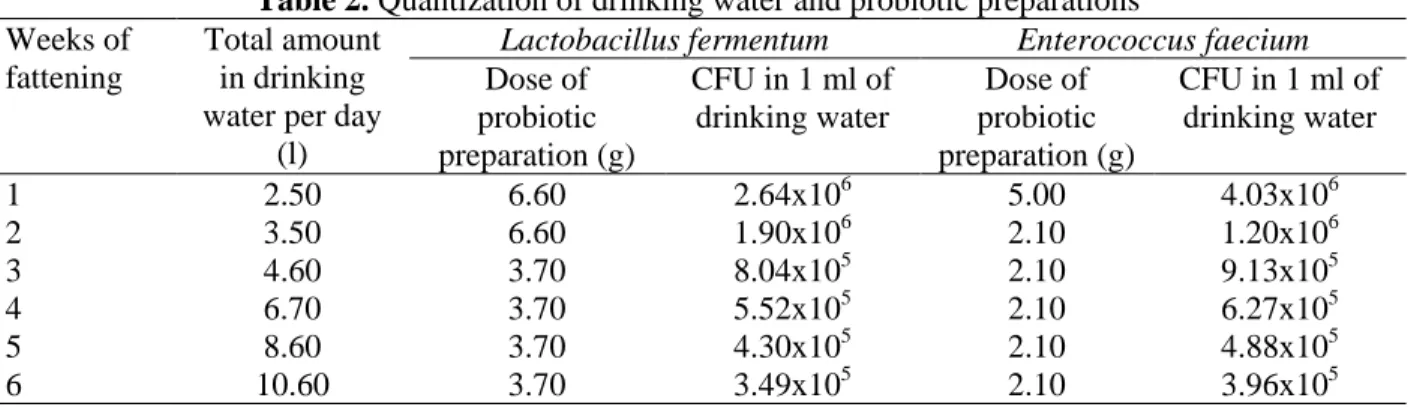
a probiotic preparation (Probiotics International, UK) in drinking water with concentration of 2x10⁹ CFU of Enterococcus faecium M 74 in 1 g of nutrient medium with dextrose (1% in preparation). Quantization of drinking water anprobiotic preparations are presented in Table 2. The control group of chickens received water without any additives.
In 42 day of experimental period the body weight of broiler chickens was recorded and the body measurements namely shank length, thigh length, drumstick length, body length, body width, breast width and wing length were measured at 6 weeks of age [18,19].
Data were analyzed using analysis of variance (ANOVA) [20]. Significant difference was used at 0.05 probability level and differences between groups were tested using the Duncan’s procedure [21].
3. Results and discussion
Table 3 presents the statistic characteristics of body weight and body measurements of control and probiotic groups of broiler chickens at 6 weeks of age.
The addition of strains Lactobacillus fermentum and Enterococcus faecium in drinking water statistically significant increased (P<0.05) body weight of 2294.59 and 2263.16 respectively compared with control (2070.65 g). These results are in agreement with [22] who observed improvement of final body weight of broiler chickens at addition of probiotic preparation. In contrast, our results are opposite to those of [23, 24] who recorded that addition of probiotic to broilers diet did not show any significant effect on body weight compared with control group. Probiotic and control groups of broiler chickens did not differ (P>0.05) in shank length, thigh length, drumstick length, body length, body width, breast width and wing length were measured at 6 weeks of age. Similar results were found by [25] who found that addition of probiotic did not have any significant effect on body measurements of broiler chickens.
Table 1. Nutritional value of complete feed mixtures
Nutrient Unit Starter Grower
Crude protein g/kg min. 210.00 min. 190.00
ME MJ/kg min.12.00 min. 12.00
Ash matter g/kg max. 70.00 max. 70.00
Fibre g/kg max. 35.00 max. 40.00
Lysine g/kg min.11.00 min. 9.50
Methionine and cistine g/kg min.7.50 min. 7.50
– from that methionine g/kg min. 4.50 min.4.00
Linoleic acid g/kg min.10.00 min. 10.00
Calcium g/kg min.8.00 min. 7.00
Phosphorus g/kg min. 6.00 min. 5.00
Sodium g/kg 1.20-3.00 1.20-2.50
Manganese mg/kg min. 50.00 min. 50.00
Iron mg/kg min. 60.00 min. 60.00
Copper mg/kg min. 6.00 min. 6.00
Zinc mg/kg min. 50.00 min. 50.00
Vitamin A i.u./kg min. 10000 min. 8000
Vitamin B2 mg/kg min. 4.00 min. 3.00
Vitamin B12 μg/kg min. 20.00 min. 20.00
Vitamin D3 i.u./kg min. 1200 min. 1200
Vitamin E mg/kg min. 15.00 min. 15.00
Table 2. Quantization of drinking water and probiotic preparations Weeks of
fattening
Total amount in drinking water per day
(l)
Lactobacillusfermentum Enterococcus faecium
Dose of probiotic preparation (g)
CFU in 1 ml of drinking water
Dose of probiotic preparation (g)
CFU in 1 ml of drinking water
1 2.50 6.60 2.64x10⁶ 5.00 4.03x10⁶
2 3.50 6.60 1.90x10⁶ 2.10 1.20x10⁶
3 4.60 3.70 8.04x10⁵ 2.10 9.13x10⁵
4 6.70 3.70 5.52x10⁵ 2.10 6.27x10⁵
5 8.60 3.70 4.30x10⁵ 2.10 4.88x10⁵
6 10.60 3.70 3.49x10⁵ 2.10 3.96x10⁵
Table 3. Comparison of final body weight and body measurements of broiler chickens
Parameter Group
Control Lactobacillusfermentum Enterococcus faecium
Body weight (g) 2070.65±180.14 2294.59±196.34a 2263.16±188.67b
Body length (cm) Body width (cm) Breast width (cm) Shank length (cm)
37.59±4.04 17.37±1.84 10.69±0.74 8.20±0.14
38.87±4.59 17.59±2.01 10.84±1.62 8.42±0.17
38.74±4.26 17.62±2.44 10.96±1.58
8.22±0.19
Thigh length (cm) 18.91±0.57 19.19±0.84 19.21±0.94
Drumstick length (cm) 8.86±0.09 9.07±0.14 9.04±0.16
Wing length (cm) 19.44±0.87 19.76±1.11 19.81±1.14
Values shown are mean ± SD (standard deviation) a,b
means in a row with different superscript differ significantly (P<0.05)
The application of probiotic strains Lactobacillus fermentum, Enterococcus faecium statistically significant improved final body weight of broiler chickens. Results indicated that the addition of Lactobacillus fermentum, had a slightly higher effect on body weight on the end of fattening period compared with Enterococcus faecium. The body measurements was not significantly affected (P>0.05) by addition of probiotic in drinking water.
Acknowledgements
This work was financially supported by VEGA 1/0493/12 and KEGA: 035SPU-4/2012.
References
1.Fature, A. A., Matanmi, I. O. The effect of probiotics supplementation on the growth performance of two strains of cockerels, Journal of Central European Agriculture, 9, 2008, 405-410 2.Král, M., Angelovičová, M., Mrázová, Ľ., Tkáčová, J., Kliment, M. Probiotic and acetic acid of broiler chickens performance, Scientifical Papers. Animal Science and biotechnologies, 44, 2011, 149-152 3.Corcionivoschi, N., Drinceanu, D., Pop, I. M., Stack, D., Stef, L., Călin, J., Bourke, B. The effect of probiotics on animal health, Scientifical Papers. Animal Science and biotechnologies, 43, 2010, 35-41 4.Gálik, B., Rolinec, M. The effect of phytogenic feed additives on the performance of non-ruminants, Proc. International Ph.D. workshop on welfare, biotechnology and quality of animal production, Nitra, Slovak University of Agriculture, 2011. 19. 5.Petruška, P., Tušimová, E., Kalafová, A., Haščík, P., Kačániová, M., Kolesárová, A., Capcarová, M. Effect of propolis in chicken diet on selected parameters of mineral profile, Journal of Microbiology, Biotechnology and Food Sciences, 1, 2012, 1090-1097
6.Benţea, M., Şara, A., Pantă, L., Clapa, L. The effects of enzymatic complex allzyme SSF and organic selenium on some growth and consumption indices of broiler turkey. Scientifical Papers. Animal Science and biotechnologies, 43, 2010, 9-14
7.Songisepp, E., Kals, J., Kullisaar, T., Mändar, R., Hűtt, P., Zilmer, M. Mikelsaar, M. Evaluation of the functional efficiency of an antioxidative probiotic in healthy volunteers. Nutrition Journal, 4, 2005, p. 22-32.
J., Polička, M., Malíková, L. Effect of probiotic strain Lactobacillus fermentum CCM 7158 supplement on performance and carcass characteristics of broiler chickens. Acta fytotechnica et zootechnica, 13, 2010, 96-98.
9.Capcarova, M., Chmelničná, L., Kolesárová, A., Massanyi, P., Kováčik, J. Effects of Enterococcus faecium M 74 strain on selected blood and production parameters of laying hens. British Poultry Science, 51, 2010, 614-620.
10.Capcarova, M., Kolesárová, A., Massanyi, P., Kováčik, J. Selected blood biochemical and haematological parameters in turkeys after experimental probiotic Enterococcus faecium M-74 strain administration. International Journal of Poultry Science, 7, 2008, 1194-1199.
11.Malíková, L., Weis, J., Hrnčár, C. Effect of administration of probiotic preparation with strain of Lactobacillus fermentum on the weight gain of the young pigeons. Journal of Microbiology, Biotechnology and Food Sciences, 3, 2013, 1469-1476.
12.Weis, J., Hrnčár, C., Mindek, S. Effect of probiotic preparates with different strain on meat production of broiler ducks. Scientifical Papers. Animal Science and Biotechnologies, 41: 717-720.
13.Hrnčár, C., Weis, J., Baraňska, B., Malíková, L., Petričová, Ľ. The effect of different probiotic strains on fattening and carcass parameters of broiler ducks. Journal of Microbiology, Biotechnology and Food Sciences, 3, 2013, 1155-1163.
14.Kizerwetter-Swida, M., Binek, M. Protective effect of potentially probiotic Lactobacillus strain on infection with pathogenic bacteria in chickens. Polish Journal of Veterinary Sciences, 12, 2009, 15-20. 15.Nayebpor, M., Farhomand, P., Hashmi A. Effects of different levels of direct fed microbial (Primalac) on growth performance and humoral immune response in broiler chickens. Journal of Animal and Veterinary Advances, 6, 2007, 1308-1313.
16.Apata, D.F. Growth performance, nutrient digestibility and immune response of broiler chicks fed diets supplemented with a culture of Lactobacillus bulgaricus. Journal of the Science of Food and Agriculture, 88, 2008, 1253-1258.
17.Lima, E.T., Filho, R.L.A., Okamoto, A.S., José, C., Noujaim, J.C., Barros, M.R. Adalberto, J., Crocci, A.J. Evaluation in vitro of the antagonistic substances produced by Lactobacillus spp. isolated from chickens. Canadian Journal of Veterinary Research, 71, 2007, 103-107.
18.Monsi, A. Appraisal of interrelationship among live measurements at different ages in meat-type chickens. Nigerian Journal of Animal Production, 19, 1992, 15-24.
19.Udeh, I.. Ugwu, S. O. C, Ogagifo, N. L. Predicting semen traits of local and exotic cocks using linear body measurements. Asian Journal of Animal Science, 5, 2011, 268-276.
20.SAS User's Guide: Statistics version 6.12 Edn., SAS Institute, Inc., Cary, NC., 2011, USA.
21.Duncan, B.D. Multiple range and multiple F test. Biometrics, 11, 1955, 1-42.
22.Kabir, S.M.L., Rahman, M.M., Rahman, M.B., Ahmed, S.U. The dynamics of probiotics on growth performance and immune response in broiler. International Journal of Poultry Science, 3, 2004, 361-364
23.Lima, A.C.F., Pizauro–Júnior, J.M., Macari, M., Malheiros, E.B. Efeito do uso de probiotic sobre o
Desempenho e atividade de enzimas digestivas de frangos de corte. Revista Brasileira de Zootecnia, 32, 2003, 200-207
24.Awad, W., Ghareeb, K., Böhm, J. Intestinal structure and function of broiler chickens on diets supplemented with a synbiotic containing Enterococcus faecium and oligosaccharides. International Journal of Molecular Sciences, 9, 2008, 2205-2216.
25. Weis, J., Pál, G., Baraňska, B., Hrnčár, C. The comparison of performance of three hybrid combinations of broiler chicks at different dose of probiotic. Scientifical Papers. Animal Science and Biotechnologies, 43, 2010, 296-299.