Aggregate Information and
Organizational Structures
1Gorkem Celik2 Dongsoo Shin3 Roland Strausz4
2019
1We thank the seminar participants at Oslo Business School, THEMA (ESSEC and University of Cergy-Pontoise), UCLA, Athens University of Economics and Business, Goethe University Frankfurt, Universidad Carlos III de Madrid, Japanese-German Workshop on Contracts and Incentives at Osaka Umeda, IIOC at Kelly School of Business, Midwest Economic Theory Meeting at Drexel University, Econometric Society European Meeting, and MACCI conference in Annweiler for various comments and discussions. Dongsoo Shin is grateful for …nancial support of Leavey Research Grant. Roland Strausz is grateful for …nancial support by the German Research Foundation (DFG) through CRC TR 190.
2Economics Department, ESSEC Business School and THEMA Research Center, Cergy Pontoise Cedex, France,Email: [email protected]
3Department of Economics, Leavey School of Business, Santa Clara University, Santa Clara, CA 95053, USA,Email: [email protected]
Aggregate Information and
Organizational Structures
ABSTRACT
We study an organization with a top management (principal) and multiple subunits
(agents) with private information that determines the organization’s aggregate e¢ ciency. Under centralization, eliciting the agents’private information may induce the principal to
manipulate aggregate information, which obstructs an e¤ective use of information for the organization. Under delegation, the principal concedes more information rent, but is able
to use the agents’ information more e¤ectively. The trade-o¤ between the organizational structures depends on the likelihood that the agents are e¢ cient. Centralization is optimal when such likelihood is low. Delegation, by contrast, is optimal when it is high.
JEL Classi…cation: D86, L23, L25
1
Introduction
Organizational structures, as pointed out by Simon (1973), are “authority mechanisms”that
are constructed to process and aggregate organizational information. In some organizations, the communication channels are heavily centralized and top management keeps a strong grip on processing information, while in other organizations, such channels are delegated to
subunits and information is aggregated through a chain of hierarchies. Given the importance of utilizing an organization’s information e¤ectively, understanding the pros and cons of
di¤erent modes of processing information is crucial for the e¢ ciency of an organization. Flow of information within an organization is particularly important if the top
manage-ment cannot process the entire information in detail. As practitioners point out, it is indeed prohibitively costly for the top management to perfectly communicate with all subunits in the organization. For example, in an interview with Harvard Business Review (Taylor
1991), Percy Barnevik, then CEO of ABB Group, reports that one of the largest obstacles he faces is communication with a large number of the organization’s subunits. Likewise,
Azziz (2013) notes in Hu¢ ngton Post that it is not possible for the top management of a large and complex organization to base all its operational decisions on too detailed
informa-tion from all the individual members of the organizainforma-tion. In practice, the top management of an organization often processes only the “aggregate” or “collective” information, as a result of limited resources.
While the top management has limited access to detailed information, it still has an informational advantage over subunits, especially when the organization’s information ‡ow
is centralized— only the top management has the aggregate information, or the “big picture” of the organization. As noted by Mintzberg (1983), although top managements have less information about operational details, their superior positions often provide them with
unique access to all-embracing internal information. As such, an organization can be prone to top management’s abuses of its position at the expense of lower levels in the hierarchy. As
Bartolome (1989) reports, incentive issues in an organization are not within the boundary of lower level subunits— the top management’s manipulation is an issue as well since it has
superior access to the organization’s bigger picture.
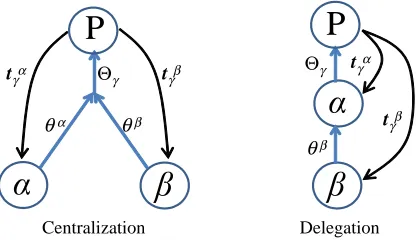
This paper studies organizational structures in coping with information process and incentive problems described above. In particular, we compare centralized and delegated
structures for information aggregation. Under centralization, all subunits of the organiza-tion directly report only to the top management who processes the aggregate informaorganiza-tion.
subunit makes a report on the aggregate information to the top management.
The central trade-o¤ in our paper is as follows. When top management centralizes the organization’s communication channels, inducing truthful behavior of the organization’s
subunits may lead to the top management’s own misrepresenting behavior— it may have an incentive to manipulate the aggregate information collected from the subunits. We show
that this tension between the top management’s and its subunits’incentives stands in the way of screening, leading to a less e¤ective use of the organization’s information.
When top management delegates aggregation of information to a subunit, the ability to manipulate aggregate information is transferred to that particular subunit. This has two counter-acting e¤ects. On one hand, the top management has to give more information rent
to that particular subunit to prevent it from manipulating the aggregate information. On the other hand, because the top management has now relinquished the power to manipulate,
the organization uses information more e¤ectively.
We identify this trade-o¤ by modeling an internal organization with a principal-agent framework— a principal (top management) and two agents (subunits) with private
infor-mation about their types (e¢ ciencies). The aggregate inforinfor-mation of the agents’ types in our model indicates the overall e¢ ciency of the organization. We postulate an organization
where it is prohibitively costly for the top management to process detailed information in the organization, and thus its decisions depend on the organization’s aggregate information,
instead of detailed information.1 In our model, the potential outcome determined by the principal depends only on the agents’aggregate type, instead of individual types.
Under centralization, each agent sends a report about his e¢ ciency to the principal
directly, and no direct communication takes place between the agents. As in standard models of screening, each agent can reap information rent by misrepresenting his e¢ ciency
and the principal reduces information rents by distorting the project size downward in the optimal contract. When these distortions are large, an incentive for the principal arises to
manipulate the aggregate information herself. In particular, when both agents report that they are ine¢ cient so that the organization’s aggregate e¢ ciency is low, the principal has an incentive to overstate the aggregate e¢ ciency. In other words, the principal gains ex
post by manipulating the aggregate information. We show that reconciling the agents’and the principal’s incentives hinders an e¤ective use of the agents’private information and may
even prevent its use in the sense that optimal contracts exhibit pooling.
Under delegation, one agent, say agent , becomes the “superior” of the other agent,
1
say agent . In this structure, agent …rst reports his e¢ ciency to agent , who in turn reports the aggregate e¢ ciency to the principal. Since the authority to process the aggregate information is shifted from the principal to agent , the principal faces a loss of control.
As a result, the principal must concede larger information rent to this agent. In order to reduce this larger information rent, the principal increases the downward distortions in
the optimal project size. There is a gain, however, from the loss of control— there is no tension between the principal’s and the agents’manipulation incentives. As a result, a fully
separating outcome is restored, implying that the principal can utilize the organization’s information more e¤ectively under delegation than under centralization.
Comparing the two structures, we show that the principal’s optimal choice of
organiza-tional structure is determined by the likelihood that an agent is e¢ cient. Our result hinges upon such likelihood because it determines distortions in the project size and thereby the
tension between the principal’s and the agents’manipulation incentives. When the agents are likely to be ine¢ cient, centralization is the optimal organizational structure. By con-trast, when the agents are likely to be e¢ cient, the optimal structure is delegation.
The rest of the paper proceeds as follows. In Section 2, we review the related studies. The model is presented in Section 3. In Section 4, we discuss our benchmark to show that, when
the principal cannot manipulate the aggregate information, centralization always dominates delegation. In Section 5, we compare centralization and delegation when the principal
can manipulate the aggregate information from the agents. In Section 6, we extend our discussion by endogenizing restrictiveness of communication technology in our model. We conclude in Section 7. All proofs are relegated to the Appendix.
2
Review of Related Studies
While earlier contributions advocate centralized structures by highlighting a loss of control under delegation (e.g. Williamson, 1967; McAfee and McMillan, 1995), there have been a
number of papers identifying situations in which delegation matches or even outperforms centralization. Unlike ours, many of these papers base their analyses of organizational struc-tures on the costs of information processing (e.g. Radner, 1992; Bolton and Dewatripont,
1994; Qian, 1994) or on problems of coordination (e.g. Rosen, 1982; Harris and Raviv, 2002; Hart and Moore, 2005). Our study belongs to the literature that studies organizations in
the presence of private information and manipulation incentives.
than information ‡ows, Baron and Besanko (1992) and Melumad et al. (1995) identify necessary conditions under which the vertical hierarchy achieves the same outcome as the horizontal hierarchy. They demonstrate that if top management can monitor transactions
between the subunits, then the optimal outcome is independent of the organizational struc-ture. Melumad et al. (1997) show that, when contracts are complex, delegating a
contract-ing authority to an agent brcontract-ings the organization more ‡exibility. Harris and Raviv (2005) study the optimal hierarchical structure in the presence of informational heterogeneity and
contract incompleteness.
Focusing on collusion, La¤ont and Martimort (1998) show that contractual delega-tion enables organizadelega-tions under limited communicadelega-tion to e¤ectively discriminate transfers
among di¤erent agents, thus mitigating collusion. Importantly, delegation in their model involves delegation of contracting— the principal contracts only with the middle-agent,
who in turn, contracts with the bottom-agent. In our model, delegation a¤ects only the information ‡ows within the organization, i.e., the principal sets all contracts also under delegation. For this reason, our model of delegation is related to Ishida (2015), who studies
how restrictions on information ‡ows within an organization a¤ect incentives for informa-tion acquisiinforma-tion. Neither of these studies consider the principal’s manipulainforma-tion incentive
under centralization.
There are a number of studies demonstrating the optimality of delegation under some
speci…c form of incomplete contracting. Beaudry and Poitevin (1995) and Olsen (1996) point out that delegation can make it harder to renegotiate. Aghion and Tirole (1997) demonstrate that delegation induces acquisition of useful information for the organization.
Studies such as Dessein (2002) and Alonso et al. (2008) show that organizations can bene…t from delegation because it makes better use of private information. Focusing on a
trade-o¤ between coordination and motivation, Choe and Ishiguro (2012) demonstrate that the optimal hierarchy depends on the extent to which externalities among a …rm’s projects
require coordination and e¤ort incentives. Shin and Strausz (2014) show that delegation mitigates dynamic incentives, when the organization cannot use long term contracts. Unlike these studies, we focus on organizational structures and the delegation of information ‡ows
rather than decision rights.
Our paper is also related to studies on the principal’s incentive to manipulate when
ma-nipulation incentive when retailers’ costs are correlated. Akbarpour and Li (2018) study the optimal mechanism for an auctioneer who can misreport the bids of the participants to the auction when the bidders cannot observe each other’s bid. Celik et al. (2018) show that
aggregate information manipulation may lead to an oversupply of public goods. None of these papers consider the e¤ect of the principal’s manipulation incentives on organizational
structures.
3
Model of Internal Organization
We model an organization with a principal who needs two agents, and , to implement a
project. The project of sizeq 0yields the principal a valuev(q);and imposes a cost kqon agentk2 f ; g:The value functionv(q)is an increasing and concave function that satis…es the Inada conditions: v(0) = 0; v(1) =1;limq!0v0(q) =1 and limq!1v0(q) = 0:2 The
project size q is publicly veri…able.
Agentk’s cost parameter k 2 f g; bg is his private information and b g >0.
We refer to kas agentk’s “type.”An agent of type g is “e¢ cient,”and an agent of type b
is “ine¢ cient.”The agents’types are drawn independently from identical distributions— an
agent is e¢ cient with probability'2(0;1), and therefore ine¢ cient with probability1 ':
The probability distribution is public knowledge.
Because the project needs both agents, the aggregate marginal cost of the project is
+ , which can be one of the three possible values:
G 2 g; M g+ b; B 2 b:
Thus, the …rst-best size of the project, denoted by q ;satis…es the condition of “marginal
value=marginal cost,” and is characterized by:
v0(q ) = ; 2 fG; M; Bg:
In order to compensate the agents for their costs, the principal pays each agent a transfer,
denoted by tk; k 2 f ; g: Given transfers, the principal’s and agent k’s payo¤s from the project of size q are respectively:
v(q) t t and uk tk kq:
In light of the Fair Labor Standards Act that allows the players to walk away from a contract when insu¢ cient compensation for the required e¤ort is expected, we assume the following
limited liability of the agents. Each agent can quit and walk away from the organization at any time, if he expects his payo¤ to be less than his reservation level (normalized to zero).3 The limited liability of an agent re‡ects the condition required for employment contracts in
practice, also known as “non-slavery condition.”
We compare two organizational structures— centralization versus delegation. Under
centralization, each agent directly reports his type only to the principal, who subsequently aggregates the information— agents cannot communicate directly with each other.4 Under
delegation, agent makes a report to agent , who in turn aggregates the information and reports it to the principal— agent cannot communicate directly with the principal.
We postulate that the principal processes only the aggregate information, thus centering
our analysis on contracts contingent on the aggregate type 2 fG; M; Bg, expressed as:5
q ; t ; t ; 2 fG; M; Bg:
As mentioned in the introduction, contracting upon aggregate information re‡ects various reports of practitioners as well as …ndings in organization studies that top managements
tend to work with aggregate, condensed information rather than with the detailed, …ne-grained information at the individual level.
Figure 1 illustrates the information ‡ows in the two organizational structures.
P
α
β
P
α
β
θα θβ Θγ
tγα tγβ tγα
tγβ θβ
Θγ
Delegation Centralization
Fig 1. Organizational Structures
The timings under centralization and delegation are summarized below.
3See Sappington (1983) for an analysis on this issue. We implicitly assume that if one agent quits,
the project yields no value but the principal has to pay the non-quitting agent according to the contract.
Alternatively, we can assume that if one agent quits the game ends and no payo¤ is realized for any player,
but this assumption may lead to an additional equilibrium where both agents may reject the contracts.
Centralization Under centralization, each agent reports his type directly only to the prin-cipal. Once the reports are made, the principal makes an announcement on 2 fG; M; Bg:
1. The principal o¤ers the contract q ; t ; t ; 2 fG; M; Bg:
2. Each agent makes a report on his type, k2 f g; bg;to the principal.
3. The principal receives aggregation of the reports and makes a public announcement
on 2 fG; M; Bg:
4. The project is implemented and transfers are paid according to :
Delegation Under delegation, agent …rst reports his information to agent , who then sends a report on 2 fG; M; Bgto the principal.
1. The principal o¤ers the contract q ; t ; t ; 2 fG; M; Bg:
2. Agent makes a report on his type to agent , who in turn, makes a report on
2 fG; M; Bg to the principal.
3. The principal makes a public announcement on 2 fG; M; Bg:
4. The project is implemented and transfers are paid according to :
In the following two sections, we compare the principal’s maximum payo¤s under
cen-tralization and delegation. We start analyzing a setup in which the principal cannot ma-nipulate the aggregate information. In this case, the principal always prefers centralization
over delegation. However, if e¢ cient agents are relatively likely, the optimal contract under centralization provides the principal with an incentive to manipulate aggregate informa-tion. Taking the principal’s incentive to manipulate aggregate information seriously reveals
that delegation dominates centralization when it is more likely that the agents are e¢ cient, because in this case the principal’s manipulation incentive is strongest.
4
When the Principal Cannot Manipulate Information
4.1 Centralization
Under centralization, the agents report directly and simultaneously to the principal and
structure, t =t = t : Thus, under centralization, we can restrict attention to contracts of the form(q ; t ); 2 fG; M; Bg:This implies that the two agents receive the same level of transfer from the principal, even when they have reported di¤erent costs( =M).6
In line with the Inada conditions for the value function, the principal wants a strictly positive size of the project regardless of the agents’types. Since an agent can quit anytime,
and in particular after the principal announces the project’s aggregate type , the pair
(q ; t ) must provide a non-negative rent to each agent for each 2 fG; M; Bg: For an e¢ cient agent, the following participation constraints must be satis…ed:
tG gqG 0and (P CG)
tM gqM 0; (P CM)
while the constraints below must be satis…ed for an ine¢ cient agent’s participation:
tM bqM 0 and (P CM)
tB bqB 0: (P CB)
The left hand side of the participation constraints above are an agent’s ex post payo¤s when he truthfully reports to the principal.
To induce each agent’s truthful report, the following Bayesian incentive compatibility conditions must be satis…ed for an e¢ cient and an ine¢ cient agent respectively:
'[tG gqG] + (1 ') [tM gqM]
'[maxftM gqM;0g] + (1 ') [maxftB gqB;0g];
'[tM bqM] + (1 ') [tB bqB]
'[maxftG bqG;0g] + (1 ') [maxftM bqM;0g]:
When reporting to the principal, each agent does not know the other agent’s type under centralization. Therefore, an agent’s incentive compatibility constraints are conditional only
on his own private information. The left hand sides (LHS) of the constraints express the agent’s expected payo¤ from reporting truthfully, whereas the right hand sides (RHS) rep-resent his expected payo¤ if he decides to misreport his type. Notice from the constraints
6In the organizational environment we study, this condition arises as a result of the principal’s ability
to process only the aggregate information. As we mention in our conclusion, an alternative justi…cation for
making the same transfers to the agents would be an obligation to treat the agents anonymously (La¤ont
that, while the payo¤ from truthful reporting is always non-negative (implied by the par-ticipation constraints), an agent can have a negative payo¤ by misreporting his type. That is, a misreporting agent may choose to quit depending on the other agent’s type— this is
captured by the maxf g operators in the RHSs of the constraints. Also, it is implied by the participation constraints(P CM) and (P CB) that an e¢ cient agent will not quit in the
case of misrepresenting himself as ine¢ cient, regardless of the other agent’s type. Likewise,
(P CM) implies that a misreporting ine¢ cient agent will remain in the organization if the principal announces that =M. The incentive compatibility constraints, therefore, can be simpli…ed as:
'[tG gqG] + (1 ') [tM gqM] '[tM gqM] + (1 ') [tB gqB]; (ICg)
'[tM bqM] + (1 ') [tB bqB] '[maxftG bqG;0g] + (1 ') [tM bqM]: (ICb)
Under centralization, the principal chooses =fq ; t g; 2 fG; M; Bg; to solve the following problem:
Pc: max ( ) ='2[v(qG) 2tG] + 2'(1 ') [v(qM) 2tM] + (1 ')2[v(qB) 2tB];
subject to the agents’participation and incentive compatibility constraints above.
Our …rst proposition presents the optimal outcome in Pc:
Proposition 1 Suppose the principal cannot manipulate the aggregate information. Under centralization, there exists 'e+ 2(0;1=2) and 'e 2 (0;'e+] such that the optimal contract,
c, entails the following outcome.7
For' >'e+;
v0(qGc) = G; v0(qMc ) = M +
'
1 ' ; v 0(qc
B) = B+ 2'
1 ' .
An e¢ cient agent gets strictly positive rent, and an ine¢ cient agent gets no rent. For' ' ;e
v0(qcG) = G; 2'v0(qMc ) + (1 2')v0(qcB) = B; where qcB=
1 2'
1 'q
c M. An e¢ cient agent gets strictly positive rent only when =M, and an ine¢ cient agent gets no rent.
7
Whether 'e+ = e' depends on the shape of the value function v( ):For a large set of well-behaved
functions (e.g.,v(q) =pq), we have'e+=
e
As in the standard screening problems, with an exception of “no distortion at the top,” the optimal project sizes are distorted downward. An e¢ cient agent has an incentive to exaggerate his cost of implementation to reap information rent, and in order to reduce
information rent while inducing truthful reports from the agents, the principal distorts the project sizes in the optimal contract except when both agents are e¢ cient.
When'is large enough(' >'e+), an e¢ cient agent receives strictly positive information rent regardless of the other agent’s type. When ' is small(' 'e ), however, an e¢ cient agent receives rent only when he is paired with an ine¢ cient agent. Since the agents of di¤erent types receive the same amount of transfer when =M; the e¢ cient agent’s rent in that case is guaranteed regardless of '. Because of this, the principal’s rent provision
when =Gis relatively smaller, and she decreases the amount of this rent as it becomes less likely that an agent is e¢ cient. As a result, for'small enough, although an e¢ cient agent’s
expected rent is strictly positive, he gets no rent when the other agent is also e¢ cient.
4.2 Delegation
Under delegation, agent reports his type, 2 f g; bg;to agent who, in turn, reports
the aggregate type, 2 fG; M; Bg;to the principal. Each agent’s participation constraints are:
tkG gqG 0and (P CGk)
tkM gqM 0; k 2 f ; g; (P C k M)
for an e¢ cient agent, and
tkM bqM 0 and (P CkM)
tkB bqB 0; k 2 f ; g; (P CBk)
for an ine¢ cient agent. Notice that, unlike under centralization, the transfers to the agents
cannot be treated symmetrically.
Since agent does not know agent ’s type when reporting his own type, his incentive
constraints coincide with the incentive constraints under centralization:
'htG gqG
i
+ (1 ')htM gqM
i
'htM gqM
i
+ (1 ')htB gqB
i
; (ICg)
'htM bqM
i
+ (1 ')htB bqB
i
'hmaxftG bqG;0g
i
+ (1 ')htM bqM
i
:
speci…cally, the Bayesian incentive conditions of agent above imply that agent , when he makes a report to the principal, has learned agent ’s type. Inducing agent ’s truthful report, therefore, requires that the following incentive compatibility conditions be satis…ed
in the optimal contract:
tG gqG t gq ; 2 fM; Bg; (ICG )
tM gqM t gq ; 2 fG; Bg; (ICM )
tM bqM t bq ; 2 fG; Bg; (ICM )
tB bqB t bq ; 2 fG; Mg: (ICB )
These stricter incentive constraints re‡ect that, under delegation, agent has more ‡exi-bility to manipulate information. Because agent knows agent ’s type when making his
report to the principal, the incentive constraints for agent ;unlike the constraints for agent
;have to hold state-by-state rather than only in expected terms.
Under delegation, the principal, chooses =fq ; t ; t gto solve the following problem:
Pd: max ( ) ='2
"
v(qG)
X
k
tkG
#
+2'(1 ')
"
v(qM)
X
k
tkM
#
+(1 ')2
"
v(qB)
X
k
tkB
#
;
subject to the agents’participation and incentive compatibility constraints above. The following proposition presents the optimal outcome in Pd.
Proposition 2 Suppose the principal cannot manipulate the aggregate information. Under delegation, there exists 'b+2(0;1=2)and 'b 2(0;b'+] such that the optimal contract, d, entails the following outcome.8
For' >'b+;
v0(qGd) = G; v0(qdM) = B+
3' 1
1 ' ; v 0(qd
B) = B+
'
1 ' .
An e¢ cient agent gets strictly positive rent, and an ine¢ cient agent gets no rent. For' ' ;b
v0(qGd) = G; 2'v0(qdM) + (1 2')v0(qBd) = B+
'2
1 '; q
d B=
1 2'
1 ' q
d M: Agent , when he is e¢ cient, gets strictly positive rent regardless of agent ’s type. Agent , when he is e¢ cient, gets strictly positive rent only for =M. An ine¢ cient agent gets no rent.
8Again, for a large set of well-behaved functions, such asv(q) =pq, we have b
'+=
b
While the reasoning behind the distorted project sizes is similar to the one under cen-tralization, agent ’s information rent is larger under delegation due to his stricter incentive constraints. By delegating the aggregation of information, the principal is relinquishing part
of her control to agent . Since agent ends up possessing more information and makes a report to the principal on behalf of both agents, he has more ‡exibility to manipulate
information, which is the source of larger information rent under delegation. Recall that, for example, when'is small, an e¢ cient agent under centralization receives rent only when
the other agent is ine¢ cient. The same is true for agent under delegation since he does not know agent ’s type when making his report. In contrast, the principal cannot distrib-ute agent ’s information rent between di¤erent states, because under delegation agent
knows agent ’s type when he reports to the principal.
4.3 Comparison
A direct comparison of the two propositions shows that di¤erent contracts are optimal under di¤erent organizational structures. When the principal cannot manipulate the aggregate
information, it is relatively straightforward to see that the principal does better under cen-tralization. The intuition is, as mentioned above, that delegation transfers the principal’s
control over agent to agent , without bringing her any bene…ts. A somewhat more technical perspective provides a deeper insight concerning the optimality of centralization, leading to a formal proof. Under delegation, incentive compatibility requires a truthful
report from agent regardless of the other agent’s reporting strategy, whereas it asks for a truthful report from him under centralization only under the assumption that the other
agent is also truthful. Hence, delegation leads to dominant strategy incentive compatibil-ity constraints for agent ’s truth-telling, while centralization demands Bayesian incentive compatibility constraints. Because Bayesian incentive compatibility constraints are weaker
than incentive constraints in dominant strategies, the principal’s problem is less restricted under centralization. As a result, the allocation which the optimal contract under
dele-gation, d, implements is also feasible under centralization, whereas the allocation which optimal contract under centralization, c, implements is not feasible under delegation. This observation leads directly to the following corollary.
5
When the Principal Can Manipulate Information
In the previous section, we derived the optimal contracts under the assumption that, after
receiving the agents’reports, the principal truthfully announces the aggregate information from the agents. As we now argue, this assumption is not innocuous since the optimal contract under centralization, c, provides the principal with an incentive to manipulate
the aggregate information. In particular, the principal, after learning that both agents are ine¢ cient, may bene…t from misreporting aggregate costs as M rather than B. Lack
of direct information ‡ows between the agents prevents them from cross-checking their reports, and the principal can achieve such manipulation without being caught out by the
agents— making each ine¢ cient agent think that the other agent is e¢ cient. In order to clarify this threat of aggregate information manipulation in centralized organizations, we start this section with revisiting the organization under centralization.
5.1 Centralization
The threat of aggregate information manipulation by the principal can be easily seen in the
case where both types are equally likely ('= 1=2). In this case, Proposition 1 shows that the optimal contract under centralization, c, provides zero rent to an ine¢ cient agent, i.e.,
tcB = bqcB and tMc = bqMc . Hence, the principal’s ex post payo¤s from a project size qB
and qM are, respectively:
v(qcB) BqBc and v(qMc ) BqcM:
Notice that, in Proposition 1, when both types are equally likely ('= 1=2), qMc coincides withqB;whileqBc is strictly smaller thanqB. SinceqBis the unique maximizer ofv(q) Bq,
it is implied that:
v(qcB) BqBc < v(qB) BqB =v(qMc ) BqcM:
Thus, under the optimal contract c, the principal is strictly better o¤ when reported
aggregate types are M instead of B for'= 1=2:We state this insight as the following
lemma.
When both agents are ine¢ cient ( = B), the principal’s announcement of = M
cannot be detected by the agents as a misrepresentation— since it could very well be that the other agent is e¢ cient, without directly cross checking their reports to the principal,
each agent cannot tell whether or not the principal’s announcement is true.9 Intuitively, the principal has an incentive to exaggerate the overall e¢ ciency of the organization, because
the agents then have to complete the bigger projectqcM rather than the smaller projectqcB. It is worthwhile to remark that the ine¢ cient agents are indi¤erent to the principal’s
manipulation of the aggregate type, because they receive a transfer equal to their cost from implementing the project for both = B and =M. But the knowledge that the information will be manipulated makes an e¢ cient agent’s truth-telling harder to secure: By
reporting a high cost, an e¢ cient agent can now guarantee taking part in the implementation of projectqcM and receiving the associated rent. To rule out an e¢ cient agent’s misreporting of the cost, the principal should persuade the agents that she will not manipulate.
For the principal’s truthful behavior, the following incentive constraint must be satis…ed in the optimal contract, in addition to the participation and incentive constraints for the
agents:10
v(qB) 2tB v(qM) 2tM: (P IC)
When the principal can manipulate the aggregate information, her problem under cen-tralization is:
e
Pc: max ( ) ='2[v(qG) 2tG] + 2'(1 ') [v(qM) 2tM] + (1 ')2[v(qB) 2tB];
subject to (P IC) and the constraints in Pc:
The next lemma makes precise when the principal’s incentive constraint(P IC)matters.
Lemma 2 Suppose the principal can manipulate the aggregate information. Under central-ization, there exist ' 2(0;1=2) and '+2[' ;1=2) such that:
For ' < ' ; the principal’s manipulation incentive is not an issue, i.e., (P IC) is non-binding.
9In Section 6, we show that if the principal can choose a communication technology before contracting
with the agents, she would like to choose a technology that limits communication between the agents to
eliminate the possibility of collusion between the agents.
1 0
Notice that the principal cannot misannounce =B as =G since the agents will detect the
prin-cipal’s misrepresentation in that case. Likewise, when true =M; the principal cannot misrepresent the
aggregate type as =B or =G— if =B is announced, then the type-gagent will know the principal’s
misannouncement, and if =Gis announced, then the type-bagent will know. When =G;the principal
For' > '+;the principal’s manipulation incentive is an issue, i.e.,(P IC)is binding.
The intuition behind Lemma 2 is that the distortion in the project size depends on the
likelihood that the agents are e¢ cient. Indeed, when such likelihood is small, the principal expects to provide information rent only with a small probability— for small ', distortions in the optimal project sizes are also small. More speci…cally, for'small enough,(' < ' ), unlike in the case of '= 1=2, the project size qcB is “closer” to the …rst best level qB than
qMc . As a result, the principal has no incentive to manipulate the aggregate information when both agents report that they are ine¢ cient.
By contrast, when the likelihood that the agents are e¢ cient is high, the probability
that the principal has to provide information rent is also high. As a result, distortions in the optimal contract to reduce information rent becomes large. For 'large enough (' > '+);
as in the case of'= 1=2, the project sizeqc
Bis further away from the …rst best levelqBthan
qMc . When both agents report that they are ine¢ cient, the principal prefers to implement project size qMc rather than qcB in such cases, which leads to her incentive to misrepresent the aggregate information as =M:
A straightforward way to dispel the principal’s manipulation incentive is to set the same project sizes forqM andqB. By doing so, she makes herself indi¤erent to her announcement
on the aggregate information (between = B and = M when true = B), and her incentive constraint(P IC)is trivially satis…ed. The following proposition shows that, when agents are more likely to be e¢ cient, such pooling of project sizes is indeed an optimal response to the principal’s manipulation incentive.
Proposition 3 Suppose the principal can manipulate the aggregate information and '
1=2. Under centralization, the optimal outcome, ec;entails:
v0(eqGc) = G; v0(qecM) =v0(qeBc) = B+ 2'2
1 '2 .
An e¢ cient agent gets strictly positive rent, and an ine¢ cient agent gets no rent.
As shown above, under centralization, the principal’s incentive to manipulate the ag-gregate information arises when it is likely enough that an agent is e¢ cient, and in such a
case, the optimal contract must discourage the principal from misrepresentation. In coping with her own manipulation incentive, the principal may pool the project sizes qB and qM
in the optimal contract. Proposition 3 shows that such pooling is optimal when it is more
revelation from an e¢ cient agent. That is, when the agents are more likely to be e¢ cient, the principal’s own manipulation incentive makes it harder to …ne-tune the optimal project sizes according to the available information in the organization.
5.2 Delegation and Comparison
Under delegation, the principal receives the aggregate information directly from agent .
Any manipulation of the information by the principal is therefore directly detectable by agent , which prevents the principal from misrepresenting the aggregate information. Thus,
the same optimal outcome as in Pd is achieved. Recall from the previous section that, in the absence of the principal’s manipulation incentive, delegation is always dominated by
centralization— under delegation, the principal simply needs to provide more information rent to agent ;who is granted the authority to aggregate information. In the presence of the principal’s manipulation incentive, however, a trade-o¤ between these structures arises.
Proposition 4 Suppose the principal cannot manipulate the aggregate information. Then, there exists 'c > ' and'd> '+ such that:
For' < 'c;centralization dominates delegation. For' 'd;delegation dominates centralization.
As shown in Lemma 2, the principal’s manipulation incentive arises only when the like-lihood that the agents are e¢ cient,', is large enough. Therefore, for'small, centralization
remains the prevailing structure. As' becomes larger, the principal’s manipulation incen-tive arises, and a trade-o¤ between the two structures starts to emerge. Under delegation, although the principal must provide more information rent due to a loss of control, the
optimality of separating types demonstrates that delegation allows the principal to use the available information within the organization more e¤ectively than centralization.
6
Unlimited Communication and Collusion
In modeling centralization, we postulated that the agents cannot directly communicate with each other. This limitation on direct communication between agents is crucial for our result, because the type of information manipulation that we consider is avoidable when the agents
Even though these limits on communication seem natural in large organizations, where it is infeasible for an agent to cross-check the reports of all other agents, we provide in this section an endogenous argument for organizations to restrict such unlimited communication.
The gist of this argument is that allowing direct communication between agents may invite collusion, and dealing with such collusion is more costly to the principal than dealing with
her own manipulation incentive. Indeed, organization studies point out that communication facilitates collusion, stressing that group behaviors are frequently observed in organizations
where communication among their members are less restricted.11 Organization theory also points out the connection of unwanted communication and collusion among agents.12
To see the potential of collusion under centralization, recall from Proposition 1 that,
without information manipulation, the optimal contract under centralization, c, yields an e¢ cient agent a strictly larger payo¤ when the other agent is ine¢ cient than when the other
agent is e¢ cient:
2tcM GqMc >2tcG GqcG: (CIC])
This inequality implies that, when both are e¢ cient, the agents can increase their payo¤ if they coordinate their reports such that one of them reports to be e¢ cient, while the other misreports his type as ine¢ cient. An implementation of this collusive agreement requires
however communication between agents for some coordination to learn each other’s types— given c; an e¢ cient agent has no incentive to misreport his type as ine¢ cient to the principal unless he knows that the other agent will report his type as e¢ cient.
To analyze collusion under asymmetric information, we follow La¤ont and Martimort
(1997) and introduce a third party side-contractor who, given the principal’s “grand con-tract”, coordinates collusion between asymmetrically informed agents. The side-contractor’s objective is to maximize the expected joint payo¤ of the agents. Given the principal’s
con-tract under centralization, = fq ; t g; 2 fG; M; Bg; the side-contractor’s o¤er to the agents speci…es a collusive reporting function to the principal,
b:fg; bg fg; bg ! fG; M; Bg;
with the interpretation that if agent reports type 2 fg; bg to the side-contractor and
agent reports type 2 fg; bg, then the side-contractor reports^( ; )to the principal. La¤ont and Martimort (1997) allows the side contract to specify side transfers, but, in our
1 1
See Mintzberg (1979) for example.
1 2
See La¤ont and Rochet (1997) among others. La¤ont and Martimort (1998) and Ishiguro (2004) point
out that asymmetric treatment of agents can prevent collusion. In a moral hazard setting, Itoh (1993) shows
framework, the threat of collusion has bite without side transfers. Hence, our concept of collusion is weaker than the concept in La¤ont and Martimort (1997).13
As formally shown in the next proposition, a necessary condition for the principal’s
contract to be collusion proof is:
tG gqG tM gqM: (CIC)
As a result, an upper bound on the principal’s expected payo¤ is the solution of the following
problem:
Pu: max ( ) ='2[v(qG) 2tG] + 2'(1 ') [v(qM) 2tM] + (1 ')2[v(qB) 2tB];
subject to(CIC)and the constraints inPc:Comparing the optimal outcome inPu to those in the previous sections leads to the following result.
Proposition 5 Suppose the organization’s communication technology is the principal’s choice and unlimited communication between the agents enables the agents to collude. Then it is suboptimal to allow unlimited communication between them.
As mentioned above, although unlimited communication between the agents removes
the principal’s manipulation incentive under centralization, it provides the agents with more ‡exibility to manipulate their private information through collusion. Our result here
shows that although limiting communication among subunits in an organization causes top management’s manipulation incentive under centralization, it is less costly to the organiza-tion since unlimited communicaorganiza-tion among subunits opens the door to collusive behavior
that lowers the organization’s optimal outcome.
7
Conclusion
In this paper, we have analyzed the optimal organizational structure when information can be manipulated, not only by the agents who possess private information, but also by the
principal who aggregates the information. Under centralization, a tension between the prin-cipal’s and the agents’incentives arises, which may lead to pooling in the optimal contract— an organization prone to the top management’s aggregate information manipulation cannot
1 3The weaker collusion concept implies weaker collusion-proofness conditions for the principal’s
optimiza-tion problem. Hence, showing that collusion is already problematic in this weaker form emphasizes the
problem of collusion. Indeed, in our proof we consider an even weaker form of collusion because we impose
use all the available information of its subunits e¤ectively. Under delegation, although the principal must provide more rent to the agent to whom processing the aggregate information is delegated, a separating outcome is restored in the optimal contract— under delegation,
an organization can use the information of its subunits more e¤ectively. This trao¤ de-termines the optimal structure of the organization. Its outcome depends on the extent to
which the agents’private information leads to distortions, and therefore the likelihood that agents are e¢ cient— centralization is optimal when such likelihood is low, whereas
delega-tion is optimal when it is high. We have also shown that, if the principal has an opdelega-tion, she will choose to impose limits on communication among the agents when communication leads to collusion.
We considered an organization that can base its decisions only on aggregate information. This assumption, however, is not crucial for our results. If the organization is under an
obligation to treat the agentsanonymously as in La¤ont and Martimort (1997, 1998), then the principal faces the very same manipulation opportunities. Indeed, the principal can circumvent her manipulation incentives only if she is able to discriminate between agents
both on the basis of their individual messages and their identity. In light of the anecdotal evidence from business practitioners, we believe that our assumption that top management
can process only aggregate information re‡ects a common limitation of organizations.14 Focusing on this natural limitation, we identi…ed a drawback— the principal’s manipulation
incentive— which also arises when organizations are to respect the anonymity of their workers.
Appendix
Proof of Proposition 1.
Instead of solving Pc, we …rst solve the following relaxed problem:
max ( )s.t. (ICg);(P CM);(P CB):
First note that since ( ) is strictly decreasing in tG, the constraint (ICg) binds for any
solution of this relaxed problem— since otherwise one could raise the objective by lowering
1 4
Simon (1962, 2000) notes that the top management’s processing of the aggregate information, instead
of the detailed raw data, is a consequence ofnear decomposabilityof the organization into di¤erent subunits. Each level of the organizational hierarchy observes the aggregate parameters that summarize the information
transmitted by the subunits at a lower level, which allows the top management to avoid facing the full
tG without a¤ecting (ICg) and (P CM). Second, note that since ( )is strictly decreasing
in tB, also (P CB) binds for any solution— since otherwise one could raise the objective
by lowering tB, as this change relaxes (ICg) and does not a¤ect (P CM). Finally, also (P CM) binds for any solution, since otherwise one could lower tM by > 0 and raisetG
by (1 2')=' . This change does not a¤ect (ICg) and (P CB), but raises the objective by 2' .
A binding (P CM),(P CBb)and (ICg) give the following expressions for the transfers:
tG = gqG+
2' 1
' qM +
1 '
' qB; tM = bqM; tB= bqB: (A1)
Substituting these transfers in the objective ( )and optimizing with respect to the project sizes gives:
v0(qcG) = G; v0(qcM) = M +
'
1 ' ; v 0(qc
B) = B+ 2'
1 ' ; (A2)
implying thatqGc > qMc > qcB:
We next check whether this solution to the relaxed problem also satis…es the neglected
constraints, (P CM),(ICb), and (P CG). Notice …rst that (P CM) implies(P CM):Also, by (A1)the constraint(ICb) simpli…es to:
0 'maxf0; tcG bqcGg;
which holds because, by(A1)and qGc > qMc > qBc;it follows that:
tGc bqGc = [(2' 1)(qcM qGc) + (1 ')(qBc qcG)] =' <0:
Finally, to check (P CG), let fc(') (2' 1)qMc + (1 ')qcB, so that the relaxed solution
satis…es (P CG) if and only if fc(') 0. Because for any ' 2[1=2;1), it holds fc(') > 0
and sincefc(0) =qB qM <0, continuity implies that there exists at least onee'2(0;1=2)
such that fc('e) = 0. Let '~+
2(0;1=2) be the largest (supremum) 'e such that fc('e) = 0,
and let'e 2(0;1=2)be the smallest (in…mum)'e such that fc('e) = 0.
Hence, (A1) and (A2) characterize the principal’s optimal contract for any ' 'e+.
Since, for the case' <e' ;the above characterization violates (P CG), we next consider the (less) relaxed problem
max ( )s.t. (ICg);(P CM);(P CB);(P CG);
where we know that, given' <' ;e the constraint(P CG)binds for any solution. Repeating
any solution of this (less) relaxed problem. Given that (P CM),(P CB), and (P CG) bind, also (ICg) binds, since maximizing the relaxed problem when disregarding (ICg) yields
the candidate solution qG =qG; qM =qB, qB =qB, which violates (ICg). Hence, for any
solution (A1) holds. Together with(P CG)binding, this implies that(1 ')qB = (1 2')qM.
It follows that, with constraints (ICg), (P CM), (P CB), and (P CG) all binding, we can
rewrite the principal’s problem as:
max q '
2[v(q
G) GqG] + 2'(1 ') [v(qM) BqM] + (1 ')2[v(qB(qM)) BqB(qM)];
where
qB(qM) =
1 2'
1 'qM:
Substituting outqB(qM)in the objective function and optimizing with respect to the project
sizes yields:
v0(qGc) = G; 2'v0(qMc ) + (1 2')v0(qcB) = B; where qBc =
1 2'
1 'q
c M:
To check (ICb), note that it is satis…ed if tcG bqcG 0. Using (A1) and the relationship (1 ')qBc = (1 2')qcM, we have:
tcG bqGc = qcG<0:
Thus, as speci…ed in the proposition, for both' <'e and' 'e+we have characterized the optimal contract. The agents’rents follow from the binding constraints.
Proof of Proposition 2.
Similar to the proof of Proposition 1, we make a conjecture about the relevant constraints
and optimize the objective function under this subset of constraints. We then verify whether the solution satis…es the other constraints. In particular, we conjecture that incentive
constraints,(ICg)and(ICG M);and the participation constraints,(P CM),(P CB),(P CM)
and (P CB)are binding. This yields the following expressions for transfers:
tG= gqG+ qM; tG= gqG+2''1 qM +1'' qB;
tM = bqM; tM = bqM;
tB= bqB; tB = bqB:
(A3)
After substituting these transfers in the objective function, an unconstrained optimization over the remaining variables yields:
v0(qdG) = G; v0(qMd ) = B+
3' 1
2(1 ') ; v
0(qd
B) = B+
'
implying thatqGd > qMd > qBd:Since g < b;(A3) implies that (P CG),(P CM) and(P CM)
are satis…ed. Also, (A3) together with qGd > qdM > qBd implies that (ICG B); (ICM );
(ICM ),(ICB )and(ICb)are satis…ed. Hence, it remains to check whether the solution also satis…es(P CG). Using (A3), it holdstG gqG 0if and only if(2' 1)qdM+(1 ')qdB 0. Hence, let fd(') (2' 1)qMd + (1 ')qBd, so that this solution satis…es(P CG) only if
fd(') 0. Because for any'2[1=2;1), it holdsfd(')>0 and sincefd(0) =qdB qMd <0, continuity implies that there exists at least one 'b 2 (0;1=2) such that fc(b') = 0. Let
b
'+ 2(0;1=2) be the largest (supremum) 'b such that fc('b) = 0, and let 'b 2(0;1=2)be the smallest (in…mum) 'b such thatfc('b) = 0.
Then, it follows that, for' 'b+;(A3) together with (A4) fully characterizes the optimal contract as presented in Proposition 2.
For' <b' , the solution characterized above violates(P CG), implying that this partic-ipation constraint also binds at the optimum. Under (A3) the constraint (P CG) simpli…es to:
(1 ')qB = (1 2')qM: (A5)
With(ICg);(ICG M);(P CM);(P CB);(P CM);(P CB)and(P CG)binding, the principal’s
problem rewrites as:
max qM;qG
'2[v(qG) GqG qM]+2'(1 ') [v(qM) BqM]+(1 ')2[v(qB(qM)) BqB(qM)];
whereqB(qM) = (1 2')qM=(1 ') from (A5). The …rst order conditions with respect to
qG and qM imply that the optimal project sizes are characterized by:
v0(qdG) = G; 2'v0(qdM)+(1 2')v0(qBd) = B+
'2
1 ' and(1 ')q
d
B = (1 2')qdM: (A6)
To check the ignored constraints are satis…ed by this solution, …rst note that (ICb) is satis…ed if tG bqGd 0. Using (A3) and(1 ')qdB= (1 2')qdM;we have:
tG bqGd = qdG<0:
Note that all the remaining ignored constraints are satis…ed if the monotonicity, qd G
qMd qBd, is satis…ed. We show the monotonicity by demonstrating thatqdM in this regime
(' <'b ) is smaller than qMd in the previous regime(' >'b+):For convenience, we denote
with the second equation in (A6) because:
2'v0(qdM) + (1 2')v0(qBd) = 2'v0(qdM) + (1 2')v0((1 2')qMd =(1 ')) <
2'v0(qdM+) + (1 2')v0((1 2')qdM+=(1 ')) <
2'v0(qMd+) + (1 2')v0(qdB+) = B+
'2
1 ';
where the …rst equality follows from (A6), the …rst inequality follows from the assumption that qMd > qdM+ and v00( )<0, the second inequality follows from thatqdM+ and qdB+ violate
P CG due to' <'^ , the last equality uses the expressions in (A4). Thus, it must be that
qMd < qMd+: Since qdM > qBd from the last equation in (A6) and qGd > qMd+; it follows that
qGd > qMd > qBd. That the remaining ignored constraints are satis…ed by the solution is in turn implied.
Proof of Corollary 1.
The proof directly follows from comparing Pc and Pd: The incentive compatibility con-straints in Pd are stronger and therefore the principal’s choices are more restricted in Pd compared to Pc:
Proof of Lemma 1.
The proof directly follows from the discussion.
Proof of Lemma 2.
In order to show that there exists ' 2 (0;1=2) such that the constraint (P IC) does not bind, we verify that the optimal contract as identi…ed in Proposition 1 satis…es (P IC) for all ' smaller than some ' > 0. To see this, …rst recall from Proposition 1 that, for
'2(0;e' ), the solution is characterized by:
2tcB = BqBc; 2tcM = BqMc ; 2'v0(qcM) + (1 2')v0(qcB) = B; and qBc =
1 2'
1 ' q
c
M: (A7)
Hence, for ' ! 0 we have qcB = qMc = qB; and with these values, (P IC) is satis…ed in equality. Using this, we show that (P IC) is non-binding for 'small enough. De…ning the functionqM(x) = (1 ')x=(1 2'), (A7) implies that qBc is implicitly de…ned by:
Di¤erentiating the expression with respect to'yields:
2v0(qcM) + 2'v00(qcM) 1 (1 2')2q
c B+
1 '
1 2' @qcB
@' 2v 0(qc
B) + (1 2')v00(qcB)
@qcB @' = 0:
Thus, we have:
@qc B
@' '=0=
2[v0(qc
B) v0(qMc )]
v00(qc
B) '=0
= 2[v
0(q
B) v0(qB)]
v00(q
B)
= 0;
where the second equality follows from qc
B =qMc =qB for '= 0. Now, di¤erentiating the
last equation in (A7), we have:
@qBc @' =
1 2'
1 ' @qMc
@'
1 1 'q
c M;
and therefore:
@qMc
@' '=0 =
1
1 'qB>0;
since @qc
B=@' = 0 and qMc = qB at ' = 0: That is, at ' = 0; (P IC) is satis…ed with
qBc =qMc =qB and @qMc =@' >0 = @qBc=@'; which implies that (P IC) is strictly satis…ed for ' > 0 close to zero. Since c violates (P IC) at '= 1=2 from Lemma 1, there exists
' 2(0;1=2)such that(P IC) is satis…ed for ' < ' :
To see that c violates the constraint for' 1=2;consider qMc characterized in Propo-sition 1. Again, at '= 1=2;we have qMc =qB and by Lemma 1, (P IC) is violated. By the implicit function theorem, it follows for' >1=2 that:
@qcM
@' = v00(qc
M)(1 ')2
<0;
where the inequality follows fromv00( )<0. As a result, we have for' >1=2thatqB > qMc :
Also, Proposition 1 implies qMc > qcB, and thus it follows from the concavity of v(q) bq
that the rankingqB> qcM > qcB implies:
max
q v(q) Bq=v(qB) BqB> v(q c
M) BqMc > v(qcB) BqcB:
This establishes that (P IC) is violated for all ' 1=2. By continuity, there exists some
'+2[' ;1=2)such that(P IC)is violated for all ' > '+.
Proof of Proposition 3.
For ' 1=2; Lemma 2 shows that (P IC) is a binding constraint at the optimum. Since
(ICg),(P CM), and (P CB) are also binding, binding (P IC) can be rewritten as:
and hence the principal’s payo¤ ( )can be rewritten as:
'2 v(qG) GqG 2
2' 1
' qM +
1 '
' qB + (1 '
2) [v(q
B) BqB]; (A9)
which is to be maximized subject to (A8). Note that for ' = 1=2 the objective function simpli…es to:
[v(qG) GqG qB]=4 + 3 [v(qB) BqB]=4;
which is independent of qM. Maximizing this expression with respect to qG and qB, and
settingqM =qB satis…es (A8) and yields a maximizer that coincides with the expression in
the proposition.
We next show that, for ' > 1=2, a solution satis…es qM = qB. To see this, note …rst
that, for' >1=2, expression (A9) is strictly decreasing in qM. Moreover note that (A8) is
satis…ed wheneverqM =qB. These two observations imply that project sizes withqM > qB
are not optimizing (A9), since it yields less payo¤ than project sizes withqM =qB:Likewise,
qB > qM is not optimal for the following reason. Using (A8), we can express (A9) as:
'2 v(qG) GqG 2
2' 1
' qM+
1 '
' qB + (1 '
2) [v(q
M) BqM]: (A10)
Thus, the solution maximizes (A10) subject to (A8). Note however that (A10) is decreasing inqB. Project sizes with qB> qM does not maximize (A10) subject to (A8), since it yields
less than project sizes withqB =qM which satis…es (A8).
For an optimal solution, we therefore have qB =qM so that (A8) is satis…ed and (A9)
simpli…es to:
'2[v(qG) GqG+ 2 qM] + (1 '2) [v(qG) BqM]:
Again, optimizing with respect toqG and qM and settingqB=qM yields the expression in
the proposition.
Proof of Proposition 4.
From Lemma 2, ( ec) = ( c) for ' ' ; and hence by Corollary 1, ( ec) > ( d)
at ' = ' : Continuity then implies the existence of 'c > ' ; such that for ' 'c;
( ec) ( d):To see the existence of'd;recall …rst from Proposition 3 that, for' 1=2;
the optimalqM and qB are bunched in ec:For' 1=2;it can be veri…ed that ec satis…es
all constraints in Pd; and hence can be implemented in Pd. Since ec 6= d and ec is not
a solution to Pd, it follows, for' 1=2; that ( d)> ( ec):By continuity there exists a
Proof of Proposition 5.
As noted in footnote 13, imposing more constraints on the side contracting problem relaxes the collusion proofness constraints on the principal. Since our objective is to obtain an upper bound of the principal’s expected payo¤ under collusion (to compare that expected payo¤
with the principal’s expected payo¤ in Pec and Pd), we impose the additional constraint that the side-contractor treats the agents equally— in particular, b(g; b) =b(b; g) =b(M);
as well as b(g; g) = b(G) and b(b; b) = b(B): Thus, given the principal’s contract ; the restricted side contract is =b( );where b; 2 fG; M; Bg:The side contract is Bayesian incentive compatible if the following conditions hold:
'[tb(G) gqb(G)] + (1 ')[tb(M) gqb(M)] (A11)
'[tb(M) gqb(g;b)] + (1 ')[tb(B) gqb(B)];
'[tb(M) bqb(M)] + (1 ')[tb(B) bqb(B)] (A12)
'[tb(G) bqb(G)] + (1 ')[tb(M) bqb(M)]:
The participation in the side contract requires that:
' tb(G) gqb(G) + (1 ')[tb(M) gqb(M)] (A13)
'[tG gqG] + (1 ') [tM gqM];
' tb(M) bqb(M) + (1 ')[tb(B) bqb(B) (A14)
'[tM bqM] + (1 ') [tB bqB]:
The RHSs of the participation constraints, (A13) and (A14), are an agent’s payo¤s if he
rejects the side contract. In case of a rejection of the side contract, both agents make their reports to the principal non-cooperatively. A reporting function b( ) is feasible if it satis…es the Bayesian incentive compatibility and individual rationality constraints, (A11),
(A12), (A13) and (A14). We say that the principal’s contract collusion proof if there does not exist a feasible report function b( ) for which at least one participation constraint is strictly satis…ed. As in La¤ont and Martimort (1997), the principal considers only the collusion proofness contracts when making an o¤er to the agents.
Next, we show that the principal’s contract is not collusion proof if it exhibits tG gqG < tM gqM. In doing so, we consider the two collectively exhaustive cases: (i)
contract b(G) = b(M) = M and b(B) = B: With tG gqG < tM gqM; this side
contract satis…es the participation constraint (A13) as a strict inequality and participation constraint (A14) as an equality. In addition, since the principal’s contract is Bayesian
incentive compatible, the side contract also satis…es (A11). BecausetB bqB tM bqM
for case (i);the side contract satis…es (A12) as well. This establishes that the principal’s contract is not collusion proof for case (i)iftG gqG< tM gqM:For case (ii);consider
the side contractb(G) =b(M) =b(B) =M:WithtG gqG< tM gqM;this side contract
strictly satis…es the participation constraint (A13). SincetB bqB< tM bqM for case(ii);
it also strictly satis…es (A14). Moreover, Bayesian incentive compatibility of the principal’s contract implies that the side contract also satis…es (A11) and (A12). This establishes
that the principal’s contract is not collusion proof for case (ii) iftG gqG < tM gqM:
Thus,(CIC)is necessary for the principal’s contract to be collusion proof.
Since (CIC) is a necessary condition for collusion proofness, we can use it to obtain an upper bound on the principal’s payo¤ from the optimal contract in Pu: The binding constraints inPu are (CIC);(P C
M);(P CB) and(ICg):It is straightforward to verify that
other constraints are satis…ed by the solution without them. From the binding constraints, the transfers are:
tG= gqG+ qM; tM = bqM; tB = bqB;
and the binding(ICg)reduces toqM =qB:After substituting for the transfers withqM =qB
in the objective function, optimization gives the following project sizes in Pu:
v0(qGu) = G; v0(quM) =v0(qBu) = B+ 2'2
1 '2 :
The optimal outcome inPu satis…es all the constraints in Pec and Pd. Thus, the expected
payo¤ from u can be implemented in Pec and Pd. Since u 6= ec and u
6
= d;it follows that u is dominated by ec and d:
References
[1] Aghion, P. and Tirole, J. (1997), “Formal and Real Authority in Organizations,” Jour-nal of Political Economy, 105, 1–29.
[2] Akbarpour, M. and Li, S. (2018), “Credible Mechanisms,”Working Paper.
[4] Azziz, R. (2013), “Meeting the Challenges of Communicating in a Large, Complex, Heterogenous Enterprise,”Hu¢ ngton Post, April 27.
[5] Baron, D. and Besanko, D. (1992), “Information, Control, and Organizational Struc-ture,”Journal of Economics and Management Strategy, 1, 237–275.
[6] Bartolome, F. (1989), “Nobody Trusts the Boss Completely— Now What?,”Harvard Business Review, March-April, 5–11.
[7] Beaudry, P. and Poitevin, M. (1995), “Contract Renegotiation: A Simple Framework
and Implications for Organization Theory,”Canadian Journal of Economics, 28, 302– 335.
[8] Bolton, P. and Dewatripont, M. (1994), “The Firm as a Communication Network,”
Quarterly Journal of Economics, 109, 809–839.
[9] Celik, G., Shin, D. and Strausz, R. (2018), “Overprovision of Public Goods under
Information Manipulations,”Working Paper.
[10] Choe, C. and Ishiguro, S. (2012), “On the Optimality of Multi-tier Hierarchies: Coordi-nation versus Motivation,”Journal of Law, Economics, and Organization, 28, 486–517. [11] Dequiedt, V. and Martimort, D. (2015), “Vertical Contracting and Informational
Op-portunism,”American Economic Review, 105, 2141–2182.
[12] Dessein, W. (2002), “Authority and Communication in Organizations,”Review of Eco-nomic Studies, 69, 811–838.
[13] Harris, M. and Raviv, A. (2002), “Organization Design,”Management Science, 48, 852–865.
[14] Harris, M. and Raviv, A. (2005), “Allocation of Decision-Making Authority,”Review of Finance, 9, 353–383.
[15] Hart, O. and Moore, J. (2005), “On the Design of Hierarchies: Coordination versus
Specialization,”Journal of Political Economy, 113, 675–702.
[16] Ishida, J. (2015), “Hierarchies versus Committees: Communication and Information
[17] Ishiguro, S. (2004), “Collusion and Discrimination in Organizations,”Journal of Eco-nomic Theory, 116, 357–369.
[18] Itoh, H. (1993), “Coalitions, Incentives and Risk Sharing,”Journal of Economic The-ory, 60, 410–427.
[19] La¤ont, J.-J. and Martimort, D. (1997), “Collusion under Asymmetric Information,”
Econometrica, 65, 875–911.
[20] La¤ont, J.-J. and Martimort, D. (1998), “Collusion and Delegation,”Rand Journal of Economics, 29, 280–305.
[21] La¤ont, J.-J. and Rochet, J.-C. (1997), “Collusion in Organizations,”Scandinavian Journal of Economics, 99, 485–495.
[22] McAfee, P. and Schwartz, M. (1994), “Opportunism in Multilateral Vertical Contract-ing: Nondiscrimination, Exclusivity, and Uniformity,”American Economic Review, 84, 210–230.
[23] McAfee, P. and McMillan, J. (1995), “Organizational Diseconomies of Scale,”Journal of Economics and Management Strategy, 4, 399–426.
[24] Melumad, M., Mookherjee, D. and Reichelstein, S. (1995), “Hierarchical Decentraliza-tion of Incentive Contracts,”Rand Journal Economics, 26, 654–672.
[25] Melumad, M., Mookherjee, D. and Reichelstein, S. (1997), “Contract Complexity,
In-centives, and the Value of Delegation,” Journal of Economics and Management Strat-egy, 6, 257–289.
[26] Mintzberg, H. (1979), The Structuring of Organizations, Prentice-Hall.
[27] Mintzberg, H. (1983),Power In and Around Organizations, Englewood Cli¤s, Prentice-Hall.
[28] Olsen, T. (1996), “Agency Costs and the Limits of Integration,”Rand Journal of Economics, 27, 479–501.
[30] Radner, R. (1992), “Hierarchy: The Economics of Managing,”Journal of Economic Literature, 30, 1382–1415.
[31] Rosen, S. (1982), “Authority, Control, and the Distribution of Earnings,”Bell Journal of Economics, 13, 311–323.
[32] Sappington (1983), “Limited Liability Contracts between Principal and Agent,” Jour-nal of Economic Theory, 29, 1–21.
[33] Shin, D. and Strausz, R. (2014), “Delegation and Dynamic Incentives,”Rand Journal of Economics, 45, 495–520.
[34] Simon, H. (1962), “The Architecture of Complexity,”Proceedings of the American Philosophical Society, 106, 467–482.
[35] Simon, H. (1973), “Applying Information Technology to Organization Design,”Public Administration Review, 33, 268–278.
[36] Simon, H. (2000), “Can There be a Science of Complex Systems?”Unifying Themes in Complex Systems: Proceedings of the International Conference on Complex Systems
(Bar-Yam Y, ed.), 1, 3–14.
[37] Taylor, B. (1991), “The Logic of Global Business: An Interview with ABB’s Percy Barnevik,”Harvard Business Review, March-April, 91–105.
[38] Weick, K. (1995), Sensemaking in Organizations, SAGE Publications.