Transforming XML Documents
using fxt
Alexandru Berlea and Helmut Seidl
University of Trier, Germany
As XML spreads to various application domains, trans-formation tasks on XML documents are accomplished by an ever increasing number of non-programmers. In this respect, rather than providing just a collection of basic operations via a library in a special purpose language, it is useful to provide a more intuitive, rule-based approach to XML transformation. The rule-based approach requires pattern-matching for identifying parts of the document to be processed. As XML document processing is basically a subarea of tree processing for which the functional programming style is very natural, we choose SML as implementation language. The functional style implies a processing model in which navigation is possible only to subtrees of a tree. This restriction can be compensated by using a tree pattern-matcher able to relate to ancestors, successors, as well as to siblings of a match. On top of the powerful fxgrep XML pattern-matcher, we build fxt, a transformation tool for XML documents. The functional processing model that fxt uses, allows an implementation more efficient than implementations permitted by the processing model of the popular XSLT, where navigation in the input tree can proceed in arbitrary directions. Usual transformations are specified in fxt in an intuitive, declarative way. More elaborate transformations can be flexibly achieved by the hooks provided to the full functionality of the SML programming language, as well as by the fxt’s variable mechanism.
Keywords: XML transformations, XML pattern match-ing with regular expressions, XSLT, fxt, fxgrep, SML, functional document model, functional programming
1. Introduction
From the very beginning, the application do-main of processing hierarchically structured doc-uments has been attracted by the functional pro-gramming style of declarative specifications. So, SGML- as well as XML-syntax quite heav-ily resembles Lisp expressions. Also, the docu-ment querying and specification language DSSSL 12] originally has been designed as a
superset of Lisp. The aim was to specify trans-formations of documents in a way which can be created and understood also by non-expert users who typically neither know nor care about exe-cution models and implementations.
This goal, however, was only partly achieved. In the end, DSSSL has a very complicated se-mantics which cannot be easily understood in-dependently of the operational behavior of a DSSSL-processor. The same holds true for the successor transformation language XSLT 30]
(see 32]for an effort of formally defining the
semantics of patterns in XSLT). In particular,
XSLT has the following drawbacks:
The document model: The XSLT model of a document is a tree, yet this is not the “func-tional” view of a tree. Instead of a structured term, the document is conceptually viewed as a collection of linked nodes in order to al-low the required arbitrary navigation in this graph. Such free navigation makes it diffi-cult to reason about meaning independently of the order of the relative navigation steps.
The pattern language: On the one hand side, it is very weak as it basically identifies nodes in the document tree only by specify-ing tree relationships among them. For pat-tern matching, XSLT uses XPath 31]whose
of matches and arbitrary navigation in the document.
Conceptually, XML documents are textual rep-resentations of trees. Thus, XML processing mainly reduces to tree processing. Typically, modern functional programming languages have built-in support for manipulating tree-like data-structures. Several attempts have been made to integrate XML processing into functional pro-gramming 16, 33, 10]. A short overview can
also be found in 21]. The direction of our
pro-posal is somewhat different. On the one hand, we want to support XML processing for func-tional programmers. On the other, however, we also want to provide the non-specialist user with a tool by which transformational ideas can be expressed conveniently, i.e., without resorting to a general-purpose programming language. In this paper we therefore present another trans-formation tool for XML documents. We build on the the modern, statically typed functional programming language SML 18, 1]. Our three
main design goals are:
to provide an as declarative specification of the intended transformation as possible; to provide only primitives, in particular for pattern matching, which can be implemented efficiently;
to allow maximal flexibility by fully inte-grating an external programming interface. In the following sections we describe concepts of our tool and critically compare them with the corresponding features of XSLT, the most com-monly used XML transformation language.
2. DSL Approach
Transformation
Specification fxt Transformer
Figure 1:The fxt generator of XML Transformers.
As depicted in Figure 1, fxt(Functional XML
Transformer) is in fact a generator of XML
transformers. It generates and compiles SML
code for the execution of a specified transforma-tion. An fxt stylesheet(the transformation
spec-ification) is translated into an SML program
which then can either be further used directly by an application programmer or compiled and used as a stand-alone application.
Clearly, this kind of architecture for a domain specific language is not new. In fact, system de-sign and implementation here follows the pre-processing paradigm for DSL implementation as sketched in 6]. The advantage of such an
approach is obvious: it clearly liberates us from re-implementing compiler support for standard programming language features. In particular,
we participate in all general enhancements of compiler implementation for free;
engineering, extending and re-engineering of our prototypical language design could very rapidly be implemented;
embedding SML code into specifications
(where needed)becomes essentially trivial.
The drawback of this approach, however, is also apparent: certain non-syntactical errors are cur-rently catched not in the pre-processing phase, but only in the follow-up compilation phase — where the original source of mal-function is more difficult to track. This problem is partly al-leviated in our system by generating comments which points back from the generated code to the corresponding fxt source locations.
Another popular solution to extending func-tional languages to specific domains is to en-rich them with a library of combinators. Com-binators are higher-order functions, uniformly defined such that they can be flexible combined with another. A small core of functions are defined in terms of which all the functional-ity required by the specific domain should be possible to express. A number of combinators libraries exist for XML processing 33], parsing
24], pretty-printing 11], computer music, and
many others(see 23] for a discussion on this
approach). One advantage of the combinator
Annotated XML
Tree (match
patterns) Matcher Pattern
Output XML
Input
patterns) Matcher Pattern
(select Transformer
Figure 2:Phases of an XML Transformers.
transformations in terms of combinators leads itself to not especially readable code, making the approach prohibitive for users from outside the functional community. We therefore think that, at least for XML processing, a library of combinators alone is not satisfactory.
3. Processing Model
The processing model of the XML transforma-tions that we consider in this paper is that of “re-cursive transformers”. A re“re-cursive transformer is specified by a set of rules. Each rule con-sists of a match pattern (the where),
identify-ing sub-documents from the input to which the rule applies and a corresponding action spec-ifying how to transform these sub-documents
(the what). An action constructs a piece of
XML content, typically by using parts of the matching sub-document and by selecting fur-ther sub-documents from the input and recur-sively applying the transformation on them. The sub-documents for recursive processing may be selected using select patterns in the context of the sub-document on which the transforma-tion is being currently applied(the current
sub-document).
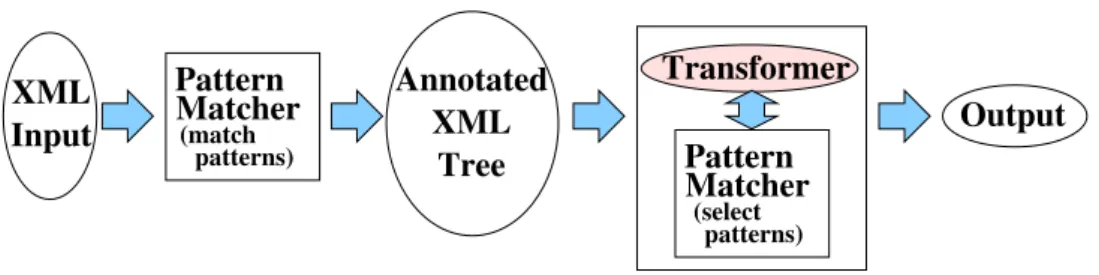
The result of the transformation is given by executing the action associated with the first match pattern in the specification matched by the root of the input document. When the trans-formation is to be applied on sub-documents selected for recursive processing, the selected sub-documents are processed according to the match pattern that they match in the initial input tree. Note here, that match patterns always refer to the initial input tree. One can therefore think of such a transformation as consisting of two phases. In the first phase, the pattern-matching phase, a pattern matcher annotates each node of the input tree with the corresponding matched
patterns. In the second phase, the transforma-tion phase, the annotatransforma-tions are used as a guide as for what actions are to be taken.
As an example of a recursive transformation, consider the following specification of an fxt transformation, which, given an XML docu-ment, produces a list of titles of the sections in the document:
<fxt:spec>
<fxt:pat>/*</fxt:pat> <ul>
<fxt:apply/> </ul>
<fxt:pat>//section/title/""</fxt:pat> <li>
<fxt:current/> </li>
<fxt:pat>default</fxt:pat> <fxt:apply/>
</fxt:spec>
Here, thefxt:patelements contain the match pat-terns of the rules, whereas the action parts span from their trigger pattern to the followingfxt:pat element (or the end). In the given example,
the topmost element of every document to be transformed matches the first pattern, i.e. /*. The corresponding action specifies that the re-sult must be an element of typeul, whose content is given by recursively transforming the content of the topmost element. The second rule says, that whenever text is found inside the title ele-ment of a section, a new li element should be created whose content is the matched text. The rule for the default pattern says, that otherwise, the transformation should simply proceed to the documents in the content of the current sub-document.
4. Match Patterns
For matching the trigger patterns of rules, the XML transformation language XSLT relies on the pattern language XPath 31]. The key idea
of XPath is to use a directory tree like analogy to document trees and use specifications of paths
to locate subtrees. So, e.g.,a/b/cspecifies a path which starts in anaelement, proceeds to an im-mediate descendent element b and from there to the ultimate target elementc. Clearly, paths are not very expressive, in particular if the only iteration operator allowing fordeepmatching is “//”(arbitrary descendent). Therefore, in order
to enhance expressiveness, XPath also allows non-regular features like checking the number of a match and applying an arbitrary predicate to it.
We take a completely different approach here. In our perspective, non-regular features are dif-ficult to understand (and also difficult to
im-plement efficiently). Therefore, these should
be avoided in the pattern language. Thus, we provide support for regular matching only, i.e., for patterns which are related to regular forest languages. Also, we see no point in unneces-sarily restricting the patterns to the very weak XPath core language. Instead, we build on the pattern matching facilities as provided by the functional XML querying tool fxgrep 7]. In
principle, fxgrep admits arbitrary regular for-est grammars as patterns 20, 19]. These are
implemented by one or two deterministic push-down forest automata. The key implementation trick then is, not to compute the transition ta-bles of the automata in advance — but only “on demand” as transitions are used during the matching process. Thus, the total number of transitions which are actually computed is at most linear in the size of the input document
(in practice, we found that typically only few
of all possible transitions are computed). The
complexity of pattern matching therefore does not depend on the structural complexity of pat-terns. Details about the capabilities and the implementation of fxgrep can be found in 19].
We doubt, however, that the power of regular forest grammars could be exploited by a non-expert fxgrep or fxt user. Therefore, fxgrep and hence also fxt provides a pattern language whose syntax is similar in spirit to the abbre-viated syntax of XPath but additionally allows
more precise specifications of paths as well as of left and right context of paths.
Structural conditions for a node may be specified as regular expressions over tree patterns. The children of a node to which a structural constraint refers must then be such that they fulfill the regular expression. Struc-tural conditions on content are given be-tween brackets following the node to which they refer. For example, the patterna[b*c[d*]] is fulfilled by an a element that has one or more b children followed by a c child that itself has onlydchildren.
Contextual conditions
— Vertical contextual conditions can be used to specify properties of paths in document trees. Opposed to the simple path expres-sions of XPath, fxgrep provides full reg-ular expressions for the vertical context. For example, (a/)+b identifies a b node, where each ancestor(at least one)is ana
node. This kind of deep matching clearly exceeds the expressiveness of XPath. — Horizontal contextual conditions may
al-so be specified as regular expressions over the siblings of a node. A contextual constraint consists of two regular condi-tionslandr, given as[l#r]following a node pattern. Suppose that the node pattern is followed by a tree pattern. Then the child of the node that matches the node pattern in which the matches of the following tree pattern are found must be such that its left siblings structurally matchland its right siblings structurally match r. Here are a few examples that illustrate the use of horizontal contextual conditions:
b[c*#d*]/amatches in a tree with type btheachildren such that its left sib-lings are all of typec and its right siblings are all of typed.
//*[# ]/a matches all the a elements
that are the first child of their fa-thers. The node test is fulfilled
by all element types. denotes an arbitrary sequence of nodes.
//*[b*#]/amatchesaelements that are
node test, while the second is the operator for regular expressions. Despite their similar syntax, the operational models of XPath and fxgrep are completely dif-ferent. fxgrep locates matches in at most two passes. In the first pass, a right to left traver-sal of the input tree determines candidates for matches as nodes where structure and right con-text match. In the second pass a left to right traversals identifies from the candidates, those matches for which the left context also matches. In contrast, in the operational model of XPath, matches are located in a number of successive steps. Each such location step selects in turn nodes which find themselves in a specified rela-tionship with the nodes selected by the previous step. The nodes selected by a location step may be subsequently filtered via predicates us-ing arbitrary XPath expressions. For example a[@b=“x”]//c is (conceptually) evaluated as
fol-lows. First, alla elements are selected. From these, the[@b=“x”]predicate filters those having a b attribute with valuex. // selects further all the descendants of the remaining a elements. Finally, the nodes with typecare filtered from the nodes selected by the previous step.
5. Select Patterns
While processing a node from the input doc-ument, a recursive transformation can produce XML content by recursively transforming a set of selected nodes. These nodes are selected through a pattern matching process — which, however, now does not (necessarily) start at
the root node of the input document but de-termines the matches relative to the node
be-ing currently processed. The patterns for this “dynamic” matching process are called select patterns. For selection, the transformation lan-guage XSLT again relies on XPath patterns. Be-yond the navigation operators, however, which can be used in match patterns, select patterns also may go upward in the document tree to ancestors of the current node.
In our perspective sucharbitrarynavigation in the document is likely to cause confusion about the intended meaning of a transformation and error-prone as the user easily gets conceptually lost. It is for this reason that fxt allows exactly the same patterns for selection as for match-ing — implymatch-ing that every fxt transformation proceeds strictly top-down over the hierarchical structure of the input document.
There are, however, transformations which can-not be achieved by simply proceeding top-down and exclusively selecting descendants of the current node for recursive processing. Consider, for example, an input document in which con-secutive repetitions of the same XML content are avoided by using a special place-holder de-noting previously defined content. Now, a trans-formation should process the XML input and re-place the definition as well as the re-place-holder elements by the result of processing this XML content. Suppose the XML content whose rep-etition is avoided is enclosed in an elementdef whereas the place-holder is the elementlastdef. In XSLT, such a transformation could be imple-mented by using selection of non-descendants nodes(in this case the next preceding def
ele-ment)as depicted in the transformation below.
This kind of backtracking obviously cannot be achieved by using the fxt selection mechanism. It turns out, however, that this transformation
<?xml version='1.0' ?>
<xsl:stylesheet xmlns:xsl="http://www.w3.org/1999/XSL/Transform" version="1.0">
<xsl:template match="def">
<DEF><xsl:apply-templates/></DEF> </xsl:template>
<xsl:template match="lastdef">
<xsl:apply-templates select="preceding::def1]"/> </xsl:template>
<xsl:template match="*">
<xsl:copy><xsl:apply-templates/></xsl:copy> </xsl:template>
can still be achieved in fxt through variables and even — at least to our taste — much more elegantly and efficiently.
6. The Transformation Language
An fxt transformation itself is specified by an XML document, as seen in the example in Sec-tion 3. The fxt specificaSec-tion must havefxt:spec as document element type and essentially con-sists of a sequence of rules. Each rule starts with anfxt:patelement containing the triggering match pattern which is followed by the corre-sponding sequence of actions.1 Patterns must
be specified in the pattern language of fxgrep. A patterndefaultcan be used for matching any sub-document in an XML sub-document. If the current sub-document matches the specified pattern of a rule, the corresponding action should be taken. In case patterns of more than one rule match, the earlier defined rule takes precedence. Here, we deviate from the XSLT philosophy where the “most specific” pattern succeeds. In our opinion, our rule is not only much easier to im-plement but also much easier to understand. When designing a specification language for the action part, we follow the approach chosen in XSLT as well as in XMλ 16]: by default,
ele-ments together with their attributes constitute parts of the output. Calls to transformation primitives as well as potentially embedded for-eign language code must be escaped. In our case, we use the prefix fxt: for identifying fxt actions. Basic actions are provided by fxt for:
Copying parts from the matching sub-do-cument like element tags (fxt:copyTag),
at-tributes(fxt:copyAttributes)or content( fxt:co-pyContent);
Inserting new XML content like element tags(fxt:tag), attributes(fxt:attribute, fxt:repla-ceAttribute, etc.), text (fxt:text), and others.
The output to be produced by these elements is specified as values for special attributes; Recursive application of the transformation: the element fxt:apply outputs the sequence of sub-documents obtained by applying the transformation recursively to the children of the current node. The nodes to be further
processed can be explicitly selected through an fxgrep pattern given as value for aselect attribute.
Consider the transformation from Section 3 with the list of section titles from an XML document. When running on the input document:
<document>
<title>Sections</title> <section>
<title>Section One</title>
<content>Here is section 1...</content> </section>
<section>
<title>Section Two</title>
<content>Here is section 2...</content> </section>
</document>
the transformation proceeds as follows. It starts at the root node which has matched the trigger pattern of the first rule. The corresponding ac-tion creates anulelement whose content is given by thefxt:applyaction. fxt:applyconcatenates the results of recursively applying the transforma-tion on the children of the current tree. As the children of the root node have all matched the default pattern, the application of the transfor-mation on each of them recursively descends to the children if any available, as specified by the fxt:apply action for the default pattern. When the transformation arrives at the text node of a title within a section, matching the second pattern in the specification, the transformation returns an li element whose content is the text being currently matched. The result tree of the transformation is depicted in Figure 3.
ul
li
li
"Section One" "Section Two"
Figure 3:The result tree.
The XML syntax of the fxt specification lan-guage allows for a natural way of expressing the output of a transformation. The nesting struc-ture of the output as well as the XML elements which appear literally in the output can both be directly recognized in the fxt specification.
This convenience should be contrasted to ap-proaches which are based on XML libraries for general purpose programming languages like, e.g., HaXML 33]for Haskell, where non-trivial
specifications soon become incomprehensible.
7. Variables and Tables
Complex transformations can be generated, by specifying different rules for different sub-do-cuments and by using recursion. The limitation of such transformations, however, is that at ev-ery step, the transformer only has access to the sub-document currently under consideration. In order to access information obtained earlier dur-ing the transformation, it would be nice to have the possibility of simply storing certain data for later use. Therefore, we decided to include a notion of global variables into fxt.
As a simple example of the use of fxt variables, recall the XSLT specification of the transfor-mation presented in Section 5. When process-ing alastdef element, the XSLT transformation needed to search backward for the last occur-ingdefelement and to recursively transform it. Opposed to that, fxt remembers the result of processing the lastdefelement in a forest vari-able. This value then just has to be looked up when transforming subsequentlastdefelements:
<fxt:spec>
<fxt:global name="res" type="Forest"/> <fxt:push name="res" val="emptyForest"/>
<fxt:pat>//def</fxt:pat> <fxt:setForest name="res">
<DEF><fxt:apply/></DEF> </fxt:setForest>
<fxt:get name='res'/>
<fxt:pat>//lastdef</fxt:pat> <fxt:get name='res'/>
</fxt:spec>
Processing hierarchically nested elements in-curs the need for introducing scopes for vari-ables. One way of doing so is to allow local variables which are visible just during process-ing a specific XML element. Re-structurprocess-ing transformations, however, asks for more flex-ible scoping rules. Therefore, we decided to organize every variable as a stack— meaning that we support push and pop operations on vari-ables. A push operation introduces a new scope whereas a pop leaves this scope again. So, the
single fxt:push element in our example above creates the first instance of the variable and ini-tializes it to the empty forest.
Besides for pushing and popping, fxt actions are provided for setting or outputting the val-ues of the topmost elements. Special actions like fxt:setForest are provided for the comfort-able use ofTreeandForestvariables.
The following specification generates a trans-formation that, given an XML document con-taining imbricatedlielements(list items), adds
before everylian integer representing the num-ber of the list item on its imbrication level:
<fxt:spec>
<fxt:global name="i" type="int"/> <fxt:push name="i" val="0"/>
<fxt:pat>//li</fxt:pat> <fxt:get name="i"/>:
<fxt:copyTag>
<fxt:inc name="i"/>
<fxt:push name="i" val="0"/> <fxt:apply/>
<fxt:pop name="i"/> </fxt:copyTag>
</fxt:spec>
The global variable i is declared of type int. Whenever anlielement is transformed, the last value of i is output using fxt:get, and the li tag is copied to the output. Before proceeding to the transformation of the sons, the current value of i is incremented, and a new level of imbri-cation is opened. This is achieved by means of thefxt:pushelement which introduces a new instance of the variable i which is initialized with 0. After processing the contents of theli element, the last instance of i is popped again usingfxt:pop.
It should be noted that XSLT also provides some notion of variables. XSLT variables, however, are lexically scoped, can have either global or local visibility and can be bound to values of any type returned by XSLT expressions. They never change their value, therefore being merely named constants.
such documents, fxt provides keys, which are a generalization of XML IDs. The key mecha-nism allows to collect sub-documents from the initial document in a table which later can be accessed via keys.
As an example, consider the following XML input document:
<graph>
<node id="1">Trier</node> <node id="2">Bonn</node> <edge from="1" to="2"/> </graph>
A specification of a transformation which lists the connections between the cities could then look as follows:
<fxt:spec>
<fxt:key name='cities' select='//node' key='id'/>
<fxt:pat>//edge</fxt:pat> There is a way from:
<fxt:copyKey name='cities' key='from'/> to:
<fxt:copyKey name='cities' key='to'/>
<fxt:pat>default</fxt:pat> <fxt:apply/>
</fxt:spec>
Thefxt:keyelement declares a table with keyed access called cities. Elements of type node re-siding everywhere in the document are stored therein with keys given by theiridattribute val-ues. Whenever anedgeis seen, the source and the destination of the edge are retrieved from the table, using as key the value of the attribute from and torespectively. The document above is therefore transformed into:
There is a way from: <node id='1'>Trier</node> to:
<node id='2'>Bonn</node>
fxt offers the possibility to apply the transfor-mation to the sub-documents associated with a key. Furthermore, it is possible to store, instead of a whole tree, some arbitrary Unicode string which, typically, is obtained from processing that tree.
8. Interfacing with SML
We expect the features provided by fxt to be rich enough to satisfy the basic needs of a non-expert user of our system. But obviously, not all potential uses, in particular of XML process-ing specialists are foreseeable. It is for such advanced and elaborated applications, that we have embedded into fxt an escape mechanism into the full programming language SML. In or-der to do so in a clean way, an interface is needed which abstracts from the implementation details of documents.
There are two main types of interfaces: tree-based and tree-based. Through the event-based interface the application has a serialized view of the document. Each syntactical com-ponent of the document triggers an event. The application can register a handler for each type of events. The document can thus only be in-spected once in a pre-determined order. One ex-ample of such an interface is the programming
hooksas provided by the functional XML parser fxp 19, 8] or the SAX interface for
object-oriented languages 15].
While event-based interfaces are well-suited for one-pass applications, tree-based interfaces also support applications that need multiple passes over the input. In the tree-based case, an abstract data type is specified. The most commonly used interface is the Document Ob-ject Model (DOM) 29]. Though claiming to
be designed for any programming language, the DOM is committed to the object-oriented paradigm: it defines class interfaces for access-ing XML documents. Also, it views the doc-ument tree as a graph within which arbitrary navigation is possible.
8.1. The Functional Document Model
A different interface is necessary for a func-tional style of XML processing. One such col-lection of types and useful functions for Haskell is HaXML 33]. For SML and specific use with
fxt, we define the interface FDM (Functional
Document Model)and provide an
implementa-tion for it.
char-signature FDM = sig
type Tree
type Forest = Tree vector ...
(* testing type and content *) val isElement : Tree -> bool
val isText : Tree -> bool
val hasElementType : Unicode.Vector -> Tree -> bool val hasTextContent : Tree -> bool
val hasAttribute : Unicode.Vector -> Tree -> bool ...
(* constructing node types *)
val element : Unicode.Vector -> Attribute list -> Tree vector -> Tree
val text : Unicode.Vector -> Tree
...
(* accesing constitutive parts *)
val getElementType : Tree -> Unicode.Vector val getTextContent : Tree -> Unicode.Vector
val getAttribute : Unicode.Vector -> Tree -> Unicode.Vector ...
(* transforming forests *)
val map : (Tree -> 'a) -> Forest -> 'a vector val foldl : (Tree * 'a -> 'a) -> 'a -> Forest -> 'a val deleteAll : (Tree -> bool) -> Forest -> Forest
val deleteFirstN : int -> (Tree -> bool) -> Forest -> int * Forest val filterFirst : (Tree -> bool) -> Forest -> Tree
...
(* outputting *)
val putTree : Tree -> string -> string option -> unit val putForest : Forest -> string -> string option -> unit
end
acters and has no notion of Unicode. There-fore a Unicode library is provided inside FDM declaring types for the Unicode characters and strings, along with basic functions for manip-ulating them, as well as conversion functions from and to SML strings.
The types Tree and Forest are provided as ab-stractions of XML sub-documents and of se-quences of XML sub-documents, respectively. Functions are provided for testing the type or content of a node, for accessing its constitu-tive parts and for constructing different node types. Basic functionality is supplied for trans-forming sequences of trees(forests), like, e.g.,
for mapping, successive composition(folding),
filtering, sorting or outputting trees or forests. The functional concept of higher-order func-tions makes it possible to elegantly obtain com-plex processing from combining basic functions provided by the FDM.
Consider the depicted excerpt from the FDM interface above.
The names of the FDM functions are mostly self-explaining. filterFirst,for example, is a func-tion which expects a predicate over trees as its first argument and a forest as the second ar-gument. It returns the first tree in the forest satisfying the predicate. Consider the call:
filterFirst hasTextContent
wherehasTextContent tests whether a node has plain text content. Then a function is returned which takes a forest and returns the first tree in the forest having only text content.
In the call:
filterFirst (hasElementType (String2Vector "alfa"))
<fxt:spec>
<fxt:pat>//*</fxt:pat> <fxt:tag
nameExp=' let
val name = getElementType current in
if Vector.length name > 6 then Vector.extract (name,0,5) else name
end'> <fxt:apply/> </fxt:tag> </fxt:spec>
8.2. Embedding SML Code into Transformations
SML code is embedded into an fxt specification via attributes of fxt actions. The values for these attributes are SML expressions. Their evalua-tion can provide XML content to be used in the output, predicates for filtering XML forests, or even functions for application onto document components.
The stylesheat presented above is the specifi-cation of a transformation that replaces every element name containing more than six charac-ters by its first six characcharac-ters.
The fxt:tag outputs an element whose name is given as the value of an attribute nameExp, which must be an SML expression evaluating to a Unicode string. The reserved FDM name cur-rentalways refers to the current sub-document. Thus, getElementType current returns the name of the current element. The content of the out-put element is given by the content of thefxt:tag element. If, as above, a default pattern is not specified, a default action is considered added for trees which do not match any of the spec-ified patterns. This default action copies the root of the current tree and recursively applies the transformation on its children, or outputs them if they are text nodes.
9. Typeful Transformations
Currently, fxt transformations are “un-typed” in the sense that no guarantee is given that the newly created documents conform to some spe-cific document type. In fact, it is possible to produce even non-XML output, and we have extensively made use of this feature in order to create the HTML pages of our tools’ online documentations.
There are, however, situations perceivable where guarantees on the relationship between the doc-ument types of input and output are indeed desir-able. Several suggestions in this direction have been recently made. One approach is to build type safety into the transformation language it-self. This approach is pursued by the language proposal XMλ which sketches an enhancement of the Haskell type-checking mechanism guar-anteeing conformance of element forests to con-tent models 16]. Based on finite tree automata,
Hosoya and Pierce have developed a type sys-tem for the small tree transformation language XDuce 10]. They provide an exponential-time
algorithm for statically inferring the types of all program expressions. Their language, however, similar to XMλ, provides only very restricted forms of pattern matching. Neither does it deal with attributes or dynamic modification of ele-ment tags.
Another approach is to abstract the transforma-tional model into a formal device for which gen-eral typing algorithms can be provided. This is advocated by Suciu 17]. Suciu proposes the
formal concept of a “k-pebble transducer” and proves a decidability result. The best currently known upper complexity bound of the decision procedure, however, is way beyond what is fea-sible in practice. Also, it is not clear yet whether this model can deal with fxt-type pattern match-ing as well — not to speak about dynamic modi-fication of element tags. Yet another approach is suggested by L¨ammel and Lohmann 14]. They
10. Traversals and Strategies
fxt transformations proceed in several traversals over the input document. Up to two traversals are used for determining the matches of the trig-gering match patterns of the rules. Possibly, further traversals allow to fill tables for random access to selected document parts. Finally, the main traversal produces the output. This seems to suffice for most standard document process-ing needs.
We think, however, that in future applications, more complicated traversal organization might be needed. In particular, it could become de-sirable to compose several transformations of different kinds. Experiences with calculi for for such compositions have been collected in the area of term rewriting languages. Term rewriting languages are another area of tree pro-cessing, usually applied in program transforma-tion. Programs are represented as terms, built from variables, constant and function symbols. Transformations are also specified through rules, where the form of rules is similar to that of fxt or XSLT rules. The left hand side is a term pattern, while the right hand side is a term tem-plate. The template is instantiated when the rule is applied on a term matching the left hand side. The application of the rule is controlled by a
strategywhich in a certain sense corresponds to one of our traversals. Typically, term rewriting uses a standard, fixed strategy. In term rewrit-ing languages like Stratego 27] 26] 28],
how-ever, the user can provide his/her own
strate-gies. In Stratego, a strategy is an operation that transforms a term into another term or fails. Basic building blocks in strategies are match-ing terms, buildmatch-ing terms and variable bindmatch-ings. More complex strategies can be obtained by us-ing strategy operators. These can be divided into operators for sequential programming and operators for term traversals. Rules are ab-breviations that allow to conveniently specify basic strategies. The separation of matching and construction of terms from the building of scopes for variable bindings allows for a pat-tern matching more expressive than that of func-tional programming languages like ML(where
pattern matching is done by simultaneously rec-ognizing structure and binding variables to sub-terms). For example, a pattern match can be
passed on to a local strategy to match sub-terms at a variable depth in the subject term. Another
feature of Stratego is the possibility of express-ing patterns that describe recursive structure. ELAN 3]is another term rewriting language
us-ing strategies. One of its features is the support for associative-commutative pattern matching. Like in Stratego, there is no special support for XML processing.
11. Comparing fxt with XSLT Implementations
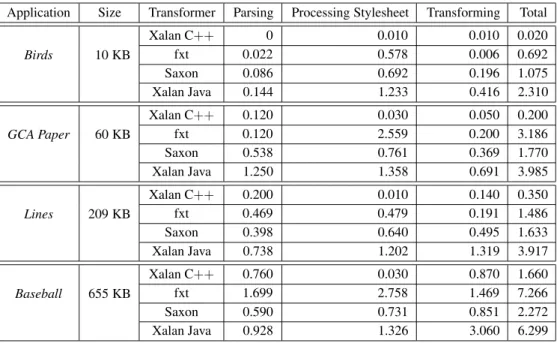
In order to assess the time performance of fxt we compared it with three XSLT processors. These were the Xalan processors (part of the
Apache XML Project 22]) Xalan Java 2 and
Xalan C++1.2 and the Saxon 6.4.4 processor
written in Java also 13].
We considered the following benchmark trans-formations:
Birds
— XML Input(10 KB): Description of classes
of birds
— Output: Plain text file presenting the information in the input in an indented manner
GCA Paper
— XML Input(60 KB): An fxt presentation
conforming to the DTD for GCA XML Conference Proceedings 5]
— Output: An HTML layout of the paper Lines
— XML Input (200 KB): Shakespeare’s
"All’s Well That Ends Well" play 4]
— Output: The collection of all the lines in the play
Baseball
— XML Input(600 KB): Baseball statistics
9]
— Output: HTML tables containing pro-cessed information about baseball play-ers.
T1 and T2
— XML Input(200 KB): Shakespeare’s play
as above
Application Size Transformer Parsing Processing Stylesheet Transforming Total Xalan C++ 0 0.010 0.010 0.020 fxt 0.022 0.578 0.006 0.692
Birds 10 KB
Saxon 0.086 0.692 0.196 1.075 Xalan Java 0.144 1.233 0.416 2.310 Xalan C++ 0.120 0.030 0.050 0.200 fxt 0.120 2.559 0.200 3.186 GCA Paper 60 KB
Saxon 0.538 0.761 0.369 1.770 Xalan Java 1.250 1.358 0.691 3.985 Xalan C++ 0.200 0.010 0.140 0.350 fxt 0.469 0.479 0.191 1.486
Lines 209 KB
Saxon 0.398 0.640 0.495 1.633 Xalan Java 0.738 1.202 1.319 3.917 Xalan C++ 0.760 0.030 0.870 1.660 fxt 1.699 2.758 1.469 7.266 Baseball 655 KB
Saxon 0.590 0.731 0.851 2.272 Xalan Java 0.928 1.326 3.060 6.299
Table 1: Transformation times (seconds).
The benchmarks were executed under Linux
(Kernel 2.4.9)on a AMD Athlon 800 MHz
pro-cessor. The JVM used to run the benchmarks with the Java XSLT implementations was the Sun JVM implementation Java version 1.3. The times listed are measured for a single run of the corresponding transformation. The to-tal times for fxt include thus the time needed to generate and compile SML code to achieve the transformation. The total times for the XSLT processors also take into account the time needed for processing the stylesheets. It is likely that one stylesheet source is used to transform multiple XML sources. In this case the stylesheet needs to be processed only once before the first transformation. It is therefore sensible to individually list the time taken by the processing of the stylesheets.
As the time spent for parsing the XML input is significant, it is individually listed in the results. Times for startup for the JVM and for the SML runtime-system were also not considered. The patterns used in the first three transforma-tions are very simple. For them fxt proved to be in general faster than the Java processors and able to keep up with Xalan C++. Table 1 shows
the results for the first three transformations.
T1andT2contain more elaborate but completely
meaningful patterns. A play is a sequence of ACTs, each of them containing a sequence of SCENEs. ASCENEhas a sequence ofSPEECHes,
each of them containing a SPEAKER and a se-quence ofLINEs containing plain text. T1
col-lects all the lines in the speeches of LAFEU appearing in scenes where BERTRAM is also present. Given the DTD for Shakespeare plays we have used, these lines are matched by the XPath pattern:
SCENE.//SPEAKER="BERTRAM"]/SPEECHSPEAKER ="LAFEU"]/LINE
The corresponding fxgrep pattern is:
//SCENE_(//SPEAKER/"BERTRAM")_]/ SPEECH_(SPEAKER/"LAFEU")_]/LINE/""
Note the differences in the patterns above due to the fact that the structural conditions within the brackets are expressed in XPath as XPath predi-cates, while in fxgrep they are regular conditions to be fulfilled by the sons of the preceding node. Thus, the first XPath predicate above is a com-parison of the node-set selected by.//SPEAKER with the stringBERTRAM, and is true if the string content of some SPEAKER descendant of the SCENEelement is equal toBERTRAM. The cor-responding structural constraint in fxgrep tells that the children of the SCENE element must consists of an arbitrary sequence of trees (as
specified by the wildcard), followed by a node
Application Transformer Parsing Processing stylesheet Transforming Total Xalan C++ 0.200 0.010 0.780 0.990 fxt 0.427 0.480 0.271 1.376 T1
Saxon 0.401 0.681 1.213 2.395 Xalan Java 0.774 1.210 1.326 3.812 Xalan C++ 0.200 0.010 7.500 7.710 fxt 0.432 0.475 0.365 1.485 T2
Saxon 0.405 0.672 3.839 5.020 Xalan Java 0.767 1.211 5.657 8.131
Table 2: Transformation times when using elaborate patterns (seconds).
T2 collects all the speeches in scenes
contain-ing a line havcontain-ing the word “husband” and be-ing in an act containbe-ing a line havbe-ing the word “abundance”. The XPath and the functionally equivalent fxgrep patterns that were used are:
ACT.//LINEcontains(.,"abundance")]]/ SCENE.//LINEcontains(.,"husband")]]/SPEECH
and respectively:
//ACT_(//LINE/"abundance")_]/ SCENE_(//LINE/"husband")_]/SPEECH
We suppose that the XPath implementation in the XSLT processors reflect more or less the processing model of XPath imposing multiple tree traversals which incur a lot of processing time. The processing times for T1 and T2 are
presented in Table 2. fxt performs significantly faster even than the C++ XSLT
implementa-tion.
For T1 and T2 we also considered the
depen-dency of the transformation time on the size of the input document. The input document was augmented by duplicating the ACTs of the play, which is doubling the breadth of the input tree. The expected effect on both the fxt and the XSLT transformations is that of doubling of the transformation steps. The size-time depen-dency showed to be indeed linear.
12. Conclusions
In this paper we have presented fxt, a trans-formation language for XML documents. fxt combines the efficiency of the pattern matching provided by fxgrep with a simple, yet power-ful set of transformation primitives and a clear programming interface to the functional pro-gramming language SML. Besides the features
we have mentioned here, fxt offers a number of further features which allow for more con-venient and expressive specifications. Among these are:
conditional processing, allowing to specify that a sequence of actions is to be considered only if some condition is fulfilled;
attribute insertion, deletion and replacement; using SML code for inserting processing in-structions with computed content as well as arbitrary Unicode content;
sorting and filtering of forests generated dur-ing the transformation;
using command line arguments within trans-formations.
For details we refer to the online documentation 2].
To our experience, the expressivity of our pattern-language together with the additional features of fxt such as stackable variables more than compensate for fxt’s restrictions on navigation through the input document. This restriction, however, allowed us to provide an elegant and understandable specification language for doc-ument transformation, whose implementation often outperforms comparable implementations of XSLT.
13. Acknowledgments
AThe syntax of an fxt specification
<!-- An action can be some XML character data, one of the listed fxt actions or any other literal XML element -->
<!ENTITY % ACTION "#PCDATA
|fxt:addAttribute|fxt:apply|fxt:applyKey|fxt:attribute |fxt:copyAttributes|fxt:copyContent|fxt:copyKey|fxt:copyTag
|fxt:copyTagAddAttribute|fxt:copyTagApply|fxt:copyTagDeleteAttribute |fxt:copyTagReplaceAttribute|fxt:copyType|fxt:cr|fxt:current
|fxt:currentText|fxt:deleteAttribute|fxt:getTableItems|fxt:ht |fxt:if|fxt:literate|fxt:pi|fxt:pop|fxt:push|fxt:pushForest |fxt:replaceAttribute|fxt:set|fxt:inc|fxt:setForest|fxt:sml|fxt:sp |fxt:switch|fxt:tag|fxt:text|ANY">
<!-- A declaration is specified by one of the following fxt elements --> <!ENTITY % DECLARATION "fxt:arg|fxt:global|fxt:key|fxt:open|fxt:push
|fxt:pop|fxt:set|fxt:inc|fxt:table">
<!-- A rule is a pattern, specified by an fxt:pat element followed by an arbitrary number of actions --> <!ENTITY % RULE "fxt:pat, (%ACTION)*">
<!-- A specification consists of a number of declarations followed by an arbitrary number of rules -->
<!ELEMENT fxt:spec ((%DECLARATION)*,(%RULE)*)>
<!-- A pattern is specified as the XML character data content of an fxt:pat element -->
<!ELEMENT fxt:pat (#PCDATA)>
<!-- The folowing fxt:actions have empty content --> <!ELEMENT
(fxt:addAttribute|fxt:apply|fxt:applyKey|fxt:arg |fxt:attribute|fxt:copyAttributes|fxt:copyContent |fxt:copyKey|fxt:copyTagApply|fxt:cr|fxt:current |fxt:currentText|fxt:deleteAttribute|fxt:getTableItems |fxt:ht|fxt:pi|fxt:pop|fxt:push|fxt:replaceAttribute |fxt:set|fxt:inc|fxt:sml|fxt:sp|fxt:table|fxt:text)
EMPTY>
<!-- The following fxt:actions can have as content an arbirary sequence of fxt actions -->
<!ELEMENT
(fxt:case|fxt:copyTag|fxt:copyTagAddAttribute
|fxt:copyTagDeleteAttribute|fxt:copyTagReplaceAttribute |fxt:copyType|fxt:default|fxt:if
|fxt:pushForest|fxt:setForest|fxt:tag) ((%ACTION)*)>
<!-- fxt:literate may have only character data content --> <!ELEMENT fxt:literate (#PCDATA)>
<!-- fxt:switch has zero or more case branches and a branch for the default -->
<!ELEMENT fxt:switch (fxt:case*,fxt:default)>
<!-- Attributes of the fxt actions --> <!ATTLIST fxt:addAttribute
(name|nameExp) NMTOKEN #REQUIRED (val|valExp) NMTOKEN #REQUIRED> <!ATTLIST fxt:apply
test NMTOKEN #IMPLIED
(selectselectExp) NMTOKEN #IMPLIED> <!ATTLIST fxt:applyKey
name NMTOKEN #REQUIRED
(key|keyExp) NMTOKEN #REQUIRED> <!ATTLIST fxt:arg name NMTOKEN #REQUIRED> <!ATTLIST fxt:attribute name NMTOKEN #REQUIRED> <!ATTLIST fxt:case test NMTOKEN #REQUIRED> <!ATTLIST fxt:copyTagAddAttribute
(name|nameExp) NMTOKEN #REQUIRED (val|valExp) NMTOKEN #REQUIRED> <!ATTLIST fxt:copyTagDeleteAttribute
<!ATTLIST fxt:copyTagReplaceAttribute (name|nameExp) NMTOKEN #REQUIRED (val|valExp) NMTOKEN #REQUIRED> <!ATTLIST fxt:deleteAttribute
(name|nameExp) NMTOKEN #REQUIRED> <!ATTLIST fxt:getTableItems
name NMTOKEN #REQUIRED
(key|keyExp) NMTOKEN #REQUIRED> <!ATTLIST fxt:global
name NMTOKEN #REQUIRED
type NMTOKEN #REQUIRED
toForest NMTKEN #IMPLIED> <!ATTLIST fxt:if test NMTOKEN #REQUIRED> <!ATTLIST fxt:key
name NMTOKEN #REQUIRED select NMTOKEN #REQUIRED (key|keyExp) NMTOKEN #REQUIRED> <!ATTLIST fxt:open
structure NMTOKEN #REQUIRED file NMTOKEN #IMPLIED> <!ATTLIST fxt:pi
procesor NMTOKEN #REQUIRED data NMTOKEN #REQUIRED> <!ATTLIST fxt:pop name NMTOKEN #REQUIRED> <!ATTLIST fxt:push
name NMTOKEN #REQUIRED val NMTOKEN #REQUIRED>
<!ATTLIST fxt:pushForest name NMTOKEN #REQUIRED> <!ATTLIST fxt:replaceAttribute
(name|nameExp) NMTOKEN #REQUIRED (val|valExp) NMTOKEN #REQUIRED> <!ATTLIST fxt:set
name NMTOKEN #REQUIRED val NMTOKEN #REQUIRED> <!ATTLIST fxt:inc
name NMTOKEN #REQUIRED>
<!ATTLIST fxt:setForest name NMTOKEN #REQUIRED> <!ATTLIST fxt:sml code NMTOKEN #REQUIRED> <!ATTLIST fxt:table
name NMTOKEN #REQUIRED select NMTOKEN #REQUIRED (key|keyExp) NMTOKEN #REQUIRED item NMTOKEN #REQUIRED>
<!ATTLIST fxt:tag nameExp NMTOKEN #REQUIRED> <!ATTLIST fxt:text code NMTOKEN #REQUIRED>
References
1] Standard ML of New Jersey, Home Page, 1989– 2001. Available online at
http://cm.bell-labs.com/cm/cs/what/smlnj/.
2] ALEXANDRU BERLEA, Fxt, Online Documenta-tion, 2001. Available online at http://www.
informatik.uni-trier.de/ aberlea/Fxt/.
3] PETER BOROVANSKY, CLAUDE KIRCHNER, HE
-LENE KIRCHNER PIERRE-ETIENNE MOREAU AND
CHRISTOPHERINGEISSEN. An overview of ELAN. In
Electronic Notes in Theoretical Computer Science, volume 15, Elsevier Science Publishers, 2000. 4] JONBOSAK, editor,The Complete Plays of
Shake-speare, Marked up in XML, 1999. Available online
at http://metalab.unc.edu/xml/examples/
shakespeare.
5] ALEXANDRUBERLEA ANDHELMUTSEIDL, fxt - A Transformation Language for XML Documents. In XML Conference And Exposition 2001, 2001.
6] A.VANDEURSEN, P. KLINT ANDJ. VISSER, Domain-Specific Languages: An Annotated Bibliography, ACM SIGPLAN Notices, 35(6):26–36, June 2000. 7] ANDREAS NEUMANN, fxgrep1.4.1, Source Code,
2001. Available online at http://www.infor
matik.uni-trier.de/ aberlea/Fxgrep/.
8] ANDREAS NEUMANN, fxp1.4, Source Code, 2001. Available online at http://www.
informatik.uni-trier.de/ aberlea/Fxp/.
9] ELIOTTER. HAROLD, editor,1998 Baseball Statis-tics – XML Sample Files, 1999, Available online
at http://metalab.unc.edu/xml/examples/
1998validstats.xml.
10] HARUO HOSOYA AND BENJAMIN C. PIERCE, XDuce: A Typed XML Processing Lan-guage, In Proceedings Of The Third Interna-tional Workshop on the Web and Databases (WebDB2000), Dallas, Texas, pages 111– 116, May 2000. Available online at http:
11] JOHNHUGHES, The Design of a Pretty-printing Li-brary. In John Jeuring and Erik Meijer, editors, Advanced Functional Programming, Tutorial text of the First international spring school on advanced functional programming techniques, Bastad, Swe-˚
den, volume 925 of Lecture Notes in Computer Science, pages 53–96, Springer, Heidelberg, 1995. 12] International Organization for Standardization,
In-formation technology – Processing Languages – Document Style Semantics and Specification Lan-guage (DSSSL). Ref. No. ISO/IEC 10179:1996(E), 1996.
13] MICHAEL KAY, Saxon, Software Documen-tation, 2001. Available online at http://
saxon.sourceforge.net.
14] RALFL ¨AMMEL ANDWOLFGANGLOHMANN, Format Evolution. In Proc. 7th International Conference on Reverse Engineering for Information Systems (RETIS 2001), volume 155 [email protected], OCG, 2001.
15] DAVIDMEGGINSON ET ALIAS, editors,SAX 1.0: The Simple API for XML. Online Documentation, Meg-ginson Technologies, May 1998. Available online at
http://www.megginson.com/SAX/index.html.
16] ERIKMEIJER ANDMARKSHIELDS, XMλ: A Func-tional Language for Constructing and Manipulating XML Documents,(Draft), 1999.
17] TOVAMILO, DANSUCIU ANDVICTORVIANU, Type-checking for XML Transformerd. In Proceedings of the ACM Symposium on Principles of Database Systems, 2000, 2000.
18] ROBIN MILNER, MADS TOFTE, ROBERT HARPER
ANDDAVID MACQUEEN, The Definition of Stan-dard ML (Revised), MIT Press, 1997.
19] ANDREASNEUMANN, Parsing and Querying XML Documents in SML, PhD thesis, University of Trier, Trier, 2000.
20] ANDREAS NEUMANN ANDHELMUTSEIDL, Locat-ing Matches of Tree Patterns in Forests. In V. Arvind and R. Ramamujan, editors, Foundations of Software Technology and Theoretical Computer Science, (18th FST&TCS), volume 1530 of Lec-ture Notes in Computer Science, pages 134–145, Springer, Heidelberg 1998.
21] BIJANPARSIA,Functional Programming and XML. Online Article, XML.com, 2001. Available online
at http://www.xml.com/pub/a/2001/02/14/
functional.html.
22] Apache XML Project, Xalan, Software Doc-umentation, 2001. Available online at http:
//xml.apache.org/xalan/index.html.
23] D. S. SWIERSTRA, P. AZERO ANDJ. SARAIVA, De-signing and implementing combinator languages, In D. S. Swierstra, P. R. Henriques and J. N. Oliveira, editors, Third International Summer School on Advanced Functional Programming, Braga, Por-tugal, 1998, volume 1608 of Lecture Notes in Computer Science, pages 150–206, Springer, Hei-delberg, 1998.
24] D. S. SWIERSTRA ANDL. DUPONCHEEL, Determin-istic, Error-Correcting Combinator Parsers. In John Launchbury, Erik Meijer and Tim Sheard, edi-tors, Advanced Functional Programming, volume 1129 of Lecture Notes in Computer Science, pages 184–207, Springer, Heidelberg, 1996.
25] The Unicode Consortium, The Unicode Standard, Version 2.0, Addison Wesley Developers Press, Reading, Massachusetts, 1996.
26] EELCO VISSER, Strategic Pattern Matching. In Rewriting Techniques and Applications (RTA ’99), Trento, Italy, volume 1631 of Lecture Notes in Computer Science, pages 30–44, Springer, 1999.
27] EELCO VISSER, The Stratego Reference Manual. Tehnical report, Institute of Information and Com-puting Science, Universiteit Utrecht, Utrecht, The Netherlands, 1999.
28] EELCOVISSER, Stratego: A Language for Program Transformation Based on Rewriting Strategies. In To Appear in Rewriting Techniques and Applica-tions (RTA ’01), Utrecht, The Netherlands, Springer, 2001.
29] VIDURAPPARAO, STEVEBYRNE ANDMIKECHAM
-PION, et alias, editors, Document Object
Model (DOM) Level 1 Specification, Ver-sion 1.0, W3C Recommendation, World Wide Web Consortium, October 1998. Available on-line at
http://www.w3.org/TR/1998/REC-DOM-Level-1-19981001.
30] JAMES CLARK, editor, XSL Transformations (XSLT) Version 1.0, W3C Proposed Rec-ommendation, World Wide Web Consor-tium, November 1999. Available online at
http://www.w3.org/TR/xslt.
31] JAMES CLARK ANDSTEVEDEROSE, editors. XML Path Language (XPath) Version 1.0, W3C Recommendation, World Wide Web Consor-tium, November 1999. Available online at
http://www.w3.org/TR/xpath.
32] PHILIP WADLER, A formal semantics of patterns in XSLT, Markup Technolo-gies, Philadelphia, to appear, December 1999. Available online at http://cm.bell-
labs.com/cm/cs/who/wadler/papers/xsl-semantics/xsl-semantics.ps.
33] MALCOLM WALLACE AND COLIN RUNCIMAN, Haskell and XML: Generic combinators or type-based translation? In Peter Lee, editor,Proceedings Of The International Conference on Functional Programming 1999, Paris, France, pages 148–259, ACM Press, New York, Sept. 1999.
Received:July, 2001
Revised:October, 2001
Contact address:
Alexandru Berlea, Helmut Seidl Department of Computer Science University of Trier Germany e-mail:faberlea,[email protected] tri er.d e
ALEXANDRUBERLEAis a Ph. D. candidate at the University of Trier, Germany. He has graduated in 1999 from the Computer Science and Engineering Department of the Politehnica University of Bucharest, Romania with the final thesis written at the Delft University of Tech-nology in The Netherlands. His research interests include document processing, functional programming, tree automata and garbage collec-tion.
HELMUTSEIDLgraduated in Mathematics(1983)and received his Ph.
D. degree in Computer Science(1986)from the University of
Frank-furt/Main, Germany. He received his Dr. Habil. (1994)from the