Orienting the Teaching of an
Introductory Object-Oriented
Programming to Meet the
Learning Objective
Jasna Kuljis
The VIVID Research Centre, Department of Information Systems and Computing, Brunel University, West London, UK
This paper describes our experiences in teaching a first year object-oriented programming course. We used Java as a vehicle to teach programming principles and BlueJ as a Java development environment. The course was heavily supported by web-based resources delivered through WebCT. So far we consider the overall students’ learning experience as being considerably enriched and a positive one.
Keywords: Web-based learning, teaching object-oriented programming, teaching Java.
1. Introduction
The majority of students, even those enrolled on computer science courses, find computer programming a difficult and complex cognitive task. Computer science educators have tried many methods to improve results in teaching programming. These include:
the choice of the first taught programming language;
the choice of the course textbook;
the choice of programming environment; variations in teaching methods;
variations in assessment.
A prescription has not been found on how to successfully teach programming or how to make any considerable improvement in a number of students successfully acquiring programming knowledge. Changing the language that is taught first does not significantly change the
pass rate 1]. Even teaching programming
us-ing specially designed languages like, for ex-ample, Pascal, has not made any considerable difference. Neither does using different text-books, nor does slowing the course down, nor does alternating a bottom-up and a top-down approach.
Some academics may have opted to lower stan-dards and/or to reduce the quantity of material
taught and concentrate on more ‘important’ top-ics 1].
Due to the increase in student population, classes of several hundred students for computer programming courses are not uncommon. For example, we normally have about 200 students in the programming class each year, however, last year we had just over 400 students in the class. Not surprisingly there is a huge variety in students’ abilities, learning speeds, and atti-tudes. Since attention to difficulties faced by an individual cannot be easily addressed in a large class, we, educators, have to find an alternative way of helping students in their learning. Thus, we provide a variety of modes of learning and support different rates of learning.
Very little is known about the learning in gene-ral. It is not our intention to explore these com-plexities. More on that can be found in 1].
The paper describes a unique synergy between BlueJ 3]and WebCT 7]resulting in a rich
en-vironment created for our students.
textbook, programming environment, and sup-porting web-based resources. The subsequent section describes the evolution of the introduc-tory programming course at Brunel. A section describing a new approach to learning using WebCT and BlueJ follows. The next section gives a flavour of student adaptation to way of working. Finally the paper argues that, even though little is known about the learning of pro-gramming, the learning experience of students can be improved with extensive web-based sup-port.
2. How to Handle Too Much Choice
The Department of Information Systems and Computing (DISC) at Brunel offers three
un-dergraduate degrees leading to an award of BSc: Computer Science, Information Systems, and Applied Computing. All three degrees require students to take in their first year a programming course currently called “Construction of Pro-grams”. Traditionally students on that course do not perform as well as on other first year courses.
Before the start of each year, we review how the course went in the previous year and whether any changes are needed or desired for the fol-lowing session. Since the success rate in the introductory programming course is never as good as in other courses, we continuously strive for improvements. Almost every year we make changes to our teaching, change course text-books and choose on programming environ-ment.
We have evaluated dozens of texts, and nearly every one is about how to program in Java, not how to construct programs using Java as the programming language. Also, most textbooks follow a standard procedural approach. Pro-gramming concepts typically consists of primi-tive types, control statements, loop statements, before going into more elaboration on classes, objects and methods. A typical first program is usually “Hello World” program, hardly an introduction to object-orientation.
Since using I–O in Java requires considerable knowledge, many textbooks come with spe-cial environments or with spespe-cial classes with custom-written I–O methods. Students taught following this type of approach end up con-fused and very few grasp the fundamentals of
object-orientation. Our experience shows that two of the most difficult concepts for students to understand are the difference between a class method and an instance method, and between a class variable and an instance variable(agreeing
with 4]).
3. Legacy Courses
This section describes how introductory pro-gramming course at DISC evolved over the last three years.
In 2001-02 there were 2 hour lectures plus 2 hours of structured laboratory sessions(we call
them ‘labs’) a week. Labs were used to put
into practice what was taught during the lecture. This was a change from the previous year when there were only 3 hour lab sessions for each student and when all new material was taught within that session. The course was delivered by a teaching team consisting of 9 academics and 2 teaching assistants(PhD students). Teaching to
each group of students was done by a different person who made their choice of how to present material and what to emphasise; therefore, each group of students had a unique experience. In order to provide a common experience, we decided to separate lectures where new ma-terial is presented from the practical sessions where these were put into practice. Two tutors were responsible for each session. The main course textbook was Hortsmann 5]. All course
material was made available on the dedicated course web page on the Department’s Intranet. The course material included details about the course (e.g., study guide, timetable, teaching
team contact details, software downloads, etc),
copies of lecture slides, lab exercises set for each week, notices, coursework details, past exam papers, etc.
JBuilder by Borland was used as the program-ming environment and a custom-written library containing I–O methods was written by a col-league Tony Elliman. All coursework that was finished on time was collated electronically(file
transfer). However, late coursework was handed
through a standard set of questions and answers and tests. The exams were in a form of mul-tiple choice questions and were marked using scanning software.
Again, the results were disappointing and there were many concerns that students were not able to program. Our main hypothesis was that since students were expected to learn how to program in the first semester, in order to spend more time on algorithms in the second semester, their time to learn programming was too short.
In 2002-03 the overall syllabus remained very similar, apart from more emphasis being given to general programming principles and problem solving rather than to data structures and algo-rithms. There were 2 hour lectures plus 2 hours of structured lab activities a week. The teach-ing team consisted of seven academics and five teaching assistants. Lectures were given in one session to all students enrolled on the course. Students were divided into nine groups and each had a 2 hour lab session per week. Two tutors were responsible for each session. The main course textbook was Hortsmann 6]. Again,
all course material was made available on the dedicated course web page on the Department’s Intranet. We again used JBuilder and in-house software library.
The assessment consisted of 2 programming as-signments and the exam. All coursework that was finished on time was submitted electroni-cally(file transfer)and, again, late coursework
was handed in on floppy disks. We again used marking software. The exam was the form of multiple choice questions and questions were divided into three sections. The first section tested the knowledge required to pass. The second section tested the knowledge required to get a better grade (up to grade B) and the
third section was used to differentiate between better students(for grade A). Again, the exams
were marked using scanning software.
There were more than 400 students on the course and coordination problems were immense espe-cially those related to the assessments.
4. Web-Enhanced BlueJ Learning (WEBL)
Our new approach WEBL uses WebCT to facili-tate constant students’ progress learning object-oriented principles with BlueJ. This required drastic changes in 2003-04 which include:
the new textbook
the new programming environment different web-based support
different assessment
The following sections list the reasons for changes made.
4.1. Objects First and BlueJ
The reason for changing the textbook was the fact that the majority of students were using Java as a procedural language because they could not understand object orientation. They were not solving problems by designing classes, but were writing monolithic programs using only the main class. They could not separate the two main concepts, class and an instance of the class. Other important object-oriented concepts like inheritance and polymorphism was a mys-tery for them. We wanted students to truly un-derstand the concept of objects, but it is difficult to put this into practice in Java. Many hurdles such as of syntax and detail have to be over-come before learners can have first experience with living objects 2].
We used JBuilder by Borland as the main pro-gramming environment for many years, but it was not learner friendly.
The combination of a textbook by Barnes and K¨olling 2] and the BlueJ development
envi-ronment 3] overcame the main weaknesses of
previous textbooks and the programming envi-ronment. Barnes and K¨olling 2] focus on the
general object-oriented and programming con-cepts, integrating this with the use of the BlueJ environment. BlueJ is an interactive develop-ment environdevelop-ment designed explicitly as an en-vironment to teach introductory object-oriented programming by Monash University, Australia. The main strengths of BlueJ are 2]:
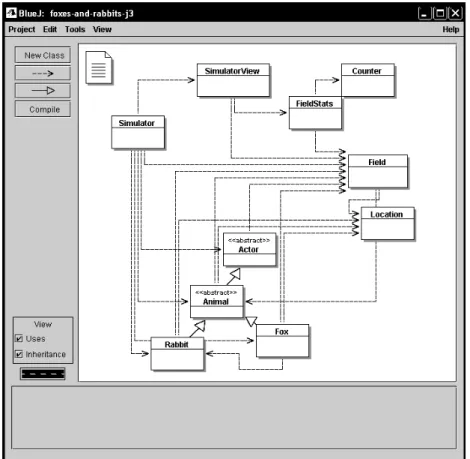
It provides visualization of class structure. It automatically displays a UML-like diagram representing the classes and relationships in a project(see Fig. 1).
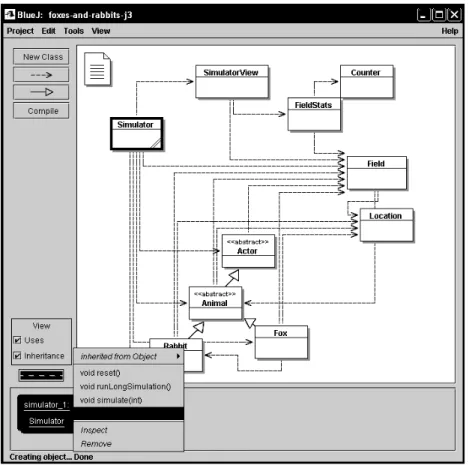
Users can directly create objects of any class
(see Fig. 2)and then interact with methods (see Fig. 3). They can try out a method
Fig. 1.Class diagram in BlueJ environment.
Fig. 3.Calling a method on an object in BlueJ.
4.2. WebCT
As already mentioned, the course had a strong web resource base. However, this was a static web page that had several weaknesses. The main weaknesses were the following.
The course web page was Intranet-based and not easy to access, especially through external means. Students were able to read material on the web, to copy it, to print it, and to download software. There were no facilities for interac-tion like, for example, to post queries, to submit their work, and to create a discussion forum. So students used e-mails as the main communica-tion channel. With 400 students on the course, a considerable and time consuming effort was spent answering similar questions.
We therefore migrated to WebCT, because it provides the following facilities:
access from any Internet point;
authentication using userid and password; it allows posting files;
submission of student work;
quizzes and tests;
course communication using course notices and discussion forum.
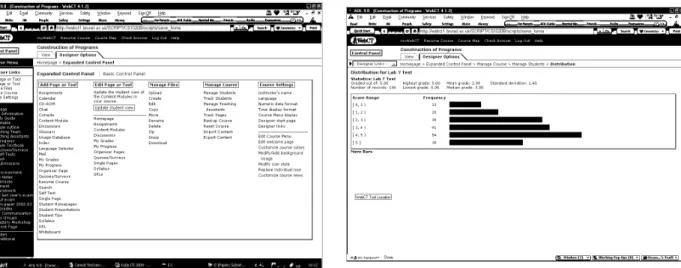
Different users of WebCT have different views and different access rights. The main categories are the designer, teaching assistants, and stu-dents. Designers have access to all parts of a particular course web page(see Fig. 4)and they
can
create web pages for the course(see Fig. 5);
upload various types of files and organize them into directories;
create tests and quizzes; create submissions; create a class list;
give access rights to students and teaching assistants;
view and download work submitted by stu-dents;
Fig. 4.WebCT – designer’s view.
Fig. 5.WebCT course home page.
modify marks for student tests and submitted coursework;
view statistics on overall submissions and tests(see Fig. 6);
view statistics on students’ access to WebCT resources like dates, pages accessed, sub-missions made(see Fig. 7), attempted tests,
etc.;
post course notices;
reply to students posted queries in the dis-cussion forum.
Teaching assistants can view all WebCT re-sources and have access right to all facilities related to students and their assessment, includ-ing addinclud-ing students to the course list. They can also view all statistics and participate in the discussion forum.
Fig. 6.Graph representing a lab test’s scores.
Fig. 7.A coursework submission made by a student.
Students can view all public material on WebCT, plus they can do the following:
attempt tests and quizzes;
submit their work by uploading files on WebCT;
view only their own marks for completed tests and the feedback on their work;
participate in the discussion forum.
4.3. Assessment
In the previous years our standard assessment consisted of 2 coursework assignments(50%)
and the exam (50%). However, we have
be-come increasingly aware of the number of very similar(sometimes identical)programs
the students copying the work. Low turn-out for lab sessions and very low Java literacy at the end of the course were things we needed to improve on.
We therefore decided to somehow assess the work done as a part of lab session exercises. Each week students are given exercises(made
available on WebCT) that address the material
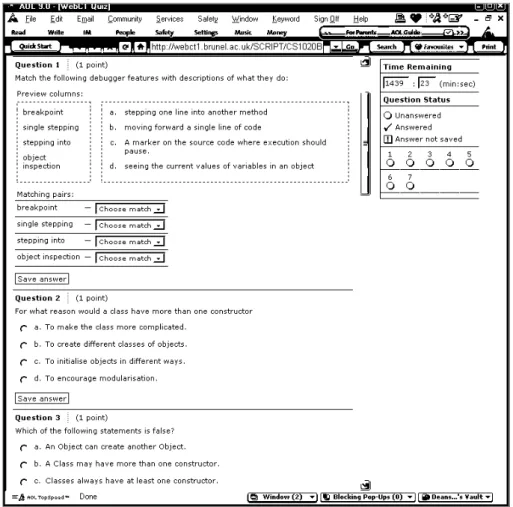
taught in that week to undertake during that week’s lab session. There are 22 lab sessions in the course. When appropriate, we made tests related to these labs. Students were asked to un-dertake the corresponding lab test upon the com-pletion of lab exercises(see Figure 8). Each test
was only made available for two weeks. Sixteen of these tests identified at the beginning of the course are used for the assessment. Lab tests contribute 25% of the overall mark.
We kept one coursework programming assign-ment contributing another 25% to overall mark. But, instead of giving a highly specified prob-lem for students to program as in previous years, this year we gave our students the opportunity to develop their own specification of a very general
problem(a text game)and then to implement it.
The examination is a combination of multiple choice questions(maximum grade for this part
is B) and problem solving questions to which
students will be expected to provide their own answers(this part can get them to A grade
pro-vided that they already scored B on the multiple choice part).
5. WEBL Working
The teaching team consists of five academics, one of whom is the course leader, and ten are teaching assistants. The course leader is re-sponsible for the course organisation and mana-gement. A course organisation involves:
Planning the course well ahead for each aca-demic session;
Clear division of duties and allocation of re-sponsibilities;
Regular weekly meeting of the whole teach-ing team so that any problems can be acted upon and to provide a consistent approach by all team members;
Coordination of activities.
There was considerable effort put into migrat-ing to WebCT, but that effort is already prov-ing worth while. The number of emails sent to tutors has dropped with students using the discussion forum to post their questions, cries for help, etc. Now there is a lively community of students helping each other and engaging in constructive dialogue about the programming problems.
With the on-line assessment of lab tests students are attempting, almost all of them, which in its turn requires students to be up to date with the material taught. However, unexpectedly, turn up for the lab sessions has not been high. On investigation, the main reasons for that are as follows:
programming concepts are taught in the lec-tures and we are using the textbooks; majority of students have their own PCs; lab exercises are published on WebCT and can be accessed from any Internet access point;
BlueJ is free, so is Java compiler;
lab tests are available for two weeks and are on WebCT so can be accessed through Inter-net.
So students are doing work, as indicated by the high number of students attempting each lab test. Thus we have succeeded in encouraging them to keep up to date with the course.
We observed during lab sessions that students have less problems understanding the difference between classes and objects. Also, compared to previous years, they are much more inclined to solve problems by designing classes. So far, there have been no complaints concerning lack of support or the transparency of the process.
6. Conclusion
This paper describes WEBL a unique approach combining the strength of BlueJ and WebCT to facilitate constant students’ progress learning object-oriented principles with BlueJ.
Early indications are encouraging both in terms of the quality of students’ discussion and in the test results. The main achievement up to date is an unusually high level of students’ involve-ment and their sense of belonging to a commu-nity willing to help each other. For the teachers, teaching programming has become pleasurable with students keeping up to date and, as far as we can tell, learning subject.
References
1] BALDWIN, L.ANDKULJIS, J., Visualisation
Tech-niques for Learning and Teaching Programming, Journal of Computing and Information Technology, 2000.8(4): pp. 285–291.
2] BARNES, D. J.ANDKOLLING, M.,Objects First with
Java. A Practical Introduction Using BlueJ, Harlow: Pearson, 2003.
3] BlueJ,http://www.bluej.org.
4] HONG, J., The Use of Java as an Introductory
Programming Language, ACM Crossroads Stu-dent Magazine, The ACM’s Electronic Publication, 1998(4.4),www.acm.org/crossroads/
xrds4-4/introjava.html.
5] HORTSMANN, C., Computing Concepts with Java
Essentials, New York: Wiley, 1998.
6] HORTSMANN, C.,Big Java, New York: Wiley, 2002.
7] WebCT,http://www.webct.com.
Received:June, 2004
Accepted:June, 2004
Contact address:
Jasna Kuljis The VIVID Research Centre Department of Information Systems and Computing Brunel University West London Middlesex, UB8 3PH, UK Phone:+44 1895 203 081
e-mail:[email protected]
JASNAKULJISis a Reader in the Department of Information Systems and Computing at Brunel University. She gained her Dipl.Ing. degree in theoretical mathematics from the University of Zagreb, Croatia. She gained her M.S. in information science from the University of Pitts-burgh, USA, and the Ph.D. in information systems from the London School of Economics, University of London. Her current research is in human computer interfaces. She is mostly interested in the design of graphical user inter aces and in the development of new paradigms that would further enhance the usability of interactive computer systems. She is Director of the VIVID Research Centre at Brunel University. Dr. Kuljis’ email and web addresses [email protected]