VOLUME 16 ISSUE 2 (2018), Page 266 - 274
HOUSING FOR DISABLED PEOPLE: WHAT DO THEY NEED?
Syakir Amir Ab Rahman1, Nasriah Samsudin2, Mariana Mohamed
Osman3, Syahriah Bachok4, & Noor Suzilawati Rabe5
1,2,3,4,5Kulliyyah of Architecture and Environmental Design
INTERNATIONAL ISLAMIC UNIVERSITY MALAYSIA
Abstract
Across the world, people with disabilities, advocacy companies, key non-authorities and government stakeholders are trying to find approaches to enhance housing assist preparations for the disabled people. In order to do so, the housing industry should be more adaptive to meet the demand of the people with special needs. The government also needs to plan for suitable housing policies for all groups of people. Housing is the central focus for human being including the disabled people and houses that follow housing standard for the disabled will improve their quality of life. The objective of this paper is to study the preferences in terms of price, location and design factors in owning a residential property among the disabled community in Kuala Lumpur and Selangor. A survey questionnaires was distributed to 400 respondents of the disabled community. The survey focused on two categories of disability, which are the physical disability and visual impairment. The outcome of this study describes the preferences in owning a residential property in term of price, location and design of the property. Recommendation was then made on housing strategy in planning for the price, location and design of residential property for the disabled community in Kuala Lumpur and Selangor.
INTRODUCTION
Home ownership or the ability to own residential property has been a goal for every Malaysian including the disabled communities. According to Coates, Anand and Norris (2015), owning a residential property provides a sense of security which leads to happiness, productive and fulfilling of one’s life. Each person in this world deserves to have a proper living place regardless of their physical disabilities. Therefore, it is important to have some standards of housing that fulfill the needs of disabled people.
El Gibbs (2016) states that the disabled people like any other human beings need affordable and accessible house, safe and secure house, and a house close to services and job opportunities. El Gibbs (2016) also asserts that the disabled people need a place to dwell, a place to call home, a place to entertain guests, a place to spend time with the people they love, and a place to feel safe and secure.
PEOPLE WITH DISABILITY
Persons with Disabilities Act 2008 (Act 685) (Malaysia) defines a person with disabilities (PwDs) as those who have long-term physical, mental, intellectual or sensory impairments which in interaction with various barriers may hinder their full and effective participation in society. The Act also specifies seven categories of PwDs which are visually impaired, hearing impaired, lack of physical effort, learning issue, speech disabilities, mental disabilities and less effort wide.
DISABLED COMMUNITY IN MALAYSIA
There are 356,677 PwDs registered in Malaysia as of 2015 (JKM, 2016a). However, as the registration is voluntary, the statistics is not completely reflective of the actual numbers in the country.
Table 1: Registration of person with disabilities (PwDs), 2013 -2015
Year Number of cases
2013 264,448
2014 318,132
2015 365,677
Source: JKM (2016a)
Table 2: Registration of Person with Disabilities (PwDs) by State, 2015
States Number of cases
Johor 45,953
Kedah 32,983
Kelantan 25,947
Melaka 18,391
Negeri Sembilan 17,273
Pahang 21,946
Perak 33,020
Perlis 4,404
Pulau Pinang 22,094
Sabah 22,806
Sarawak 25,037
Selangor 55,594
Terengganu 18,281
W.P Kuala Lumpur 20,911
W.P. Labuan 1,037
Total 365,677
Source: Source: JKM (2016a)
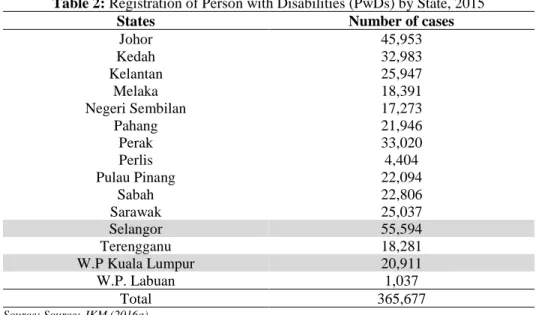
Table 2 shows the number of registered disabled community in Malaysia by states. Selangor has the highest registered number of PwDs (55,594) while Kuala Lumpur has 20,911 registered PwDs.
HOUSING PRICE FOR THE DISABLED
The price of purchasing a house is an important matter for everyone regardless their abilities. Price of the house also relates to the access to the loan. Credit facilities or finance can be a factor in encouraging and discouraging in addition to offering a property land (Wurtzebach, Cannon, & Miles, 1995). Currently, the personal loan for buying a house is only provided for the normal people and there is no special loan provided for the disabled people to buy a house.
LOCATION OF HOUSE FOR THE DISABLED
The location factor plays an important role in influencing the property market of residential land. Strategic location with good features, equipped with infrastructure of modern and comfortable living quarters are attractive to the buyers. Another important feature include a location that is closely linked to the development of environment, accessibility and infrastructure facilities.
iii. Have scenic views;
iv. Near to entertainment and shopping area; and
v. Near to public transport routes.
DESIGN OF HOUSE FOR THE DISABLED
Universal homes incorporate universal design principles, resulting in a living environment that can, with little difficulty and expense, be adapted to virtually any user’s long-term comfort, safety and ease. Among the characteristics of the barrier-free adaptable housing are:
i. It allows free access to buildings, housing units and services for people
with mobility, hearing or vision limitations;
ii. It provides adequate turning and working space for wheelchairs in housing units and public spaces;
iii. It improves the safety for people to be engaged in normal daily activities; iv. It provides features that increase safety in emergencies; and
v.
It provides features that make it easier to use and maintain the building, dwelling units and equipment.METHODOLOGY
Data was obtained thrugh questionnaire survey. Sample was selected using purposive sampling. The survey focuses on two categories of disabilities which are physically and visually impaired. This selection was due to the reason that about 90% of the worlds’ visually impaired live in low-income settings (Krahn, 2011). Additionally, 28% of 25-to-64-year-olds with severe physical disabilities fall far below the federal poverty line - nearly four times the rate for people of the same age who are not disabled (Reed Karaim, 2002). The questionnaires were distributed to 400 respondents from various organization of physical and visual impaired people in Kuala Lumpur and Selangor.
FINDINGS AND ANALYSIS
House ownership
Figure 1: Percentage of home ownership
Source: Questionnaire survey, January- April 2017
Price Factor
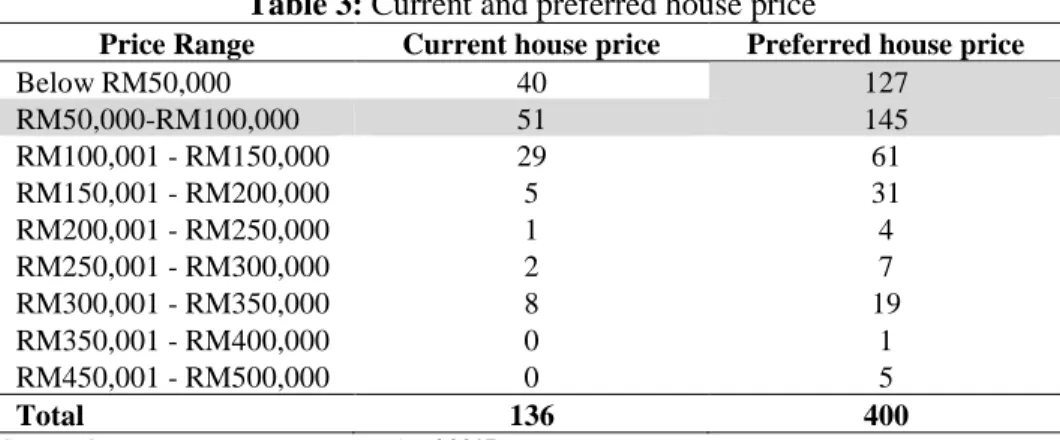
The purpose of knowing the current house price and preferred house price is to examine what is the current range of housing price that the disabled people have purchased and what is the actual range of housing price that they can afford or preferred based on their income.
Table 3: Current and preferred house price
Price Range Current house price Preferred house price
Below RM50,000 40 127
RM50,000-RM100,000 51 145
RM100,001 - RM150,000 29 61
RM150,001 - RM200,000 5 31
RM200,001 - RM250,000 1 4
RM250,001 - RM300,000 2 7
RM300,001 - RM350,000 8 19
RM350,001 - RM400,000 0 1
RM450,001 - RM500,000 0 5
Total 136 400
Source: Questionnaire survey, January- April 2017
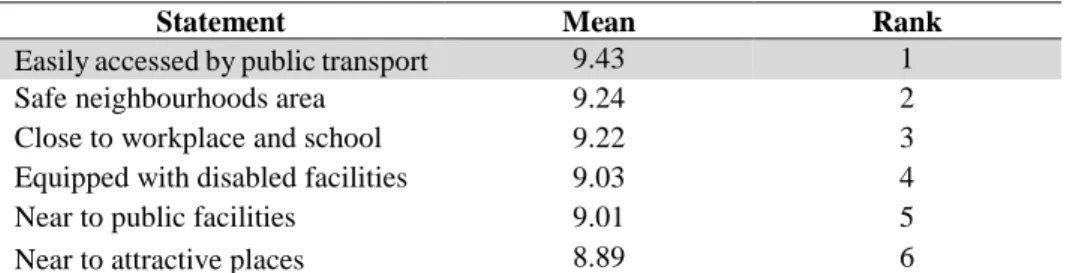
9.43.However, referring to Table 5, the current satisfaction on the location of a house that is easily accessed by public transport was ranked at number 4. This result shows that the current location of house for disabled people are not meeting with the demand.
Table 4: Preferred house location
Statement Mean Rank
Easily accessed by public transport 9.43 1
Safe neighbourhoods area 9.24 2
Close to workplace and school 9.22 3
Equipped with disabled facilities 9.03 4
Near to public facilities 9.01 5
Near to attractive places 8.89 6
Source: Questionnaire survey, January- April 2017
Table 5: Current satisfaction/condition for houselocation
Statement Mean Rank
Near to attractive places 7.26 1
Safe neighbourhoods area 7.25 2
Near to public facilities 7.11 3
Easily accessed by public transport 6.88 4
Close to work place and school 6.58 5
Equipped with disabled facilities 6.35 6
Source: Questionnaire survey, January- April 2017
Design Factor
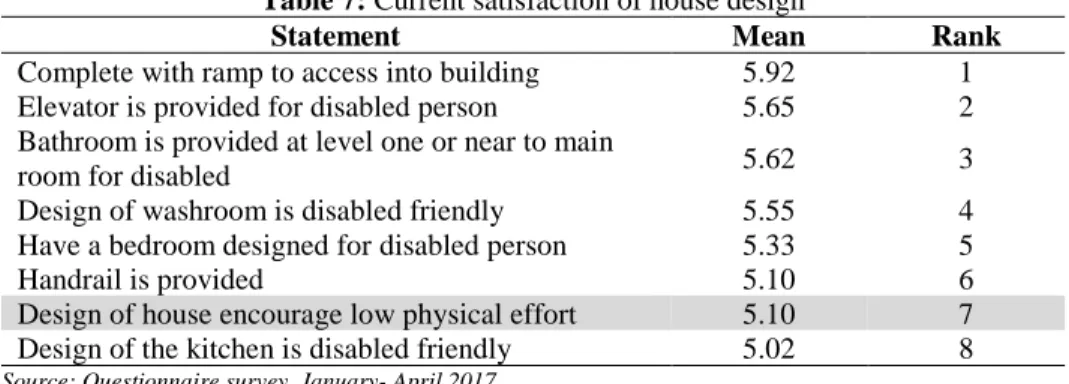
Table 6 shows that the respondents preferred a house that is designed to accommodate physical limitations or encourage low physical effort. However, based on Table 7, the design of house that encourages low physical effort was ranked at seventh place. These show that the current house design does not meet the needs and the demand of disabled people.
Table 6: Preferred house design
Statement Mean Rank
Design of house encourage low physical effort 8.94 1
Elevator is provided for disabled person 8.91 2
Design of washroom is disabled friendly 8.78 3
Complete with ramp to access into building 8.58 4
Handrail is provided 8.55 5
Bathroom is provided at level one or near to main
room for disabled 8.51 6
Design of the kitchen is disabled friendly 8.46 7
Have a bedroom designed for disabled person 8.44 8
Table 7: Current satisfaction of house design
Statement Mean Rank
Complete with ramp to access into building 5.92 1
Elevator is provided for disabled person 5.65 2
Bathroom is provided at level one or near to main
room for disabled 5.62 3
Design of washroom is disabled friendly 5.55 4
Have a bedroom designed for disabled person 5.33 5
Handrail is provided 5.10 6
Design of house encourage low physical effort 5.10 7
Design of the kitchen is disabled friendly 5.02 8
Source: Questionnaire survey, January- April 2017
RECOMMENDATION AND CONCLUSION
Most of the disabled people could not afford to own a house due to the high prices that are mismatched with their income. Therefore, two recommendations are suggested to resolve this issue.
i. Provide ‘Rent to Own Housing Program’.
Federal and state government with related housing agencies should offer and conduct ‘Rent to Own Housing Program’, where the disabled can have the opportunity to rent selected houses under low-cost housing scheme in Malaysia, for a certain period of time such as five to ten years. Later, if the disabled people have a good record of monthly rental payment and fulfill other requirements, the particular house will automatically be their house.
ii. Provide ‘Help to Buy: Shared Ownership’ scheme.
This scheme is proposed for disabled people that could not afford to buy the house on their own. It is suggested that the ownership of the house will be shared between the disabled people and local authority.
This proposal is one of the initiatives in giving a chance for the disabled people to own a house. It is suggested that this program will involve between two parties, the applicant (the disabled people) and local authority. The applicant may buy a share of the house (between 25% and 75% of the house’s value) and pay rent on the remaining share. In time, they could buy bigger shares until the house’s share 100% belong to them.
the local authority will have the right to take the house back and sell to the other potential applicant.
Another finding was the current satisfaction or situation on housing design does not meet the preferences of the disabled people. Therefore, another two recommendations are suggested to resolve this issue.
i. Provide at least the minimum elements of universal design in all housing
unit.
Universal design elements are not only designated for the disabled people, but also for the aging population. Therefore, there is a need for each housing unit in the upcoming housing projects to implement at least the minimum requirement or elements of universal design. The government needs to make this requirement as compulsory to all housing developers and efficiently implement the enforcement. It is to suggest that in specific, the house should at least have unobstructed width of doors with minimum width of 850mm, 900mm or more, provide ramp to access into the house and have toilet that are complete with PwDs facilities such as the level one toilet, suitable toilet seat, foldable grab rail, independent water supply beside toilet seat and wash hand basin at suitable height for wheelchair user.
ii. Home modification scheme.
Every day, disabled individuals find that their homes need to be modified in a way that gives them easier access. These modifications make it possible for them to stay in their home and live an independent life. Home adjustments come in all shapes and sizes and can vary in cost from one manufacturer and contractor to another. The idea for this proposal is designated for the disabled people that already own a house but need some modification of the house to cater their needs. Among the types of home modifications that can be offered are:
a. Bathroom and toilets renovations to make them disabled
friendly;
b. Modification of kitchen to be user-friendly for disabled people; c. Installation of ramp, grab rails and handrails;
d. Widening of the doorways; and
e. Other modification needed by the disabled people.
the house for the disabled have been highlighted. Therefore, it is essential for the related government or housing agencies to learn further from success and failures of other countries to improve the need for the disabled communities by providing related housing policies for the disabled.
REFERENCES
Coates, D., Anand, P., & Norris, M. (2015). Housing, happiness and capabilities: A summary of the international evidence and models. Open Discussion Papers in Economics, 81.
El Gibbs (2016). Why the ‘problem’ of housing for people with disability is one for everyone. Retrieved from https://croakey.org/cripcroakey-why-the-problem-of-housing-for-people-with-disability-is-one-for-everyone/
JKM (2016) Statistic of registered disabled community in Malaysia.
Karaim, R. (2002). People with physical disabilities. The United States of America. Krahn, G. L. (2011). WHO world report on disability: A review. Disability and Health
Journal, 4, 141-142.
Persons with Disabilities Act 2008 (Act 685) (Malaysia).
Weintraub, E. (2017). What location, location, location means in real estate. Retrieved from https://www.thebalance.com/what-location-means-in-real-estate-1798766.