310
The Dynamic of Main Indices of Spermiogram at Boars, in
Function on Some Factors of Influence
Gherasim Nacu, Constantin Pascal, Gabriel Hoha, Mihaela Ivancia
Faculty of Animal Husbandry 8, Iasi, 700490, Mihail Sadoveanu Alley, Romania
Abstract
Breeding boars used for semen production. This is conditioned by many factors. The research aim was to assess the some indices of spermogram (volume, mobility, concentration, total sperm / ejaculate) at 21 boars, the breeds Large White, Landrace, Duroc and Pietrain in relation with some factors of influence: the race, age, individual and harvesting season. The age of boars was between 8 months and 30 months. The rhythm of harvesting was following: one harvesting followed by the five days break. Depending on the breed, were differences for volume (183,5± 4,88 ml at Pietrain boars and 256±5,3 ml at Landrace boars) and for concentration (309,7±6,0 millions/ml at Duroc boars and 430,7±9,3 millions/ml at Pietrain boars). In function on the season, semen volume varied insignificant between summer (minimum values: 188.4 ± 5.6 ml) and winter (maximum values: 222.1 ± 6.6 ml). The spermatozoon concentration was insignificantly influenced by the season (371.6 ± 11.7 million/ml - summer; 399.4 ± 12.6 million/ ml – autumn). The greatest differences for all indices of semen analysis were in function on individual. The results show that the indices analyzed are strongly influenced by internal environmental factors (breed, individual) and are less conditioned by environmental factors such as the season.
Keywords: boars, factors of influence, indices of spermiogram.
1. Introduction
Preparation the spermiogram of boars is a prerequisite to the efficient organization of breeding activity. Knowing the level of sperm indices help determine the number of breeders in a unit and enables the exploitation of their on scientific principles. The spermatic value index is in continuous dynamics in relation to the some external environmental factors (nutrition, microclimate, harvesting frequency, system maintenance etc.) and genetic factors: race, age, line, individuality.
2. Materials and methods
The biological material was represented by 21 boars of Large White breeds, Duroc, Landrace and Pietrain. Observations were made from the age of
* Corresponding author: Gherasim Nacu, email: [email protected]
8 months and up to 30 months old. Boars were kept in individual pens with an aria of 6 m2. Each harvest was followed by five days’ rest. Semen collection was done by manual method. The main sperm indices were analyzed: volume of ejaculate, the semen concentration in spermatozoids, the mobility and the total number of spermatozoids/ ejaculate.
Ejaculate volume was estimated directly in the collector cup; concentration was determined using the photo-densitometer (Spermacue) and regularly with the hem-cytometer; mobility was determined with the optical microscope with phase contrast and represent the proportion of spermatozoa with adequate motion. Semen dilution was made with a synthetic diluter and has provided 3.5 billion mobile spermatozoa per dose.
3. Results and discussion
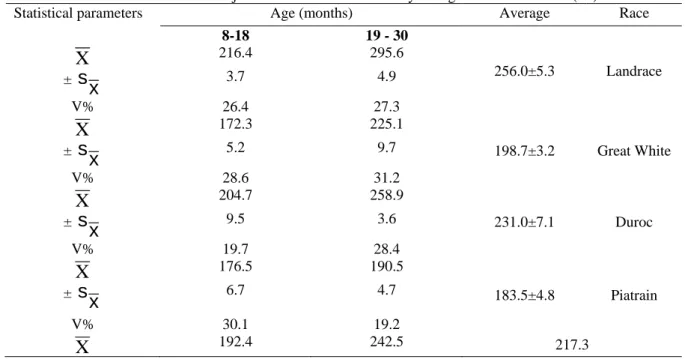
311 significantly higher at Landrace boars: 256 ± 5.3 ml. At the boars of other breeds were registered intermediate values: 198,7±3.2 ml at Great White and 231,5±7,1 ml at Duroc (table 1).
These values are similar to those cited in the specialty literature, for most breeds of swine [1, 2, 3]. In all races there was an upward curve of the entry into service until age 30 months, which proves that the functioning of glands is highest
during in this period. The average ejaculate volume calculated until the age of 18 months was 192.4 ml and slightly higher at the boars of 9-30 months category (242.5 ml) (table 1). The biggest difference between young and adult boars was found in Landrace breed (79.2 ml), and the smallest, at the breed Duroc (16.0 ml).
Table 1. The ejaculate volume in function by the age and race of boars (ml)
Statistical parameters Age (months) Average Race
8-18 19 - 30
256.0±5.3 Landrace
X
216.4 295.6±
x
s
3.7 4.9V% 26.4 27.3
X
172.3 225.1198.7±3.2 Great White ±
x
s
5.2 9.7V% 28.6 31.2
X
204.7 258.9231.0±7.1 Duroc ±
x
s
9.5 3.6V% 19.7 28.4
X
176.5 190.5183.5±4.8 Piatrain ±
x
s
6.7 4.7V% 30.1 19.2
X
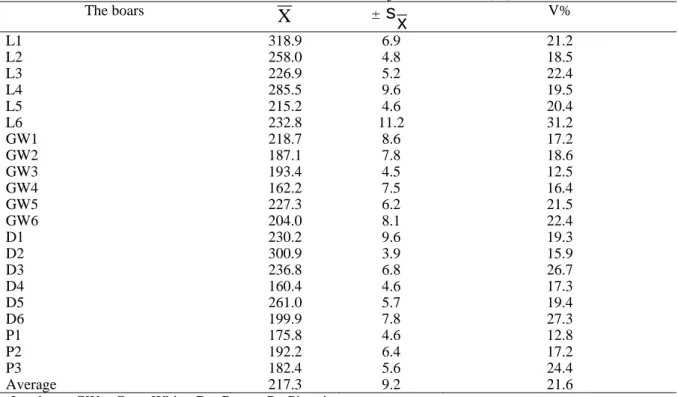
192.4 242.5 217.3The ejaculate volume was significantly influenced by individuality at the boars of the all breeds (table 2). The limits have fluctuated between 160.4± 4.6 ml and 318.9 ± 6.9 ml.
Seasonal analysis of sperm count showed slightly lower values in summer (188.4±8.4 ml), compared with other times of the year in which this indicator has fluctuated between 222.1±9.7 ml in the autumn and 230.1±11.2 ml in the winter (table 3). The average semen concentration in spermatozoon was 366.7±10.2x10⁶ spermatozoon/ml, with significantly differences between Duroc breed (309.7±6.0 mil. gametes/ml), Pietrain (430,7±9,3 mil. gametes/ml) and other races (table 4). For this indicator values are higher than those commonly cited by the specific references (150 – 250x106 spermatozoids/ml) [1, 2, 4, 5]. Values comparable to those found by us were recently communicated for Pietrain boars [6,7].
Regarding the evolution of concentration in relation to age of boars are found the levels close during the evaluation, lower in early breeding
312
Table 2 The individual variation of ejaculate volume (ml)
The boars
X
±x
s
V%L1 318.9 6.9 21.2
L2 258.0 4.8 18.5
L3 226.9 5.2 22.4
L4 285.5 9.6 19.5
L5 215.2 4.6 20.4
L6 232.8 11.2 31.2
GW1 218.7 8.6 17.2
GW2 187.1 7.8 18.6
GW3 193.4 4.5 12.5
GW4 162.2 7.5 16.4
GW5 227.3 6.2 21.5
GW6 204.0 8.1 22.4
D1 230.2 9.6 19.3
D2 300.9 3.9 15.9
D3 236.8 6.8 26.7
D4 160.4 4.6 17.3
D5 261.0 5.7 19.4
D6 199.9 7.8 27.3
P1 175.8 4.6 12.8
P2 192.2 6.4 17.2
P3 182.4 5.6 24.4
Average 217.3 9.2 21.6
L – Landrace; GW – Great White; D – Duroc; P - Pietrain
Table 3. The seasonal dynamic of ejaculate volume (ml)
Statistical parameters Season Average
Winter Spring Summer Autumn
X
230.1 227.0 188.4 222.1 217.3±
x
s
11.2 9.7 8.4 5.9 11.2V% 19.5 31.2 25.7 22.5 22.6
Table 4. The semen concentration in spermatozoon in function by the age and race (mill./ml) Statistical
parameters
Age (months) Average Race
8-18 19 - 30
X
356.4 386.2371.7±9.2 Landrace ±
x
s
7.8 7.1V% 21.0 23.5
X
348.6 361.8355.2±5.1 Great White
±
x
s
7.2 5.9V% 28.4 26.2
X
282.3 337.1309.7±6.0 Duroc
±
s
x
11.2 7.8V% 19.6 32.4
X
418.5 442.9430.7±9.3 Pietrain ±
x
s
9.4 7.3V% 25.7 28.8
X
351.4 382.0 366.7±
x
s
11.2 9.6 9.8313 The individual values of semen concentration in spermatozoon ranged between 256.0±7.4 mill./ml
and 459.3±5.6 mill./ml. (table 5).
Table 5 The individual variation of semen concentration in spermatozoon (mill./ml)
The boars
X
±x
s
V%L1 341.6 9.3 21.4
L2 256.0 7.4 30.2
L3 459.3 5.6 25.8
L4 400.1 5.1 19.9
L5 444.6 8.4 17.6
L6 368.9 6.5 25.4
GW1 310.3 8.7 27.9
GW2 428.0 7.3 18.2
GW3 379.3 4.2 19.8
GW4 378.9 11.3 16.6
GW5 341.8 10.2 30.1
GW6 320.3 4.8 26.3
D1 319.4 9.7 29.8
D2 292.8 6.4 31.1
D3 319.5 2.6 27.6
D4 294.0 11.4 26.1
D5 305.5 8.9 17.5
D6 347.4 9.5 19.6
P1 427.1 3.8 20.1
P2 456.2 7.9 1.2
P3 407.7 6.8 26.8
Average 366.7 8.3 38.4
L – Landrace; GW – Great White; D – Duroc; P - Pietrain
The action of high temperatures in summer season on spermatogenesis caused significant decrease in the number of gametes / ml. Concentration values fell to 57.8 million sperm / ml compared to peak
in autumn (table 6). Taking account of these oscillations is necessary to evaluate each ejaculate in part to avoid a concentration of lower doses of sperm that may compromise the fertility of sows [5].
Table 6. The seasonal variation of semen concentration in spermatozoons (mill./ml)
Statistical parameters Season Average
Winter Spring Summer Autumn
X
369.9 355.9 341.6±7 399.4 366.7±
x
s
9.2 10.4 11.1 12.6 10.2V% 22.2 24.7 19.9 26.2 27.3
The motility was between 75.6% and 80.2% without significant differences in function by the race, age, boars, individual or harvesting season. The total number of spermatozoids / ejaculate was close at the races studied, with insignificantly differences between them (table 7). For all races, young boars concentration was lower than in the adults. The biggest differences between the two age groups were the Landrace breed.
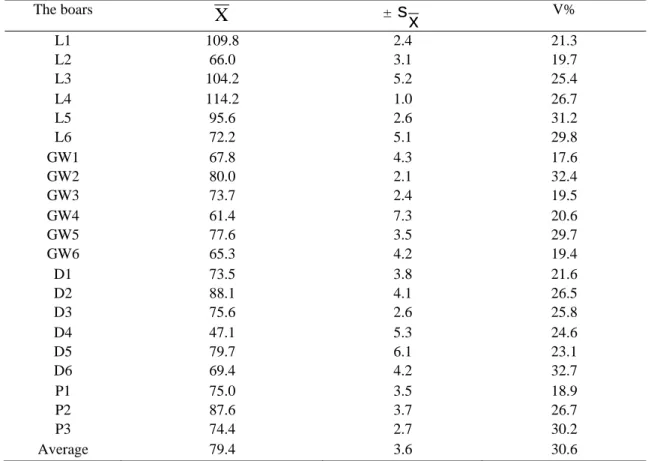
In function by OF individual, total sperm / ejaculate varied greatly. The limit values was: 47.1 bill. and 114.2 bill. (table 8). These values
314
Table 7. The average number of the spermatozoon/ejaculate, in function on the race and age (billions) Statistical
parameters
Age (months)
Average Race
8-18 19 - 30
X
77.2 114.295.6±4.2 Landrace ±
x
s
2.1 5.3V% 22.4 28.3
X
60.0 81.470.7±3.4 Great White
±
x
s
2.8 3.4V% 19.6 21.5
X
57.7 87.272.4±6.8 Duroc ±
x
s
3.6 2.1V% 25.1 20.4
X
73.8 84.279.0±4.5 Pietrain ±
x
s
2.5 3.5V% 20.4 19.5
X
67.9 92.6 79.4±
x
s
3.3 5.1 5.1V% 26.5 21.4 18.6
Table 8. The individual dynamics of spermatozoons number/ejaculate (billions)
The boars
X
±x
s
V%L1 109.8 2.4 21.3
L2 66.0 3.1 19.7
L3 104.2 5.2 25.4
L4 114.2 1.0 26.7
L5 95.6 2.6 31.2
L6 72.2 5.1 29.8
GW1 67.8 4.3 17.6
GW2 80.0 2.1 32.4
GW3 73.7 2.4 19.5
GW4 61.4 7.3 20.6
GW5 77.6 3.5 29.7
GW6 65.3 4.2 19.4
D1 73.5 3.8 21.6
D2 88.1 4.1 26.5
D3 75.6 2.6 25.8
D4 47.1 5.3 24.6
D5 79.7 6.1 23.1
D6 69.4 4.2 32.7
P1 75.0 3.5 18.9
P2 87.6 3.7 26.7
P3 74.4 2.7 30.2
Average 79.4 3.6 30.6
L – Landrace; MA – Great White; D – Duroc; P - Pietrain
Because the warm season caused the reduced of volume and spermatozoids concentration. in this
315
Table 9 The dynamic of spermatozoids number/ejaculate (billions) Statistical
parameters
Season Average Winter Spring Summer Autumn
X
85.1 80.7 64.3 88.7 79.5±
x
s
3.2 1.7 2.8 6.5 4.8V% 23.4 18.2 20.6 31.2 29.5
4. Conclusions
The semen volume and sperm concentration are higher in comparison with the values cited in the literature for exploit breeds and hybrids in Romania. This production on the sperm ensures the obtaining, on average, 18 doses / ejaculate. The factors environmental internal such as the race, age and individuality more influences the volume and sperm concentration and less the mobility.
The values of the spermogram indices were lower in summer, heat stress having a negative effect on spermatogenesis.
References
1. Bogdan, A.T., Mantea, St., Bogdan, D., Tratat de reproductie si însamântari artificiale la suine, Edit. Tehnica Agricola, Bucuresti, 1999
2. Dinu, I., Influenta mediului asupra productiei la porcine, Edit. Ceres, Bucuresti, 1978
3.Tapaloaga D., Cercetari de micromorfometrie computerizata asupra spermatozoizilor de la vier. Teza de doctorat, USAMV, Bucuresti, 2004
4. Feredean, T., Contributii la studiul factorilor care influenteaza fertilitatea suinelor în conditiile însamântarii artificiale, Teza doctorat, I. A. Bucuresti, 1972
5.Tanase, D., Cercetari asupra influentei unor factori stresanti din combinatele de porci asupra fertilitatii scroafelor, Teza doctorat, Instit. Agr. Iasi, 1981
6. Kunc, J., Mrkun, J., Kosec, M., Study of reproduction ability in boars, Animal Breeding Abstract, 2002, 69, 5, 465