Ayanore et al
Context-specific Factors and Contraceptive Use
African Journal of Reproductive Health June 2017; 21(2):
81
ORIGINAL RESEARCH ARTICLE
Context-specific Factors and Contraceptive Use: A Mixed Method
Study among Women, Men and Health Providers in a Rural
Ghanaian District
Martin Amogre Ayanore
1, 2, 4
, Milena Pavlova
2, Wim Groot
2, 3Department of Family and Community Health, School of Public Health, University of Health and Allied Sciences, Hohoe, Ghana1; Department of Health Services Research, CAPHRI, Maastricht University Medical Centre, Faculty of Health, Medicine and Life Sciences, Maastricht University, The Netherlands2; Top Institute Evidence-Based Education Research (TIER); Maastricht University; Maastricht, The Netherlands3; Centre for Health Policy Advocacy, Innovation & Research in Africa (CHPAIR-Africa), Accra, Ghana4
For Correspondence: Email: [email protected]
Abstract
Suitable options for improving women‘s access to effective, safe and context-specific contraceptive methods must be explored to curtail rising unmet needs for contraceptive use in rural Ghana. The study aimed to outline context-specific factors associated with contraceptive use, access on demand and future use intentions among women in one district of Ghana. Using mixed method approach, quantitative data (n=720) was collected among women aged 18-28. Focus group discussions and in-depth interviews were also conducted among women (n=30) aged 18-49 and men (n=10) respectively. IDIs were conducted among 3 midwives. Women who received focused counseling on contraceptive use were twice likely to have ever used (OR=2 95% CI 1.163-3.467) or be current users (OR=2, 95% CI 1.146-4.010) of contraceptives. Male partner support can drive cultural sensitivities towards accepting use of contraception (OR=34.5, CI% 19.01-64.22). Covert use is still preferred by most in the study. Services delivered on good provider-relational grounds and convenient clinic hours encourage contraceptive use among women. Male targeting for improving contraceptive service use must first identify context-specific preferences of the woman, since covert use is highly valued. Ascertaining the prevalence of covert use and how community systems can address this for improved contraceptive uptake is further recommended. (Afr J Reprod Health 2017; 21[2]: 81-95).
Keywords: context-specific factors, contraceptive use, access on demand, future contraceptive use, rural Ghana
Résumé
Des options appropriées pour améliorer l'accès des femmes à des méthodes contraceptives efficaces, sûres et spécifiques au contexte doivent être explorées pour réduire les besoins non satisfaits de l‘utilisation des contraceptifs au Ghana rural. L'étude visait à décrire les facteurs contextuels associés à l'utilisation de contraceptifs, l'accès sur demande et les intentions d'utilisation future chez les femmes d'un district du Ghana. En utilisant une approche par méthode mixte, des données quantitatives (n = 720) ont été recueillies parmi les femmes âgées de 18 à 28 ans. Des discussions à groupes ciblés et des entretiens approfondis ont également été réalisés auprès des femmes (n = 30) âgées de 18 à 49 ans et les hommes (n = 10) respectivement. Les IDI ont été menées auprès de 3 sages-femmes. Les femmes qui ont reçu des conseils ciblés sur l'utilisation des contraceptifs ont été deux fois plus susceptibles d'avoir déjà utilisé (OR = 2 95% IC 1.163-3.467) ou être des utilisateurs actuels (OR = 2, 95% IC 1.146-4.010) des contraceptifs. Le soutien des partenaires masculins peut stimuler les sensibilités culturelles à l'acceptation de l'utilisation de la contraception (OR = 34,5, IC% 19.01-64.22). L'usage secret est encore préféré par la plupart dans l'étude. Les services fournis sur de bons motifs relationnels avec les fournisseurs et les heures de clinique appropriées encouragent l'utilisation de contraceptifs chez les femmes. Le ciblage masculin pour améliorer l'utilisation des services de contraception doit d'abord identifier les préférences spécifiques au contexte de la femme, car l'utilisation secrète est très appréciée. On recommande en outre de déterminer la prévalence de l'utilisation secrète et comment les systèmes communautaires peuvent répondre à cette question pour une meilleure prise en charge des contraceptifs. (Afr J Reprod Health 2017; 21[2]:81-95).
Ayanore et al
Context-specific Factors and Contraceptive Use
African Journal of Reproductive Health March 2017; 21 (1):
82
Introduction
Despite the increase in global contraceptive use, millions of women of reproductive age (15-49 years) have unmet needs for contraception1. Method related side effects, partner opposition for contraceptive use, financial constraints to access and poor provider-client counselling needs are often cited as barriers to contraceptive use2. User misinformation on contraceptive use and medical barriers also account for lower contraceptive uptake worldwide3-5. These barriers affecting women‘s choices for fertility needs are described as ―remarkably pervasive‖6
. Barriers affecting women‘s choices are also increasingly evidenced to affect women‘s ability to effectively regulate their reproductive choices in the short to long term6-8. Unintended pregnancies resulting from unplanned pregnancies are the consequences of poor contraceptive use in most developing countries9. Consequently, when faced with an unintended pregnancy, women may resort to an unsafe abortion if adequate safe abortion services are not available6,10,11.
In Ghana, unmet need levels for family planning stands at 29.9% in recent 2014 Demographic Health Survey (DHS) results12. Abortion in Ghana has been asserted to be widespread13 too, underpinning research findings that women contraceptive demands are not fully met among certain population groups14. Ineffective use for modern contraceptives is also reported among women in Ghana15-17. Evidence of trends for modern contraceptive uptake differentials between urban-rural areas is known12,18. An assessment of barriers and determinants for family planning uptake show context differences exist across and within regions. Religion, place of residence (rural/urban), educational status, age, parity and social economic status are among common predictors of family planning use in different settings. Many studies in Ghana have provided wide-range predictors and determinants of family planning use across several population groups 19-23. However, some studies in sub-Saharan Africa (SSA) show that different factors influence fertility and family planning interventions differently24-27. This underscores the need for identifying effective context family planning factors as an important step for improving acceptance and uptake of such services in many local contexts in Ghana. Across northern Ghana where this study was conducted, fertility studies on
the use, barriers, and influencing factors related to contraceptive use have largely relied on the DHS data. Other studies have focused on the use, socio-cultural determinants, and barriers for women contraceptive utilization28-31. While prevailing evidence on women‘s low or non-use of contraceptives exists widely in some districts of Ghana, limited knowledge of context drivers for contraceptive use exist in the Garu-Tempane district of Ghana. The district remains largely rural, and dominated by poor indices of low acceptance rates on contraceptive use compared with other districts across the region.
The study aims to explore context-specific factors associated with contraceptive use among women in the Garu-Tempane district of Ghana. Three main measures were investigated; current contraceptive use, access on demand for contraceptives, and future use intentions for contraceptive. The study was necessitated due to poor data on family planning practices and use in the district. It was also necessary to provide large scale baseline data to district health teams working to scale up free family planning services across the district. Understanding women‘s accounts and choices for contraceptive use could provide acumens for improved contraceptive uptake in the districts. Such evidence is needed to inform district, regional and national health planning programs for family planning interventions. Our study specifically contributes to literature by exhuming knowledge related to rural context-specific factors influencing contraceptive uptake. Characterized by a study setting typical in rural SSA, the study provides insights into rural context factors that need attention to accelerate progress for women contraceptive use in rural Ghana and in other rural settings in SSA.
Methods
Study setting and population
Ayanore et al
Context-specific Factors and Contraceptive Use
African Journal of Reproductive Health June 2017; 21(2):
83
fertility rate of 3.9, with an estimated general fertility rate of 106.2 births per 1000 women aged 15-49 years32. The district is inhabited by many tribes; Bimobas, Kusasis, and other minority tribes such as Busangas, Mamprusis and Fulanis. At the time of the study there were 24 functional health facilities zoned under 6 sub-districts managed by the district health administration. The 6 sub-district health zones served 194 communities. Earlier evidence in the district show that majority of girls have their first birth children before age 1833. The study population included young women (18-28 years), women of reproductive age (15-49 years), male spouses and midwives.
Data was collected between February and March 2012. All twenty four functional health facilities within the Garu-Tempane district at the time of the study were conveniently included. The health facilities included 6 health centres, 4 clinics, 12 Community Based Health Planning and Services (CHPS) centres and 2 privately health facilities. The Garu Township had a total of 8 health facilities while 17 of the other facilities were located in 17 different communities across the district jurisdiction. The study employed a mixed method design approach. Two main phases of data collection were simultaneously carried out: quantitative and qualitative. Mixed method studies allows for unearthing new insights on a complex problem under investigation, and also allow the researcher to address practice and policy issues from multiple view points34 The phases are subsequently described together with the methods of data analysis applied.
Quantitative phase
The quantitative part of the study took the form of a survey among young women aged 18-28. The sample size for the survey was determined using Kish35 formula for survey sampling for descriptive studies35. The required sample size was estimated to be 316 participants. To select the participants, maximum variation purposive sampling was applied where 30 eligible women seeking healthcare were sampled across all 24 functional health facilities selected for the study. A total of 720 survey questionnaires were administered in all 24 health facilities.
Survey participants were recruited while waiting in queues to consult health staff at one of the 24 health facilities. At each health facility, 30
young women were purposively selected as eligible participants. Women were eligible if they were mothers, within the age 18-28 and received family planning and reproductive health services within the last 6 months in any facility within the study settings. For women who could not recount their birth dates, their personal clinic records were assessed to ascertain this. The study purpose was described to each eligible participant. A verbal consent of the participant was requested. There were not refusals. Participants, who provided such consent, were invited to participate in the survey after they were attended to by the health staff. Women reported on a rolling basis to the research team after receiving health care services. The data collection at a given facility ended after the 30th participant was recruited. The survey questionnaire was pre-tested twice at the Garu health center to validate its appropriateness for data collection (face validity). Questionnaires were administered face-to-face with participants with the support of six research assistants recruited across the six zones in the district. Three languages; Kusal, Bimob and Bissa were adopted to be used in collecting survey data across all facility settings. Each research assistant had adequate knowledge of these three dominant languages for administering the questionnaires.
Ayanore et al
Context-specific Factors and Contraceptive Use
African Journal of Reproductive Health June 2017; 21(2):
84
significant associations between socio-demographic and health characteristics, and the three key measures in the study: contraceptive use access on demand, and future use intentions.
Qualitative phase
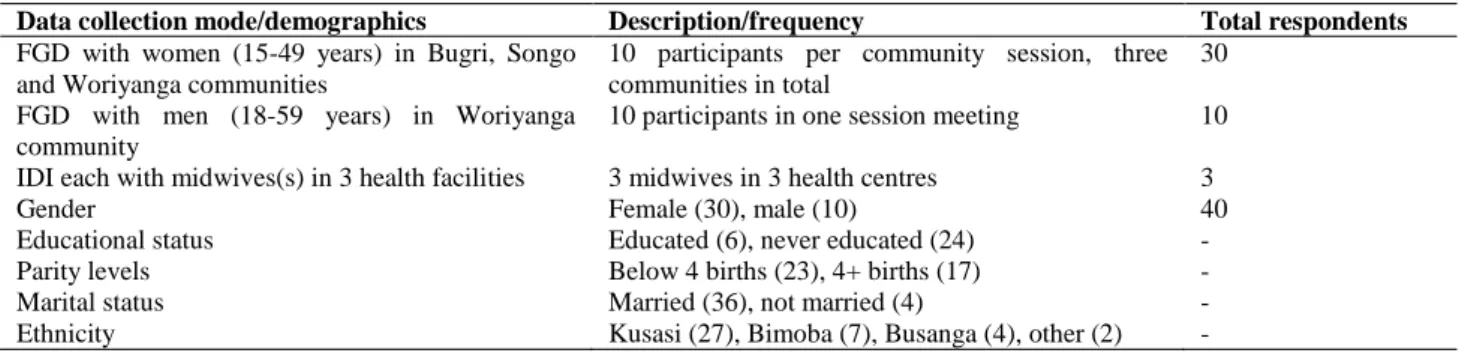
FGDs and IDIs were applied for the qualitative data collection. The FGDs were designed to engage additional women (n= 30) aged 15-49 and male spouses (n=10) on the study topic. IDIs were conducted among midwives (n=3) working in the 3 health sub-districts operating in communities women participants resided. Table 1 provides a profile of socio-demographics of study participants.
Three separate FGDs were held with women (n=10 at each community) aged 18-49 in three communities; Songo, Bugri and Woriyanga. Clinic staff at each community level assisted to select eligible women from functional mother-to-mother support groups for women FGDs. Mother-to-mother support groups are informal women groups existing with the study settings that aim to provide education and sensitization of family planning and child caring practices to young mothers. One FGDs with male spouses (n=10) was held in Woriyanga community. Men were included in the FGDs to also obtain a fair idea of their influence in the use of family planning services by women at the household level. Woriyanga community was purposively selected for the men FGDs because of its heterogeneous nature, and provided a possibility to engage diverse men from different ethnic and social tribes for the FGD. Purposive sampling was applied to select 3 midwives for IDIs. Two midwives were selected from Tempane zone while 1 midwife was from the Garu zone of the district. Midwives formed part of the study to provide health system and health provider insights of family planning services that were provided for women across the district.
FGDs guide for qualitative data collection for women were organized into three thematic areas; current and ever use experiences including decision making and contraceptive information received, support for contraceptive use, and women prioritization of factors accounting for use and non-use of contraceptives (see Table 2). Each discussion group was comprised of young mothers with the following characteristics; young mothers in school or out of school, widowed or divorced, never
married or married, current, and ever users of family planning.
FGDs guide for male spouses elicited views on contraceptive awareness, practices and support for contraceptive use among both educated and non-educated male spouses. Each FGD (men and women) lasted an average of one hour and was conducted in Kusal language, predominantly spoken across the three communities. IDIs with midwives elicited their views on women‘s preferred contraceptive choices, social hindrances and institutional challenges confronting the delivery of family planning services. The midwives were selected from Songo, Woriyanga, and Bugri health centers where women were earlier engaged for FGDs. IDIs took place at convenient clinic rooms that ensured less distraction and confrontation with patients visiting to seek care. IDIs were conducted in English. Midwives were included in the study to corroborate women and men context views on service provision across the two districts. Qualitative data from all IDIs were audio taped. FGDs were transcribed verbatim from the local languages to English. IDIs were transcribed directly into English. All transcribed data were coded and analyzed manually based on three themes; contraceptive use, access on demand and future contraceptive use applying content analysis. Final emergent quotes are then presented in tabulated boxes. The qualitative results provide further clarity of expressions and views expressed in quotes.
Ethical considerations
Study approval was provided by the University for Development Studies, Tamale Ghana Institutional review board. The Regional Health Directorate and the District Health Management Team (DHMT) provided approval for health facility visits and follow-ups in all 24 visited facilities. Research assistants assisted all participants to fill out a signed/thump print consent form. Participants who were literate provided signed consent while non-educated participants provided thump print consent. In addition, all participants provided verbal consent during participant recruitment for the study.
Results
Quantitative findings
Ayanore et al
Context-specific Factors and Contraceptive Use
African Journal of Reproductive Health June 2017; 21(2):
85
Table 1: Brief Profile of Qualitative Demographics in Study
Data collection mode/demographics Description/frequency Total respondents
FGD with women (15-49 years) in Bugri, Songo and Woriyanga communities
10 participants per community session, three communities in total
30
FGD with men (18-59 years) in Woriyanga community
10 participants in one session meeting 10
IDI each with midwives(s) in 3 health facilities 3 midwives in 3 health centres 3
Gender Female (30), male (10) 40
Educational status Educated (6), never educated (24) -
Parity levels Below 4 births (23), 4+ births (17) -
Marital status Married (36), not married (4) -
Ethnicity Kusasi (27), Bimoba (7), Busanga (4), other (2) -
Table 2: List of Main Questions included in the FGDs and IDI Guide.
Sample questions/probes
a. What is/are your experience(s) of accessing/using/providing contraceptives at your facility level? Probe on ;
1. Current and ever use levels and reasons accounting for these 2. User satisfaction, convenient clinic hours at facility level
3. Contraceptive information seeking behavior and impact on their use 4. Decision making regarding family and reproductive health needs 5. Did you consider information provided to you on use adequate
b. Does any support exist in assisting women meet their reproductive needs? Probe on;
6. Levels of partner support and engagement for contraceptive use? 7. Provider relational factors for use and non-use
8. Independent choices for reproductive services
9. How convenient are clinic opening hours for access, provision and use of family planning services (probe further on opening hours, on-demand service provision etc.)
c. What factors do you consider important as contributing to the use or non-use of contraception. Probe further on;
10. What is considered high priority and least priority?
11. What place cost and money has in influencing contraceptive uptake?
12. How these contributory factors play in their intention for future contraceptive use?
Majority of respondents (473 representing 65.7%) were within the age brackets of 26-28. More survey respondents were never educated and more likely to be married. Parity levels were high for births between 1 and 4 with majority of women in monogamous family unions.
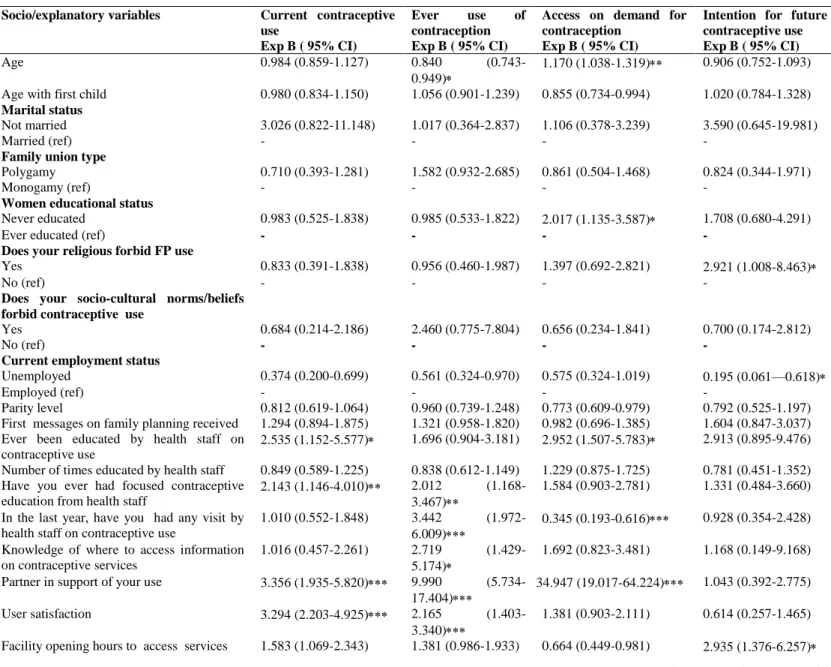
Table 4 provides further analysis of survey data using multinomial logistic regression. Women with male partner support, and those reporting satisfactory service use in the past where three times more likely to be current users of contraception. Women who received prior education and those with access to focused counseling on contraceptive use were twice likely to have ever used or be current users of contraceptives (OR=2, 95% CI 1.146-4.010) for current use and OR=2 95% CI 1.163-3.467) for ever use. Additionally, non-educated women were more likely to have access on demand with adequate prior counseling services. Current users with prior focused counseling had less intention to use contraceptives in the future. Socio-cultural norms and beliefs had a positive effect on young women who had ever used contraceptives.
Outreach community services such as home visits by health staff were associated with the likelihood of contraceptive use for ever users. Client user satisfaction, and young women adequate knowledge of where to access services, was associated with ever use of contraception. Age had no effect on current and ever use. Age was also evidenced not to have any association with women access on demand and intentions for future use.
Non-married women were more likely to use contraception compared to married women. Dominant religious beliefs were positively associated with previous user‘s discontinuation of use over time (see Table 4). Having access on demand for contraceptive use is associated positively with a strong male partner support (OR=34.5, 95% CI 19.01-64.22).
Ayanore et al
Context-specific Factors and Contraceptive Use
African Journal of Reproductive Health March 2017; 21 (1):
86
Table 3: Background Characteristics of Survey Respondents Interviewed
Socio-demographic variables Frequency (%) Age range
18-21 56 (7.8)
22-25 191 (26.5)
26-28 473 (65.7)
Languages
Kusal, Bimob & Bissa 3
Educational status
Ever Educated 209 (29.0)
Never educated 511 (71.0)
Marital status
Married 661 (91.8)
Not married 59 (8.2)
Family union of husband
Monogamy 460 (63.9)
Polygamy 260 (36.1)
Employment status
Unemployed 216 (30.0)
Employed 504 (70.0)
Parity levels 1-4 births 4+ births
679 (94.3) 41 (5.7)
contraceptives. Women who received prior contraceptive education were twice more likely to have the intention to use contraceptives in the future compared to those with contradictory and misinformed information. Women‘s intention for future use is also significantly associated with the ability to pay for service provision, although current associated cost was not significant for current and ever users. Convenient opening hours at facility level had a positive association with future contraceptive use among young women. Young women in communities with a strong affirmation for their religion and customary belief systems indicated this could possibly affect their future contraceptive use intentions. Non-married young women were three times more likely to express their intention for future use of contraceptives.
Qualitative findings
Ever and current contraceptive use
During the FGDs, few young women expressed concerns about their previous or current use of contraceptives. Often cited issues includes; poor health staff relational behaviors, commodity supply shortages, women‘s own inability to stick promptly to stipulated dates, and weak partner support toward their desires for meeting their reproductive needs. Mothers reported they had often been scolded and treated poorly by health facility staff. Accounts of women threatened by health providers to withhold
essential information and health care needs underscored some women expressions of healthcare consequences at facility levels.
Other women recounted that most scolding and inhuman treatment were suffered under young nurses who took advantage of their low literacy levels to humiliate them. Users of contraceptive services who spoke in unanimity intimated the relief contraceptive use has brought them and their children. Men were often referred to as obstacles and were never seen by women to have enabled them plan well for the next births. Most women did not hide their frustrations and their inability to meet their sexual needs through spacing or limiting. They indicated how their salient desires for contraception has been met through the covert use (see Box 1 quote 7). In separate FGDs with men to ascertain their roles in supporting their female spouses meet their reproductive needs, men appeared unevenly divided on their support levels.
Ayanore et al
Context-specific Factors and Contraceptive Use
African Journal of Reproductive Health March 2017; 21 (1):
87
Box 1: Expressions of Current and Ever Uses for Contraception
resistance and desire to do something concerning this as expressed by one man (see Box 1 quote 8). Despite these, IDIs separately with midwives revealed most women desired these services, despite their opposition. Women therefore prefer to visit clinic settings at their convenient times and when privacy could be guaranteed to access services. Young women who had also received focused counselling services where most likely to be empowered to overcome opposition at home as well as address side effects as users. Midwives argued that contraceptive misinformation was high among women. This is largely due to low educational standards among women, tending to affect current and intentions among women for future use.
Access on demand and future contraceptive
use intentions
Table 5presents interactive key emergent responses across two thematic areas: access on demand and future use intentions. Women asserted some male spouses unwillingness to engage and support them to plan their families, which made it difficult for them to disclose contraceptive use issues with their male spouses. Discussants however acknowledged that there are male spouses who support their wives to attend family planning clinics for contraception. Women could not provide definite responses when
askedif they wish to continue contraceptive use (see Table 5, w4).
They indicated continual contraceptive information and counseling by health staff, good relational issues with provider‘s, convenient clinic operational hours all year round, cost and opposition that do not threaten their marriages were weighted considerations for contraceptive use in the future. Women discussants identified other broader social related factors that affect their desire to benefit from contraceptive services. This included fear of side effects for current and ever users, lack of appropriate information for non-users and user financial constraints.
FGD and IDI discussions under two themes. Wn, mn, midn denote women, men, and midwives in the discussions. Superscript n denotes the number of view counts expressed by discussants.
Though many women group discussants asserted that direct financial payments at clinic service points was not a challenge, associated cost including transportation for those with difficult access to the facility level was a problem. FGDs with women and men showed most women had unmet reproductive health desires (Table 5, w1). When discussants where asked a direct question on whether they wished to limit or space their childbearing, women were observed to be disadvantaged since they could not be definite about their responses. Women ―I use to use family planning after the birth of my second child. After I gave birth, I have not been able to continue because of certain challenges. I cannot say because the nurses stopped coming here to educate and provide the services for us here again. The clinic is far and we cannot walk just..”. (focus group discussant at Bugri)-quote 1
“The young nurses sometimes speak anyhow to us because they feel we have never been to school. They are not friendly at all and make me afraid to go there for services. I have been going to the Clinic in town because of their attitude towards us anytime we visit”. (focus group participant-Bugri)-quote 2
“Is very bad to leave your work and come and sit in the queue for long before you are attended to. I don‟t like the way the
nurses make us waste time anytime we go there”. (focus group participant-Woriyanga)-quote 3
“As for me, I tried it when I was advised by a friend and I have never regretted. Even though I had few problems from the beginning, am still using it and its helping me plan my family”. (focus discussant at Songo)-quote 4
Contraceptive use causes cancer, especially the pills because it affects your uterus causing you to develop abdominal pains all the time. My close friend cannot give birth because she was operated upon to rectify that problem caused by her use of family planning even though I initially advised her not to go for it”. (focus discussant at Woriyanga)-quote 5
“We have found hidden ways to support women improve their sexual rights and opposition from their husband. We intend to support them plan and space their births which their husbands don‟t care about”. (Midwife at health centre 2)-quote 6
―The men disturb us a lot about child bearing. We want to stay healthy and strong. In fact, ever since I started family planning, I really have peace of mind to concentrate on my business and take care of my six children”. (focus group discussant with six children laments-Bugri)-quote 7
Ayanore et al
Context-specific Factors and Contraceptive Use
African Journal of Reproductive Health March 2017; 21 (1):
88
Table 4: Multinomial Logistic Regression of Current Use, Ever Use, Access on Demand and Future Contraceptive Use with Explanatory Variables
Socio/explanatory variables Current contraceptive use
Exp B ( 95% CI)
Ever use of contraception Exp B ( 95% CI)
Access on demand for contraception
Exp B ( 95% CI)
Intention for future contraceptive use Exp B ( 95% CI)
Age 0.984 (0.859-1.127) 0.840
(0.743-0.949)
1.170 (1.038-1.319) 0.906 (0.752-1.093)
Age with first child 0.980 (0.834-1.150) 1.056 (0.901-1.239) 0.855 (0.734-0.994) 1.020 (0.784-1.328)
Marital status
Not married 3.026 (0.822-11.148) 1.017 (0.364-2.837) 1.106 (0.378-3.239) 3.590 (0.645-19.981)
Married (ref) - - - -
Family union type
Polygamy 0.710 (0.393-1.281) 1.582 (0.932-2.685) 0.861 (0.504-1.468) 0.824 (0.344-1.971)
Monogamy (ref) - - - -
Women educational status
Never educated 0.983 (0.525-1.838) 0.985 (0.533-1.822) 2.017 (1.135-3.587) 1.708 (0.680-4.291)
Ever educated (ref) - - - -
Does your religious forbid FP use
Yes 0.833 (0.391-1.838) 0.956 (0.460-1.987) 1.397 (0.692-2.821) 2.921 (1.008-8.463)
No (ref) - - - -
Does your socio-cultural norms/beliefs forbid contraceptive use
Yes 0.684 (0.214-2.186) 2.460 (0.775-7.804) 0.656 (0.234-1.841) 0.700 (0.174-2.812)
No (ref) - - - -
Current employment status
Unemployed 0.374 (0.200-0.699) 0.561 (0.324-0.970) 0.575 (0.324-1.019) 0.195 (0.061—0.618)
Employed (ref) - - - -
Parity level 0.812 (0.619-1.064) 0.960 (0.739-1.248) 0.773 (0.609-0.979) 0.792 (0.525-1.197) First messages on family planning received 1.294 (0.894-1.875) 1.321 (0.958-1.820) 0.982 (0.696-1.385) 1.604 (0.847-3.037) Ever been educated by health staff on
contraceptive use
2.535 (1.152-5.577) 1.696 (0.904-3.181) 2.952 (1.507-5.783) 2.913 (0.895-9.476)
Number of times educated by health staff 0.849 (0.589-1.225) 0.838 (0.612-1.149) 1.229 (0.875-1.725) 0.781 (0.451-1.352) Have you ever had focused contraceptive
education from health staff
2.143 (1.146-4.010) 2.012 (1.168-3.467)
1.584 (0.903-2.781) 1.331 (0.484-3.660)
In the last year, have you had any visit by health staff on contraceptive use
1.010 (0.552-1.848) 3.442 (1.972-6.009)
0.345 (0.193-0.616) 0.928 (0.354-2.428)
Knowledge of where to access information on contraceptive services
1.016 (0.457-2.261) 2.719 (1.429-5.174)
1.692 (0.823-3.481) 1.168 (0.149-9.168)
Partner in support of your use 3.356 (1.935-5.820) 9.990 (5.734-17.404)
34.947 (19.017-64.224) 1.043 (0.392-2.775)
User satisfaction 3.294 (2.203-4.925) 2.165 (1.403-3.340)
1.381 (0.903-2.111) 0.614 (0.257-1.465)
Ayanore et al
Context-specific Factors and Contraceptive Use
African Journal of Reproductive Health June 2017; 21(2):
89
Convenient use periods 0.934 (0.671-1.300) 0.980 (0.718-1.338) 1.124 (0.830-1.523) 0.648 (0.364-1.152) Health provider attitudes towards utilization 1.547 (1.252-1.911) 1.247 (0.998-1.556) 1.238 (0.990-1.547) 1.557 (1.049-2.313) Is cost a factor affecting your use 0.715 (0.479-1.067) 0.777 (0.541-1.116) 0.719 (0.503-1.029) 0.760 (0.416-1.388) Does cost have effects on service type
preferred
1.241 (0.625-2.463) 1.673 (0.866-3.232) 0.969 (0.490-1.918) 0.591 (0.206-1.696)
Discontinued contraceptive use due to your inability to pay
0.599 (0.319-1.122) 1.113 (0.641-1.934) 1.324 (0.740-2.369) 2.214 (0.613-8.000)
Parity decision making on use 0.725 (0.560-0.938) 1.077 (0.855-1.356) 1.005 (0.802-1.259) 0.749 (0.505-1.112) Who makes decisions on your contraceptive
use
0.948 (0.615-1.461) 0.828 (0.539-1.271) 1.196 (0.791-1.807) 0.434 (0.192-0.977)
- 2LL Ratio
Cox and Snell R square Nagelkerke R square
410.050 0.511 0.704
458.161 0.520 0.694
477.766 0.466 0.639
195.913 0.193 0.311
Ayanore et al
Context-specific Factors and Contraceptive Use
African Journal of Reproductive Health March 2017; 21 (1):
90
Table 5: Key Thematic Expressions on Contraceptive Access on Demand and Future Use Intentions.
Theme Young women (FGDs) Men(FGDs) Midwives(IDIs)
Access on demand for contraception
Response/meaning:
―There was no peace at home and now am about four months pregnant, even though I did not intend to have it now‖w1
Signals unmet need for spacing
―Some nurses are really supportive. They keep our cards against our husbands notice…‖w2
Supportive providers enabling covert use by women
―Contraceptive injection can cause infertility. I don‘t want to hear anything on this. ‖w3
Wrong myths about contraceptive use
Response/meaning:
‘After I visited the clinic together with my wife and the nurse gave us a talk on family planning, my wife and I choose the three month contraceptive
injection…..‖ m1
Willing men who understand
contraception benefits support their spouses for use
―Health providers assume with our wives that we don‘t support them….‖m2
Men arguments see women assertions as judgmental
Response/meaning:
―For farming seasons, they prefer services later in the evening‖mid1
Convenient hours preferred for use is dictated by seasons (rainy/dry season)
―Women don‘t sometimes come consistently when they are supposed to…‖mid2
Women often forget about return dates for next injections. Reasons as not properly counselled, high illiteracy and low self-empowerment accounts for this
Future use intentions
Response/meaning:
―I cannot talk about future use now because don‘t know what will happen….‖w4
Uncertain future use of contraceptives
―I am using now, but my faith made me stop after I was told by a friend. Not sure is possible in future‖w5
Woman uncertain future use may not be possible because of her religion
―I may use in the future if am widowed‖w6
Future use may be prompted by unavertable loss of male spouse
Response/meaning:
―For us to accept these information‘s on contraceptives use continually, we need to see how it will benefit our lives‖m3
Men may assert to accept contraceptive use is they feel real benefits associated with it
Response/meaning:
―Perceptions are changing about the need to limit family size…..‖mid3
People within communities are beginning to think about birth spacing and limiting in response to current economic situations affecting them
―having all the method choices all the time will help build trust and confidence for use‖mid4
Contraceptive commodities availability all year round can provide trust for continual use
―Addressing those who have experienced side effects helps a lot in gaining trust among current users‖mid5
Clinic staff ability to address health concerns arising helps improve women trust and disregard for myths on contraception
accentuated their access to choices for contraceptives on demand and its attendant health outcomes as priority in dealing with their continual contraceptive use. A larger proportion also indicated fear of later health outcomes and ―misguided truths‖ from peers and older women as priority issues to
address for their contraceptive non-use.
Discussion
Ayanore et al
Context-specific Factors and Contraceptive Use
African Journal of Reproductive Health June 2017; 21(2):
91
contraception may be influenced by broader social arrangements within the society, context clinic arrangements as exemplified by these results, show the need for user friendlier clinic hours for women contraceptive use. Contextual social and group norms such as male dominance, clinic operational hours, focused counselling/education could provide the basis for reaching women at various rural settings. Using descriptive cross sectional survey in a heterogeneous cultural setting in rural Ghana, our study draws on the pluralism of women‘s unmet need gaps that need urgent attention if family planning programs must succeed.
Addressing
women
ever
and
current
contraceptive use concerns
Young women‘s satisfaction with service use is evidenced in this study to play a significant role among current users of contraception. The study shows that current contraceptive users may not have preconceived intention (s) for any future use of contraception. Thus, if current users needs remain unaddressed, future choices for contraceptive use may be illusive for reproductive program planning. This supports the evidence provided by the family planning literature in SSA that a wide gap exists between family planning intentions and use36-38. Contraceptive programs at the facility level must provide multiple choice ranges, address accessibility and insecurity concerns to reassure and increase current user‘s satisfaction with contraceptive use.
FGDs evinced women would often start, continue, or have any future options for fertility regulation from their relational associations with health care providers. Some women in this study cited strict clinic rules prescribed by health providers for service use. Providers were blamed for often providing limited or ―scanty‖ information that does not address individual women‘s needs and concerns. Even among contraceptive users, women reiterated open censure from providers when making enquiries on alternative method choices for use. Views and expressions from this study personify the challenge that rural women face in meeting their reproductive intentions and reflect the consistency of evidence on provider relational challenges in rural Ghana and developing countries
29,39-41
. To attain optimal results for improving provider relational issues, multi-dimensional context approaches that pays attention to culturally respectful and acceptable norms may reassure
women meeting current and future options for contraception.
Another significant finding show focused counselling and education prior to contraceptive use may contribute significantly among non-educated current users. This evidence is far-reaching of the potential benefits of women educational status on contraceptive and maternity seeking behavior in developing countries7,24,42,43. By responding to non-educated women concerns through focused counselling, contraceptive misconceptions, myths and cultural norms that divest women‘s intention for use could be addressed. This could potentially lead to community empowerment for women, with its attendant positive corollaries for health care seeking. This view supports various research findings that women economic empowerment could improve women reproductive health while improving women fertility life choices such as incidence of domestic violence, freedom from prohibition and empowered decision making abilities44-47. This finding is important since the majority of women in Ghana live in rural areas, with high illiteracy rates. Focused counselling provides an alternative route for many rural context health providers to reach underserved and un-educated populations. Integrated health services delivered in rural settings must ensure focused services while adhering to confidentiality for improved service utilization. This finding reemphasizes the call by family planning experts in 2012 to ensure that national efforts are accelerated and focused contraception is available for women in confined minority areas and among vulnerable population groups48.
Access on demand for contraception versus
future use
Ayanore et al
Context-specific Factors and Contraceptive Use
African Journal of Reproductive Health June 2017; 21(2):
92
meet their demands for contraception. These views are expressed strongly by other researchers as well. Specifically, male spouses may not necessarily be against birth spacing or limitation, which refutes the notion or perception about male roles in family fertility regulation41,49. According to women in our study, strategies for scaling up contraceptive uptake with men inclusion must identify existing strengths for male support under the specific context to ensure that they are willing to continue to use contraceptive services. Cautiously, the drive and ambition within fertility debates for the inclusion of men for improving women reproductive rights must not sloppy efforts for context and system level changes in the broad scheme of providing care. Collective willingness by men, women and broader local context factors must be considered important at both the family and community level when using men as entry points for contraceptive acceptance and use.
Nevertheless, covert use as delineated among women discussants gives credence to the pervasive existence of unfair gender relations and poor spousal negotiation arrangements on fertility issues in rural Ghana. Covert use offered an opportunity for some women in the study to attain their demand for contraceptive use. For these women, continuous use is not a guarantee since they could be potentially abused if detected. Even among covert users, a convenient period that guarantees privacy is important. They assert in this study that their salient use must be ―protected‖ by health providers, with convenient hours crucial for the continual use of contraception.
Adequate, prompt, and timely behavioral education could support both educated and non-educated women to attain the far reaching principle of the ―calculus of conscious choice‖ beyond contraceptive use50. In rural Ghana, traditional norms influence largely a woman‘s life choices for child bearing. Opportunities that assist women to adopt the current use regimes by improving their knowledge on failed method options will improve the consistency and correctness for contraceptive use. It is also proven that effective counseling could assist women to make postpartum contraceptive choices later in life49. Clinic counseling services must incorporate willing men who support contraceptive use as role models for community reproductive health services that target improving male support for women use for contraception. Steps by health facility staff to ensure that women
who desire privacy and confidentiality meet these desires as covert use could still be practiced by women within settings that men tend to support joint spousal contraceptive decision making.
Implications for practice and policy
Providing client centred, culturally sensitive and acceptable care that respects women‘s preferred convenient clinic hours for service use has the propensity to improve user satisfaction and subsequent future use shown from this study. For current user‘s preference for covert use, services should be delivered confidentially. Clinic settings must design structures that guarantees continued confidentiality and provide mechanisms that address individual health concerns during use. Additionally, policy decisions for male targeting to improve contraceptive use by health program planners must first identify context preference by women for their inclusion or exclusion. At local community level, health advocacy and campaigns must address context poor health seeking behavioural reasons that perpetuates myths and misinformed clients of safe and beneficial clinic services. Broader engagements using existing local clinic health committees in the design and implementation of contraceptive user interventions could improve wider acceptance by men and larger family ties for women in rural settings. At a national level, the wider incorporations of socio-cultural and social anthropological inclusions into nursing training curricula will improve health care provider‘s worldviews of the role of cultural context factors for healthcare delivery among diverse social groups.
Ayanore et al
Context-specific Factors and Contraceptive Use
African Journal of Reproductive Health June 2017; 21(2):
93
assistants were well trained to conduct interviews with cultural sensitivity as well as minimize recall bias. Methodologically, our choice of study design limits our ability to draw strong inferences with contraceptive use. The relatively large sample and district wide coverage of the study provides a good basis for a wider acceptance of results and its greater use and generalization in similar context across SSA.
Conclusion
This study exhumed rural context associations influencing young women‘s reproductive health needs in rural Ghana. As indicated by this study, to improve access to contraception demand and use, convenient clinic hours desirable by women and attentive health staff attitude must be reached, especially in areas where covert use and family work arrangements may permit women only on certain periods. Health providers need to incorporate focused counselling and educational support, guarantee privacy and support the existence of male partners willing to support women meet their fertility desires. To establish how covert users could be better protected and supported for improved contraceptive uptake in any rural setting, research is needed for ascertaining prevalence of covert users and how existing community systems can support intended users.
Competing Interests
Authors declare there is no competing interest in this study.
Funding
No funding was received for this study.
Acknowledgment
Authors are grateful to staff of the Garu-Tempane District Health Directorate that helped identify community volunteers to support in mobilizing study participants during the period of the study.
Author’s Contribution
MAA collected data as part of his master thesis dissertation. MAA, MP, and WG undertook a reexamination of the initial study data collected, and
agreed on the aim of this study. MAA drafted the manuscript. MP and WG provided intellectual content reviews during data analyses and drafting of the manuscript. All authors read and approved the final review manuscript for submission.
References
1. WHO. Sexual health, human rights and the law. World Health Organization; 2015.
2. Casterline JB and Sinding SW. Unmet need for family planning in developing countries and implications for population policy. Population and development review. 2000;26(4):691-723.
3. UNICEF, and WHO. Trends in maternal mortality: 1990 to 2010. WHO, UNICEF. In: UNFPA and The World Bank estimates. Geneva: World Health Organization; 2012.
4. Ashford L. Unmet need for family planning: Recent trends and their implications for programs. Population Reference Bureau; 2003.
5. Darroch JE, and Singh S. Trends in contraceptive need and use in developing countries in 2003, 2008, and 2012: An Analysis of National Surveys. The Lancet. 2013;381(9879):1756-1762.
6. Campbell M, Sahin-Hodoglugil NN, and Potts M. Barriers to Fertility Regulation: A Review of the Literature. Studies in family planning. 2006;37(2):87-98. 7. Asekun-Olarinmoye E, Adebimpe W, Bamidele J, Odu O,
Asekun-Olarinmoye I, and Ojofeitimi E. Barriers to use of modern contraceptives among women in an inner city area of Osogbo metropolis, Osun state, Nigeria. International journal of women's health. 2013;5:647.
8. Smith R, Ashford L, Gribble J, and Clifton D. Family planning saves lives. 2009.
9. Tsui AO, McDonald-Mosley R, and Burke AE. Family planning and the burden of unintended pregnancies. Epidemiologic reviews. 2010:mxq012.
10. Sedgh G, Singh S, Shah IH, Åhman E, Henshaw SK, and Bankole A. Induced abortion: incidence and trends worldwide from 1995 to 2008. The Lancet. 2012;379(9816):625-632.
11. Mosha I, Ruben R, and Kakoko D. Family planning decisions, perceptions and gender dynamics among couples in Mwanza, Tanzania: a qualitative study. BMC public health. 2013;13(1):523.
12. GSS, GHS, and ICF Macro. Ghana Demographic and Health Survey. Accra, Ghana: GSS,GHS, ICF Macro; 2014.
13. Blanc AK, and Grey S. Greater than expected fertility decline in Ghana: untangling a puzzle. Journal of Biosocial Science. 2002;34(04):475-495.
14. Johnson FA, and Madise NJ. Targeting women at risk of unintended pregnancy in Ghana: Should geography matter? Sexual & Reproductive Healthcare. 2011;2(1):29-35.
Ayanore et al
Context-specific Factors and Contraceptive Use
African Journal of Reproductive Health June 2017; 21(2):
94
16. Asamoah B, Agardh A, and Östergren PO. Inequality in fertility rate and modern contraceptive use among Ghanaian women from 1988-2008. International Journal for Equity in Health. 2013;12(1):37.
17. Teye JK. Modern Contraceptive Use among Women in the Asuogyaman District of Ghana: Is Reliability More Important than Health Concerns? African journal of reproductive health. 2013;17(2):58.
18. GSS, GHS, and ICF Macro. Ghana Demopgraphic and Health Survey 2008. Accra Ghana: GSS, GHS, and ICF Macro; 2009.
19. Blanc AK. The effect of power in sexual relationships on sexual and reproductive health: an examination of the evidence. Studies in family planning. 2001;32(3):189-213.
20. Eliason S, Baiden F, Quansah-Asare G, Graham-Hayfron Y, Bonsu D, Philips J, and Awusabo-Asare, K. Factors influencing the intention of women in rural Ghana to adopt postpartum family planning. Reprod Health. 2013;10(1):34.
21. Dalaba MA, Stone AE, Krumholz AR, Oduro AR, Phillips JF, and Adongo PB. A qualitative analysis of the effect of a community-based primary health care programme on reproductive preferences and contraceptive use among the Kassena-Nankana of northern Ghana. BMC Health Services Research. 2016;16(1):1-8.
22. Abekah-Nkrumah G, and Abor PA. Socioeconomic determinants of use of reproductive health services in Ghana. Health Economics Review. 2016;6(1):1-15. 23. Atuahene MD, Afari EO, Adjuik M, and Obed S. Health
knowledge, attitudes and practices of family planning service providers and clients in Akwapim North District of Ghana. Contraception and Reproductive Medicine. 2016;1(1):1.
24. Do M, and Kurimoto N. Women's empowerment and choice of contraceptive methods in selected African countries. International perspectives on sexual and reproductive health. 2012:23-33.
25. Darroch JE. Trends in contraceptive need and use in developing countries in 2003, 2008, and 2012: an analysis of national surveys. Contraception. 2013;87(3):259-263.
26. Cleland J, Bernstein S, Ezeh A, Faundes A, Glasier A, and Innis J. Family planning: the unfinished agenda. The Lancet. 2006;368.
27. DeRose LF, Dodoo NA, and Patil V.Fertility desires and perceptions of power in reproductive conflict in Ghana. Gender & Society. 2002;16(1):53-73. 28. Adongo PB, Phillips JF, Kajihara B, Fayorsey C, Debpuur
C, and Binka FN. Cultural eactors constraining the introduction of family planning among the Kassena-Nankana of Northern Ghana. Social science & medicine. 1997;45(12):1789-1804.
29. Yakong VN, Rush KL, Bassett-Smith J, Bottorff JL, and Robinson C. Women‘s experiences of seeking reproductive health care in rural Ghana: challenges for maternal health service utilization. Journal of Advanced Nursing. 2010;66(11):2431-2441.
30. Crissman HP, Adanu RM, and Harlow SD. Women's sexual empowerment and contraceptive use in Ghana. Studies in family planning. 2012;43(3):201-212.
31. Debpuur C, Phillips JF, Jackson EF, Nazzar A, Ngom P, and Binka FN. The impact of the Navrongo Project on contraceptive knowledge and use, reproductive preferences, and fertility. Studies in family planning. 2002;33(2):141-164.
32. GSS. 2010 Population and Housing Census Final Report. Accra,Ghana.2012.
33. Meij J, De Craen A, Agana J, Plug D, and Westendorp R. Low-cost interventions accelerate epidemiological transition in Upper East Ghana. Transactions of the Royal Society of Tropical Medicine and Hygiene. 2009;103(2):173-178.
34. Borkan JM. Mixed Methods Studies: A Foundation for Primary Care Research. Annals of Family Medicine. 2004;2(1):4-6.
35. Kish L. Timing of surveys for public policy. Australian Journal of Statistics. 1986;28(1):1-12.
36. Ross JA, and Winfrey WL. Contraceptive use, intention to use and unmet need during the extended postpartum period. International family planning perspectives. 2001:20-27.
37. Ross J, and Hardee K. Access to contraceptive methods and prevalence of use. Journal of biosocial science. 2013;45(06):761-778.
38. DeRose LF, Dodoo FN, Ezeh AC,and Owuor TO. Does discussion of family planning improve knowledge of partner's attitude toward contraceptives? International family planning perspectives. 2004:87-93.
39. Jewkes R, Abrahams N, and Mvo Z. Why do nurses abuse patients? Reflections from South African obstetric services. Social science & medicine. 1998;47(11):1781-1795.
40. D'Ambruoso L, Abbey M, and Hussein J. Please understand when I cry out in pain: women's accounts of maternity services during labour and delivery in Ghana. BMC Public Health. 2005;5(1):140.
41. Cleland J, Bernstein S, Ezeh A, Faundes A, Glasier A, and Innis J. Family planning: the unfinished agenda. The Lancet. 2006;368(9549):1810-1827.
42. Adebayo SB, Gayawan E, Ujuju C, and Ankomah A. Modelling geographical variations and determinants of use of modern family planning methods among women of reproductive age in Nigeria. Journal of biosocial science. 2013;45(01):57-77.
43. Ononokpono DN, Odimegwu CO, Imasiku E, and Adedini S. Contextual determinants of maternal health care service utilization in Nigeria. Women & health. 2013;53(7):647-668.
44. Corroon M, Speizer IS, Fotso JC, Akiode A, Saad A, Calhoun L, and Irani L. The role of gender empowerment on reproductive health outcomes in urban Nigeria. Maternal and child health journal. 2014;18(1):307-315.
45. Izugbara C, Ibisomi L, Ezeh AC, and Mandara M. Gendered interests and poor spousal contraceptive communication in Islamic northern Nigeria. Journal of Family Planning and Reproductive Health Care. 2010;36(4):219-224.
46. Rottach E, Schuler SR, and Hardee K. Gender perspectives improve reproductive health outcomes: new evidence. 2009.
Ayanore et al
Context-specific Factors and Contraceptive Use
African Journal of Reproductive Health June 2017; 21(2):
95
maternal mortality in the Ugandan context: effects of mitigative intervention strategies [M.A thesis.]: Arts & Social Sciences: School for International Studies, Simon Fraser University; 2010.
48. Cleland J, and Shah IH. The contraceptive revolution: focused efforts are still needed. The Lancet. 2013;381(9878):1604-1606.