12
Effects of Temperature and Cocatalyst Concentration on
the Number of Active Sites in a TiCl
4/Mg(OEt)
2Catalyst
for Ethylene Polymerization
S. M. Ghafelebashi Zarand1*, S. M. M. Mortazavi2, M. Najafi3, and V. Haddadi-Asl4 1. Polymer Group, Research and Technology, National Petrochemical Company
2. Iran Polymer and Petrochemical Institute, Tehran, Iran
3. Color and Polymer Engineering Research Center, Amirkabir University of Technology 4. Polymer and Color Engineering Department, Amirkabir University of Technology
Abstract
The slurry polymerization of ethylene was studied by employing a (TiCl4/Mg(OEt)2/TEA) catalyst system in hexane. The effects of triethylaluminum concentration and temperature on polymer yield and polymer viscosity average molecular weight, Mv, were investigated. The maximum polymer yield was obtained at an Al/Ti molar ratio of 124. The highest yield and Mv were achieved at 60 °C. The concentration of active sites of the obtained catalyst system for ethylene polymerization was evaluated as a function of Al/Ti molar ratio and polymerization temperature. Increasing Al/Ti molar ratio from 62 to 124 raised the active site concentration of catalyst, [C*], from 0.0003 to 0.0017, whereas a further increase in Al/Ti molar ratio from 124 to 231 reduced [C*] from 0.0017 to 0.0013. Similarly, increasing the temperature from 40 °C to 60 °C increased the [C*] from 0.0002 to 0.0017, but when temperature was increased above the optimum value, [C*] decreased.
Keywords:
Active Site Concentration, Triethylaluminum, Ziegler-Natta Catalyst, Ethylene Po-lymerization, Molecular WeightIntroduction
More than 50 years have been passed since the Ziegler-Natta catalysts were discovered. A great deal of efforts has been made on the improvement of the catalyst
per-formance, such as activity and stereospecifity [1]. The
elucidation of fundamental matters concerning the active sites, however, has not been attained, even though the na-ture of active sites plays a crucial role in determining the catalyst performance [2]. The determination of the struc-ture and concentration of active sites is indispensable in elucidating the kinetics and mechanism of Ziegler-Natta polymerization. There have been continuous efforts to determine the concentration of active sites by different techniques. However, up to the present, there is no uni-versal method to evaluate active sites directly [3]. Nev-ertheless, because only indirect methods are available,
this determination is particularly difficult and at the same
time controversial [4].
Reviews of active site measurement have been given in different works [5-9]. In the present study, using a highly active supported titanium-magnesium catalyst, the num-ber of active sites and the propagation rate constant in
ethylene polymerization were determined. The objective of this work was to study the effects of temperature and cocatalyst concentration on the number of active sites.
Experimental
MaterialsPolymerization grade ethylene (Messer Company) was passed through a 4Å molecular sieve before use. N-hexane, a highly pure industrial grade supplied by Arak petrochemical company, was dried over a 4Å molecular sieve and Na wires. Triethylaluminum was purchased
from Fluka and used without further purification. Sup
ported titanium catalyst (Mg(OEt)2/TiCl4), supplied by Arak petrochemical company, was used as received. To degas the reactor, ultra pure (99.999%) nitrogen was passed through molecular sieve (4Å) and then was
flowed into the reactor. All solutions and catalyst compo
nents were kept and transformed under a dry N2 blanket.
Polymerization Procedure
pressure of ethylene using n-hexane as the slurry medi-um. 400 ml of n-hexane was charged into the reactor un-der a purge of dry N2 that was to remove impurities from the reaction system. After purging by ethylene, the co-catalyst and co-catalyst were added to the reactor by means of two separate syringes under a dry N2 flow.
With the addition of catalyst and ethylene, the reaction immediately started and the ethylene consumption rate, at a constant pressure of ethylene (1 bar), was measured
as a function of time using a flow rate meter. At the end
of the polymerization, the reaction was quenched and stopped by adding 10% acidic methanol. The obtained slurry was washed and dried under vacuum at 60 °C. Molecular Weight Measurement
Molecular weights of the produced polymers were de-termined by employing viscosity method in decalin at 135 °C using the Mark-Houwink equation. The measure-ment of thin solutions is a simple and common method in determination of polymer molecular weight. In fact, the Mark-Houwink equation is used to correlate the vis-cosity of the polymer solution to its molecular weight.
For measuring viscosity, specific amount of polymer was
dissolved in decalin at 135 °C and was added to an ub-belohde viscometer. The time needed for passing the so-lution through the capillary tube was measured for four times, and then the measurement was carried out again after the solution was diluted and reached the bath tem-perature. The same procedure was performed for four different concentrations and the required calculations, based on a and k Mark-Houwink constant values equal to 0.70 and 0.062 (ml.g-1) for polyethylene [10], were
carried out to measure the final Mv.
Results and Discussion
Active Site DeterminationIn this study, the effects of polymerization temperature and Al/Ti molar ratio on polymer yield and viscosity average molecular weight, Mv, were investigated (see Tables 1 and 2). The concentration of active sites was determined with the help of polymer yield and viscosity average molecular weight.
It is well known that the polymerization reaction rate can be expressed by:
Rp=kp[C*][M] (1)
where, Rp and kp are polymerization reaction rate and propagation rate constant respectively, while [C*](mol/ molTi) and [M] are the concentrations of active sites and monomer accordingly.
The rate of macromolecule creation equals transfer reac-tion rates, such as transfer to monomer and hydrogen, which can be given by [11-12]:
dNt
/
dt=Rtr=Ktr[C*]t[M] (2) By integrating Equation (2), one may obtain:[N]t-[N]0=ktr[C*]t[M]t (3) where, [N]o, [N]t are the concentrations of macromol-ecules at time 0 and t respectively and ktr is transfer reac-tion rate constant.
As the concentration of macromolecules at time 0 is equal to the concentration of active sites, i.e.:
[N]0=[C*]0=[C*]
Table 1: Effect of time on polymer yield and molecular weight using different cocatalyst concentrations; Polymerization conditions are: [Ti]=3.24×10⁻²mmol.l-1, t=1 hr., T=60 °C, P=1 bar, and Hexane=400 ml
Al/Ti=62 Al/Ti=124 Al/Ti=231 t (min) Yield (gr) Mv Yield (gr) Mv Yield (gr) Mv
60 77 885584 100.3 663036 89 522727 30 53.4 840364 58 494245 54.3 435340
15 32.9 799275 40 480184 37
---10 16.9 641295 28 430817 10 187998
5 3.8 --- 18 396241 8 149966
Table 2: Effect of time on polymer yield and molecular weight at different reaction temperatures; Polymerization conditions are: [Ti]=3.24×10⁻²
mmol.l-1, t=1 hr., Al/Ti=124, P=1 bar, and Hexane=400 ml
T=40 °C T=60 °C T=80 °C t (min) Yield (gr) Mv Yield (gr) Mv Yield (gr) Mv
---the concentration of macromolecule at time t, [N]t, can then be calculated from the experimental results, polymer yield and viscosity average molecular weight as follows: [Nt]=Wt
/
Mv.t (4) where, Wt and Mv,t are polyethylene yield and viscosity average molecular weight of polyethylene at time t ac-cordingly. Therefore:Wt
/
Mv.t= [C*]+ktr[C*][M]t [M]t (5) [N]t=[C*]+ktr[C*][M]t=A+Bt (6) Taking advantage of the presented equation and experi-mental changes in polymer yield and viscosity average molecular weight versus time, the concentration of ac-tive sites, [C*], can be calculated.Effect of Cocatalyst
Invariably triethylaluminum is the most common and effec-tive alkyl metal compound used as cocatalyst in ethylene polymerization. In general, polymerization kinetics in these catalytic systems is strongly dependent upon the type of the alkylation and aluminum molar ratio to the transition metal. Changes in the concentration of triethylaluminum might
result in profound variations in the olefin polymerization
kinetics as studied by Tait [13-14] and Keii [15].
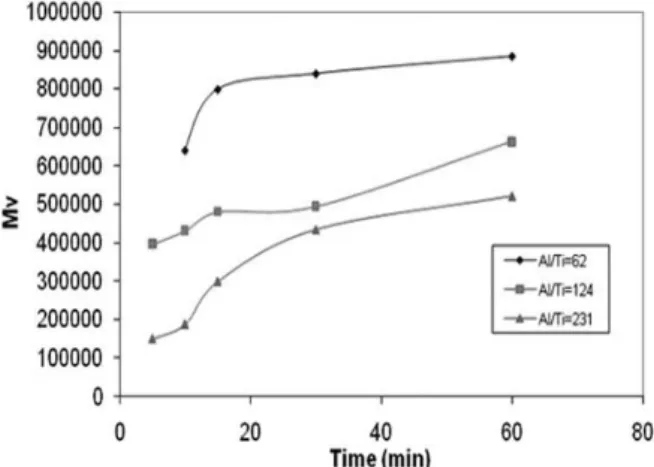
For this catalyst system, the effect of molar ratio of tri-ethylaluminum to titanium (Al/Ti) on the ethylene po-lymerization and on the viscosity average molecular weight (Mv) of the polyethylene synthesized was studied. The results are shown in Figures 1 and 2. It can be seen that polymerization rate increases sharply by increasing Al/Ti molar ratio from 60 to 124. A further increase in this ratio, however, causes the activity of catalyst to de-crease. One possible explanation for the maximum rate at a certain cocatalyst concentration is competitive ad-sorption between monomer and cocatalyst on the same site, which can be attributed to the change of catalyst active site [3,16,17]. Howevere, since the reaction rate of chain transfer to cocatalyst compounds increases as the concentration of cocatalyst rises, a reduction in the molecular weight [3,17] is expectable.
Figure 1: Effect of cocatalyst concentration on polymer yield. For polymerization conditions, see Table 1.
Figure 2: Variation of molecular weight as a function of time in dif-ferent cocatalyst concentrations. For polymerization conditions, see
Table 1.
Effect of Temperature
In Ziegler-Natta polymerization systems, chain transfer re-actions tend to increase by increasing polymerization tem-perature. It is normally observed that higher initial polym-erization rate and much catalyst deactivation are obtained at higher reaction temperatures [18]. The apparent effect of an increase in the polymerization temperature is a dramatic increment in the catalyst activity up to a certain optimal temperature, beyond which a further increase in the reactor temperature leads to a reduction in the activity. Thus, all site activation, chain propagation, and site deactivation steps
vary significantly with temperature.
The dependence of the catalyst activity and molecular weight of polyethylene on polymerization temperature is shown in Figures 3 and 4. The molecular weight of the polyethylene, because of an increment in chain transfer reaction rate, decreased by increasing polymerization temperature [19-21].
Calculation of Active Site Concentration
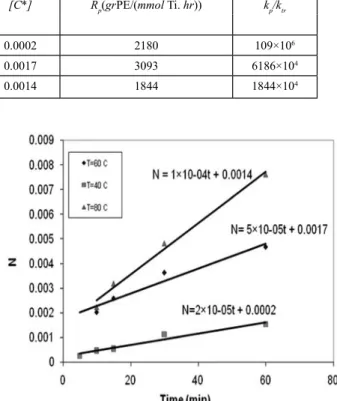
The coefficients of the linear equation [N]t=A+Bt and the concentration of active sites are listed in Tables 3 and 4, and the corresponding experimental results are depict-ed in Figures 5 and 6.
Figure 4: Variation of molecular weight as a function of time at different reaction temperatures. For polymerization conditions, see Table 2.
Table 3: Calculated results ([C*], Rp, and kp/ktr) of ethylene polymerization using different cocatalyst concentrations Results according to Eq. (6) [C*] Rp (grPE/(mmol Ti. hr)) kp/ktr
A B
Al/Ti=62 0.0003 5×10⁻⁵ 0.0003 2374 4748×104
Al/Ti=124 0.0017 5×10⁻⁵ 0.0017 3093 6186×104
Al/Ti=231 0.0013 7×10⁻⁵ 0.0013 2744 3920×104
Table 4: Calculated results ([C*], Rp, and kp/ktr) of ethylene polymerization at different reaction temperatures Results according to Eq. (6) [C*] Rp(grPE/(mmol Ti. hr)) kp/ktr
A B
T=40 °C 0.0002 2×10⁻⁵ 0.0002 2180 109×106
T=60 °C 0.0017 5×10⁻⁵ 0.0017 3093 6186×104
T=80 °C 0.0014 1×10⁻⁴ 0.0014 1844 1844×104
Figure 5: Variation of macromolecule concentration as a function of time in different cocatalyst concentrations
Figure 6: Variation of macromolecule concentration as a function of time in different reaction temperatures
As it can be seen in Figure 5 and Table 3, increasing Al/Ti molar ratio from 62 to 124 increased the concentration of active sites from 0.0003 to 0.0017, whereas a further in-crease in this parameter from 124 to 231 caused the concen-tration of active sites to fall from 0.0017 to 0.0013. Figure 6 and Table 4 show the effect of temperature on the concentration of polyethylene macromolecules and the concentration of active sites. Increasing the
tem-perature from 40 °C to 60 °C raised the concentration of active sites from 0.0002 to 0.0017. However, when temperature was increased above the optimum value, the concentration of active sites decreased [21].
Conclusion
tration and temperature on the polymer yield and vis-cosity average molecular weight were investigated. The results showed that an Al/Ti molar ratio of 124 leads to maximum polymer yield. In addition, reactions carried out at 60 °C resulted in highest polymer yield and mo-lecular weight. Another interesting feature of the current work was relevant to the measurement of variation of active site concentration versus Al/Ti molar ratio and temperature. Increasing Al/Ti molar ratio caused the con-centration of active sites to pass a maximum. In other words, raising Al/Ti molar ratio from 62 to 124 increased the concentration of active sites from 0.0003 to 0.0017, while a further increase in Al/Ti molar ration from 124 to 231 reduced the concentration of active sites from 0.0017 to 0.0013. The same trend was also observed for the variation of the concentration of active sites versus temperature. The maximum concentration of active sites was reached at 60 °C.
References
[1]. Albizzati E., Gionnini U., Collina G., Noristi L.,
and Resconi L., “Polypropylene Handbook, Moore E P
(Ed)”, Hanser Publishers, Munich, 1996, pp.11-112.
[2]. Mori H., Hasebe K., Terano M., “Polymer”, 1999, 40, 1389-1394.
[3]. Jaber I. A., Fink G., “Macromol, Chem. Phys”., 195,
pp. 2505-2515, 1994.
[4]. Marques M. M., Tait P. J. T., Mejzlik J., and Dias A. R., J. of Polymer, “Sci; Part A: Polymer Chemistry”, 36, pp. 537-585, 1998.
[5]. Kissin Y. V., Liu X., Pollick D. J., N. Brungard L.,
Chang M., “J of Molecular Catalysis, A: Chemical”,
287, 1–2, pp. 4552, 2008.
[6]. Kissin Y. V, “J. of Catalysis”, 200, 2, pp. 232-240, 2001.
[7]. Wolf C. R., Madalena de Camargo Forte M., and J.
Henrique Z. dos Santos, “Catalysis Today”, pp. 107108,
451-457, 2005.
[8]. Kissin Y. V., Rishina L. A., N. Galashina M.,
Ga-gieva S. Ch., and Tuskaev V. А., “European Polymer Journal”, 45, 10, pp. 29512961, 2009.
[9]. Kamrul Hasan A. T. M., Fang Y., and Liu B., Minoru
Terano, “Polymer”, 51, 16, pp. 36273635, 2010. [10]. J. E. Mark, “Polymer Data Handbook”, Oxford
University Press, Inc., p. 498, 1999.
[11]. SalamiKalajahi M., HaddadiAsl V., Najafi M., Ghafelebashi Zarand S. M., “e-Polymers”, no. 004, 2008. [12]. SalamiKalajahi M., Najafi M., and HaddadiAsl V., “Int J Chem Kinet”, 41: 45–56, 2009.
[13]. Burfield D.R., Mekenzie I. D., Tait P. J. T., “
Poly-mer”, 17, 130136, 1976.
[14]. Tait P. J. T., Jaber I. A., and Loontgens A. J., “
Cata-lytic olefin polymerization, Recent Developments in Ole fin Polymerization Catalysts” T. Keii and K. Soga, Eds.,
Kodansha Ltd., Tokyo, pp 11, 1990.
[15]. Keii T., Suzuki E., Tamura M., Murata M., and Doi
Y., “Makromol. Chem”, 183, pp. 2285-2304, 1982.
[16]. Kim I. L., Kim J. H., and Woo S. I. “J. Appl. Poly-mer Sci.”, pp. 39. 837, 1990.
[17]. Zhouri G. H., Mortazavi M. M., Jamjah R., and
Ah-madjo S., “J. Appl. Polymer Sci”., 93, pp. 25972605,
2004.
[18]. Jaber I. A. and Ray W. H., “J. Appl.Polymer Sci.”,
50, 201-215, 1993.
[19]. Eskelinen M., and Seppala J. V., “European Ppoly-mer Journal”., 32, pp. 331335, 1996.
[20]. Czaja K. and Bialek M., J. Appl. “Polymer”, Sci., ,
79, pp. 361-365, 2001.
![Table 2: Effect of time on polymer yield and molecular weight at different reaction temperatures; Polymerization conditions are: [Ti]=3.24×10 -2 mmol.l -1 , t=1 hr., Al/Ti=124, P=1 bar, and Hexane=400 ml](https://thumb-us.123doks.com/thumbv2/123dok_us/8035913.2127817/2.892.140.751.1010.1155/polymer-molecular-different-reaction-temperatures-polymerization-conditions-hexane.webp)