PERFORMANCE DIMENSIONS OF SRI LANKAN HOTEL INDUSTRY
Prathap Kaluthanthri1, Atasya Osmadi2
1
Department of Estate Management and Valuation UNIVERSITY OF SRI JAYEWARDENEPURA
2
School of Housing, Building and Planning UNIVERSITI OF SAINS MALAYSIA
Abstract
The mixed nature of industrial and service dimension of a hotel including pure service (room service), stock management service (beverage and vendors product), and in-house processing (Food at the restaurant) crafts are a unique business setting for a hotel. In consequence, it creates a challenging task for monitoring the alignment of the strategic plan of the hotel. Hence, the performance of a hotel needs to be measured through a three-dimensional perspective which covers (i) nature of pure service, (ii) product, and (iii) service-product. The measure of the three-dimensional perspective requires empirically validated hotel-specific performance measurement system. The study reviews experts’ views on performance measurement dimensions for the hotel industry in Sri Lanka based on the Analytic Hierarchy Process (AHP). Performance dimensions identified through literature review evaluated by a panel of experts consists of academics, seniors and middle-level management of hotels, government and travel advisory officials, and opinion leaders. The results of AHP on performance dimensions were re-confirmed by applying Content Validity Ratio (CVR) analysis. The AHP order of performance dimensions begins with Competitiveness followed by Finance, Quality, Innovation, Flexibility, Resource utilization, Environment, and Supplier Performance respective. The CVR on AHP order confirmed 6 dimensions on performance measurement for Sri Lankan hotel industry as final selection leaving out environmental and supplier performance from the list of performance dimensions.
INTRODUCTION
The effectiveness of value delivery process of an organization measured by the performance measurement system of the organization (Antony and Bhattacharyya, 2010) and conventionally performance are used to monitor and control the strategic attainment of organization’s goals (Nanni, Dixon and Vollmann, 1990). Accordingly, performance measurement is common to any organization whether it is profit-oriented or non-profit oriented and depicts the success level of organizations. The measurement dimensions of performance are based on key results areas of the organization and different from organization to organization or industry to industry; universal organizational performance measurement dimensions are not popular due to the differences between industries.
The classical performance measurement system evolved with the footprint of the financial dimension and influenced by indicators like earnings per share, return on investment. Nevertheless, the emphasis on non-financial perspective dimensions such as strategic management, management accounting and operational management to measure the organizational performance and integration with financial performance have been highlighted since the early 1990s (Eccles and Pyburn, 1992; Fitzgerald et al., 1991). The argument behind the combination of financial and non-financial dimension to measure the performance of an organization is the multiplicity of stakeholder’s expectation where owners and investors are keen on financial performance while customers, the public, and government focused on the non-financial performance of the organization. On account of this, scholars argued that performance measurement system must review the macro perspective that includes the roles of investors, employees, management and potential investors. Therefore, the multi-dimensional performance measurement system is essential to review the overall performance of an organization.
The hotel industry in Sri Lanka is growing continuously from 2012 to 2017 and recorded 2.05 million tourist arrivals during the year 2016 (SLTDA, 2016a) with earnings of US$ 3,518 million (CBSL, 2016) and expected is to earn US$ 7 billion by 2020 (SLTDA, 2016b). The 14 per cent growth of the industry during 2016 is well above the rate of the world tourism of 3.9 per cent and 10.7 per cent in South Asia respectively (UNWTO, 2017). This incremental growth influences the possible investment in the hotel industry and leads to gradual growth in hotel constructions, new entrance, and facelift like rebranding, renovation and upgrading to higher star grade of existing hotels.
offering range between pure intangible heterogeneous services to a tangible homogeneous product (Brignall and Ballantine, 1996), and creates the difficulty on defining whether the hotel’s offering is pure service or a pure product. Thus, a holistic approach is required to measure performance accommodates unique service-product nature of the hotel into its performance measurement system. Thus, the three-dimensional view for hotel performance measurement is required to describe the “Total Hotel Product”. A multi-dimensional performance system is required to institutionalize the performance dimensions to incorporate industrial and institutional differences of the given territory (Wadongo et al., 2010). This absorbs the local as well as industry-specific characteristics to the organizational performance measurement system. Nevertheless, many hoteliers simply practised performance measurement based on cost and productivity that derived from narrowly defined quantifiable aspects (Fitzgerald et al., 1991) which hinder the absolute measurement of organizational performance. However, as noted, the unique service-product nature of hotel industry which has the pure service (room service), retail (beverage) and production and distribution (food at the restaurant) confirm the requirement of industry-specific mechanism for measurement of performance of hotels rather simply practising general performance measurement system. Thus, the study aims to review the literature on performance measurement dimensions of the hotel industry and analyse the experts’ view on priorities of performance measurement dimensions for Sri Lankan hotel industry.
PERFORMANCE DIMENSION OF HOTEL INDUSTRY
accounting period delay as well as incongruities of financial references in a competitive business environment. This makes irregular or incompatible outcomes on performance and makes difficulty on comparisons (Harris and Mongiello, 2001). Further sole application of financial dimensions on performance measurement criticized by citing its poor market orientation, and micro in nature (Phillips, 1999). As a result, the combined use of financial and non-financial dimensions on performance measurement for hotels is recommended. This highlighted the importance of measuring the success of the organization to not purely depends on financial performance but also how overall adoption of the organization to the environment within which exist (Emmanuel, Otley and Merchant, 2013). On the other hand, designing, production and marketing functions of product or service are important areas of business success (Turney and Anderson, 1989), and priority should be given to those non-financial dimensions compared to financial dimension on performance.
FINANCIAL DIMENSION VS NON-FINANCIAL DIMENSION
classified broadly as Results and Determinants. The Results includes (a) financial performance and (b) competitiveness while; (c) quality of service, (d) flexibility, (e) resource utilization, and (f) innovation identified as four determinants. Incorporation of employee related performance indicators or dimensions for the hotel industry also recommended since, satisfaction and the moral of the employees are prevalent to make a satisfied guest (Fitzgerald et al., 1991; fwaya, 2006). However, this addition is not widely accepted.
Fitzgerald et al. (1991) suggest financial and competitiveness are results of successful management of other four dimensions (i.e. determinants) namely; quality of service, flexibility, resource utilization, and innovation. Quality of service attends on the ability of the organization to maintain a satisfactory service to its customers. This is identified as one of the key areas on performance since the quality is pivotal to attract guests which lead to the financial performance of the hotel. The capability of the hotel on reliability, curtsey and the level of satisfying guest’s requirements are indicators of the quality of service. Overall service indicators of a hotel like reliability, responsiveness, aesthetics/appearance, cleanliness/tidiness, comfort and security are identified as indicators of the quality of service (Fitzgerald et al., 1991). Flexibility as a dimension on hotel performance concentrates on process, volume and delivery which defined as the ability of the hotel to customize the chargers/rates, the job of the employees according to requirements of customers. Customer satisfaction on flexible check-in and check-out time and localized food lead to guest satisfaction and hotel performance. The resources utilization explains the ability of the organization to ensure productivity and efficiency of the organization. The innovation; final dimension focus on the individual and organizational level action or process for innovation which includes Performance of the innovation process and individual innovations (Fitzgerald et al., 1991).
complain response, payroll percentage, employee turnover, revenue by segment. Finally, new markets, staff appraisal, staff target, courses completed, and improvements identified as indicators of Innovation and Learning perspective (Evans, 2005). It is argued that overall measures of four dimensions ensure the financial and non-financial view of hotel performance.
A case study on performance dimension of Northern Cyprus hotel industry Haktanir and Harris, (2005) established (a) Business dynamics, (b) Overall performance, (c) Employee performance, (d) Customer satisfaction, (e) financial performance and (f) Innovative activity as core themes of performance measurements. The Business Dynamic review the decision making rational and the behaviour of response mechanism for business related issues of the hotel. The overall success of the hotel was evaluated based on periodical measures of long-term overall performance or strategic attainment of hotel’s objectives i.e. Overall Performance. The employee performance measured how well employees achieve set targets. The critical indicators such as comments on a guest card, feedback from the customer after checkout, and repeat business are indicators of Customer Satisfaction. The Financial Performance investigated financial success and measured by F&B costs in comparison with the budget, F&B revenue, F&B expenses, income per head and room revenue per head. Finally, Innovative Activity measured based on new additions and innovation implemented within the financial year to increase in-house sales.
In the meantime, the performance of Nigerian hospitality industry is appraised using adopted Fitzgerald model (Brignall and Ballantine, 1996), confirmed competitiveness, quality of service, innovation, community social responsibility, supplier performance resource utilization, and flexibility as the non-financial dimensions on hotel performance (Wadongo et al., 2010). This adopted model includes two new determinants namely (a) supplier performance and (b) environmental/community perspectives making a total number of dimensions into eight (Kennerley and Neely, 2002). In 2010, the study on Kenyan hospitality industry confirmed the inclusion of non-financial dimensions namely resource utilization, innovation, supplier performance and environmental indicator as determinants to the model (Wadongo et al., 2010).
Production of the hotel (Sigala, 2004) while Marketing as the third dimension focused on (a) market orientation which explains how far the organization is concentrated on customer requirements, (b) quality which is the heterogeneity in nature due to personal contact in the hotel industry and (c) seasonality (Sin et al., 2005). The market orientation is important to the organization because the future of the hotel and its performance depend on how far the hotel is satisfied in fulfilling the requirements of its guests. Human Resource Management as a fourth dimension measures the effectiveness of knowledge management and staff satisfaction of the hotel (Sainaghi, 2010). The dimension reviews the supportive team culture, knowledge sharing to innovation performance and the relationship between employee satisfaction and the performance. Information Technology is identified as the final dimension which was not a popular dimension. Thus, later it was dropped from the list of performance dimension of the hotel industry (Sainaghi, 2010).
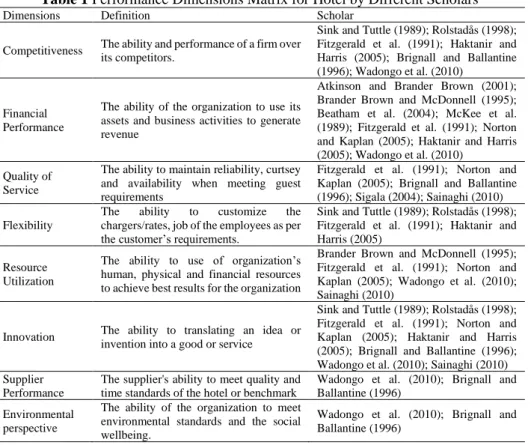
Macroeconomic forces like 9/11 or respiratory syndrome epidemic, the structure of tourism sector or market and destinations which are functions of tourist market also proposed as a dimension to be considered for performance and received marginal emphasis (Sainaghi, 2010). The removal of macroeconomic forces from the performance dimension list further confirmed by Chen (2007) as their poor explanatory power on hotel performance is low as 8-10 per cent. Financial performance of the hotel is indicator for financial dimension while competitiveness, quality of service, flexibility, resource utilization, innovation, supplier performance, and environmental perspective are identified as indicators for non-financial dimensions. Citation of a scholar on each dimension and the common definition for each dimension are summarized in Table 1.
Table 1 Performance Dimensions Matrix for Hotel by Different Scholars
Dimensions Definition Scholar
Competitiveness The ability and performance of a firm over its competitors.
Sink and Tuttle (1989); Rolstadås (1998); Fitzgerald et al. (1991); Haktanir and Harris (2005); Brignall and Ballantine (1996); Wadongo et al. (2010)
Financial Performance
The ability of the organization to use its assets and business activities to generate revenue
Atkinson and Brander Brown (2001); Brander Brown and McDonnell (1995); Beatham et al. (2004); McKee et al. (1989); Fitzgerald et al. (1991); Norton and Kaplan (2005); Haktanir and Harris (2005); Wadongo et al. (2010)
Quality of Service
The ability to maintain reliability, curtsey and availability when meeting guest requirements
Fitzgerald et al. (1991); Norton and Kaplan (2005); Brignall and Ballantine (1996); Sigala (2004); Sainaghi (2010)
Flexibility
The ability to customize the
chargers/rates, job of the employees as per the customer’s requirements.
Sink and Tuttle (1989); Rolstadås (1998); Fitzgerald et al. (1991); Haktanir and Harris (2005)
Resource Utilization
The ability to use of organization’s human, physical and financial resources to achieve best results for the organization
Brander Brown and McDonnell (1995); Fitzgerald et al. (1991); Norton and Kaplan (2005); Wadongo et al. (2010); Sainaghi (2010)
Innovation The ability to translating an idea or invention into a good or service
Sink and Tuttle (1989); Rolstadås (1998); Fitzgerald et al. (1991); Norton and Kaplan (2005); Haktanir and Harris (2005); Brignall and Ballantine (1996); Wadongo et al. (2010); Sainaghi (2010) Supplier
Performance
The supplier's ability to meet quality and time standards of the hotel or benchmark
Wadongo et al. (2010); Brignall and Ballantine (1996)
Environmental perspective
The ability of the organization to meet environmental standards and the social wellbeing.
Wadongo et al. (2010); Brignall and Ballantine (1996)
METHODOLOGY
Multi-Criteria Decision Analysis (MCDA) is a part of operational research which founded upon a mathematical base, ensures quantitative operational decisions upon identified decision criteria (Zavadskas, Turskis and Kildienė, 2014). The method has been applied in different disciplines including the application of strategic management (Nasab and Milani, 2012), production (Rabbani et al., 2014), tourism (Akincilar and Dagdeviren, 2014), energy and environmental management (Sambasivan and Fei, 2008). One of the tools used in MCDA is the Analytic Hierarchy Process (AHP). The AHP is a model which measures the relative importance of an element based on pairwise comparison with others and used in this study to identify priority on dimensions on performance of the hotel. The general AHP model represented as a hierarchy which has three main procedural steps including the problem structuring, evaluation, and choice (Saaty, 1977; Hummel, Bridges and Ijzerman, 2014).
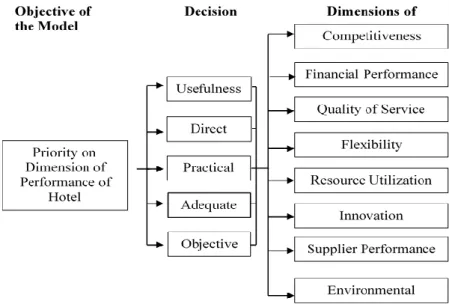
measure the ability and efficacy of the indicator at the tactical level and fit for the purpose, (b) Direct measurement; able to measure the single aspect of performance (c) Practical; able to apply within the context hotel environment, (d) Adequate; cover important aspects/dimensions of performance, and (e) Objective; clear and unambiguous about what is being explained. The single aspect of the dimension evaluated and jointly results of each analysis form a single construct. Thus, the multi-item measurement model ensures the breath of covering all aspects of a single construct by different dimensions (Diamantopoulos and Winklhofer, 2001). The lowest level of the hierarchy shows alternatives dimensions of hotel performance based on the outcome of the literature review. The AHP hierarchy model to prioritize the dimensions of hotel performance is shown in Figure 1.
Figure 1 AHP Model on Dimension of Performance of Hotel, Sri Lanka
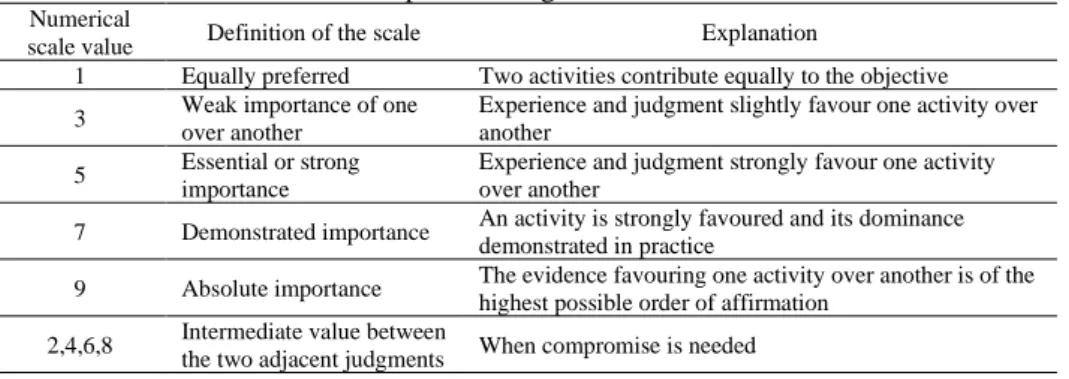
The second step of the AHP hierarchy which is evaluation; explains the procedure on judging the relative importance of decision criteria and alternates as well as group aggregation of judgment, consistency and sensitivity analysis. The pair-wise comparison of the relative importance of each dimension completed using a 1 to 9 scale from Equally Preferred to Extremely Preferred. Scale definition is given in Table 2.
question statements (including criteria and alternative) are framed as positive measures of value to maintain the compatibility and relative value.
Table 2 Pairwise Comparison Original Scale for AHP Preference Numerical
scale value Definition of the scale Explanation
1 Equally preferred Two activities contribute equally to the objective
3 Weak importance of one
over another
Experience and judgment slightly favour one activity over another
5 Essential or strong
importance
Experience and judgment strongly favour one activity over another
7 Demonstrated importance An activity is strongly favoured and its dominance demonstrated in practice
9 Absolute importance The evidence favouring one activity over another is of the highest possible order of affirmation
2,4,6,8 Intermediate value between
the two adjacent judgments When compromise is needed
Source: (Saaty, 1977)
The group decision approach and multiple stakeholders on the subject area used to increase the validity of the subjective decision. According to Hummel et al. (2014), stakeholder’s judgment on the multi-criteria decision can be administered via an online questionnaire, electronic voting in a face to face sitting, or online voting in a dispersed group setting. In this study a total of 38 experts from disciplines related to the hotel and hospitality industry were interviewed which is well above to a minimum number of 10 experts required for expert opinion review (Cavana, Delahaye and Sekaran, 2001).
The selection of experts was done based on their knowledge priority, depth, and area of discipline and suitability in terms of perspective and affiliation. The study employee interviewer filed questionnaire in a dispersed group setting and mostly where met at their office. Details of participants are given in Table 3.
Table 3 Distribution of Experts
Expert Category No. of Experts
Academics 03
Senior management staff of hotels 12
Middle management staff of hotels 14
Management staff of Sri Lanka Tourist Development Authority 02
Management staff of Travel Advisory Organizations 05
Opinion Leaders 02
Total 38
of criteria first and then alternative to estimate the final weight of the performance dimensions to rank them from most to least preferred. The priority order of each performance decision was considered as the preferred choice by the experts in the decision tree.
The sensitivity analysis on priority order estimate by changing the weight of each criterion by ±10% (Triantaphyllou and Sánchez, 1997; Mareschal, 1988) to analyse the vigour of the judgment. The results of the AHP pairwise comparison confirm the external validity of the dimension based on a clearly defined questionnaire after the literature review through the content validity study. A Consistency Ratio (CR) of Saaty (1980) also calculated to ensure or confirm individual judgments made a purely random set of comparison without any compulsion. However, perfect consistency is rarely occurring in practice, CR lower than 0.1 is considered as reasonable, between 0.1 and 0.2 is tolerable while higher than 0.2 is unacceptable with a recommendation of revision of pairwise comparison or discarded (Saaty, 1980).
The finalized indicators pointed out by the experts were then given to randomly 10 experts from the same expert list to review content validity based on decision rule of Lawshe (1975) Content Validity Ratio (CVR). The results of CVR measure between -1.0 and 1.0 and closer to 1.0 means more essential to the object and conversely, closer to -1.0 is more non-essential. This ensures the inclusion of most appropriate indicators of an exogenous variable of the study (Lawshe, 1975). The CVR allows measurement instrument to reflect the content universe to which the instrument will be generalized.
RESULTS OF AHP ANALYSIS
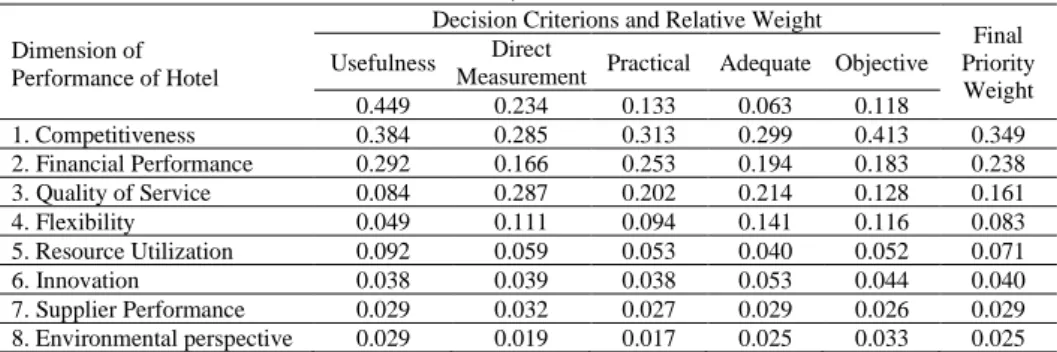
The individual weight of the decision criteria for evaluating performance confirms Usefulness as the most important decision criteria followed by the direct measurement, practical, adequate and finally objective. The overall priority of 45 per cent is accumulated by criterion “Usefulness” while only 6.4 per cent is given to the least important criterion “Adequate”. The lambda (λ) maximum value of 5.447 and CR of 0.0988 confirm the reviewer’s reasonable consistency on evaluation. This approves that experts gave higher weight on the applicability of the measurement dimension in a context of tactical level of the organization and its ability to measure the single aspect of performance when prioritizing decision criterion compared to its adequacy and practical application. Refer Table 4 for detail results of experts.
dimension compared to the ability of the hotel to use its assets and business activities to generate revenue i.e. financial performance.
Table 4 Normalized Comparison Matrix and the Ranks for Decision Criterions
Usefulness measurement Direct Practical Adequate Objective Priority weight
Usefulness 1.000 3.317 3.193 3.099 5.267 0.450
Direct measurement 0.301 1.0000 3.361 5.065 1.299 0.234
Practical 0.313 0.298 1.000 3.212 1.331 0.133
Adequate 0.323 0.197 0.311 1.000 0.493 0.064
Objective 0.190 0.770 0.751 2.030 1.000 0.119
lambda (λ) Max: 5.447; Consistency Index (CI): 0.112; Random-like matrix (RI): 1.120; Consistency Ratio (CR): 0.0998
Source: Expert Review Results (2017)
The level of flexibility or the hotel’s ability to customize the chargers/rates, the job of the employees as per the customer’s requirements is identified as the third important dimension on performance. Flexibility on room, services and hotel package ensure maximum occupancy throughout the year without making any drastic reduction during the off-season tourism in Sri Lanka. Further, the ability of the hotel on volume and delivery flexibility ensures the accommodation and management of special functions without making any guest dissatisfaction. This ensures repeat guests.
The resource utilization received 7.1 per cent priority with the attention on productivity and efficiency of the process of the hotel. The productivity and efficiency have interconnection where the efficiency concern on cost reduction of hotel activities while productivity concern on the input-output ratio of the hotel activities. However, dimensions like innovation, supplier performance, and environmental perspective receive the lower level of priority less than a five per cent importance per each dimension. Refer Table 4 for normalized comparison rank for each dimension performance of the hotel.
Table 4 Normalized Comparison Matrix and the Ranks for Dimension of Performance of Hotel, Sri Lanka
Dimension of Performance of Hotel
Decision Criterions and Relative Weight
Final Priority Weight Usefulness Direct
Measurement Practical Adequate Objective
0.449 0.234 0.133 0.063 0.118
1. Competitiveness 0.384 0.285 0.313 0.299 0.413 0.349
2. Financial Performance 0.292 0.166 0.253 0.194 0.183 0.238
3. Quality of Service 0.084 0.287 0.202 0.214 0.128 0.161
4. Flexibility 0.049 0.111 0.094 0.141 0.116 0.083
5. Resource Utilization 0.092 0.059 0.053 0.040 0.052 0.071
6. Innovation 0.038 0.039 0.038 0.053 0.044 0.040
7. Supplier Performance 0.029 0.032 0.027 0.029 0.026 0.029
8. Environmental perspective 0.029 0.019 0.017 0.025 0.033 0.025
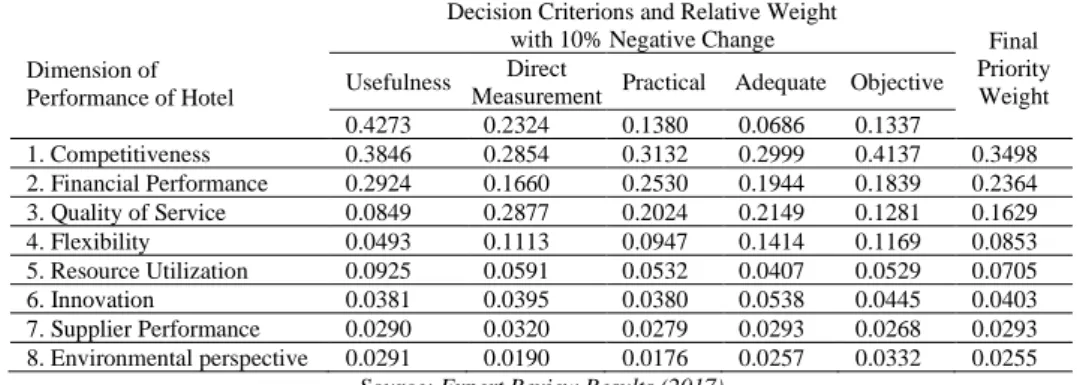
Once the AHP rank order was completed, the robustness of the rank order was studied through the sensitivity analysis. The study theatrically changed the weight of the decision criteria by ±10 per cent to evaluate the sensitivity of the results. Refer to Table 5 and 6 for result.
Table 5 The Sensitivity Analysis (+10% Change) on Decision Criterions and Ranks for Dimension of Performance of Hotel, Sri Lanka
Dimension of Performance of Hotel
Decision Criterions and Relative Weight
with 10% Positive Change Final
Priority Weight Usefulness Direct
Measurement Practical Adequate Objective
0.4695 0.2357 0.1291 0.0592 0.1065
1. Competitiveness 0.3846 0.2854 0.3132 0.2999 0.4137 0.3501
2. Financial Performance 0.2924 0.1660 0.2530 0.1944 0.1839 0.2402
3. Quality of Service 0.0849 0.2877 0.2024 0.2149 0.1281 0.1602
4. Flexibility 0.0493 0.1113 0.0947 0.1414 0.1169 0.0824
5. Resource Utilization 0.0925 0.0591 0.0532 0.0407 0.0529 0.0723
6. Innovation 0.0381 0.0395 0.0380 0.0538 0.0445 0.0400
7. Supplier Performance 0.0290 0.0320 0.0279 0.0293 0.0268 0.0294
8. Environmental perspective 0.0291 0.0190 0.0176 0.0257 0.0332 0.0255
Source: Expert Review Results (2017)
Table 5 The Sensitivity Analysis (+10% Change) on Decision Criterions and Ranks for Dimension of Performance of Hotel, Sri Lanka
Dimension of Performance of Hotel
Decision Criterions and Relative Weight
with 10% Negative Change Final
Priority Weight Usefulness Direct
Measurement Practical Adequate Objective
0.4273 0.2324 0.1380 0.0686 0.1337
1. Competitiveness 0.3846 0.2854 0.3132 0.2999 0.4137 0.3498
2. Financial Performance 0.2924 0.1660 0.2530 0.1944 0.1839 0.2364
3. Quality of Service 0.0849 0.2877 0.2024 0.2149 0.1281 0.1629
4. Flexibility 0.0493 0.1113 0.0947 0.1414 0.1169 0.0853
5. Resource Utilization 0.0925 0.0591 0.0532 0.0407 0.0529 0.0705
6. Innovation 0.0381 0.0395 0.0380 0.0538 0.0445 0.0403
7. Supplier Performance 0.0290 0.0320 0.0279 0.0293 0.0268 0.0293
8. Environmental perspective 0.0291 0.0190 0.0176 0.0257 0.0332 0.0255
Source: Expert Review Results (2017)
The results show that ±10 per cent change in weight of the decision criterion does not affect the original Priority Weight of Dimension of Performance of Hotel which confirms the validity of the AHP results with ±10 per cent sensitivity.
CONTENT VALIDITY RATIO
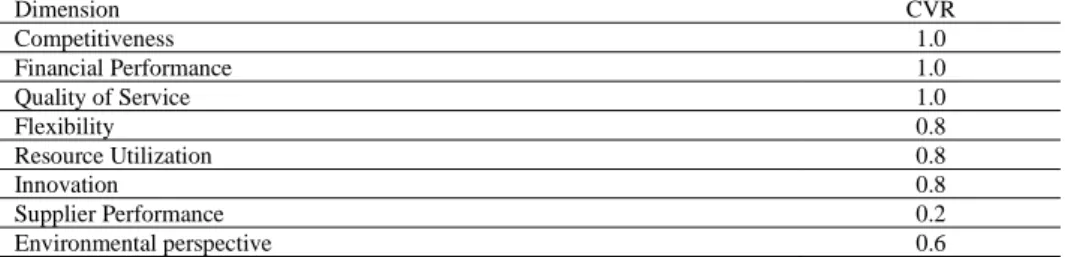
priority order value in AHP model (Hummel et al., 2014), a study carried out the Lawshe Content Validity Ratio (CVR) to confirm the most suitable dimensions for performance measurement of hotels in Sri Lanka. A total of 10 experts are randomly selected from the same panel for CVR analysis (refer to Table 7) and result suggest the critical value for panel size (N) of 10 is 0.8 which suggest the cut-off value.
Table 7 Lawshe Content Validity Ratios (CVR) for Performance Dimension for Hotel industry of Sri Lanka
Dimension CVR
Competitiveness 1.0
Financial Performance 1.0
Quality of Service 1.0
Flexibility 0.8
Resource Utilization 0.8
Innovation 0.8
Supplier Performance 0.2
Environmental perspective 0.6
Source: Expert Review Results (2017)
The results confirm that except two indicators namely “Supplier Performance” and “Environmental Perspective” all other six dimensions meet the critical value requirement. Thus, based on the results of CVR, the study concluded (a) Competitiveness, (b) Financial Performance, (c) Quality of Service, (d) Flexibility, (e) Resource Utilization, and (f) Innovation as most suitable dimensions to collectively measure the performance of hotel industry in Sri Lanka.
CONCLUSION
REFERENCES
Akincilar, A. & Dagdeviren, M. (2014). A hybrid multi-criteria decision making model to evaluate hotel websites. International Journal of Hospitality Management, 36, 263-271.
Antony, J. P. & Bhattacharyya, S. (2010). Measuring organizational performance and organizational excellence of SMEs-Part 2: an empirical study on SMEs in India.
Measuring Business Excellence, 14(2), 42-52.
Atkinson, H. & Brander Brown, J. (2001). Rethinking performance measures: assessing progress in UK hotels. International Journal of Contemporary Hospitality Management, 13(3), 128-136.
Beatham, S., Anumba, C., Thorpe, T. & Hedges, I. (2004). KPIs: a critical appraisal of their use in construction. Benchmarking: An International Journal, 11, 93-117. Brander Brown, J. & Mcdonnell, B. (1995). The balanced score-card: short-term guest or
long-term resident? International Journal of Contemporary Hospitality Management, 7(2/3), 7-11.
Brignall, S. & Ballantine, J. (1996). Performance measurement in service businesses revisited. International Journal of Service Industry Management, 7(1), 6-31. Cavana, R. Y., Delahaye, B. L. & Sekaran, U. (2001). Applied business research:
Qualitative and quantitative methods, Milton, QLD: John Wiley & Sons. Central Bank of Sri Lanka (CBSL). (2016). Annual Report 2016.
Chen, C.-F. (2007). Applying the stochastic frontier approach to measure hotel managerial efficiency in Taiwan. Tourism Management, 28, 696-702.
Claver-Cortes, E., Molina-Azorín, J. F. & Pereira-Moliner, J. (2006). Strategic groups in the hospitality industry: intergroup and intragroup performance differences in Alicante, Spain. Tourism Management, 27(6), 1101-1116.
Delaney, J. T. & Huselid, M. A. (1996). The impact of human resource management practices on perceptions of organizational performance. Academy of Management Journal, 39(4), 949-969.
Diamantopoulos, A. & Winklhofer, H. M. (2001). Index construction with formative indicators: An alternative to scale development. Journal of Marketing Research, 38, 269-277.
Eccles, R. G. & Pyburn, P. J. (1992). Creating a comprehensive system to measure performance. Management accounting, 74, 41.
Evans, N. (2005). Assessing the balanced scorecard as a management tool for hotels.
International Journal of Contemporary Hospitality Management, 17(5), 376-390. Fitzgerald, L., Brignall, S., Silvestro, R., Voss, C. & Robert, J. (1991). Performance measurement in service businesses, London: Chartered Institute of Management Accountants (CIMA).
Fwaya, E. (2006). Human resource systems and competitive strategies in hospitality organizational performance in Kenya. Unpublished master's thesis, Maseno University, Maseno, Kenya.
Harris, P. J. & Mongiello, M. (2001). Key performance indicators in European hotel properties: general managers' choices and company profiles. International Journal of Contemporary Hospitality Management, 13(3), 120-128.
Hummel, J. M., Bridges, J. F. & Ijzerman, M. J. (2014). Group decision making with the analytic hierarchy process in benefit-risk assessment: a tutorial. The Patient-Patient-Centered Outcomes Research, 7(2), 129-140.
Kennerley, M. & Neely, A. (2002). Performance measurement frameworks: A review. In Neely, A.D. (2002). (Eds.) Business performance measurement: Theory and Prcatice. Cambridge: Cambridge University Press.
Lawshe, C. H. (1975). A quantitative approach to content validity. Personnel Psychology, 28, 563-575.
Lee, M. J. & Jang, S. S. (2007). Market diversification and financial performance and stability: A study of hotel companies. International Journal of Hospitality Management, 26(2), 362-375.
Lee, S. & Park, S.-Y. (2009). Do socially responsible activities help hotels and casinos achieve their financial goals? International Journal of Hospitality Management, 28(1), 105-112.
Lynch, R. L. & Cross, K. F. (1995). Measure up!: Yardsticks for Continuous Improvement, Cambridge: Blackwell.
Mareschal, B. (1988). Weight stability intervals in multicriteria decision aid. European Journal of Operational Research, 33, 54-64.
Mckee, D. O., Varadarajan, P. R. & Pride, W. M. (1989). Strategic adaptability and firm performance: a market-contingent perspective. The Journal of Marketing, 53, 21-35.
Nanni, A. J., Dixon, J. R. & Vollmann, T. E. (1990). Strategic control and performance measurement. Journal of Cost Management, 4, 33-42.
Nasab, H. H. & Milani, A. S. (2012). An improvement of quantitative strategic planning matrix using multiple criteria decision making and fuzzy numbers. Applied Soft Computing, 12(8), 2246-2253.
Norton, D. & Kaplan, R. (2005). The Balanced Scorecard. Measures that drive performance, Harvard Business Review, 70(1), 71-79.
Emmanuel, C., Otley, D. & Merchant, K. (eds). (2013). Readings in accounting for management control, UK: Chapman & Hall.
Phillips, P. A. (1999). Hotel performance and competitive advantage: a contingency approach. International Journal of Contemporary Hospitality Management, 11(7), 359-365.
Rabbani, A., Zamani, M., Yazdani-Chamzini, A. & Zavadskas, E. K. (2014). Proposing a new integrated model based on sustainability balanced scorecard (SBSC) and MCDM approaches by using linguistic variables for the performance evaluation of oil producing companies. Expert Systems with Applications, 41(16), 7316-7327. Rolstadås, A. (1998). Enterprise performance measurement. International Journal of
Operations & Production Management, 18(9/10), 989-999.
Saaty, T. L. (1977). A scaling method for priorities in hierarchical structures. Journal of Mathematical Psychology, 15(3), 234-281.
Sainaghi, R. (2010). Hotel performance: state of the art. International Journal of Contemporary Hospitality Management, 22(7), 920-952.
Sambasivan, M. & Fei, N. Y. (2008). Evaluation of critical success factors of implementation of ISO 14001 using analytic hierarchy process (AHP): a case study from Malaysia. Journal of Cleaner Production, 16(13), 1424-1433. Sigala, M. (2004). Using data envelopment analysis for measuring and benchmarking
productivity in the hotel sector. Journal of Travel & Tourism Marketing, 16(2/3), 39-60.
Sin, L. Y., Alan, C., Heung, V. C. & Yim, F. H. (2005). An analysis of the relationship between market orientation and business performance in the hotel industry.
International Journal of Hospitality Management, 24(4), 555-577.
Sink, D. S. & Tuttle, T. C. (1989). Planning and measurement in your organization of the future, Industrial Engineering And Management, Norcross, GA: IE Press. SLTDA (2016a). Annual Statistic Report 2016. Colombo: Sri Lanka Toursit
Development Authority.
SLTDA (2016b). Sri Lanka Tourism Stragic Plan 2017-2020.
Steele, K., Carmel, Y., Cross, J. & Wilcox, C. (2009). Uses and misuses of multicriteria decision analysis (MCDA) in environmental decision making. Risk Analysis, 29(1), 26-33.
Straub, D., Boudreau, M.-C. & Gefen, D. (2004). Validation guidelines for IS positivist research. The Communications of the Association for Information Systems, 13, 63. Triantaphyllou, E. & Sánchez, A. (1997). A sensitivity analysis approach for some deterministic multi‐criteria decision‐making methods. Decision Sciences, 28, 151-194.
Turney, P. B. & Anderson, B. (1989). Accounting for continuous improvement. in: Sloan Management review, Nr.2, S.37-47.
World Tourism Organization (UNWTO). (2017). UNWTO Tourism Highlights: 2017 Edition. Spain.
Venkatraman, N. & Ramanujam, V. (1986). Measurement of business performance in strategy research: A comparison of approaches. Academy of Management Review, 11, 801-814.
Wadongo, B., Odhuno, E., Kambona, O. & Othuon, L. (2010). Key performance indicators in the Kenyan hospitality industry: a managerial perspective.
Benchmarking: An International Journal, 17(6), 858-875.
Wilson, R. M. S. & Chua, W. F. (1993) (2nd Ed). Managerial accounting: method and
meaning, London: Chapman & Hall.