Hungarian Association of Agricultural Informatics European Federation for Information Technology in Agriculture, Food and the Environment
Journal of Agricultural Informatics. Vol. 9, No. 3 journal.magisz.org
A fuzzy-based decision support system for soil selection in olericulture
Adebukola Onashoga1, Olusegun Ojesanmi2, Femi Johnson3, Femi Emmanuel Ayo4
I N F O
Received 23 Nov 2018 Accepted 29 Dec 2018 Available on-line 30 Dec 2018 Responsible Editor: M. Herdon
Keywords:
fuzzy logic, olericulture, prediction, decision, nutrients
A B S T R A C T
With the advent of modern computer technology, the field of Artificial Intelligence is playing a significant role in improving almost every spectrum of human life. In the field of agriculture, there is always need for optimality with improved crop yield. This paper dwells majorly on the application of fuzzy logic to predict crop type with optimal crop yield based on available soil nutrients. Some soil data samples were collected from the department of soil science, Federal University of Agriculture, Abeokuta and used as input into the system. The proposed system was simulated using MatLab Fuzzy inference System with a triangular member function. The range of nutrients was later deployed as input into a visual basic developed application to predict the best crop to be planted. A dual method (static and dynamic) was used in testing and validating the result of research which showed a significant improvement on the crop type selection than the conventional prediction mode.
1. Introduction
In recent time, research in computer science has been geared towards soft computing which deals with approximate models and gives solutions to complex real-life problems. Soft computing includes fuzzy logic, neural networks, probabilistic reasoning, and genetic algorithms (Efraim et al., 2008).
Today, techniques or a combination of techniques from these areas are used in artificial intelligence to design intelligent systems (Corne et al, 1999). However, these intelligent systems are capable of exhibiting the characteristics associated with intelligence in human behavior-understanding, language learning, reasoning, solving problems and so on (Kalogirou,2003).
The current trend is to computerize farming operations by using specially designed software and assigning various tasks to a computer (Diasio and Agell,2009), which include choosing the best soil for planting, determining soil moisture content, diagnosing animal health etc.
Nowadays, farmers are not only better educated but also informed of the current trends of computer applications that can help to improve operations in order to meet their ever increasing demands which are more preferable to the conventional or traditional methods used in early years (Regan, 2005). The soil is a fundamental natural resource on which civilization depends (Huddleston, 1984). Agricultural production is directly related to the quality of soil, and as soil nutrients diminish so does crop yield (Larson and Pierce, 1994). Maintaining soil quality is essential, not only for agricultural sustainability, but also for environmental protection. Mechanisms to measure changes in soil quality (nutrients) are important if soil scientists and farmers are to develop better methods (which will provide understanding) to manage the soil system and improve crop yield.
Many methods have been deployed by researchers for monitoring soil quality for improved crop yield. A major method for monitoring is the utilization of soil quality indicators. Bremer et al., (2004)
1 Adebukola Onashoga, Federal University Of Agriculture, Abeokuta Ogun State Nigeria [email protected]
2 Olusegun Ojesanmi, Federal University Of Agriculture, Abeokuta Ogun State Nigeria [email protected]
3 Femi Johnson, Federal University Of Agriculture, Abeokuta Ogun State Nigeria [email protected]
also provided examples of the development and use of soil quality indices. These and many more ongoing types of research are evidence that soil nutrients are a major determinant for a successful and blossom crop yield. The main objective of this paper is to develop a decision making tool built with a fuzzy logic model to enhance soil selection in the planting of vegetables.
2. Meaning of Olericulture
Olericulture is the science of vegetable crops or the cultivation of vegetable crops e.g. pumpkin, water leaf, tomato, potato, radish, carrot, chilli, bottle gourd. All societies and ethnic groups eat vegetables because they are essential for maintaining human health.
The importance of vegetables is quite numerous that the demand will increase as the population continues to grow. Most vegetables are good sources of proteins, vitamins and minerals required for the proper functioning and development of the human body. Nutrients resident in vegetables vary considerably but with sufficient proportions of their required minerals, pro-vitamins, vitamins (A, B6 and K) and carbohydrates respectively. The availability of nutrients can also be influenced by a list of factors such as topography, soil structure, climate etc.
2.1. Soil composition and nutrients
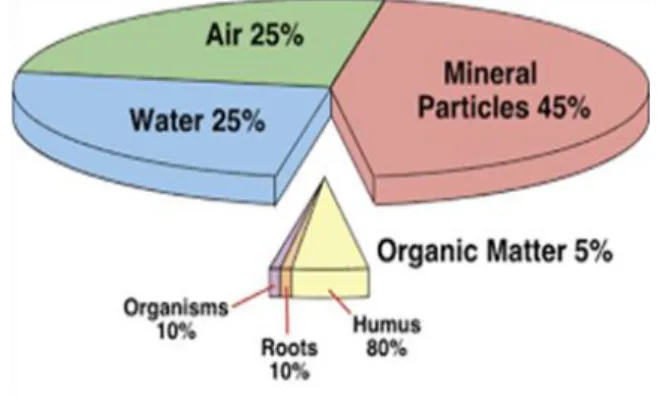
The soil is a mixture of organic matters, minerals, gases, liquids, and organisms that together support life. It is the source of moisture, plant nutrients, support, and some air needed for plant growth. The composition of soil is an important aspect of nutrient management. While soil minerals and organic matter hold and store nutrients, soil water readily provides nutrients for plant uptake. Soil air plays an integral role since many of the micro-organisms that live in the soil need air to undergo the biological processes that release additional nutrients into the soil.
The basic components of soil are minerals, organic matter, water and air. A typical soil consists of approximately 45% mineral, 5% organic matter, 20-30% water and 20-30% air. (See Figure 1)
In reality, the soil is very complex and dynamic. Soil’s composition can fluctuate on a daily basis, depending on numerous factors such as water supply, cultivation practices and soil type.
Figure 1. The composition of the soil sample
Plants, like all other living things, need food for their growth and development (Badifu and Gabriel, 1993). Plants require some essential nutrients for proper growth. These nutrients are basically grouped into two categories namely:
Macro plant nutrients: These nutrients are required by plants in large quantities. Examples are nitrogen, phosphorus, potassium, calcium, magnesium, sulphur, carbon, hydrogen and oxygen.
2.2. Fuzzy Logic in Decision Support Systems
Decision Support Systems, which employ the concept of fuzzy logic for making a decision, are generally termed as fuzzy logic based systems. Fuzzy logic is an approach to computing based on "degrees of truth" rather than the usual "true or false" (1 or 0) boolean logic on which the modern computer is based (Satzger, 2012).
The Fuzzy logic tool introduced in 1965 by Lotfi Zadeh, is a mathematical tool for dealing with uncertainties. Zadeh proposed a set membership idea to make suitable decisions when uncertainty occurs unlike the classical set with crisp values.
Classical set
Fuzzyset
₰A (x) = 1 if x € A
a(x) = Degree (x
∈
A),
0 if x € A
A= {(x,a(x))},x
∈
X
It can be generally seen in classical sets that there is no uncertainty, hence they have crisp boundaries, but in the case of a fuzzy set, since uncertainty occurs, the boundaries may be ambiguously specified.
Fuzzy Logic provides a simple way to arrive at a definite conclusion based upon input information that is the experience of experts. Fuzzy logic helps to arrive at a distinct conclusion, depending upon the input sensor information that is the experience knowledge of experts (Sprague, 1993).
The most common operators applied to fuzzy sets are ‘AND’ (minimum), ‘OR’ (maximum) and negation (complementation), where ‘AND’ and ‘OR’ have binary arguments, while negation has a unary argument (Konar et al., 1998). Fuzzy logic is used mainly in control engineering. It is based on fuzzy logic reasoning which employs linguistic rules in the form of “IF-THEN” statement (Whinston, 1996).
2.2.1. Fuzzy-based Decision Support System’s Design procedures
A well-designed decision support system aids decision makers in compiling a variety of data from many sources: raw data, documents, personal knowledge from employees, management, executives and business model (Liang, 2008). The following are the main phases of fuzzy system design:
i. Identifying the problem and choosing the type of fuzzy system which best suits the problem requirements. A fuzzy based decision system can be designed consisting of several fuzzy modules linked together.
ii. Defining the input and output variables, their fuzzy values, and their membership functions.
iii. Articulating the set of fuzzy heuristic rules.
iv. Choosing the fuzzy inference method, fuzzification and defuzzification methods if necessary; some experiments may be necessary until a proper inference method is chosen.
v. Experimenting with the fuzzy system prototype; drawing the goal function between input and fuzzy output variables; changing membership functions and fuzzy rules if necessary; tuning the fuzzy system validation of the results (Luis and Andreas, 2007).
2.2.2. Review of Related Work
In a bid to manage agricultural production, (Azaza et al., 2016) developed a Smart Greenhouse Control System (SGCS) based on fuzzy logic. This fuzzy logic controlled system integrates all the green house key climate parameters through specific measures to the temperature and humidity correlation. To further enhance the system, a wireless data monitoring platform which allows data routing and logging was incorporated to provide real time data access. Research findings revealed a significant improvement in the application of the SGCS towards managing energy and water saving level for optimal agricultural production.
The process of site selection for the installation of a Managed Aquifer Recharge (MAR) facility is of paramount importance for the feasibility and effectiveness of the project itself, especially when the facility includes the use of waters of impaired quality as a recharge source, as in the case of
Soil-Aquifer-Treatment systems.
Tsangaratos et al, (2017) developed a multi-criteria Decision Support System (DSS) framework that integrates within a dynamic platform the main groundwater engineering parameters associated with MAR applications together with the general geographical features which determine the effectiveness of such a project. As reported, the proposed system is meant to provide an advanced coupled DSS-GIS tool capable of handling local MAR-related issues such as hydrogeology, topography, soil, climate etc., and spatially distributed variables -such as societal, economic, administrative, legislative etc., with special reference to Soil-Aquifer-Treatment technologies.
Vishwajith et al., (2014) designed a Decision Support System (DSS) for fertilizer application recommendation in different crops. The DSS application was developed using Visual Basic 6.0 as a platform taking help of the information from Soil Test and Crop Response (STCR) research. The study revealed that the developed DSS is useful in augmenting economic agricultural production maintaining soil and environmental health, avoiding unnecessary wastage of resources, even in the absence of experts by the farmers themselves
.
3. Data sources and methodology
3.1. Scope of the collected data set.
It has been discovered from the literature that soil selection and crop prediction is full of uncertainties hence the reason for the use of fuzzy logic to provide a solution for dealing with uncertainties. The proposed fuzzy-based decision support system for soil selection and predicting crop type is based on the ranges of soil nutrients. Inputs of dataset collected from research conducted on the FUNAAB farm with fuzzy inference system whose membership functions parameters were tuned to provide an appropriate prediction of crop type.
3.2. Fuzzy Logic Paradigm
3.2.1. Fuzzy set
A fuzzy set is any set, which provides different grades of the membership function for its elements usually in the interval of (0-1). A fuzzy set is an extension of a crisp set. Crisp sets allow only full membership or no membership at all, whereas fuzzy sets allow partial membership. The list of soil nutrients formed the fuzzy set
A = { Nitrogen , Phosphorus, Potassium, Calcium,…} (1)
3.2.2. Membership Function
A membership function is a curve that defines how each point in the input space is mapped to a membership value (or degree of membership) between 0 and 1. The membership function maps each element of X to a membership value between 0 and 1 represented by the equation:
3.2.3. Fuzzification
This is the process of turning a crisp input into a linguistic variable using the membership function provided by the fuzzy knowledge base. The triangular membership function is also used in this work since the linguistic variables are modeled into three sets: (High, Moderate and Low).
3.2.4. Defuzzification
Defuzzification involves turning fuzzy values to crisp values for better understanding. The defuzzification method applied in this research is the centroid model. This method determines the centre of gravity (centroid) and uses that value as the output of the fuzzy logic system. It is represented as shown below
CoG( Y*) = Σµy(Xi)xi (3)
Σµy(Xi)
3.3. Input linguistic variables and values
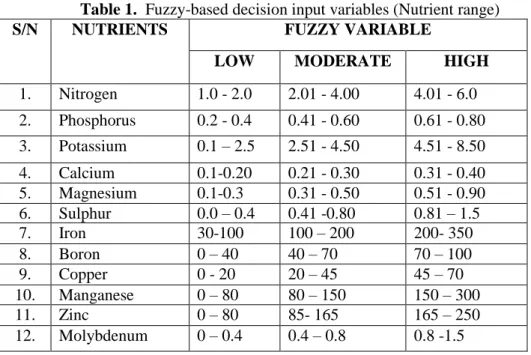
The fuzzy based inference decision system needs to get input supplied by the user. The compositional ranges of these nutrients are great determinants for the prediction of selected crop. These nutrients range have been grouped into three linguistic variables as shown in Table 1.
Table 1. Fuzzy-based decision input variables (Nutrient range)
S/N NUTRIENTS FUZZY VARIABLE
LOW MODERATE HIGH
1. Nitrogen 1.0 - 2.0 2.01 - 4.00 4.01 - 6.0 2. Phosphorus 0.2 - 0.4 0.41 - 0.60 0.61 - 0.80 3. Potassium 0.1 – 2.5 2.51 - 4.50 4.51 - 8.50 4. Calcium 0.1-0.20 0.21 - 0.30 0.31 - 0.40 5. Magnesium 0.1-0.3 0.31 - 0.50 0.51 - 0.90 6. Sulphur 0.0 – 0.4 0.41 -0.80 0.81 – 1.5
7. Iron 30-100 100 – 200 200- 350
8. Boron 0 – 40 40 – 70 70 – 100
9. Copper 0 - 20 20 – 45 45 – 70
10. Manganese 0 – 80 80 – 150 150 – 300
11. Zinc 0 – 80 85- 165 165 – 250
12. Molybdenum 0 – 0.4 0.4 – 0.8 0.8 -1.5
3.4. Fuzzy rule Knowledge Base
The knowledge base is a component where knowledge is developed, stored, organized, processed and disseminated. It consists of a database and a rule base. The database provides the necessary elements for defining the linguistic variables and rules using IF - THEN control constructs. The database includes a set of facts used to match against the IF (condition) parts of rules stored in the knowledge base. The rule knowledgebase for this paper follows the Mamdani rule formation. Table 2 shows some of the rules derived from the adoption of Mamdani rule.
Table 2. Sample fuzzy rules for crop prediction
S/N N P K Ca S Mg Fe B C Mn Zn Mo Crop type
1 H H H H H H H H H H H H Pumpkin leaf
2 H H M M M M M M H H H M Pumpkin
4 M M M M M M M M M M M M Eggplant leaf
5 M M M M M L M L L L M M Jute leaf
6 M M H H H H H H M M M M Pumpkin leaf
7 M L M M M H L M H L H L Waterleaf
8 H M H M M L L L L L L L Eggplant leaf
9. H H H H H H L H M L H H Pumpkin leaf
10. H M H M L M M L L L L L Bitter leaf
11. M L L M M M H L L M M H Jute leaf
12. H M H M L H M M L L L M Bitter leaf
13. M M M L H M L L M L L L Eggplant leaf
14. H M L M M M M L L M M L Jute leaf
15. M M L M M M L L L L M M Waterleaf
4. Implementation and Discussion
The Fuzzy-based decision support system was built on MATLAB because it integrates computation, visualization, and programming in an easy-to-use environment where problems and solutions are expressed in familiar mathematical notations.
MATLAB is a high-level matrix/array language with control flow statements, functions, data structures, input/output, and object-oriented programming features. It allows both "programming in the small" to rapidly create quick and dirty throw-away programs, and "programming in the large" to create complete large and complex application programs.
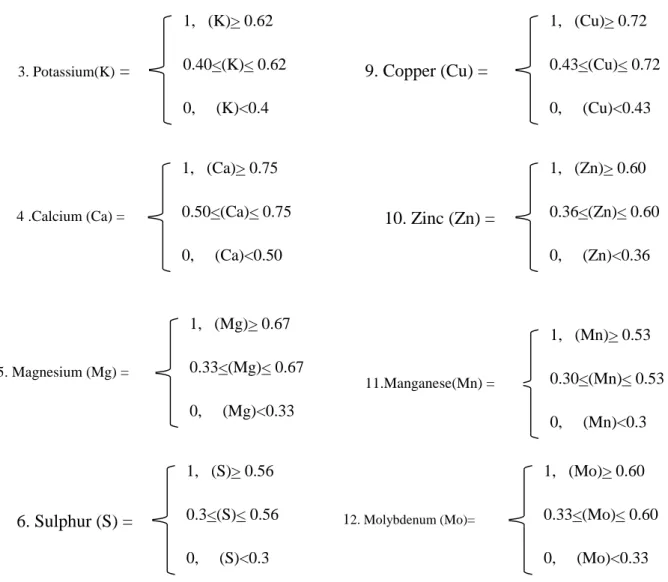
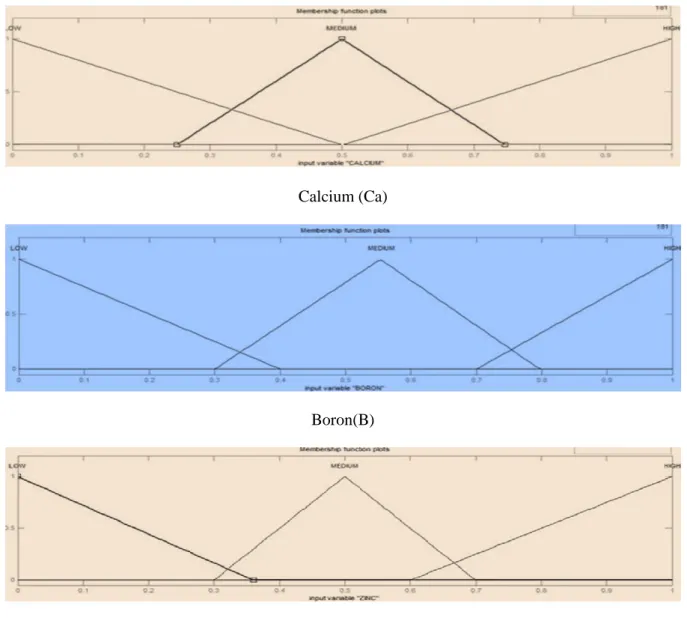
In this paper, the various soil nutrient ranges as shown in Table1 above were converted to their equivalent fuzzy sets to which individual membership function was assigned as depicted in figure 2 and figure 3 respectively below.
1, (N) > 0.67
0.25 <(N)< 0.67
0, (N)<0.25 1. Nitrogen (N) =
1, (Fe) > 0.71
0.4<(Fe)< 0.71
0, (Fe)<0.4
7. Iron (Fe) =
1, (B)> 0.7
0.4<(B)< 0.7
0, (B)<0.4
8. Boron (B) =
1, (P)> 0.60
0.4<(P)< 0.60
0, (P)<0.40
Figure 2. Fuzzy set representation of Input variables
Nitrogen (N)
Phosphorus (P)
1, (Zn)> 0.60
0.36<(Zn)< 0.60
0, (Zn)<0.36
10. Zinc (Zn) =
1, (Mo)> 0.60
0.33<(Mo)< 0.60
0, (Mo)<0.33 12. Molybdenum (Mo)=
1, (S)> 0.56
0.3<(S)< 0.56
0, (S)<0.3
6. Sulphur (S) =
1, (Mn)> 0.53
0.30<(Mn)< 0.53
0, (Mn)<0.3 11.Manganese(Mn) =
1, (Cu)> 0.72
0.43<(Cu)< 0.72
0, (Cu)<0.43
9. Copper (Cu) =
1, (Mg)> 0.67
0.33<(Mg)< 0.67
0, (Mg)<0.33 5. Magnesium (Mg) =
1, (Ca)> 0.75
0.50<(Ca)< 0.75
0, (Ca)<0.50 4 .Calcium (Ca) =
1, (K)> 0.62
0.40<(K)< 0.62
Potassium (K)
Sulphur (S)
Magnessium(Mg)
Iron (Fe)
Calcium (Ca)
Boron(B)
Zinc (Zn)
Figure 3. Input variable membership function plots
4.1. Fuzzy Logic Rule Editor and Viewer
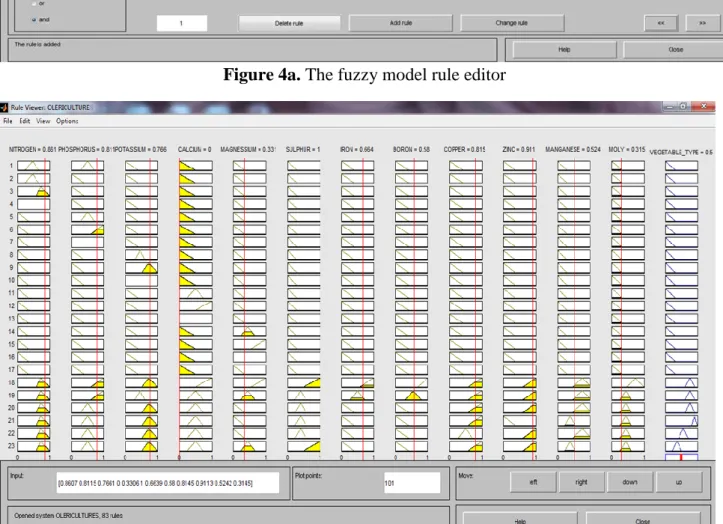
Figure 4a.
The fuzzy model rule editor
Figure 4b. Fuzzy model rule editor viewer
In addition, the output of a fuzzy system is a fuzzy set with an assigned membership function. This output may not be easily understood until it has been interpreted. In a bid to avoid difficulty in the interpretation of result and complexity in the determination of the vegetables to be planted a system was developed.
4.2. Discussion
The performance of the developed system was evaluated repeatedly to determine its correctness and accuracy. Soil samples data ranges used by the system were those shown in figure2. The ranges and membership functions are also depicted in Figure 3 depicted.
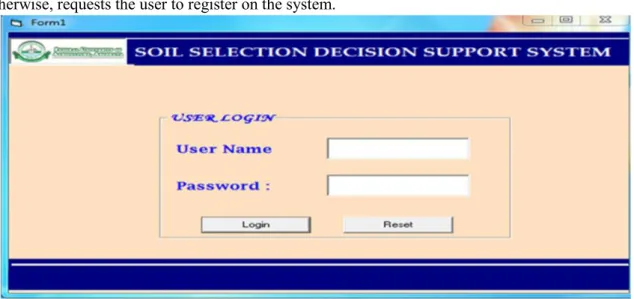
Figure 5 shows a screenshot of the “user login interface” for the system. The user will log into the system by providing login details which include a username and password. In the case of the user entering a wrong username or password, the system will authenticate the details supplied by the user and if otherwise, requests the user to register on the system.
Figure 5. User login interface for the developed system
For the authenticated user, a soil nutrients data interface, where the user selects linguistic variables of soil nutrient ranges is displayed as shown in Figure 6.
Figure 6. Decision support system with linguistic variables interface
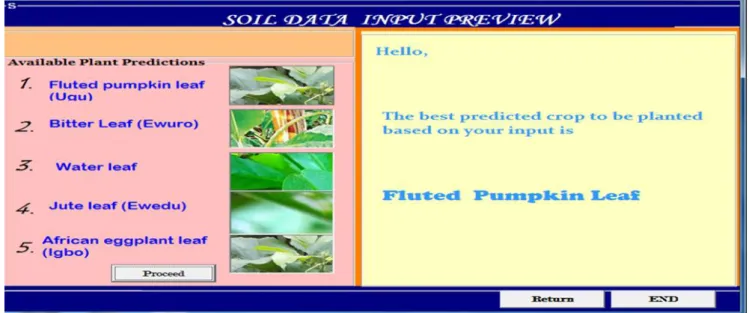
Figure 7. Result interface
Conclusion
As useful and important the computer is in this present age, its application in the area of agriculture must not be under estimated such as prediction of the best crop to be planted on farm land with specific soil samples that will result in optimum crop yield leading to the improved economic and financial status of farmers. Farmers should also be aware of the various ways soil nutrients can be lost and thus seek ways and methods to reduce nutrient lost. The inference derived from the result of tested soil samples also attest to the fact that the fuzzy based decision support developed is capable of accurately performing its intended function.
This paper reduces the challenges faced by farmers in the selection of soil by proposing a scientific method for selecting the best suitable soil for planting selected vegetables through an interactive fuzzy based decision support system and thus improves the economic status of farmers.
Furthermore, the system can be implemented as many times as possible thus overcoming the stressful challenge faced by human experts with other forms of shortcoming associated with traditional systems.
References
Azaza M.,Tanougast C., Fabrizio E, Mami A.,2016. Smart greenhouse fuzzy logic based control system enhanced with wireless data monitoring. ISA Transactions, Vol. 60, pp.297-307.
https://doi.org/10.1016/j.isatra.2015.12.006
Badifu, T.M and Gabriel I.O., 1993. Food potentials of some unconventional oilseeds grown in Nigeria: A Brief Review. Journal of Plant Foods for Human Nutrition, pp. 211-214.
Cook, R. 2001. The Dynamic U.S. Fresh Produce Industry: An Industry in Transition. Postharvest Technology of Horticultural Crops. University of California, Division of Agriculture and Natural Resources, Oakland,
California. Vol.3, p.15.
Corn S., Murray T., Openshaw S., See L., and Turton I., 1999. Using computational intelligence techniques to model sub glacial water systems. Journal of Geographical systems, Vol.1, pp. 37-60. https://doi.org/10.1007/s101090050004
Diasio S., Agell, N. 2009. The evolution of expertise in decision support technologies: A challenge for organizations. 13th International Conference Paper on Computer Supported Cooperative Work in Design. pp. 692–697. http://www.computer.org/portal/web/csdl/doi/10.1109/CSCWD.2009.4968139
Hackathorn, R.D., and Keen P. G. 1981. Organizational Strategies for Personal Computing in Decision Support Systems." MIS Quarterly, Vol. 5, No. 3, pp. 21-25. https://doi.org/10.2307/249288
Huddleston J.H., 1984. Development and use of soil productivity ratings in the United States.
Geoderma, Vol.32, issue 4, pp. 297-310. https://doi.org/10.1016/0016-7061(84)90009-0 Kalogirou, P.S. 2003.Uses of Computer in Agriculture: A scholarly Review. Available at
http://www.buzzzle.com/articles/uses-of-computers
Keen, P.G (1980). Decision support systems: A Research Perspective."Cambridge, Mass: Centre for Information Systems Research, Alfred P. Sloan School of Management. https://doi.org/10.1016/B978-0-08-027321-1.50007-9
Larson W.E. and Pierce F.J. 1994. The dynamics of soil quality as a Measure of Sustainable
Management in defining soil quality for a sustainable environment. SSSA Special Publication 35, Soil Science Society of America and American Society of Agronomy, pp. 37-50.
Letey, J.B et al. 2003. Deficiencies in the soil quality concept and its application. Journal of Soil and Water Conservation, 58: pp. 180–187.
Luis T., and Andreas, M. 2007. A Fuzzy Recommender System for Elections. International Journal of Intelligent Systems, University of Fribourg, Switzerland.Vol. 22, pp. 401– 410.
Okoli, B. E. and Mgbeogu, C. M. 1983. "Fluted Pumpkin, Telfairiaoccidentalis: West African
Vegetable Crop." Journal of the school of Biological Sciences, University of Port-Harcourt, vol. 37.2, pp. 45-49.
Regan, H. 2005. How are computers used in farming? An Online article available at http://www.ehow .com/facts_5850042_computers
Rossiter, D.G. and Wambeke A.R 1997. Automated Land Evaluation System. ALES version 4.65 user's manual. SCAS teaching series; Vol. T93-2, revision6,pp.12-25.http://www.itc.nl/rossiter/ Docs/ALES_V4.65_Manual.pdf
Rubatzky, V.E. and Yamaguchi, M. 1997. World Vegetables - Principals, Production, and Nutritive Values, 2nd edition. AVI Publishing, Westport, Connecticut, pp 603.
Sauter S., 2012, Fuzzy Decision support systems: An applied managerial approach. Journal of Intelligent and Fuzzy Systems. Vol. 20(3):123-136.
Silva J. A. and Uchida R. 2000. Essential Nutrients for Plant Growth: Nutrient Functions and Deficiency Symptoms. Journal of the College of Tropical Agriculture and Human Resources, University of Hawaii, Manoa.Honolulu, pp. 31-55.
Sprague, R. H. and Watson H.J. 1993. Decision support systems putting theory into practice. Englewood Cliffs, New Jersey, Prentice Hall International Editions. Vol.3, pp.400-425.
Tsangaratos P., Kallioras A., Pizpikis T.,Vasileiou E., Ilia I., and Pliakas F. 2017. Multi-criteria Decision Support System (DSS) for optimal locations of Soil Aquifer Treatment (SAT) facilities’ Science of The Total Environment, Vol. 603, pp. 472-486. https://doi.org/10.1016/j.scitotenv.2017.05.238
Vishwajith, K., Bhat, A., Ashalatha, K. and Sahu, P. K. 2014. Decision support system for fertilizer recommendation–A case study’ Indian Journal of Agronomy, Vol. 59, No. 2, pp. 344-349.