AN INVESTIGATION INTO THE RELATIONSHIP
BETWEEN VEHICLE COLOUR AND CRASH RISK
by
Stuart Newstead
Angelo D’Elia
Report No. 263
May 2007
Project Sponsored By
MONASH UNIVERSITY ACCIDENT RESEARCH CENTRE REPORT DOCUMENTATION PAGE
Report No. Date ISBN Pages
263 May 2007 0 7326 2333 2 20
Title: An Investigation into the Relationship between Vehicle Colour and Crash Risk
Author(s): Stuart Newstead & Angelo D’Elia
Sponsoring Organisation(s): This project was funded as contract research by the
following organisations: New South Wales Roads and Traffic Authority, NRMA Motoring and Services, Royal Automobile Club of Victoria, Transport Accident Commission, VicRoads.
Abstract:
This study has assessed the relationship between vehicle colour and crash risk through the analysis of real crash outcomes described in mass crash data reported to police in two Australian states. A stratified induced exposure study design was employed identifying vehicle to vehicle crashes and crashes involving unprotected road users as those having a risk dependent on vehicle colour whilst exposure was induced from single vehicle crash involvement. Analysis was stratified by vehicle type, light conditions and jurisdiction of crash.
Results of the analysis identified a clear statistically significant relationship between vehicle colour and crash risk. Compared to white vehicles, a number of colours were associated with higher crash risk. These colours are generally those lower on the visibility index and include black, blue, grey, green, red and silver. No colour was statistically significantly safer than white although a number of other colours could not be distinguished from white statistically in terms of relative crash risk. The association between vehicle colour and crash risk was strongest during daylight hours where relative crash risks were higher for the colours listed compared to white by up to around 10%. Comparison of analysis results between the two states of Australia analysed suggested that vehicle colour also has an association with crash severity with lower visibility colours having higher risks of more severe crashes. Furthermore, the results also suggested that environmental factors can also modify the relationship between vehicle colour and crash risk although further work is required to quantify this.
Key Words: Disclaimer:
Crash risk, vehicle colour, statistical analysis, induced
exposure This report is disseminated in the interest of information exchange. The views expressed here are those of the authors, and not necessarily those of Monash University.
Reproduction of this page is authorised. Monash University Accident Research Centre
Building 70, Clayton Campus Wellington Road, Clayton Monash University VIC 3800 Australia Telephone: +61 3 9905 4371, Fax: +61 3 9905 4363 www.monash.edu.au/muarc
Preface
Project Manager / Team Leader:
Dr. Stuart Newstead
Research Team:
Contents
EXECUTIVE SUMMARY...vii
1 INTRODUCTION & AIMS...1
1.1 LITERATURE REVIEW ...1
1.2 AIMS ...2
2 DATA...2
3 METHODOLOGY ...3
3.1 INDUCED EXPOSURE METHODS ...3
3.1.1 Identification of Crash Groups ...3
3.2 STATISTICAL ANALYSIS ...4
3.2.1 Model Formulation...4
3.2.2 Extension of the Model ...5
3.2.3 Estimation of Average Effects...6
4 RESULTS ...7
5 DISCUSSION ...9
6 CONCLUSION...13
7 REFERENCES ...14
EXECUTIVE SUMMARY
An often asked question regarding vehicle safety is whether vehicle colour has an influence on crash risk and if so, what is the differential in risk between the various colours of vehicles available. Identifying a measurable difference would enable a more informed choice to be made with regard to safety outcomes. Relatively few studies have been undertaken to investigate the relationship and have produced conflicting outcomes. The major objective of this project was to re-assess the relationship between vehicle colour and crash risk through the analysis of real crash outcomes described in mass crash data. The study aimed to achieve this through application of an alternative study design based on induced exposure methods in order to address the apparent weaknesses in prior studies. Police reported crash data from the two states where vehicle colour was available, namely Victoria and Western Australia, during 1987-2004 assembled for the Used Car Safety Rating (UCSR) project formed the basis of the data used in this study. The Victorian data covered 102,559 injured drivers of 1982 to 2004 model vehicles involved in Police reported crashes during 1987 to 2004 that resulted in injury. The Western Australian data included 752,699 drivers of vehicles manufactured between 1982 and 2004 involved in Police reported crashes during 1991 to 2004 that resulted in injury or a vehicle being towed away. Vehicles were classified into 17 colour categories.
A stratified induced exposure study design was employed to estimate relative crash risks associated with each vehicle colour. Vehicle to vehicle crashes and crashes involving unprotected road users were defined as those having a risk dependent on vehicle colour whilst exposure was induced from single vehicle crash involvement. Analysis was stratified by vehicle type, light conditions and jurisdiction of crash to both adjust the overall estimates of crash risk for the confounding effects of these factors as well as to allow crash risk associated with vehicle colour to be estimated within levels of these factors. The analysis models estimated a crash risk associated with each vehicle colour relative to a reference colour which was chosen to be white.
Results of the analysis identified a clear statistically significant relationship between vehicle colour and crash risk. Compared to white vehicles, a number of colours were associated with higher crash risk. These colours are generally those lower on the visibility index and include black, blue, grey, green, red and silver. No colour was statistically significantly safer than white although a number of other colours could not be distinguished from white statistically in terms of relative crash risk. The association between vehicle colour and crash risk was strongest during daylight hours where relative crash risks were higher for the colours listed compared to white by up to around 10%. Comparison of analysis results between the two states of Australia analysed suggested that vehicle colour also has an association with crash severity with lower visibility colours having higher risks of more severe crashes. Furthermore, the results also suggested that environmental factors can also modify the relationship between vehicle colour and crash risk although further work is required to quantify this.
1 INTRODUCTION
&
AIMS
An often asked question regarding vehicle safety is whether vehicle colour has an influence on crash risk and if so, what is the differential in risk between the various colours of vehicles available. Identifying a measurable difference would enable a more informed choice to be made. Relatively few studies have been undertaken to investigate the relationship and have generally used questionable or potentially flawed methodology. 1.1 LITERATURE REVIEW
A literature search was performed for work which investigated the relationship between vehicle colour and crash risk. Resources covering both transportation and medical research were included. Numerous studies have examined the issue of visibility and colour however relatively few studies have investigated the question of whether vehicle colour has an influence on crash risk.
One study attempting to address this question using a case-control design was published in the British Medical Journal during 2003 (Furness et al., 2003). It concluded that silver cars were 50% less likely to be involved in a crash resulting in serious injury than white cars. However, a number of weaknesses are evident in this study. Whilst the case-control design attempted to match for a number of confounding factors, some that are possibly critical to the results obtained were not included. The first of these is vehicle type. The market sector a vehicle is from may determine both its colour and crash risk simultaneously. An example of this is commercial vehicles that are predominantly white and might be expected to have a relatively high crash risk due to high exposure. Second, there may be an association between colour choice and driver safety culture or, more broadly, personality traits of the driver. For example, a more conservative, safety conscious, family buyer may choose silver whilst someone with a more sporting pretence to their driving behaviour, and hence higher crash risk, may choose a colour such as black or yellow.
In contrast to the work published in the British Medical Journal, a prior study published in
Epidemiology during 2002 (Lardelli-Claret et al., 2002) found that light (white and yellow) coloured vehicles were associated with a slightly lower risk of being passively involved in a collision compared with vehicles of other colours. A paired case-control study was used with data from a database of traffic crashes. Only collisions where one of the drivers committed an infraction were included with violators constituting the control group and other drivers forming the case group. Driver, vehicle and environmental variables were also collected and a logistic regression analysis was run to obtain odds ratios adjusted for certain driver and vehicle characteristics. Although this study attempted to account for a large number of confounding factors, perhaps to a greater extent than Furness et al. (2003), the study design still contains the inherent weakness that it is not possible to adjust the results for unknown, unmeasured or unmeasurable confounding factors.
In their paper on the influence of colour on fire vehicle accidents, Solomon & King (1995) use probability theory to show that lime-yellow/white fire vehicles are significantly statistically safer than red and red/white fire vehicles. They refer to research by Allen (1970) which states that the luminance of a well-worn highway and the luminance of its scenery are about the same. Light colours, which include white and yellow, are the most visible against this background. They also point to work by Southall (1961) which states that the relative brightness of the various parts of the daylight spectrum as it appears to a normal bright-adapted eye reaches its peak somewhere in the greenish-yellow region.
1.2 AIMS
As evident from the difference in results between the studies previously undertaken, there is still some uncertainty about the role of vehicle colour in influencing crash risk. Consequently, a need was identified to further investigate the issue, ideally avoiding the use of case-control methodologies and the inherent weaknesses evident in this approach when applied to the problem of interest.
The major objective of this project was to re-assess the relationship between vehicle colour and crash risk through the analysis of real crash outcomes described in mass crash data. The study aimed to achieve this through application of an alternative study design based on induced exposure methods in order to address the apparent weaknesses in prior studies.
2 DATA
Police reported crash data assembled for the Used Car Safety Rating (UCSR) project (Newstead et al., 2006) formed the basis of the data used in this study. The UCSR project utilised data from Australian and New Zealand crashes during 1987-2004. However, because vehicle colour is only recorded in the UCSR crash data from the Australian states Victoria and Western Australia, only crash data from these states was used in this study. Nonetheless, there was considered to be sufficient data to achieve meaningful analysis outcomes.
The Victorian data covered 102,559 injured drivers of 1982 to 2004 model vehicles involved in Police reported crashes during 1987 to 2004 that resulted in injury. The Western Australian data included 752,699 drivers of vehicles manufactured between 1982 and 2004 involved in Police reported crashes during 1991 to 2004 that resulted in injury or a vehicle being towed away.
For the analysis, the Victorian and Western Australian data were combined and variables which allowed for stratification along the lines of key variables of interest were prepared. These included light condition at the time of crash, vehicle type, crash injury severity and state. In addition, the relatively large number of variations on vehicle colour in the Western Australian data was reduced to match the 17 colours used in the Victorian data. The colour classifications used were:
Black White Blue Mauve
Brown Orange
Cream Pink
Fawn Purple
Gold Red
Green Silver
Grey Yellow
Maroon
Clearly, there is potential for significant variation in actual vehicle colour hues and saturation within each colour category. However, this was the maximum resolution the data allowed for analysis.
Cases involving commercial vehicles (a majority of which are white) and Victorian taxis (which are mostly yellow) were discarded from the analysis due to significant differences
in the way these vehicles are often used and the narrower range of environments (typically urban) in which they are used. Furthermore, the relative uniformity of colour of these vehicle types did not allow adequate contrasting in the analysis design.
3 METHODOLOGY
3.1 INDUCED EXPOSURE METHODS
One of the key weaknesses noted in the case-control study designs of Furness et al. (2003) and Lardelli-Claret et al. (2002) was the limited range of measurable confounding factors that could be controlled in the analysis. Failure to measure and match key factors influencing crash risk in the case-control design can lead to significant bias in the measures association between the key feature of interest, vehicle colour, and the measured outcome, crash risk. This study uses an alternative study design based on induced exposure methods which offers the potential to more definitively assess the relationship between crash risk and vehicle colour by intrinsically controlling for confounding factors, including those which are generally unmeasurable.
A recent study assessing changes in crash risk associated with Anti-lock Braking Systems (ABS) brake presence in a vehicle (Burton et al., 2004) has demonstrated the use of induced exposure methods on Australian crash data sources to measure primary safety outcomes. Like the current study, the ABS brake study used induced exposure measures to measure crash risk in the absence of a more traditional exposure measure such as travel. The successful use of the method relied on the existence of a crash type not influenced by the focus feature to both induce a baseline measure of exposure and to control for other confounding factors influencing crash risk. In the ABS braking study, side impact crashes were used to induce exposure. Evans (1998) also demonstrates the use of induced exposure methods to measure ABS brake effectiveness in the USA.
For the current study investigating the influence of vehicle colour on crash risk, use of induced exposure methods required identification of a crash type unaffected by vehicle colour as well as those potentially dependent on vehicle colour. Appropriate selection of the comparison group of crashes is critical since all specific non-colour related factors affecting crash risk, such as driver type or vehicle market group, need to be implicitly controlled for in the base comparison crash type. A well specified induced exposure design offers the potential to overcome many of the deficiencies noted in the British Medical Journal and Epidemiology studies of crash risk relating to vehicle colour.
3.1.1 Identification of Crash Groups
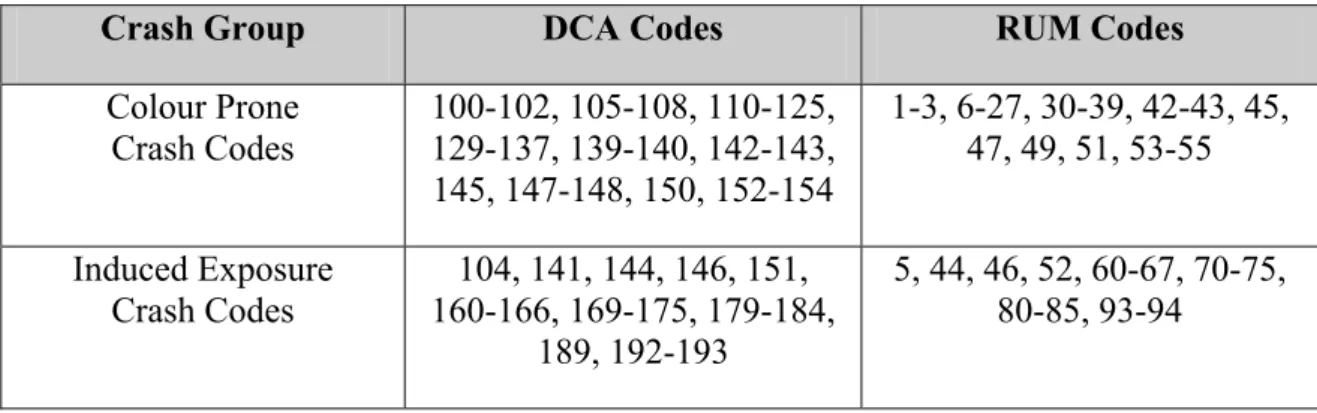
Crash types potentially affected and unaffected by vehicle colour were identified using the variables Definitions for Classifying Accidents (DCA) for the Victorian data and Road User Movements (RUM) for Western Australia. In general, crash types affected by vehicle colour were those where the visibility of the vehicle was potentially a factor in the crash occurring. These were generally vehicle to vehicle crashes including those that occurred at intersections and those where vehicles were travelling in the same and opposite directions as well as crashes where a pedestrian was struck. The induced exposure crash types were those where visibility of the vehicle was not likely to have been a factor. These included single vehicle crashes and crashes with parked vehicles or other stationary objects. Through the use of crash type, the combined data was therefore split into two vehicle crash groups, namely the colour prone crash group and the induced exposure crash group. The DCA and RUM codes of the crash types assigned to each group are given in Table 3.1.
Table 3.1RUM and DCA Codes Assigned to Colour Related and Induced Exposure Crash Groups
Crash Group DCA Codes RUM Codes
Colour Prone Crash Codes
100-102, 105-108, 110-125, 129-137, 139-140, 142-143, 145, 147-148, 150, 152-154
1-3, 6-27, 30-39, 42-43, 45, 47, 49, 51, 53-55 Induced Exposure
Crash Codes 160-166, 169-175, 179-184, 104, 141, 144, 146, 151, 189, 192-193
5, 44, 46, 52, 60-67, 70-75, 80-85, 93-94
3.2 STATISTICAL ANALYSIS
A log-linear Poisson regression analysis was used to investigate the relationship between vehicle colour and crash risk. This method uses a class of statistical Generalised Linear Model (GLM) incorporating a log transformation of the response variable (crash counts) and assumes a Poisson error structure for the outcome data. The Poisson error structure is consistent with the assumption that crash count data follows a Poisson distribution (Nicholson, 1985 and Nicholson, 1986). The log transformation of the crash counts reflects the non-negative nature of crash counts and ensures that fitted values from the model are non-negative.
3.2.1 Model Formulation
Figure 3.1 defines a contingency table for the analysis of differences in the risk of crash involvement attributable to vehicle colour. One car colour, say white, is chosen as a baseline against which to compare each of the other colours. Relative crash risks are estimated for each colour of vehicle relative to white (ψwhite = 1, ψblack, …, ψyellow)
Confidence intervals for these odds ratios are calculated and tests of the hypothesis that they are individually equal to unity are carried out. Specifically, the null hypothesis being tested is that there is no difference in the risk of crash involvement attributable to vehicle colour. The alternative hypothesis states that the risk of involvement does differ between white vehicles and vehicles of a different colour.
Figure 3.1 Contingency Table Layout
Vehicle Colour
White Black … Yellow
Colour Prone
Crash Group n10 n11 … n1y
Vehicle Crash
Group Induced Exposure
In terms of the contingency table representation of crashes in Figure 3.1, a crash effect attributable to vehicle colour will be reflected in an interactive effect on cell counts between the rows and columns of the table. A log-linear model framework to test for the statistical significance of the interactive effect has been described by Brühning and Ernst (1985). A log-linear Poisson regression model for the contingency table above is defined by Equation 4.1.
gc gc c g gc
n )=α+β +γ +δ +ε
ln( (4.1)
where n is the cell crash count assumed to follow a Poisson distribution;
g is the index for vehicle crash group (0 = Induced Exposure, 1 = Colour Prone);
c is the index for vehicle colour (0 = White, 1 = Black, …, y = Yellow);
α, β, γ, δ are parameters of the model; and
ε is a random error term. 3.2.2 Extension of the Model
Although the model defined by Equation 4.1 estimates the crash effect attributable to vehicle colour, in practice it may be influenced by light condition (daylight, dawn or dusk, dark), vehicle type (cars, four wheel drives) or state (Victoria, Western Australia). Therefore it is of interest to assess the crash effect by these factors. In addition, it is necessary to control for the confounding effects of these factors on the estimated crash risks should they not be balanced equally between the various vehicle colours. This is achieved through a stratification of the data and extension of the analysis model.
The Poisson regression model for the analysis of crash effects attributable to vehicle colour by light condition, vehicle type and state is an extension of that described by Equation 4.1. The extended model is given by Equation 4.2 and is essentially Equation 4.1 with each term interacted with a light condition, vehicle type and state variable.
lvsgc lvsgc lvsc lvsg lvsgc
n )=α+β +γ +δ +ε
ln( (4.2)
where n is the cell crash count assumed to follow a Poisson distribution;
l is the index for light condition (Daylight, Dawn or Dusk, Dark);
v is the index for vehicle type (Cars, Four Wheel Drives);
s is the index for state (Victoria, Western Australia);
g is the index for vehicle crash group (0 = Induced Exposure, 1 = Colour Prone);
c is the index for vehicle colour (0 = White, 1 = Black, …, y = Yellow);
α, β, γ, δ are parameters of the model; and
In order to obtain direct estimates of the crash effect attributable to vehicle colour, one level of each of the categorical variables must be aliased through setting the associated parameter to zero. For ease of interpretation of the remaining parameters, it is most convenient to alias the parameters that correspond to the zero levels of the variables vehicle crash group, which is induced exposure, and vehicle colour, which is white. Which of the levels of the variables light condition, vehicle type and state are aliased is not important.
Aliasing in this way leaves the parameters δlvs1c,c = 1, 2, …, y, as direct estimates of the
crash effect attributable to each vehicle colour relative to white for each light condition, vehicle type and state. The crash risk odds ratio for each vehicle colour relative to white is given by Equation 4.3.
y c
c lvs c
lvs1 =exp(δ 1 ), =1,2,K,
ψ (4.3)
The (1 – k) × 100% confidence limits can be calculated for the parameters δlvs1c, c = 1, 2,
…, y using Equation 4.4 where zk is the kth percentile of the standard normal distribution.
y c
e s
zk lvsc
c
lvs . .( 1 ), 1,2, , 2
1 ± × δ = K
δ (4.4)
The confidence limit for the parameter estimate can be transformed into a confidence limit for the estimated odds ratio by applying Equation 4.3 to each bound of the parameter confidence limit.
3.2.3 Estimation of Average Effects
Use of the extended model to estimate the crash effect attributable to vehicle colour across light condition, vehicle type and state means that the model of Equation 4.2 can be modified subtly to provide an average crash effect across light condition, vehicle type, state or a combination of these variables. This involves a subtle modification to Equation 4.2 replacing the 5-way interaction term δlvsgc with 2-way, 3-way or 4-way interaction
terms. To assess:
Crash risk overall, the term δlvsgc becomes the 2-way interaction term δgc;
Crash risk by light condition, the term δlvsgc becomes the 3-way interaction term
δlgc;
Crash risk by state, the term δlvsgc becomes the 3-way interaction term δsgc;
Crash risk by light condition and state, the term δlvsgc becomes the 4-way
interaction term δlsgc;
Crash risk by vehicle type, the term δlvsgc becomes the 3-way interaction term δvgc;
Crash risk by light condition and vehicle type, the term δlvsgc becomes the 4-way
For each of the above, calculation of the odds ratio and confidence limits are as before but based on the new overall effect parameter.
4 RESULTS
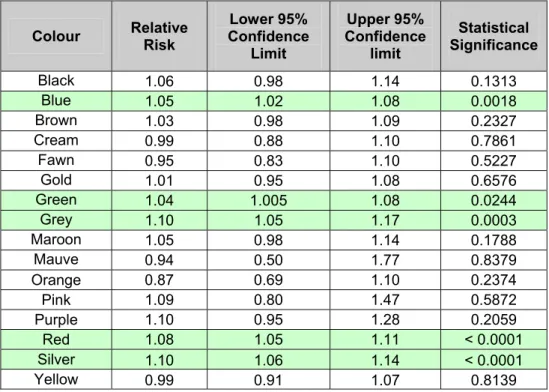
The estimated crash risk relative to white for the extended model overall are shown in Table 4.1. The estimated relative risks are derived from Equation 4.3 using the appropriate model overall parameter. Given along with the estimated odds ratios are 95% confidence limits on the estimates as well as the statistical significance of the estimates. Low statistical significance values indicate the crash risk effect attributable to vehicle colour is unlikely to have arisen through chance variation in the data.
Table 4.1 Estimated Crash Risk Odds Ratios Relative to White – Extended Model Overall
Colour Relative Risk Confidence Lower 95% Limit
Upper 95% Confidence
limit
Statistical Significance
Black 1.06 0.98 1.14 0.1313
Blue 1.05 1.02 1.08 0.0018
Brown 1.03 0.98 1.09 0.2327
Cream 0.99 0.88 1.10 0.7861
Fawn 0.95 0.83 1.10 0.5227
Gold 1.01 0.95 1.08 0.6576
Green 1.04 1.005 1.08 0.0244
Grey 1.10 1.05 1.17 0.0003
Maroon 1.05 0.98 1.14 0.1788
Mauve 0.94 0.50 1.77 0.8379
Orange 0.87 0.69 1.10 0.2374
Pink 1.09 0.80 1.47 0.5872
Purple 1.10 0.95 1.28 0.2059
Red 1.08 1.05 1.11 < 0.0001
Silver 1.10 1.06 1.14 < 0.0001
Yellow 0.99 0.91 1.07 0.8139
For the extended model overall, Table 4.1 shows highly statistically significantly increased crash risk for the colours red and silver and statistically significantly increased crash risk for the colours blue, green and grey. All of these colours demonstrate a higher crash risk relative to white. None of the vehicle colours indicating a lower crash risk relative to white are statistically significant.
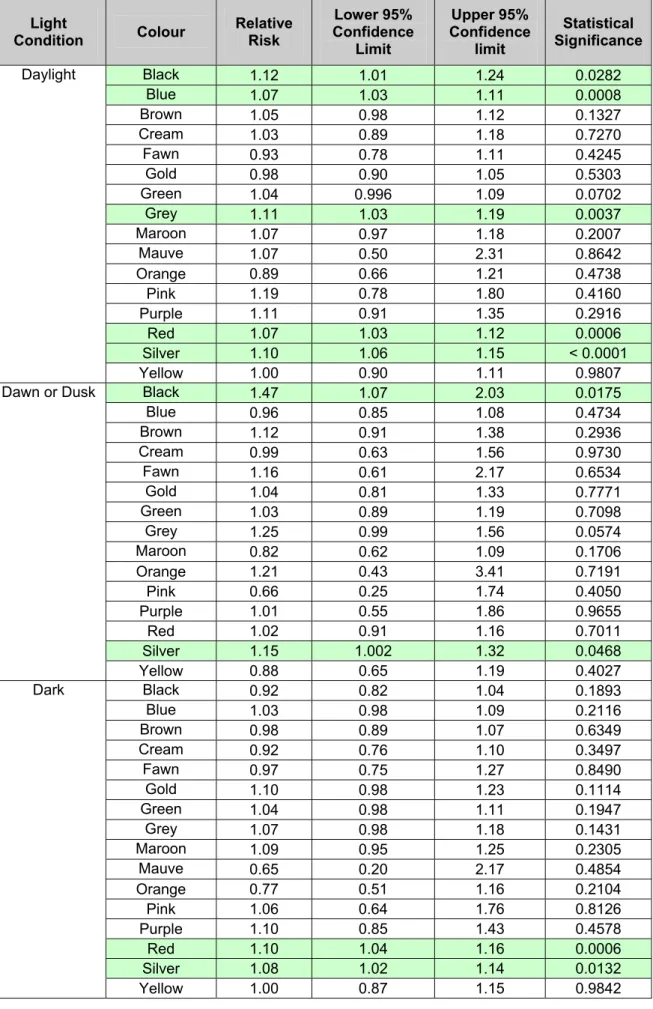
The estimated crash risk odds ratios relative to white for the extended model by light condition are shown in Table 4.2. The estimated odds ratios are derived from Equation 4.3 using the appropriate model by light condition parameter. Given along with the estimated odds ratios are 95% confidence limits on the estimates as well as the statistical significance of the estimates.
Table 4.2 Estimated Crash Risk Odds Ratios Relative to White – Extended Model by Light Condition
Light
Condition Colour Relative Risk
Lower 95% Confidence Limit Upper 95% Confidence limit Statistical Significance
Daylight Black 1.12 1.01 1.24 0.0282
Blue 1.07 1.03 1.11 0.0008
Brown 1.05 0.98 1.12 0.1327
Cream 1.03 0.89 1.18 0.7270
Fawn 0.93 0.78 1.11 0.4245
Gold 0.98 0.90 1.05 0.5303
Green 1.04 0.996 1.09 0.0702
Grey 1.11 1.03 1.19 0.0037
Maroon 1.07 0.97 1.18 0.2007
Mauve 1.07 0.50 2.31 0.8642
Orange 0.89 0.66 1.21 0.4738
Pink 1.19 0.78 1.80 0.4160
Purple 1.11 0.91 1.35 0.2916
Red 1.07 1.03 1.12 0.0006
Silver 1.10 1.06 1.15 < 0.0001
Yellow 1.00 0.90 1.11 0.9807
Dawn or Dusk Black 1.47 1.07 2.03 0.0175
Blue 0.96 0.85 1.08 0.4734
Brown 1.12 0.91 1.38 0.2936
Cream 0.99 0.63 1.56 0.9730
Fawn 1.16 0.61 2.17 0.6534
Gold 1.04 0.81 1.33 0.7771
Green 1.03 0.89 1.19 0.7098
Grey 1.25 0.99 1.56 0.0574
Maroon 0.82 0.62 1.09 0.1706
Orange 1.21 0.43 3.41 0.7191
Pink 0.66 0.25 1.74 0.4050
Purple 1.01 0.55 1.86 0.9655
Red 1.02 0.91 1.16 0.7011
Silver 1.15 1.002 1.32 0.0468
Yellow 0.88 0.65 1.19 0.4027
Dark Black 0.92 0.82 1.04 0.1893
Blue 1.03 0.98 1.09 0.2116
Brown 0.98 0.89 1.07 0.6349
Cream 0.92 0.76 1.10 0.3497
Fawn 0.97 0.75 1.27 0.8490
Gold 1.10 0.98 1.23 0.1114
Green 1.04 0.98 1.11 0.1947
Grey 1.07 0.98 1.18 0.1431
Maroon 1.09 0.95 1.25 0.2305
Mauve 0.65 0.20 2.17 0.4854
Orange 0.77 0.51 1.16 0.2104
Pink 1.06 0.64 1.76 0.8126
Purple 1.10 0.85 1.43 0.4578
Red 1.10 1.04 1.16 0.0006
Silver 1.08 1.02 1.14 0.0132
For the extended model by light condition, Table 4.2 shows that none of the vehicle colours indicating a lower crash risk relative to white are statistically significant. Statistically significant results for the light condition daylight show that the colour black has a 12% higher crash risk relative to white, followed by grey (11% higher), silver (10% higher) and blue and red (both 7% higher). For the light condition dawn or dusk, statistically significant results occur for the vehicle colours black and silver with higher crash risks relative to white of 47% and 15% respectively. A marginally statistically significant result occurs for the colour grey (25% higher crash risk relative to white).
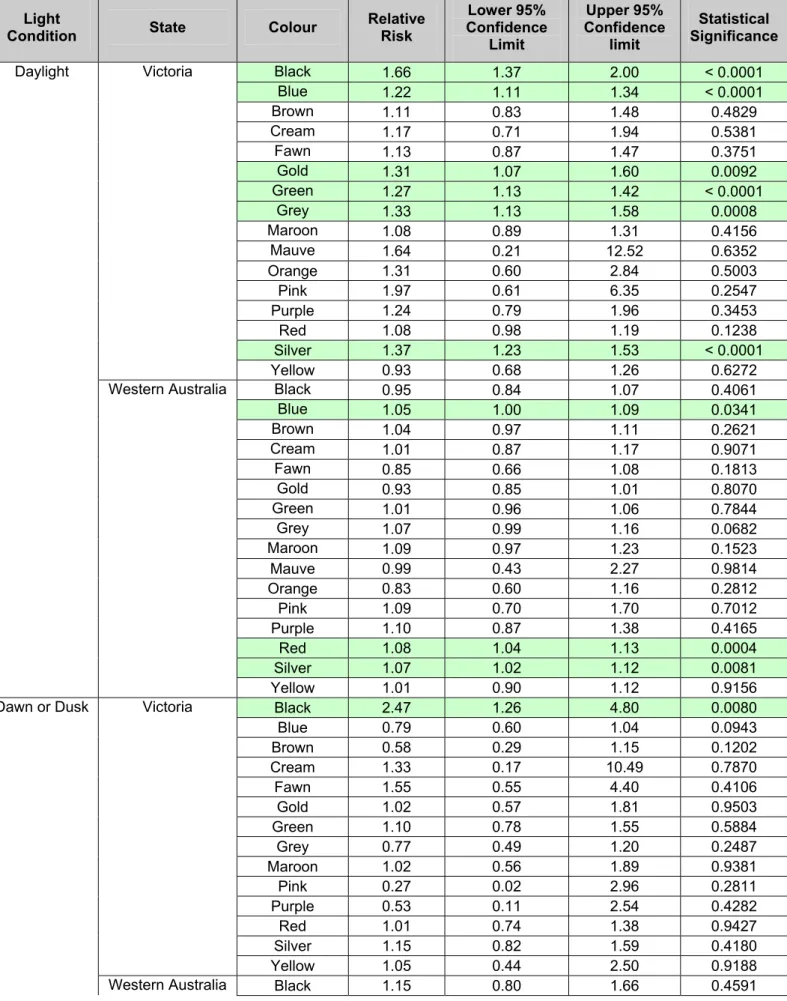
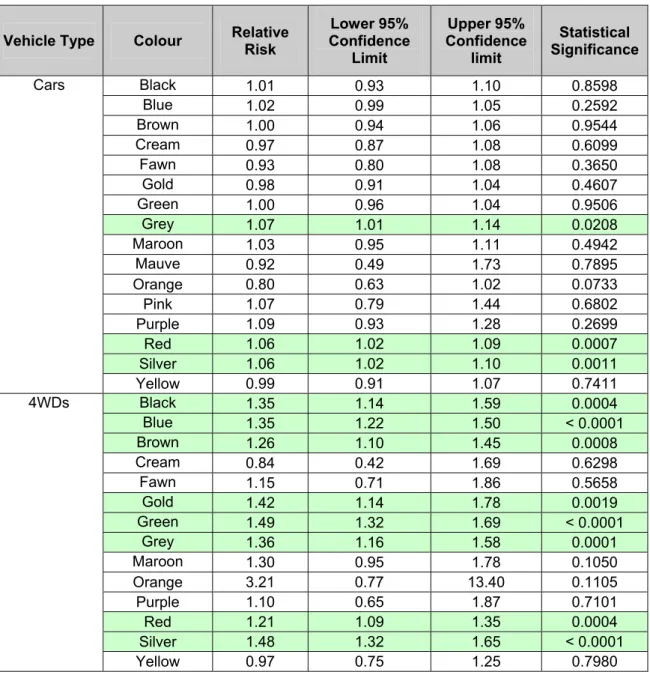
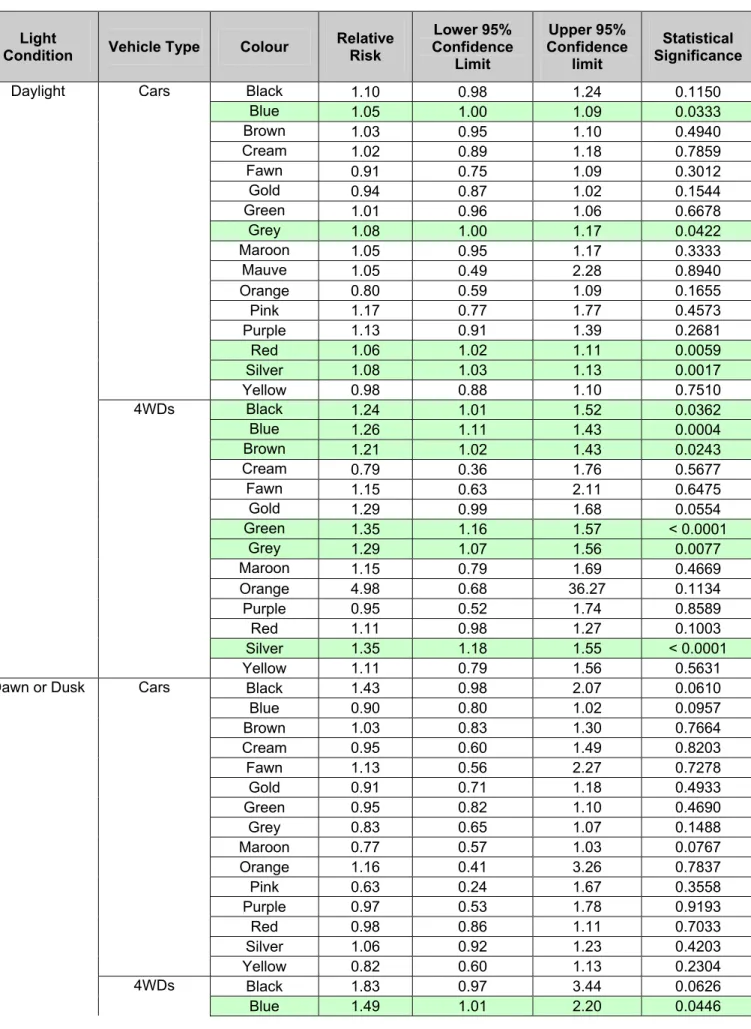
The estimated crash risk odds ratios relative to white for the extended model by state, by light condition and state, by vehicle type and by light condition and vehicle type are shown in Appendix 1.
5 DISCUSSION
Government agencies and automobile clubs in Australia report a high level of consumer interest in the issue of crash risk related to vehicle colour. As identified in the literature, there have only been a small number of studies attempting to address this issue. Unfortunately the results published from these studies are conflicting which does little for providing solid consumer advice. The two major prior studies attempting to research the issue have both been based on case-control designs. Case-control designs can provide good statistical analysis power when examining rare outcomes, hence their popularity in medical research. However, the strength of the analysis outcomes relies heavily on how well the control crashes are matched to the case crashes on all important factors affecting the outcome of interest apart from the factor being assessed. As noted, there are some concerns about how well the cases and controls have been matched in the previously published studies on vehicle colour and crash risk.
Ideally, crash risk would be best assessed through the use of an appropriate exposure measure such as vehicle travel. Such exposure measures are generally not available on a vehicle by vehicle basis required for studying the effects of specific vehicle properties such as colour. Furthermore, exposure based crash risk measures still need to be adjusted for the influence of confounding factors that may differ between levels of the factor of interest before unbiased estimates of the influence of the factor of interest on crash risk can be assessed. Like the case control study, the confounding factors are not always available in the analysis data and in some instances cannot be readily measured.
Use of an induced exposure design for this study offered the potential to overcome the lack of suitable exposure data whilst making maximum use of the available crash data. It also offered potential to overcome the limitations of case-control studies and address the research hypothesis in a different analytical setting. Certainly, driver behavioural characteristics associated with vehicle colour choice which are difficult to measure in the case control study can be better controlled in the induced exposure setting since vehicle crash distributions within the same colour type are being compared. However, induced exposure studies can have some of the similar failings to case-control studies if the crash type from which exposure is induced does not appropriately represent exposure in the group affected by the factor of interest. Key confounding factors identified in this study include type of vehicle being driven, the light conditions and jurisdiction of crash. Using the stratified induced exposure design allowed the adjustment of the analysis results for the confounding influences of each of these factors. Conveniently, it also allowed differential effects of vehicle colour on crash risk to be assessed within the levels of each of these confounding factors. The fact that differential relative crash risks by vehicle colour were
found between the levels of the confounding factors justifies the need for their control in the analysis. Whether there are other factors that should also have been controlled for in the analysis is difficult to assess and ultimately must be judged on the intuitive nature of the results and their relationship to other established research data.
The results from the analysis using the induced exposure study design, presented in Section 4, are generally intuitive. Vehicle colour effects on crash risk were greatest in daylight hours compared to twilight or dark times. This makes intuitive sense since use of vehicle lighting in twilight and at night reduces contrast differences between different vehicle colours. Use of daytime running lights or headlights during the day in Australia is not common hence visibility differences between vehicles would be left largely due to the colour of the vehicle.
Of the statistically significant results for daylight hours, black, grey and silver vehicles were estimated to have the highest crash risks relative to white of 12%, 11% and 10% higher respectively. The other statistically significant results were for the colours blue and red which were also estimated to have higher crash risks relative to white. Although relative risks for the twilight and dark analyses were generally less, there were still some statistically significant results. For the Dawn or Dusk stratum, the results for black and silver vehicles were again statistically significant with a nearly statistically significant result being achieved for grey. In this case black vehicles were found to have a 47% higher crash risk relative to white, silver 15% higher and grey 25% higher. All the statistically significant results are for colours that are low on the visibility spectrum or low in contrast to key road features, such as the grey of the road surface, again an intuitive result.
The results for silver vehicles in particular are in direct contrast with the study by Furness et al. (2003) which concluded that silver cars were 50% less likely to be involved in a crash resulting in serious injury than white cars. However the results are generally consistent with the investigation of Lardelli-Claret et al. (2002) which found that light (white and yellow) coloured vehicles were associated with a slightly lower risk of being passively involved in a collision compared with vehicles of other colours. As the results in Tables 4.1 and 4.2 demonstrate, none of the vehicle colours that indicate a lower estimated crash risk relative to white (including yellow) are statistically significant.
It was stated earlier that cases involving commercial vehicles (a majority of which are white) and Victorian taxis (which are mostly yellow) were removed for this study. The strength of using induced exposure methods lies in the ability of the induced exposure group to take into account influencing factors, especially unknown, unmeasured or unmeasurable confounding factors. In this way the inherent weaknesses of prior vehicle colour studies were largely overcome. Although the stratified induced exposure methods have the advantage of accounting for confounding factors effectively, the method by which the colour prone and induced exposure crash groups were identified relies on an assumed constant proportional exposure split between the colour dependent and induced exposure crash types across all vehicle colours. For this reason it was deemed sensible to remove commercial vehicles and taxis. Such vehicles are driven predominantly in the metropolitan location and would therefore be more prone to the types of crashes that occur there, in particular, vehicle to vehicle crashes and crashes where a pedestrian was struck. This would see a bias towards inclusion of these vehicles in the colour prone crash group. Including taxis would see a biased crash risk estimated for yellow vehicles whilst including commercial vehicles would bias the results for all vehicle colours which were estimated relative to the colour white.
One key limitation in interpreting the results of this study relates to the definition and interpretation of the vehicle colour classifications. Obviously, vehicle colours cover an almost infinite spectrum of hues and saturations. Due to pragmatic requirements, vehicle registers are forced to record these into a fixed number of discrete classifications. Consequently, there will be significant variation in the tomes of colour classified within each of the 17 colour groupings used for this study. For example, blue can range from a shade close to black up to almost silver. The visibility index across this range and hence possibly the associated crash risk could vary significantly within the one colour classification. To be borne in mind when interpreting the results is that they represent the average risk across all colour variations within the defined category of vehicle colour. Comparison of the relative crash risks for each vehicle colour between the two Australian states from which data was drawn for this study shows significant variation. In general, Table A1 of Appendix 1 shows there is a much higher dispersion in the crash risk odds estimated for Victoria than for Western Australia. There are two possible reasons for this. First, Australian Bureau of meteorology historical statistics show Western Australia has more hours of sunshine annually than Victoria and a lower number of rainy days. This suggests that visibility in Western Australia may be generally better and hence the influence of vehicle colour on crash risk correspondingly less than in Victoria. A second key difference is in the reporting criteria for road crashes between the two states. The official police reported crash data in Victoria only includes crashes involving someone being injured. In contrast, Western Australia’s crash data includes non-injury crashes where a vehicle is towed from the crash scene or a minimum damage cost is reached. As such, the relative crash risks associated with vehicle colour estimated for Victoria are relative risks of an injury crash whereas results for Western Australia give the relative risks of all crashes of tow-away or greater severity. The overall results given in Table 4 are a weighted average of results from the two states. Differential crash risks associated with vehicle colour by crash severity would explain the difference in results between the two states.
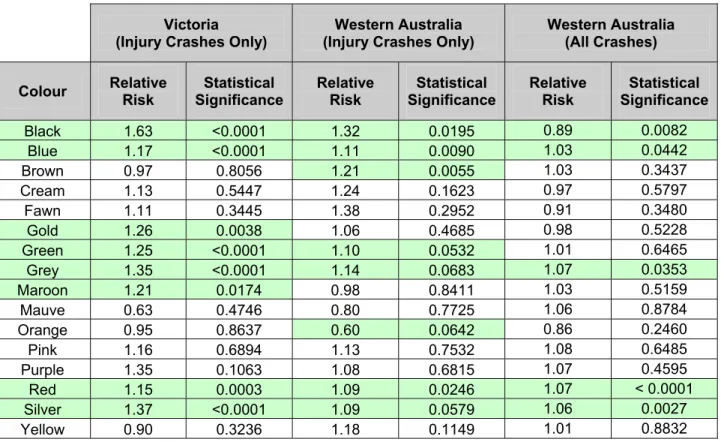
To investigate the relative influence of crash reporting basis and environmental conditions on the differences in relative risks estimated between the two states, a further analysis was undertaken restricted to injury-only crashes in Western Australia. Results are summarised in Table 5.1 which shows the relative crash risk associated with each vehicle colour compared to white for injury crashes in Victoria and Western Australia and for all crashes in Western Australia for direct comparison. Results indicate differential effects of vehicle colour on crash risk across different crash severity levels. Comparing the all crash results with injury crash results for Western Australia show larger relative crash risks for injury crashes than for all crashes indicating vehicle colour not only affects crash risk but also relative crash severity with lower visibility colours being involved in higher severity crashes. Similarly, comparing the relative injury only crash risk estimates between Victoria and Western Australia suggests there are also environmental factors that affect crash risk. Relative crash risks associated with vehicle colour seem to have a greater variation in Victoria where there is less sunshine and more rainy days compared to Western Australia. Although sunshine hours and rainy days have been noted as key differences between the states, it is not possible from the results of this study to identify which environmental factors in particular lead to the differences in vehicle colour effects on crash risk.
Table 5.1 Comparison of Relative Crash Risks Associated with Vehicle Colour by State and Crash Severity Levels
Victoria
(Injury Crashes Only) (Injury Crashes Only) Western Australia Western Australia (All Crashes)
Colour Relative Risk Significance Statistical Relative Risk Significance Statistical Relative Risk Significance Statistical
Black 1.63 <0.0001 1.32 0.0195 0.89 0.0082
Blue 1.17 <0.0001 1.11 0.0090 1.03 0.0442
Brown 0.97 0.8056 1.21 0.0055 1.03 0.3437
Cream 1.13 0.5447 1.24 0.1623 0.97 0.5797 Fawn 1.11 0.3445 1.38 0.2952 0.91 0.3480
Gold 1.26 0.0038 1.06 0.4685 0.98 0.5228
Green 1.25 <0.0001 1.10 0.0532 1.01 0.6465
Grey 1.35 <0.0001 1.14 0.0683 1.07 0.0353
Maroon 1.21 0.0174 0.98 0.8411 1.03 0.5159
Mauve 0.63 0.4746 0.80 0.7725 1.06 0.8784
Orange 0.95 0.8637 0.60 0.0642 0.86 0.2460
Pink 1.16 0.6894 1.13 0.7532 1.08 0.6485 Purple 1.35 0.1063 1.08 0.6815 1.07 0.4595
Red 1.15 0.0003 1.09 0.0246 1.07 < 0.0001
Silver 1.37 <0.0001 1.09 0.0579 1.06 0.0027
Yellow 0.90 0.3236 1.18 0.1149 1.01 0.8832
Another apparent difference in the influence of vehicle colour on crash risk highlighted by the analysis results is between vehicle types. Tables A3 and A4 of the Appendix show the relative crash risks between various colours vary much more for 4WD vehicles than for other passenger cars with darker coloured 4WDs having much higher relative crash risks than the same coloured regular passenger cars. The reasons behind this result remain unclear but could be related to the lower dynamic abilities of 4WDs giving less opportunity for such vehicles to avoid crashes in circumstances where they were not seen by the collision partner. Further research would be required to better understand this result.
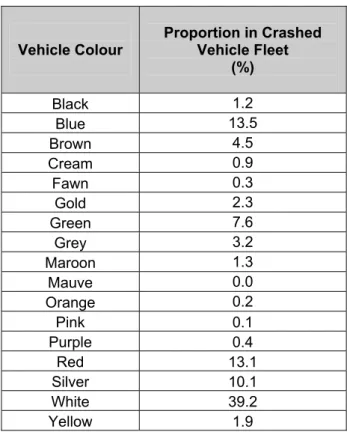
Given the results of this study are likely to be used for consumer advice it is important to consider their practical meaning and significance. A basic finding of the study has been to confirm that the colour of a vehicle can significantly influence the risk of being involved in a crash, particularly in daylight hours when no vehicle lighting is generally being used. The colours that tend to be associated with higher crash risk are generally those lower on the visibility index such as black, blue, grey, green, red and silver. Although black, grey and silver appear to have the highest relative crash risk compared to white, statistically it is not possible to give a firm ranking of risk due to the level of statistical uncertainty in the estimated risks. No colour was statistically significantly safer than white although a number of other colours could not be distinguished from white statistically in terms of relative crash risk. Appropriate consumer advice would be to avoid purchasing vehicles of those colours associated with a statistically significantly higher crash risk than white. Table 5.2 shows the percentage breakdown of colours of vehicles appearing in the crash data analysed. It shows that whilst white is by far the most prevalent colour, vehicles with colours associated with a crash risk significantly higher than white represent almost 50% of all vehicles. This suggests there could be significant reductions made in reducing the
overall crash risk of the vehicle fleet by influencing consumers choice of vehicle colour away from those higher risk colours. It is important, however, to keep the magnitude of the potential risk modification in perspective. Whilst campaigns to modify vehicle colour choice could alter crash risk for the fleet as a whole between 5 and 10 percent over the life cycle of the vehicle fleet, colour is a much less influential crash risk modifier than behavioural traits such as drink driving and speeding which can alter crash risks by orders of magnitude. Technologies such as Electronic Stability Program have also proven to be greater modifiers of overall crash risk and hence should receive higher priority for consumer awareness. Furthermore, it may be possible that simple solutions such as the use of daytime running lights or headlights could effectively negate the elevated risks of those identified higher risk vehicle colours. However further research on the interaction between vehicle colour and the use of daytime running light on crash risk would need to be conducted before this recommendation could be made on an evidence base.
Table 5.2Percentage Representation of Each Vehicle Colour in the Crash Data
Vehicle Colour Proportion in Crashed Vehicle Fleet (%)
Black 1.2
Blue 13.5
Brown 4.5
Cream 0.9
Fawn 0.3
Gold 2.3
Green 7.6
Grey 3.2
Maroon 1.3
Mauve 0.0
Orange 0.2
Pink 0.1 Purple 0.4
Red 13.1 Silver 10.1 White 39.2 Yellow 1.9
6 CONCLUSION
This study has assessed the relationship between vehicle colour and crash risk. This was achieved through the analysis of real crash outcomes described in mass crash data using induced exposure methods. Results of the analysis identified a clear statistically significant relationship between vehicle colour and crash risk. Compared to white vehicles, a number of colours were associated with higher crash risk. These colours are generally those lower on the visibility index and include black, blue, grey, green, red and silver. No colour was statistically significantly safer than white although a number of other colours could not be distinguished from white statistically in terms of relative crash risk. The association between vehicle colour and crash risk was strongest during daylight hours where relative crash risks were higher for the colours listed compared to white by up to around 10%.
Comparison of analysis results between the two states of Australia analysed suggested that vehicle colour also has an association with crash severity with lower visibility colours having higher risks of more severe crashes. Furthermore, the results also suggested that environmental factors can also modify the relationship between vehicle colour and crash risk although further work is required to quantify this.
7 REFERENCES
Allen, M. (1970) Vision and highway safety, Chilton Book Company.
Brühning, E. & Ernst, G. (1985), Log-Linear Models in Effectiveness Studies – An Application to Simultaneous Before-After Comparisons with Control Group, Evaluation ’85, International Meeting on the Evaluation of Local Traffic Safety Measures, Paris. Burton, D., Delaney, A., Newstead, S., Logan, D. & Fildes, B. (2004) Evaluation of Anti-lock Braking Systems Effectiveness, Research report 04/01, Royal Automobile Club of Victoria, Melbourne, Australia.
Evans, L. (1998) ‘Antilock brake systems and risk of different types of crashes in traffic’, Paper Number 98-S2-O-12, Proceedings 16th International Technical Conference on the Enhanced Safety of Vehicles (ESV),Windsor, Ontario, Canada, May 31- June 4, 1998. Furness, S., Connor, J., Robinson, E., Norton, R., Ameratunga, S. & Jackson, R. (2003) ‘Car colour and risk of car crash injury: population based case control study’, British Medical Journal, Vol. 327, No. 7429, pp. 1455-1456.
Lardelli-Claret, P., de Dios Luna-del-Castillo, Jiménez-Moleón, J., Femia-Marzo, P., Moreno-Abril, O. & Bueno-Cavanillas, A. (2002) ‘Does Vehicle Color Influence the Risk of Being Passively Involved in a Collision?’, Epidemiology, Vol. 13, No. 6, pp. 721-724. Newstead, S., Cameron, M. & Watson, L. (2006) Vehicle safety ratings estimated from police reported crash data: 2006 update, Report No. 248, Monash University Accident Research Centre, Melbourne, Australia.
Nicholson, A. J., (1985). The Variability of Accident Counts. Accident Analysis and Prevention 17(1), pp. 47-56.
Nicholson, A. J., (1986). The Randomness of Accident Counts. Accident Analysis and Prevention 18(3), pp. 193-198.
Solomon, S. & King, J. (1995) ‘Influence of Color on Fire Vehicle Accidents’, Journal of Safety Research, Vol. 26, No. 1, pp. 41-48.
APPENDIX 1 – Additional Results
Table A.1 Estimated Crash Risk Odds Ratios Relative to White – Extended Model by State
State Colour Relative Risk Confidence Lower 95% Limit
Upper 95% Confidence
limit
Statistical Significance
Victoria Black 1.63 1.42 1.88 < 0.0001
Blue 1.17 1.09 1.26 < 0.0001
Brown 0.97 0.79 1.20 0.8056
Cream 1.13 0.76 1.67 0.5447
Fawn 1.11 0.90 1.37 0.3445
Gold 1.26 1.08 1.48 0.0038
Green 1.25 1.15 1.36 < 0.0001
Grey 1.35 1.18 1.53 < 0.0001
Maroon 1.21 1.03 1.41 0.0174
Mauve 0.63 0.18 2.24 0.4746
Orange 0.95 0.54 1.69 0.8637
Pink 1.16 0.55 2.46 0.6894
Purple 1.35 0.94 1.95 0.1063
Red 1.15 1.07 1.24 0.0003
Silver 1.37 1.25 1.49 < 0.0001
Yellow 0.90 0.72 1.11 0.3236
Western Australia Black 0.89 0.81 0.97 0.0082
Blue 1.03 1.00 1.07 0.0442
Brown 1.03 0.97 1.08 0.3437
Cream 0.97 0.87 1.08 0.5797
Fawn 0.91 0.74 1.11 0.3480
Gold 0.98 0.91 1.05 0.5228
Green 1.01 0.97 1.05 0.6465
Grey 1.07 1.01 1.13 0.0353
Maroon 1.03 0.94 1.13 0.5159
Mauve 1.06 0.51 2.22 0.8784
Orange 0.86 0.66 1.11 0.2460
Pink 1.08 0.78 1.50 0.6485
Purple 1.07 0.90 1.26 0.4595
Red 1.07 1.04 1.11 < 0.0001
Silver 1.06 1.02 1.10 0.0027
Table A.2Estimated Crash Risk Odds Ratios Relative to White – Extended Model by Light Condition and State
Light
Condition State Colour Relative Risk
Lower 95% Confidence Limit Upper 95% Confidence limit Statistical Significance
Daylight Victoria Black 1.66 1.37 2.00 < 0.0001
Blue 1.22 1.11 1.34 < 0.0001
Brown 1.11 0.83 1.48 0.4829
Cream 1.17 0.71 1.94 0.5381
Fawn 1.13 0.87 1.47 0.3751
Gold 1.31 1.07 1.60 0.0092
Green 1.27 1.13 1.42 < 0.0001
Grey 1.33 1.13 1.58 0.0008
Maroon 1.08 0.89 1.31 0.4156
Mauve 1.64 0.21 12.52 0.6352
Orange 1.31 0.60 2.84 0.5003
Pink 1.97 0.61 6.35 0.2547
Purple 1.24 0.79 1.96 0.3453
Red 1.08 0.98 1.19 0.1238
Silver 1.37 1.23 1.53 < 0.0001
Yellow 0.93 0.68 1.26 0.6272
Western Australia Black 0.95 0.84 1.07 0.4061
Blue 1.05 1.00 1.09 0.0341
Brown 1.04 0.97 1.11 0.2621
Cream 1.01 0.87 1.17 0.9071
Fawn 0.85 0.66 1.08 0.1813
Gold 0.93 0.85 1.01 0.8070
Green 1.01 0.96 1.06 0.7844
Grey 1.07 0.99 1.16 0.0682
Maroon 1.09 0.97 1.23 0.1523
Mauve 0.99 0.43 2.27 0.9814
Orange 0.83 0.60 1.16 0.2812
Pink 1.09 0.70 1.70 0.7012
Purple 1.10 0.87 1.38 0.4165
Red 1.08 1.04 1.13 0.0004
Silver 1.07 1.02 1.12 0.0081
Yellow 1.01 0.90 1.12 0.9156
Dawn or Dusk Victoria Black 2.47 1.26 4.80 0.0080
Blue 0.79 0.60 1.04 0.0943
Brown 0.58 0.29 1.15 0.1202
Cream 1.33 0.17 10.49 0.7870
Fawn 1.55 0.55 4.40 0.4106
Gold 1.02 0.57 1.81 0.9503
Green 1.10 0.78 1.55 0.5884
Grey 0.77 0.49 1.20 0.2487
Maroon 1.02 0.56 1.89 0.9381
Pink 0.27 0.02 2.96 0.2811
Purple 0.53 0.11 2.54 0.4282
Red 1.01 0.74 1.38 0.9427
Silver 1.15 0.82 1.59 0.4180
Yellow 1.05 0.44 2.50 0.9188
Blue 1.01 0.88 1.14 0.9393
Brown 1.18 0.95 1.47 0.1368
Cream 0.98 0.62 1.56 0.9299
Fawn 0.90 0.40 2.01 0.7960
Gold 1.04 0.79 1.37 0.7994
Green 1.00 0.86 1.17 0.9670
Grey 1.45 1.11 1.89 0.0064
Maroon 0.75 0.54 1.04 0.0843
Orange 1.04 0.37 2.97 0.9381
Pink 0.76 0.26 2.22 0.6219
Purple 1.11 0.57 2.15 0.7535
Red 1.02 0.90 1.17 0.7354
Silver 1.14 0.98 1.33 0.0826
Yellow 0.85 0.62 1.18 0.3424
Dark Victoria Black 1.50 1.19 1.89 0.0005
Blue 1.18 1.04 1.34 0.0110
Brown 0.89 0.62 1.27 0.5194
Cream 1.05 0.55 2.01 0.8867
Fawn 1.01 0.70 1.47 0.9395
Gold 1.23 0.93 1.63 0.1542
Green 1.24 1.07 1.45 0.0042
Grey 1.55 1.23 1.95 0.0002
Maroon 1.53 1.16 2.03 0.0029
Pink 0.73 0.22 2.38 0.6039
Purple 1.83 0.93 3.61 0.0798
Red 1.32 1.16 1.51 < 0.0001
Silver 1.41 1.21 1.63 < 0.0001
Yellow 0.85 0.61 1.18 0.3207
Western Australia Black 0.76 0.66 0.88 0.0003
Blue 1.02 0.96 1.08 0.5571
Brown 0.97 0.89 1.07 0.5704
Cream 0.90 0.74 1.09 0.2749
Fawn 1.07 0.73 1.55 0.7370
Gold 1.08 0.96 1.23 0.2106
Green 1.02 0.95 1.09 0.6794
Grey 1.00 0.90 1.11 0.9905
Maroon 0.99 0.85 1.16 0.9441
Mauve 1.32 0.28 6.20 0.7283
Orange 0.87 0.55 1.37 0.5424
Pink 1.15 0.66 2.01 0.6191
Purple 1.01 0.76 1.33 0.9654
Red 1.07 1.01 1.13 0.0268
Silver 1.03 0.96 1.10 0.3930
Table A.3Estimated Crash Risk Odds Ratios Relative to White – Extended Model by Vehicle Type
Vehicle Type Colour Relative Risk Confidence Lower 95% Limit
Upper 95% Confidence
limit
Statistical Significance
Cars Black 1.01 0.93 1.10 0.8598
Blue 1.02 0.99 1.05 0.2592
Brown 1.00 0.94 1.06 0.9544
Cream 0.97 0.87 1.08 0.6099
Fawn 0.93 0.80 1.08 0.3650
Gold 0.98 0.91 1.04 0.4607
Green 1.00 0.96 1.04 0.9506
Grey 1.07 1.01 1.14 0.0208
Maroon 1.03 0.95 1.11 0.4942
Mauve 0.92 0.49 1.73 0.7895
Orange 0.80 0.63 1.02 0.0733
Pink 1.07 0.79 1.44 0.6802
Purple 1.09 0.93 1.28 0.2699
Red 1.06 1.02 1.09 0.0007
Silver 1.06 1.02 1.10 0.0011
Yellow 0.99 0.91 1.07 0.7411
4WDs Black 1.35 1.14 1.59 0.0004
Blue 1.35 1.22 1.50 < 0.0001
Brown 1.26 1.10 1.45 0.0008
Cream 0.84 0.42 1.69 0.6298
Fawn 1.15 0.71 1.86 0.5658
Gold 1.42 1.14 1.78 0.0019
Green 1.49 1.32 1.69 < 0.0001
Grey 1.36 1.16 1.58 0.0001
Maroon 1.30 0.95 1.78 0.1050
Orange 3.21 0.77 13.40 0.1105
Purple 1.10 0.65 1.87 0.7101
Red 1.21 1.09 1.35 0.0004
Silver 1.48 1.32 1.65 < 0.0001
Table A.4Estimated Crash Risk Odds Ratios Relative to White – Extended Model by Light Condition and Vehicle Type
Light
Condition Vehicle Type Colour Relative Risk
Lower 95% Confidence Limit Upper 95% Confidence limit Statistical Significance
Daylight Cars Black 1.10 0.98 1.24 0.1150
Blue 1.05 1.00 1.09 0.0333
Brown 1.03 0.95 1.10 0.4940
Cream 1.02 0.89 1.18 0.7859
Fawn 0.91 0.75 1.09 0.3012
Gold 0.94 0.87 1.02 0.1544
Green 1.01 0.96 1.06 0.6678
Grey 1.08 1.00 1.17 0.0422
Maroon 1.05 0.95 1.17 0.3333
Mauve 1.05 0.49 2.28 0.8940
Orange 0.80 0.59 1.09 0.1655
Pink 1.17 0.77 1.77 0.4573
Purple 1.13 0.91 1.39 0.2681
Red 1.06 1.02 1.11 0.0059
Silver 1.08 1.03 1.13 0.0017
Yellow 0.98 0.88 1.10 0.7510
4WDs Black 1.24 1.01 1.52 0.0362
Blue 1.26 1.11 1.43 0.0004
Brown 1.21 1.02 1.43 0.0243
Cream 0.79 0.36 1.76 0.5677
Fawn 1.15 0.63 2.11 0.6475
Gold 1.29 0.99 1.68 0.0554
Green 1.35 1.16 1.57 < 0.0001
Grey 1.29 1.07 1.56 0.0077
Maroon 1.15 0.79 1.69 0.4669
Orange 4.98 0.68 36.27 0.1134
Purple 0.95 0.52 1.74 0.8589
Red 1.11 0.98 1.27 0.1003
Silver 1.35 1.18 1.55 < 0.0001
Yellow 1.11 0.79 1.56 0.5631
Dawn or Dusk Cars Black 1.43 0.98 2.07 0.0610
Blue 0.90 0.80 1.02 0.0957
Brown 1.03 0.83 1.30 0.7664
Cream 0.95 0.60 1.49 0.8203
Fawn 1.13 0.56 2.27 0.7278
Gold 0.91 0.71 1.18 0.4933
Green 0.95 0.82 1.10 0.4690
Grey 0.83 0.65 1.07 0.1488
Maroon 0.77 0.57 1.03 0.0767
Orange 1.16 0.41 3.26 0.7837
Pink 0.63 0.24 1.67 0.3558
Purple 0.97 0.53 1.78 0.9193
Red 0.98 0.86 1.11 0.7033
Silver 1.06 0.92 1.23 0.4203
Yellow 0.82 0.60 1.13 0.2304
4WDs Black 1.83 0.97 3.44 0.0626
Brown 1.65 0.97 2.80 0.0628
Fawn 1.43 0.31 6.57 0.6461
Gold 3.37 1.20 9.50 0.0216
Green 2.16 1.25 3.74 0.0060
Grey 1.53 0.84 2.77 0.1645
Maroon 1.46 0.42 5.11 0.5533
Red 1.36 0.91 2.04 0.1293
Silver 2.09 1.32 3.31 0.0016
Yellow 1.39 0.47 4.15 0.5546
Dark Cars Black 0.85 0.75 0.97 0.0156
Blue 1.00 0.94 1.05 0.8738
Brown 0.94 0.86 1.04 0.2382
Cream 0.90 0.74 1.08 0.2488
Fawn 0.96 0.73 1.27 0.7899
Gold 1.06 0.95 1.20 0.3037
Green 0.99 0.93 1.06 0.8758
Grey 1.03 0.94 1.14 0.5180
Maroon 1.05 0.91 1.20 0.5186
Mauve 0.64 0.19 2.11 0.4605
Orange 0.75 0.49 1.13 0.1703
Pink 1.04 0.63 1.71 0.8881
Purple 1.07 0.81 1.39 0.6448
Red 1.07 1.01 1.13 0.0208
Silver 1.03 0.97 1.10 0.2825
Yellow 1.03 0.89 1.19 0.7286
4WDs Black 1.53 1.12 2.09 0.0079
Blue 1.58 1.29 1.94 < 0.0001
Brown 1.31 1.00 1.72 0.0488
Cream 0.96 0.24 3.90 0.9589
Fawn 1.08 0.43 2.76 0.8640
Gold 1.49 0.95 2.35 0.0829
Green 1.79 1.40 2.29 < 0.0001
Grey 1.48 1.10 2.01 0.0099
Maroon 1.67 0.91 3.06 0.0954
Orange 1.09 0.10 12.01 0.9458
Purple 1.58 0.57 4.34 0.3781
Red 1.45 1.18 1.79 0.0005
Silver 1.72 1.36 2.17 < 0.0001