Standards-Based Nutrition Education
Vegetables:
Color Your Plate
With
Great-Tasting Veggies
Try to eat more dark-green, red, and orange vegetables, and beans and peas.
Grains:
Make at Least
Half Your Grains
Whole Grains
Choose whole-grain foods, such as whole-wheat bread, oatmeal, whole-wheat tortillas, brown rice, and popcorn, more often.Protein:
Vary Your
Protein Foods
Try fish, shellfish, beans, and peas more often. Some tasty ways include a bean burrito, hummus, veggie chili, fish taco, shrimp stir-fry, or grilled salmon.
Dairy:
Get Your
Calcium-Rich
Foods
Choose fat-free or low-fat milk, yogurt, and cheese at meals or snacks. Dairy foods contain calcium for strong bones and healthy teeth.
Fruits:
Fuel Up With
Fruits at Meals
or Snacks
Pears, watermelon, plums, raisins, berries, and applesauce (without extra sugar) are just a few of the great choices. Make sure your fruit juice is 100% juice.
Keep on Moving!
Kids need at least 60 minutes of physical activity every day. Whether that’s running, biking, tossing a ball, or playing tag, every little bit counts. So, run around at recess, jump rope with friends, ride your scooter, or play a sport. It all adds up!
Know Your “Sometimes” Foods
Look out for foods with added sugars or solid fats, such as candy, cake, cookies, chips, ice cream, soda, fruit punch, lemonade, hot dogs, and bacon. They fill you up so that you don’t have room for the foods that help you eat smart and play hard. Enjoy these every once in a while, not every day.
SERVING UP
MyPlate
3
Teachers
LETTER TO
What are healthy food choices? What is a balanced diet? The U.S. Department of Agriculture’s Food and Nutrition Service is providing these lessons under its Team Nutrition initiative in order to help teachers integrate nutrition education into Math, Science, English Language Arts, and Health. This yummy curriculum introduces the importance of eating from all five food
groups using the new MyPlate icon and a variety
of hands–on activities. Students will also learn the importance of physical activity to staying healthy. In this Teacher’s Guide, you’ll find three inquiry-driven
lessons that help 3rd and 4th grade children discover
nutrition, explain their understandings, and reflect upon their experiences — all of which encourage a lasting awareness of what it means to be healthy. In addition to subject-driven learning, each lesson offers valuable and easy-to-implement cafeteria activities and home connections. We encourage you to include these in your planning, as they will provide your students with further practice and real-world experience. Let parents know what their children will be learning about in class so they can support these new skills at home.
You will also find:
• A Pacing Guide: time required per activity and recommended pacing to help you plan each lesson
• Teacher’s Morsels: helpful resources, background, and tips
• Extra Helpings: ideas on how to extend the learning beyond the lesson
• Savor the Learning: valuable ways to connect the learning to the school cafeteria and/or students’ homes to provide real-world practice
• Student Handouts: easily reproducible handouts designed to appeal to students while reinforcing lesson objectives
• Three Original Songs: Alive With 5 Food Groups and
Do/Be help students learn about healthy choices in an engaging and memorable way and are incorporated into the lessons. Dancing and singing along to an
additional song called Do Your Body Right may
be a fun extension activity in the third lesson. We invite you to listen to it ahead of time to determine whether your class would enjoy it. All of the songs are provided on the enclosed CD, along with the lyrics, and may be downloaded at http://teamnutrition. usda.gov/myplate.html.
• Eat Smart To Play Hard With MyPlate Poster: a
two-sided poster showing the MyPlate icon and foods
in the five food groups. The blank MyPlate on the
reverse can be used as a tool to assess students’ understanding.
• MyPlate at Home: a colorful handout to share with parents that reinforces the lesson at home. It’s also available in Spanish. Additional copies are free for schools at http://teamnutrition.usda.gov/myplate.html. We hope you and your students enjoy the process of learning how to make healthy choices. It’s an education that will last a lifetime!
Sincerely,
Your Friends at Team Nutrition
Dear Teacher,
United States Department of Agriculture
Food and Nutrition Service • FNS-445 September 2012
The U.S. Department of Agriculture (USDA) prohibits discrimination in all of its programs and activities on the basis of race, color, national origin, age, disability, and where applicable, sex (including gender identity and expression), marital status, familial status, parental status, religion, sexual orientation, political beliefs, genetic information, reprisal, or because all or part of an individual's income is derived from any public assistance program. (Not all prohibited bases apply to all programs.) Persons with disabilities who require alternative means for communication of program information (Braille, large print, audiotape, etc.) should contact USDA's TARGET Center at (202) 720-2600 (voice and TDD).
To file a complaint of discrimination, write to USDA, Assistant Secretary for Civil Rights, Office of the Assistant Secretary for Civil Rights, 1400 Independence Avenue, S.W., Stop 9410, Washington, DC 20250-9410; or call toll-free at (866) 632-9992 (English) or (800) 877-8339 (TDD) or (866) 377-8642 (English Federal-relay) or (800) 845-6136 (Spanish Federal-relay). USDA is an equal opportunity provider and employer.
4
Contents
TABLE OF
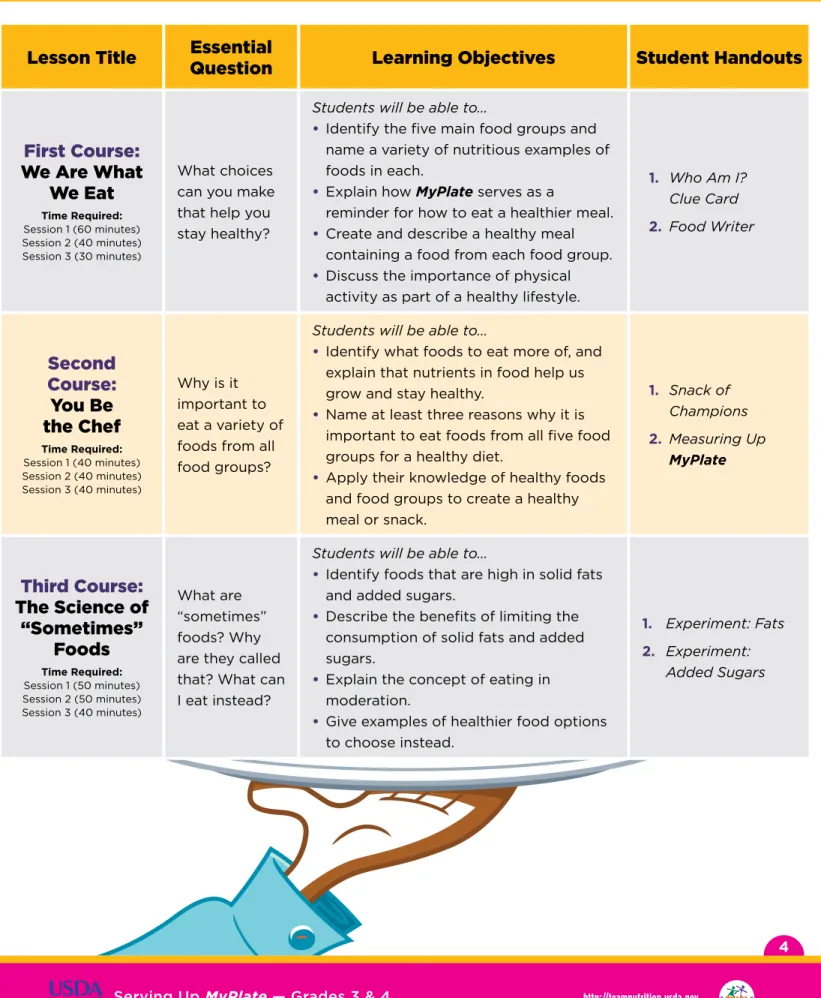
Lesson Title
Question
Essential
Learning Objectives
Student Handouts
First Course:
We Are What
We Eat
Time Required:
Session 1 (60 minutes) Session 2 (40 minutes) Session 3 (30 minutes)
What choices can you make that help you stay healthy?
Students will be able to…
• Identify the five main food groups and
name a variety of nutritious examples of foods in each.
• Explain how MyPlate serves as a
reminder for how to eat a healthier meal.
• Create and describe a healthy meal
containing a food from each food group.
• Discuss the importance of physical
activity as part of a healthy lifestyle.
1. Who Am I? Clue Card
2. Food Writer
Second
Course:
You Be
the Chef
Time Required:
Session 1 (40 minutes) Session 2 (40 minutes) Session 3 (40 minutes)
Why is it important to eat a variety of foods from all food groups?
Students will be able to…
• Identify what foods to eat more of, and
explain that nutrients in food help us grow and stay healthy.
• Name at least three reasons why it is
important to eat foods from all five food groups for a healthy diet.
• Apply their knowledge of healthy foods
and food groups to create a healthy meal or snack.
1. Snack of Champions
2. Measuring Up
MyPlate
Third Course:
The Science of
“Sometimes”
Foods
Time Required:
Session 1 (50 minutes) Session 2 (50 minutes) Session 3 (40 minutes)
What are “sometimes” foods? Why are they called that? What can I eat instead?
Students will be able to…
• Identify foods that are high in solid fats
and added sugars.
• Describe the benefits of limiting the
consumption of solid fats and added sugars.
• Explain the concept of eating in
moderation.
• Give examples of healthier food options
to choose instead.
1. Experiment: Fats
2. Experiment: Added Sugars
55
Contents
TABLE OF
Lesson Title
Standards Met*
First Course:
We Are What
We Eat
English Language Arts: Language Standards: Conventions of Standard English
(3.2, 4.2): Demonstrate command of the conventions of standard English grammar
and usage when writing or speaking; Vocabulary Acquisition and Use (3.5, 4.5):
Demonstrate understanding of word relationships and nuances in word meanings;
Conventions of Standard English (3.2, 4.2): Demonstrate reading standards for
informational text (3.2, 4.2): Determine the main idea of a text and explain how it is supported by key details; summarizing the text; Writing Standards (3.1, 4.1): Write opinion pieces on topics or texts, supporting a point of view with reasons; Speaking and
Listening Standards (3.1, 4.1): Engage effectively in a range of collaborative discussions
with diverse partners, building on others’ ideas and expressing their own clearly.
Science: Standard (A): Understandings about Scientific Inquiry: Classifying Objects.
Health: Standard (8.5.1): Encourage others to make positive health choices; Standard (6.2.1):
Identify a short-term personal health goal and take action toward achieving the goal.
Second
Course:
You Be
the Chef
English Language Arts: Speaking and Listening Standards (3.1, 4.1): Participate
in collaborative conversations with diverse partners; Writing Standards (3.2, 4.2):
Write informative/explanatory texts to examine a topic and convey ideas and information clearly.
Health: Standard (1.5.1): Describe the relationship between healthy behaviors and
personal health; Standard (5.5.5): Choose a healthy option when making a decision;
Standard (6.2.1): Identify a short-term personal health goal and take action toward
achieving the goal.
Science: Standard (F): Personal Health:Nutrition is essential to health. Students
should understand how various foods contribute to health.
Math: Numbers and Operations (3, 4): Fractions: Develop understanding of fractions
as numbers.
Third Course:
The Science of
“Sometimes”
Foods
English Language Arts: Reading Standards for Information Text (4.7): Interpret
information presented visually, orally, or quantitatively (Meal 2); Writing Standards
(4.2): Write informative/explanatory texts to examine a topic and convey ideas and
information clearly.
Science: Standard (A): Understandings about Scientific Inquiry. Communicate
investigations and explanations. Use data to construct a reasonable explanation. Use simple equipment and tools to gather data and extend the senses; Standard
(F): Students should understand how the body uses food and how various foods
contribute to health.
Health: Standard (1.5.1): Describe the relationship between healthy behaviors and
personal health.
Math: Numbers and Operations (4): Use place value understanding and properties
of operations to perform multi-digit arithmetic; Measurement and Data (4):
Represent and interpret data.
*Sources: English Language Arts and Math standards — Common Core; Science education standards — National Academy of Sciences; Health standards — American Cancer Society
Serving Up MyPlate — Grades 3 & 4 http://teamnutrition.usda.gov
6
Original Songs
LYRICS
Alive With 5 Food Groups
(Talking about the five food groups, what they are and what they help do)
Banana is a fruit, broccoli is a veggie Rice is a grain, chicken is a protein food Milk is dairy, and now we’ve got five
We’re going to feel our best (uh huh), we’re going to feel alive! Chorus:
Alive, with five, both you and I Alive with five, let’s give them a try Fruits and vegetables, dairy and grains
Add to that a protein food and you’ll be on your way! So many fruits and vegetables are good for me
Some help me heal my wounds, or give me more energy
Sometimes I like to eat them with some meat, bread, and cheese These five food groups give me what I need, wouldn’t you agree? Chorus
I’ve got a red apple (a fruit, a fruit)
And green spinach leaves (a vegetable, a vegetable) I toasted up some bread (a grain, a grain)
With some low-fat cheddar cheese (that’s dairy, that’s dairy) A few slices of turkey (a protein food, a protein food)
That’s a fine-looking plate (my plate, my plate)
If you want to be healthy, if you want to feel your best These five food groups are the key to your success! Chorus
Do/Be
Chorus:
Nutrients are good for me
Some help me do and some help me be Some help me run and jump and grow Others keep me feeling like a pro Nutrients are good for me
Some help me do and some help me be Working all together to keep me healthy Those five food groups we learned about They’ve got nutrients we need
To do things at our peak To be more healthy
Some help give our skin a healthy glow Some help keep us from catching colds And others strengthen bones and muscles So round those bases we can hustle Chorus
That candy, cookies, soda, ice cream Sometimes we eat too much
They don’t have as many nutrients No, they don’t have quite the touch So, how about we substitute The sweet stuff with a piece of fruit
Because fruit’s got the stuff we’re talking about So many nutrients — there is no doubt
7
First
COURSE
We Are What We Eat
What’s Cooking?
In this first lesson, students are introduced to MyPlate and the importance
of eating foods from the five food groups. Through interactive and engaging activities that meet curriculum standards in English Language Arts, Science, and Health, students will explore and model healthy behaviors.
FIRST TASTE:
Engage
(30 minutes)
1. Begin by asking students to think about the Essential Question. First
ask them to think about the word “health” and what it means to them, then about the word “choice.” What do they think it means to make a healthy choice? What do they think a healthy food choice would be? Accept all answers and take notes of student responses.
2. Ask students if they have heard of, can explain, or can identify any of the
food groups. Introduce students to MyPlate and the five food groups
(Fruit, Vegetable, Grain, Protein Foods, Dairy) by displaying the MyPlate
poster. Invite students to share what they observe about the MyPlate
icon. Can they identify and give examples of foods they think belong in each of the five food groups? Do they notice any
differences in the food groups shown on the
MyPlate icon? The portion sizes of each are slightly different because we need different amounts from each food group. For example, we need more vegetables than fruit. Students should also notice that our plates should be half fruits and vegetables.
3. Explain that the MyPlate
icon serves as a reminder that a person should eat foods from the five food groups each day. By eating a variety of foods from each food group, we give our bodies what they need to be and stay healthy. Ask what other behavior can
help us stay healthy? (Being
physically active at least 60 minutes a day)
Recommended Pacing:
Session 1 (60 minutes) — First Taste, Digging In (Part A)
Session 2 (40 minutes) — Digging In (Part B)
Session 3 (30 minutes) — Digesting It All
Essential Question:
What choices can you make that help you stay healthy?
Learning Objectives:
Students will be able to…
• Identify the five main food groups and name a variety of nutritious examples of foods in each.
• Explain how MyPlate serves as a reminder for how to eat a healthier meal.
• Create and describe a healthy meal containing a food from each food group.
• Discuss the importance of physical activity as part of a healthy lifestyle.
Subject Connections:
English Language Arts, Science, Health
Materials & Preparation:
• Index cards (to make food cards; one per student)
• Art supplies, tape, and poster boards
• Food magazines, journals, or cookbooks
• Computers with Internet access
(optional)
• Computer, CD or MP3 player with speakers
• Original Song & Lyrics:Alive With 5 Food Groups
• Student Reproducible 1:Who Am I? Clue Card
• Student Reproducible 2: Food Writer
• Eat Smart To Play Hard With MyPlate
Poster (display in the classroom)
• MyPlate at Home parent handouts
Main Ingredients
Serving Up MyPlate — Grades 3 & 4 http://teamnutrition.usda.gov
8
4. Play the song Alive With 5 Food Groups
for the class — the song introduces the five food groups and gives examples of foods in each. After students have had a chance to listen to it once, divide them into groups (ideally of five students). Tell them they will work together to create a dance routine to the song. Their challenge is to represent five foods that come from each food group on
MyPlate (for example, they can act as a chicken for protein, or take the shape of a plant or fruit as a group), and develop movements that express how healthy choices can make them feel. Use the
MyPlate poster as a reference. Ask students to use their five senses when thinking about how it feels to be healthy. Encourage them to use all parts of their bodies — legs, arms, fingers, toes, elbows, knees, heads, even facial expressions! Play the song two more times to let students create and practice their routines.
5. Have each group perform its dance routine with
the song Alive With 5 Food Groups. Ask audience
members to watch carefully and then guess what foods and healthy feelings were represented in the dance.
6. Finally, ask each student to share something new he
or she learned so far about MyPlate, the song, and
the five food groups. Go around the room asking each student to mention something new. List their responses on the board. When everyone has shared something, see if the class can think of anything else they learned.
DIGGING IN:
Explore, Explain
Part A: Who Am I?
(30 minutes)
7. To expand on students’ vocabulary and awareness
of different foods in each food group, play the
Who Am I? game. In preparation, create enough food cards (using index cards) to have one per student. Each card should have the name of a specific food from each of the five food groups. Aim to have the same number of foods from each
food group. Visit http://www.chooseMyPlate.gov/
food-groups for examples of healthy food options from each food group. Include dark-green, red, and
orange vegetables, beans and peas, whole grains, seafood, and fat-free or low-fat milk among the foods represented.
8. Explain to students that they will play the game Who
Am I? and will need to guess what food they are by asking classmates “Yes” or “No” questions. Distribute the Who Am I? Clue Card handout. They will use it to keep track of their questions and clues in the game. Have students spend a few minutes quietly thinking of yes or no questions they can ask and writing them down on their handout. Read some of the following examples of yes or no questions out loud to students to help them get started:
• Am I a vegetable?
• Am I a protein food?
• Am I round?
• Am I green?
• Am I made from wheat?
• Do I grow on a tree?
• Do I live in the sea?
• Do I taste spicy?
9
• Am I juicy?
• Am I a drink?
• Do I have seeds?
• Do I sound crunchy when you eat me?
• Do you eat me for breakfast?
Are there any additional questions students can come up with before they begin the game? Encourage students to think with their five senses: Taste, Smell, Sight, Sound, and Touch.
9. Next, tape one food card to the back of each
student without them seeing what it says. Give students 15 – 20 minutes to play the game. Tell students to walk around the room to ask each other questions. If they receive a “no” as an answer, they should move on to a new person. Once they guess their food correctly, have students sit down. They may enlist your help if they are having trouble guessing.
10. Once students have all guessed their foods, ask
students to group themselves together to create
a meal following MyPlate. What foods might taste
good together? What are some other healthy options they learned about? Were there any new foods they learned about? Also, don't forget to include fat-free or low-fat dairy foods, such as milk and yogurt.
Part B: Food Writers
(40 minutes)
11. Next, explain to students that they have been hired
by a food magazine to write a one- to two-page article about a new food. The article should:
a. Teach readers about the food by identifying its
food group.
b. Inspire readers to try the food by describing it
using the five senses.
c. Provide readers with at least two ways to cook or
prepare the food from their research.
d. And finally, build a healthy plate that includes
the food. What other foods could a reader serve it with to make it a complete meal (following
MyPlate)?
You may let students choose a new food they don’t know much about, or they may want to use their
foods from the Who Am I? game. As a variation,
collect all the cards and have students select a new food card.
12. First, students will need to do a bit of research to
learn more about how to write a food article, and
to learn about their food item. Distribute the Food
Writer handout. Have students read examples of food articles before they begin to write their own. Look at food magazines, recipe books, and food blogs online (if you have Internet access). Have students work in pairs to discuss the structure and elements of a food article. What kind of language does the writer use? Does the article inspire them to want to try the food or a recipe? If recipes are included in the article, what food groups are represented in the finished product? For example, a soup might include vegetables, grains, and protein.
13. Encourage students to use new vocabulary and
descriptive language as they write their articles. How can they describe the food to someone who can’t see it? How can they persuade someone
Serving Up MyPlate — Grades 3 & 4 http://teamnutrition.usda.gov
10 10
EXTRA HELPINGS:
Elaborate
(15 minutes each)
Food Art: For students who complete their food writer articles early, or if you have time, have students draw a picture or create a collage to go along with their article. They may create artwork depicting either a particular food item or the full meal they write about in their article. Encourage
them to follow MyPlate as a guide and to use a
colorful variety of materials to create their food art.
Veggie Variety: Have students work in teams to sort
vegetable food cards (developed for the Who Am I?
activity) into the vegetable subgroups:
• Dark-Green (e.g., broccoli, spinach, romaine
lettuce, bok choy, collard greens)
• Red and Orange (e.g., acorn or butternut squash,
carrots, pumpkin, red peppers, sweet potatoes, tomatoes)
• Beans and Peas (e.g., chickpeas/garbanzo beans;
lentils; black, kidney, navy, or pinto beans)
• Starchy (e.g., corn, green peas, green lima beans,
plantains, potatoes)
• Other (e.g., celery, cucumbers, green beans, green
peppers, iceberg lettuce, zucchini)
Explain that most people need to eat more vegetables from the Dark-Green, Red and Orange, and Beans and Peas subgroups. Ask students to name some of their favorites from these subgroups. Have a veggie-tasting activity to try new dark-green, red, and orange vegetables, and beans and peas!
to try it? Ask students to share and present their food articles to the class.
DIGESTING IT ALL:
Explain, Evaluate
(30 minutes)
14. Ask students to think about and answer the
Essential Question again: What choices can you make that help you stay healthy? Allow students time to answer.
15. As a final reflection, have students do a
Think-Pair-Share to come up with tips to eat smart and play hard (answering the Essential Question). First, ask each student to think about a healthy food selection from each food group and fun ways to be more physically active. Then, working in pairs, have students work together to create a list of ways they can “eat smart” and “play hard,” incorporating their food group choices and fun physical activity ideas. For example, “Snack like a soccer star. Eat an orange after practice.”
16. Ask each pair to share its tips with the rest of
the class. List student ideas on the board or have students create mini-posters to display on a bulletin board.
SAVOR THE LEARNING:
Elaborate
Cafeteria:
• Create posters from the final reflection activity to
share your students’ healthy food tips with the rest of the school, and display in the cafeteria.
• Analyze the menus from the cafeteria for 1 week.
Identify what foods belong to which food groups. Provide three more options for each food item. If the menu is missing options that students like from a specific food group, suggest alternative menu items.
At Home:
• Send home the MyPlate at Home parent reproducible.
Encourage students to help their families plan meals
using MyPlate as a guide.
• Assemble the food articles into a class Healthy Food
Journal for students to take home and share with their families for ideas of new foods to try at home.
Serving Up MyPlate — Grades 3 & 4
U.S. Department of Agriculture • Food and Nutrition Service • September 2012 • FNS-445
Name:_________________________________ Date: ________________________
You will now play the
Who Am I?
game, where you will gather clues about what food item you
are. Write down 10 questions you want to ask. Your questions should be answered with a yes
or no. Then keep track of your clues. Can you figure out who you are?
10 Questions:
1.
yes no
2.
yes no
3.
yes no
4.
yes no
5.
yes no
6.
yes no
7.
yes no
8.
yes no
9.
yes no
10.
yes no
Who am I?
What food group do I belong to?
What other foods can I be eaten with?
Clue Card
WHO AM I
?
Food
WRITER
Name:_________________________________ Date:__________________________
You are a writer who has been hired by a famous food magazine to write a one- to two-page
article about a new food! Your article must:
a. Teach readers about the food by identifying its food group.
b. Inspire readers to try the food by describing it using the five senses.
c. Provide readers with at least two ways to cook or prepare the food.
d. Build a healthy plate that includes the food. What other foods could a reader serve it with to make it a
complete meal (following MyPlate)?
You may need to do some research online or in the library or look through some
cookbooks or food magazines for inspiration and information. Use the space below
to gather information to help you write your article. You may type your article using
a computer or write it neatly by hand. Describe with the five senses (use descriptive
adjectives).
It looks like:
It feels like:
It tastes like:
It smells like:
It sounds like:
Two ways to cook or prepare it:
1.
2.
13
Second
COURSE
You Be the Chef
What’s Cooking?
In this lesson, students will build upon their understanding of healthy eating. Students will participate in creative activities that meet curriculum standards in English Language Arts, Math, Science, and Health as they learn how eating a variety of foods from all five food groups will give them the nutrients they need to grow, stay healthy, and be their best.
FIRST TASTE:
Engage
(40 minutes)
1. Begin by playing the song Do/Be, and ask students to listen to it
carefully. Ask them to share what they learned from the song. Accept all answers and list them on the board in two columns under “Do” and “Be.”
2. Add the word “nutrient” on the board and ask students to explain what
they think it means. Explain that a nutrient is something found in food that your body uses to grow and stay healthy. Different nutrients do different things for our bodies and help us be healthy. Play the song again, this time passing out lyric sheets so students can sing along. The song lyrics give us examples of benefits the nutrients in foods can
give us. (Giving us energy to play hard, strengthening our bones and
muscles, keeping us healthy, keeping our skin glowing)
3. Ask students to add to the list on the board of what nutrients can
help us “Do.” Why do we need and want energy? For example, we need energy to
blink, breathe, walk, and think. We also need energy to play sports, dance, be creative, do our homework well, and hang out with our friends. What can students add to the “Be” column? What are some additional benefits that nutritious foods can give us?
Recommended Pacing:
Session 1 (40 minutes) — First Taste
Session 2 (40 minutes) — Digging In
Session 3 (40 minutes) — Digesting It All
Essential Question:
Why is it important to eat a variety of foods from all food groups?
Learning Objectives:
Students will be able to…
• Identify what foods to eat more of and explain that nutrients in food help us grow and stay healthy.
• Name at least three reasons why it is important to eat foods from all five food groups for a healthy diet.
• Apply their knowledge of healthy foods and food groups to create a healthy meal or snack.
Subject Connections:
English Language Arts, Math, Health, Science
Materials & Preparation:
• Dry measuring cup (1 cup and 1/2 cup),
plates and bowls for displaying food
• Various fruits, vegetables, and cooked grains to show amounts (1 1/2 cups of
each type). For example, pineapple chunks, sliced or baby carrots, cooked brown rice, cooked pasta
• 5 quarters, 10 pennies
• 1 slice of whole-wheat bread
• Poster board and art supplies
• Computer, CD or MP3 player with speakers
• Original Song & Lyrics:Do/Be (make copies of lyrics for students)
• Student Reproducible 1:Snack of Champions
• Student Reproducible 2:Measuring Up
MyPlate
Main Ingredients
Serving Up MyPlate — Grades 3 & 4 http://teamnutrition.usda.gov
14
4. How can we get a variety of nutrients? Remind
students to think back to what they learned from
the first lesson and Alive With 5 Food Groups.
What were some of the tips they came up with to make healthy food choices? How can they make a nutritious meal?
(By making healthy choices from all five food groups, we are more likely to get the nutrients we need to help us do what we want and need to do, better. Mixing things up — meaning eating different types of foods within each food group — is also important. Different foods give us different nutrients. Most people need to eat more dark-green, red, and orange vegetables; beans and peas; whole grains; and low-fat milk and other milk products.)
5. *Optional: Divide the class into groups of four to
five students. Have them work together to create a
song called Eat Smart To Play Hard. They can sing it
to the tune of Do/Be or to the tune of their favorite
song. As creative prompts, ask students:
• To think about their own lives. How can healthy food
choices help them be their best? Do their best?
• To tell what additional benefits can a healthy meal
give them?
• To be creative and descriptive with their
language. Can they also make their lyrics rhyme?
6. Provide each group with a poster board to write
down its lyrics. Then have each group display its poster when it performs its song to the rest of the class. *If not completing step 5, have students write down and illustrate their tips from step 4 onto posters.
DIGGING IN:
Explore
(40 minutes)
Snack of Champions
7. Explain that today they must imagine they are all
professional chefs. Their challenge is to create a fun and healthy Snack of Champions for members of the U.S. Olympic team! They will have to create a recipe for a snack that will not only be healthy and nutritious, but will taste good too.
8. Divide the class into teams of four. Start
brainstorming with students by asking them what they should keep in mind when creating a snack for the athletes. Explain that professional athletes need healthy meals with nutrients, just like the students do, so they can have the energy and strength to perform well. What else do students think is important in order to create a healthy snack? (Creating a snack using foods from different food groups helps makes a snack with lots of different nutrients. It also makes your snack more interesting and fun.)
9. Pass out the Snack of Champions handout to each
team. Ask a volunteer to read the instructions at the top of the page. Explain that each team will use the foods in the chart to create a recipe for its “Snack of Champions.” It also needs to come up with a creative name for its snack. Finally, it must be able to explain why it chose the foods that it did.
10. Before the teams get to work on their snacks, you
may want to share the following example of a recipe
for a healthy snack called PB Power Fruit-Wich.
Alternatively, you might want to develop your own creative recipe with the class as an example of the exercise.
compare. How does this look in relation to 2/3 or 3/4 of a cup?
Weight: An ounce is a measure of weight. How much does an ounce feel like? Provide students with the following to hold in their hand: a 1-ounce piece of bread, 5 quarters, or 10 pennies. Explain that
1/2 cup of cooked pasta or rice is equal to 1 ounce.
Have students look again at the 1/2 cup of pasta on
the plate. Is that the amount they usually eat? Your pasta at lunch might actually provide a full cup of grains, or 2 ounces.
14. Explain that students will continue in their roles
as chefs and work in groups of four. Their next challenge is to figure out a full day of meals for Lucia, a moderately active 9-year-old girl.
Lucia needs to eat the following amounts of food from each food group every day to give her the energy and nutrients to do what she needs and wants to do.
Write this information out on the board for students to see:
Vegetables 2 cups
Fruits 1.5 cups
Grains 5 ounces (half of these should be whole grains)
Protein 5 ounces
Dairy 3 cups
15 PB Power Fruit-Wich
(Makes 1 open-faced sandwich) 1 slice whole-wheat bread
2 tablespoons (Tbsp) peanut butter
1/
4 apple or banana, thinly sliced
(Optional) 2 Tbsp sliced or grated carrot
1. Spread 2 Tbsp peanut butter on bread
2. Place fruit slices on top
3. (Optional) Top with grated or sliced carrot Chase down this snack with low-fat milk.
11. Give students time to brainstorm different ideas.
Teams should decide on a recipe (including the ingredients and steps needed to make the snack), come up with a creative name for their snack, and then create a poster advertising their Snack of Champions. Their poster must include at least three reasons why the Olympic team should choose their snack. Reasons do not have to be health-related, but can also include things like convenience, taste, “cool” factor, texture.
12. Ask each group to present its snack recipe and
poster to the class.
DIGESTING IT ALL:
Explain, Evaluate
(40 minutes)
Measuring Up
MyPlate
13. Create and print a sample MyPlate Daily Food Plan
for a typical student at: http://www.chooseMyPlate.
gov/myplate/index.aspx. Enter the age, gender (male or female), and physical activity level
(moderately active is 30 to 60 minutes per day). The food plan will show the amount of food students need from each food group each day. The amounts of foods are listed in cups for fruits, vegetables, and dairy, and in ounce equivalents for grains and protein foods. It can be hard to picture what these amounts of foods might look like over the day.
Volume: Show students what 1/2 cup of fruits,
vegetables, and cooked grains looks like. Use a measuring cup and then display the food on a plate or in a bowl. Have students measure 1 cup to
Serving Up MyPlate — Grades 3 & 4 http://teamnutrition.usda.gov
16
EXTRA HELPINGS:
Elaborate
(30 minutes)
The Hunt for Whole Grains. Where can students find whole grains at school? Have students go on a scavenger hunt. First, have them make a checklist with two columns with examples of refined grains and
examples of whole grains. Use the MyPlate poster and
http://www.chooseMyPlate.gov/food-groups/grains.
html as a resource. Next, have students split up in teams and search the school for whole grains. When they come back, have them report what whole-grain examples they found, and where.
15. Distribute the Measuring UpMyPlate handout
to each team. Students will use this to create a meal and snack plan for Lucia, identifying what she will eat and how much. Students need to work together to ensure that:
• Lucia gets the right amounts of food in each food
group.
• Lucia gets a variety of foods from all of the food
groups.
Tell students that this activity will require discussion between the group members. They will also need to use math to calculate the amounts of food for Lucia’s menu.
16. When the groups have finished creating the meals,
have them present Lucia’s menu to the class. Ask each group member to explain how he/she chose his/her foods and why. While presenting, make sure the groups explain how the meals meet Lucia’s food needs. Finally, have them share what they learned. Was there anything that surprised them? (For example, they may have been surprised to discover how many fruits and vegetables are needed in a daily meal plan.) Explain to students that, depending on their age, gender, and level of physical activity, they may need more or less of a food than Lucia does each day. For example, a moderately active 10-year-old boy would need an additional ounce of
bread and 1/2 cup of vegetables each day.
SAVOR THE LEARNING:
Elaborate
Cafeteria:
• Ask the school food service director to visit the
classroom and discuss the amounts from each food group that are provided as part of the school lunch. Have students graph how eating the school lunch helps Lucia meet her daily meal plan.
• Ask students to give an impromptu performance of
Alive With 5 Food Groups or Do/Be for other students and teachers during lunch.
At Home:
• Have students create an illustration of their snack
recipes. Compile all the recipes the student chefs created in the activity, along with the artwork, to
create a Snack for Champions Cookbookto share
with families, other students, and the rest of the school. Note: This meets English Language Arts writing
Serving Up MyPlate — Grades 3 & 4
U.S. Department of Agriculture • Food and Nutrition Service • September 2012 • FNS-445
Champions
SNACK OF
Name:_________________________________Date:__________________________
You have been asked to create an original “Snack of Champions” recipe for the athletes of
the U.S. Olympic team. Remember to refer to the
MyPlate
icon as a guide when creating
your healthy recipe. Use the chart below to help you get started. It lists some healthy food
options for each food group. Be creative. Try to incorporate at least three food group
ingredients and a whole grain. Think like a champion!
VEGETABLES
FRUITS
WHOLE GRAINS
PROTEIN
DAIRY
broccoli
oranges
brown rice
chicken breast
fat-free milk
sweet potatoes
apples
oatmeal
almonds
low-fat fruit yogurt
spinach
watermelon
popcorn
salmon
plain yogurt
carrots
bananas
whole-wheat bread
lean beef steak
low-fat cottage cheese
tomatoes
grapes
whole-wheat crackers
hard-boiled egg
low-fat mozzarella stick
black beans
strawberries
whole-wheat pasta
sunflower seed butter
soy milk (with calcium)
hummus
peaches
whole-wheat cereal
pinto beans
low-fat cheddar cheese
Romaine lettuce
raisins
whole-wheat tortillas
lean turkey slices
low-fat frozen yogurt
red peppers
blueberries
quinoa
tofu
low-fat American cheese
1. What will you call your Snack of Champions?
2. Write out your healthy snack recipe. First, list all the ingredients. Then explain the steps that are needed to make it.
Ingredients:
How To Make It:
3. Explain why you chose these foods for your snack recipe. What benefits will they give an Olympic athlete?
Name:__________________________Date:____________
Lucia needs your help to eat smart and play hard.
On the chart below, circle foods and drinks for her for 1 day.
On another piece of paper, write a menu for her meals and
snacks using the foods you circled. Lucia is a moderately
active 9-year-old girl. She needs to eat the following
amounts from each food group each day:
Add up the amounts of foods in each food group your circled food choices provide.
Do the meals and snacks you planned give her what she needs for the day?
MyPlate
MEASURING UP
Note: “oz” is the abbreviation for ounce.
VEGETABLES
FRUITS
GRAINS
PROTEIN
DAIRY
small bowl of romaine lettuce
(1/ 2 cup)
small orange (1/
2 cup)
2 slices whole-wheat bread (2 oz whole grains)
slice of turkey
(1 oz) glass fat-free milk (1 cup) small bowl spinach
(1/2 cup) small apple (1/2 cup) 5 whole-wheat crackers (1 oz whole grains) 1 hard-boiled egg (1 oz)
2 slices low-fat Swiss cheese
(1 cup) medium baked potato
(1 cup) large banana (1 cup)
1/2 cup cooked
brown rice (1 oz whole grains)
1/2 cup cooked
black beans (2 oz)
1.5 oz low-fat shredded cheddar cheese
(1 cup) 12 baby carrots
(1 cup) 16 grapes (1/ 2 cup)
packet of instant oatmeal (1 oz whole grains)
small hamburger patty (3 oz)
snack-size container low-fat yogurt
(1/2 cup)
large sweet potato
(1 cup) mango (1 cup)
3 cups popped popcorn (1 oz whole grains)
small chicken breast half
(3 oz)
1 fat-free milk chug (1 cup) 6 – 8 cherry tomatoes
(1 cup) large peach (1 cup)
medium piece of cornbread (2 oz refined grains)
12 almonds (1 oz)
slice low-fat American cheese
(1/ 2 cup)
large ear of corn
(1 cup) large plum (1/2 cup)
small whole-wheat tortilla (1 oz whole grains)
small salmon patty (3 oz)
small low-fat milk carton
(1 cup) side of cooked
collard greens (3/4 cup)
snack container of pineapple
(1/2 cup)
1 slice white bread
(1 oz refined grains) 2 slices ham (2 oz) side of cooked lentils
(1/ 2 cup)
small bowl of blueberries
(1/2 cup)
1 cup whole-wheat pasta (2 oz whole grains)
3 small turkey meatballs
(2 oz) 4 tablespoons
tomato sauce (1/
4 cup)
glass of 100% fruit juice
(1 cup) 1 bowl low-fat granola (1 oz whole grains) 1 cup veggie chili (2 oz)
19
Third
COURSE
The Science of “Sometimes” Foods
What’s Cooking?
Through hands-on experiments and lessons that meet standards in Math, Science, English Language Arts, and Health, students will learn about foods high in solid fats and added sugars and use the scientific method to make hypotheses and draw conclusions about how they affect our bodies.
FIRST TASTE:
Engage
(20 minutes)
1. Begin by reminding students that we need foods from all food groups
to get the nutrients we need to play hard, grow, and be healthy. Some foods within the food groups are healthier choices that we want to eat more often. These foods contain a lot of nutrients but not a lot of added sugars and solid fats. What are some examples of foods in each of the
food groups that are healthier choices? Vegetables and fruits (when
prepared without adding solid fat or sugar), whole grains, fat-free and low-fat milk, yogurt and cheese, seafood, lean meats, chicken and turkey without the skin, eggs, beans and peas, and nuts and seeds.
2. Ask students the Essential Questions: “Sometimes” foods? Why are
they called that? Accept all answers. (Students may offer answers
such as cupcakes (Grain Group), ice cream (Dairy Group), lollipops (no food group), fried chicken or fish (Protein Foods Group), French fries (Vegetable Group), chocolate-covered raisins (Fruit Group).)
Explain that in each food group, there are foods that are higher in solid fats or added sugars or both. For example, fried chicken belongs to the Protein Foods Group but it contains more solid fat (from the frying and the skin) than grilled, skinless chicken. Frosted breakfast cereal belongs to the Grain Group, but contains more added sugars than regular corn flakes. We call these foods “sometimes” foods because we want to eat
these foods only some of the time and in smaller amounts. We want
to choose foods lower in solid fats and added sugars most of the time.
For example, we want to choose fat-free milk every day and have ice cream only sometimes, or as a special treat.
Ask students: In what food group do soda and candy belong? Explain that these foods are made up almost entirely of added sugars and/or solid fats. They do not contain enough of any nutrients to put them into a food group. Since these foods do not give our bodies what we need to play hard, grow, and be healthy, it’s best to eat them only as special “treats” and not every day.
3. Ask students to share ideas of why they think these foods
should be eaten less. Eating too many solid fats and added
Recommended Pacing:
Session 1 (50 minutes) — First Taste, Digging In (Part A)
Session 2 (50 minutes) — Digging In (Part B, Part C)
Session 3 (40 minutes) — Digesting It All
Essential Question:
What are “sometimes” foods? Why are they called that? What can I eat instead?
Learning Objectives:
Students will be able to…
• Identify foods that are high in solid fats and added sugars.
• Describe the benefits of limiting the consumption of solid fats and added sugars.
• Explain the concept of eating in moderation.
• Give examples of healthier food options to choose instead.
Subject Connections:
Science, Math, Health, English Language Arts
Materials & Preparation:
• Any three of the following: regular potato chips, French fries, bacon, hot dog, regular butter, chocolate chip cookies
• Any three of the following: banana slices, reduced-fat potato chips, apple slices, graham crackers, nuts
• 1 stick of butter
• 1/2 cup vegetable oil (e.g., corn oil) • Straws
• 1 box of cane sugar
• Teaspoons
• Brown paper bags cut into squares
• Six beverages (12-oz can regular soda, 8-oz carton fat-free unflavored milk, 8-oz carton fat-free chocolate milk, 1 cup 100% orange juice, 1 cup lemonade, 1 cup water)
• Index cards to make labels
• Student Reproducible 1: Experiment: Fats
• Student Reproducible 2: Experiment: Added Sugars
Main Ingredients
Serving Up MyPlate — Grades 3 & 4 http://teamnutrition.usda.gov
20
sugars makes it harder to eat enough of the other foods we need to play hard, grow, and be healthy. These foods can make it harder to keep a healthy weight and have a healthy heart, and too many added sugars can also lead to more cavities.
DIGGING IN:
Explore
(80 minutes)
4. Split students into groups of four. Distribute the
Experiment: Fats andExperiment: Added Sugars
handouts. Explain that they will be conducting two experiments to learn more about solid fats and added sugars in food. In each case, they will have to first think about their hypothesis or guess, about the experiment outcome. They will then record results from each experiment and compare the results to
their hypothesis and explain their conclusion.Set up
as many stations as there are groups of students for each experiment.
Part A: Solid Fats Experiment
(30 minutes)
Please note that the Solid Fats Experiment will require a follow-up one day later.
Day 1:
5. In this experiment, students will answer the
questions: What foods have a higher fat content? Which contain heart-healthy liquid fats and which contain solid fats? Before you introduce the experiment, give groups a few minutes to discuss the questions, then ask each student to hypothesize, or make educated guesses, and write them down on his/her handout. Note: If students run out of room on their handout, have them use the back or a notebook for extra space.
6. Explain that fats are an important nutrient in the
body because they provide us with energy, promote healthy skin and growth, and help the body absorb some vitamins. However, there are different kinds of fats, and some are better than others. Ask students if they know the difference between solid fats and
liquid fats. Can they identify any examples? (Solid
fats are not liquid at room temperature. Examples of solid fats are: butter, beef fat, chicken fat, pork fat, stick margarine, and shortening. Oils, or liquid fats, are liquid at room temperature. Examples of
oils/liquid fats are: canola, corn, olive, soybean, and sunflower oils. A number of foods, such as nuts, olives, some fish, and avocados, are naturally high in heart-healthy oils.)
7. Do a quick demonstration to show the difference
between the two kinds of fats. Put a couple of tablespoons of butter in one bowl, and pour some oil into another. Ask a volunteer to dip a straw into the oil and describe what they observe. Can they
blow through the straw? (Yes, quite easily). Ask
another student to dip a straw into the butter and describe what he/she observes. Is he/she able to
blow through the straw? (No, or not as easily as the
straw with the oil)
8. Explain that liquid fats are healthier for our hearts
than solid fats. Our hearts pump blood through our bodies using little tubes (like straws) called arteries and veins, which carry blood to the rest of our body parts. We need our heart and these tubes to be healthy so that our body functions well.
9. It can be hard to tell what foods are higher in fat,
including solid fats. You might be surprised at how much fat some foods have. Explain that students will now do an experiment to see which foods contain more fat.
First, show students what they will find at each station in order to carry out their experiment: unglazed brown-paper grocery bags cut up into 4-inch squares (at least six squares), and six of the following foods:
21
a. Any three of the following: regular
potato chips, French fries, bacon, hot dog, regular butter, chocolate chip cookies
b. Any three of the following: banana
slices, reduced-fat baked potato chips, apple slices, graham crackers, nuts
Before starting the experiment, ask students to predict which food has the highest fat content, and which has the lowest. They should note these predictions on their handouts.
10. Students should first label each of the paper-bag
squares with the name of a food they will be testing. Next, they will rub or crush a piece of the food onto the paper-bag square. Remind students to rub each food for the same amount of time (for example, rub the food back and forth across the paper square 10 times). Allow the paper bags to sit overnight. This way, any moisture caused by water content from the foods can evaporate, and what is left on the paper bag is fat only.
Part B: Solid Fats Experiment
(20 minutes)
Day 2:
11. Students should check the results the following day.
Which food left a grease/oil/fat spot? Ask: Which food has the highest fat content? Which foods have the lowest amounts of fat (a smaller or no grease spot)? How does this compare to their predictions? What conclusions can students draw about their own consumption of foods with high fat content from this experiment? Give students a few minutes to think about and write out their analysis and conclusions.
12. Conclude the experiment with a discussion allowing
students to share their observations, predictions, and conclusions. Of these foods, are there any that you think might contain heart-healthy oils as the fat instead of solid fats? Nuts and seeds contain heart-healthy oils, as do some fish, avocados, and olives. Which of the foods tested have the lowest fat content? Fruits and vegetables tend to be naturally low in solid fats — unless solid fats are added during cooking (like putting butter on vegetables).
Part C: Added Sugars Experiment
(30 minutes)
13. Begin by asking students if they drink any beverages
with added sugars. Explain that in this experiment, students will answer the question: Which beverage has the most teaspoons of added sugars? Display the following six beverages on a table: a 12-oz can of regular soda, an 8-oz carton of fat-free unflavored milk, an 8-oz carton of fat-free chocolate milk, a cup of 100% orange juice, 1 cup of lemonade, 1 cup of water.
14. After they have made their predictions, students will
learn how many grams of added sugars are found in each beverage. Place cards that have been prepared beforehand in front of each beverage indicating the
amount of added sugars in grams (soda = 32g,
fat-free unflavored milk = 0g, fat-fat-free chocolate milk = 14g, orange juice = 0g, lemonade = 22g, water = 0g) Have students write these numbers on their handout.
15. Next, they will calculate the equivalent amount in
teaspoons. Give them the formula that 1 teaspoon of added sugar equals 4 grams. Therefore, they will need to divide the total amount of added sugars in grams by 4. They should do these calculations on their handouts. Once they have done their calculation, have them display the amount of added sugar in each drink by measuring out the teaspoons and pouring them into a dish next to each drink. Allow students to note their analyses and conclusions of the experiment on their handouts.
Serving Up MyPlate — Grades 3 & 4 http://teamnutrition.usda.gov
22
16. Are any of these results surprising?
Were their predictions correct? What does this tell them about the amount of added sugar they consume? Ask students to share some of the effects of drinking so
much added sugar each day. (For example:
tooth decay, cavities, or a lack of nutrients)
17. What are some healthier beverages students
can choose instead? Ask each group to create a flavorful, healthy alternative with little or no added sugars. Possibilities could include seltzer water and fruit slices, or water with lemon, or milk with vanilla and a sprinkle of cinnamon. Have them share their ideas with the class.
DIGESTING IT ALL:
Explain,
Evaluate
(40 minutes)
18. Now that students have learned more about
“sometimes” foods (foods with added sugars and solid fats), tell them that their final task is to communicate tips on healthier options to eat
instead. Ask students to think about what they love about their favorite snack or treat. Is it the taste?
(For example, the sweetness of a cookie) Or is it
the texture? (For example, the crunch of a potato
chip) If it’s a food that has a lot of added sugars or solid fat, how can they modify it to be healthier
but just as delicious? (For example, for crunch,
choose a sliced apple or whole-grain cracker, and for sweetness, try fruit.) Working in groups still, allow students to choose from the following options on how they wish to communicate their ideas:
• A colorful poster or collage
• A song or poem
• A short play or skit
Regardless of what they choose, each group must offer six ideas (three for added sugars, three for solid fats) of healthier food options.
19. Give students time to prepare, and then let them share
their projects with the rest of the class and explain their suggestions. Invite other classes or parents to learn more about healthy “What Instead” tips.
SAVOR THE
LEARNING:
Elaborate
At School:
• Invite the coach or physical education teacher to talk
to the class about drinking water instead of sugary drinks during sports. A glass of low-fat milk is also a great way to refuel after play. Save sports drinks for prolonged, vigorous physical activity (such as running) lasting more than an hour or for when playing in the heat.
At Home:
• Share tips and student ideas with parents on
healthy sweet treats and ideas of substitutions for fatty foods. Share the following link as a helpful resource for parents: http://www.choosemyplate. gov/food-groups/downloads/TenTips/
DGTipsheet13CutBackOnSweetTreats.pdf.
Do they have any suggestions they can contribute and share with the class?
• Have students track the number of minutes they
spend in front of the TV and computer at home for 1 day. After they report their amounts back to the class, add everyone’s minutes together to see how much time is spent inactive each day. Ask students to brainstorm ideas for being more active at home. APPLE
Serving Up MyPlate — Grades 3 & 4
U.S. Department of Agriculture • Food and Nutrition Service • September 2012 • FNS-445
Name:_________________________________Date:__________________________
You will be conducting two experiments with fats and added sugars. You will be
using the Scientific Method to answer the questions in these activities.
For each experiment:
1. Write the name of the food or beverage in the correct box.
2. Make a hypothesis, or an “educated guess,” answering each question.
3. Conduct the experiments in your groups. Write down your observations carefully.
4. Analyze the results of the experiments and answer the original question. Compare the result to your hypothesis.
5. Complete the reflection questions. Use your notebook if you need more space to write.
Question:
What foods have a higher fat content? Which contain heart-healthy liquid fats and which contain solid fats?
My Hypothesis
:
Food item 1
___________
Food item 2
___________
Food item 3
___________
Food item 4
___________
Food item 5
___________
Food item 6
___________
Experiment Procedures:
(Write down the steps in conducting your experiment.)
My Observations:
(What do you notice, see?)
Food item 1
Food item 2
Food item 3
Food item 4
Food item 5
Food item 6
Analysis and Conclusion:
(Think about what your observations mean and answer the original question again.)
My Reflection:
(What did you discover? What was surprising? What do you still want to know?)
Fats
EXPERIMENT:
Question:
Which beverage has the most added sugars?
My Hypothesis
:
How many teaspoons (tsp) of added sugar do you think are in each beverage?
Beverage 1
___________
Beverage 2
___________
Beverage 3
___________
Beverage 4
___________
Beverage 5
___________
Beverage 6
___________
tsp
tsp
tsp
tsp
tsp
tsp
Experiment Procedures:
How many total grams (g) of added sugar are in each?
Beverage 1
Beverage 2
Beverage 3
Beverage 4
Beverage 5
Beverage 6
g
g
g
g
g
g
1 tsp equals 4 g of sugar. Divide the total g of added sugar by 4.
How many tsps of added sugar are in each beverage?
Beverage 1
Beverage 2
Beverage 3
Beverage 4
Beverage 5
Beverage 6
tsp
tsp
tsp
tsp
tsp
tsp
My Observations:
(What do you notice, see?)
Analysis and Conclusion:
(Think about what your observations mean and answer the original question again.)
My Reflection:
(What did you discover? What was surprising? What do you still want to know?)
Added Sugars
EXPERIMENT:
SUGAR
Use your notebook if you need more space to write.
USDA Project Managers/Members
Project Officer:
Alicia H. White, MS, RD Child Nutrition Division
USDA Food and Nutrition Service
Project Team:
Heidi Bishop, BS Erika Pijai, MS, RD Child Nutrition Division
USDA Food and Nutrition Service Judy F. Wilson, MSPH, RD
Office of Research and Analysis USDA Food and Nutrition Service Jackie Haven, MS, RD
Donna Johnson-Bailey, MPH, RD
USDA Center for Nutrition Policy and Promotion
Pilot Schools:
Michener School, Adrian, MI
Immaculate Conception, Bronx, NY
Reviewers:
Gayle Coleman, MS, RD, CD Betsy Kelley, MS
University of Wisconsin-Extension Carol R. Miller, RD, MEd, LDN University of Maryland Extension
This curriculum
was created through a
contract with CarrotNewYork.
CarrotNewYork Project Team:
Huma Mody Deb Levy Filiz Soyak Jack Roberts Lance Campbell
Marissa Lippert, MS, RD
Art Director/Designer:
Mabel Zorzano
Illustrator:
Gary Lacoste
Singer/Songwriter:
Ari Hest
Teacher Advisors:
Suzanna Elkin Rona Ily
Stephanie Krimsky
Serving Up MyPlate was developed by the Food and Nutrition Service (FNS) of the U.S. Department of Agriculture. FNS wishes to extend a sincere thank you to those individuals who provided their extensive knowledge and
expertise to this program from concept to finish.
Acknowledgements
Serving Up MyPlate — Grades 3 & 4 http://teamnutrition.usda.gov