A Study on SMO-type Decomposition
Methods for Support Vector Machines
Pai-Hsuen Chen, Rong-En Fan, and Chih-Jen Lin
Department of Computer Science, National Taiwan University, Taipei 106, Taiwan
[email protected]
Abstract
Decomposition methods are currently one of the major methods for training support vector ma-chines. They vary mainly according to different working set selections. Existing implementations and analysis usually consider some specific selection rules. This article studies Sequential Minimal Optimization (SMO)-type decomposition methods under a general and flexible way of choosing the two-element working set. Main results include: 1) a simple asymptotic convergence proof, 2) a general explanation of the shrinking and caching techniques, and 3) the linear convergence of the methods. Extensions to some SVM variants are also discussed.
I. INTRODUCTION
The support vector machines (SVMs) [1], [6] are useful classification tools. Given training vectors
xi ∈Rn, i= 1, . . . , l, in two classes, and a vectory∈Rl such thatyi∈ {1,−1}, SVMs require the
solution of the following optimization problem: min
α f(α) =
1 2α
TQ
α−eTα
subject to 0≤αi≤C, i= 1, . . . , l, (1)
yTα= 0,
where e is the vector of all ones, C < ∞ is the upper bound of all variables, and Q is an l by l
symmetric matrix. Training vectors xi are mapped into a higher (maybe infinite) dimensional space
by the function φ, Qij ≡ yiyjK(xi,xj) =yiyjφ(xi)Tφ(xj), and K(xi,xj) is the kernel function.
ThenQis a positive semi-definite (PSD) matrix. Occasionally some researchers use kernel functions not in the form ofφ(xi)Tφ(xj), soQmay be indefinite. Here we also consider such cases and, hence,
require only Qto be symmetric.
Due to the density of the matrixQ, the memory problem causes that traditional optimization methods cannot be directly applied to solve (1). Currently the decomposition method is one of the major methods to train SVM (e.g. [3], [10], [23], [25]). This method, an iterative procedure, considers only a small subset of variables per iteration. Denoted as B, this subset is called the working set. Since each iteration involves only |B| columns of the matrixQ, the memory problem is solved.
A special decomposition method is the Sequential Minimal Optimization (SMO) [25], which restricts
B to only two elements. Then at each iteration one solves a simple two-variable problem without needing optimization software. It is sketched in the following:
Algorithm 1 (SMO-type Decomposition methods)
1) Findα1 as the initial feasible solution. Setk= 1.
2) Ifαk is an stationary point of (1), stop. Otherwise, find a two-element working setB={i, j} ⊂ {1, . . . , l}. Define N ≡ {1, . . . , l}\B andαkB andαkN as sub-vectors of αk corresponding to B andN, respectively.
3) Solve the following sub-problem with the variableαB:
min
αB
1 2 h
αTB (αk N)T
i
QBB QBN QN B QN N
αB
αkN
−
h
eTB eTN
i
αB
αkN
=1 2 h
αi αj
i
Qii Qij Qij Qjj
αi αj
+ (−eB+QBNαkN)T
αi αj
+ constant
subject to 0≤αi, αj≤C, (2)
yiαi+yjαj=−yTNαkN,
wherehQBB QBN
QN BQN N
i
is a permutation of the matrixQ. Setαk+1B to be the optimal point of (2).
4) Set αk+1N ≡αkN. Setk←k+ 1 and goto Step 2.
Note that the set B changes from one iteration to another. To simplify the notation, we use B
instead of Bk. Algorithm 1 does not specify how to choose the working set B as there are many
possible ways. Regarding the sub-problem (2), ifQis positive semi-definite, then it is convex and can be easily solved. For indefinite Q, the situation is more complicated, and this issue is addressed in Section III.
If a proper working set is used at each iteration, the function valuef(αk)strictly decreases. However,
this property does not imply that the sequence {αk} converges to a stationary point of (1). Hence, proving the convergence of decomposition methods is usually a challenging task. Under certain rules for selecting the working set, the asymptotic convergence has been established (e.g. [16], [2], [9], [20]). These selection rules may allow an arbitrary working set size, so they reduce to SMO-type methods when the size is limited to two.
This article provides a comprehensive study on SMO-type decomposition methods. The selection rule of the two-element working set B is under a very general setting. Thus, all results here apply to any SMO-type implementation whose selection rule meets the criteria of this paper. In Section II, we discuss existing working set selections for SMO-type methods and propose a general scheme. Section III proves the asymptotic convergence and gives a comparison to former convergence studies.
Shrinking and caching are two effective techniques to speed up the decomposition methods. Earlier research [18] gives the theoretical foundation of these two techniques, but requires some assumptions. In Section IV, we provide a better and a more general explanation without these assumptions. Conver-gence rates are another important issue and they indicate how fast the method approaches an optimal solution. We establish the linear convergence of the proposed method in Section V. All the above results hold not only for support vector classification, but also for regression and other variants of SVM. Such extensions are presented in Section VI. Finally, Section VII is the conclusion.
II. EXISTING ANDNEWWORKINGSETSELECTIONS FORSMO-TYPEMETHODS
In this Section, we discuss existing working set selections and then propose a general scheme for SMO-type methods.
A. Existing Selections
Currently a popular way to select the working set B is via the “maximal violating pair:”
WSS 1 (Working set selection via the “maximal violating pair”)
1) Select
i∈arg max
t∈Iup(αk)−
yt∇f(αk)t, j ∈arg min
t∈Ilow(αk)−
yt∇f(αk)t,
where
Iup(α)≡ {t|αt< C, yt= 1 orαt>0, yt=−1}, and Ilow(α)≡ {t|αt< C, yt=−1 orαt>0, yt= 1}.
(3)
2) Return B={i, j}.
This working set was first proposed in [14] and has been used in many software packages, for example, LIBSVM[3].
WSS 1 can be derived through the Karush-Kuhn-Tucker (KKT) optimality condition of (1): A vector α is a stationary point of (1) if and only if there is a numberband two nonnegative vectorsλandµ such that
∇f(α) +by=λ−µ,
λiαi= 0, µi(C−α)i= 0, λi≥0, µi≥0, i= 1, . . . , l,
where ∇f(α)≡Qα−eis the gradient of f(α). This condition can be rewritten as
∇f(α)i+byi≥0 ifαi< C, (4)
Since yi =±1, by definingIup(α)andIlow(α) as in (3), and rewriting (4)-(5) to have the range of b, a feasibleα is a stationary point of (1) if and only if
m(α)≤M(α), (6)
where
m(α)≡ max
i∈Iup(α)−
yi∇f(α)i, andM(α)≡ min i∈Ilow(α)−
yi∇f(α)i.
Note that m(α)andM(α)are well defined except in a rare situation where all yi = 1(or −1). In
this case the zero vector is the only feasible solution of (1), so the decomposition method stops at the first iteration.
Following [14], we define a “violating pair” of the condition (6) as:
Definition 1 (Violating pair) If i ∈ Iup(α), j ∈ Ilow(α), and −yi∇f(α)i > −yj∇f(α)j, then
{i, j}is a “violating pair.”
From (6), the indices {i, j} which most violate the condition are a natural choice of the working set. They are called a “maximal violating pair” in WSS 1.
Violating pairs play an important role in making the decomposition methods work, as demonstrated by:
Theorem 1 ([9]) AssumeQis positive semi-definite. The decomposition method has the strict decrease of the objective function value (i.e.f(αk+1)< f(αk),∀k) if and only if at each iterationB includes at least one violating pair.
For SMO-type methods, if Q is PSD, this theorem implies that B must be a violating pair. Unfortunately, having a violating pair in B and then the strict decrease of f(αk) do not guarantee
the convergence to a stationary point. An interesting example from [13] is as follows: Given five data x1 = [1,0,0]T,x2 = [0,1,0]T,x3 = [0,0,1]T,x4 = [0.1,0.1,0.1]T, and x5 = [0,0,0]T. If y1 =· · · =y4 =−1, y5 = 1,C = 100, and the linear kernel K(xi,xj) = xTixj is used, then the
optimal solution of (1) is[0,0,0,200/3,200/3]T and the optimal objective value is−200/3.
Starting with α0= [0,0,0,0,0]T, if in the first iteration the working set is{1,5}, we haveα1=
[2,0,0,0,2]T with the objective value−2. Then if we choose the following working sets at the next
three iterations:
{1,2} → {2,3} → {3,1}, (7)
the next three αare:
If we continue as in (7) for choosing the working set, the algorithm requires an infinite number of iterations. In addition, the sequence converges to a non-optimal point [2/3,2/3,2/3,0,2]T with the
objective value −10/3. All working sets used are violating pairs.
A careful look at the above procedure reveals why it fails to converge to the optimal solution. In (7), we have the following for the three consecutive iterations:
−yt∇f(αk)t, t= 1, . . . ,5 −yi∇f(αk)i+yj∇f(αk)j m(αk)−M(αk)
[0,0,−1,−0.8,1]T 1 2
[0,−0.5,−0.5,−0.8,1]T 0.5 1.8
[−0.25,−0.5,−0.25,−0.8,1]T 0.25 1.8
Clearly, the selected B = {i, j}, though a violating pair, does not lead to the reduction of the maximal violationm(αk)−M(αk). This discussion shows the importance of the maximal violating
pair in the decomposition method. When such a pair is used as the working set (i.e. WSS 1), the convergence has been fully established in [16] and [17]. However, if B is not the maximal violating pair, it is unclear whether SMO-type methods still converge to a stationary point. Motivated from the above analysis, we conjecture that a “sufficiently violated” pair is enough and propose a general working set selection in the following subsection.
B. A General Working Set Selection for SMO-type Decomposition Methods
We propose choosing a “constant-factor” violating pair as the working set. That is, the difference between the two selected indices is larger than a constant fraction of that between the maximal violating pair.
WSS 2 (Working set selection: constant-factor violating pair)
1) Consider a fixed 0< σ≤1 for all iterations. 2) Select anyi∈Iup(αk), j∈Ilow(αk)satisfying
−yi∇f(αk)i+yj∇f(αk)j≥σ(m(αk)−M(αk))>0. (8)
3) Return B={i, j}.
Clearly (8) ensures the quality of the selected pair by linking it to the maximal violating pair. We can consider an even more general relationship between the two pairs:
WSS 3 (Working set selection: a generalization of WSS 2)
1) Let h:R1→R1 be any function satisfying
a) hstrictly increases onx≥0, b) h(x)≤x,∀x≥0, h(0) = 0.
2) Select anyi∈Iup(αk), j∈Ilow(αk)satisfying
−yi∇f(αk)i+yj∇f(αk)j ≥h(m(αk)−M(αk))>0. (9)
3) Return B={i, j}.
The conditionh(x)≤xensures that there is at least one pair{i, j}satisfying (9). Clearly,h(x) =σx
with0< σ≤1fulfills all required conditions and WSS 3 reduces to WSS 2. The functionhcan be in a more complicated form. For example, if
h(m(αk)−M(αk))≡min
m(αk)−M(αk),
q
m(αk)−M(αk)
, (10)
then (10) also satisfies all requirements.
Subsequently, we mainly analyze the SMO-type method using WSS 3 for the working set selection. The only exception is the linear convergence analysis, which considers WSS 2.
III. ASYMPTOTICCONVERGENCE
The decomposition method generates a sequence {αk}. If it is finite, then a stationary point is obtained. Hence we consider only the case of an infinite sequence. This section establishes the asymptotic convergence of using WSS 3 for the working set selection. First we discuss the sub-problem in Step 3) of Algorithm 1 with indefinite Q. Solving it relates to the convergence proof.
A. Solving the sub-problem
Past convergence analysis usually requires an important property, the function value is sufficiently decreased: There is λ >0such that
f(αk+1)≤f(αk)−λkαk+1−αkk2, for allk. (11) If Q is positive semi-definite and the working set {i, j} is a violating pair, [17] has proved (11). However, it is difficult to obtain the same result ifQis indefinite. Some such kernels are, for example, the sigmoid kernel K(xi,xj) = tanh(γxTi xj +r) [19] and the edit-distance kernel K(xi,xj) =
exp−d(xi,xj), where d(x
i,xj) is the edit distance of two stringsxi andxj [5]. To obtain (11), [24]
modified the sub-problem (2) to the following form: min
αB
fhαB
αkN
i
+τkαB−αkBk2
subject to yBTαB=−yTNαkN, (12)
0≤αi≤C, i∈B,
where τ >0 is a constant. Clearly, an optimalαk+1B of (12) leads to
f(αk+1) +τkαk+1
and then (11). However, this change also causes differences to most SVM implementations, which consider positive semi-definiteQand use the sub-problem (2). Moreover, (12) may still be non-convex and possess more than one local minimum. Then for implementations, convex and non-convex cases may have to be handled separately. Therefore, we propose another way to solve the sub-problem where
1) The same sub-problem (2) is used when Qis positive definite (PD), and 2) The sub-problem is always convex.
An SMO-type decomposition method with special handling on indefinite Qis in the following algo-rithm.
Algorithm 2 (Algorithm 1 with specific handling on indefinite Q)
Steps 1), 2), and 4) are the same as those in Algorithm 1.
Step 3’) Let τ >0 be a constant throughout all iterations, and define
a≡Qii+Qjj −2yiyjQij. (13)
a) Ifa >0, then solve the sub-problem (2). Setαk+1B to be the optimal point of (2). b) Ifa≤0, then solve a modified sub-problem:
min
αi,αj
1 2 h
αi αj
i
Qii Qij Qij Qjj
αi αj
+ (−eB+QBNαkN)T
αi αj +
τ−a
4 ((αi−α
k
i)2+ (αj−αkj)2)
subject to 0≤αi, αj ≤C, (14)
yiαi+yjαj =−yTNαkN.
Setαk+1B to be the optimal point of (14).
The additional term in (14) has a coefficient(τ−a)/4related to the matrixQ, but that in (12) does not. We will show later that our modification leads (14) to a convex optimization problem.
Next we discuss how to easily solve the two sub-problems (2) and (14). Consider αi≡αki +yidi
andαj≡αkj+yjdj. The sub-problem (2) is equivalent to
min
di,dj
1 2 h
di dj
i
Qii yiyjQij yiyjQij Qjj
di dj
+ (−eB+ (Qα)B)T
yidi yjdj
subject to di+dj= 0,
0≤αki +yidi, αkj +yjdj ≤C. (15)
Substituting di=−dj into the objective function leads to a one-variable optimization problem:
min
dj
g(dj)≡f(α)−f(αk)
= 1
2(Qii+Qjj−2yiyjQij)d
2
j+ (−yi∇f(αk)i+yj∇f(αk)j)dj (16)
whereLandUare lower and upper bounds ofdjafter including information ondi:di=−dj and0≤ αk
i +yidi ≤C. Asa defined in (13) is the leading coefficient of the quadratic function (16),a >0
if and only if the sub-problem (2) is strictly convex. We then claim that
L <0andU ≥0. (17)
If yi=yj = 1,0≤αki +yidi, αkj+yjdj≤C implies L= max(−αk
j, αki −C)≤dj≤min(C−αkj, αki) =U.
Clearly, U ≥0. Sincei ∈Iup(αk)andj ∈Ilow(αk), we have αkj >0 andαki < C. Thus, L <0.
For other values of yi andyj, the situations are similar.
When the sub-problem (2) is not strictly convex, we consider (14) via adding an additional term. With di=−dj,
τ−a
4 kαB−α
k Bk2=
τ−a
2 d
2
j. (18)
Thus, by defining
a1≡
a if a >0,
τ otherwise,
(19) and
a2≡ −yi∇f(αk)i+yj∇f(αk)j >0, (20)
problems (2) and (14) are essentially the following strictly convex optimization problem: min
dj
1 2a1d
2 j+a2dj
subject to L≤dj ≤U. (21)
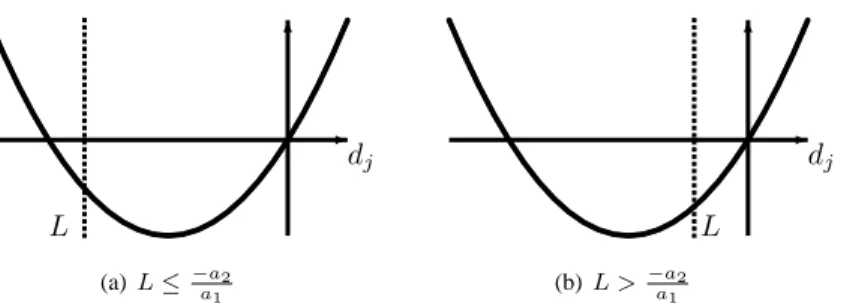
Moreover,a1>0, a2>0, L <0,andU ≥0. The quadratic objective function is shown in Figure 1
and the optimum is
¯
dj= max(− a2 a1
, L)<0. (22)
Therefore, once a1 is defined in (19) according to whether a >0 or not, the two sub-problems can
be easily solved by the same method as in (22).
To check the decrease of the function value, the definition of the function g in (16), d¯j <0 and a1d¯j+a2≥0 from (22), andkαk+1−αkk2= 2 ¯dj
2
imply
f(αk+1)−f(αk) = g( ¯dj)
= 1
2a1d¯j
2
+a2d¯j
= (a1d¯j+a2) ¯dj−a1
2 d¯j
2
≤ −a1 2 d¯j
2
-6 dj
.
...
...
...
...
...
...
...
....
...
....
...
...
...
...
...
... ...
...
...
...
...
...
...
...
L(a)L≤−a2
a1 -6 dj
.
...
...
...
...
...
...
...
....
...
....
...
...
...
...
...
... ...
...
...
...
...
...
...
...
L (b)L > −a2a1
Fig. 1. Solving the convex sub-problem (21)
Therefore, by defining
λ≡14min(τ,min{Qii+Qjj−2yiyjQij |Qii+Qjj −2yiyjQij>0}), (23)
we have the following lemma:
Lemma 1 Assume at each iteration of Algorithm 2 the working set is a violating pair and let {αk}
be the sequence generated. Then (11) holds withλdefined in (23).
The above discussion is related to [19], which examines how to solve (2) when it is non-convex. Note that a = 0 may happen as long as Q is not PD (i.e., Q is PSD or indefinite). Then, (16), becoming a linear function, is convex but not strictly convex. To have (11), an additional term makes it quadratic. Given that the function is already convex, we of course hope that there is no need to modify (2) to (14). The following theorem shows that ifQis PSD andτ <2/C, the two sub-problems indeed have the same optimal solution. Therefore, in a sense, for PSDQ, the sub-problem (2) is always used.
Theorem 2 Assume Q is PSD, the working set of Algorithm 2 is a violating pair, and τ ≤ 2 C. If a= 0, then the optimal solution of (14) is the same as that of (2).
Proof: From (16) and a2 > 0 in (20), if a = 0, (2) has optimal d¯j = L. For (14) and the
transformed problem (21), a= 0implies a1=τ. Moreover, sinceQis PSD,
a= 0 =Qii+Qjj−2yiyjQij =kφ(xi)−φ(xj)k2,
and henceφ(xi) =φ(xj). Therefore,Kit=Kjt,∀t implies
−yi∇f(αk)i+yj∇f(αk)j
= −
l
X
t=1
ytKitαkt +yi+ l
X
t=1
ytKjtαkt −yj
Since {i, j} is a violating pair,yi−yj >0 indicates thata2=yi−yj= 2. Asτ≤ C2, (22) implies
that d¯j = L is the optimal solution of (14). Thus, we have shown that (2) and (14) have the same
optimal point. The derivation ofa2= 2was first developed in [17].
B. Proof of Asymptotic Convergence
Using (11), we then have the following lemma:
Lemma 2 Assume the working set at each iteration of Algorithm 2 is a violating pair. If a sub-sequence
{αk}, k ∈ K converges to α¯, then for any given positive integer s, the sequence {αk+s}, k ∈ K
converges to α¯ as well.
Proof: The lemma was first proved in [16, Lemma IV.3]. For completeness we give details here. For the sub-sequence {αk+1}, k ∈ K, from Lemma 1 and the fact that{f(αk)} is a bounded
decreasing sequence, we have lim
k∈K,k→∞k
αk+1−α¯k
≤ lim
k∈K,k→∞
(kαk+1−αkk+kαk−α¯k)
≤ lim
k∈K,k→∞
r 1
λ(f(α
k)−f(αk+1)) +kαk
−α¯k !
= 0.
Thus
lim
k→∞,k∈K
αk+1= ¯α.
From{αk+1}we can provelimk→∞,k∈Kαk+2= ¯αtoo. Therefore,limk→∞,k∈Kαk+s= ¯αfor any givens.
Since the feasible region of (1) is compact, there is at least one convergent sub-sequence of{αk}. The following theorem shows that the limit point of any convergent sub-sequence is a stationary point of (1).
Theorem 3 Let {αk}be the infinite sequence generated by the SMO-type method Algorithm 2 using WSS 3. Then any limit point of {αk} is a stationary point of (1).
Proof: Assume that α¯ is the limit point of any convergent sub-sequence {αk}, k∈ K. Ifα¯ is not a stationary point of (1), it does not satisfy the optimality condition (6). Thus, there is at least one maximal “violating pair”:
¯i∈argm( ¯α) ¯j ∈argM( ¯α) (24) such that
We further define ∆′≡min
∆,1
2min n
| −yt∇f( ¯α)t+ys∇f( ¯α)s|
−yt∇f( ¯α)t6=−ys∇f( ¯α)s
o
>0. (26) Lemma 2, the continuity of ∇f(α), and h(∆2′)> 0 from (26) imply that for any given r, there is ¯
k∈ K such that for allk∈ K, k≥¯k:
Foru= 0, . . . , r, −y¯i∇f(αk+u)¯i+y¯j∇f(αk+u)¯j>∆′. (27)
If i∈Iup( ¯α), theni∈Iup(αk), . . . , i∈Iup(αk+r). (28)
If i∈Ilow( ¯α), theni∈Ilow(αk), . . . , i∈Ilow(αk+r). (29)
If −yi∇f( ¯α)i>−yj∇f( ¯α)j, then for u= 0, . . . , r,
−yi∇f(αk+u)i>−yj∇f(αk+u)j+
∆′
√
2. (30)
If −yi∇f( ¯α)i=−yj∇f( ¯α)j, then for u= 0, . . . , r,
| −yi∇f(αk+u)i+yj∇f(αk+u)j|< h(∆′). (31)
Foru= 0, . . . , r−1,
(τ−ˆa)kαk+u+1−αk+uk ≤∆′, (32) whereaˆ≡min{Qii+Qjj−2yiyjQij |Qii+Qjj−2yiyjQij <0}.
If −yi∇f( ¯α)i>−yj∇f( ¯α)j and{i, j}is the working set at the(k+u)th iteration,
0≤u≤r−1, theni /∈Iup(αk+u+1)or j /∈Ilow(αk+u+1). (33)
The derivation of (27)-(32) is similar, so only the details of (27) are shown. Lemma 2 implies sequences {αk},{αk+1}, . . . ,{αk+r}, k∈ Kall converge toα. The continuity of¯ ∇f(α)and (26) imply that for any given0≤u≤rand the corresponding sequence{αk+u}, k∈ K, there iskusuch that (27) holds
for all k≥ku, k∈ K. Asris finite, by selectingk¯to be the largest of theseku, u= 0, . . . , r, (27) is
valid for all u= 0, . . . , r. Next we derive (33) [16, Lemma IV.4]. Similar to the optimality condition (6) for problem (1), for the sub-problem at the(k+u)th iteration, if problem (14) is considered and αB is a stationary point, then
max
t∈Iup(αB)−
yt∇f
h αB
αk+u
N
i
t−
yt(τ−a)
2 (αt−α
k t)
≤ min
t∈Ilow(αB)−
yt∇f
h αB
αk+u
N
i
t−
yt(τ−a)
2 (αt−α
k t).
NowB={i, j} andαk+u+1B is a stationary point of the sub-problem satisfying the above inequality. If
then from (32) and (18) −yi∇f(αk+u+1)i
≤ −yj∇f(αk+u+1)j+
yi(τ−a)
2 (α
k+u+1
i −αk+ui )−
yj(τ−a)
2 (α
k+u+1
j −αk+uj )
≤ −yj∇f(αk)j+ τ−a
√ 2 kα
k+u+1−αk+uk
≤ −yj∇f(αk)j+
∆′
√
2. (34)
However, −yi∇f( ¯α)i >−yj∇f( ¯α)j implies (30) for αk+u+1, so there is a contradiction. Ifa >0
and the sub-problem (2) is considered, (34) has no term √∆′
2, so immediately we have a contradiction
to (30).
For the convenience of writing the proof, we reorder indices of α¯ so that
−y1∇f( ¯α)1≤ · · · ≤ −yl∇f( ¯α)l. (35)
We also define
S1(k)≡
X
{i|i∈Iup(αk)}andS2(k)≡
X
{l−i|i∈Ilow(αk)}. (36)
Clearly,
l≤S1(k) +S2(k)≤l(l−1). (37)
If {i, j} is selected at the(k+u)th iteration (u= 0, . . . , r), then we claim that
−yi∇f( ¯α)i>−yj∇f( ¯α)j. (38)
It is impossible that −yi∇( ¯α)i < −yj∇( ¯α)j as −yi∇(αk+u)i < −yj∇(αk+u)j from (30) then
violates (9). If −yi∇( ¯α)i=−yj∇( ¯α)j, then
−yi∇(αk+u)i+yj∇(αk+u)j < h(∆′)< h(−y¯i∇f(αk+u)¯i+y¯j∇f(αk+u)¯j)
≤ h(m(αk+u)−M(αk+u)). (39)
With the property thathis strictly increasing, the first two inequalities come from (31) and (27), while the last is from¯i∈Iup( ¯α),¯j∈Ilow( ¯α), (28), and (29). Clearly, (39) contradicts (9), so (38) is valid.
Next we use a counting procedure to obtain the contradiction of (24) and (25). From thekth to the (k+ 1)st iteration, (38) and then (33) show that
i /∈Iup(αk+1)or j /∈Ilow(αk+1).
For the first case, (28) implies i /∈Iup( ¯α)and hence i∈Ilow( ¯α). From (29) and the selection rule
(9), i∈Ilow(αk)∩Iup(αk). Thus,
With j∈Ilow(αk),
S1(k+ 1)≤S1(k)−i+j≤S1(k)−1, S2(k+ 1)≤S2(k), (40)
where −i+j≤ −1comes from (35). Similarly, for the second case,
j∈Ilow(αk)∩Iup(αk)andj /∈Ilow(αk+1).
With i∈Iup(αk),
S1(k+ 1)≤S1(k), S2(k+ 1)≤S2(k)−(l−j) + (l−i)≤S2(k)−1. (41)
From iteration (k+ 1) to (k+ 2), we can repeat the same argument. Note that (33) can still be used because (38) holds for working sets selected during iterations k tok+r. Using (40) and (41), at r ≡l(l−1) iterations, S1(k) +S2(k) is reduced to zero, a contradiction to (37). Therefore, the
assumptions (24) and (25) are wrong and the proof is complete.
Moreover, if (1) has a unique optimal solution, then the whole sequence{αk} globally converges. This happens, for example, when Qis PD.
Corollary 1 IfQis positive definite, {αk} globally converges to the unique minimum of (1).
Proof: Since Qis positive definite, (1) has a unique solution and we denote it as α. Assume¯ {αk} does not globally converge to α. Then there is¯ ǫ > 0 and an infinite subset K such that kαk−α¯k ≥ǫ,∀k ∈ K. Since{αk}, k∈ K are in a compact space, there is a further sub-sequence converging to α∗ andkα∗−α¯k ≥ǫ. Since α∗ is an optimal solution according to Theorem 3, this contradicts that α¯ is the unique global minimum.
For example, if the RBF kernelK(xi,xj) =e−γkxi−xjk
2
is used and allxi6=xj, thenQis positive
definite [22] and we have the result of Corollary 1.
We now discuss the difference between the proof above and earlier convergence work. The work [16] considers a working set selection which allows more than two elements. When the size of the working set is restricted to two, the selection is reduced to WSS 1, the maximal violating pair. This proof in [17] has used a counting procedure by considering two sets related to {¯i,¯j}, the maximal violating pair atα:¯
I1(k) ≡ {t|t∈Iup(αk),−yt∇f( ¯α)t≥ −y¯j∇f( ¯α)¯j}, and I2(k) ≡ {t|t∈Ilow(αk),−yt∇f( ¯α)t≤ −y¯i∇f( ¯α)¯i}.
Clearly, if WSS 1 is used, ¯i ∈ Iup(αk)and¯j ∈ Ilow(αk) imply that the selected {i, j} must
satisfy i ∈ I1(k) and j ∈ I2(k). Using (33) to show that |I1(k)|+|I2(k)| decreases to zero, we
obtain a contradiction to the fact that |I1(k)|+|I2(k)| ≥ 2 from ¯i ∈ Iup(αk)and¯j ∈ Ilow(αk).
maximal violating pair. Therefore, a new counting scheme is developed. By arranging −yi∇f( ¯α)i in
an ascending (descending) order, in (36), we count the sum of their ranks.
IV. STOPPINGCONDITION, SHRINKING ANDCACHING
In this section we discuss other important properties of our method. In previous sections,Qis any symmetric matrix, but here we further require it to be positive semi-definite. To begin, the following theorem depicts some facts about the problem (1).
Theorem 4 Assume Qis positive semi-definite.
1) Ifα¯ 6= ˆα are any two optimal solutions of (1), then
−yi∇f( ¯α)i =−yi∇f( ˆα)i, i= 1, . . . , l, (42) and
M( ¯α) =m( ¯α) =M( ˆα) =m( ˆα). (43) 2) If there is an optimal solutionα¯ satisfyingm( ¯α)< M( ¯α), thenα¯ is the unique optimal solution
of (1).
3) The following set is independent of any optimal solutionα¯:
I≡ {i| −yi∇f( ¯α)i> M( ¯α)or −yi∇f( ¯α)i< m( ¯α)}. (44)
Moreover, problem (1) has unique and bounded optimal solutions atαi,i∈I.
Proof: Since Q is positive semi-definite, (1) is a convex programming problem and α¯ and αˆ are both global optima. Then
f( ¯α) =f( ˆα) =f(λα¯ + (1−λ) ˆα), for all0≤λ≤1,
implies
( ¯α−α)ˆ TQ( ¯α−α) = 0ˆ .
As Q is PSD, Qcan be factorized to LLT. Thus, kLT( ¯α−α)ˆ k = 0and hence Qα¯ =Qα. Thenˆ
(42) follows.
To prove (43), we will show that
m( ˆα)≥M( ¯α)andm( ¯α)≥M( ˆα). (45) With optimality conditions M( ¯α)≥m( ¯α)andM( ˆα)≥m( ˆα), (43) holds.
Due to the symmetry, it is sufficient to show the first case of (45). If it is wrong, then
We then investigate different situations by comparing−yi∇f( ¯α)i withM( ¯α)andm( ˆα). If
−yi∇f( ¯α)i ≥M( ¯α)> m( ˆα), theni /∈Iup( ˆα)and
ˆ
αi =
0 if yi=−1, C if yi= 1.
(47)
With 0≤α¯i≤C,
yiαˆi−yiα¯i≥0. (48)
If −yi∇f( ¯α)i≤m( ˆα)< M( ¯α), theni /∈Ilow( ¯α)and
¯
αi =
C if yi=−1,
0 if yi= 1.
(49)
Hence, (48) still holds.
Other indices are in the following set
S≡ {i|m( ˆα)<−yi∇f( ˆα)i=−yi∇f( ¯α)i< M( ¯α)}.
If i∈S, theni /∈Iup( ˆα)andi /∈Ilow( ¯α). Hence (47) and (49) imply
yiαˆi−yiα¯i =C. (50)
Thus,
0 = yTαˆ−yTα¯
= X
i:i /∈S
(yiαˆi−yiα¯i) +C|S|.
Since (48) implies each term in the above summation is non-negative, |S|= 0 andαˆi= ¯αi,∀i /∈S.
Therefore, α¯ = ˆα. However, this contradicts the assumption that α¯ and αˆ are different optimal solutions. Hence (46) is wrong and we have m( ˆα) ≥ M( ¯α) in (45). The proof of (43) is thus complete.
The second result of this theorem and the validity of the set Idirectly come from (43). Moreover,
I is independent of any optimal solution.
For any optimal α, if i ∈I and−yi∇f(α)i > M(α)≥m(α), then, i /∈ Iup(α) and αi is the
same as (47). Thus, the optimal αi is unique and bounded. The situation for−yi∇f(α)i< m(α)is
similar.
Lemma 3 in [12] shows a result similar to (43), but the proof is more complicated. It involves both primal and dual SVM formulations. Using Theorem 4, in the rest of this section we derive more properties of the proposed SMO-type methods.
A. Stopping Condition and Finite Termination
As the decomposition method only asymptotically approaches an optimum, in practice, it terminates after satisfying a stopping condition. For example, we can pre-specify a small stopping toleranceǫ >0 and check if
m(αk)−M(αk)≤ǫ (51)
is satisfied. Though one can consider other stopping conditions, (51) is commonly used due to its closeness to the optimality condition (6). To justify its validity as a stopping condition, we must make sure that under any given stopping tolerance ǫ > 0, the proposed decomposition method stops in a finite number of iterations. Thus, an infinite loop never happens. To have (51), one can prove a stronger condition:
lim
k→∞m(α
k)−M(αk) = 0. (52)
This condition is not readily available as from the respective definitions of m(α) and M(α), it is unclear whether they are continuous functions of α. Proving (52) will be the main result of this subsection.
The first study on the stopping condition of SMO-type methods is [11]. They consider a selection rule which involves the stopping tolerance, so the working set is a so-calledǫ−violating pair. Since our selection rule is independent ofǫ, their analysis cannot be applied here. Another work [18] proves (52) for WSS 1 under the assumption that the sequence {αk} globally converges. Here, for more general selection WSS 3, we prove (52) with positive semi-definite Q.
Theorem 5 AssumeQis positive semi-definite and the SMO-type decomposition method Algorithm 2 using WSS 3 generates an infinite sequence{αk}. Then
lim
k→∞m(α
k)
−M(αk) = 0. (53)
Proof: We prove the theorem by contradiction and assume that the result (53) is wrong. Then,
there is an infinite setK¯ and a value∆>0such that
|m(αk)−M(αk)| ≥∆,∀k∈K¯. (54)
Since in the decomposition methodm(αk)> M(αk),∀k, (54) can be rewritten as
m(αk)−M(αk)≥∆,∀k∈K¯. (55)
In this K¯ there is a further sub-sequenceKso that lim
k∈K,k→∞
αk= ¯α.
AsQis positive semi-definite, from Theorem 4,∇f(αk)globally converges:
lim
k→∞∇f(α
k)
We then follow a similar counting strategy in Theorem 3. First we rewrite (55) as
m(αk)≥M(αk) + ∆′,∀k∈K¯, (57) where
∆′ ≡min
∆,1
2min n
| −yt∇f( ¯α)t+ys∇f( ¯α)s|
−yt∇f( ¯α)t6=−ys∇f( ¯α)s
o
. (58)
We still require (27)-(33), but use (56) and (58) to extend (30) and (31) for allk≥k¯(i.e., not only
k∈ K):
If −yt∇f( ¯α)t>−ys∇f( ¯α)s, then −yt∇f(αk)t> ys∇f(αk)s. (59)
If −yt∇f( ¯α)t6=−ys∇f( ¯α)s, then| −yt∇f(αk)t+ys∇f(αk)s|>∆′. (60)
If −yt∇f( ¯α)t=−ys∇f( ¯α)s, then| −yt∇f(αk)t+ys∇f(αk)s|< h(∆′). (61)
Then the whole proof follows Theorem 3 except (39), in which we need m(αk+u)−M(αk+u)≥
∆′,∀u= 0, . . . , r. This condition does not follow from (57), which holds for only a sub-sequence.
Thus, in the following we further prove
m(αk)−M(αk)≥∆′,∀k≥¯k. (62)
Assume at one k′ ≥¯k,0 < m(αk′
)−M(αk′
)<∆′ and{i, j} is the working set of this iteration.
Asi∈Iup(αk ′
)andj∈Ilow(αk ′
) from the selection rule, we have
M(αk′)≤ −yj∇f(αk ′
)j <−yi∇f(αk ′
)i≤m(αk ′
). (63)
Then according to (60), {i, j} and indices achieving m(αk′
) and M(αk′
) have the same value of −yt∇f( ¯α)t. They are all from the following set:
{t| −yt∇f( ¯α)t=−yi∇f( ¯α)i =−yj∇f( ¯α)j}. (64)
For elements not in this set, (59), (60), and (63) imply that If −yt∇f( ¯α)t>−yi∇f( ¯α)i, then
−yt∇f(αk ′
)>−yi∇f(αk ′
)i+ ∆′ > m(αk ′
)and hencet /∈Iup(αk ′
). (65) Similarly,
If −yt∇f( ¯α)t<−yi∇f( ¯α)i, thent /∈Ilow(αk ′
). (66)
As we have explained, the working set is from the set (64), other components remain the same from iteration k′ to k′ + 1. Therefore, indices satisfying (65) and (66) have t /∈ I
up(αk ′+1
) and
t /∈ Ilow(αk ′+1
), respectively. Furthermore, indices in (65) have larger −yt∇f(αk ′+1
)t than others
according to (59). Thus, their −yt∇f(αk ′+1
)t are greater than m(αk ′+1
). Similarly, elements in (66) are smaller than M(αk′+1
). With the fact thatm(αk′+1
)> M(αk′+1
m(αk′+1
)andM(αk′+1
)are again from the set (64). This situation holds for allk≥k′. Using (61)
and the condition on h, we have
m(αk)−M(αk)< h(∆′)≤∆′,∀k≥k′,
a contradiction to (57). Thus, the required condition (62) holds.
B. Shrinking and Caching
Shrinking and caching are two effective techniques to make the decomposition method faster. If an
αk
i remains at 0 or C for many iterations, eventually it may stay at the same value. Based on this
principle, the shrinking technique [10] reduces the size of the optimization problem without considering some bounded variables. The decomposition method then works on a smaller problem which is less time consuming and requires less memory. In the end we put back the removed components and check if an optimal solution of the original problem is obtained.
Another technique to reduce the training time is caching. Since Q may be too large to be stored, its elements are calculated as they are needed. We can allocate some space (called cache) to store recently use Qij [10]. If during final iterations only few columns ofQare still needed and the cache
contains them, we can save many kernel evaluations. [18, Theorem II.3] has proved that during the final iterations of using WSS 1, only a small subset of variables are still updated. Such a result supports the use of shrinking and caching techniques. However, this proof considers only any convergent sub-sequence of {αk} or assumes the global convergence. In this subsection, we provide a more general theory without these two assumptions.
Theorem 6 Assume Q is positive semi-definite and the SMO-type method Algorithm 2 uses WSS 3. Let I be the set defined in (44).
1) There is ¯ksuch that after k≥¯k, every αk
i, i∈I has reached the unique and bounded optimal solution. It remains the same during all subsequent iterations andi∈I is not in the following set:
{t|M(αk)≤ −yt∇f(αk)t≤m(αk)}. (67)
2) If (1) has an optimal solution α¯ satisfying m( ¯α)< M( ¯α), thenα¯ is the unique solution and the decomposition method reaches it at a finite number of iterations.
3) If{αk} is an infinite sequence, then the following two limits exist and are equal:
lim
k→∞m(α
k) = lim k→∞M(α
k) =m( ¯α) =M( ¯α), (68)
whereα¯ is any optimal solution. Thus, (68) is independent of any optimal solution.
1) If the result is wrong, there is an index¯i∈I and an infinite set Kˆ such that
α¯ki 6= ˆα¯i,∀k∈Kˆ, (69)
whereαˆ¯i is the unique optimal component according to Theorem 4. From Theorem 3, there is
a further subsetK of Kˆ such that
lim
k∈K,k→∞
αk= ¯α (70)
is a stationary point. Moreover, Theorem 4 implies thatα¯i,i∈Iare unique optimal components.
Thus,α¯¯i= ˆα¯i.
As¯i∈I, we first consider one of the two possible situations:
−y¯i∇f( ¯α)¯i> M( ¯α). (71)
Thus,¯i /∈Iup( ¯α). (69) then implies
¯i∈Iup(αk),
∀k∈ K. (72)
For eachj∈argM( ¯α), we have j∈Ilow( ¯α). From (70), there is¯ksuch that
j∈Ilow(αk),∀k∈ K, k≥k.¯ (73)
Thus, (72) and (73) imply
m(αk)−M(αk)≥ −y¯i∇f(αk)i¯+yj∇f(αk)j,∀k∈ K, k≥k.¯ (74)
With (70), the continuity of∇f(α), and (53), taking the limit on both sides of (74) obtains 0≥ −y¯i∇f( ¯α)¯i+yj∇f( ¯α)j=−y¯i∇f( ¯α)¯i−M( ¯α).
This inequality violates (71), so there is a contradiction. For the other situation −y¯i∇f( ¯α)¯i < m( ¯α), the proof is the same.
The proof thati ∈I is not in the set (67) is similar. If the result is wrong, there is an index ¯i∈I such that∀k∈ K,¯iis in the set (67). Then (74) holds and causes a contradiction. 2) If the result does not hold, then{αk}is an infinite sequence. From Theorems 3 and 4,α¯ is the
unique optimal solution and{αk} globally converges to it. Define
I1≡ {i| −yi∇f( ¯α)i=M( ¯α)}, I2≡ {i| −yi∇f( ¯α)i=m( ¯α)}.
Using the first result of this theorem, after k is sufficiently large, argm(αk) andargM(αk)
must be subsets of I1∪I2. Moreover, using (53), the continuity of ∇f(α), and the property
limk→∞αk= ¯α, there isk¯ such that for allk≥k¯,
If at the kth iteration, argm(αk) and argM(αk) are both subsets of I
1, then following the
same argument in (63)-(64), we have
the working setB ⊂I1. (76)
As the decomposition method maintains feasibility, X
i∈B yiαki =
X
i∈B
yiαk+1i . (77)
From (76) and the assumption thatm( ¯α)< M( ¯α), everyα¯i,i∈B satisfiesi /∈Iup(α). Thus,
¯
αi,i∈B is the same as (47). This and (77) then imply
kαk+1−α¯k1
= X
i /∈B
|αk+1i −α¯i|+
X
i∈B,yi=1
(C−αk+1i ) + X
i∈B,yi=−1
(αk+1i −0)
= X
i /∈B
|αki −α¯i|+
X
i∈B,yi=1
(C−αki) +
X
i∈B,yi=−1
(αki −0)
= kαk−α¯k1. (78)
Ifargm(αk)andargM(αk)are both subsets ofI
2, (78) still holds. Therefore,
06=kαk−α¯k1=kαk+1−α¯k1=· · ·,
a contradiction to the fact that{αk}converges toα. Thus, the decomposition method must stop¯
in a finite number of iterations.
3) Since{αk} is an infinite sequence, using the result of 2), problem (1) has no optimal solution ¯
αsatisfying M( ¯α)> m( ¯α). From Theorem 4, we have
M( ¯α) =m( ¯α) =−yt∇f( ¯α)t,∀t6∈I, (79)
and this is independent of different optimal solutions α. From the result of 1), there is¯ k¯ such that for allk≥k¯,i∈I is not in the set (67). Thus,
I′≡ {1, . . . , l} \I (80)
is a superset of (67) and hence min
i∈I′−yi∇f(α k)
i≤M(αk)< m(αk)≤max
i∈I′ −yi∇f(α k)
i. (81)
Though {αk} may not be globally convergent, {−yi∇f(αk)i},i= 1, . . . , l, are according to
(42). The limit of both sides of (81) are equal using (79), so (68) follows.
Theorem 6 implies that in many iterations, the SMO-type method involves only indices inI′. Thus,
caching is very effective. This theorem also illustrates two possible shrinking implementations: 1) Elements not in the set (67) are removed.
2) Anyαi which has stayed at the same bound for a certain number of iterations is removed.
The softwareLIBSVM[3] considers the former approach, whileSV Mlight[10] uses the latter.
V. CONVERGENCERATE
Though we proved the asymptotic convergence, it is important to investigate how fast the method converges. Under some assumptions, [15] was the first to prove the linear convergence of certain decomposition methods. The work [15] allows the working set to have more than two elements and WSS 1 is a special case. Here we show that when the SMO-type working set selection is extended from WSS 1 to WSS 2, the same analysis holds. Since [15] was not published, we include here all details of the proof.
Note that WSS 3 uses a function h to control the quality of the selected pair. We will see in the proof that it may affect the convergence rate. Proving the linear convergence requires the condition (8), so results established in this section are for WSS 2 but not WSS 3.
First we make a few assumptions.
Assumption 1 Qis positive definite.
Then (1) is a strictly convex programming problem and hence has a unique global optimumα.¯ By Theorem 6, after large enough iterations working sets are all from the set I′ defined in (80).
From the optimality condition (6), the scalar¯bsatisfies¯b=m( ¯α) =M( ¯α), and the setI′corresponds
to elements satisfying
∇f( ¯α)i+ ¯byi= 0. (82)
From (4)-(5), another form of the optimality condition, ifα¯i is not at a bound, (82) holds. We further
assume that this is the only case that (82) happens.
Assumption 2 (Nondegeneracy) For the optimal solution α¯,∇f( ¯α)i+ ¯byi = 0 if and only if0 <
¯
αi< C.
This assumption, commonly used in optimization analysis, implies that indices of all boundedα¯i are
exactly the set I. Therefore, after enough iterations, Theorem 6 and Assumption 2 imply that all bounded variables are fixed and are not included in the working set. By treating these variables as constants, essentially we solve a problem with the following form:
min
α
f(α) = 1 2α
TQ
α+pTα
subject to yTα= ∆, (83)
where pis a vector by combining−eand other terms related to the bounded components. Moreover, 0< αk
the optimal solutionα¯ with the corresponding¯bcan be obtained by the following linear system:
Q y
yT 0
¯ α ¯b
=
−p
∆
. (84)
In each iteration, we consider minimizingf(αk
B+d), wheredis the direction fromαkB toαk+1B , so
the sub-problem (2) is written as min
d
1 2d
TQBBd+
∇f(αk)TBd
subject to yTBd= 0, (85)
where ∇f(αk) = Qαk +p. If an optimal solution of (85) is dk, then αk+1
B = αkB +dk and
αk+1N =αkN. With the corresponding bk, this sub-problem is solved by the following equation:
QBB yB yBT 0
dk bk
=
−∇f(αk)B
0
. (86)
Using (84),
Q(αk−α)¯ = Qαk+p+ ¯by
= ∇f(αk) + ¯by. (87)
By defining Y ≡ diag(y) to be a diagonal matrix with elements of y on the diagonal, and using
yi=±1,
−Y Q(αk−α) =¯ −Y∇f(αk)−¯be. (88)
The purpose of checking Q(αk−α)¯ is to see how close the current solution is to the optimal one.
Then (88) links it to −Y∇f(αk), a vector used for the working set selection. Remember that for
finding violating pairs, we first sort−yi∇f(αk)i in an ascending order.
The following two theorems are the main results on the linear convergence.
Theorem 7 Assume the SMO-type decomposition method uses WSS 2 for the working set selection. If problem (1) satisfies Assumptions 1 and 2, then there are c <1 and ¯ksuch that for all k≥¯k
(αk+1−α)¯ TQ(αk+1−α)¯ ≤c(αk−α)¯ TQ(αk−α)¯ . (89)
(83). We then directly calculate the difference between the (k+ 1)st and the kth iterations:
(αk+1−α)¯ TQ(αk+1−α)¯ −(αk−α)¯ TQ(αk−α)¯ (90) = 2(dk)T(Q(αk−α))¯ B+ (dk)TQBBdk
= (dk)T(2(Q(αk−α))¯ B− ∇f(αk)B−bkyB) (91)
= (dk)T((Q(αk−α))¯ B+ (¯b−bk)yB) (92)
= (dk)T((Q(αk−α))¯
B+ (bk−¯b)yB) (93)
= −[−(Q(αk−α))¯ B+ (¯b−bk)yB]TQ−BB1[−(Q(α k
−α))¯ B+ (¯b−bk)yB],
where (91) is from (86), (92) is from (87), (93) is by using the factyTBdk= 0from (86), and the last equality is from (86) and (87). If we define
ˆ
Q≡YBQ−BB1YB andv≡ −Y(Q(αk−α))¯ , (94)
where YB≡diag(yB), thenvB=−YB(Q(αk−α))¯ B and (90) becomes
−[vB+ (¯b−bk)eB]TQˆ[vB+ (¯b−bk)eB]. (95)
From (88), we define
v1≡max
t (vt) =m(α k)
−¯b, vl≡min
t (vt) =M(α k)
−¯b. (96)
Thus, the selection rule (8) of WSS 2 implies
|vi−vj| ≥σ(v1−vl), (97)
where {i, j} is the working set of the kth iteration.
respectively. A further calculation of (95) shows
[vB+ (¯b−bk)eB]TQˆ[vB+ (¯b−bk)eB]
≥ min(eig( ˆQ))[vB+ (¯b−bk)eB]T[vB+ (¯b−bk)eB]
≥ min(eig( ˆQ)) max
t∈B(vt+ (¯b−bk)) 2
≥ min(eig( ˆQ))(vi−vj
2 )
2, where
{i, j} is working set (98)
≥ min(eig( ˆQ))σ2(v1−vl
2 )
2 (99)
≥ min(eig( ˆQ))( y
TQ−1y
2P
i,j|Q− 1 ij |
)2σ2max(|v1|,|vl|)2 (100) ≥ min(eig( ˆl Q))( y
TQ−1y
2P
t,s|Q− 1 ts |
)2σ2(Q(αk−α))¯ TQ(αk−α)¯ (101) ≥ lmax(eig(min(eig( ˆQQ−))1))(
yTQ−1y
2P
t,s|Q− 1 ts |
)2σ2(Q(αk−α))¯ TQ−1Q(αk−α)¯ ≥ lmax(eig(min(eig( ˆQQ−))1))(
yTQ−1y
2P
t,s|Q− 1 ts |
)2σ2(αk−α)¯ TQ(αk−α)¯ , (102) where (98) is from Lemma 3, (99) is from (97), (100) is from Lemma 4, and (101) follows from (96). Note that both lemmas are given in Appendix A.
Next we give more details about the derivation of (100): Ifv1vl<0, then of course
|v1−vl| ≥max(|v1|,|vl|).
With yi = ±1, y
TQ−1y P
t,s|Q−
1
ts| ≤
1 so (100) follows. In contrast, if v1vl ≥ 0, we consider v = (Y QY)(−Y(αk −α))¯ from (94). Since −eTY(αk −α) =¯ −yT(αk −α) = 0, we can apply¯
Lemma 4: With
|(Y QY)−ij1|=|Qij−1yiyj|=|Q−ij1|and eT(Y QY)−1e=yTQ−1y,
we have
|v1−vl| ≥ max(|v1|,|vl|)−min(|v1|,|vl|)
≥ ( y
TQ−1y
P
t,s|Q−ts1|
) max(|v1|,|vl|),
which implies (100).
Finally we can define a constantc as follows:
c≡1−min
B
min(eig(Q−1
BB)) lmax(eig(Q−1))(
yTQ−1y
2P
t,s|Q− 1 ts |
)2σ2
<1,
The condition (8) of Algorithm 2 is used in (97) and then (99). If WSS 3 is considered, in (99) we will have a term h((v1−vl)/2)2. Thus, the functionhaffects the convergence rate. Sinceh(x)≤x,
linear rate is the best result using our derivation.
The linear convergence of the objective function is as follows:
Theorem 8 Under the same assumptions of Theorem 7, there arec <1and¯ksuch that for allk≥k¯,
f(αk+1)−f( ¯α)≤c(f(αk)−f( ¯α)). Proof: We show that for anyk≥k¯,
f(αk)−f( ¯α) =1
2(α
k−α)¯ TQ(αk−α)¯ ,
and the proof immediately follows from Theorem 7. Using (84),
f(αk)−f( ¯α)
= 1
2(α
k)TQ
αk+pTαk−12( ¯α)TQα¯−pTα¯
= 1
2(α
k)TQαk+ (
−Qα¯−¯by)Tαk−1 2( ¯α)
TQα¯
−(−Qα¯ −¯by)Tα¯
= 1
2(α
k)TQαk−( ¯α)TQαk+1
2( ¯α)
TQα¯ (103)
= 1
2(α
k
−α)¯ TQ(αk−α)¯ .
Since we always keep the feasibility ofαk, (103) comes fromyTαk =yTα.¯
VI. EXTENSIONS
In this section we show that the same SMO-type methods can be applied to some variants of SVM.
A. Support Vector Regression and One-class SVM
First we extend (1) to the following general form: min
α f(α) =
1 2α
TQ
α+pTα
subject to Li≤αi≤Ui, i= 1, . . . , l, (104)
yTα= ∆,
where −∞< Li< Ui<∞, i= 1, . . . , l, are lower and upper bounds, andQis anl byl symmetric
matrix. Clearly, if Li= 0, Ui=C, andp=−e, then (104) reduces to (1). The optimality condition
is the same as (3) though in the definition of Iup(α)andIlow(α),0 andC must be replaced byLi
andUi, respectively. Therefore, SMO-type decomposition methods using WSS 2 or 3 can be applied
Problem (104) covers some SVM formulations such as support vector regression (SVR) [28] and one-class SVM [26]. Next we discuss SVR in detail. Given a set of data points{(x1, z1), . . . ,(xl, zl)}
such that xi∈Rn is an input vector andz
i∈R1 is a target output, support vector regression solves
the following optimization problem: min
α,α∗
f(α,α∗) = 1 2(α−α
∗)TK(α−α∗) +ǫ
l
X
i=1
(αi+α∗i) + l
X
i=1
zi(αi−α∗i)
subject to
l
X
i=1
(αi−α∗i) = 0,
0≤αi, α∗i ≤C, i= 1, . . . , l, (105)
where Kij =φ(xi)Tφ(xj), andǫ >0 is the width of theǫ-insensitive tube.
We can rewrite (105) as
min
α,α∗ f(α,α
∗) = 1
2 h
αT,α∗T i
K −K
−K K
α α∗ + h
ǫeT +zT, ǫeT −zT
i α α∗
subject to yT
α α∗
= 0,
0≤αi, α∗i ≤C, i= 1, . . . , l, (106)
where y is a 2l by 1 vector with yi = 1, i= 1, . . . , landyi =−1, i=l+ 1, . . . ,2l. Thus (106) is
in the form of (104) and an SMO-type method with WSS 3 can be applied. Moreover, the procedure asymptotically converges and possesses all properties in Section IV. An interesting issue is about Corollary 1, which requires the Hessian matrix K −K
−K K
to be positive definite. This condition never holds as−KK K−Kis only positive semi-definite. Note that in Corollary 1, the positive definite Hessian is used to have a unique optimal solution. For SVR, [4, Lemma 4] proves that if ǫ > 0 andK is positive definite, then (106) has a unique solution. Thus, for SVR, Corollary 1 can be modified to require only thatK is positive definite.
For the linear convergence result in Section V, Assumption 1 does not hold as now−KK K−Kis not positive definite. However, we will show that similar to Corollary 1, a positive definiteKis sufficient. Note that in Section V, the Hessian matrix of (83) is in fact QI′I′ as αi, i∈I can be removed after
large enough iterations, where I andI′ are defined as in (44) and (80) except that the set{1, . . . , l}
is replaced by {1, . . . ,2l}. Then in the linear convergence proof we needQI′I′ to be invertible and
this condition holds ifQis positive definite (i.e., Assumption 1). For SVR, this means K −K
−K K
I′I′
should be invertible. To prove it, we first claim that for any1≤i≤l,
Asǫ >0 implies
−yi∇f(α,α∗)i=−(K(α−α∗))i+ǫ+zi
6
= −(K(α∗−α))i−ǫ+zi=−yi+l∇f(α,α∗)i+l, (108)
the definition of I′ directly leads to (107). We further define
¯
I′ ≡ an index vector by replacing anyt, l≤t≤2l inI′ witht−l.
From (107),I′ andI¯′ have the same number of elements and furthermore,
K −K
−K K
I′I′
=YI′KI¯′I¯′YI′, (109)
where YI′ ≡diag(yI′)is a diagonal matrix. Clearly, (109) indicates that if K is positive definite, so
isKI¯′I¯′ and
K −K
−K K
I′I′. Therefore, by replacing Assumption 1 on the Hessian matrix with that on
the kernel matrix, the linear convergence result holds for SVR.
B. Extension to ν-SVM
ν-SVM [27] is another SVM formulation which has a parameterν instead of C. Its dual form is min
α f(α) =
1 2α
TQ
α
subject to yTα= 0,
eTα=ν,
0≤αi≤1/l, i= 1, . . . , l, (110)
where e is the vector of all ones. Note that some useeTα≥ν as a constraint, but [4] and [7] have shown that decision functions are the same. Moreover, [4] proved that (110) is equivalent to problem (1) with certain C. It also discusses the decomposition method for training ν-SVM.
Via the KKT condition, a vectorα¯ is a stationary point of (110) if and only if there are two scalars
ρandb such that
∇f(α)i−ρ+byi≥0 ifαi<1/l,
∇f(α)i−ρ+byi≤0 ifαi>0.
By separating the case of yi = 1 andyi =−1, we obtain two conditions on −ρ+b and−ρ−b,
respectively. Thus, similar to (6), there is the following optimality condition:
where
mp(α)≡ max i∈Iup(α),yi=1−
yi∇f(α)i, Mp(α)≡ min i∈Ilow(α),yi=1−
yi∇f(α)i, and
mn(α)≡ max
i∈Iup(α),yi=−1−
yi∇f(α)i, Mn(α)≡ min i∈Ilow(α),yi=−1−
yi∇f(α)i.
One can also define a violating pair as the following:
Definition 2 (Violating pair of (111)) If i ∈ Iup(α), j ∈ Ilow(α), yi = yj, and −yi∇f(α)i >
−yj∇f(α)j, then{i, j} is a “violating pair.”
Clearly, the condition yi = yj is the main difference from Definition 1. In fact the selected pair B ={i, j} must satisfyyi=yj. If yi6=yj, then the two linear equalities result in the sub-problem
having only one feasible pointαk
B. For the sameyi andyj, the two equations in the sub-problem are
identical, so we could move αkB to a better point. In addition, the sub-problem is then in the same form of (2), so the procedure in Section III-A directly works.
All working set selections discussed in Section II can be extended here. We modify WSS 3 as an example:
WSS 4 (Extension of WSS 3 for ν-SVM)
1) Select anyi∈Iup(αk),j∈Ilow(αk),yi=yj satisfying
−yi∇f(αk)i+yj∇f(αk)j≥h(D(αk))>0, (112)
where
D(αk)≡max(m
p(αk)−Mp(αk), mn(αk)−Mn(αk)). (113)
2) Return B={i, j}.
Results in Sections III-IV hold with minor modifications. They are listed in the following without detailed proofs. For easier description, we let
αp (αn)be the sub-vector ofα corresponding to positive (negative) samples.
Theorem 9 Let{αk}be the infinite sequence generated by the SMO-type decomposition method using WSS 4 for the working set selection. Then any limit point of{αk}is a stationary point of (110).
Theorem 10 Assume Qis positive semi-definite.
1) Ifα¯ 6= ˆα are any two optimal solutions of (110), then
Ifα¯p 6= ˆαp (α¯n6= ˆαn), then
Mp( ¯α) =mp( ¯α) =Mp( ˆα) =mp( ˆα) (115)
(Mn( ¯α) =mn( ¯α) =Mn( ˆα) =mn( ˆα)). (116)
2) If there is an optimal solution α¯ satisfying mp( ¯α) < Mp( ¯α), then α¯p is unique for (110). Similarly, ifmn( ¯α)< Mn( ¯α), thenα¯n is unique.
3) The following sets are independent of any optimal solution α¯:
Ip≡ {i|yi= 1,−∇f( ¯α)i> Mp( ¯α)or − ∇f( ¯α)i< mp( ¯α)}, (117) In≡ {i|yi =−1,∇f( ¯α)i > Mn( ¯α)or ∇f( ¯α)i< mn( ¯α)}. (118)
Moreover, problem (110) has unique and bounded optimal solutions atαi,i∈Ip∪In.
Theorem 11 Assume Qis positive semi-definite. Let {αk} be the infinite sequence generated by the SMO-type decomposition method using WSS 4. If {(αk)p} ({(αk)n}) is updated in infinitely many iterations, then
limk→∞mp(αk)−Mp(αk) = 0 (119)
(limk→∞mn(αk)−Mn(αk) = 0). (120) Theorem 12 Assume Qis positive semi-definite and the SMO-type method Algorithm 2 uses WSS 4. LetIp andIn be the sets defined in (117) and (118). DefineKp andKn to be iterations in which the working set is from positive and negative samples, respectively.
1) There is k¯ such that after k≥¯k, every αk
i, i∈Ip∪In has reached the unique and bounded optimal solution. For any i ∈ Ip, there is k¯ such that after k ≥ ¯k, k ∈ Kp, i is not in the following set
{t|yt= 1, Mp(αk)≤ −yt∇f(αk)t≤mp(αk)}. (121) The same result holds for the negative part.
2) If (110) has an optimal solution α¯ satisfying mp( ¯α)< Mp( ¯α)(mn( ¯α)< Mn( ¯α)), then α¯p (α¯n) is unique for (110) and the decomposition method reaches it in a finite number of iterations.
3) If{(αk)p} is updated in infinitely many iterations, then the following two limits exist and are equal:
limk→∞mp(αk) = limk→∞Mp(αk) =mp( ¯α) =Mp( ¯α) (122)
VII. DISCUSSION ANDCONCLUSIONS
This paper provides a comprehensive study on SMO-type decomposition methods. Below we discuss some issues for future investigation.
A. Faster Training via a Better Selection Rule
Under the general framework discussed in this paper, we can design various selection rules for prac-tical implementations. Among them, the one using the maximal violating pair has been widely applied in SVM software. Developing better rules from the proposed framework is important. Otherwise, this article has only theoretical values. A working set selection which leads to faster training should:
1) reduce the number of iterations of the decomposition method. In other words, the convergence is faster, and
2) keep the cost of identifying the working setB similar to that of finding the maximal violating pair.
The challenge is that these two goals are often at odds. For example, fewer iterations may not reduce the training time if the cost of working set selections is higher. We proposed some rules with the above properties in [8]. This work shows that the “maximal violating pair” uses only the first-order information of the objective function, and derives a better selection rule using the second-first-order information. The new rule is a special case of WSS 2. The training time is generally shorter than that by using the “maximal violating pair.”
B. Necessary Conditions for the Convergence
Previous studies and the discussion in Section III provide “sufficient conditions” for the convergence of decomposition methods. That is, under given working set selections, we prove the convergence. Investigating the “necessary conditions” is also interesting. When the decomposition method converges, which conditions does its working set selection satisfy?
We may think that WSS 3 is general enough so that every convergent SMO-type method satisfies the condition (9). However, this may not be right. We suspect that even if some iterations select{i, j} without enough violation (i.e. −yi∇f(αk)i+yi∇f(αk)j< h(m(αk)−M(αk))), the method may
still converge if other iterations have used appropriate working sets. Therefore, finding useful necessary conditions may be a challenging task.
It is worth mentioning another working set selection proposed in [21]. This work requires the following condition:
There is N >0 such that for allk,
Clearly, a cyclic selection of {i, j} in every l(l−1)/2 iterations satisfies (123): {1,2},{1,3}, . . . ,{1, l},{2,3}, . . . ,{l−1, l},
where l is the number of data instances. With (123), the convergence proof in Theorem 3 becomes very simple. For the limit point α¯ assumed not stationary, its maximal violating pair{¯i,¯j} is also a violating pair at iteration k, where k∈ K, k ≥k¯. According to (123), this pair {¯i,¯j} of α¯ must be selected at iteration k′, where k≤k′ ≤k+N. Then at the(k′+ 1)st iteration, (28) and (29) imply
¯i∈Iup(αk′+1
)and¯j∈Ilow(αk ′+1
),
but (33) indicates that
¯i6∈Iup(αk′+1
)or ¯j6∈Ilow(αk ′+1
).
Thus, immediately there is a contradiction. In a sense, (123) is a rule “designed” for the convergence proof.
The two conditions (9) and (123) on the working set selection are quite different, so neither is a necessary condition. From the counter-example in Section II we observed that the selected {i, j}has a much smaller violation than m(αk)−M(αk), and hence proposed WSS 2 and 3. This example
also has a violating pair{4,5}never selected, a situation opposite to (123). Thus both WSS 3 and the condition (123) attempt to remedy problems imposed from this counter-example, but they take very different directions. One focuses on issues related to the maximal violating pair, but the other requires that all current violating pairs are selected later in a finite number of iterations. In general, we think the former leads to faster convergence as it more aggressively reduces the violation. However, this also complicates the convergence proof as a counting procedure in Theorem 3 must be involved in order to obtain the contradiction.
ACKNOWLEDGMENTS
This work was supported in part by the National Science Council of Taiwan via the grant NSC 93-2213-E-002-030.
REFERENCES
[1] B. E. Boser, I. Guyon, and V. Vapnik. A training algorithm for optimal margin classifiers. In Proceedings of the Fifth
Annual Workshop on Computational Learning Theory, pages 144–152. ACM Press, 1992.
[2] C.-C. Chang, C.-W. Hsu, and C.-J. Lin. The analysis of decomposition methods for support vector machines. IEEE
Transactions on Neural Networks, 11(4):1003–1008, 2000.
[3] C.-C. Chang and C.-J. Lin. LIBSVM: a library for support vector machines, 2001. Software available athttp://www. csie.ntu.edu.tw/˜cjlin/libsvm.
[4] C.-C. Chang and C.-J. Lin. Trainingν-support vector classifiers: Theory and algorithms. Neural Computation, 13(9):2119– 2147, 2001.