Object Class Recognition by Unsupervised Scale-Invariant Learning
R. Fergus
1P. Perona
2A. Zisserman
11
Dept. of Engineering Science
2Dept. of Electrical Engineering
University of Oxford
California Institute of Technology
Parks Road, Oxford
MC 136-93, Pasadena
OX1 3PJ, U.K.
CA 91125, U.S.A.
{
fergus,az
}
@robots.ox.ac.uk
[email protected]
Abstract
We present a method to learn and recognize object class models from unlabeled and unsegmented cluttered scenes in a scale invariant manner. Objects are modeled as flexi-ble constellations of parts. A probabilistic representation is used for all aspects of the object: shape, appearance, occlu-sion and relative scale. An entropy-based feature detector is used to select regions and their scale within the image. In learning the parameters of the scale-invariant object model are estimated. This is done using expectation-maximization in a maximum-likelihood setting. In recognition, this model is used in a Bayesian manner to classify images. The flex-ible nature of the model is demonstrated by excellent re-sults over a range of datasets including geometrically con-strained classes (e.g. faces, cars) and flexible objects (such as animals).
1. Introduction
Representation, detection and learning are the main issues that need to be tackled in designing a visual system for rec-ognizing object categories. The first challenge is coming up with models that can capture the ‘essence’ of a cate-gory, i.e. what is common to the objects that belong to it, and yet are flexible enough to accommodate object vari-ability (e.g. presence/absence of distinctive parts such as mustache and glasses, variability in overall shape, changing appearance due to lighting conditions, viewpoint etc). The challenge of detection is defining metrics and inventing al-gorithms that are suitable for matching models to images efficiently in the presence of occlusion and clutter. Learn-ing is the ultimate challenge. If we wish to be able to design visual systems that can recognize, say, 10,000 object cate-gories, then effortless learning is a crucial step. This means that the training sets should be small and that the operator-assisted steps that are required (e.g. elimination of clutter
in the background of the object, scale normalization of the training sample) should be reduced to a minimum or elimi-nated.
The problem of describing and recognizing categories, as opposed to specific objects (e.g. [6, 9, 11]), has re-cently gained some attention in the machine vision litera-ture [1, 2, 3, 4, 13, 14, 19] with an emphasis on the de-tection of faces [12, 15, 16]. There is broad agreement on the issue of representation: object categories are rep-resented as collection of features, or parts, each part has a distinctive appearance and spatial position. Different au-thors vary widely on the details: the number of parts they envision (from a few to thousands of parts), how these parts are detected and represented, how their position is repre-sented, whether the variability in part appearance and posi-tion is represented explicitly or is implicit in the details of the matching algorithm. The issue of learning is perhaps the least well understood. Most authors rely on manual steps to eliminate background clutter and normalize the pose of the training examples. Recognition often proceeds by an ex-haustive search over image position and scale.
We focus our attention on the probabilistic approach pro-posed by Burl et al. [4] which models objects as random constellations of parts. This approach presents several ad-vantages: the model explicitly accounts for shape variations and for the randomness in the presence/absence of features due to occlusion and detector errors. It accounts explicitly for image clutter. It yields principled and efficient detection methods. Weber et al. [18, 19] proposed a maximum like-lihood unsupervised learning algorithm for the constella-tion model which successfully learns object categories from cluttered data with minimal human intervention. We pro-pose here a number of substantial improvement to the con-stellation model and to its maximum likelihood learning al-gorithm. First: while Burl et al. and Weber et al. model explicitly shape variability, they do not model the variabil-ity of appearance. We extend their model to take this aspect
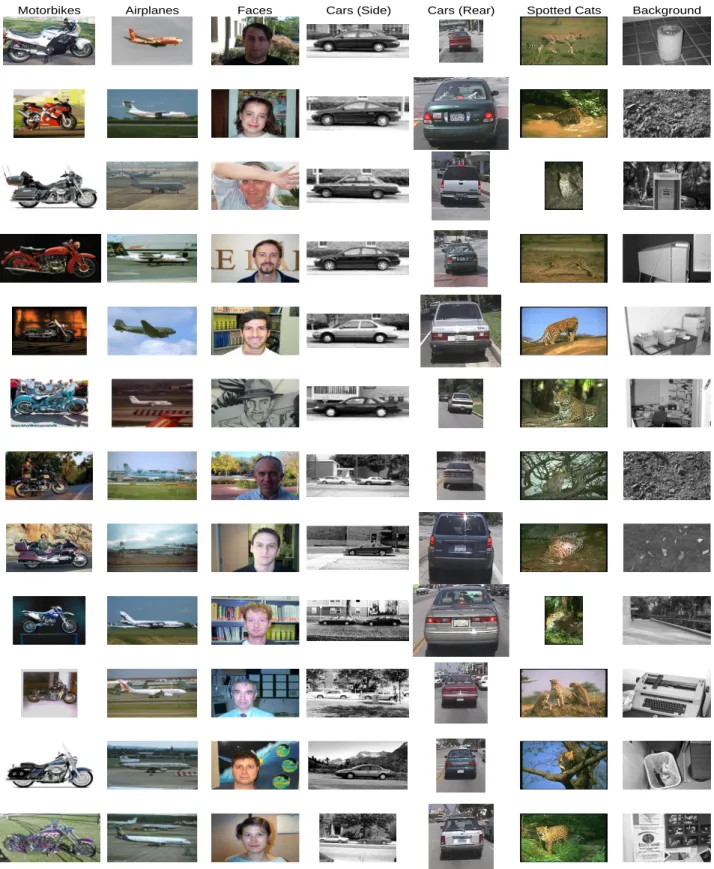
into account. Second, appearance here is learnt simultane-ously with shape, whereas in their work the appearance of a part is fixed before shape learning. Third: they use correla-tion to detect their parts. We substitute their front end with an interest operator, which detects regions and their scale in the manner of [8, 10]. Fourthly, Weber et al. did not ex-periment extensively with scale-invariant learning, most of their training sets are collected in such a way that the scale is approximately normalized. We extend their learning algo-rithm so that new object categories may be learnt efficiently, without supervision, from training sets where the object ex-amples have large variability in scale. A final contribution is experimenting with a number of new image datasets to validate the overall approach over several object categories. Examples images from these datasets are shown in figure 1.
2. Approach
Our approach to modeling object classes follows on from the work of Weber et al. [17, 18, 19]. An object model consists of a number of parts. Each part has an appear-ance, relative scale and can be be occluded or not. Shape is represented by the mutual position of the parts. The en-tire model is generative and probabilistic, so appearance, scale, shape and occlusion are all modeled by probabil-ity densprobabil-ity functions, which here are Gaussians. The pro-cess of learning an object category is one of first detecting regions and their scales, and then estimating the parame-ters of the above densities from these regions, such that the model gives a maximum-likelihood description of the train-ing data. Recognition is performed on a query image by again first detecting regions and their scales, and then eval-uating the regions in a Bayesian manner, using the model parameters estimated in the learning.
The model, region detector, and representation of ap-pearance are described in detail in the following subsec-tions.
2.1. Model structure
The model is best explained by first considering recogni-tion. We have learnt a generative object class model, with
P parts and parametersθ. We are then presented with a
new image and we must decide if it contains an instance of our object class or not. In this query image we have
identi-fiedN interesting features with locationsX, scalesS, and
appearancesA. We now make a Bayesian decision,R:
R = p(Object|X,S,A)
p(No object|X,S,A)
= p(X,S,A|Object)p(Object)
p(X,S,A|No object)p(No object)
≈ p(X,S,A|θ)p(Object)
p(X,S,A|θbg)p(No object)
The last line is an approximation since we will only use a
single value forθ (the maximum-likelihood value) rather
than integrating overp(θ)as we strictly should. Likewise,
we assume that all non-object images can also be modeled
by a background with a single set of parametersθbg. The
ratio of the priors may be estimated from the training set or set by hand (usually to 1). Our decision requires the calcu-lation of the ratio of the two likelihood functions. In order to do this, the likelihoods may be factored as follows:
p(X,S,A|θ) =
h∈H
p(X,S,A,h|θ) =
h∈H
p(A|X,S,h, θ)
Appearance
p(X|S,h, θ)
Shape
p(S|h, θ)
Rel. Scale
p(h|θ)
Other
Since our model only hasP (typically 3-7) parts but there
areN (up to30) features in the image, we introduce an
in-dexing variablehwhich we call a hypothesis.his a vector
of lengthP, where each entry is between0andNwhich
al-locates a particular feature to a model part. The unallocated
features are assumed to be part of the background, with0
in-dicating the part is unavailable (e.g. because of occlusion).
The setH is all valid allocations of features to the parts;
consequently|H|isO(NP).
In the following we sketch the form for likelihood ra-tios of each of the above factored terms. Space prevents a full derivation being included, but the full expressions follow from the methods of [17]. It will be helpful to
de-fine the following notation: d = sign(h)(which is a
bi-nary vector giving the state of occlusion for each part),
n=N −sum(d)(the number of background features
un-der the current hypothesis), andf =sum(d)which is the
number of foreground features.
Appearance. Each feature’s appearance is represented
as a point in some appearance space, defined below. Each
partphas a Gaussian density within this space, with mean
and covariance parametersθapp
p ={cp, Vp}which is
inde-pendent of other parts’ densities. The background model
has parametersθappbg = {cbg, Vbg}. Both Vp andVbg are
assumed to be diagonal. Each feature selected by the hy-pothesis is evaluated under the appropriate part density. All features not selected by the hypothesis are evaluated under the background density. The ratio reduces to:
p(A|X,S,h, θ) p(A|X,S,h, θbg) =
P
p=1
G(A(hp)|cp, Vp)
G(A(hp)|cbg, Vbg)
dp
whereGis the Gaussian distribution, anddpis the pthentry
of the vectord, i.e.dp =d(p). So the appearance of each
feature in the hypothesis is evaluated under foreground and background densities and the ratio taken. If the part is
Motorbikes Airplanes Faces Cars (Side) Cars (Rear) Spotted Cats Background
Figure 1: Some sample images from the datasets. Note the large variation in scale in, for example, the cars (rear) database. These datasets
are from http://www.robots.ox.ac.uk/∼vgg/data/, except for the Cars (Side) from (http://l2r.cs.uiuc.edu/∼cogcomp/index research.html)
and Spotted Cats from the Corel Image library. A Powerpoint presentation of the figures in this paper can be found at
Shape. The shape is represented by a joint Gaussian
den-sity of the locations of features within a hypothesis, once they have been transformed into a scale-invariant space. This is done using the scale information from the features in the hypothesis, so avoiding an exhaustive search over scale that other methods use. The density has parameters
θshape ={µ,Σ}. Note that, unlike appearance whose
co-variance matricesVp, Vbg are diagonal,Σis a full matrix.
All features not included in the hypothesis are considered as arising from the background. The model for the back-ground assumes features to be spread uniformly over the
image (which has areaα), with locations independent of the
foreground locations. If a part is occluded it is integrated out of the joint foreground density.
p(X|S,h, θ)
p(X|S,h, θbg) = G(X(h)|µ
,Σ)αf
Relative scale. The scale of each partprelative to a ref-erence frame is modeled by a Gaussian density which has
parametersθscale = {t
p, Up}. The parts are assumed to
be independent to one another. The background model
as-sumes a uniform distribution over scale (within a ranger).
p(S|h, θ) p(S|h, θbg) =
P
p=1
G(S(hp)|tp, Up)dprf
Occlusion and Statistics of the feature finder.
p(h|θ) p(h|θbg) =
pP oiss(n|M)
pP oiss(N|M)
1
nC
r(N, f)
p(d|θ)
The first term models the number of features detected using
a Poisson distribution, which has a meanM. The second is
a book-keeping term for the hypothesis variable and the last
is a probability table (of size2P) for all possible occlusion
patterns and is a parameter of the model.
The model of Weber et al. contains the shape and oc-clusion terms to which we have added the appearance and relative scale terms. Since the model encompasses many of the properties of an object, all in a probabilistic way, this model can represent both geometrically constrained objects (where the shape density would have a small covariance) and objects with distinctive appearance but lacking geomet-ric form (the appearance densities would be tight, but the shape density would now be looser). From the equations above we can now calculate the overall likelihood ratio from
a given set ofX,S,A. The intuition is that the majority of
the hypotheses will be low scoring as they will be picking up features from background junk on the image but hope-fully a few features will genuinely be part of the object and hypotheses using these will score highly. However, we must be able to locate features over many different instances of the object and over a range of scales in order for this ap-proach to work.
2.2. Feature detection
Features are found using the detector of Kadir and Brady [7]. This method finds regions that are salient over both location and scale. For each point on the image a
his-togramP(I)is made of the intensities in a circular region
of radius (scale)s. The entropyH(s)of this histogram is
then calculated and the local maxima ofH(s)are candidate
scales for the region. The saliency of each of these
candi-dates is measured byHdPds (with appropriate normalization
for scale [7, 8]). TheN regions with highest saliency over
the image provide the features for learning and recognition. Each feature is defined by its centre and radius (the scale).
A good example illustrating the saliency principle is that of a bright circle on a dark background. If the scale is too small then only the white circle is seen, and there is no ex-trema in entropy. There is an entropy exex-trema when the scale is slightly larger than the radius of the bright circle, and thereafter the entropy decreases as the scale increases.
In practice this method gives stable identification of fea-tures over a variety of sizes and copes well with intra-class variability. The saliency measure is designed to be invari-ant to scaling, although experimental tests show that this is not entirely the case due to aliasing and other effects. Note, only monochrome information is used to detect and repre-sent features.
2.3. Feature representation
The feature detector identifies regions of interest on each
image. The coordinates of the centre give usXand the size
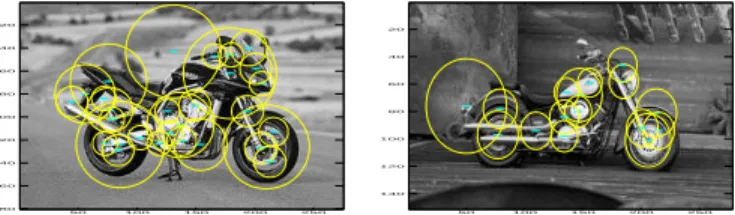
of the region givesS. Figure 2 illustrates this on two typical
images from the motorbike dataset.
50 100 150 200 250
20
40
60
80
100
120
140
160
180
50 100 150 200 250
20
40
60
80
100
120
140
Figure 2: Output of the feature detector
Once the regions are identified, they are cropped from the image and rescaled to the size of a small (typically
11×11) pixel patch. Thus, each patch exists in a 121 dimen-sional space. Since the appearance densities of the model must also exist in this space, we must somehow reduce the dimensionality of each patch whilst retaining its distinctive-ness, since a 121-dimensional Gaussian is unmanageable from a numerical point of view and also the number of pa-rameters involved (242 per model part) are too many to be estimated.
This is done by using principal component analysis (PCA). In the learning stage, we collect the patches from
all images and perform PCA on them. Each patch’s ap-pearance is then a vector of the coordinates within the first
k(typically10-15) principal components, so giving usA.
This gives a good reconstruction of the original patch whilst
using a moderate number of parameters per part (20-30).
ICA and Fisher’s linear discriminant were also tried, but in experiments they were shown to be inferior.
We have now computedX,S, andAfor use in learning
or recognition. For a typical image, this takes 10-15 seconds (all timings given are for a 2 Ghz machine), mainly due to the unoptimized feature detector. Optimization should reduce this to a few seconds.
2.4. Learning
The task of learning is to estimate the parameters
θ={µ,Σ,c, V, M, p(d|θ), t, U} of the model discussed
above. The goal is to find the parametersθˆM Lwhich best
explain the dataX,S,Afrom all the training images, that is
maximize the likelihood:θˆM L=arg max
θ
p(X,S,A|θ).
Learning is carried out using the
expectation-maximization (EM) algorithm [5] which iteratively
converges, from some random initial value ofθto a
maxi-mum (which might be a local one). It works in two stages;
the E-step in which, given the current value of θ, some
statistics are computed and the M-step in which the current
value ofθ is updated using the statistics from the E-step.
The process is then repeated until convergence. The scale information from each feature allows us to learn the model shape in a scale-invariant space. Since the E-step involves evaluating the likelihood for each hypothesis and there
beingO(NP)of them per image, efficient search methods
are needed. A∗and space-search methods are used, giving
a considerable performance improvement. Despite these
methods, aP = 6-7part model withN = 20-30features
per image (a practical maximum), using 400 training
images, takes around 24-36 hours to run. Learning complex
models such as these has certain difficulties. Table 1
illustrates how the number of parameters in the model
grows with the number of parts, (assumingk = 15). To
Parts 2 3 4 5 6 7
# parameters 77 123 177 243 329 451
Table 1: Relationship between number of parameters and number of parts in model
avoid over-fitting data, large datasets are used (up to 400 images in size). Surprisingly, given the complexity of the search space, the algorithm is remarkable consistent in it’s convergence, so much so that validation sets were not necessary. Initial conditions were chosen randomly within a sensible range and convergence usually occurred within
50-100 EM iterations. Using a typical6 part model on a
typical dataset (Motorbikes),10runs from different initial
conditions gave the same classification performance for
9 of them, with the other showing a difference of under
1%. Since the model is a generative one, the background
images are not used in learning except for one instance: the appearance model has a distribution in appearance space modeling background features. Estimating this from foreground data proved inaccurate so the parameters were estimated from a set of background images and not updated within the EM iteration.
2.5. Recognition
Recognition proceeds by first detecting features, and then evaluating these features using the learnt model, as de-scribed in section 2.1. By calculating the likelihood ratio,
R, and comparing it to a threshold; the presence or absence
of the object within the image may be determined. In recog-nition, as in learning, efficient search techniques are used
since largeN andP mean around 2-3 seconds are taken
per image. It is also possible to search reliably for more than one instance in an image, as needed for the Cars (Side) dataset.
3. Results
Experiments were carried out as follows: each dataset was split randomly into two separate sets of equal size. The model was then trained on the first and tested on the
second. In recognition, the decision was (as described
above) a simple object present/absent one, except for the cars (side) dataset where multiple instances of the object
were to be found. The performance figures quoted are
the receiver-operating characteristic (ROC) equal error rates (i.e. p(True positive)=1-p(False positive)) testing against the
background dataset. For example a figure of91% means
that91%of the foreground images were correctly classified
but9%of the background images were incorrectly
classi-fied (i.e. thought to be foreground). A limited amount of preprocessing was performed on some of the datasets. For the motorbikes and airplanes the images were flipped to en-sure the object was facing the same way. The spotted cat
dataset was only100images originally, so another100were
added by reflecting the original images, making200in
to-tal. Amongst the datasets, only the motorbikes, airplanes and cars (rear) contained any meaningful scale variation.
There were two phases of experiments. In the first those datasets with scale variability were normalized so that the objects were of uniform size. The algorithm was then eval-uated on the datasets and compared to other approaches. In the second phase the algorithm was run on the datasets con-taining scale variation and the performance compared to the scale-normalized case.
In all the experiments, the following parameters were
used: k = 15,P = 6and on averageN = 20. The only
parameter that was adjusted at all in all the following ex-periments was the scale over which features were found.
The standard setting was 4−60pixels but for the
scale-invariant experiments, this was changed to account for the wider scale variation in features.
Figures5-8show models and test images for four of the
datasets. Notice how each model captures the essence, be it in appearance or shape or both, of the object. The face and motorbike datasets have tight shape models, but some of the parts have a highly variable appearance. For these parts any feature in that location will do regardless of what it looks like. Conversely, the spotted cat dataset has a loose shape model, but a highly distinctive appearance for each patch. In this instance, the model is just looking for patches of spotty fur, regardless of their location. The differing nature of these examples illustrate the flexible nature of the model. The majority of errors are a result of the object receiv-ing insufficient coverage from the feature detector. This happens for a number of reasons. One possibility is that,
when a threshold is imposed onN (for the sake of speed),
many features on the object are removed. Alternatively, the feature detector seems to perform badly when the object is much darker than the background (see examples in figure
5). Finally, the clustering of salient points into features,
within the feature detector, is somewhat temperamental and can result in parts of the object being missed.
Figure3shows a recall-precision curve1(RPC) and a
ta-ble comparing the algorithm to previous approaches to ob-ject class recognition [1, 17, 19]. In all cases the perfor-mance of the algorithm is superior to the earlier methods, despite not being tuned for a particular dataset.
Figure4(a) illustrates the algorithm performs well even
when the signal-to-noise ratio is degraded by introducing
background images into the training set and Fig.4(b) shows
how variation in the number of parts affects performance.
Dataset Ours Others Ref.
Motorbikes 92.5 84 [17]
Faces 96.4 94 [19]
Airplanes 90.2 68 [17]
Cars(Side) 88.5 79 [1]
Agarwal−Roth algorithm Our algorithm
Figure 3: Comparison to other methods [1, 17, 19]. The diagram on the right shows the RPC for [1] and our algorithm on the cars (side) dataset. On the left the table gives ROC equal error rates (except for the car (side) dataset where it is a recall-precision equal error) on a number of datasets. The errors for our algorithm are at least half those of the other methods, except for the face dataset.
1Recall is defined as the number of true positives over total positives in
the data set, and precision is the number of true positives over the sum of false positives and true positives.
0 20 40 60 80 100
0 10 20 30 40 50 60 70 80 90 100
Face dataset
% training images containing object
% correct
2 3 4 5 6
75 80 85 90 95 100
Number of parts
% correct
Motorbike dataset
(a) (b)
Figure 4: (a) shows the effect of mixing background images into the training data (in this case, the face dataset). Even with a 50-50 mix of images with/without objects, the resulting model error is a
tolerable13%. In (b), we see how the performance drops off as
the number of parts in the model is reduced.
−80 −60 −40 −20 0 20 40 60 80
−60
−40
−20
0
20
40
60
Face shape model
0.92 0.45
0.27
0.79 0.92
0.67
Part 1 − Det:5e−21
Part 2 − Det:2e−28
Part 3 − Det:1e−36
Part 4 − Det:3e−26
Part 5 − Det:9e−25
Part 6 − Det:2e−27
Background − Det:2e−19
Correct Correct Correct Correct Correct
Correct Correct Correct Correct Correct
Correct Correct Correct Correct Correct
INCORRECT Correct Correct Correct Correct
Correct Correct INCORRECT Correct Correct
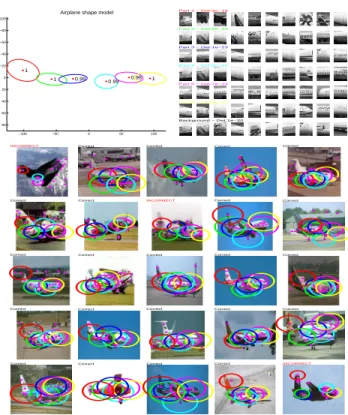
Figure 5: A typical face model with 6 parts. The top left fig-ure shows the shape model. The ellipses represent the variance of each part (the covariance terms cannot easily be shown) and the probability of each part being present is shown just to the right of the mean. The top right figure shows 10 patches closest to the mean of the appearance density for each part and the background density, along with the determinant of the variance matrix, so as to give an idea as to the relative tightness of each distribution. Below these two are some sample test images, with a mix of correct and incorrect classifications. The pink dots are features found on each image and the coloured circles indicate the features of the best hy-pothesis in the image. The size of the circles indicates the score of the hypothesis (the bigger the better).
−50 −40 −30 −20 −10 0 10 20 30 40 50 −40
−30
−20
−10
0
10
20
30
40
Motorbike shape model
0.85
0.78 1
0.99 1
0.75
Part 1 − Det:5e−18
Part 2 − Det:8e−22
Part 3 − Det:6e−18
Part 4 − Det:1e−19
Part 5 − Det:3e−17
Part 6 − Det:4e−24 Background − Det:5e−19
Correct Correct Correct Correct Correct
Correct Correct Correct Correct Correct
Correct Correct INCORRECT Correct Correct
Correct Correct Correct Correct Correct
Correct INCORRECT Correct Correct Correct
Figure 6: A typical motorbike model with 6 parts. Note the clear identification of the front and rear wheels, along with other parts such as the fuel tank.
−25 −20 −15 −10 −5 0 5 10 15 20
−20
−15
−10
−5
0
5
10
15
Spotted cat shape model
0.94
1 1
1
0.97 0.97
Part 1 − Det:8e−22
Part 2 − Det:2e−22
Part 3 − Det:5e−22
Part 4 − Det:2e−22
Part 5 − Det:1e−22
Part 6 − Det:4e−21 Background − Det:2e−18
Correct Correct Correct Correct Correct
Correct Correct Correct Correct Correct
Correct Correct Correct Correct INCORRECT
Correct Correct Correct Correct INCORRECT
Correct Correct Correct Correct Correct
Figure 7: A typical spotted cat model with 6 parts. Note the loose shape model but distinctive “spotted fur” appearance.
−100 −50 0 50 100
−100
−80
−60
−40
−20
0
20
40
60
80
Airplane shape model
1
1 0.99 0.99 0.98 1
Part 1 − Det:3e−19
Part 2 − Det:9e−22
Part 3 − Det:1e−23
Part 4 − Det:2e−22
Part 5 − Det:7e−24
Part 6 − Det:5e−22 Background − Det:1e−20
INCORRECT Correct Correct Correct Correct
Correct Correct INCORRECT Correct Correct
Correct Correct Correct Correct Correct
Correct Correct Correct Correct Correct
Correct Correct Correct Correct INCORRECT
Figure 8: A typical airplane model with 6 parts.
Dataset Total
size of dataset
Object width (pixels)
Motorbike model
Face model
Airplane model
Cat model
Motorbikes 800 200 92.5 50 51 56
Faces 435 300 33 96.4 32 32
Airplanes 800 300 64 63 90.2 53
Spotted Cats 200 80 48 44 51 90 .0
Table 2: A confusion table for a number of datasets. The di-agonal shows the ROC equal error rates on test data across four categories, where the algorithm’s parameters were kept exactly the same, despite a range of image sizes and object types. The performance above can be improved dramatically (motorbikes in-crease to95.0%, airplanes to94.0%and faces to96.8%) if feature scale is adjusted on a per-dataset basis. The off-diagonal elements demonstrate how good, for example, a motorbike model is at
dis-tinguishing between spotted cats and background images: 48%
-at the level of chance. So despite the models being inherently gen-erative, they perform well in a distinctive setting.
Table2shows the performance of the algorithm across
the four datasets, with the learnt models illustrated in
fig-ures5-8. Exactly the same algorithm settings are used for
all models. Note that the performance is above90%for all
four datasets. In addition, the table shows the confusion between models which is usually at the level of chance.
Table3compares the performance of the scale-invariant
models on unscaled images to that of the scale-variant mod-els on the pre-scaled data. It can be seen that the drop in performance is marginal despite a wide range of ob-ject scales. In the case of the cars (rear) dataset, there is a significant improvement in performance with the
scale-invariant model. This is due to the feature detector
per-forming badly on small images (< 150 pixels) and in the
pre-scaled case, all were scaled down to100 pixels.
Fig-ure9shows the scale-invariant model for this dataset. This
dataset was tested against background road scenes (rather than the background images, examples of which are in Fig.
1) to make a more realistic experiment.
Total size Object size Pre-scaled Unscaled
Dataset of dataset range (pixels) performance performance
Motorbikes 800 200-480 95.0 93.3
Airplanes 800 200-500 94.0 93.0
Cars (Rear) 800 100-550 84.8 90.3
Table 3: Results for scale-invariant learning/recognition.
−100 −80 −60 −40 −20 0 20 40 60 80 −60
−40
−20
0
20
40
60
80
Cars (rear) scale−invariant shape model
1 1
0.98 0.98 0.99
0.99
Part 1 − Det:2e−19
Part 2 − Det:3e−18
Part 3 − Det:2e−20
Part 4 − Det:2e−22
Part 5 − Det:3e−18
Part 6 − Det:2e−18
Background − Det:4e−20
Correct INCORRECT Correct Correct Correct
Correct Correct Correct Correct Correct
Correct Correct Correct Correct Correct
Correct Correct Correct Correct Correct
Correct Correct Correct Correct INCORRECT
Figure 9: A scale-invariant car model with 6 parts.
4. Conclusions and Further work
The recognition results presented here convincingly demon-strate the power of the constellation model and the associ-ated learning algorithm: the same piece of code performs
well (less than 10% error rate) on six diverse object
cat-egories presenting a challenging mixture of visual charac-teristics. Learning is achieved without any supervision on datasets that contain a wide range of scales as well as clut-ter.
Currently, the framework is heavily dependent on the feature detector picking up useful features on the object. We are addressing this by extending the model to incorporate several classes of feature, e.g. edgels. Other than this there are two areas where improvements will be very beneficial.
The first is in a further generalization of the model struc-ture to have a multi-modal appearance density with a single shape distribution. This will allow more complex appear-ances to be represented, for example faces with and without sunglasses. Second, we have built in scale-invariance, but full affine-invariance should also be possible. This would enable learning and recognition from images with much larger viewpoint variation.
Acknowledgements
Timor Kadir for advice on the feature detector. D. Roth for providing the Cars (Side) dataset. Funding was provided by CNSE, the UK EPSRC, and EC Project CogViSys.
References
[1] S. Agarwal and D. Roth. Learning a sparse representation for object detection. In Proc. ECCV, pages 113–130, 2002.
[2] Y. Amit and D. Geman. A computational model for visual selection.
Neural Computation, 11(7):1691–1715, 1999.
[3] E. Borenstein. and S. Ullman. Class-specific, top-down segmenta-tion. In Proc. ECCV, pages 109–124, 2002.
[4] M. Burl, M. Weber, and P. Perona. A probabilistic approach to object recognition using local photometry and global geometry. In Proc.
ECCV, pages 628–641, 1998.
[5] A. Dempster, N. Laird, and D. Rubin. Maximum likelihood from incomplete data via the em algorithm. JRSS B, 39:1–38, 1976. [6] W. E. L. Grimson. Object Recognition by Computer, The Role of
Geometric Constraints. MIT Press, 1990.
[7] T. Kadir and M. Brady. Scale, saliency and image description. IJCV, 45(2):83–105, 2001.
[8] T. Lindeberg. Feature detection with automatic scale selection. IJCV, 30(2):77–116, 1998.
[9] D. G. Lowe. Perceptual Organization and Visual Recognition.
Kluwer Academic Publishers, 1985.
[10] K. Mikolajczyk and C. Schmid. Indexing based on scale invariant interest points. In Proc. ICCV, 2001.
[11] C. Rothwell, A. Zisserman, D. Forsyth, and J. Mundy. Planar object recognition using projective shape representation. IJCV, 16(2), 1995. [12] H. Rowley, S. Baluja, and T. Kanade. Neural network-based face
detection. IEEE PAMI, 20(1):23–38, Jan 1998.
[13] C. Schmid. Constructing models for content-based image retrieval. In Proc. CVPR, volume 2, pages 39–45, 2001.
[14] H. Schneiderman and T. Kanade. A statistical method for 3d object detection applied to faces and cars. In Proc. CVPR, 2000.
[15] K. Sung and T. Poggio. Example-based learning for view-based hu-man face detection. IEEE PAMI, 20(1):39–51, Jan 1998.
[16] P. Viola and M. Jones. Rapid object detection using a boosted cas-cade of simple features. In Proc. CVPR, pages 511–518, 2001. [17] M. Weber. Unsupervised Learning of Models for Object Recognition.
PhD thesis, California Institute of Technology, Pasadena, CA, 2000. [18] M. Weber, M. Welling, and P. Perona. Towards automatic discovery
of object categories. In Proc. CVPR, June 2000.
[19] M. Weber, M. Welling, and P. Perona. Unsupervised learning of models for recognition. In Proc. ECCV, pages 18–32, 2000.
![Figure 3: Comparison to other methods [1, 17, 19]. The diagram on the right shows the RPC for [1] and our algorithm on the cars (side) dataset](https://thumb-us.123doks.com/thumbv2/123dok_us/8427711.2241781/6.918.490.845.377.823/figure-comparison-methods-diagram-right-shows-algorithm-dataset.webp)