TENURE OF LEGISLATORS, LOGIC OF TURNOVER AND THE IMPLICATIONS FOR CAPACITY BUILDING OF THE MEMBERS FOR EFFECTIVE ROLE PERFORMANCE: THE PROS AND CONS ON THE ENUGU STATE HOUSE OF
ASSEMBLY
HYGINUS BANKO OKIBE
Department of political science, Faculty of the social sciences Enugu state university of science & technology
Abstract
Term limit for legislators in Nigeria has become a volatile subject that refreshes scholarly debates on Nigeria’s form of democracy during every national election. While no law specifically prescribes term limits for parliamentarians in many political systems, several factors predicated on political necessities tend to foist term limit as a prize tag on the tenure of Nigerian legislators. It has become recurrent decimal in Nigeria, and Enugu State in particular where politically contrived term limit has crept into the tenure of legislators of the State House of Assembly, and National Assembly by extension. This is unlike the United States of America where a legislator could stay in the parliament for as long as his/her constituent desires and expresses it in the ballot box during election. It necessitates some questions: first, what law prescribes term limits for legislators in Nigeria? What impact does short tenure have on skill, knowledge and experience that support effective performance of legislative functions? What political factor influences intermittent turnover of legislators in Enugu State House of Assembly? The study adopts both survey and documentary methods in sourcing information. In the same vein, it uses statistical instruments for data presentation and content analysis for the accompanying discussions. Game Theory anchors the study and provides insight into how the emergent ruling class and their bourgeoisie counterpart from the economic sector in most post-colonial states convert politics generally into means of primitive accumulation and in a game like situation, lacking in compelling rules, alternate persons in various positions, whom they believe would work toward promoting these interests. The findings of the study indicate clusters of causative factors for intermittent turnover of legislators and thus recommend various approaches to overcoming the unconstitutional practice that ridicules legislature and its symbol of democracy.
Introduction
Every elective office has specified tenure that the officeholder occupies the office before vacating it and not re-contests the position for life when the full tenure circle is already completed. It refers to term limits. In most countries, the term limit for executive offices, either as president or as governor, is maximum period of 8 years, comprising two terms of 4 years each and in some instance; it is 5 years or more of single term. In Nigeria, the maximum 8 years tenure is the norm and stipulations of law. However, the officeholder can seek re-election for the same position if he/she spends only 4 years before exiting, in which case, he has only additional 4 years to be in the office, which brings the total number to the maximum 8 years prescribed by law. This provision only applies to executive position, whereas the legislature has no term limits defined or stipulated in any law book in Nigeria. The legislature is a branch of government that performs three key functions: representation, lawmaking and oversight. It is the only branch of government with multiple electoral constituencies. It has closely knitted outreach in terms of people it represents and geographic area. Thus, Section 71 of the 1999 Constitution (as amended) authorised the Independent National Electoral Commission, to,
1) divide each State of the Federation into three Senatorial districts for purposes of elections to the Senate; and subject to the provisions of section 49 of this Constitution,
2) divide the Federation into three hundred and sixty Federal constituencies for purposes of elections to the House of Representatives.
For clarity in the division, Section 72 stipulates that no Senatorial district or Federal constituency shall fall within more than one State, and the boundaries of each district or constituency shall be as contiguous as possible and be such that the number of inhabitants thereof is as nearly equal to the population quota as is reasonably practicable. In furtherance, Section 91 says that, a House of Assembly of a State shall consist of three or four times the number of seats, which that State has in the House of Representatives, divided in a way to reflect, as far as possible nearly equal population:
• Provided that a House of Assembly of a State shall consist of not less than twenty-four and not more than forty members.
Based on the foregoing provisions, the Enugu State House of Assembly was divided into 24 constituencies and each constituency in turn, grouped intrinsically into differentiated political/electoral units from where people aspire to gain access for election into the House of Assembly. Each political unit has always clamoured for inclusiveness in the opportunity to stand for elections into legislative offices, for purposes of giving sense of belonging to the diversities of interests and primordial cleavages. Meanwhile, there is no legally defined term limits for legislative positions, aside that Section 105 (1) of the 1999 Constitution provides that a House of Assembly shall stand dissolved at the expiration of a period of four years commencing from the date of the first sitting of the House. Impliedly, the constitution does not have anything in the form of term limits.
convention in most emerging democracies is that election into the legislative offices tends to rotate randomly, among the units that constitute each electoral constituency. However, no formal legal provision streamlines such rotation but the switchover usually derives from mutual understanding among the stakeholders in each political party. It could be after a single term of four years or two consecutive terms of eight years and even more, before the occupant of the legislative seat exits for the next unit to take its own turn.
Nevertheless, the rule is not sacrosanct but in many respects depended on the political template existing in the state or personal political designs developed by the sitting governor of the state and other powerful political godfathers in the zone. The governor with the stakeholders, most times, unilaterally decides the choice candidates in each election and imposes the choices on the party and the electorates. It makes a governor become political demigod in determining the political fortunes of many prospective power seekers. Such magnificent portrait of the governor plays key roles in building clusters of interests around the persona. Since the return to democratic governance in Nigeria in May 29, 1999 and reinforcement of the powerbase of the executive branch at both national and state levels, there has been diminishing significance of political parties as the sole association whose responsibility is to nominate candidates for election. Political party supremacy has since caved in while the executive decides the formula for rotation or zoning of elective offices in the state. The phenomenon has been the root cause of intermittent turnover of legislators in the House, thereby imposing a political term limit sequel to interplay of elimination and substitution factors. The major focus of this study is to ascertain how inexperienced legislators that such intermittent turnovers midwife in Enugu State House of Assembly significantly affect the performance of their functions.
Situating Enugu State In Historical Perspective
Table 1: Distribution of Local Government Councils among the three Senatorial Zones in Enugu State
S/ No
ENUGU EAST SENATORIAL ZONE
S/N o
ENUGU NORTH SENATORIAL ZONE
S/N o
ENUGU WEST SENATORIAL ZONE
1 Enugu East Local Govt
1 Igbo Etiti Local Govt 1 Aninri Local Govt
2 Enugu North Local Govt
2 Igboeze North Local Govt
2 Awgu Local Govt
3 Enugu South Local Govt
3 Igboeze South Local Govt
3 Ezeagu Local Govt
4 Isiuzo Local Govt 4 Nsukka Local Govt 4 Oji-River Local Govt
5 Nkanu East Local Govt
5 Udenu Local Govt 5 Udi Local Govt
6 Nkanu West Local Govt
6 Uzo-Uwani Local Govt
Extract from Enugu State Government Handbook The Evolution Of Enugu State House Of Assembly
The Enugu State House of Assembly evolved from the defunct Legislative Assemblies that formally served the Eastern Region, the East Central State, and old Anambra State. In their stead, the new Enugu State upon its creation in 1991 established House of Assembly for the State, with new electoral constituencies drawn from the 17 local government areas in the State. Table 2 lists the 24 constituencies, which constitute the electoral districts for elections into the State House of Assembly.
Table 2: List of 24 Constituencies in Enugu State House of Assembly, grouped by Senatorial Zones/Districts
S/N o
ENUGU EAST
ZONE
S/N o
ENUGU NORTH ZONE
S/N o
ENUGU WEST ZONE
1 Enugu East 1 1 Igbo Etiti East 1 Aninri 2 Enugu East 11 2 Igbo Etiti West 2 Awgu North 3 Enugu South 1 3 Igboeze North 1 3 Awgu South 4 Enugu South 11 4 Igboeze North 11 4 Ezeagu 5 Enugu North 5 Igbo-Eze South 5 Oji River
6 Isi-Uzo 6 Nsukka East 6 Udi North
7 Nkanu East 7 Nsukka West 7 Udi South
8 Nkanu West 8 Udenu
9 Uzo-Uwani
Extract from Enugu State House of Assembly Records
amended provide for these functions. The sections empower the legislature at the state levels to exercise oversight powers over the activities of the executive, especially in the area of budget implementation. This is addition to lawmaking. Nevertheless, the oversight functions specifically, are the duties of the committees of the House, which are of three categories - the Standing Committee, Special Committee and Ad-hoc Committee. Apart from the committee system, the House uses oversight tools for its oversight functions. They include budget defence, oversight visits to project sites and MDAs, reports on oversight visits, investigation and public hearing, summon or invitation for questioning, resolution and orders. These tools serve a great deal of purpose in ensuring that the legislators apply the experience, knowledge and skill typical of legislative scrutiny to effectively monitor budget implementation and other executive activities in the state.
Each committee conducts oversight over the activities of a particular ministry, departments and agencies assigned to it, to monitor and subject its operations to legislative scrutiny for accountability to thrive in the governance process, and most especially, in project implementation. Every House Committee has a Clerk attached to it, whose duty is to provide secretarial and other ancillary support services, to enable the respective House Committee to discharge its duties very effectively. As a different arm of government, the House conducts its affairs independently. It has its own leadership, referred to as Principal Officers. They are elected from amongst the members, and consist of the Speaker and the Deputy Speaker; Leader of the House, Deputy Leader, Chief Whip, and Deputy Chief Whip, in addition to the office of the Clerk of the House of Assembly (other than the Clerks of the House Committees). The leadership of the House constitutes House Committees in accordance with the provisions of relevant laws – the Constitution and Standing Orders of the House, composed of the Chairmen and members. Aside the exclusivity of position of Principal Officers for ranking members of the House, new members are also appointed as Chairmen of the House Committees. These committees dwell on experience, skill and knowledge for performance of legislative functions.
With the forgoing background, this study attempts to interrogate some critical questions, which none bears semblance of ignorance of how politics is done or elective offices occupied, retained and consolidated in Nigeria generally and Enugu State in particular. First, does Enugu State House of Assembly have any specified tenure for the prospective legislators? Second, what does the turnover of legislators look like in Enugu State House of Assembly from across the 24 constituencies? Third, how does high rate of turnover of legislators affect the experience, skill and capacity needed in legislative institution for effective performance of its functions? Analyzing these issues warranted a specialized approach, involving definite research design that helps to explain the impact of the various variables.
Theoretical Framework
and Morgenstern assert that game theory, provides tools for analyzing situations in which parties, called players, make decisions that are interdependent (Morrow, 1994). The interdependence causes each player to consider other player’s possible decisions, or strategies, in formulating his own strategy. A solution to a game describes the optimal decisions of the players, who may have similar, opposed, or mixed interests, and the outcomes that may result from these decisions, (https://www.britannica.com/science/game-theory).
However, game theory has been applied to a wide variety of situations in which the choices of players interact to affect the outcome. In stressing the strategic aspects of decision-making, or aspects controlled by the players rather than by pure chance, the theory both supplements and goes beyond the classical theory of probability, (Schelling, (1960) and Robert, (1994). It has been used, for example, to determine what political coalitions are likely to form the strongest force in the face of competition, the power of a voter or a bloc of voters, whom to select for a jury, and the behaviour of competitors and political actors in their struggle for survival. It has even been used to challenge the legality of certain voting systems. Most importantly, games can be classified according to certain significant features, the most obvious of which is the number of players. Thus, a game can be designated as being a one-person, two-one-person, or n-person (with n greater than two) game, with games in each category having their own distinctive features. In addition, a player need not be an individual; it may be a nation, a corporation, or a team comprising many people with shared interests.
The extent to which the goals of the players coincide or conflict is another basis for classifying games. Constant-sum games are games of total conflict, which are also called games of pure competition. Poker, for example, is a constant-sum game because the combined wealth of the players remains constant, though its distribution shifts in the course of play. According to Rapaport (1974:1) games involve some important elements, such as mentioned below:
i. Players or decision makers;
ii. Strategies available to each player; iii. Rules governing player’s behaviour
iv. Outcomes, each of which is a result of particular choices made by players at any given point in the game, and
v. Payoffs accrued by each player as a result of each possible outcome.
pursue strategies that help him/her achieve the most profitable outcome in every situation, thus implying rationality in choices and select strategies.
Relevance Of Games Theory In The Study
Within the context of a state, politics is viewed as a game and the theory focuses on analyzing political phenomena and explaining the rules governing each game and providing insight into the consequence of differences in strategy in political practice from prisms of options that each party considers profitable when the rival force is outwitted. This game type relates to the nature of political game that colonial legacies bequeathed to newly inducted players in post-colonial states. It thwarted consideration for other contending players and functions in reverse form, based on winner-takes-all principle. In government administration and economic organization, the conventional game rules rarely apply in post-colonial states, which suddenly have turned many players into spectators in the face of absurdities committed by bias referees in connivance with other officiating members that believe in winning the game at all cost and giving out the trophy unchallenged to their preferred team.
In the case of this study, godfathers, heads of executive branch of government and their bourgeois colleagues in other strategic sectors visibly but poignantly officiate virtually the political game as referees regardless of the fact that they are either players or sponsors of players. In that contest, knowing the value of the trophy under contest, they usually do anything possible to win the trophy and extend the largesse to their loyalists. This forms the circle of political influence they exert in dictating both the content of the political game, the applicable rules, and the criteria for eligibility to participate and maybe become a winner. Therefore, there is relationship between the strategies used by the departed colonial authorities in preserving the system for privileged class in a zero-sum game type and the pattern adopted by the indigenous leaders since after attaining political independence.
As it was a practice during the colonial period, the post-colonial state remains intrinsically tied to class conspiracy, which the potential victims are the ruled class. As a result, state resources, just like government powers has become major means of affluence and thus making politics the most lucrative business. The godfathers market subordinate politicians like the European football clubs sale players and harvest the fortune. In other words, they have established big clubs that compete with other clubs for the purpose of winning and controlling state resources. Some teams (political parties) occasionally go on relegation, coaches are either sacked or suspended and erring players shown the way out. Politicians play similar games in Nigeria, where each team leader’s interest is to apply best strategies that maximize profits and minimize losses, thus resulting in intermittent turnover of officeholders as gateway to increasing access to control machinery of the game and having firm grip on the contested trophy. As football coaches control a team, decide which player to field in a game, who is to be in reserve bench, whom to remove and who to substitute him/her, the political godfathers and actors apply similar game tact in deciding the form of elimination and substitution to adopt in politics.
Methodology
discussion of the results. Using random technique, the study selected 230 persons as its population spread across the 24 House of Assembly State Constituencies in Enugu State. It composed of both former and serving Legislators in Enugu State, the Support Staff (i.e. Committee Clerks who partake in oversight), Legislative Assistants, Officials of Ministries, Departments and Agencies (MDAs, who interface with the legislators during oversight activities), Civil Society Organizations (CSO) and some Members of the Constituents. Out of the 250-population size, it selected a sample size of 175, representing 70 percent of the population. Nwana (2005) contends that ‘‘if the population is a few hundreds, a 40% or more samples will do; if many hundreds, a 20% sample will do; if a few thousands, a 10% sample will do; and if several thousands, a 5% or less samples will do’’. In this case, the study involves a few hundreds, and thus justifies the use of more than 40% sample. Nwana (2005) further observes that where it is evident that the phenomenon subjected to investigation exhibits glaring and distinct variability, such as it applies to a study on turnover of legislators, A high sample percentage drawn from the population will give reasonably reliable and valid results. This is because ‘‘there is no fixed and inviolate rule regarding the size of the sample. No fixed number and no fixed percentage are ideal. Rather, it is the circumstances of the study situation that determine what number or what percentage of the population should be studied, (Nwana, 2005).
On the other hand, random sampling technique was applied for the distribution of the questionnaire from amongst the selected sample size for the study. The implication is that each person in the sample size had equal chances of selection to answer the questions in the questionnaire, without any inherent discrimination. Furthermore, it applied the “judgmental sampling method” in selecting those interviewed. According to Ashley (2016), “judgmental sampling method” is a non-probability sampling technique where the researcher selects the sampled units based on their knowledge and professional judgment’’. In addition, using non-probability technique to select the number has no affect on the reliability and validity of the data; instead, it provides a fair representation of the heterogeneity in the population and plurality of opinions needed to for objective analysis of data.
Data Presentation And Interpretation
Table 3: Questionnaire – the frequencies and percentages of responses by the respondents
S/N o
Statements/ Questions Agree Undeci
ded
Disag ree
Tota l 1 Enugu State House of Assembly does not
have any legally prescribed term limit for the office of legislators
139 79.43 % 03 1.71% 33 18.86 % 175 100 %
2 There is intermittent turnover of legislators in Enugu State House of Assembly from across the 24 constituencies
103 58.86 % 05 2.86% 67 38.28 % 175 100 %
3 The intermittent turnover of legislators creates gap in skill, knowledge and experience that legislators needed to acquire and thereby perform their legislative functions effectively 119 68% 11 6.29% 45 25.71 % 175 100 %
4 The new legislators do not possess the requisite skill, knowledge and experience required for effective legislative functions
127 72.57 % 09 5.14% 39 22.29 % 175 100 %
5 The lack of requisite skill, knowledge and experience hinders effective performance of their function especially in the area of oversight over executive activities on budget implementation 144 82.29 % 01 0.57% 30 17.14 % 175 100 %
Source: Field Survey, 2017
The responses in table 3 was expressed in the bar chart 1, which showed the flow in the percentages of the responses based on each option of answer to the question. The frequencies of the responses reflected the divergences in the opinions of the respondents.
Source: Field Survey, 2017
The preponderance of the affirmative responses largely indicates that the performance of legislative functions are skill and experience based, therefore; inexperience in the performance of these functions may be blamed on the intermittent turnover of legislators, which has the potential to hinder effective oversight especially in the area of budget implementation. The discussion of the data presented in the foregoing table 3 and further illustrated in Figure 1, provides illuminating evidence on the matter.
Table 4: Questionnaire – the frequencies and percentages of responses by the respondents
S/ No
Statements/ Questions Agree Undecid
ed
Disagr ee
Total
6 Political godfathers handpick those that become submissive, dependent and executive rubberstamp when elected into the House
157 89.71 %
7 4%
11 6.29%
175 100%
7 The intermittent turnover serves the purpose of subjecting the legislators to doing the biddings of the executive in all spheres of governance
162 92.57 %
4 2.29%
9 5.14%
175 100%
8 The fears of opposition to the executive make new legislators to easily and readily neglect infraction and impeachable acts in executive activities
169 96.57 %
- 0%
6 3.43%
175 100%
9 The turnover relegates tenure stability and makes oversight powers to be used for extortion/witch-hunt of vulnerable MDAs personnel
132 75.43 %
9 5.14%
34 19.43 %
175 100%
10 Legislative position in Enugu State is viewed as poverty alleviation programme which avails each member opportunity to enrich him/herself
171 97.71 %
- 0%
4 2.29%
175 100%
Source: Field Survey, 2017
Figure 2: Bar Chart showing percentage of aggregate responses according to matching answer options
Source: Field Survey, 2017
The preponderance of the affirmative responses clearly indicates that the performance of legislative functions are skill and experience based, therefore; inexperience in the performance of legislative functions largely relate to the turnover of legislators with the potential to hinder effective oversight especially in the area of budget implementation.
Problematizing The Tenure Riddle In Nigeria
The prolongation of a legislator’s stays in the legislature (National Assembly – Senate and House of Representatives or State Assembly) has been a subject of debate. While some view it as normal in representative democracy, many others disagree, contending that diversity and federal character naturally imposed limitation on such practice. From the data presented in table 3, which focuses on Enugu State, 79.43 percent of the respondents admit that there is no term limits in Enugu State House of Assembly seats, whereas 58.86 percent, (though not in disbelief), agree that there is intermittent turnover of legislators in the State Assembly. The turnover is not peculiar to Enugu State but a generalized phenomenon across the 36 States, including the National Assembly – Senate and House of Representatives. What does the contradictory practice portend in a constitutional democracy?
Pertinently, it is a shared view that such intermittent turnover affects length of tenure that correlates with acquisition of knowledge, skill and experience which prolonged tenures guarantee, and which observers consider as necessary condition for performance of legislative functions. Accordingly, Padró i Miquel and Snyder, (2004) analogically espoused the tacit relationship between performance and length of tenure and argue, “The performance of legislators increases with tenure, and it is believed that learning by doing is a possible
explanation”. The implication is that the longer a legislator stays in the House, the more
representation and oversight over executive activities, particularly, in the area of budget implementation.
The foregoing deduction buttresses the reign of defective representation, protracted loss of vision in lawmaking and poor oversight functions, which sometimes are attributed to intermittent turnover of legislators that culminates in the elimination of ranking members and injection of new ones who start to learn on the job rather than doing work. As evident, new legislators that replace the departing ranking legislators possess no experience and skill on the job at the very moments they assume offices. They know little or nothing about moving or seconding of motions, initiating debates and citation of procedural rules (Standing Orders of the House) where necessary to support arguments. Additionally, they are bereft of legislative ideas pertaining to rules of engagement with the executive on oversight. These are among the entry behaviours and orientation that bolster the performance of a legislator. For example, 76.22% respondents agree that the new legislators do not possess the requisite skill, knowledge and experience required for effective oversight functions. Arguably, inexperience affects the performance of oversight functions and the consensus view among scholars suggest that,
A state legislature would not function effectively unless a substantial number of its members have acquired several sessions of experience in the lawmaking process, (Hyneman, 1938; 2018).
Except for few isolated cases, the zoning or rotation of legislative seats does not permit an elected House member to stay in the House for longer terms because other zones also agitate for their own turn. It characterizes the intermittent turnover of legislators through politics of zoning or rotation in all cadres of elective offices in Enugu State and Nigeria, although with varied intensity in each state. It is the same context that English, (2003) and Birkholz, (2005) generalized the trend and assert that; “A problem with term limits is that they lower the stock
of legislative expertise by forcing turnover”. Once a legislator who has started imbibing the
tenets of legislative process is replaced after serving short term in office, the valuable contribution that his experience supposed to make is lost. Moreover, there is always the tendency that each new legislator will face similar circumstances with time due to unending claims and counter-claim for the seat by all the sections that make up the constituency. The development makes each successive legislator, regardless of whether ranking or a neophyte to focus more on seeking ways of recouping electoral expenses before the obvious happens. It sacrifices lawmaking, thorough oversight and accountable representation and a minus for legislative institution.
Legislator’s Turnover And The Consequent Institutional Fragility
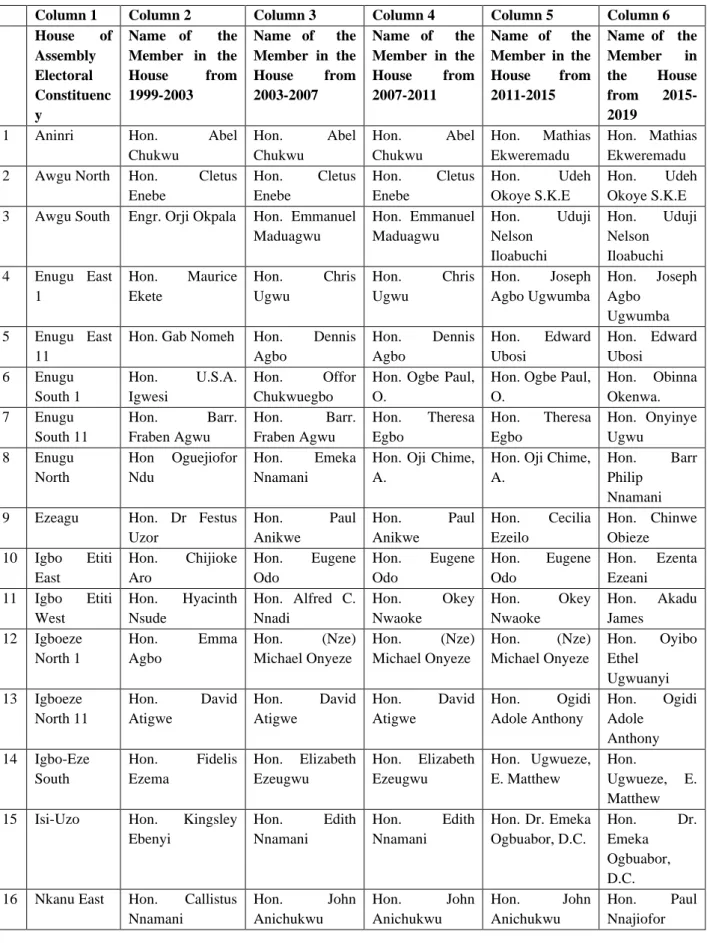
Table 5 shows the legislators in Enugu State House of Assembly, from the inception of fourth Republic from 1999 to 2019. Some of the legislators were in the House of Assembly for three consecutive terms (12 years combined) and others 8 years or 4 years single term. Fundamentally, the political triggers for the intermittent turnover, which were commonplace in 2003 and 2011 mainly, corroborate the notion that every turnover has political explanation and satisfies political interests.
Table 5: Frequency of turnover of legislators in Enugu State House of Assembly, 1999 to 2019
Column 1 Column 2 Column 3 Column 4 Column 5 Column 6
House of
Assembly Electoral Constituenc y
Name of the Member in the
House from
1999-2003
Name of the Member in the
House from
2003-2007
Name of the Member in the
House from
2007-2011
Name of the Member in the
House from
2011-2015
Name of the
Member in
the House
from
2015-2019
1 Aninri Hon. Abel
Chukwu
Hon. Abel
Chukwu
Hon. Abel
Chukwu
Hon. Mathias Ekweremadu
Hon. Mathias Ekweremadu
2 Awgu North Hon. Cletus
Enebe
Hon. Cletus
Enebe
Hon. Cletus
Enebe
Hon. Udeh
Okoye S.K.E
Hon. Udeh
Okoye S.K.E 3 Awgu South Engr. Orji Okpala Hon. Emmanuel
Maduagwu
Hon. Emmanuel Maduagwu
Hon. Uduji
Nelson Iloabuchi
Hon. Uduji Nelson Iloabuchi 4 Enugu East
1
Hon. Maurice
Ekete
Hon. Chris
Ugwu
Hon. Chris
Ugwu
Hon. Joseph Agbo Ugwumba
Hon. Joseph Agbo
Ugwumba 5 Enugu East
11
Hon. Gab Nomeh Hon. Dennis
Agbo
Hon. Dennis
Agbo
Hon. Edward Ubosi
Hon. Edward Ubosi
6 Enugu
South 1
Hon. U.S.A.
Igwesi
Hon. Offor
Chukwuegbo
Hon. Ogbe Paul, O.
Hon. Ogbe Paul, O.
Hon. Obinna Okenwa.
7 Enugu
South 11
Hon. Barr.
Fraben Agwu
Hon. Barr.
Fraben Agwu
Hon. Theresa Egbo
Hon. Theresa Egbo
Hon. Onyinye Ugwu
8 Enugu
North
Hon Oguejiofor Ndu
Hon. Emeka
Nnamani
Hon. Oji Chime, A.
Hon. Oji Chime, A.
Hon. Barr
Philip Nnamani
9 Ezeagu Hon. Dr Festus
Uzor
Hon. Paul
Anikwe
Hon. Paul
Anikwe
Hon. Cecilia Ezeilo
Hon. Chinwe Obieze 10 Igbo Etiti
East
Hon. Chijioke Aro
Hon. Eugene
Odo
Hon. Eugene
Odo
Hon. Eugene Odo
Hon. Ezenta Ezeani 11 Igbo Etiti
West
Hon. Hyacinth Nsude
Hon. Alfred C. Nnadi
Hon. Okey
Nwaoke
Hon. Okey
Nwaoke
Hon. Akadu
James 12 Igboeze
North 1
Hon. Emma
Agbo
Hon. (Nze)
Michael Onyeze
Hon. (Nze)
Michael Onyeze
Hon. (Nze)
Michael Onyeze
Hon. Oyibo Ethel
Ugwuanyi 13 Igboeze
North 11
Hon. David
Atigwe
Hon. David
Atigwe
Hon. David
Atigwe
Hon. Ogidi
Adole Anthony
Hon. Ogidi Adole
Anthony 14 Igbo-Eze
South
Hon. Fidelis
Ezema
Hon. Elizabeth Ezeugwu
Hon. Elizabeth Ezeugwu
Hon. Ugwueze, E. Matthew
Hon.
Ugwueze, E. Matthew
15 Isi-Uzo Hon. Kingsley
Ebenyi
Hon. Edith
Nnamani
Hon. Edith
Nnamani
Hon. Dr. Emeka Ogbuabor, D.C.
Hon. Dr.
Emeka Ogbuabor, D.C. 16 Nkanu East Hon. Callistus
Nnamani
Hon. John
Anichukwu
Hon. John
Anichukwu
Hon. John
Anichukwu
Hon. Paul
17 Nkanu West Hon. Nwabueze Ugwu Hon. Chukwuma Nnonna Hon. Chukwuma Nnonna
Hon. Aniagu Iloabuchi, D.
Hon. Aniagu Iloabuchi, D.
18 Nsukka East Hon. Ogbo
Asogwa
Hon. Felix Amu Hon. Felix Amu Hon. Chinedu Nwamba
Hon. Chinedu Nwamba 19 Nsukka
West
Hon. Fabian
Onah
Hon. Fabian
Onah
Hon. Fabian
Onah
Hon. Dame
Nkechi Omeje
Hon. Dame
Nkechi Omeje
20 Oji River Hon. Uche Anya Hon. Jonny
Obiadinma
Hon. Donatus Uzoagbado, O
Hon. Donatus Uzoagbado, O
Hon. Donatus Uzoagbado, O
21 Udenu Hon. Eze
Emmanuel
Hon. Princess Eugenia Ogbu
Hon. Princess Eugenia Ogbu
Hon. Ezeugwu Ikechukwu, M.
Hon. Ezeugwu Ikechukwu, M.
22 Udi North Hon. Kenneth
Ogbozor
Hon. Maxwell Njeze
Hon. Maxwell Njeze
Hon. Johnbull Nwagu
Hon. Johnbull Nwagu 23 Udi South Hon. Foster Agu Hon. Mrs Chika
Eneh
Hon. Mrs Chika Eneh
Hon. Chukwuka Eneh
Hon. Chukwuka Eneh
24 Uzo Uwani Hon. Barr.
Jonathan Chukwuma
Hon. Anthony Chigbo
Hon. Anthony Chigbo
Hon. J.J. Ukuta Hon. J.J. Ukuta
Source: Adapted from the Records of Enugu State House of Assembly
N/B: In December 2017, Hon. Udeh Okoye S.K.E representing Awgu North was elected the PDP National Youth Leader
Columns 1 and 2 show that 19 out of the 24 legislators that served first term in the administration of Governor Chimaroke Nnamani (1999-2003) were not re-elected to serve second term (2003-2007). Only 5 of the 1st term legislators were re-elected to the House. With such overwhelming majority (19) ranking legislators substituted with new legislators, who lack legislative skill, knowledge and experience, performance of legislative function was bound to suffer serious setback. It would naturally turn legislative process to teaching-learning programme, where many showed less interest even in the teaching-learning but believed that loyalty to the executive, support for anything emanating there-from, and express approval or passage of executive bills constitute their primary responsibility in the House. Therefore, oversight was not a priority because it could mean investigating the conducts of executive or coming to crossroad with its policies and programme. It attests to the fact that the governor mainly or some loyal godfathers in few instances, handpick virtually the legislators. The practice compromises legislature, gives executive unlimited advantage to freely expend public funds not duly appropriated by the House, and secures legislative approval for them at its convenient time.
sharing appointive positions and most significantly, the resources that accrued to the state. It further percolated through other layers in the system, and made much impact in the House of Assembly where their own internal divisions conformed to the already evident split among their godfathers. It caused serious cracks in the flanks of the legislators, and divided them into two opposing camps - those that supported governor and those that opposed the governor and stuck to their rampaging godfathers. It explained why governor with his much powers and influence over party structure and electoral process laid off the opposing legislators during re-election campaigns in 2003.
The use of legislators for prosecution of political conflict in the state makes the institution become executive rubberstamp, for the purposes of securing governor’s confidence for possible re-election. It corroborates the speculation that the major thrust of intermittent turnover of legislators was to elect stooges that pledge unconditional loyalty to their principal. It was a near consensus that politics of godfatherism influences this trend. In other words, each godfather (governor in most cases) handpicks people that become submissive, dependent and rubberstamp when serving in the State House of Assembly and does not relent in frustrating the election of potential rivals or enemies who might contemplate upturning the chessboard and igniting fire of threats of impeachments on the executive.
However, there was a slight deviation during the 1st term of Governor Sullivan Chime (2007-2011), where only 5 members were newly elected as 1st term legislators and 19 re-elected through the overwhelming influence of the exiting governor. The massive re-election harvest seemed like reward package for the loyal legislators who served the exiting executive under turbulent circumstances without succumbing to public outcry against the activities of the government. Besides, the domestication of master-servant atmosphere characterizing the relationship between the executive and legislature has since become an entrenched attitudinal culture, where opposition or dissenting opinion to executive activities is viewed as taboo among the legislators. It is either that the convention has held legislature captive in democratic governance or that their lack of skill and inexperience combines to reduce them to stooge, thus culminating in their personal ambition taking precedence over other considerations.
For example, many of the re-elected legislators served two terms of 8yrs or three terms of 12yrs but were unable to subject executive policies and programmes to thorough scrutiny and thereby demonstrate the seriousness of the institution. For instance, the ranking legislators that dominated the House between 2007 and 2011, which nominally implied that they would perform robust legislative functions on lawmaking, representation and oversight failed in distinguishing themselves from the neophytes and could not match public expectations with reality. The foregoing assumption reflects in the dilemma and palliative arguments by scholars, which contest the fact that:
to introduce more bills or to have a better attendance record. However, they are significantly more likely to see their bills passed, (Haynie (2002).
Extrapolating the arguments further and using the Enugu State House of Assembly to substantiate the applicability, many ranking legislators who dominated the 1st term of the administration (2007-2011) and possessed legislative skill and experience ceased to be catalyst whose watchdog roles influenced the executive to achieve the significant infrastructural projects recorded in the state. This is evident in many lapses in oversight, which involved some of the ranking legislators that have acquired requisite experiences and skill on budget process and oversight activities. In that regard, the explanation for inactivity in the performance of legislative function may not reside in skill, knowledge or experience on legislative process but found in the apprehension of becoming a victim of the turnover politics. It bars legislators from applying their experience to checkmate the activities of the executive; and instead, focus on serving their selfish purposes. For example, the fears for replacement during next elections make many legislators to pay less attention to oversight and more on material acquisition. They engage in a wide range of primitive accumulation in readiness for probable exit in the next election season based on the inherent phobia associated with the fragile zoning or rotation formula.
Tenure Question And Effectiveness Of Legislators On Oversight
The nature of politics and meddling roles of godfathers as already discussed deemphasize skill or experience and constitute parts of hitches in the performance of legislative functions. First, the political party system stifles opposition and demands unwavering support to the government in power. The system gives godfathers the leverage to tailor the system to satisfy their pecuniary motives. In order to accelerate this process, they handpick all manners of persons to contest elections into the House. In many instances, most of these nominees are relatives, friends and supporters of the incumbent governor, Senator, Reps member and other political bigwig.
The naivety exhibited by these products of nepotism and mediocre in governance show in their inability to comprehend the technicalities embodied in legislative activities; hence, they easily relegate performance of legislative functions. By that means, they tactfully compromise budget through its speedy passage process. To that extent, legislative activities especially in the area of budget implementation lag tremendously in due process. For example, the gloss over of the infractions in budget laws and/or implementation guidelines could explain the quick dilapidation of many road projects constructed during the 2nd term (2011-2015) of the administration. Impliedly, fears of opposition to the executive make new legislators to become willing tools for mismanagement of public funds by constantly overlooking budget implementation and the accompanying oversight inspections and pursuing personal goals that guarantee their re-election and material empowerment.
the ranking of the legislators. This is unlike the ranking legislators who have served either two terms or three terms and possessed requisite skills and experience. When many ranking legislators lose return tickets to the House, it signposts executive absolutism and becomes a ploy by the executive and loyal godfathers, to stop them from applying already acquired experiences and knowledge to improve on legislative watchdog roles over executive activities. For example, 16 ranking legislators were not re-elected during the 2011 general elections in Enugu State, when Governor Sullivan Chime assumed 2nd term in office. Invariably, only 8 sitting members of the State House of Assembly were re-elected (See column 5 in table 5 above). They included Enugu South 1, Enugu South 11; Enugu North, Igbo-Etiti East, Igbo-Etiti West, Igboeze North 1, Nkanu East and Oji River, while the other 16 constituencies elected 1st term legislators.
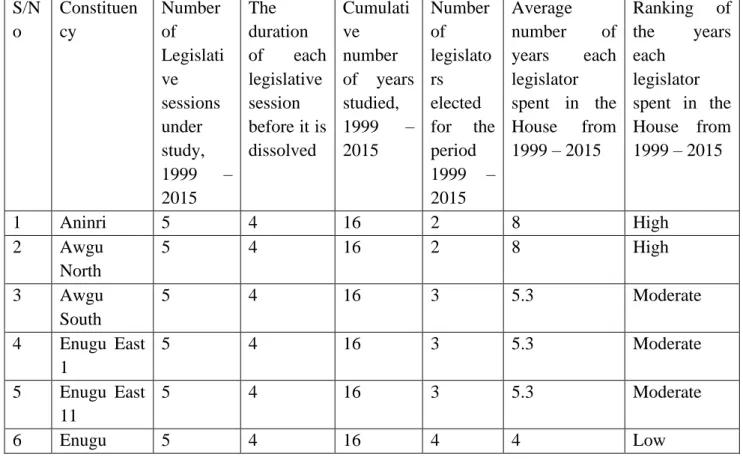
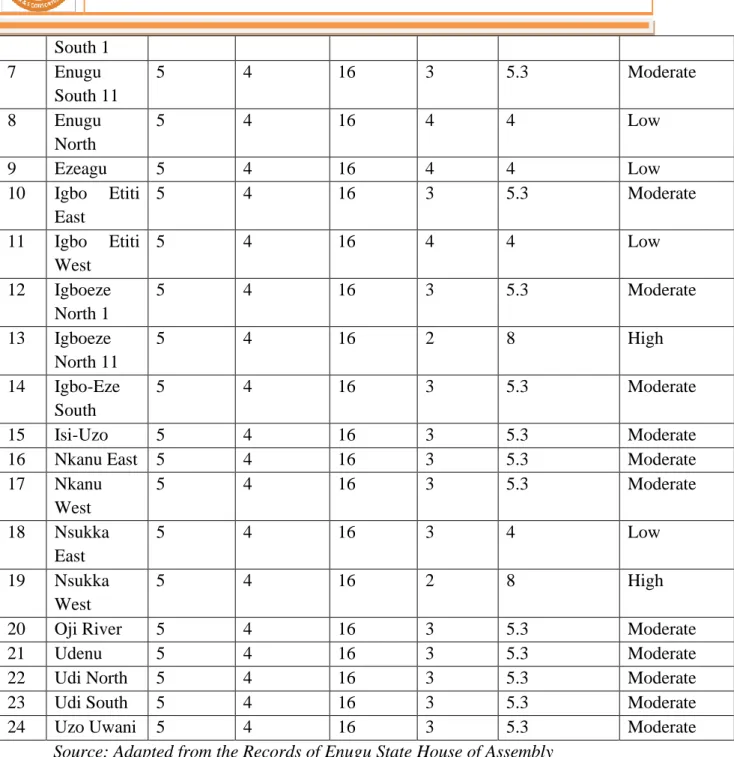
The faceoff between Governor Sullivan Chime and the supposed political godfather, Governor Chimaroke Nnamani was responsible for substitution of the 16 ranking legislators during the 2011 general elections in the state. In fact, each faceoff in the camp of ruling class comes with mistrust and loss of confidence in the feuding parties, and it usually affects their support base. It gave Governor Chime the impetus to offload the loyalist of Nnamani (Ebeano Political Dynasty), especially those whom he tied their re-elections to Nnamani during 2007 general elections when he had not acquired power to select his preferences. Although viewed as imposition of political gatekeepers, each governor commits similar common crime at the verge of leaving office. Table 6 below shows data on the turnover of legislators in the State Assembly across the 24 State constituencies, 1999-2015.
Table 6: Summary of turnover of legislators in the House of Assembly by Constituencies, 1999-2015
S/N o
Constituen cy
Number of Legislati ve sessions under study, 1999 – 2015
The duration of each legislative session before it is dissolved
Cumulati ve number of years studied, 1999 – 2015
Number of legislato rs elected for the period 1999 – 2015
Average number of years each legislator spent in the House from 1999 – 2015
Ranking of the years each
legislator spent in the House from 1999 – 2015
1 Aninri 5 4 16 2 8 High
2 Awgu North
5 4 16 2 8 High
3 Awgu South
5 4 16 3 5.3 Moderate
4 Enugu East 1
5 4 16 3 5.3 Moderate
5 Enugu East 11
5 4 16 3 5.3 Moderate
South 1 7 Enugu
South 11
5 4 16 3 5.3 Moderate
8 Enugu North
5 4 16 4 4 Low
9 Ezeagu 5 4 16 4 4 Low
10 Igbo Etiti East
5 4 16 3 5.3 Moderate
11 Igbo Etiti West
5 4 16 4 4 Low
12 Igboeze North 1
5 4 16 3 5.3 Moderate
13 Igboeze North 11
5 4 16 2 8 High
14 Igbo-Eze South
5 4 16 3 5.3 Moderate
15 Isi-Uzo 5 4 16 3 5.3 Moderate
16 Nkanu East 5 4 16 3 5.3 Moderate
17 Nkanu West
5 4 16 3 5.3 Moderate
18 Nsukka East
5 4 16 3 4 Low
19 Nsukka West
5 4 16 2 8 High
20 Oji River 5 4 16 3 5.3 Moderate
21 Udenu 5 4 16 3 5.3 Moderate
22 Udi North 5 4 16 3 5.3 Moderate
23 Udi South 5 4 16 3 5.3 Moderate
24 Uzo Uwani 5 4 16 3 5.3 Moderate
Source: Adapted from the Records of Enugu State House of Assembly
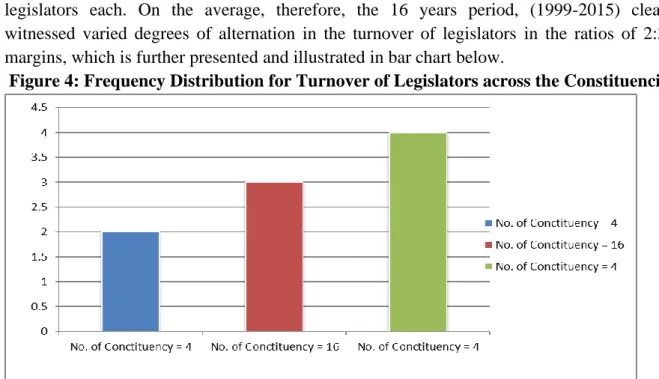
The summary of data in the Pie Chart shows that out of the 24 constituencies that make up Enugu State House of Assembly, the frequencies of turnover of legislators in the various constituencies are unevenly distributed. For example, in 4 constituencies marked blue, 2 legislators each were voted into the House during the 16 years period; in 16 constituencies marked orange, it was 3 legislators each and in 4 constituencies marked green, it was 4 legislators each. On the average, therefore, the 16 years period, (1999-2015) clearly witnessed varied degrees of alternation in the turnover of legislators in the ratios of 2:3:4 margins, which is further presented and illustrated in bar chart below.
Figure 4: Frequency Distribution for Turnover of Legislators across the Constituencies
The calibration of average number of years each legislator spent in the House from 1999 – 2015 (See table 6, column 7) shows considerable variations in their hierarchical order of ranking – high, moderate and low, respectively. The same disparity in years spent tended to be associated with their experience, skill and knowledge, hence the notion that usually accompany the distinction between ranking legislators and the new entrants. Nonetheless, apart from lawmaking experience, moving or seconding of motions, regulatory rules guiding debates and procedural exposures on legislative-executive interface, (which new legislators lack), each category of legislators in the divides did not make remarkable difference while carrying out oversight functions in the committees assigned to them. There was no spectacular proof of unique skill or experience in the functions that many of the committees performed. Both old and new legislators alike were all engrossed in acts of sycophancy, poverty alleviation agenda among members and voluntary submission to executive manipulation.
It shows that the explanation for effective performance of legislative functions ascribed to knowledge, skill and experience garnered over long stay in the House may not lie in the number of years or length of term but some other attributes they shared in common. This is considered from two perspectives:
issues concerning policy implementation during legislative oversight visits. They shy away from their primary assignment for fears of exposing their ignorance and bringing avoidable mockery upon themselves. The few others who are not restrained by deficiency in education use “Commando styles” to confront the personnel of MDAs, and it sometimes result in serious faceoff.
❖ Secondly, what characterizes the interface between legislators and MDAs officials are unbridled extortion of MDAs through unwarranted intimidation. As common practice among politicians in Nigeria, those who find themselves in elective and appointive positions commit much energy in those ventures that promise good returns in their investments in politics. To that extent, most legislators usually preoccupy themselves with pursuits of personal benefits than public good and thereby surrendering their willpower to executive manipulation and at most, becoming political robots to be used and dumped as circumstances or situations warrant.
This conforms to the views that state legislature lack independence in the performance of its functions and it is more so for the State House of Assembly, which subjects itself to the executive bossy influence, and emphasizes personal enrichment at the expense of effective oversight. The same personalized goals beclouded the conduct of budget defence for the respective MDAs, oversight visits to project sites and investigation of infractions of the budget laws between 1999 and 2015. It was sheer misnomer in view of wide range of powers that the 1999 Constitution (as amended), vest in the legislature. Examples include, investigation or public hearing on matters within its jurisdiction to entertain, summon of any person for questioning and general oversight over executive activities.
Arguably, while it is evident that new legislators do not have requisite skill, knowledge and experience, there is dearth of proof showing that the ranking legislators use their experience to influence executive policies and programmes in Enugu State and Nigeria in general. Except for the National Assembly that have gained some degree of independence from executive control, (in the meantime), the various categories of legislators (new and ranking) at the State level exhibit lukewarm attitudes toward focusing torchlight on public funds that the executive controlled and expended on projects and other programmes. They prefer to demonstrate unfettered loyalty to the executive and their godfathers alike, than addressing the needs of their constituents. Ironically, both old and new legislators show interest in improving their economic status than doing effective legislative functions.
The Foundational Causes Of Poor Performance Of Oversight
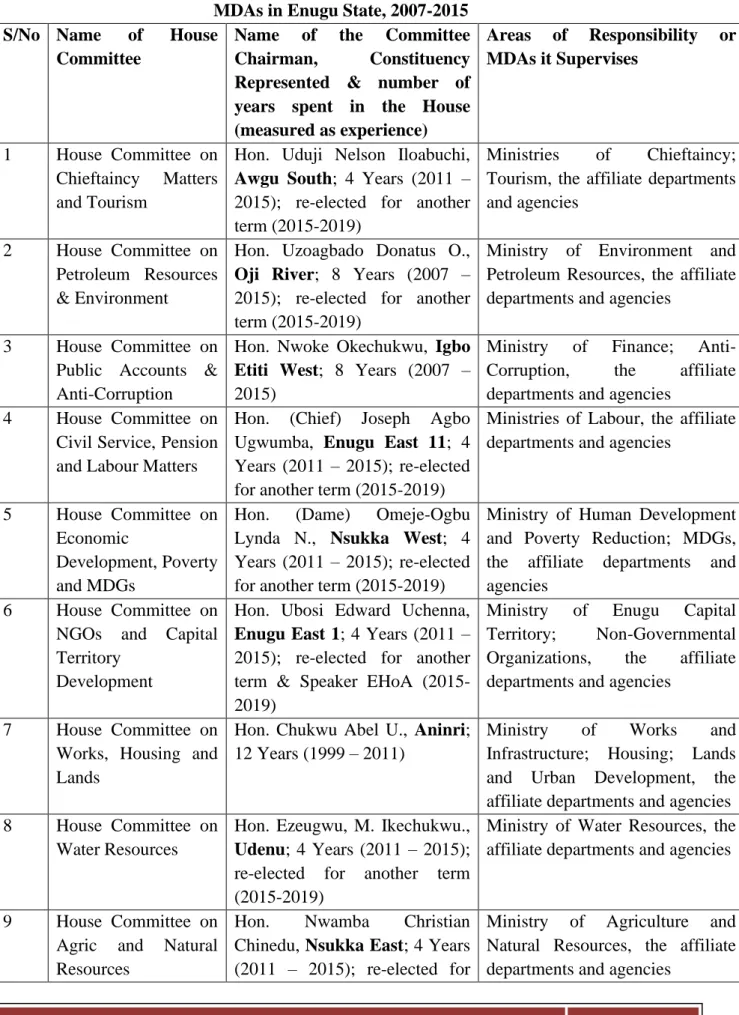
Table 7: Committees headed by mismatched legislators that conducted oversight in MDAs in Enugu State, 2007-2015
S/No Name of House Committee
Name of the Committee Chairman, Constituency Represented & number of years spent in the House (measured as experience)
Areas of Responsibility or MDAs it Supervises
1 House Committee on Chieftaincy Matters and Tourism
Hon. Uduji Nelson Iloabuchi, Awgu South; 4 Years (2011 – 2015); re-elected for another term (2015-2019)
Ministries of Chieftaincy; Tourism, the affiliate departments and agencies
2 House Committee on Petroleum Resources & Environment
Hon. Uzoagbado Donatus O., Oji River; 8 Years (2007 – 2015); re-elected for another term (2015-2019)
Ministry of Environment and Petroleum Resources, the affiliate departments and agencies
3 House Committee on Public Accounts & Anti-Corruption
Hon. Nwoke Okechukwu, Igbo Etiti West; 8 Years (2007 – 2015)
Ministry of Finance; Anti-Corruption, the affiliate departments and agencies
4 House Committee on Civil Service, Pension and Labour Matters
Hon. (Chief) Joseph Agbo Ugwumba, Enugu East 11; 4 Years (2011 – 2015); re-elected for another term (2015-2019)
Ministries of Labour, the affiliate departments and agencies
5 House Committee on Economic
Development, Poverty and MDGs
Hon. (Dame) Omeje-Ogbu Lynda N., Nsukka West; 4 Years (2011 – 2015); re-elected for another term (2015-2019)
Ministry of Human Development and Poverty Reduction; MDGs, the affiliate departments and agencies
6 House Committee on NGOs and Capital Territory
Development
Hon. Ubosi Edward Uchenna, Enugu East 1; 4 Years (2011 – 2015); re-elected for another term & Speaker EHoA (2015-2019)
Ministry of Enugu Capital Territory; Non-Governmental Organizations, the affiliate departments and agencies
7 House Committee on Works, Housing and Lands
Hon. Chukwu Abel U., Aninri; 12 Years (1999 – 2011)
Ministry of Works and Infrastructure; Housing; Lands and Urban Development, the affiliate departments and agencies 8 House Committee on
Water Resources
Hon. Ezeugwu, M. Ikechukwu., Udenu; 4 Years (2011 – 2015); re-elected for another term (2015-2019)
Ministry of Water Resources, the affiliate departments and agencies
9 House Committee on Agric and Natural Resources
Hon. Nwamba Christian Chinedu, Nsukka East; 4 Years (2011 – 2015); re-elected for
another term (2015-2019) 10 House Committee on
Commerce and Industry
Hon. (Sir) Ugwueze E. Matthew., Igbo-Eze South; 4 Years (2011 – 2015); re-elected for another term (2015-2019)
Ministry of Commerce and Industry, the affiliate departments and agencies
11 House Committee on Health
Hon. (Dr.) Emeka Ogbuabor D.C., Isi-Uzo; 4 Years (2011 – 2015); re-elected for another term (2015-2019)
Ministry of Health, the affiliate departments and agencies
12 House Committee on Women Affairs
Hon. (Mrs) Chika, F. Eneh, Udi South; 8 Years (2003 – 2011)
Ministry of Gender Affairs and Social Development, the affiliate departments and agencies
13 House Committee on Youths, Sports and Security Matters
Hon. Ogbe Paul O., Enugu South 1; 8 Years (2007 – 2015)
Ministry of Youths and Sports; Security Matters, the affiliate departments and agencies
14 House Committee on Finance and Appropriation
Hon. Johnbull Nwagu, Udi North; 4 Years (2011 – 2015); re-elected for another term (2015-2019)
Ministry of Finance, the affiliate departments and agencies
15 House Committee on Transport
Hon. Aniagu Iloabuchi D., Nkanu West; 4 Years (2011 – 2015); re-elected for another term (2015-2019)
Ministry of Transport, the affiliate departments and agencies
16 House Committee on Local Govt., Inter-Parliament & ENSIEC
Hon. John Anichukwu, Nkanu East; 12 Years (2003 – 2015)
Ministry of Local Government; Inter-Parliament Affairs and ENSIECMatters, the affiliate departments and agencies
17 House Committee on Rural Development and CSDP Affairs
Hon. Ogidi Adole Anthony, Igboeze North 11; 4 Years (2011 – 2015); re-elected for another term (2015-2019)
Ministry of Rural Development, the affiliate departments and agencies
18 House Committee on Education, Science & Technology
Hon. (Nze) Michael Onyeze, Igboeze North 1; 12 Years (2003 – 2015)
Ministries of Education; Science and Technology, with the affiliate departments and agencies
Source: Adapted from the Records of Enugu State House of Assembly
appropriation, education, science and technology; agriculture and natural resources; works, housing and lands; water resources; public accounts and anti-corruption. Only the House Committee Chairman on Health was a specialist; most of the others lacked the entry knowledge and competence. Nevertheless, appointments into the House Committees are visibly reward oriented and not based on areas the legislators could function effectively. It makes legislative position in Enugu State seem as though it is a poverty alleviation programme, which avails each member the opportunity for self-enrichment. Whether as new or old legislator, the recourse to material empowerment makes them lack zeal in the performance of their functions but search for money through lobbying for constituency projects, land allocation, overseas travel sponsorship, etc.
Essentially, misplacement of legislators in the House committee that requires specific knowledge most times underscores the apparent lack of skills for oversight. It is not entirely the case of newness of a legislator but generalized. Some examples suffice. The leadership of the House did not appoint legislators with skill and experience in engineering professions to head the Committees on Works, Housing, Lands and Water Resources. In addition, Appropriation and Public Accounts were not presided over by persons who possess versed knowledge or experience in financial accounting, to provide leadership while scrutinizing the Appropriation Bill or Public Accounts and finances of government. Additionally, Chairman House Committee on Agriculture sector was not a specialist in the field, etc. It was apparent that many of the old and new legislators that headed unfamiliar sensitive committees rarely understood the language and technicalities involved in the activities of the field and thereby easily succumbed or acquiesced with the viewpoints of the personnel of the MDAs who play on their ignorance. Faced with these daunting challenges, legislators seem to appear overwhelmed by politics of turnover and it affects performance of legislative functions in Enugu State. It buttresses the instability and fragility in the work and tenure of legislators, where the overriding goal is nothing but pursuit of material benefits instead of acquiring basic legislative skills, experience and knowledge.
The Problem Associated With Intermittent Turnover Of Legislators
only serve as disincentive to impartial oversight but damages any form of robust executive – legislative synergy.
In consonance, each legislator utilizes every opportunity for self-enrichment, while the tenure subsists. In other words, the popular slogan has always taken the form of “turn by turn politics” with the prevalent share the money syndrome. The phenomenon of “turn by turn politics” is at the expense of effective oversight, thus the frequent unpredictable turnover makes each legislator to focus more on self-enrichment for fears of losing the next election. It explains the reason that most legislators look down on skill or experience and focus more on pecuniary interests. In every ramification, the syndrome places the ranking legislators on the same pedestal with the new legislators. Importantly, the turnover of legislators thus transforms into ordinary zoning or rotation of resource allocation among the units that form each State House of Assembly constituency without much emphasis on skill, experience for effective oversight on budget implementation and legislative function generally.
It makes the public to disregard legislative position and activities as skill or career driven but empowerment-oriented which each unit is entitled to benefit from. For example, most legislators in the House committees readily believe in “kick-back” in their dealings with the MDAs and contractors, (remittance to the House committee of any amount from the proceeds of budgetary appropriation and contract sums for the year). The kick back syndromes deemphasize strict oversight that does not add financial benefits to their election projects. It is evident that scrambling for material benefits is often the rule rather than the exception in discharging the core mandates of the legislature. In other words, the cultures of zoning the House seats among the component units in each constituency obfuscate the principles of quality representation. It does not allow the very best candidates to scale through the election huddle. It neglects the very essence of legislative oversight. In that context, the prevalence of material focus in the activities of executive and legislators is to recover campaign expenses made in desperate attempts to impose a bad candidate and market highly opinionated programmes.
Political Factors That Trigger Turnover Of Legislators
The above discussions reveal that the constituents play little or no role in bringing about the candidates that represent them in the House. Instead, the sitting governor and very often the political godfathers in each constituency allocates the seat according to their whims and caprices, thereby culminating in petty traders, widely known political jobbers, loyal thugs and semi-illiterates, school certificate holders and artisans being elected into the House. The political gladiators exploit the loophole provided by zoning the seats to flout the civility of the hallowed chambers. In that regard, there is overwhelming evidence to allude to the fact that the intermittent turnover of legislators in Enugu State House of Assembly has significant impact on effective legislative functions. This untoward malpractice undermines the desired capacity, competence and productivity of the legislative institution by solely promoting selfish interests of those who operate around the corridors of power.
functions. Specifically, first term legislators in the State House of Assembly often misunderstand the processes involved in oversight. Aside that, intermittent turnover causes the recurring horror of inexperience, incapacity and lack of skill among very many legislators in the House. Ironically, lack of training to bridge the gap narrows the attention of the legislators to pursuit of personal material goals, which culminates in their consequent vulnerability to executive manipulation. However, Fashagba, (2009) submits that aside the ‘crippling internal conflict, inexperience and high rate of member’s turnover hampering legislative efficiency, the legislature has compromised its role’, and this is possible because of their ambitions.
Moreover, the appointment of legislators into unfamiliar House Committees that needed specialists to supervise MDAs, compromise oversight. The placement of legislators (whether 1st term or ranking legislators), in sensitive committees, which their comparative advantage in skill or exposures do not match, transforms the conduct of oversight to extortion and personal aggrandizement. Thus, the ineffective nature of oversight activities by legislators makes the impact of oversight on policy implementation by the executive, not usually felt seriously by the public. It contradicts the powers conferred on the legislative institution by the existing constitutional and institutional legal frameworks, which forbid any form of executive censorship on legislative activities or subjection of legislative position to term limits. The godfathers manipulate the incessant turnover and inject into the Assembly, persons who are inexperienced, who lack capacity and requisite knowledge of the roles of legislature. In other words, the pattern of politics of representation in the State House among the units that make up each constituency provides room for emergence of stooges as candidates, whose loyalty are to godfathers and not the constituents. It accounts for the predominance of newly elected inexperienced legislators who lack the skill and political will to perform legislative functions. Conclusion
The foregoing discussions have unravelled the environmental factors that demystify turnover of legislators in Nigeria and in the Enugu State House of Assembly in particular. These factors consist of political, economic, psychological and changing tides in values associated with modern governance. The study argues that the turnovers of legislators in the Enugu State House of Assembly bring about inexperienced legislators and thereby hinders effective oversight functions on budget implementation. Obviously, the intermittent turnover of legislators with the accompanying visible inexperience and lack of knowledge on legislative activities hinders the performance of oversight functions. This is despite the fact that the Enugu State House of Assembly has adequate constitutional and institutional legal frameworks to perform its functions, including exerting substantial control over the activities of the executive in the area of budget implementation without undue interference or censorship.
salary scale and allowances determined by the exigencies of duties assigned to the institution. This will discourage many ambitious fortune seekers from aspiring to clinch the position for selfish enrichment. It is the material interests and the perquisite of office that lures power mongers to contest the election; thereby sacrificing the core demands of the office at the expense of focusing on effective oversight. It brings about complete neglect of developing requisite skills, or craving for the necessary knowledge and capacity to perform on the job. In addition, politics of godfatherism should be dispensed to deepen the values of democratic governance in Nigeria. It has done much harm than good to the system. Primordial political culture should be discarded and quality control focused on while choosing legislators.
References
Ashley Crossman (2016) ‘‘Understanding Purposive Sampling: An Overview of the Method
and Its Application’’
.www.sociology.about.com/od/Types-of-Samples/a/Purposive/Sample.htm
Birkholz, Patricia (2005). “Effects of Term Limits in Michigan: Bureaucrats with more
Power”. Spectrum: The Journal of State Government (Winter), 35-36.
Charles, S. Hyneman (1938; 2018). “Tenure and Turnover of Legislative Personnel”. The American Academy of Political and Social Science, SAGE Journals, Vol. 195; Issue 1; p.21, http://journals.sagepub.com/doi/pdf/10.1177/000271623819500104
English, Art (2003). “Effects of Term Limits in Arkansas: Opportunities and Consequences”. Spectrum: The Journal of State Government (Fall), 30-33.
Joseph Yinka Fashagba (2009) ‘‘Legislative Oversight under the Nigerian Presidential
System’’ in The Journal of Legislative Studies, Volume 15, Issue 4; pp. 439-459
Haynie, Kerry (2002). “The Color of Their Skin or the Content of Their Behavior? Race and
Perceptions of African American Legislators”. Legislative Studies Quarterly 27, 295-314.
Morrow, D. James (1994) Game Theory for Political Scientists. Princeton. New Jersey: Princeton University Press
Nwana, O. Clifford (2005) Introduction to Educational Research for Student-Teachers
(Revised Edition). Ibadan: HEBN Publishers Plc.
Padró i Miquel Gerard and James Snyder (2004). “Legislative Effectiveness and Legislative
Life”. MIT: Department of Economics Working Paper No. 04-28.
Rapoport, A. (ed.). (1974) Game Theory as a Theory of Conflict Resolution. MI: University of Michigan Press
Robert, P. (1994) “Multilateral Cooperation in an Integrated Prisoner’s Dilemma”. The Journal of Conflict Resolution, 38:2