Sri Krishna International Research & Educational Consortium http://www.skirec.com
- 98 -
The Journal of Sri Krishna Research & Educational Consortium
ECONSPEAK:
A J O U R N A L O F A D V A N C E S I N M A N A G E M E N T , I T & S O C I A L
S C I E N C E S
I n t e r n a ti on a l l y I n d e x e d & L i s te d R e f er r e d e - J ou r n a l
COMPONENT BASED SOFTWARE
DEVELOPMENT- THE APPROACH TO COMPOSE A SOFTWARE
SANDEEP KUMAR*
*Galaxy Global Group of Institutions, Dinarpur, Ambala,Haryana,India.
ABSTRACT
Here is a new approach of software development, called Component Based Software development, where we do not build the software, rather we compose a software from existing components. Using CBSD, we can reuse the existing components that are developed independent of any application. It results in faster development, lesser cost and more usability. Idea is to ‘Buy, not Built’ new components. So approach and methodology are different from conventional approaches.
INTRODUCTION
Till today, it may be argued whether Software Engineering is actually an engineering field or not. At least it is not pure engineering in its present form. In all traditional engineering fields, a final product is given shape by attaching independent components that may be purchased off the shelf. Take the example of a car manufacturing process. After preparing the design, various components, that are rather independently designed and developed, are attached into an assembly line to give the vehicle its final shape. Even if one component breaks down or stops working, a new component is purchased and the old one is replaced. But this type of development is far away as far as software engineering is concerned. Component Based Development is a step towards this direction. The primary role of component-based software engineering is to address the development of systems as an assembly of parts (components), the development of parts as reusable entities, and the maintenance and upgrading of systems by customizing and replacing such parts. Component-based development requires a systematic approach to and focus on the component aspects of software development [1]. Traditional software engineering disciplines must be adjusted to the new approach, and new procedures must be developed.
Component-based Software Engineering (CBSE) has become recognized as such a new sub-discipline of
Sri Krishna International Research & Educational Consortium http://www.skirec.com
- 99 -
COMPONENT SPECIFICATION
Before we can understand what Component Based Development is all about, we must agree on what a Component is and what a Component is not. There are many definitions of Component in the literature [3] [4], but one given by Szyperski [2] is worth mentioning here:
A software component is a unit of composition with contractually specified interface and explicit context dependencies only. A software component can be deployed independently and is subject to composition by third parts.
A Component’s implementation is different from its interface. Every component has a ‘provides’ and a ‘require’ interface. Through ‘Provide’ interface it provides its services to other components and through ‘Requires’ interface it takes the services from other components. Integration of a component into an application is independent of its development life cycle, and whole application should not be recompiled when a new component is attached with it.
WHY CBSD
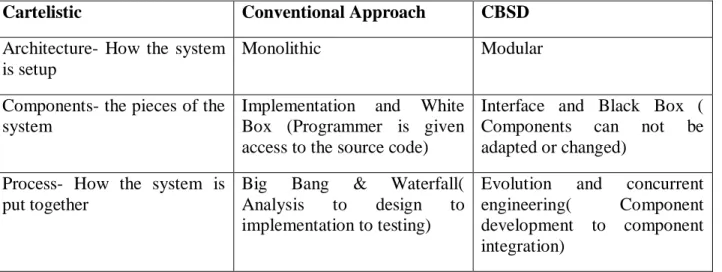
Main goal of component-based development is to build and maintain software systems by using existing software components, e.g. [5, 9, 2,]. They must interact with each other in system architecture [6, 9, 8,].Question arises Why should we adopt CBSE? The answer lies in the definition itself. Moreover CBSE aims to improve the Quality (Flexibility, Maintainability, Reliability) of software systems and productivity & Time-to-market of software development through enabling the easy assembly of software from existing building blocks. Other reasons can be seen by comparing the conventional design and development with Component Based Software Development. Table 1 below gives these comparisons:
TABLE 1: COMPARISONS OF CONVENTIONAL APPROACH TO CBSD
Cartelistic Conventional Approach CBSD
Architecture- How the system is setup
Monolithic Modular
Components- the pieces of the system
Implementation and White Box (Programmer is given access to the source code)
Interface and Black Box (
Components can not be
adapted or changed)
Process- How the system is put together
Big Bang & Waterfall(
Analysis to design to
implementation to testing)
Evolution and concurrent
engineering( Component
Sri Krishna International Research & Educational Consortium http://www.skirec.com
- 100 - Methodology-How the system
changes through time
Built from scratch Composition
Organization- Market for
buying and selling
components
None Specialized- Component
vendors and integrators
Basically conventional approach to software development can be compared with CBSD using five parameters. In the context of software architecture conventional approach adopts monolithic development whereas CBSD adopts a Modular approach. The development process followed in conventional approach is generally waterfall model which goes from analysis to testing one phase at a time, whereas in case of CBSD a more robust evolutionary and concurrent engineering model is adopted there is more emphasis on component development and component integration. Another level where conventional methodology differs from CBSD is the methodology. The conventional software are developed from scratch whereas components are composed together to make a new product in case of CBSD. Another advantage is that in case of CBSD there are specialized vendors and integrators for buying and selling the components.
CBSD LIFECYCLE
Sri Krishna International Research & Educational Consortium http://www.skirec.com
- 101 -
FIGURE 2: WATERFALL MODEL
In case of Component based systems, the first objective should be to look for the existing components wherever in the market they are available. If they are not available then they should be developed in house. So it should be considered in the requirement and design phase itself whether existing components are available or not. Waterfall model can be modified with implementation phase incorporating the component selection. The modified model is shown in the following diagram, figure 3.
Requirements
Deployment Validation
Integration Implementation
Sri Krishna International Research & Educational Consortium http://www.skirec.com
- 102 -
FIGURE 3: WATERFALL MODEL FOR COMPONENT BASED DEVELOPMENT
Requirements
Design
Integrate
Validate
Deploy
Maintain Implementation
Select existing component
Adapt
Implement new component
Sri Krishna International Research & Educational Consortium http://www.skirec.com
- 103 - The difference can be seen at the implementation level. If we can have a component that has already been built and used in some application, that is selected and integrated with the current application or else a component may have to be adapted to the current application. Third alternative is to design and develop a totally new component and then integrate it into the current application.
CBSD: PROS AND CORNS
CBSD has its potential advantages and disadvantages .Advantages include.
REDUCED DEVELOPMENT TIME: It takes a lot less time to buy a component than it does to design it, code it, test it, debug it, and document.
INCREASED RELIABILITY OF SYSTEMS: An off-the-shelf component may have been used in many other systems earlier, and should therefore have had more bugs found out of it.
INCREASED FLEXIBILITY: Positioning a system to accommodate off-the-shelf components means that the system has been built to be immune from the details of the implementation of those components.
This was one side of the coin. It has its own negative side also.
If the primary supplier goes out of business or stops making the component, other suppliers may not step in to fill the gap
The vendor may stops supporting the current version of the component, and the new versions may be incompatible with the old
If the system demands high reliability or high availability, how can the consumer be sure that the component will allow the satisfaction of those requirements?
CONCLUSION
Sri Krishna International Research & Educational Consortium http://www.skirec.com
- 104 -
REFERENCES
[1] Crnkovic, I. and Larsson, M. A Case Study: Demands on Component-based
Development, Proceedings 22nd International Conference on Software Engineering, ACM Press, 2000.
[2] Szyperski C., Component Software –Beyond Object-Oriented Programming.
Addison-Wesley, 1998.
[3] Szyiperski C. and Pfister C., Workshop on Component-Oriented Programming,
Summary. In Muhlhauser M. (ed.) Special Issues in Object-Oriented Programming – ECOOP96 Workshop Reader, Springer 1997
[4] ICSE 1999, Workshop on Component-Based Software Engineering (CBSE 2),
http://www.sei.cmu.edu/cbs/icse99/cbsewkshp.html
[5] Schneider J.G. and Nierstrasz O., Components, scripts and glue. In L. Barroca, J. Hall,
and P. Hall, editors, Software Architectures Advances and Applications, pages 13 – 25. Springer, 1999.
[6] Shaw M. and Garlan D., Software Architectures: Perspectives of an Emerging Discipline.
Prentice Hall, 1996.
[7] Kamiya, T., Kusumoto S., Inoue K., Mohri Y., Empirical Evaluation of Reuse
Sensitiveness of Complexity Metrics, pages 297-305, Information and Software Technology Journal, 1999,.
[8] Hoek A., Rakic M., Roshandel R., and Medvidovic N., Taming architecture evolution. In
Proceedings of the 6th European Software Engineering Conference (ESEC) and the 9th
ACM SIGSOFT Symposium on the Foundations of Software Engineering (FSE-9), 2001.
[9] Medvidovic N. and Taylor R.N., A classification and comparison framework for
software architecture description languages. IEEE Transactions on Software Engineering, 26(1):70–93, 2000.
[10] Blevins D., Overview of the Enterprise JavaBeans Component Model, in G. T.
Heineman and W. T. Councill (editors), Component-Based Software Engineering: Putting the Pieces Together, Addison Wesley, 2001.
[11] Garlan D., Monroe R.T. and Wile D., Acme: Architectural description of