A Fair Access Mechanism Based on TXOP in IEEE
802.11e Wireless Networks
Marjan Yazdani
1, Maryam Kamali
2, Neda Moghim
*3 and Mahdieh Ghazvini41,2,3
Department of Information Technology Engineering, Faculty of Computer Engineering, University of Isfahan, Isfahan, Iran
4
Computer Engineering Department, Faculty of Engineering, Shahid Bahonar University of Kerman, Kerman, Iran, [email protected], [email protected], [email protected], [email protected]
Abstract: IEEE 802.11e is an extension of IEEE 802.11 that provides Quality of Service (QoS) for the applications with different service requirements. This standard makes use of several parameters such as contention window; inter frame space time and transmission opportunity to create service differentiation in the network. Transmission opportunity (TXOP), which is the focus point of this paper, is the time interval during which a station is allowed to transmit packets without any further contention. As the fixed amounts of TXOPs are allocated to different stations, unfairness appears in the network. And when users with different data rates exist, IEEE 802.11e WLANs face the lack of fairness in the network. Because the higher data rate stations transfer more data compared to the lower rate ones. Several mechanisms have been proposed to solve this problem by generating new TXOPs adaptive to the network's traffic condition. In this paper, some proposed mechanisms are evaluated and according to their evaluated strengths and weaknesses, a new mechanism is proposed for TXOP determination in IEEE 802.11e wireless networks. The new algorithm considers data rate, channel error rate and data packet lengths to calculate adaptive TXOPs for the stations. The simulation results show that the proposed algorithm leads to better fairness. It also achieves higher throughput and lower delays in the network.
Keywords: IEEE 802.11e, MAC, TXOP, Fairness
1.
Introduction
IEEE 802.11 is a set of standards for the implementation and communication of computers in wireless local area network (WLAN) in the 2.4, 3.6 and 5 GHz frequency bands.
802.11e committee is responsible to provide Quality of Service (QoS) in wireless networks and a mechanism called HCF1 is proposed for this purpose. HCF has two access methods[1]:
- Enhanced Distributed Channel Access (EDCA2 or EDCF3)
- Hybrid Coordination Channel Access (HCCA)
An important feature of HCF is the existence of four access category (AC) queues and eight traffic stream (TS) queues in the MAC layer. When a frame arrives at its MAC layer, it is tagged with a traffic priority identifier (TID), considering its QoS requirement. TIDs can take the values of 0 to 15 and the frames with TID values of 0 to 7 are mapped in to four ACs. Frames placed in these queues use EDCF access rules. On the other hand, frames with TID values of 8 to 15 are mapped into eight TS queues and use HCF controlled channel access rules. The reason of separating TS queues from AC queues is to support strict parameterized
* Corresponding author. Tel.: +98 313 7935607 1
Hybrid Coordination Function 2
Enhanced Distributed Channel Access 3 Enhanced Distributed Channel Function
QoS at TS queues while prioritized QoS is supported at AC queues[1].
Another important feature of HCF is the transmission opportunity (TXOP). TXOP is the time interval during which a particular STA is permitted to transmit packets without contention. Frames that are transmitted by a station in each TXOP are separated by SIFS4. The TXOP is called either EDCF-TXOP, if it is obtained by winning a successful EDCF contention or polled-TXOP, if it is obtained by receiving a QoS CF-poll frame from the QoS-enhanced AP (QAP). The maximum value of TXOP is called TXOP Limit, which is determined by QAP [1].
2.
EDCA
EDCA is designed to support the contention-based prioritized QoS. Figure 1 shows the structure of EDCF.
Figure 1. EDCA proposed by 802.11e [1]
Each QoS-enhanced STA (QSTA) has 4 access category queues (ACs) to support 8 user priorities (UPs). Therefore, one or more UPs are mapped to the same AC queue [1, 2].
4 Short Inter Frame Space
8 Ups mapping to 4 Access categories (AC) 802.11e: up to 8 user priorities (UPs) per QSTA
Backoff (AIFSN0) CWmin0 CWmax0
Backoff (AIFSN1) CWmin1 CWmax1
Backoff (AIFSN2)
CWmin2 CWmax2
Backoff (AIFSN0)
CWmin0 CWmax0
Scheduler (resolve internal collision)
Transmission attempt
AC0
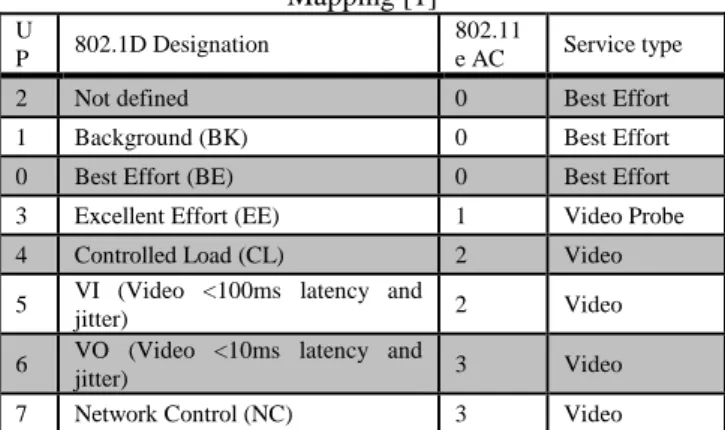
Table 1 shows the mapping between ACs and UPs. These eight kinds of applications do not usually transmit frames simultaneously. Therefore, this mapping is very useful and MAC layer overhead is reduced. Fewer queues are also necessary for the implementation of ACs compared to those that are used for the UPs implementation. Each AC queue works as an independent DCF5 STA and uses its own back off parameters [1, 2].
Table 1.User Priority (UP) and Access Category (AC) Mapping [1] Service type 802.11 e AC 802.1D Designation U P Best Effort 0 Not defined 2 Best Effort 0 Background (BK) 1 Best Effort 0
Best Effort (BE) 0
Video Probe 1
Excellent Effort (EE) 3
Video 2
Controlled Load (CL) 4
Video 2
VI (Video <100ms latency and jitter)
5
Video 3
VO (Video <10ms latency and jitter)
6
Video 3
Network Control (NC) 7
Two main methods have been introduced in EDCF to provide different levels of Quality of Service[1]:
• Using different Inter Frame Space (IFS) sizes for different ACs.
• Allocation of different CW6 sizes to different ACs. Simulations have shown that although internal collisions are reduced in EDCF, external collisions between different QSTAs with the same priorities are still high.
CW can alter between a minimum and maximum value and it is doubled after each unsuccessful transmission attempt until a pre-defined maximum value of CWmax is reached. After each successful transmission, CW is reset to a fixed minimum value of CWmin[3].
The default values of AIFSN AC
[ ]
, CWmin[ ]
AC ,[ ]
max
CW AC and TXOP Limit AC
[ ]
are announced by the QAP7 in beacon frames, and IEEE 802.11e standard allows the QAP to adapt these parameters dynamically according to the network conditions.To improve throughput, EDCF packet bursting can be used. It means that once a QSTA gains an EDCF-TXOP, it is allowed to send more than one frame without contending for the medium any more. After accessing the medium, QSTA can transmit several frames till the channel access time does not exceed the TXOP limit bound. SIFS is used between packet bursts so that no other QSTA interrupts the packet bursting and if collision occurs, the EDCF bursting is ended. This mechanism can increase throughput by multiple transmissions, using SIFS8 and burst acknowledgements. It can also reduce the network overhead [1, 2].
5
Distributed Coordination Function 6
Contention Window 7
QoS Access Point 8 Short Inter Frame Space
2.1 EDCA parameters
There are some EDCA parameters that can be adjusted to create different levels of service in IEEE 802.11e wireless networks. These parameters are[4]:
- Contention Window
- The arbitrary inter frame space(AIFS)
- TXOP
Table 2 shows the default EDCA parameters for different ACs.
To make more service differentiation, different CW sizes are considered for different ACs. The difference of CWmax and CWmin should not be too high for the two higher priorities ACs (voice and video) because this will lead to increased delay in the network. Due to the delay sensitivity, dropping packets is preferred to waiting for a transmission opportunity, when the network is congested [4].
Table 2. Default EDCA parameters for each AC [4]
TXOP limit 802.11 b PHY (ms) TXOP limit 802.11 a PHY (ms) max CW min CW A I F S N AC 3.264 1.504
min 1 1
2
aCW +
− min 1 1
4 aCW + − 2 Priority 0 AC_V0 3.016 3.008 min aCW
min 1 1
2
aCW + −
2 Priority 1 AC_V1 0 0 max aCW min aCW 3 Priority 2 AC_BE 0 0 max aCW min aCW 7 Priority 3 AC_BK
When CW is small, delay will become less and more transmission opportunities will be provided. However, a small CW causes a higher collision probability. When the number of high priority traffic streams increases, the effect of CW becomes smaller, because more collisions occur between the high priority flows [4].
Figure 2. Channel access mechanism of the 802.11e EDCA
scheme[5]
AIFS is a new inter-frame space time that is different for each AC. It is the minimum time that the medium remains idle before starting a back off. The arbitrary inter-frame space number (AIFSN) is used to calculate AIFS. AIFSN shows the number of slots that a station should wait after SIFS and before back off or before starting its transmission.
[ 3] +
[ 2] +
[ 1] +
[ 0] +
ACK
[ 0] [ 3]
[ 2]
Back off time for each AC is the sum of AIFS and a random number between zero and CW. First of all, CW is set equal to CWmin for each AC and after each collision, CW is doubled until it reaches CWmax [6].
Increasing AIFS decreases the system throughput because stations must wait longer to access the medium. This effect becomes stronger when network load increases, because AIFS occurs after each transmission. Thus, larger AIFS has negative effects on the network under heavy load condition. So, it should be kept as small as possible.
TXOP is a bounded time interval which is given to each
station. During this interval, each station can send as many frames as possible without any competition with other stations.
There are two kinds of TXOP:
1-The TXOP limit used in HCCA, which is called HCCA TXOP limit. HCCA TXOP is unique for each QSTA and it is based on the requirements of QSTA.
2-The TXOP limit used in EDCA, which is called EDCA TXOP limit. EDCA TXOP limit is announced in the beacon frames that are sent periodically by the access point. It has a deterministic value for each access category and is different from the TXOP of the other access categories.
The focus of the present study is on EDCA TXOP limit. When there are multi-rate transmissions in IEEE802.11e WLANs, fixed TXOP leads to unfairness. If a fixed TXOP is considered for all stations of an AC, the stations with higher data rates can transfer more data compared to the ones with lower data rates. The reason is that the number of transmitted packets in any given period of time depends on the data rate. To solve this problem, several mechanisms have been proposed to generate TXOPs adaptive to network traffic conditions. In this paper, the performance of some of these mechanisms will be evaluated and compared. Also, a new mechanism is proposed that helps to improve the drawbacks of the evaluated approaches. In section III, a number of adjusting TXOP algorithms are introduced and their advantage and disadvantages are discussed. With the disadvantages in mind, a new method is proposed in section IV to improve the network performance. The simulation of the proposed method and its results are presented in Section V and section VI is devoted to the conclusion of paper.
3.
Related works
In the adjusting TXOP algorithms, different solutions are proposed to assign larger TXOPs to the stations with lower data rates compared to the high data rate ones and in this way, they want to provide fairness in the network.
It is shown that equalizing the channel access time will lead to the throughput adaptation with the nodes' transmission rates in a multi-rate WLANs [7].
The authors in [8] introduced a Dynamic TXOP (DTXOP) algorithm which enhances fairness between upstream and downstream resource allocations in Wi-Fi networks.
The authors in [9] proposed another dynamic algorithm with the same name of DTXOP that TXOP is periodically updated for each AC according to the traffic conditions. Their simulations showed that DTXOP maintained fairness between upstream and downstream flows and improved throughput and delay as well.
In [10], TXOP is periodically adjusted according to the present traffic condition of each AC by calculating the number of stations involved in each AC and packet loss rates for each connection.
Min et al. [11] proposed a dynamic TXOP that is adjusted according to the condition of the stations' queues.
In TBD-TXOP [11, 12] method, TXOP will be equal to its default value as long as the queue length is less than the threshold. But if the queue length exceeds the threshold, TXOP will be increased. The value of new TXOP should not be too large because large TXOPs often cause large fluctuations in the performance and unfairness will occur.
Feng et al.[13] set TXOPs by using a RED like mechanism. Queue length that is a reflection of network load is used for TXOP adjustment in this algorithm. RED is a method of buffer management, in which packet loss probability increases linearly with the average queue length. Traffic conditions are monitored in QAP and stations. Similar to RED mechanism, if queue length is less than its low threshold, the lower value is assigned to TXOP and if the queue length is more than this threshold, TXOP increases linearly with the average queue length. If the queue length is greater than the upper threshold, the maximum TXOP will be used. These algorithms have focused on improving the QoS of video streams, similar to [14].
Through simulation, Suzuki et al.[15] showed that suitable TXOP determination has the ability of improving audio and video quality in the presence of channel errors.
Some simulation results and numerical analyses have shown that TXOP value should be chosen according to the buffer size [16-22].
The authors of [23] designed a distributed approach, in which each node measures its throughput in a time window. Then, it compares its throughput with the desired one and accordingly determines its TXOP value.
A dynamic multi-step TXOP allocation is presented in [24],based on the estimation of channel conditions. In this method and in each step, traffic is re-prioritized based on the network conditions and requirements of the traffic delays. Then, the new TXOP value will be adjusted with the estimation of channel error, collision and successful transmission probabilities.
The author of [25] proposed a distributed TXOP allocation scheme based on the delay bound of multimedia traffic. In the proposed scheme, a station checks the delay bound of each data packet in the queue, and allocates its TXOP value to guarantee their delay bounds.
In [26] , according to the dynamisms of WLAN networks and the number of nodes in the network, a game theoretic approach called GTXOP is proposed to determine TXOP dynamically. GTXOP is defined based on the analytical models of EDCA. In GTXOP, nodes can choose their TXOP autonomously and users' QoS and overall network performance are both improved.
the network in saturation condition with only three stations in the single-hop mode.
In [28], a method called adaptive opportunity (ATXOP) is proposed to solve the unfair problem in multi-rate IEEE 802.11e networks. In this algorithm, an average total data rate in the network is calculated and then the ratio of current data rate of stations to this average data rate is calculated. According to this ratio that is lower or higher than one; TXOP will be increased or decreased. Although this algorithm could solve the problem of unfairness, packet size is not considered for the TXOP determination.
Simulation results showed that this algorithm does not provide fairness for the nodes with different packet sizes . In fact; this algorithm leads to fairness only for the small packet sizes not for the large packets. Also, the network is considered error-free and the number of nodes is not considered in TXOP calculation as well. Actually, collision probability has been ignored in the network. Therefore, when the number of nodes increases, collision will increase and data traffic sent will decrease.
In [29], some parameters are defined to assign new TXOPs to the stations with different data rates. These parameters are defined considering the successful transmissions during a single TXOP in a multi-rate IEEE 802.11e WLAN. The length of the packets is considered for TXOP calculation in [29] and the simulation showed that this algorithm provides almost better fairness when different lengths of data packets are used. Similar to the [28], the network is considered error-free in [29] and the number of nodes is not considered for the TXOP calculation. So, when the number of nodes increases, collisions will more frequently occur and data traffic sent will decrease.
In another investigated algorithm [30], channel collision and error probability are predicted and considered in TXOP calculation. Thereby, the throughput enhances and the delay decreases in the network. But different data rates are not involved in the calculation of new TXOP. Therefore, fairness is not provided in a multi-rate condition. Nodes’ TXOPs are increased for almost the same amount that can only improve the network throughput.
4.
Proposed algorithm
In the proposed algorithm, a new TXOP determination formula is given to improve fairness and throughput together in different network conditions. This formula takes almost all the effective factors in to consideration for the TXOP calculation. The following parameters are defined in this regard:
To consider the impact of different transmission rates on TXOP determination, RFj and [ ]
ATX OP
i i
f are defined [28].
(
)
_
_ j j
data rate RF
A vg data rate
= (1)
Equation (1) represents the ratio of station j’s current data rate to the average possible data rates in the network.
[ ]
i[ ]
i A TX OP
j
TX OP i f
RF
= (2)
According to equation (2), a station with a lower data rate has a better chance of channel access compared to the stations with higher data rates. If data rate is the only assumed parameter for TXOP determination and packet size
is disregarded, nodes with different data rates will achieve unequal access to the medium.In fact; this algorithm leads to fairness only for the small packets not for the large ones. In addition, channel condition information should also be considered for better network performance.
To apply the effect of channel condition on the TXOP determination Ps is used. Ps can be calculated according to Equation (3), with the use of Pc and Pe. Pcstands for the error probability due to the collision, and Peshows the probability of channel error [5].
(
)(
)
#
1 1
#
s c e
SuccessfulTransmits
P P P
A ttemptedTransmits
= = − − (3)
To calculate the probability of channel error, the network is run several times and the bit error rate is determined for each node. The average of these rates is considered as the error probability of each node.
Collision probability is estimated as the ratio of the number of busy slots due to the others’ transmission to the total number of slots. As it is obvious, collision probability depends on the number of nodes and it is estimated as shown in paper [19].
The proposed dynamic TXOP allocation is done in each station according to the channel condition. When a new flow arrives at a station, it starts with the estimation of successful transmission probability (Ps). Then, the estimated probability Ps will be compared to the threshold of δ. This threshold is assumed to consider the channel status and is determined experimentally. Using a comprehensive simulation, the optimum value of 0.54 is obtained for δ. If
s
P probability is larger than the threshold, TXOP will be increased and if Ps is smaller than δ, TXOP will be decreased. The pseudo-code of dynamic TXOP allocation procedure is given below:
(
)
[ ]
(
)
( )
[ ]
(
)
( )
1 i
i
1
1000 s
i i s A TX OP
s i i s ATX OP
i i
if P
TX OP P f
else if P
TX OP P f
New TX OP
PacketSize
Past TX OP TX OP
δ
δ
α α
>
= + ×
≤
= ×
=
− × + × ×
Each time a new TXOP is calculated according to Ps and the previous amount of TXOP. The smoothing factor (α) is equal to 0.83 and a proportion of packet length is considered in the equation to consider the impact of different packet sizes on the TXOP determination. Regarding Equation (2), different data rates are considered and according to the pseudo-code, channel error rate and data packet lengths are also involved in the new TXOP calculation.
5.
Simulation
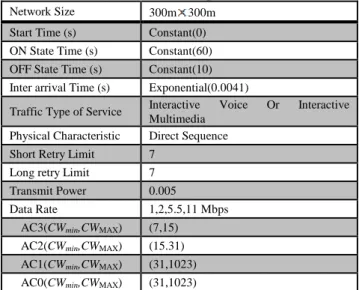
OPNET is used to simulate and evaluate the performance of the proposed algorithm. Its performance will be compared with that of the standard IEEE 802.11e EDCA. Three fixed nodes with different data rates of 2Mbps, 5.5Mbps and 11 Mbps are simulated that send data to the same fixed destination.
TXOP of the stations with AC1 and AC0 traffic is assumed equal to MSDU9 and each time they send a single data unit disregarding their data rate. Therefore, (AC2) video and (AC3) voice Traffics are considered in this simulation. OPNET parameters are set according to Table 3.
It is noteworthy that each simulation was run for 10 different Seeds. The average of the results is shown in the following figures.
Table 3.Simulation parameters
300m 300m Network Size
Constant(0) Start Time (s)
Constant(60) ON State Time (s)
Constant(10) OFF State Time (s)
Exponential(0.0041) Inter arrival Time (s)
Interactive Voice Or Interactive Multimedia
Traffic Type of Service
Direct Sequence Physical Characteristic
7 Short Retry Limit
7 Long retry Limit
0.005 Transmit Power
1,2,5.5,11 Mbps Data Rate
(7,15) AC3(CWmin,CWMAX)
(15.31) AC2(CWmin,CWMAX)
(31,1023) AC1(CWmin,CWMAX)
(31,1023) AC0(CWmin,CWMAX)
Using the proposed algorithm, the TXOPs calculated for AC2 and AC3 in different data rates and packet sizes are shown in Table 4.
Table 4: New TXOPs for AC3 and AC2
New TXOP for AC2 (video) in ms New TXOP for AC3 (voice)
in ms
300 1024 2048
300 1024 2048
Packet size (Bytes)
14.2 48.34 65.53
7.68 26.23 52.46
2 Mbps
5.34 18.25 36.49
2.9 9.9
19.8 5.5 Mbps
2.83 9.65
19.29 1.53
5.23 10.47 11 Mbps
The AC2's data traffic sent, achieved by our proposed algorithm, is shown in Figures 3 and 4 in different data rates. Data packets are considered 1024 and 300 bits long in Figure 3 and 4 respectively.
The AC3's data traffic sent, achieved by our proposed algorithm, is shown in Figures 5 and 6 in different data rates. Data packets are considered 1024 and 300 bits long in Figure 5 and 6 respectively. These improvements are because of considering data rate, channel error rate and data packet lengths in the TXOP calculations.
Figures 3-6 show that traffics with different data rates in each access category have almost the same chance to send
9 MAC Protocol Data Unit
data traffic. Therefore the proposed method achieves better fairness. As mentioned before, packet length is considered for the TXOP calculation in the proposed algorithm. Therefore, as it was predictable, Figures 10-13 confirmed that this algorithm is relatively fair for different packet lengths.
Figure 3. Data Traffic Sent at AC2 for the data packets of
1024 bits long
Figure 4.Data Traffic Sent at AC2 for the data packets of
300 bits long
Figure 5. Data Traffic Sent at AC3 for the data packets of
1024 bits long
Figure 6. Data Traffic Sent at AC3 for the data packets of
300 bits long
suggest that the throughput of the network in AC2 and AC3 classes of traffic has been increased through using the proposed algorithm in comparison with fixed TXOP usage in EDCA standard. This means that the proposed algorithm has improved both the throughput and fairness in the network.
Figure 7. Throughput comparison of the fixed TXOP and
the proposed TXOP at AC2
Figure 8. Throughput comparison of the fixed TXOP and
the proposed TXOP at AC3
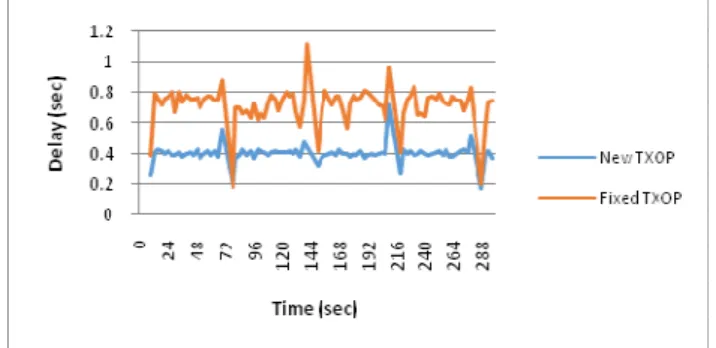
The comparison of these methods in terms of the end-to-end delay is shown in Figures 9 and 10. The end-to-end-to-end-to-end delay refers to the time taken for a packet to be transmitted from the source to the destination. It is noteworthy that the end-to-end delay does not include the delays of the lost packets, which are dropped due to the successive collisions. However, end-to-end delay resulted in the proposed algorithm is smaller than the delays resulted from EDCA at both AC2 and AC3 traffic classes.
Figure 9. Delay comparison of the fixed TXOP and the
proposed TXOP at AC2
Figure 10. Delay comparison of the fixed TXOP and the
proposed TXOP at AC3
6.
Conclusions
When different data rates are used in IEEE 802.11e WLANs, unfairness problem occurs. The reason is that equal TXOP or transmission opportunity is allocated to the stations, without any data rate consideration. The stations with higher data rates can send more traffic in the network compared to the lower rate ones.
Several algorithms have been proposed to solve this problem. They determine the new TXOP adaptive to the network's traffic condition. Some of these protocols were investigated in this paper and their advantages and disadvantages were discussed.
Considering the drawbacks, an algorithm was proposed that takes different effective factors in to account for the TXOP determination. The simulation results showed that the proposed algorithm leads to better fairness and network throughput. Furthermore, packets’ delay improves.
References
[1] Q. Ni, L. Romdhani, and T. Turletti, "A Survey of QoS Enhancements for IEEE 802.11 Wireless LAN," Wireless
Communications and Mobile Computing, vol. 4, pp.
547-566, 2004.
[2] I. W. Group, "IEEE 802.11, IEEE Standard for Information Technology Telecommunications and Information Exchange Between Systems Local and Metropolitan area Networks Specific Requirements. Part 11: Wireless LAN Medium Access Control (MAC) and Physical Layer (PHY) Specifications," 2007.
[3] M. Ghazvini and N. Movahedinia, "A game theory based contention window adjustment for IEEE 802.11 under heavy load," International Journal of Communication
Networks and Information Security (IJCNIS), vol. 5,
2013.
[4] A. Matinlauri, "Fairness and transmission opportunity limit in IEEE 802.11 e enhanced distributed channel access," Msc., Faculty of Electronics, Communications and Automation Networking Laboratory HELSINKI UNIVERSITY OF TECHNOLOGY 2008.
[5] K. Ju, D. Lee, and K. Chung, "Dynamic TXOP allocation to support QoS based on channel conditions in wireless networks," in Computing Technology and Information
Management (ICCM), 2012 8th International Conference on, 2012, pp. 721-724.
Communication Networks and Information Security, vol.
5, p. 192, 2013.
[7] I. Tinnirello and S. Choi, "Temporal fairness provisioning in multi-rate contention-based 802.11e WLANs," in Sixth IEEE International Symposium on
World of Wireless Mobile and Multimedia Networks,WoWMoM 2005. , 2005, pp. 220-230.
[8] A. Andreadis and R. Zambon, "Improving QoS Performance in IEEE 802.11 e Under Heavy Traffic Loads," International Journal of Wireless Information
Networks, vol. 19, pp. 49-61, 2012.
[9] A. Andreadis and R. Zambon, "QoS enhancement with dynamic TXOP allocation in IEEE 802.11 e," in 18th
International Symposium on Personal, Indoor and Mobile Radio Communications, PIMRC'07, 2007, pp.
1-5.
[10] A. Andreadis and R. Zambon, "QoS enhancement for multimedia traffics with dynamic TXOPlimit in IEEE 802.11 e," in Proceedings of the 3rd ACM workshop on
QoS and security for wireless and mobile networks,
2007, pp. 16-22.
[11] G. Min, J. Hu, and M. E. Woodward, "A dynamic IEEE 802.11e txop scheme in wlans under self-similar traffic: Performance enhancement and analysis," in
International Conference on Communications, ICC '08,
2008, pp. 2632-2636.
[12] J. Hu, G. Min, and M. E. Woodward, "A threshold-based dynamic TXOP scheme for intra-AC QoS differentiation in IEEE 802.11 e networks," in
Computational Science and Engineering (CSE), 2011 IEEE 14th International Conference on, 2011, pp.
526-531.
[13] Z. Feng, G. Wen, Z. Zou, and F. Gao, "RED-TXOP scheme for video transmission in IEEE802. 11E EDCA WLAN," in Communications Technology and Applications, 2009. ICCTA'09. IEEE International Conference on, 2009, pp. 371-375.
[14] J. Majkowski and F. C. Palacio, "Dynamic TXOP configuration for Qos enhancement in IEEE 802.11 e wireless LAN," in International Conference on Software
in Telecommunications and Computer Networks, SoftCOM'06. , Barcelona 2006, pp. 66-70.
[15] T. Suzuki, A. Noguchi, and S. Tasaka, "Effect of TXOP-bursting and transmission error on application-level and user-application-level QoS in audio-video transmission with IEEE 802.11 e EDCA," in Personal, Indoor and
Mobile Radio Communications, 2006 IEEE 17th International Symposium on, 2006, pp. 1-7.
[16] Y. P. Fallah and H. M. Alnuweiri, "Modeling and Performance Evaluation of Frame Bursting in Wireless LANs," in IWCMC ’06: Proceeding of the 2006
International Conference on Communications and Mobile Computing, New York, NY, USA, 2006, pp.
869-874.
[17] J. Hu, G. Min, and M. E. Woodward, "Analysis and Comparison of Burst Transmission Schemes in Unsaturated 802.11e WLANs," in Global Telecommunications Conference (Globecom),
Washington, DC, USA, 2007, pp. 5133–5137.
[18] F. Peng, H. M. Alnuweiri, and V. C. M. Leung, "Analysis of burst transmission in IEEE 802.11 e
wireless LANs," in Communications, 2006. ICC'06.
IEEE International Conference on, 2006, pp. 535-539.
[19] L. Romdhani and C. Bonnet, "Performance analysis and optimization of the 802.11 e EDCA transmission opportunity (TXOP) mechanism," in Third IEEE
International Conference on Wireless and Mobile Computing, Networking and Communications, WiMOB 2007., 2007, pp. 68-75.
[20] S. Selvakennedy, "The Influence of MAC Buffer on the Contention Based Access Scheme with Bursting Option for IEEE 802.11e Wireless Networks," Journal of
Engineering Science and Technology (JESTEC),, vol. 1,
pp. 119–138, 2006.
[21] Rashwand S. and J. Mišic, "Stable operation of IEEE 802.11e EDCA: Interaction between offered load and MAC parameters," Ad Hoc Networks, vol. 10, pp. 162-173, 2012.
[22] S. Rashwand and J. Misic, "IEEE 802.11e EDCA under Bursty Traffic-How Much TXOP Can Improve Performance," IEEE Transactions on Vehicular Technology, vol. 60, pp. 1099-1115, 2011.
[23] J. Y. Lee, H. Y. Hwang, J. Shin, and S. Valaee, "Distributed optimal TXOP control for throughput requirements in IEEE 802.11 e wireless LAN," in 22nd
International Symposium on Personal Indoor and Mobile Radio Communications (PIMRC), 2011, pp. 935-939.
[24] Q. Cao, T. Li, and D. Leith, "Achieving fairness in lossy 802.11 e wireless multi-hop mesh networks," in
Mobile Adhoc and Sensor Systems, 2009. MASS'09. IEEE 6th International Conference on, 2009, pp.
645-650.
[25] S. Kim, "Distributed TXOP Allocation Scheme in IEEE 802.11 e Wireless LANs," Applied Mechanics and
Materials, vol. 284, pp. 2904-2907, 2013.
[26] M. Ghazvini, N. Movahedinia, and K. Jamshidi, "GTXOP: A Game Theoretic Approach for QoS Provisioning Using Transmission Opportunity Tuning,"
PloS one, vol. 8, p. e62925, 2013.
[27] N. Guo, C. Chen, and C. Pei, "Dynamic TXOP Assignment for Fairness (DTAF) in IEEE 802.11 e WLAN under Heavy Load Conditions," in Parallel and
Distributed Computing, Applications and Technologies, 2006. PDCAT'06. Seventh International Conference on,
2006, pp. 80-85.
[28] E. K. Kim and Y. J. Suh, "ATXOP: an adaptive TXOP based on the data rate to guarantee fairness for IEEE 802.11 e wireless LANs," in Vehicular Technology
Conference, 2004. VTC2004-Fall. 2004 IEEE 60th,
2004, pp. 2678-2682.
[29] E. Kim and Y. J. Suh, "A Rate Adaptive Transmission Opportunity for Fairness over IEEE 802.11 e Wireless LANs," in IEEE International Conference on Communications, ICC '07 2007, pp. 4523-4528.
[30] K. Ju, D. Lee, and K. Chung, "Dynamic TXOP allocation to support QoS based on channel conditions in wireless networks," in 8th International Conference on
![Figure 1. EDCA proposed by 802.11e [1]](https://thumb-us.123doks.com/thumbv2/123dok_us/8125504.2155003/1.892.469.830.598.1007/figure-edca-proposed-by-e.webp)