UDC: (811.111:371.694):004.94 DOI: 10.22190/JTESAP1701055D
INTERNET TECHNOLOGY AS AN AID TO TRADITIONAL
METHODS IN THE DEVELOPMENT OF FRESHMAN
STUDENTS’ USE OF ACADEMIC WORDS
Tanju Deveci
Communication Department, Khalifa University of Science and Technology, Petroleum Institute, P.O. Box 2533, Abu Dhabi, United Arab Emirates
Phone: +9712 60 75561, E-Mail: [email protected]
Abstract. English language preparatory programs’ focus on academic vocabulary
provides university students with the threshold of lexical competence to embark on their freshman studies. However, a lack of interest in a systematic approach to increasing students’ lexical competence can result in limited academic development and cause frustration and boredom among freshman students. The problem can be magnified when instructors’ teaching styles are not geared towards the learning styles of students who often use computer technologies. This paper outlines an initiative taken to tackle this very issue in the local context of the Petroleum Institute (PI) in Abu Dhabi, UAE. It presents results from the corpus analyses conducted on texts used in one of the freshman courses at PI and from students’ writing papers, as well as students’ thoughts on the use of traditional and technology-aided teaching materials and activities. The effectiveness of the initiative is discussed, and suggestions are offered to support EAP students’ lexical competence.
Key words: AWL, lexis, vocabulary, instruction, technology, academic vocabulary
1. INTRODUCTION
The vast number of lexical items in English is a formidable challenge for learners of English as a foreign language. The magnitude of the problem can be even greater for university students who have to grapple with academic and technical vocabulary on top of advanced general English words. This prompts university preparatory programs to devise a lexical strand for their courses, as in the example of Sabanci University in Turkey (Deveci & Simpson, 2013). The nature of such programs allows for form-focused instruction in terms of grammar and vocabulary. However, some students graduating from preparatory programs with required proficiency examination results may assume that they do not have to worry about language-focused studies any longer. Should this assumption by students be coupled with a freshman program‟s lack of interest in form-focused instruction at the expense of teaching content, their language development may be only incidental. It has been well-documented in the literature that students lacking essential English vocabulary, syntax and grammar, cannot effectively meet academic demands such as reading textbooks and other literature, writing essay assignments and
Submitted April 10
participating in discussions with faculty and peers (Kinsella, 2005). However, freshman instructors choosing to incorporate some elements of form-focused instruction with an emphasis on vocabulary may still face the challenge of deciding which words to focus on (Kinsella, 2005), as well as the kind of methodology to follow in teaching vocabulary. Although intuition can be of some help, a systematic approach to choosing lexis is required. The same is true for instructional design. Not all freshman instructors may be equipped with the contemporary theoretical and practical knowledge to engage in vocabulary instruction. As a result, they may opt for traditional methods devoid of new technologies, limiting their ability to address different learning styles. Taken together, these factors could easily lead to students losing interest in learning and cause frustration for both students and instructors. The current study targeted this relatively less investigated aspect of freshman studies. With this purpose, this paper describes how internet technology can help in analyzing assigned texts in a given course, and presents the results of a piece of action research incorporating a traditional and internet-aided teaching approach.
2. BACKGROUND
2.1. Words to learn
It goes without saying that grammar knowledge is essential to be able to speak English as a foreign language. However, vocabulary knowledge is equally important, if not more so. There seems to be a limit to the amount of grammatical knowledge a language learner can acquire; however, vocabulary in English seems so vast that there may not be an easy end to learning vocabulary whatever one‟s proficiency level may be. This feature of the English language can be a serious challenge for learners, creating frustration for even more advanced learners. Several initiatives have been taken to help guide learners in terms of the kind of lexical items they should acquire as they progress. One such initiative is the General Service List (GSL) created by Michael West (1953). The GSL was put together with a careful study of the lexical items most frequently used for general purposes and therefore considered appropriate for learners of English to learn. The GSL is comprised of 2,000 headwords, knowledge of which is believed to help learners understand 90% of spoken and 80% of written texts in English. These words have been commonly used in EFL course books, graded readers and dictionaries. Considering the sixty-three year gap since the GSL was first produced, it is only natural to expect certain words such as „headdress‟ and „shilling‟ to have become less frequent, and some others like „television‟ to have gained more popularity. Due to such concerns, the GSL has been updated recently by Brezina and Gablasova (2013) who created the (new) GSL which consists of 2,494 lemmas and is argued to represent current language use better.
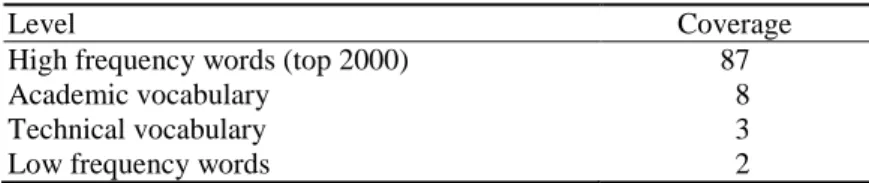
levels arranged from the most to the least frequent words. Coxhead (1998) later created the Academic Word List (AWL) which replaced the UWL. Coxhead analyzed a corpus of 3.5 million running words coming from texts in disciplines such as Science, Arts, Commerce and Law, and identified 570 headwords that would be essential for EAP students to acquire on top of the GSL words. Coady and Huckin (1997) state that a typical academic text would cover certain percentages of the GSL, AWL, technical and low frequency words, as shown in Table 1 below.
Table 1 Vocabulary coverage in a typical academic text
Level Coverage
High frequency words (top 2000) 87
Academic vocabulary 8
Technical vocabulary 3
Low frequency words 2
2.2. Approaches to vocabulary instruction
As can be seen in the table above, language instruction for EAP students requires special attention to the GSL words; however, this should not be at the expense of the AWL or technical lexis. Otherwise, students will be denied the opportunity to acquire necessary academic knowledge. However, the availability of the above-mentioned word lists alone will not guarantee that students will learn the lexical items necessary for their studies. Instructional design, in EAP programs in particular, should consider adopting a certain approach to incorporating vocabulary. One of the approaches is that of explicit instruction which “involves diagnosing the words learners need to know, presenting words for the first time, elaborating word knowledge, and developing fluency with known words” (Hunt & Beglar, 2002, p. 258). Hanson and Padua (2011) state that explicit instruction helps students acquire the in-depth knowledge necessary for them to understand the meaning of words. They suggest four strategies for explicit instruction of words: providing student-friendly definitions, using words in context, providing multiple exposures, and offering opportunities for active involvement. However, explicit instruction has also been criticized on the grounds that it is more teacher-centered, can be time-consuming and can be too laborious for learners (Wu, 2009).
that extensive reading reinforces the words students have already been studying and exposes them to more vocabulary items. This lends further credence to Krashen‟s (2003) „comprehension hypothesis‟ suggesting that learners need comprehensible input to reinforce the language skills and knowledge they have already been exposed to and develop new ones.
It is quite possible that instructors can embed elements of incidental and explicit learning in their instruction. Schmitt (2000) states that “the proper mix of explicit teaching and activities from which incidental learning can occur” (p. 145) would benefit learners greatly. According to empirical evidence, using both approaches when teaching vocabulary facilitates learning new items with longer retention (Shakouri, Mahdavi, Mousavi & Pourteghali, 2014). Ellis (2010) also notes that it can be very difficult to divorce explicit instruction from incidental learning. This is because explicit instruction can result in incidental learning when learners notice instances of language in the instructor‟s explanation.
2.3. Technology use in teaching vocabulary
It is often the coursebook that decides how the target lexis should be taught in any given language classroom. However, this does not prevent more independent and resourceful teachers from exploiting different ways of teaching the lexis. These instructors tend to have a variety of vocabulary teaching tools and activities at their disposal. With the recent developments in educational technologies and the growth of the internet, more teachers may resort to utilizing these resources. It has been argued that students‟ attitudes, confidence and motivation can be improved significantly through the use of computer technologies (Ferris & Hedgcock, 1998). These technologies also lend themselves to explicit, implicit and incidental vocabulary teaching approaches. Ma and Kelly (2006) note that instructional design incorporating computer technology should aim at both explicit and implicit vocabulary learning by training students to become active learners.
It is beyond the scope of this study to list all the available technologies that could be utilized for vocabulary instruction. However, among the most commonly used digital technologies are iPads, smartphones and SMARTBoard, each of which has multiple applications dedicated to learning. Moreover, the internet houses an infinite number of Web 2.0 tools, interactive games, exercises and quizzes, dictionaries, and online platforms where students and teachers interact with the aim of developing various language skills including vocabulary competence. At the most basic level, computer technology provides contextual and visual presentation of new vocabulary items through a simple search on the web for graphics, images, and stories that put them in context, which allows students to learn lexis more successfully (Wise, 2015). On the other hand, corpus analysis with the help of internet tools such as Antconc and Lexical Tutor enables the identification of word frequencies and coverages in a given text or a subject area. Students having instant online access to different corpora can enjoy the exposure to target vocabulary items as much as they want, and they can obtain ample data on how these items are used in real life, while familiarizing themselves with the morphological variations of the lexis (Zhou, 2012).
cards to WordChamp, a vocabulary management system. They found that those who used the online application performed better on the immediate vocabulary test as well as on a delayed post-test. Similarly, Tamjid and Moghadam (2012) investigated the effects of a vocabulary learning software (Narsis) in comparison to only using a coursebook. They also found that students in the experimental group mastered the target vocabulary items better than those in the control group. Taken together, these studies indicate that technology use has a positive effect on students‟ vocabulary acquisition.
Other studies, on the other hand, investigated how a combination of traditional methods with educational technologies affects learning. For instance, Khazaei and Dastjerdi (2011) found that students who experienced such a blended approach outperformed those who studied vocabulary only in the traditional way. Kilickaya and Krajka (2010) agree that language instructors should exploit both traditional materials as well as computer resources in their attempts to teach vocabulary learning strategies.
3. THE RESEARCHER‟S CONTEXT AND THE RATIONALE FOR THE STUDY
The impetus for the current study comes from the researcher‟s personal observations in the freshman English program where he teaches at the Petroleum Institute (PI) in Abu Dhabi, UAE. PI is a university offering degrees in various engineering disciplines including Chemical Engineering, Electrical Engineering, Mechanical Engineering, Materials Science and Engineering, Petroleum Engineering, and Petroleum Geosciences. Students whose English level is not at an adequate level spend a year learning academic English in the Academic Bridge Program prior to their freshman studies. This is followed by their freshman studies in the College of Arts and Sciences, which hosts the Communication Department among many other departments aiming to equip students with the basic knowledge and skills required before embarking on their engineering education.
The Communication Department offers two freshman courses: COMM101 and COMM151. The former is an introductory course teaching the language and communication skills required for undergraduate study. Students in this course develop their critical reading, writing and oral presentation skills through a context of humanities and social research projects. The latter course, on the other hand, builds on the skills acquired in COMM101 and further enhances their academic literacy skills through projects students undertake to address social and technical issues. There is also an emphasis on communication theories including effective listening, inter- and intrapersonal communication, and intercultural communication. Both courses put a heavy emphasis on the soft skills engineering students need to acquire. Students engage in both individual and team work to develop various communication skills. With this purpose, instructors in the Communication Department focus on grammar and vocabulary in their classes where and when the need arises. However, a specific language component does not exist, and it is left to the discretion of individual teachers. Although there may be no harm in individual teachers using their judgment on their students‟ needs and taking action accordingly, a general roadmap that provides flexibility might help guide them.
for lexical items such as morphemes and spelling might still challenge some students, and therefore, this current research did not disregard grammar altogether. Hunston, Francis and Manning (1997) state that “all words can be shown to have patterns, and words which have the same pattern tend to share aspects of meaning [… which] contribute to the teaching of both grammar and vocabulary” (p. 208). Students whose grammar knowledge is at a certain level can also be expected to divert more of their attention to lexis at the mastery level, which makes them more flexible and precise at a productive level (Deveci, 2015). Although grammar and lexis cannot be divorced from each other, limited attention to lexis can become a serious barrier to the overall development of students‟ linguistic competence.
The PI has recently launched an initiative to utilize technology more fully for educational purposes, with a heavy focus on laptop use. For this purpose, the students are provided with laptops with certain specifications, and the instructors are encouraged to enhance the students‟ learning by making them use the laptops both inside and outside of the classroom. Despite this heavy emphasis on technology, neither the students nor the instructors seem to have a clear understanding of what to do or how best to integrate technology into the teaching and learning process. While some instructors wish to do away with traditional methods altogether, others still stick to their old ways of teaching. The students, on the other hand, do not seem to be particularly enthusiastic about laptops. This is partly because they are already familiar with them and see nothing groundbreaking with the new initiative. However, it seems that the majority of the students are only accustomed to using their laptops for social purposes or for typing their assignments. It seems that they are not really aware of the variety of educational opportunities available to them.
Also, a small-scale study the researcher previously conducted with COMM151 students showed that the heavy course-load challenged the students in general, and the situation was further complicated by some students‟ limited linguistic competence, causing them to be bored (Deveci, 2016). In order to alleviate the problem, the current research aimed at developing a vocabulary strand for COMM151 supported by technology-enhanced instruction. The research also aimed at engaging students in inquiry learning through the use of certain online learning tools with a view towards promoting their independent and lifelong learning skills. This was believed both to help increase their linguistic competence and to decrease boredom levels. Furthermore, the research aimed at identifying students‟ preferences for traditional teaching materials versus online tools, which was hoped to shed light on their perceptions of different kinds of educational materials and activities.
4. METHODOLOGY
4.1. Participants
4.2. Instructional design and evaluation method
A variety of instructional activities and materials were used with the experimental group. These are as follows.
a) Self-assessment: This included a self-assessment test taken by the students in the experimental group twice. The first one was in the form of a diagnostic survey asking the students to reflect on their knowledge of particular lexical items. It was hoped that this would raise the students‟ interest in the planned vocabulary intervention strand of the syllabus and encourage the students to devise a learning plan for themselves to close the gaps in their lexical knowledge. The students completed the same survey a second time at the end of the course to reflect on their development.
b) Classroom activities: In order to increase the students‟ engagement with the target lexical items, various traditional and technology-friendly activities were used in class. These included the following:
1) Handouts: These were mainly in the form of exercises that focused on the meanings of the target words. The students had to do tasks such as matching, filling in blanks, and multiple-choice tests. These were given to students before or after they read the seminar texts in order to raise their schemata and/or revise the words they had been exposed to.
2) Games: These included fun activities to revise the target vocabulary items. There was an emphasis on both meaning and form, with a particular attention to spelling since it appeared to be a challenging aspect of vocabulary learning for Arab students in particular. Games were used as warm-up activities at the beginning of the classes and as wrap-up activities at the end of the classes. They also served as time-fillers.
3) Online vocabulary analysis activities: These were mainly done using online education software available free of charge at http://www4.caes.hku.hk/vocabulary/tools_cp.htm. The students were trained to use these tools. They were asked to analyze the words in their texts for the seminars. However, they were not always able to do so when their texts were in pdf format. They were also asked to use various concordancers, such as the one at http://ec-concord.ied.edu.hk/paraconc/monoconcE.htm to learn more about how words were used in context, their collocational forms and their grammatical surroundings. (See appendix for sample activities.)
Class-time was also allocated to online AWL word exercises at http://www. englishvocabularyexercises.com/AWL/, which contains more than 200 exercises to review and recycle academic words categorized according to sublists. In this way, the students received immediate feedback on their answers. (See appendix for sample activities.)
4) Vocabulary journals: The students were asked to keep vocabulary journals where they kept track of the words they learned with their meanings, word forms, example sentences, etc. They were also asked to do some creative writing using the words they had learned. Their journals were regularly collected for feedback.
5) Peer-tests: In order for students to take an active role in their own and their peers‟ learning processes, they were asked to prepare vocabulary exercises similar to the ones which the researcher provided them.
Overall, these activities, exercises and tools were believed to have increased both the number and the quality of exposures to the target words. It was hoped that this engagement with the words would increase the students‟ retention rates.
order to determine whether or not the instructional intervention made a difference in their active use of the target AWL words.
The effect of the intervention was also evaluated using an end-of-course vocabulary quiz. This quiz was comprised of three sections. Section A required the students to fill in the blanks with the words provided. This section was expected to be the least challenging section. However, in order to increase the difficulty level, some extra words were included. The second section focused on word building, which the students had found difficult at the beginning of the course. The last section, on the other hand, included 15 questions requiring the students to utilize their collocational knowledge of the target words. This section was expected to be the most challenging section since the students were not provided with any options from which to choose. Student‟s t-test was used to compare the quiz results of the experimental and control groups. A p-value less than 0.05 was considered statistically significant.
Semi-structured interviews were held with volunteering students to collect qualitative data on students‟ perceptions on the overall initiative.
5. RESULTS
One of the aims of this research was to identify the vocabulary profile of the seminar texts in the COMM151 course using online software. This was done to determine whether or not they possessed the characteristics of typical academic texts as identified by Coady and Huckin (1997). The results of the data analysis conducted with this purpose can be seen in Table 2.
Table 2 Vocabulary Profile of COMM 151 seminar texts
Table 2 shows that the first seminar text on effective listening includes a total of 2,021 words, 89.95% of which were part of the top 2,000 high-frequency words; this percentage is about 3% higher than Coady and Huckin‟s expectations of a typical
1-1000 words
1001-2000 words
AWL words
UWL words
Off-list words
Total
f % f % f % f % f % f %
Text 1 (Effective Listening)
1,871 83.27 150 6.68 114 5.07 1 0.04 111 4.94 2,247 100
Text 2 (Interpersonal Communication)
825 75.14 47 4.28 151 13.75 0 0 75 6.83 1,098 100
Text 3 (Intrapersonal Communication)
602 79.32 37 4.88 82 10.8 0 0 38 5 759 100
Text 4
(Cross-cultural Communication)
1,744 79.28 84 3.83 258 11.74 0 0 113 5.15 2,199 100
academic text. The number of academic words in this text, on the other hand, was found to be 114 (5.07%), which is about 3% lower than what is expected of a typical academic text. The higher number of GWL words compared to the AWL words in this text may not be a cause for concern. This is because this very first text the students are assigned could be perceived as less challenging by the students and could help activate their lexis with a greater focus on GWL words. This can be of particular help in the case of students who have limited experience reading academic texts.
When the numbers for the second text on interpersonal communication are considered, it is seen that the number of AWL words in this text (151) is about 6% higher than the expected number of AWL words for a typical academic text (13.75% vs. 8%). Such an exposure to academic words in this text can only increase the students‟ AWL competency if their attention is explicitly drawn to these items. In comparison to Coady and Huckin‟s (1997) expectations, the number of GWL words in this text, with a total percentage of 79.42, was found to be lower. The 7.58% difference was not expected to cause the students to face difficulties in understanding the text, especially because they were offered guidance on the AWL and off-list words.
Similarly, the third text on intrapersonal communication included slightly more academic words (10.8%), and slightly fewer GWL words (84.7%) in comparison to the expectations in the literature (Coady & Huckin, 1997). Table 2 also shows that the total number of words in this text (759) is comparatively lower than the number of the words in the other three texts.
The last seminar text on cross-cultural communication was the second longest text with a total number of 2,199 words, 83.11% of which were found in the top 2,000 high-frequency words. The number of AWL words, on the other hand, was found to be 258 (11.74%), which is 3.74% higher than what would be expected of a typical academic text.
Taken together, the relatively higher number of academic words in the seminar texts of the COMM 151 course, compared to Coady and Huckin‟s (1997) findings, was challenging for certain students, especially those with lower English proficiency exam results.
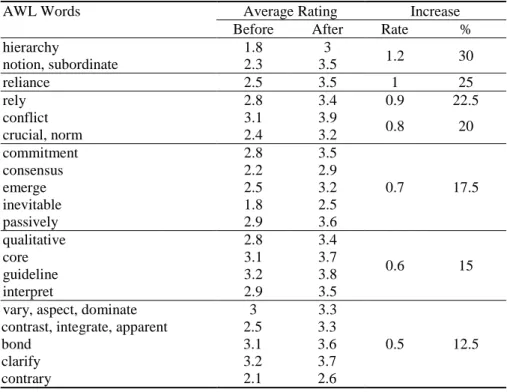
Another aim of this research was to identify the effects of instructional activities on the students‟ vocabulary development.First of all, the results of the self-assessment test indicated that the students thought that they experienced an overall development, reflected by an overall 0.4 increase in their self-evaluation of lexical competence. Although their average ratings went down slightly (ranging from 0.1 to 0.2) for certain vocabulary items such as „achieve‟ and „dynamic‟, they felt that they had more control over the majority of the AWL words targeted by the intervention. In general, the increase in ratings for the target AWL words varied between 0.1 and 1.2. Although every single increase is valuable in itself, the researcher of this study tends to regard a change of 0.5 or more as significant since it suggests a substantial improvement. See Table 3 for a list of these words.
Table 3 Increased feeling of empowerment over AWL words
AWL Words Average Rating Increase
Before After Rate %
hierarchy 1.8 3
1.2 30 notion, subordinate 2.3 3.5
reliance 2.5 3.5 1 25
rely 2.8 3.4 0.9 22.5
conflict 3.1 3.9
0.8 20
crucial, norm 2.4 3.2
commitment 2.8 3.5
0.7 17.5
consensus 2.2 2.9
emerge 2.5 3.2
inevitable 1.8 2.5
passively 2.9 3.6
qualitative 2.8 3.4
0.6 15
core 3.1 3.7
guideline 3.2 3.8
interpret 2.9 3.5
vary, aspect, dominate 3 3.3
0.5 12.5 contrast, integrate, apparent 2.5 3.3
bond 3.1 3.6
clarify 3.2 3.7
contrary 2.1 2.6
This instructional intervention was further evaluated by analyzing the students‟ second reflective writing examination papers on interpersonal and intrapersonal communication in order to determine whether or not the instructional intervention made a difference in their active use of the target AWL words. Table 4 below summarizes the quantitative results of the analyses conducted for both the experimental and the control groups.
instead, was found to have used more of the first 1,000 GWL words (78.2% vs. 77.8%). The number of off-list words used by the experimental group was also found to be slightly higher compared to the number of off-list words used by the control group (7.5% vs. 7.2%).
Table 4 Quantitative comparison of lexis-use by the experimental and the control group.
CORPUS 1
(Experimental Group N=19)
CORPUS 2 (Control Group N=15)
f % f %
1-1000 words 5,463 78.2 4,491 77.8
1001-2000 words 299 4.3 236 4.6
AWL words 703 10 600 10.4
UWL words 0 0 0 0
Off-list words 522 7.5 414 7.2
Total 6,987 100 5,830 100
The AWL words in the two corpora were further compared to detect other differences. The results of the analysis conducted with this purpose showed that the corpus from the experimental group included a higher number of AWL „headwords‟ (122) compared to the corpus derived from the control group (102). That is, the AWL words in corpus 2 were less varied with more frequent use of certain words. Although this was found to increase the AWL density in this corpus, it limited lexical dexterity. This suggests that the students in the experimental group tended to use a greater variety of AWL words despite the comparatively lower overall number of AWL words in their responses to the exam question. The words that were found to be unique in corpus 1 were as follows: „academic‟, „appreciated‟, „aspects‟, „attribute‟, „beneficial‟, „bond‟.
It also emerged that out of 102 AWL headwords used in corpus 2, only 14 of them (13.7%) were used in different word forms. This number was found to increase to 20 out of 122 words (16.4%) in the case of corpus 1. This shows that the students in the experimental group had a greater tendency to vary the word forms they used, which suggests slightly more lexical dexterity. The different word forms detected in corpus 1 can be seen below:
„achieve, achievement‟; „category, categorize‟; „establish, establishment‟; „evaluate, evaluation‟; „global, globalization‟; „individual, individually‟; „interact, interaction‟, interactively‟; „motivation, motive‟; „occur, occurrence‟; „process, processing‟; „react, reaction‟; „research, researchers‟; and „similarly, similarity‟.
Taken together, these data suggest that the instructional intervention increased the tendency of the students in the experimental group to use a variety of AWL words, as well as different word forms, despite the relatively lower percentage of AWL words used in their corpus.
combinations. Examples of collocations were „academic life,‟ „achieve goals/personal targets/more and more,‟ „the concept of,‟ „establish an identity/a conversation/functions,‟ and „seek knowledge.‟ There were also, however, instances of inaccuracies as in „achieve personal needs,‟ „interact through/to someone,‟ „an affect on,‟ and „make research,‟ some of which seem to be fossilized errors in the interlanguage of these students.
In terms of writing mechanics, spelling mistakes with the AWL words were less frequent in corpus 1 than in corpus 2. Some common spelling mistakes included „commincation‟, „achive‟, „breif‟ „defind‟, „occurance‟, „princepl‟, and „proceses‟. In addition, the students in the experimental group made comparatively fewer grammar mistakes in their use of the AWL words. The following mistakes were found to be less frequent, or nonexistent, in corpus 1: „researches‟, „informations‟, „many evidence‟ and „unrelevant‟.
The effect of the intervention was also evaluated using an end-of-course vocabulary quiz. The quiz was given to both the experimental and the control group to determine the effect of the intervention. The results of the analyses done with this purpose can be seen in Table 5 below.
Table 5 Quiz results
Experimental Group (N=19) Control Group(N=15) p Section
A
Section B
Section C
Average Section A
Section B
Section C
Average
60 75 51 62 53 57 49 53 0.1157
p < 0.05
According to Table 5, the average grade for the experimental group (62) is higher than that of the control group (53). However, the t-test conducted to compare the two data sets revealed that the difference was not at a statistically significant level (p= 0.1157 > 0.05). Despite this, the detailed analysis of the average scores in both groups showed that 60% of the students in the control group was ≤ 50, while only 38.9% of those in the experimental group had a score of ≤ 50. Also, the students‟ average marks in the control group varied between 22.5 and 85. However, the average marks in the experimental group varied between 22.5 and 100. Taken together, these suggest that the instructional intervention had a positive effect on the students‟ quiz results despite the lack of a statistically significant difference between the two data sets.
papers. The qualitative analyses of their exam papers revealed that they often utilized incorrect collocations, as exemplified above.
Another form evaluating the intervention was a survey the students in the experimental group filled in at the end of the course to give their perceptions on the instructional intervention.
This survey included sections on their perceived lexical competence before and after the intervention, their motivation levels regarding vocabulary learning before and after the intervention, their thoughts on the vocabulary activities and materials used in class.
The results of the survey showed that the majority of the students (89.5%) felt that the intervention had a positive effect on their vocabulary development. However, two of the students signified that they felt otherwise. In order to identify possible reasons for this, interviews were held with them. One of the students, who missed a substantial amount of class time, remarked that the main reason was his lack of control over his learning throughout the term due to reasons outside of class. The other student, on the other hand, said that he already knew a lot of vocabulary, and that he still could have received a high mark from the quiz without having participated in the vocabulary strand. However, he added that he did enjoy the games they played to reinforce vocabulary.
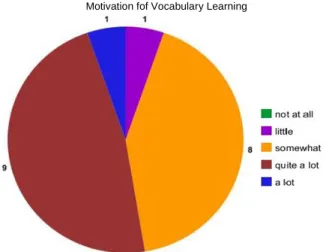
The results of the data analyses regarding how much their motivation had increased as a result of their engagement in the vocabulary strand can be seen in Figure 1 below.
Motivation fof Vocabulary Learning
Fig. 1 Increase in motivation for vocabulary learning
Figure 1 shows that an overwhelming majority of the students (94.7%) expressed that they became more motivated to learn vocabulary as a result of their engagement in the intervention.
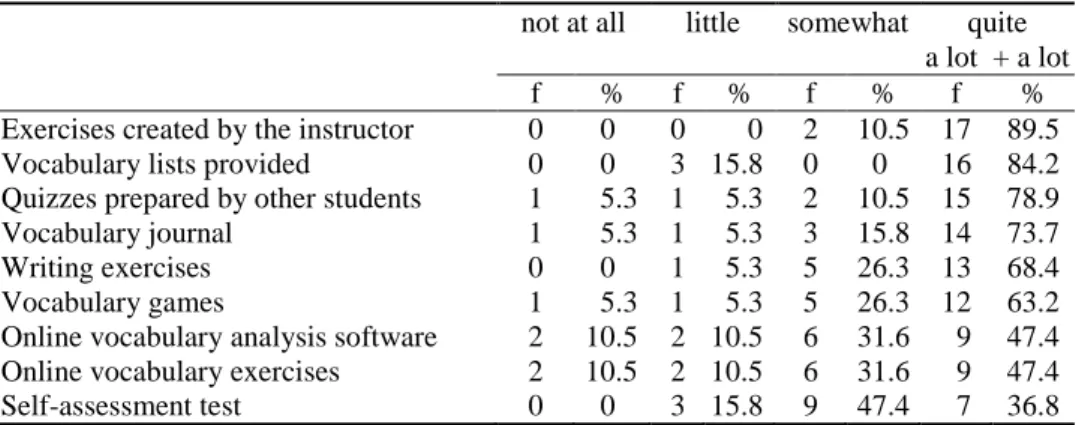
Table 6 Students‟ opinions on the extent to which learning activities contributed to their vocabulary development
not at all little somewhat quite a lot + a lot f % f % f % f % Exercises created by the instructor 0 0 0 0 2 10.5 17 89.5 Vocabulary lists provided 0 0 3 15.8 0 0 16 84.2 Quizzes prepared by other students 1 5.3 1 5.3 2 10.5 15 78.9 Vocabulary journal 1 5.3 1 5.3 3 15.8 14 73.7 Writing exercises 0 0 1 5.3 5 26.3 13 68.4 Vocabulary games 1 5.3 1 5.3 5 26.3 12 63.2 Online vocabulary analysis software 2 10.5 2 10.5 6 31.6 9 47.4 Online vocabulary exercises 2 10.5 2 10.5 6 31.6 9 47.4 Self-assessment test 0 0 3 15.8 9 47.4 7 36.8
As can be seen in Table 6, vocabulary exercises created by the instructor were the most popular type of activity, with 89.5% of the students believing that they benefited from them to a great extent. This is followed by the vocabulary lists, which were also put together by the instructor (84.2%). During the interviews held with some of the participants, it was often mentioned that the lists gave the students a reason for studying, and provided them with a definite path for learning. Of the students, 78.9% also felt that the quizzes their peers wrote contributed to their vocabulary development. They often stated that when they had to produce vocabulary quizzes themselves, they had to engage in mental activities which helped them practice the target words and process a variety of language skills.
Vocabulary journals also appeared to be popular with the students, with 73.7% of them believing that keeping a journal reinforced their learning. Furthermore, some students stated that the template they were provided with helped them organize their work more efficiently. Finally, writing exercises and vocabulary games seemed to attract a similar number of students‟ interest (68.4% and 63.2% respectively).
The least popular learning tool was the self-assessment test administered at the beginning and end of the course. The students often expressed their dissatisfaction with the length of this tool.
Beyond all this, the students were asked to rate the overall efficiency of the vocabulary strand of the curriculum. Their responses can be seen in Figure 2 below.
Fig. 2 Students‟ opinions on efficiency of vocabulary strand
Figure 2 shows that an overwhelming majority of the students (84.2%) rated the vocabulary strand as „quite efficient,‟ and one student felt that it was „very efficient.‟ However, one other student rated it as „a little efficient.‟ This was the very student who had missed quite a bit of classroom time due to outside issues. Therefore, his opinion could be biased.
When asked for their opinions on how to improve the vocabulary strand of the curriculum, most students seemed to hold the belief that more frequent quizzes would help them reinforce the words they study. Interestingly, some of these students stated that they would rather receive quizzes prepared by their instructor rather than their peers. Their justification for this was the poor quality of quizzes written by their peers. Games were also found to be popular with students, some of whom stated that a game would be good in each class. Additionally, a student expressed his interest in online language games. Meanwhile, other students suggested that more writing exercises requiring them to use the target words would enhance their lexical competence.
6. CONCLUSIONS
The effects of the study were evaluated in different ways. It was found that there were not always significant differences between the experimental and control groups in terms of the percentages of academic words they used in their exam papers and their quiz results. However, the results also indicated that students did benefit from the intervention, varying the academic words they used, reducing the number of mistakes and attempting to use a comparatively wider range of collocations. Students also reported an overall satisfaction with having greater engagement in their own learning due to the intervention. They seemed to develop a sense of empowerment regarding their learning as a result of their raised awareness of various learning tools. Further, they came to the realization that activities in the form of games can increase their motivation for learning more generally. Despite these positive results, almost half of the students did not think the use of technology enhanced their learning. One of the reasons for this was found to be the intellectually challenging nature of the chosen web-based applications. The students disliked the amount of time these applications required. This was coupled with other complications when they could not work on their PDF texts using these applications. Taken together, it can be understood why the internet-based instructional activities were not popular with these students. Previous research has also found that having to use new online tools has the potential to result in functional and psychological obstacles (Lin & Yang, 2011). Some other students, though, believed the technology-related tasks added to their academic load, which they felt was not necessary had they only used traditional materials and methods for vocabulary learning. Research by Lavin, Korte and Davies (2010) also revealed that removing technology from courses would not necessarily have a negative effect on student behaviors such as attendance and interaction with the instructor. Jordan and Sanchez (1994) further note that students‟ performance may not be improved significantly by using technology and other innovations in the classroom. It appears that at least some of the students in the current study might have been expected to benefit from traditional methods whether or not the technological aspects were removed. One reason for the unpopularity of the online learning environments with these students may be their perceived impersonal nature; this has been found to be the case in earlier research (Weber & Lennon, 2007). Shelly, Cashman, Gunter and Gunter (2008) also warn that successful integration of technology and learning is dependent on students‟ perception of it. They note that today‟s students are technologically savvy, and should they feel challenged working through exercises they will likely get bored or frustrated, thus developing a dislike for the technological tool being utilized. Other researchers have also noted that the internet generation may not be as inclined to participate in internet technology as they appear to be (Jones, Ramanau, Cross & Healing, 2010).
The nature of the Communication courses at PI allows for language-focused interventions. However, the other departments could also consider assuming some responsibility for developing their students‟ academic and subject-specific lexical competence. This could be done by adopting some of the instructional initiatives taken in this study, with an emphasis on analytical skills. This will surely have a positive effect on the students‟ comprehension of content matter as well as their foreign language competence.
REFERENCES
Brezina, V. & Gablasova, D. (2013). Is there a core general vocabulary? Introducing the new general service list. Applied Linguistics, 34(5). 1-23.
Coady, J. & Huckin, T. (1997). Second language vocabulary acquisition: A rationale for
pedagogy. Cambridge: Cambridge University Press.
Coxhead, A. J. (1998). An academic word list (English Language Institute Occasional Publication No. 18). Wellington, New Zealand: Victoria University of Wellington. Deveci, T. (2016). Boredom among freshman engineering students in a communication
course. The Journal of Teaching English for Specific and Academic Purposes, 4(2), 261-276.
Deveci, T. (2015). Communication students‟ use of lexis in a writing examination. The
Asian ESP Journal, 17(1), 39-63.
Deveci, T. & Simpson, A. J. (2013). Developing academic vocabulary objectives: Corpus analysis and word lists, In L. Bosworth & M.G.J. Smith (Eds.). A Practical Guide to English Language Curriculum Development in an Academic Context: Creating,
Vitalizing and Evaluation (pp.77-88), Ankara: Blackswan.
Ellis, R. (2010). Explicit form-focused instruction and second language acquisition. In B. Spolsky & F. M. Hult (Eds.). The handbook of educational linguistics (pp. 437-455). Oxford: Wiley-Blackwell.
Ferris, D., & Hedgcock, J. (1998). Teaching ESL composition: Purpose, process, and
practice. Mahwah, NY: Lawrence Erlbaum.
Hanson, S. & Padua, J. F. M. (2011). Effective Instructional Strategies Series: Teaching Vocabulary Explicitly. Hawai'i. Pacific Resources for Education and Learning. Hollingsworth, J. & Ybarra, S. (2013). Explicit direct instruction for English learners.
Thousand Oaks, CA: Corwin Press and DataWorks Educational Research.
Horst, M., Cobb, T., & Meara, P. (1998). Beyond a clockwork orange: Acquiring second language vocabulary through reading. Reading in a Foreign Language, 11, 207–223. Hunston, S., Francis. G. & Manning, E. (1997). Grammar and vocabulary: Showing the
connections. ELT Journal, 51(3), 208-216.
Hunt, A. & Beglar, D. (2002). Current research and practice in teaching vocabulary. In J. C. Richards & W. A. Renandya (Eds.) Methodology in language teaching: An
anthology of current practice (pp. 254- 266), Cambridge: Cambridge University Press.
Jones, C. Ramanau, R., Cross, S. & Healing, G. (2010). Net generation or digital natives: Is there a distinct new generation entering university?. Computers & Education. 54, 722-732.
Jordan, D. L. & Sanchez, P. M. (1994). Traditional versus technology-aided instruction: The effects of visual stimulus in the classroom. Political Science and Politics, 26, 64-67.
Khazaei, S., Dastjerdi, H.V. (2011). An Investigation into the impact of traditional vs. blended teaching on EFL learners‟ vocabulary acquisition: M-learning in focus.
International Journal of Humanities and Social Science, 1(15), 202-207.
Kilickaya, F. & Krajka, J. (2010). Teachers‟ technology use in vocabulary teaching.
Academic Exchange Quarterly, 14(1), 81-86.
Kinsella, K. (2005). Preparing for effective vocabulary instruction. A Publication of Aiming High: A Countrywide Commitment to Close the Achievement Gap for English Learners. https://www.scoe.org/docs/ah/AH_kinsella1.pdf
Krashen, S. (2003). Explorations in language acquisition and use. Portsmouth: Heinemann. Lavin, A. M., Korte, L. & Davies, T. (2010). The impact of classroom technology on
student behavior. Journal of Technology Research, 1-13. Retrieved from EBSCOhost. Lin, W.C. & Yang, S. C. (2011). Exploring students‟ perceptions of integrating Wiki
technology and peer feedback into English writing courses. English Teaching: Practice and Critique, 10(2), 88-103.
Longhurst, M. (2013). The benefits of explicit vocabulary teaching in the EFL classroom
(Unpublished master‟s thesis). Malmo University, Sweden.
Ma, Q. & Kelly, P. (2006). Computer assisted vocabulary learning: design and evaluation. Computer-Assisted Language Learning, 19(1), 15-45.
Nation, P., & Wang, M. (1999). Graded readers and vocabulary. Reading in a Foreign
Language, 12, 355-380.
Nation, I.S.P. (2001). Learning vocabulary in another language. Cambridge: Cambridge University Press.
Schmitt, N. (2008). Instructed second language vocabulary learning. Language Teaching
Research, 12(3), 329-363.
Schmitt, N. (2000). Vocabulary in language teaching. Cambridge University Press, Cambridge.
Shakouri, A., Mahdavi, M., Mousavi, Y. & Pourteghali A. A. (2014). The effect of explicit and implicit vocabulary instruction on the reading compression of university students via online classroom, International Journal of Multidisciplinary and Current Research,
2, 522-528.
Shelly, G. B., Cashman, T. J., Gunter, R. E. & Gunter, G. A. (2008). Teachers discovering
computers: Integrating media in the classroom. Boston: Course Technology.
Tamjid, N. H. & Moghadam, S. S. (2012). The effect of using vocabulary teaching software on Iranian intermediate EFL learners‟ vocabulary acquisition. World
Applied Sciences Journal, 19(3), 387-394.
Xue, G. & Nation, I. S. P. (1984). A university word list. Language Learning and
Communication, 3(2), 215-229.
Weber, J. M. & Lennon, R. (2007). Multi-course comparison of traditional versus web-based course delivery systems. The Journal of Educators Online, (4)2, 1-19. West, M. (1953). A general service list of English words. London: Longman.
Wise, D. (2015). Equipping students with 21st century technology skills. Los Angeles: QuikiTech.
Wu, L. (2009). Incidental English vocabulary studying in L2 learning (Unpublished master‟s thesis). Kristianstad University College, Sweden.
Wu, L. (2014). Technical college students‟ perceptions of English for specific purposes vocabulary learning and teaching. International Journal of English Language
Education, 2(1), 176-186.
Zhou, Y. (2012). Using technology to assist in vocabulary acquisition of ESL learners.
APPENDIX – ONLINE LEARNER TRAINER MATERIALS
RESEARCH TOOLS
Go to the following address to see the research tools we will be using to analyze the lexis in our seminar texts. http://www4.caes.hku.hk/vocabulary/tools_cp.htm
Concordancer
Go to the following page to learn the collocational surroundings of the words you want to learn.
Study the sample concordance lines below. What two verbs are used with the noun „conflict‟?
Frequency Analysis
Go to the following address to see the frequency of words in your seminar texts. http://www4.caes.hku.hk/vocabulary/frequency.htm
Vocabulary Profiler
Online AWL Exercises