An Analysis of Economic Implications of the UK
Leaving the EU
Parvez Azim*1
Received: 2016/07/03 Accepted: 2016/09/25
Abstract
hether the United Kingdom (UK) should remain in the European Union (EU) or not has been a fiercely debated issue both before and after the referendum in the UK on June 23, 2016.
The main purpose of this paper is to evaluate the pros and cons of the UK leaving the EU. It is concluded that if the UK leaves the EU, the resulting economic shock would risk adverse effects on macroeconomic variables such as foreign trade, high inflation, employment level, interest rate, aggregate supply and aggregate demand, trade creation and diversion, balance of payments, balance of trade, term of trade, depreciation of the pound sterling, rising consumer price index (CPI) and reduction in the standards of living in the UK. Effects of leaving the EU on money market, labour market and goods market in the UK have also been explored to show the effects on the exchange rate, the interest rate, nominal and real wages and output level in the UK. It has therefore been concluded that it is not in the best interest of the UK to leave the EU. Benefits of remaining in the EU far outweigh the disadvantages.
Keywords: Macroeconomic Variables, Trade Creation and Diversion, Exchange Rate, Standards of Living, Balance of Payments.
JEL Classification: E20, F13, F14, F31, F32.
1. Introduction
Economic integration is considered to be one of the most important causes of regional change in the 1990. The European Community’s progress towards the unprecedented elimination of borders would have been unimaginable barely three decades ago (Suarez-Villa, 1993). Regional economic integration leads to trade augmenting effects on member countries. Aitken (1973) and Balassa (1967) showed that the formation of the European Economic Community
1. Professor, Foreign Faculty, University of Faisalabad, Islamabad, Pakistan (Corresponding Author: [email protected]).
(EEC) and European Free Trade Association (EFTA) significantly increased inter-member trade.
The establishment of trading block such as the EU has been considered as a way to increase the size of the “country” which is intended to benefit the member countries economically. It has also been concluded that regional economic integration provides an important stimulus not only to trade but also to foreign direct investment (FDI). Keeping this point in view it is beneficial for the UK to remain in the EU to be a part of the globalised world economy. Figures 6 to 9 are based on the data obtained from THE TIMES, Monday June 27, 2016. Figure 6 depicts the rise in the quantity of workers from the EU by 10.64 percent over the period under consideration; and the converse holds true for the workers from outside the EU where it declined by -0.50 percent.
0 0.5 1 1.5 2 2.5
Dec.2010 Dec.2011 Dec.2012 Dec.2013 Dec.2014 Dec.2015 Figure 6: Non-UK Nationals Working
in the UK, Millions
From the EU
From outside the EU
0 2 4 6 8 10 12 14
Total EU Total non-EU USA China
Figure7: UK Exports, £ Billion
Figure 7 depicts a rising trend in UK’s exports to its major trading partners during 2015-16. It increased by 11.62 percent, 6.28 percent, 5.02 percent and 89 percent to the EU, non-EU countries, the USA and China, respectively. The highest increase in exports was recorded to be to China.
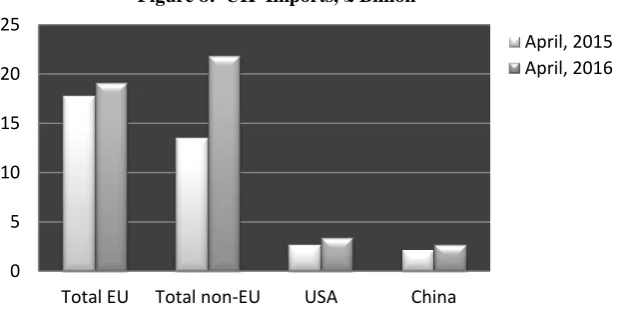
Figure 8 depicts a rising trend in UK’s imports from its major trading partners during 2015-16. It is evident from the graph that its total imports from non-EU countries raised more than EU, the USA and China. It increased by 7.63 percent, 61.86 percent, 23.72 percent and 22.97 percent from the EU, non-EU countries, the USA and China, respectively. The highest increase in imports was recorded to be from non-EU countries.
0 5 10 15 20 25
Total EU Total non-EU USA China
Figure 8: UK Imports, £ Billion
April, 2015 April, 2016
504 564 658
15399
20432
28250 35073
22085
6686
2012/13 2013/14 2014/15
Figure 9: EU Foreign Direct Investment Projects in the UK
Figure 9 depicts a sharp rising trend by 35.44 percent in creation of new jobs in the UK due to FDI projects by the EU, but the safeguarded jobs continuously declined during the last three years by -29.28 percent, while the number of the projects during the same period increased by just 14.25 percent (504 to 658).
2. Arguments in Favour of Britain’s EU Membership
Table 1 shows the share of the UK exports to its trading partners in the EU’s single market having more than 500 million customers and an economy over five times bigger than the UK. The EU buys about 44% of all exports sold abroad by the UK, while UK’s imports are less than 8% from the EU. Moreover, more than 3 million UK jobs are linked to exports to the EU. Therefore, being a part of the EU guarantees full access to its Single Market. Leaving the EU will create uncertainty and risk. Being a member of the EU enables the UK’s exporters to sell their product cheaper and more easily to the Single Market; more exports means more jobs for British workers and more foreign earnings which in turns increases capacity to import from the EU countries. More exports means increased demand for the pound sterling which will increase the exchange rate (appreciation) of the currency against its trading partners’ currencies in the EU member countries. During the last decade foreign companies have invested 540 billion pound sterling in the UK.
Table 1: Industry Wise Share of the UK Exports to the European Union Industry Jobs Share of exports going to the EU
Aerospace 110,000 47%
Chemicals and pharmaceuticals 136,000 54%
Financial services 1,069,000 41%
Food manufacturing 373,000 53%
IT and telecoms 1,364,000 46%
Transport 1,065,000 44%
Resource:EUReferendum.gov.uk
and consequently, lower standards of living (real per capita income) of Britons. Depreciation of the currency will make foreign tours expensive for UK citizens. Less exports means less production of goods and services, implying reduction in the demand for workers which, in the labour market, means lower nominal and real wages. A higher rate of unemployment implies a rise in payment of unemployment allowance by the government and reduction in tax revenue. Rising unemployment also means a higher dependency ratio. Owing to inflation, supply of real money in the money market will decrease which in turn will raise the interest rate (Figure 2). Higher interest rates will increase the inflow of money to improve the capital account component of the balance of payments of the UK. Higher interest rates will also cause a reduction in the investment level, which in turn will decrease the output level by a multiplier factor. Finally, higher interest rates will put downward pressure on demand for houses which may cause reduction in house prices. Reduction in exports of goods and services would reduce both the visible exports and invisible exports of the UK, which will adversely affect the current account component and hence the overall balance of payments of the UK. When a country’s exports fall the capacity to import falls, which results in a reduction in the volume of trade and hence a decrease in the standards of living of the trading partners.
Leaving the EU might deny the free or cheaper public healthcare to UK citizens who travel to European countries. It will also deny UK citizens to get EU citizenship, thus, denying them the right to live and work over there. In anticipation, many German companies have already started leaving the UK which will have an adverse effect on both economies. If the UK leaves the EU, banks of the EU member countries operating in the UK will curtail or close their business in the UK, which will cost billions of US dollars to the UK’s economy and other countries.
member countries. A bigger market to sell means achieving economy of scale, more job opportunities, and specialisation in production of those goods in which the UK has comparative advantage and greater economic security for British people. Trade enables countries to consume much more than what they can produce by importing goods from other countries which have a comparative advantage. Needless to say, the UK is not geographically linked with the EU but economically it is. The overall welfare and security of these countries is linked with each other.
After leaving the EU, there would be reduction in UK’s exports which in turn will decreases the demand of pound sterling by other countries, consequently, depreciation of the currency will take place (Figure 3), lower profits and fewer jobs. Consequently, it may cause worsening of a country’s trade balance, balance of payments and terms of trade. A fall in exports can trigger negative multiplier and accelerator effects on national income and employment (Figure 1). The composite impact of reduction in GNP and rising inflation will cause a reduction in the standards of living and the capacity to import from other countries.
3. Trade Creation vs Trade Diversion
Trade creation leads to an increase in economic welfare from joining a free trade area, such as custom union. Trade creation takes place when there is a reduction in tariff barriers and custom duties, which leads to lower prices and hence a rise in consumer surplus in the importing countries. Therefore, it causes a rise in producer surplus in exporting countries and a rise in the overall global welfare. Custom unions eliminate barriers to trade between members, which is assumed to provide an incentive to increase trade between members and to reduce trade between members and non-members. Therefore, it is in the interest of the UK not to leave the EU. Leaving the EU would lead to trade reduction rather than trade creation. It will cause trade diversion from the EU member states to other non-member countries such as Australia, New Zealand, India and other low cost producing countries in which they have comparative advantage.
4. Impact on the Production (Output) in the UK
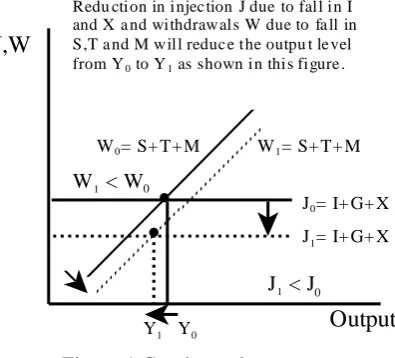
Figure 1 shows a reduction in injection J through injection elements investment (I) and exports (X) from J0 to J1 shown by a dotted line.
Reduction in injection means reduction of finance in economy. There would also be reduction in withdrawals W through its elements, savings (S), taxes (T) and imports (M). The new intersection point of W1 and J1 gives us a reduction in the output level from Y0 to Y1. Thus,
leaving the EU will cause reduction in the output level in the UK. Less output means less demand for labour; and hence unemployment.
J,W
Output
Figure 1 Goods market
J1= I+ G+ X
W0= S+ T+ M
..
Redu ction in injec tion J due to fall in I and X a nd withdraw als W due to fa ll in S,T a nd M w ill reduc e the outpu t le vel from Y0 to Y1 as shown in this figure .
J0= I+ G+ X
W1= S+ T+ M
Y0
Y1
J1 < J0
W1 < W0
5. Impact on the Rate of Interest in the UK
Figure 2 shows shifting of the LM curve to the left because of a rise in inflation. When prices raise the real supply of money, (M/P) decreases which is shown by the leftward shifting of the LM curve. The IS curve will also shift to the left due to a reduction in investment I. The new intersection of LM1 and IS1 curves gives us higher interest rate r1. Thus,
Interest rate
Output
Figure 2 Money market
LM0 IS0
.
.
Inte rest ra te rise s due to fa ll in rea l mone y supply ow ing to rise in P, thus sh ifts LM to the le ft, w hile IS c urve shifts to the left due to fa ll in I, thus resulting into reduc tion in output from Y0 to Y1.
IS1
LM1
r0
r1
Y1 Y0
6. Impact on the Exchange Rate of the Pound Sterling
Figure 3 depicts the depreciation of the exchange rate of pound sterling after leaving the EU. When the UK’s exports decrease to the EU member countries, the demand for pound sterling will decrease which is shown by the leftward shifting of the demand curve from D0
to D1. The supply curve will also shift to the left, because when
exports of a country decrease its ability to import also decreases. Less imports by a country means less supply of its currency in international market. Thus, the supply curve also shifts from S0 to S1. The new
intersection point gives us a reduction in the exchange rate from e0 to
e1. Thus, if the UK leaves the EU, its currency will depreciate which
in turn might lead to a higher inflation rate in the UK?
Exchange rate
Q
Figure 3 Exchange rate of the UK’s currency
S0
S1
.
Less UK’s exports m eans less demand for pounds by EU show n by le ftwa rd shift of the dem and c urve, le ss im ports by the UK also me ans le ss supply of pound by UK , so leftwa rd shift of S curve , resulting into fa ll in the exchange rate of UK’s currency.
.
D0
D1
Q1 Q0
e0
e1
7. How the Exchange Rate Affects Inflation
Depreciation in the exchange rate causes inflation to increase. According to the Fisher equation E£ (PEU)= PUK, E£ represents the
exchange rate of pound sterling to euro €, PEU stands for the price of a
certain good X in the EU and PUK stands for price of the same good X
in the UK. If the exchange rate E£ decreases the price of imported goods
PEU increases. A depreciation of the currency means the currency buys
less foreign exchange, therefore, imports are more expensive and exports are cheaper for foreigners, which is termed as imported inflation in the country whose currency has depreciated. The price of imported goods will increase because they are more expensive to buy from abroad. Cheaper exports increase demand for the UK’s exports. Therefore, there would be an increase in domestic aggregate demand AD as shown in Figure 4 by the dotted line AD1, which creates demand
pull inflation shown by a rise in the price from P0 to P1.
Price level
Output
Figure 4 Goods market S0
AS
. .
A D0 A D1
Q1 Q0
P0
P1
8. Impact on the Wage Rate and Employment Level
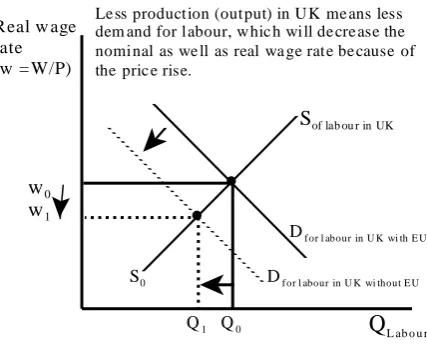
Figure 5 pertains to the wage rate and employment level in the UK after leaving the EU.
As discussed above (Figure 1), if the UK leaves the EU, production will decrease. To produce less, less labour will be needed. This will decrease the nominal wage rate. Since price level might rise, it will decrease the real wage rate ‘w’. (w=W/P) also. Thus, leaving the EU will decrease the wage rate, increase unemployment, increase the dependency ratio and reduce the overall standards of living of the country. Reduction in the demand for labour is shown by the leftward shifting of the demand curve, the dotted line. The new intersection gives us a lower wage rate (from w0 to w1) and less employment level
(from Q0 to Q1).
Real w age rate (w = W/P)
QL ab o u r
Figure 5 Labour market S0
Sof lab ou r in UK
.
Le ss production (output) in U K me ans less dem and for labour, w hic h will de cre ase the nominal as we ll as real wa ge rate be cause of the pric e rise.
.
Df or l abour in U K wi th E U
Df or l abour in U K wi thout E U
Q1 Q0 w0
w1
9. Arguments against Britain’s EU Membership
Albania, Macedonia, Montenegro, Serbia and Turkey with population size 2.8 million, 2.1 million,0.6 million, 4.2 million and 76 million, respectively. Immigration from these and relatively poor countries will tend to rise, which will adversely affect the employment level and living wages in the UK. Almost 2 million people came to the UK from the EU over the last ten years. Leaving the EU means greater control over immigration from the European Union. Besides, the EU is not allowing the UK to sign trade deals with Australia or New Zealand and other growing economies like India, China or Brazil. Leaving the EU means more trading opportunities which means more jobs and better standard of living for British people, faster economic growth and greater prosperity in the future. Furthermore, the EU places tariffs and charges value added tax (VAT) on goods from outside the EU which makes thing expensive for British buyers and is not good for developing countries. It is also said that the UK is sending about £20 billion a year (£350 million every week) to the EU. More is being paid in to the EU than the UK is getting out of it. Leaving the EU will enable us to regain control and spend our money according to our priorities such as on NHS and other infrastructure. More than a quarter of a million people migrate to the UK from the EU every year.
It is also argued that the only way to control immigration is to leave the EU. Five new countries are in the queue to join the EU- Albania, Macedonia, Montenegro, Serbia and Turkey. When they join, there would be more immigration of prospective job seekers in the UK, which might exert downward pressure on the living wage rate in the UK. More schools, hospitals and houses would be needed to cater to their demands. Consequently, house prices would tend to rise.
While in the EU, the UK is not allowed to negotiate its own trade deals with other countries. The EU law overrules the UK law. The UK can trade with the EU even without being a member of it, for example, Switzerland is not in the EU, even than it is trading with EU. These are the arguments for leaving the EU membership.
10. Conclusion
the average household saving over £350 a year (Centre for Economic Performance) and better standards of living. Leaving the EU would make UK households worse off by £ 4,300 a year (The Treasury), its exchange rate will depreciate, exports and investment will decrease, production will decrease and even a small recession may set in. Wages will fall, interest rate may go up which will decrease the output in the economy by a multiplier factor. Reduced exports means lower profits and fewer jobs, consequently worsening of the UK’s trade balance, balance of payments, and terms of trade. A fall in exports can trigger negative multiplier and accelerator effects on national income and employment and reduction in the standards of living of British people. Leaving the EU would lead to trade reduction rather than trade creation. It will cause trade diversion from the EU member states to other non-member states such as Australia, New Zealand, India and other low cost producing countries in which they have comparative advantage.
Britain is stronger and safer in Europe. Allies of the UK including the USA and NATO are also stressing the UK to stay in. Being in the EU will protect jobs, provide security and strengthen the UK’s economy. In conclusion, the UK is better off by not leaving the EU. Advantages of being in the EU far outweigh the disadvantages. It is also feared and speculated that after Brexit there would be further disintegration of the EU due to Frexit (France leaving the EU) and Nexit (Netherland leaving the EU) because of the pressure of the anti-European forces within the union. Therefore, it is harmful for the entire Europe if that happens.
References
Aitken, N. D. (1973). The Effects of the EEC and EFTA on European Trade: A Temporal Cross-Section Analysis. American Economic Review, 63(5), 881-892.
Buckley, P. J., Clegg, J., Forsaus, N., & Kevin, T. R. (2001). Increasing the Size of the “Country”: Regional Economic Integration and Foreign Direct Investment in a Globalised World Economy.
Management International Review, 41(3), 251-274.