Recommended Adult Immunization Schedule, United States, 2020*
Mark Freedman, DVM, MPH; Andrew Kroger, MD, MPH; Paul Hunter, MD; and Kevin A. Ault, MD; for the Advisory Committee on Immunization Practices†
I
n October 2019, the Advisory Committee onImmuni-zation Practices (ACIP) voted to approve the Recom-mended Adult Immunization Schedule for Ages 19 Years or Older, United States, 2020. The 2020 adult im-munization schedule, available at www.cdc.gov/vaccines /schedules/hcp/imz/adult.html, summarizes ACIP
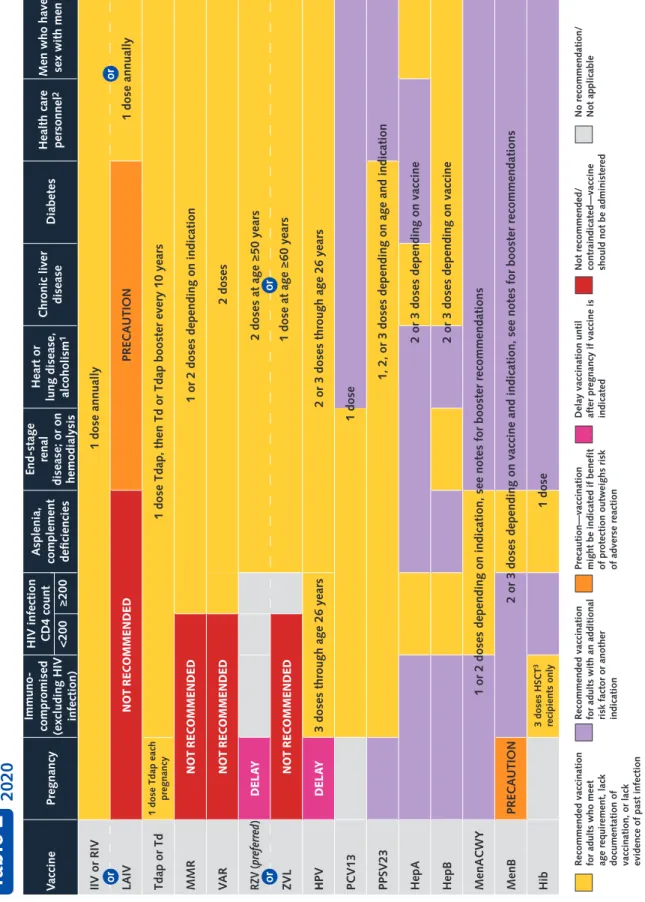
recom-mendations in 2 tables and accompanying notes (Figure).
The full ACIP recommendations for each vaccine are avail-able at www.cdc.gov/vaccines/hcp/acip-recs/index.html. The 2020 schedule has also been approved by the direc-tor of the Centers for Disease Control and Prevention (CDC) and by the American College of Physicians (www .acponline.org), American Academy of Family Physicians (www.aafp.org), American College of Obstetricians and Gynecologists (www.acog.org), and American College of Nurse-Midwives (www.midwife.org).
The ACIP develops recommendations on the use of each vaccine after in-depth review of vaccine-related data, such as the epidemiology and burden of the vaccine-preventable disease, vaccine efficacy and ef-fectiveness, vaccine safety, the quality of evidence, fea-sibility of program implementation, and economic anal-yses of immunization policy (1). ACIP recommendations can be complex and challenging to implement. The purpose of the schedule, published annually, is to con-solidate and summarize updates to ACIP recommenda-tions on vaccination of adults and assist providers in implementing current ACIP recommendations. The use of vaccine trade names in this article and in the sched-ule is for identification purposes only and does not im-ply endorsement by the ACIP or CDC.
C
HANGES TO THE2020 A
DULTI
MMUNIZATIONS
CHEDULEInfluenza vaccination (2). Updates to the
recom-mendations reflect discussions during public meetings of ACIP held on 25 October 2018, 27 February 2019, and 27 June 2019. For the 2019 –2020 flu season, rou-tine annual influenza vaccination is recommended for all persons age 6 months and older who do not have contraindications. No preferential recommendation is made for one influenza vaccine product over another for persons for whom more than one licensed, recom-mended, and appropriate product is available. LAIV
(in-fluenza vaccine, live attenuated) is an option for adults through age 49 years, except for those who have immu-nocompromising conditions, including HIV infection; have anatomical or functional asplenia; are pregnant; have close contact with or are caregivers of severely im-munocompromised persons in a protected environment; have received influenza antiviral medications in the previ-ous 48 hours; or have cerebrospinal fluid leak or a co-chlear implant. Those with a history of Guillain–Barre´ syn-drome within 6 weeks of a previous dose of influenza vaccine generally should not be vaccinated, unless vacci-nation benefits outweigh risks for those at higher risk for severe complications from influenza.
Hepatitis A vaccination(3). In June 2019, ACIP
rec-ommended all persons with HIV age 1 year or older be routinely vaccinated with hepatitis A vaccine. The list of other populations at risk for hepatitis A infection or se-vere hepatitis A disease has not changed significantly and includes persons with chronic liver disease; travel-ers in countries with high or intermediate endemic hep-atitis A; persons with close, personal contact with an international adoptee in the first 60 days after arrival from a country with high or intermediate endemic hep-atitis A; men who have sex with men; persons who use injection or noninjection drugs; persons experiencing homelessness; and persons who work with hepatitis A virus in a laboratory or nonhuman primates infected with the virus (3– 6). Clotting factor disorders has been removed from the list. The definition of chronic liver disease has been expanded and includes, but is not limited to, persons with hepatitis B, hepatitis C, cirrho-sis, fatty liver disease, alcoholic liver disease, autoim-mune hepatitis, and alanine aminotransferase (ALT) or aspartate aminotransferase (AST) level greater than twice the upper limit of normal. A 2-dose series HepA (or 3-dose series HepA-HepB) is recommended for pregnant women if they are at risk for infection or se-vere outcome from infection during pregnancy. Lastly, hepatitis A vaccination is recommended for persons working in settings of exposure (e.g., those working in health care settings for injection or noninjection drug us-ers or group homes and nonresidential day care facilities for developmentally disabled persons). In addition, any person who is not at risk for hepatitis A virus infection but wants protection against it may be vaccinated.
Ann Intern Med. 2020;172:337-347. doi:10.7326/M20-0046
This article was published at Annals.org on 4 February 2020.
* The 2020 adult immunization schedule appeared inAnnals of Internal Medicineand on the Centers for Disease Control and Prevention Web site at www.cdc.gov/vaccines/schedules/hcp/index.html. An announcement summarizing changes to the 2020 adult immunization schedule is published concur-rently in theMorbidity and Mortality Weekly Report. Readers can cite the 2020 adult immunization schedule as follows: Freedman M, Kroger A, Hunter P, Ault K; Advisory Committee on Immunization Practices. Recommended adult immunization schedule, United States, 2020. Ann Intern Med. 2020;172:337-47. doi:10.7326/M20-0046
† The 2020 adult immunization schedule was prepared by the Advisory Committee on Immunization Practices (ACIP); the ACIP Adult Immunization Work Group; Mark Freedman, DVM, MPH, and Andrew Kroger, MD, MPH (Centers for Disease Control and Prevention, Atlanta, Georgia); Paul Hunter, MD (City of Milwaukee Health Department, Milwaukee, Wisconsin); and Kevin A. Ault, MD (University of Kansas Medical Center, Kansas City, Kansas). For a list of members of the ACIP and the ACIP Adult Immunization Work Group, see theAppendix(available at Annals.org).
Figure. Recommended Adult Immunization Schedule for Ages 19 Years or Older, United States,
2020. Report Injury claims Questions or comments Helpful information
Recommended Adult Immunization Schedule
How to use the adult immunization schedule
12
3
UNITED ST A TES2020
Vaccines in the Adult Immunization Schedule* Vaccines
Abbreviations
Trade names
Hib
Hepatitis A vaccine
HepA
Hepatitis A and hepatitis B vaccine
HepA-HepB
Twinrix
®
Hepatitis B vaccine
HepB
Human papillomavirus vaccine
HPV vaccine
Gardasil 9
®
Influenza vaccine (inactivated)
IIV
Many brands
Influenza vaccine (live, attenuated)
LAIV
FluMist
® Quadrivalent
Influenza vaccine (recombinant)
RIV
Flublok
® Quadrivalent
Measles, mumps, and rubella vaccine
MMR
M-M-R
® II
Meningococcal serogroups A, C, W
, Y vaccine
MenACWY
Meningococcal serogroup B vaccine
MenB-4C MenB-FHbp
Bexsero
®
Trumenba
®
Pneumococcal 13-valent conjugate vaccine
PCV13
Prevnar 13
®
Pneumococcal 23-valent polysaccharide vaccine
PPSV23
Pneumovax
® 23
Tetanus and diphtheria toxoids
Td
Tenivac
®
Tdvax™
Tetanus and diphtheria toxoids and acellular pertussis vaccine
Tdap Adacel ® Boostrix ® V aricella vaccine V AR V arivax ®
Zoster vaccine, recombinant
RZV
Shingrix
Zoster vaccine live
ZVL
Zostavax
®
Download the CDC V
accine Schedules App for providers at
www
.cdc.gov/vaccines/schedules/hcp/schedule-app.html
.
for ages 19 years or older
Determine recommended vaccinations by age (Table 1) Assess need for additional recommended vaccinations by medical condition and other indications (T
able 2)
Review vaccine types, frequencies, and intervals and considerations for special situations (Notes)
Haemophilus influenzae
type b vaccine
ActHIB ® Hiberix ® PedvaxHIB ® Havrix ® V aqta ® Engerix-B ® Recombivax HB ® Heplisav-B ® Menactra ® Menveo ®
*Administer recommended vaccines if vaccination history is incomplete or unknown. Do not restart or add doses to vaccine series if there are extended intervals between doses. The use of trade names is for identification purposes only and does not imply endorsement by the ACIP or CDC.
Recommended by the Advisory Committee on Immunization Practices (www
.cdc.gov/vaccines/acip
) and approved by the Centers for Disease
Control and Prevention (
www
.cdc.gov
), American College of Physicians
(
www
.acponline.org
), American Academy of Family Physicians (
www
.aafp.org
),
American College of Obstetricians and Gynecologists (
www
.acog.org
), and
American College of Nurse-Midwives (
www
.midwife.org
).
x
Suspected cases of reportable vaccine-preventable diseases or outbreaks to
the local or state health department xClinically significant postvaccination reactions to the V
accine Adverse Event
Reporting System at
www
.vaers.hhs.gov
or 800-822-7967
All vaccines included in the adult immunization schedule except pneumococcal 23-valent polysaccharide (PPSV23) and zoster (RZV
, ZVL) vaccines are covered by
the V
accine Injury Compensation Program. Information on how to file a vaccine
injury claim is available at
www .hrsa.gov/vaccinecompensation . Contact www .cdc.gov/cdc-info
or 800-CDC-INFO (800-232-4636), in English or
Spanish, 8 a.m.–8 p.m. ET
, Monday through Friday
, excluding holidays.
x
Complete ACIP recommendations:
www
.cdc.gov/vaccines/hcp/acip-recs/index.html
x
General Best Practice Guidelines for Immunization
(including contraindications and precautions): www
.cdc.gov/vaccines/hcp/acip-recs/general-recs/index.html
x
V
accine information statements:
www
.cdc.gov/vaccines/hcp/vis/index.html
x
Manual for the Surveillance of V
accine-Preventable Diseases
(including case identification and outbreak response): www
.cdc.gov/vaccines/pubs/surv-manual
x
Travel vaccine recommendations:
www
.cdc.gov/travel
x
Recommended Child and Adolescent Immunization Schedule, United States, 2020:
www
.cdc.gov/vaccines/schedules/hcp/child-adolescent.html
V
accine
19–26 years
27–49 years
50–64 years
≥
65 years
1 dose annually
Influenza live, attenuated (LAIV)
1 dose annually
Tetanus, diphtheria, pertussis (Tdap or Td) Measles, mumps, rubella (MMR)
1 dose Tdap, then Td or Tdap booster every 10 years
1 or 2 doses depending on indication
(if born in 1957 or later)
V
aricella
(V
AR)
2 doses (if born in 1980 or later)
2 doses
2 doses
Zoster live (ZVL)
1 dose
Human papillomavirus (HPV)
2 or 3 doses depending on age at initial vaccination or condition
27 through 45 years
Pneumococcal conjugate (PCV13)
65 years and older
Pneumococcal polysaccharide (PPSV23)
1 or 2 doses depending on indication
1 dose
Hepatitis A (HepA)
2 or 3 doses depending on vaccine
Hepatitis B (HepB)
2 or 3 doses depending on vaccine
Meningococcal A, C, W
, Y
(MenACWY)
1 or 2 doses depending on indication, see notes for booster recommendations
Meningococcal B (MenB) Haemophilus influenzae
type b
(Hib)
1 or 3 doses depending on indication
1 dose
Table 1
Recommended Adult Immunization Schedule by Age Group, United States, 2020
or
or
or
or
Recommended vaccination for adults who meet age requirement, lack documentation of vaccination, or lack evidence of past infection Recommended vaccination for adults with an additional risk factor or another indication No recommendation/ Not applicable
2 or 3 doses depending on vaccine and indication, see notes for booster recommendations
19 through 23 years
Influenza inactivated (IIV) or Influenza recombinant (RIV) Zoster recombinant (RZV) (
pr
eferr
ed
)
V
accine
Pregnancy
Immuno-compromised (excluding HIV infection) HIV infection CD4 count
Asplenia,
complement deficiencies
End-stage
renal
disease; or on hemodialysis
Chronic liver
disease
Diabetes
Men who have sex with men
<200
≥
200
IIV or RIV
1 dose annually
LAIV
NO
T RE
CO
MM
END
ED
PRECAUTION
1 dose annually
Tdap or Td
1 dose Tdap each
pregnancy
1 dose Tdap, then Td or Tdap booster every 10 years
MMR
N
O
T R
EC
OMM
EN
DED
1 or 2 doses depending on indication
VA
R
N
O
T R
EC
OMM
EN
DED
2 doses
RZV (
pr
eferr
ed
)
DE
LA
Y
ZVL
N
O
T R
EC
OMME
N
DED
2 doses at age
≥
50 years
H
PV
DE
LA
Y
3 doses through age 26 years
PCV13 PPSV23 HepA HepB MenACWY MenB
PRECAUTION
Hib
2 or 3 doses through age 26 years
1 dose
1, 2, or 3 doses depending on age and indication
1 or 2 doses depending on indication, see notes for booster recommendations
2 or 3 doses depending on vaccine and indication, see notes for booster recommendations
2 or 3 doses depending on vaccine 2 or 3 doses depending on vaccine
1 dose
Table 2
orRecommended Adult Immunization Schedule by Medical Condition and Other Indications, United States,
2020
No recommendation/ Not applicable
or
or
or
1 dose at age
≥
60 years
Heart or
lung disease, alcoholism
1
Health care personnel
2
3 doses HSCT
3
recipients only
Recommended vaccination for adults who meet age requirement, lack documentation of vaccination, or lack evidence of past infection Recommended vaccination for adults with an additional risk factor or another indication Precaution—vaccination might be indicated if benefit of protection outweighs risk of adverse reaction Delay vaccination until after pregnancy if vaccine is indicated Not recommended/ contraindicated—vaccine should not be administered
1. Precaution for LAIV does not apply to alcoholism. 2. See notes for influenza; hepatitis B; measles, mumps, and rubella; and
Haemophilus influenzae
type b vaccination
Special situations
Hepatitis A vaccination
Routine vaccination Special situations
Hepatitis B vaccination
Routine vaccination Special situations
Human papillomavirus vaccination
Routine vaccination Shared clinical decision-making
Recommended Adult Immunization Schedule, United States, 2020
Notes
Anatomical or functional asplenia (including sickle cell disease):1 dose if pr
eviously did not r
eceive Hib;
if elective splenectomy
, 1 dose, pr
eferably at least
14 days befor
e splenectomy
Hematopoietic stem cell transplant
(HSCT): 3-dose
series 4 weeks apart starting 6–12 months after successful transplant, r
egar
dless of Hib vaccination
history
x x
x
x x x
x
x x
Not at risk but want protection from hepatitis A (identification of risk factor not r
equir
ed): 2-dose
series HepA (Havrix 6–12 months apart or V
aqta 6–18
months apart [minimum interval: 6 months]) or 3-dose series HepA-HepB (T
winrix at 0, 1, 6 months [minimum
intervals: 4 weeks between doses 1 and 2/5 months between dose 2 and 3]) At risk for hepatitis A virus infection:
2-dose series
HepA or 3-dose series HepA-HepB as above -Chronic liver disease
(e.g., persons with hepatitis B,
hepatitis C, cirrhosis, fatty liver disease, alcoholic liver disease, autoimmune hepatitis, alanine aminotransferase [AL
T] or aspartate aminotransferase
[AST] level gr
eater than twice the upper limit of
normal)
-HIV infection
-Men who have sex with men
-Injection or noninjection drug use
-Persons experiencing homelessness
-W
ork with hepatitis A virus
in r
esear
ch laboratory or
with nonhuman primates with hepatitis A virus infection
-Travel in countries with high or intermediate endemic hepatitis A
-Close, personal contact with international adoptee (e.g., household or r
egular babysitting) in first 60 days
after arrival fr
om country with high or intermediate
endemic hepatitis A (administer dose 1 as soon as adoption is planned, at least 2 weeks befor
e adoptee’
s
arrival)
-Pregnancy
if at risk for infection or sever
e outcome
fr
om infection during pr
egnancy
-Settings for exposure, including health
car
e settings
tar
geting services to injection or noninjection drug
users or gr
oup homes and nonr
esidential day car
e
facilities for developmentally disabled persons (individual risk factor scr
eening not r
equir
ed)
Not at risk but want protection from hepatitis B (identification of risk factor not r
equir
ed): 2- or 3-dose
series (2-dose series Heplisav-B at least 4 weeks apart [2-dose series HepB only applies when 2 doses of Heplisav-B ar
e used at least 4 weeks apart] or 3-dose
series Engerix-B or Recombivax HB at 0, 1, 6 months [minimum intervals: 4 weeks between doses 1 and 2/8 weeks between doses 2 and 3/16 weeks between doses 1 and 3]) or 3-dose series HepA-HepB (T
winrix
at 0, 1, 6 months [minimum intervals: 4 weeks between doses 1 and 2/5 months between doses 2 and 3]) At risk for hepatitis B virus infection:
2-dose
(Heplisav-B) or 3-dose (Engerix-B, Recombivax HB) series or 3-dose series HepA-HepB (T
winrix) as above
-Chronic liver disease
(e.g., persons with hepatitis C,
cirrhosis, fatty liver disease, alcoholic liver disease, autoimmune hepatitis, alanine aminotransferase [AL
T]
or aspartate aminotransferase [AST] level gr
eater than
twice upper limit of normal)
-HIV infection
-Sexual exposure risk
(e.g., sex partners of hepatitis B
surface antigen [HBsAg]-positive persons; sexually active persons not in mutually monogamous relationships; persons seeking evaluation or tr
eatment
of a sexually transmitted infection; men who have sex with men)
-Current or recent injection drug use
-Percutaneous or mucosal risk for exposure to blood (e.g., household contacts of HBsAg-positive persons; residents and staf
f of facilities for developmentally
disabled persons; health car
e and public safety
personnel with r
easonably anticipated risk for
exposur
e to blood or blood-contaminated body fluids;
hemodialysis, peritoneal dialysis, home dialysis, and predialysis patients; persons with diabetes mellitus age younger than 60 years and, at discr
etion of tr
eating
clinician, those age 60 years or older)
-Incarcerated persons
-Travel in countries with high or intermediate endemic
hepatitis B - Pregnancy
if at risk for infection or sever
e outcome
fr
om infection during pr
egnancy (Heplisav-B not
curr
ently r
ecommended due to lack of safety data in
pr
egnant women)
HPV vaccination recommended for all adults through age 26 years:
2- or 3-dose series depending on age at
initial vaccination or condition: -Age 15 years or older at initial vaccination:
3-dose
series at 0, 1–2, 6 months (minimum intervals: 4 weeks between doses 1 and 2/12 weeks between doses 2 and 3/5 months between doses 1 and 3; repeat dose if administer
ed too soon)
-Age 9 through 14 years at initial vaccination and received 1 dose or 2 doses less than 5 months apart: 1 dose
-Age 9 through 14 years at initial vaccination and received 2 doses at least 5 months apart:
HPV
vaccination complete, no additional dose needed.
Special situations
Influenza vaccination
Routine vaccination Special situations
Measles, mumps, and rubella vaccination
Routine vaccination Special situations
Meningococcal vaccination
Special situations for MenACWY Shared clinical decision-making for MenB Special situations for MenB
Recommended Adult Immunization Schedule, United States, 2020
Notes
x
x
x x x x x x
x x x x x x
x
x x x x
Pregnancy through age 26 years:
HPV vaccination is not
recommended until after pr
egnancy; no intervention
needed if vaccinated while pr
egnant; pr
egnancy testing
not needed befor
e vaccination
Persons age 6 months or older:
1 dose any influenza
vaccine appr
opriate for age and health status annually
For additional guidance, see
www
.cdc.gov/flu/
pr
ofessionals/index.htm
Egg allergy
, hives only:
1 dose any influenza vaccine
appr
opriate for age and health status annually
Egg allergy more severe than hives
(e.g., angioedema,
respiratory distr
ess): 1 dose any influenza vaccine
appr
opriate for age and health status annually in
medical setting under supervision of health car
e
pr
ovider who can r
ecognize and manage sever
e aller
gic
conditions LAIV should not be used
in persons with the following
conditions or situations: -History of sever
e aller
gic r
eaction to any vaccine
component (excluding egg) or to a pr
evious dose of
any influenza vaccine
-Immunocompr
omised due to any cause (including
medications and HIV infection)
-Anatomical or functional asplenia
-Cochlear implant -Cer ebr ospinal fluid-or opharyngeal communication
-Close contacts or car
egivers of sever
ely
immunosuppr
essed persons who r
equir
e a pr
otected envir onment -Pr egnancy
-Received influenza antiviral medications within the previous 48 hours
History of Guillain-Barré syndrome within 6 weeks of previous dose of influenza vaccine:
Generally should
not be vaccinated unless vaccination benefits outweigh risks for those at higher risk for sever
e complications
fr
om influenza
No evidence of immunity to measles, mumps, or rubella:
1 dose
-Evidence of immunity:
Born befor
e 1957 (health
car
e personnel, see below), documentation of r
eceipt
of MMR vaccine, laboratory evidence of immunity or disease (diagnosis of disease without laboratory confirmation is not evidence of immunity)
Pregnancy with no evidence of immunity to rubella:
MMR contraindicated during pr
egnancy; after
pr
egnancy (befor
e dischar
ge fr
om health car
e facility),
1 dose Nonpregnant women of childbearing age with no evidence of immunity to rubella:
1 dose
HIV infection with CD4 count
≥
200 cells/µL for at
least 6 months and no evidence of immunity to measles, mumps, or rubella:
2-dose series at least
4 weeks apart; MMR contraindicated in HIV infection with CD4 count <200 cells/µL Severe immunocompromising conditions:
MMR
contraindicated Students in postsecondary educational institutions; international travelers; and household or close, personal contacts of immunocompromised persons with no evidence of immunity to measles, mumps, or rubella:
2-dose series at least 4 weeks apart if
pr
eviously did not r
eceive any dose of MMR or 1 dose if
pr
eviously r
eceived 1 dose MMR
Health care personnel: -Born in 1957 or later with no evidence of immunity to measles, mumps, or rubella:
2-dose series at least
4 weeks apart for measles or mumps or at least 1 dose for rubella
-Born before 1957 with no evidence of immunity to measles, mumps, or rubella:
Consider 2-dose series at
least 4 weeks apart for measles or mumps or 1 dose for rubella
Anatomical or functional asplenia (including sickle cell disease), HIV infection, persistent complement component deficiency
, complement inhibitor
(e.g., eculizumab, ravulizumab) use:
2-dose series
MenACWY (Menactra, Menveo) at least 8 weeks apart and r
evaccinate every 5 years if risk r
emains
Travel in countries with hyperendemic or epidemic meningococcal disease, microbiologists routinely exposed to
Neisseria meningitid
is
:
1 dose
MenACWY (Menactra, Menveo) and r
evaccinate
every 5 years if risk r
emains
First-year college students who live in residential housing (if not previously vaccinated at age 16 years or older) and military recruits:
1 dose MenACWY
(Menactra, Menveo) Adolescents and young adults age 16 through 23 years (age 16 through 18 years preferred) not at increased risk for meningococcal disease:
Based on
shar
ed clinical decision-making, 2-dose series
MenB-4C at least 1 month apart or 2-dose series MenB-FHbp at 0, 6 months (if dose 2 was administer
ed
less than 6 months after dose 1, administer dose 3 at least 4 months after dose 2); MenB-4C and MenB-FHbp are not inter
changeable (use same pr
oduct for all
doses in series) Anatomical or functional asplenia (including sickle cell disease), persistent complement component deficiency
, complement inhibitor (e.g., eculizumab,
ravulizumab) use, microbiologists routinely exposed to
Neisseria meningitid
is
:
2-dose primary series
MenB-4C (Bexser
o) at least 1 month apart or 3-dose
primary series MenB-FHbp (T
rumenba) at 0, 1–2, 6
months (if dose 2 was administer
ed at least 6 months
after dose 1, dose 3 not needed); MenB-4C and MenB- FHbp ar
e not inter
changeable (use same pr
oduct for all
doses in series); 1 dose MenB booster 1 year after primary series and r
evaccinate every 2–3 years if risk
remains Pregnancy:
Delay MenB until after pr
egnancy unless at
incr
eased risk and vaccination benefits outweigh
p
Pneumococcal vaccination
Routine vaccination Shared clinical decision-making Special situations
Tetanus, diphtheria, and pertussis vaccination Routine vaccination Special situations
V
aricella vaccination
Routine vaccination
Special situations
Zoster vaccination
Routine vaccination Special situations
Recommended Adult Immunization Schedule, United States, 2020
Notes
x
x x x
x x x x x x x x
x x x
x x x
Age 65 years or older
(immunocompetent – see
www
.
cdc.gov/mmwr/volumes/68/wr/mm6846a5.htm?s_ cid=mm6846a5_w
): 1 dose PPSV23
-If PPSV23 was administer
ed prior to age 65 years,
administer 1 dose PPSV23 at least 5 years after previous dose
Age 65 years and older
(immunocompetent): 1 dose
PCV13 based on
shared clinical decision-making
-If both PCV13 and PPSV23 ar
e to be administer
ed,
PCV13 should be administer
ed first
-PCV13 and PPSV23 should be administer
ed at least
1 year apart
-PCV13 and PPSV23 should not be administer
ed during
the same visit
(see
www
.cdc.gov/mmwr/volumes/68/wr/mm6846a5
htm?s_cid=mm6846a5_w
)
Age 19 through 64 years with chronic medical conditions (chronic heart [excluding hypertension], lung, or liver disease, diabetes), alcoholism, or cigarette smoking:
1 dose PPSV23
Age 19 years or older with immunocompromising conditions (congenital or acquired immunodeficiency [including B- and T
-lymphocyte deficiency
, complement
deficiencies, phagocytic disorders, HIV infection], chronic renal failure, nephrotic syndrome, leukemia, lymphoma, Hodgkin disease, generalized malignancy
,
iatrogenic immunosuppression [e.g., drug or radiation therapy], solid organ transplant, multiple myeloma) or anatomical or functional asplenia (including sickle cell disease and other hemoglobinopathies):
1 dose PCV13
followed by 1 dose PPSV23 at least 8 weeks later
, then
another dose PPSV23 at least 5 years after pr
evious
PPSV23; at age 65 years or older
, administer 1 dose
PPSV23 at least 5 years after most r
ecent PPSV23 (note:
only 1 dose PPSV23 r
ecommended at age 65 years or
older)
Age 19 years or older with cerebrospinal fluid leak or cochlear implant:
1 dose PCV13 followed by 1 dose
PPSV23 at least 8 weeks later; at age 65 years or older
,
administer another dose PPSV23 at least 5 years after PPSV23 (note: only 1 dose PPSV23 r
ecommended at
age 65 years or older) Previously did not receive Tdap at or after age 11 years:
1 dose Tdap, then Td or Tdap every 10 years
Previously did not receive primary vaccination series for tetanus, diphtheria, or pertussis:
At least 1 dose
Tdap followed by 1 dose Td or Tdap at least 4 weeks after Tdap and another dose Td or Tdap 6–12 months after last Td or Tdap (Tdap can be substituted for any Td dose, but pr
eferr
ed as first dose); Td or Tdap every
10 years ther
eafter
Pregnancy:
1 dose Tdap during each pr
egnancy
,
pr
eferably in early part of gestational weeks 27–36
For information on use of Td or Tdap as tetanus prophylaxis in wound management, see
www
.cdc.gov/
mmwr/volumes/67/rr/rr6702a1.htm No evidence of immunity to varicella:
2-dose series
4–8 weeks apart if pr
eviously did not r
eceive
varicella-containing vaccine (V
AR or MMR
V
[measles-mumps-rubella-varicella vaccine] for childr
en); if pr
eviously
received 1 dose varicella-containing vaccine, 1 dose at least 4 weeks after first dose -Evidence of immunity: U.S.-born befor
e 1980 (except
for pr
egnant women and health car
e personnel [see
below]), documentation of 2 doses
containing vaccine at least 4 weeks apart, diagnosis or verification of history of varicella or herpes zoster by a health car
e pr
ovider
, laboratory evidence of
immunity or disease
Pregnancy with no evidence of immunity to varicella: VAR contraindicated during pr
egnancy; after pr
egnancy
(befor
e dischar
ge fr
om health car
e facility) 1 dose if
pr
eviously r
eceived 1 dose varicella-containing vaccine
or dose 1 of 2-dose series (dose 2: 4–8 weeks later) if previously did not r
eceive any varicella-containing
vaccine, r
egar
dless of whether U.S.-born befor
e 1980
Health care personnel with no evidence of immunity to varicella:
1 dose if pr
eviously r
eceived 1 dose
varicella-containing vaccine; 2-dose series 4–8 weeks apart if pr
eviously did not r
eceive any
varicella-containing vaccine, r
egar
dless of whether U.S.-born
befor
e 1980
HIV infection with CD4 count
≥
200 cells/µL with no
evidence of immunity:
V
accination may be consider
ed
(2 doses, administer
ed 3 months apart); V
AR
contraindicated in HIV infection with CD4 count <200 cells/µL Severe immunocompromising conditions:
VA
R
contraindicated Age 50 years or older:
2-dose series RZV (Shingrix)
2–6 months apart (minimum interval: 4 weeks; r
epeat
dose if administer
ed too soon), r
egar
dless of pr
evious
herpes zoster or history of ZVL (Zostavax) vaccination (administer RZV at least 2 months after ZVL) Age 60 years or older:
2-dose series RZV 2–6 months
apart (minimum interval: 4 weeks; r
epeat if administer
ed
too soon) or 1 dose ZVL if not pr
eviously vaccinated.
RZV pr
eferr
ed over ZVL (if pr
eviously r
eceived ZVL,
administer RZV at least 2 months after ZVL) Pregnancy:
ZVL contraindicated; consider delaying RZV
until after pr
egnancy if RZV is otherwise indicated
Severe immunocompromising conditions (including HIV infection with CD4 count <200 cells/µL):
ZVL
contraindicated; r
ecommended use of RZV under r
Meningococcal B vaccination. In June 2019, ACIP recommended persons age 10 years or older with complement deficiency, complement inhibitor use, or as-plenia or who are microbiologists should receive a MenB booster dose 1 year following completion of a MenB pri-mary series, followed by MenB booster doses every 2–3 years thereafter, for as long as the increased risk remains. For persons age 10 years or older determined by public health officials to be at increased risk during an outbreak, ACIP recommends a one-time booster dose if it has been 1 year or more since completion of a MenB primary se-ries. In addition, a booster dose interval of 6 months or more may be considered by public health officials de-pending on the specific outbreak, vaccination strategy, and projected duration of elevated risk.
Pneumococcal vaccination(10). In June 2019, ACIP
recommended PCV13 (pneumococcal 13-valent conju-gate vaccine) based on shared clinical decision-making for adults 65 years or older who do not have an immu-nocompromising condition, cerebrospinal fluid leak, or cochlear implant and who have not previously received PCV13. All adults 65 years or older should receive a dose of PPSV23 (pneumococcal 23-valent polysaccha-ride vaccine).
Tetanus, diphtheria, and pertussis vaccination(11).
In October 2019, ACIP recommended either Td or Tdap vaccine be used in situations where only Td vac-cine is currently recommended for the decennial booster, tetanus prophylaxis in wound management, and in the catch-up immunization schedule, including in pregnant women.
Varicella vaccination(12). Vaccination may be
con-sidered for persons with HIV without evidence of vari-cella immunity who have CD4 counts ≥200 cells/μL.
R
EVISEDC
ONTENT, F
ORMAT,
ANDG
RAPHICSThe cover page of the 2020 schedule provides ba-sic instructions on how to use the schedule to system-atically identify vaccination needs of adults and lists routinely recommended vaccines and their standard-ized abbreviations and trade names. Web links are pro-vided, where providers can download the CDC Vaccine Schedules app and access reference materials for the surveillance of vaccine-preventable diseases, including case identification and disease outbreak response. In-structions on reporting suspected cases of reportable vaccine-preventable diseases to local or state health departments and significant postvaccination adverse events to the Vaccine Adverse Event Reporting System are listed. Information on the Vaccine Injury Compen-sation Program is provided, as well as links to other resources, such as vaccine information statements and recommended vaccines for travelers.
Table 1. Recommended Adult Immunization
Sched-ule by Age Group. Table 1 describes routine and
catch-up vaccination recommendations for adults by age. For 2020, the columns for ages 19 –21 and 22–26 years have been combined into a single column for 19 –26 years and there is a single row for HPV vaccine (previously there were separate rows for females and
Hepatitis B vaccination (7).Thelistofpopulationsat
risk for hepatitis B infection or severe hepatitisB
dis-easehasnotchangedandincludes personswith
hep-atitisC,cirrhosis,fattyliverdisease,alcoholic liver
dis-ease, autoimmune hepatitis, alanine aminotransferase
(ALT)oraspartateaminotransferase(AST)levelgreater
thantwicetheupperlimitofnormal,personswithHIV
infection, sexual exposure risk (e.g., sex partners of
hepatitis B surface antigen [HBsAg]–positive persons,
sexually active persons not in mutually monogamous
relationships,personsseekingevaluationortreatment
ofasexually transmitted infection, men whohavesex
withmen),currentorrecentinjectiondruguse,
percu-taneous or mucosal risk for exposure to blood (e.g.,
household contacts of HBsAg-positive persons,
resi-dents and staff of facilities for developmentally
dis-abledpersons,healthcareandpublicsafetypersonnel
withreasonablyanticipatedrisk forexposureto blood
orblood-contaminatedbodyfluids,hemodialysis,
peri-tonealdialysis,homedialysis,andpredialysispatients,
personswith diabetes mellitus youngerthan60 years
of age and,at the discretion of the treatingclinician,
thoseage60yearsorolder),incarceratedpersons,and
personstravelingincountrieswithhighorintermediate
endemichepatitisB.Pregnancy,ifatriskforinfectionor
severeoutcome frominfection during pregnancy, has
beenaddedasapopulationatrisk.Inaddition,
HepB-Cpg (Heplisav-B) administration is not recommended
duringpregnancyduetoalackofsafetydata.
Human papillomavirus (HPV) vaccination (8). In
June2019,ACIPrecommendedcatch-upHPV
vaccina-tion for all adults through age 26 years who are not
adequatelyvaccinated.Previously,catch-upvaccination
wasrecommended through age26 years for females
and21yearsformales;theupdatedrecommendation
isharmonizedacrossgenders.Inaddition,ACIP
recom-mended shared clinical decision-making regarding
HPV vaccination for adults aged 27 through 45 years
whoarenotadequatelyvaccinated.Publichealth
ben-efit ofHPV vaccinationsfor adultsin thisagerange is
minimal,yetsomepersonswhoarenotadequately
vac-cinatedmightbenefit.HPV vaccinationdoesnotneed
tobediscussedwithmostadultsolderthan26yearsof
age, butclinicians canconsider discussing HPV
vacci-nationwithpersonswhoaremostlikelytobenefit.HPV
vaccines are notlicensed for use inadults olderthan
age45years.
Measles, mumps, and rubella (MMR) vaccination
(9).Language hasbeenaddedinthe notessectionto
clarifyindicationsforMMRvaccineinhealthcare
work-ers. For health care personnel born in 1957 or later
withoutevidence of immunity to measles, mumps, or
rubella, a2-dose seriesat least 4 weeksapart should
beadministered formeasles ormumpsimmunity and
atleast1doseofMMRshouldbeadministeredfor
ru-bellaimmunity.Forhealthcarepersonnelbornbefore
1957withoutevidenceofimmunitytomeasles,mumps,
orrubella,considera2-doseseriesatleast4weeksapart
formeaslesormumpsimmunityandatleast1doseMMR
ACIP does not recommend catch-up HPV vaccina-tion for all adults older than age 26 years. Instead, shared clinical decision-making regarding HPV vaccina-tion is recommended for some adults age 27 through 45 years who are not adequately vaccinated. For these adults, clinicians can consider discussing HPV vaccina-tion with persons who are most likely to benefit, using the following considerations (8):
• HPV is a very common sexually transmitted infec-tion. Most HPV infections are transient and asymp-tomatic and cause no clinical problems.
• Although new HPV infections are most commonly acquired in adolescence and young adulthood, some adults are at risk for new HPV infections. At any age, having a new sex partner is a risk factor for acquiring a new HPV infection.
• Persons who are in a long-term, mutually monog-amous sexual partnership are not likely to acquire a new HPV infection.
• Most sexually active adults have been exposed to some HPV types, although not necessarily all of the HPV types targeted by vaccination.
• No clinical antibody test can determine whether a person is already immune or still susceptible to any given HPV type.
• HPV vaccine efficacy is high among persons who have not been exposed to vaccine-type HPV before vaccination.
• Vaccine effectiveness might be low among persons with risk factors for HPV infection or disease (e.g., adults with multiple lifetime sex partners and likely previous infection with vaccine-type HPV), as well as among persons with certain immunocompromising conditions.
• HPV vaccines are prophylactic (i.e., they prevent new HPV infections). They do not prevent progression of HPV infection to disease, decrease time to clearance of HPV infection, or treat HPV-related disease.
Pneumococcal Conjugate Vaccination
Streptococcus pneumoniae (pneumococcus) has
the potential to cause serious illness, including sepsis, meningitis, and pneumonia, both with bacteremia (in-vasive) or without bacteremia (nonin(in-vasive). Herd im-munity due to routine vaccination of children with pneumococcal conjugate vaccine (PCV) protects adults from pneumococcal disease. There have been sharp declines in pneumococcal disease in unvaccinated chil-dren and adults due to the widespread use of PCV7 and PCV13 in children. This has resulted in the preven-tion of carriage and, thereby, transmission, of vaccine-type strains. In 2014, ACIP recognized that, while in the short term, routine PCV13 use among adults age 65 years and older was warranted, in the long term, con-tinued indirect effects from PCV13 use in children might limit the utility of this recommendation. In addi-tion, an economic model estimated that vaccinating adults would have limited public health benefits in the long term, given the relatively low remaining
PCV13-males).Inaddition,anewcolor(blue)hasbeenadded
toindicatesharedclinicaldecision-makingforHPV
vac-cinationin persons 27–45years of age, for
meningo-coccalBvaccinationforadolescentsandyoungadults
age16through23years(age16through18years
pre-ferred)notatincreasedriskformeningococcaldisease,
and for pneumococcal conjugate (PCV13) vaccination
in immunocompetent persons 65 years of age and
older.
Table 2. Recommended Adult Immunization
Sched-ulebyMedicalConditionandOtherIndications.Table2
describes the recommended adult immunization
schedule by medical condition and other indications.
For2020,theHPVrowhasbeencombinedintoasingle
rowforallgenders,includingfemalesandmales.Inthe
hepatitisArow,theboxforallpersonslivingwithHIV,
regardlessofCD4count,hasbeenchangedtoyellow.
Lastly, the red color now indicates the vaccine is not
recommended/contraindicated.
Notes.RecommendedAdultImmunizationSchedule.
EachrecommendedvaccineforadultsinTables1and2
isaccompaniedbyanote (previouslyknown asa
foot-note),whichisdesignedtoprovideadditionalinformation
onroutinevaccinationandrecommendations inspecial
situations.Eachsectioncontains conciseinformationon
vaccineindications,dosingfrequenciesandintervals,and
otherpublishedACIPrecommendations.Neworrevised
recommendationsfor influenza,hepatitis A,HPV,
pneu-mococcal, and meningococcal B vaccines have been
addedtotheirrespectivesectionsinthe notes.All
vac-cinesidentifiedinTables1and2(exceptzostervaccines)
alsoappearintheRecommendedChildandAdolescent
ImmunizationSchedulefor Ages 18Years orYounger,
United States, 2020 (https://www.cdc.gov/vaccines
/schedules/hcp/imz/child-adolescent.html). The notes
forvaccinesthatappearinboththeadultimmunization
schedule and the child and adolescent immunization
schedulehavebeenharmonizedtotheextentpossible.
HPV Vaccination
HPV is a preventable, potentially cancer-causing
infectioncommonlyacquiredsoonafterfirstsexual
ac-tivity(13).MostHPVinfectionsaretransientand
asymp-tomaticanddonotprogresstocancer.However,
per-sistentinfectionswith high-risk(oncogenic) HPV types
canleadtodevelopmentofcervical,anal,penile,
vag-inal, vulvar, and oropharyngeal cancers, usually after
severaldecades(13).MostnewHPVinfectionsoccurin
adolescentsandyoungadults.Althoughmostsexually
activeadults havebeenexposed to HPV (14),new
in-fections canoccur with anew sex partner at any age
(15).
InOctober2018,theU.S.FoodandDrug
Administra-tion expandedthe approved age rangefor 9vHPV use
from9through26yearsto9through45yearsinwomen
and men (www.fda.gov/media/90064/download). After
reviewing evidence related to HPV vaccination of
adults,inJune2019,ACIPupdatedrecommendations
for catch-up vaccination and for vaccination of adults
type disease burden (16). Therefore, in 2014, ACIP rec-ommended that routine PCV13 use among adults age 65 years and older be reevaluated in or after 2018 (10). Indirect effects of the pediatric use of PCV13 has reduced the incidence of PCV13-type disease to histor-ically low levels among adults age 65 years and older. Implementation of a PCV13 recommendation for all adults age 65 years and older in 2014 has had minimal impact on PCV13-type disease at the population level in this age group. However, PCV13 has been shown to be a safe and effective vaccine that can reduce the risk for PCV13-type invasive pneumococcal disease and noninvasive pneumonia among persons age 65 years and older. Balancing this evidence and considering ac-ceptability and feasibility concerns, in June 2019, ACIP voted to no longer routinely recommend PCV13 for all adults age 65 years and older and, instead, to recom-mend PCV13 based on shared clinical decision-making for adults age 65 years and older who do not have an immunocompromising condition, cerebrospinal fluid leak, or cochlear implant (10).
When patients and vaccine providers engage in a discussion to determine whether PCV13 is right for an immunocompetent individual age 65 years or older, the following considerations may be used (10):
• PCV13 is a safe and effective vaccine for older adults.
• The following adults age 65 years and older are potentially at increased risk for exposure to PCV13 serotypes and might attain higher than average benefit from PCV13 vaccination. Clinicians and practices caring for many patients in these groups
may considerregularlyoffering PCV13 to their
pa-tients age 65 years and older who have not previ-ously received PCV13:
— Persons residing in nursing homes or other long-term care facilities.
— Persons residing in settings with low pediatric PCV13 uptake.
— Persons traveling to settings with no pediatric PCV13 program.
• Incidence of PCV13-type invasive pneumococcal disease and pneumonia increases with increasing age and is higher among persons with chronic heart, lung, or liver disease, diabetes, or alcohol-ism, and those who smoke cigarettes or who have more than one chronic medical condition. Al-though indirect effects from pediatric PCV13 use were documented for these groups of adults and were comparable to those observed among healthy adults, the residual PCV13-type disease burden remains higher in these groups. Clinicians and practices caring for patients with these medi-cal conditions may consider offering PCV13 to such patients who are age 65 years and older and who have not previously received PCV13.
ACIP continues to recommend that all adults age
dose of PPSV23 is recommended for routine use among all adults age 65 years and older (16).
From Centers for Disease Control and Prevention, Atlanta, Georgia (M.F., A.K.); City of Milwaukee Health Department, Milwaukee, Wisconsin (P.H.); and University of Kansas Medical Center, Kansas City, Kansas (K.A.A.).
Disclosures:To ensure the integrity of the ACIP, the U.S.
De-partment of Health and Human Services has taken steps to ensure there is technical adherence to ethics statutes and reg-ulations regarding financial conflicts of interest. Concerns re-garding the potential for the appearance of a conflict are ad-dressed or avoided altogether through preappointment and postappointment considerations. Individuals with particular vaccine-related interests will not be considered for appoint-ment to the committee. Potential nominees are screened for conflicts of interest and, if any are found, are asked to divest or forgo certain vaccine-related activities. In addition, at the beginning of each ACIP meeting, each member is asked to declare his or her conflicts. Members with conflicts are not permitted to vote if the conflict involves the vaccine or biolog-ical being voted on. Details can be found at www.cdc.gov /vaccines/acip/committee/structure-role.html. Dr. Freedman and Dr. Kroger have nothing to disclose. Dr. Hunter reports travel expenses to ACIP meetings paid by the Centers for Dis-ease Control and Prevention; grants from the Wisconsin Department of Health Services for speaking to clinicians in Milwaukee about adult vaccinations; and board membership in Immunize Milwaukee! (www.immunizationcoalitions.org
/network-members/?coal=immunize-milwaukee_oid457), an
ad hoc, nonincorporated, unfunded community coalition seeking to increase vaccination rates in metro Milwaukee. Dr. Ault reports travel expenses to the ACIP meetings paid by the Centers for Disease Control and Prevention and the American College of Obstetricians and Gynecologists (ACOG). Dr. Ault is also on committees for ACOG and the National Cancer In-stitute and has travel expenses paid by those organizations. Dr. Ault was a member of a data safety and monitoring com-mittee for an immunization trial and received consultant fees and travel expenses from ACI Clinical for this activity. Dr. Ault is also a volunteer medical advisor for “Families Fighting Flu” (www.familiesfightingflu.org) and receives no compensation from that nonprofit organization. Disclosures can also be viewed at www.acponline.org/authors/icmje/ConflictOfInterest Forms.do?msNum=M20-0046.
Corresponding Author:Mark Freedman, DVM, MPH,
Immuni-zation Services Division, National Center for ImmuniImmuni-zation and Respiratory Diseases, Centers for Disease Control and Preven-tion, 1600 Clifton Road NE, Mailstop H24-6, Atlanta, GA 30329-4027; e-mail, fl[email protected].
Current author addresses and author contributions are avail-able at Annals.org.
References
1. Centers for Disease Control and Prevention. Charter of the
Advisory Committee on Immunization Practices. Updated 1 April 2018. Accessed at www.cdc.gov/vaccines/acip/committee/acip -charter.pdf on 6 September 2019.
2.Grohskopf LA, Alyanak E, Broder KR, et al.Prevention and control of seasonal influenza with vaccines: recommendations of the advi-sory committee on immunization practices - United States, 2019-20 influenza season. MMWR Recomm Rep. 2019;68:1-21. [PMID: 31441906] doi:10.15585/mmwr.rr6803a1
3.Doshani M, Weng M, Moore KL, et al.Recommendations of the
advisory committee on immunization practices for use of hepatitis A vaccine for persons experiencing homelessness. MMWR Morb Mor-tal Wkly Rep. 2019;68:153-6. [PMID: 30763295] doi:10.15585/mmwr .mm6806a6
4.Advisory Committee on Immunization Practices (ACIP) Centers for
Disease Control and Prevention (CDC).Update: Prevention of
hep-atitis A after exposure to hephep-atitis A virus and in international travel-ers. Updated recommendations of the Advisory Committee on Im-munization Practices (ACIP). MMWR Morb Mortal Wkly Rep. 2007; 56:1080-4. [PMID: 17947967]
5.Centers for Disease Control and Prevention (CDC).Updated
rec-ommendations from the Advisory Committee on Immunization Prac-tices (ACIP) for use of hepatitis A vaccine in close contacts of newly arriving international adoptees. MMWR Morb Mortal Wkly Rep. 2009;58:1006-7. [PMID: 19763077]
6.Fiore AE, Wasley A, Bell BP; Advisory Committee on
Immuniza-tion Practices (ACIP).Prevention of hepatitis A through active or
pas-sive immunization: recommendations of the Advisory Committee on Immunization Practices (ACIP). MMWR Recomm Rep. 2006;55:1-23. [PMID: 16708058]
7.Schillie S, Vellozzi C, Reingold A, et al.Prevention of hepatitis B
virus infection in the United States: recommendations of the advisory committee on immunization practices. MMWR Recomm Rep. 2018; 67:1-31. [PMID: 29939980] doi:10.15585/mmwr.rr6701a1
8.Meites E, Szilagyi PG, Chesson HW, et al.Human papillomavirus
vaccination for adults: updated recommendations of the advisory committee on immunization practices. MMWR Morb Mortal Wkly Rep. 2019;68:698-702. [PMID: 31415491] doi:10.15585/mmwr .mm6832a3
9.McLean HQ, Fiebelkorn AP, Temte JL, et al; Centers for Disease
Control and Prevention.Prevention of measles, rubella, congenital
rubella syndrome, and mumps, 2013: summary recommendations of the Advisory Committee on Immunization Practices (ACIP). MMWR Recomm Rep. 2013;62:1-34. [PMID: 23760231]
10.Matanock A, Lee G, Gierke R, et al.Use of 13-valent
pneumococ-cal conjugate vaccine and 23-valent pneumococpneumococ-cal polysaccharide vaccine among adults aged ≥65 years: updated recommendations of the advisory committee on immunization practices. MMWR Morb Mortal Wkly Rep. 2019;68:1069-75. [PMID: 31751323] doi:10 .15585/mmwr.mm6846a5
11.Havers FP, Moro PL, Hunter P, et al.Use of tetanus toxoid,
re-duced diphtheria toxoid, and acellular pertussis vaccines: updated recommendations of the Advisory Committee on Immunization Practices—United States, 2019. MMWR Morb Mortal Wkly Rep. 2020;69:77-83. doi:10.15585/mmwr.mm6903a5
12.Marin M, Gu¨ris D, Chaves SS, et al; Advisory Committee on
Im-munization Practices, Centers for Disease Control and Prevention
(CDC).Prevention of varicella: recommendations of the advisory
committee on immunization practices (ACIP). MMWR Recomm Rep. 2007;56:1-40. [PMID: 17585291]
13.Markowitz LE, Dunne EF, Saraiya M, et al; Centers for Disease
Control and Prevention (CDC).Human papillomavirus vaccination:
recommendations of the advisory committee on immunization prac-tices (ACIP). MMWR Recomm Rep. 2014;63:1-30. [PMID: 25167164]
14.Chesson HW, Dunne EF, Hariri S, et al.The estimated lifetime
probability of acquiring human papillomavirus in the United States. Sex Transm Dis. 2014;41:660-4. [PMID: 25299412] doi:10.1097/OLQ .0000000000000193
15.Winer RL, Hughes JP, Feng Q, et al.Incident detection of
high-risk human papillomavirus infections in a cohort of high-high-risk women aged 25-65 years. J Infect Dis. 2016;214:665-75. [PMID: 27009602] doi:10.1093/infdis/jiw074
16.Tomczyk S, Bennett NM, Stoecker C, et al; Centers for Disease
Control and Prevention (CDC).Use of 13-valent pneumococcal
versity of Kansas Medical Center, Kansas City, Kansas; Lynn Bahta, RN, MPH, CPH, Minnesota Department of Health, St. Paul, Minnesota; Beth P. Bell, MD, MPH, Uni-versity of Washington, Seattle, Washington; Henry Bernstein, DO, MHCM, Zucker School of Medicine at Hofstra/Northwell Cohen Children's Medical Center, New Hyde Park, New York; Sharon E. Frey, MD, Saint Louis University Medical School, Saint Louis, Missouri; Paul Hunter, MD*, City of Milwaukee Health Depart-ment, Milwaukee, Wisconsin; Grace M. Lee, MD, MPH, Lucile Packard Children's Hospital, Stanford University School of Medicine, Stanford, California; Veronica V. McNally, JD, Franny Strong Foundation, West Bloom-field, Michigan; Katherine A. Poehling, MD, MPH, Wake Forest School of Medicine, Winston-Salem, North Car-olina; Pablo J. Sa´nchez, MD, The Research Institute at Nationwide Children's Hospital, Columbus, Ohio; Peter Szilagyi, MD, MPH, University of California, Los Ange-les, Los AngeAnge-les, California; Helen Keipp Talbot, MD, MPH, Vanderbilt University, Nashville, Tennessee. A list of current ACIP members is available at www.cdc.gov /vaccines/acip/committee/members.html.
ACIP Adult Immunization Work Group
Work Group Chair: Paul Hunter, MD*, Milwaukee,
Wisconsin.
Work Group Members: John Epling, MD, MSEd,
Syracuse, New York; Sandra Fryhofer, MD, Atlanta, Georgia; Molly Howell, MPH, North Dakota Department of Health, Bismarck, North Dakota; Laura Pinkston Koe-nigs, MD, Springfield, Massachusetts; Marie-Miche`le Le´ger, MPH, PA-C, Alexandria, Virginia; Susan M. Lett, MD, Boston, Massachusetts; Charles (Chad) Rittle, DNP, MPH, RN, Pittsburgh, Pennsylvania; William (Bill) Schaffner, MD, Nashville, Tennessee; Kenneth Schmader, MD, Dur-ham, North Carolina; Rhoda Sperling, MD, New York, New York; David Weber, MD, MPH, Chapel Hill, North Carolina.
Work Group Contributors: Noah Aleshire, Atlanta,
Georgia; Melissa Arvay, MPH, PhD, Atlanta, Georgia; Carolyn Bridges, MD, Atlanta, Georgia; Kathy Byrd, MD, MPH, Atlanta, Georgia; Mitesh Desai, MD, MPH, Atlanta, Georgia; Kathleen Dooling, MD, MPH, Atlanta, Georgia; Amy Parker Fiebelkorn, MSN, MPH, Atlanta, Georgia; Lisa Grohskopf, MD, MPH, Atlanta, Georgia; Fiona Havers, MD, MHS, Atlanta, Georgia; Ram Kop-paka, MD, PhD, Atlanta, Georgia; Andrew Kroger, MD, MPH*, Atlanta, Georgia; Jennifer Liang, DVM, MPVM, Atlanta, Georgia; Mona Marin, MD, Atlanta, Georgia; Lauri Markowitz, MD, Atlanta, Georgia; Almea Ma-tanock, MD, MS, Atlanta, Georgia; Sarah Mbaeyi, MD, MPH, Atlanta, Georgia; Jessica MacNeil, Atlanta, Geor-gia; Sara Oliver, MD, MSPH, Atlanta, GeorGeor-gia; Manisha Patel, MD, Atlanta, Georgia; Priti Patel, MD, MPH, At-lanta, Georgia; Tamara Pilishvili, MPH, BS, AtAt-lanta, Georgia; Ginger Redmon, MA, BA, Atlanta, Georgia; Candice Robinson, MD, MPH, Atlanta, Georgia; Sarah
Current Author Addresses:Dr. Freedman: Immunization
Ser-vices Division, National Center for Immunization and Respiratory Diseases, Centers for Disease Control and Prevention, 1600 Clif-ton Road NE, Mailstop H24-6, Atlanta, GA 30329-4027. Dr. Hunter: City of Milwaukee Health Department, 1100 Dela-plaine Court, Madison, WI 53715.
Dr. Kroger: Centers for Disease Control and Prevention, 1600 Clifton Road, MS H24-6, Atlanta, GA 30329.
Dr. Ault: University of Kansas Medical Center, Department of
Obstetrics and Gynecology, 3901 Rainbow Boulevard,
Mail-stop 2028, Kansas City, KS 66160.
AuthorContributions:Conception and design: M.S. Freedman.
Analysis and interpretation of the data: K. Ault, P.H. Hunter.
Drafting of the article: M.S. Freedman.
Critical revision for important intellectual content: K. Ault, P.H. Hunter, A. Kroger.
Final approval of the article: K. Ault, M.S. Freedman, P.H.
Hunter, A. Kroger.
Administrative, technical, or logistic support: A. Kroger.
Collection and assembly of data: K. Ault, M.S. Freedman, A.
Kroger.
APPENDIX
Recommendations for routine use of vaccines in
children,adolescents,andadultsaredevelopedbythe
AdvisoryCommitteeonImmunizationPractices(ACIP).
ACIP is chartered as a federal advisory committee to
provideexpertexternaladviceandguidancetothe
Di-rectorofthe Centersfor DiseaseControl and
Preven-tion(CDC)ontheuseofvaccinesandrelatedagentsto
control vaccine-preventable diseases in the civilian
populationoftheUnitedStates.Recommendationsfor
routineuseofvaccinesinchildrenandadolescentsare
harmonizedto the extentpossiblewith
recommenda-tions made by the American Academy of Pediatrics
(AAP), the American Academy of Family Physicians
(AAFP),andtheAmericanCollegeofObstetriciansand
Gynecologists (ACOG). Recommendations for routine
useof vaccines inadults areharmonized with
recom-mendationsofAAFP,ACOG,theAmericanCollege of
Physicians(ACP),and theAmerican Collegeof
Nurse-Midwives(ACNM).ACIPrecommendationsadoptedby
the CDC Director become agency guidelines on the
datetheyarepublishedintheMorbidity and Mortality
Weekly Report (MMWR). Additional information on
ACIPisavailableatwww.cdc.gov/vaccines/acip.
MembersoftheACIP
Unless otherwise indicated, the members listed
werenonauthorcontributorstothisarticle.
Jose´ R. Romero, MD, University of Arkansas for
Medical Sciences, Arkansas Children's Hospital, Little
Rock,Arkansas(Chair);AmandaCohn,MD,Centersfor
DiseaseControl and Prevention,Atlanta, Georgia (
Ex-ecutive Secretary);RobertL.Atmar,MD,BaylorCollege
Uni-Schillie, MD, Atlanta, Georgia; Raymond A. Strikas, MD, MPH, Atlanta, Georgia; Cindy Weinbaum, MD, MPH, Atlanta, Georgia; Walter W. Williams, MD, MPH, At-lanta, Georgia; LaDora Woods, BS, AtAt-lanta, Georgia.
Work Group Consultants:Kathleen Harriman, PhD,
MPH, RN, Richmond, California; Robert H. Hopkins Jr.,
MD, Little Rock, Arkansas; Maria C. Lanzi, ANP, MPH, Philadelphia, Pennsylvania; Diane Peterson, Saint Paul, Minnesota; Litjen Tan, PhD, Chicago, Illinois.
Work Group Lead: Mark Freedman, DVM, MPH*,
Atlanta, Georgia.
C
ORRECTION: R
ECOMMENDEDA
DULTI
MMUNIZATIONS
CHEDULE, U
NITEDS
TATES, 2020
The 2020 adult immunization schedule from the Advisory Committee on Immunization Practices (1) contained an inac-curacy regarding the efficacy of PCV13. The Revised Content and Graphics section states that “PCV13 is a safe and poten-tially effective vaccine for older adults.” The word “potenpoten-tially” is inaccurate. The sentence should state: “PCV13 is a safe and effective vaccine for older adults.”
Reference