Evolving Controllers for Simulated Car Racing
Julian Togelius and Simon M. LucasDepartment of Computer Science University of Essex
Colchester CO4 3SQ, United Kingdom [email protected], [email protected]
Abstract-This paper describes the evolution of controllers for racing a simulated radio-controlled car around a track, modelled on a real physical track. Five different con-troller architectures were compared, based on neural networks, force fields and action sequences. The con-trollers use either egocentric (first person), Newtonian (third person) or no information about the state of the car (open-loop controller). The only controller that able to evolve good racing behaviour was based on a neural network acting on egocentric inputs.
1 Introduction
That car racing is a challenging problem, generating consid-erable public excitement, is evident from the huge amount of time and money invested both in practising and watching physical car racing, and in developing and playing racing games. For the same reasons, the problem(s) cannot sensi-bly be considered “trivial” or “solved” - no one would want to watch a race where the drivers were perfect.
Though experiments with neural and evolutionary meth-ods have undoubtedly taken place in commercial game stu-dios, these have not been published for reasons of commer-cial confidentiality. The academic evolutionary computa-tion community has apparently not devoted much energy to the car racing domain. One exception is Wloch and Bent-ley [11], who used evolutionary algorithms to optimize the parameters of simulated Formula 1 racing car with good results. However, they did not try to evolve the car con-troller, but rather used the simulator’s built-in controller. Another interesting example is due to Floreano et al. [3], who evolved a controller for a first-person car racing game that successfully drove the car around the track. The con-troller used direct visual input to a neural network, but only a very small part (5×5pixels) of the visual field was used at a time. This was achieved through letting the neural net-work select which part of the visual field to concentrate on by moving and focusing an artificial retina, a process known as active vision. Further, Stanley and Miikkulainen [7] evolved a collision warning system, but did not espe-cially concern themselves with evolving good driving per se. At the same time as this work was done, Tanev et al. [8] evolved the parameters for a control algorithm for a physi-cal model racing car. Worth mentioning also is the famous ALVINN experiments, where a neural network trained with back-propagation learned to keep a car on the road by ob-serving a human driver’s behaviour[6].
Applying evolutionary methods to car racing can be worthwhile from several perspectives. One is the
devel-opment of appropriate automatic drivers for various pur-poses, such as more interesting/challenging racing game op-ponents that automatically can adapt to new tracks, or even racing physical cars of some sort. Another is automatically testing track/car combinations for “sweet spots”, i.e. simple but non-desirable strategies a player can exploit to beat a computer game, something which is a great concern for the game industry [2]. But it is also worth considering car rac-ing from an evolutionary robotics (ER) / embodied artificial intelligence perspective. Most ER experiments use robots with simple morphology and simple sensor setups in simple environments [5]. The archetypical ER research robot, the Khepera, can turn on the spot, accelerate and decelerate al-most instantaneously and move with equal speeds forwards and backwards. These and other features set it apart from nearly every vehicle that is actually used for anything in the real world. At the same time, the sensor setup is very lim-ited. While the availability of standardized research robots has doubtlessly benefited ER in many ways, it is plausible that the very limited dynamics, sensors, and environments used in such experimental setups is a major obstacle for ER to scale up, i.e. for evolution to produce really com-plex intelligence. We believe the more comcom-plex dynamics of the car racing problem could allow different and poten-tially more complex behaviour to evolve.
The main question we are trying to answer in this pa-per is what sort of information a control mechanism needs in order to proficiently race a car around a track, and how it should be represented. Along the way we will look at whether different input representations and control mecha-nisms give rise to qualitatively different driving styles, and not only quantitatively different lap times, and which rep-resentation/mechanism combinations give rise to general good driving behaviour as opposed to optimising behaviour for one particular way of driving around a track. (A problem here is the lack of objective measure driving quality.) Some constraints we adopt in these experiments are that all con-trollers are to be reactive (i.e. they do not learn or integrate information over time in any other way) and that we only use one track for evaluating them. Given these constraints, we implemented a wide range of simple evolvable control architectures.
1.1 Overview of the paper
networks and their oft-touted universal approximation ca-pabilities. A neural network should in principle be able to approximate a function that maps a point in time to the op-timal action at that time, though it is not known how easy such a function would be to evolve. The other is based on action sequences, which are lookup tables with one action per time step. An action sequence should be able to make an optimal controller, given a fixed starting point and a de-terministic simulation, though there is a question of evolv-ability here as well. Also, minor variations in the starting position and angle of the car are likely to have detrimen-tal effects on these controllers, something borne out by our experiments.
After that, we investigate two evolvable controllers which makes use of Newtonian information, i.e. “third-person” information about the state of the car, in this case velocity, position, orientation, angular velocity and speed. Again, the first of these controllers is based on a neural network, which here implements a function from the above mentioned inputs to car actions. The second is based on a force field approach, where the actual speed and orientation of the car is compared with the value associated with the particular part of the track the car occupies. This approach is broadly similar to that used in [4].
Finally, we investigate the use of neural networks to con-trol the car based on egocentric information, i.e. “first per-son” data from simulated sensors whose characteristics are co-evolved with the neural networks.
2 The model
At the University of Essex, a permanent arena for racing miniature RC cars has been constructed, and similar are-nas have been assembled for competition and demonstra-tion sessions at the 2003 and 2004 IEEE Congresses on Evolutionary Computation (CEC), and a competition is also planned for CEC 2005. The arena measures approximately 2.4×1.2metres, and the RC cars are1/24th scale (approx-imately17centimeters long). The RC cars, which are of a type commercially available in toy stores, are controlled by the provided radio transmitter, attached to a PC by con-necting the switches on the transmitter to a custom-made circuit board which plugs into the parallel port. The car con-trols are all on/off types (also known as bang-bang control), with the main motor either driving the car backward, for-ward or being un-powered, and the steering wheels pointing either to the left, to the right or towards the center, making nine possible control commands in all. Visual input is fed to the computer either from a web camera mounted on top of the track and connected via USB, or from a web cam-era mounted on top of the car and connected via a wireless link. Using this setup (with the overhead camera), hand-designed algorithms have driven the cars around the track, though with frequent collisions and intermittent progress.
For the experiments in this article, we have created a sim-ple car-racing model aiming to reproduce many of the qual-itative features of RC car racing. RC cars are much more robust than real cars (owing to their smaller size, smaller mass, and lower speed), and can bounce off walls rather than
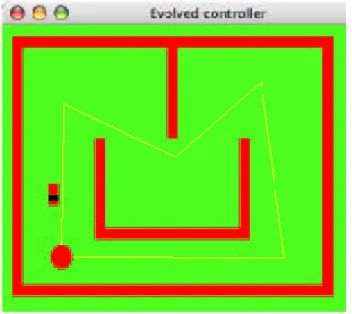
breaking down when crashing into them. We have not aimed to reproduce the characteristics of any particular make of RC car or surface material, however the shape of the track used in these experiments is modelled on the track used for the competition at CEC 2003. The dimensions of the model track is 400 pixels horizontal by 300 vertical, as depicted in Figure 1.
Figure 1: The simulated track with five aim points and the car at its starting position. The circle marks the aim point closest to the car.
Major differences between our current simulation and the real-world RC cars are as follows:
• In our simulation, the car position is known exactly at each point in time; in the real-world system, our com-puter vision system is imperfect, and while tracking the car fairly accurately most of the time, is occasion-ally prone to poor position estimates. Furthermore, our current real-world car tracker only estimates the position of the car, whereas the simulation also pro-vides the orientation and heading of the car as possi-ble inputs to a controller.
• The simulation proceeds via constant size time-steps, and has no latency (i.e., the current position of the car is available at each time step). The real system is subject to variable time delays, due to the compu-tational demands of the vision system (the variability being a result of running on a multi-tasking operating system). Also, the real system often suffers a latency of over 100ms, which is time enough for the car to travel 30cm.
• We have implemented a simple model of skidding, whereby the car has some side-slip when cornering, which causes under-steer. On the real RC cars, this is highly non-linear, and can be exploited by skilled drivers to execute the equivalent of a hand-brake turn (which induces severe over-steer), to take very tight corners.
2.1 Dynamics
mini-mize the amount of computational effort needed per updat-ing step, while still providupdat-ing a qualitative similarity to the dynamics of real RC car racing. The simulation, which is implemented in Java, is based on Newtonian particle kinet-ics; the car’s state is defined by its position, velocity, orien-tation and angular velocity.
The moving resistance of the car is modelled as a fric-tional force proporfric-tional to the velocity of the car. The trac-tion of the tyres is limited, which causes skidding when cor-nering at high speed.
Wall collisions affect the velocity and angular velocity of the car in such a way that the car bounces off the walls in a realistic manner, and a collision at an unfortunate angle and speed can spin the car around so that it faces the wrong way, adding to the challenges of the task.
We did consider using an existing car racing simulation for our studies, such as RARS (Robot Auto Racing Simula-tion)1, but found it easier to implement our own simulation in order to better match our requirements.
2.2 Fitness function
The fitness of a controller is determined by how far along the track it has managed to drive the car after a fixed amount of time; for the experiments in this paper this amount is specified as500time steps. How far the car has travelled is measured using a system of aim points. Five aim points are laid out quite evenly on the track, and the controller is scored on how many aim points it manages to reach in the correct order, which is counter-clockwise. To smooth the fitness function, the progress made towards the next aim point is also taken into account.
Each of the experiments below is carried out under two different regimes, a fixed starting point regime and a ran-domized starting point regime. Under the fixed starting point regime, the car always starts at pixel coordinates50, 150, pointing straight downwards in the preferred direction of movement for that part of the track. Under the random-ized starting point regime, the x-coordinate of the start-ing position is randomized between40and60, and the y-coordinate between120 and180, while the orientation of the car is set to a random angle between+/−30degrees from straight downwards. When calculating fitness under the randomized regime, each fitness evaluation is an aver-age of three separate trials using different starting positions, in order to make the fitness function somewhat less noisy. Under the fixed regime, a very small random term is added to the fitness value in order to encourage neutral mutations. The car can be controlled not only by an evolved con-troller, but also by a human player through a keyboard in-terface. When the car simulation was demonstrated at the IEEE 2005 Symposium on Computational Intelligence and Games, a number of conference delegates took the oppor-tunity to try to beat the evolved controllers. Of the10 par-ticipants who tried the game several times, the average best fitness (score) was 11.86. Overall winner was Jay Bradley of the University of Edinburgh, who once reached fitness
1http://sourceforge.net/projects/rars
15.97.
2.3 Evolutionary algorithm
An evolutionary algorithm with truncation-based selection and elitism was used for all experiments. The workings of the algorithm were as follows: in each generation, the fit-ness of all individuals were evaluated, and the population was sorted in fitness order. The less fit half of the popula-tion was then deleted and replaced with a clone of the fitter half of the population, after which the mutation operator was applied to all individuals, except the two fittest individ-uals. All experiments in this paper used a population size of 100and, unless otherwise stated, ran for100generations.
3 Neural networks
Three of the five experimental setups in this paper use neural network-based controllers. The neural networks are stan-dard multi-layer perceptrons, with n input neurons, a single layer ofhhidden neurons, and two output neurons, where each neuron implements the tanh transfer function. At each time step, the inputs as specified by the experimental setup is fed to the network, activations are propagated, and the outputs of the network are interpreted as actions that are used to control the car. Specifically, an activation of less than -0.3 of output 0 is interpreted as backward, more than 0.3 as forward and anything in between as no motor action; in the same fashion, activations of output 1 is interpreted as steering left, center or right.
At the start of an evolutionary run, the m*n*2 connec-tions are initialized to strength 0. The mutation operator then works by applying a different random number, drawn from a gaussian distribution around zero with standard de-viation 0.1, to the strength of each connection.
4 No inputs and action sequences
4.1 Methods
An action sequence is a one-dimensional array of length 500, containing actions, represented as integers in the range 0-8. An action is a combination of driving command (for-ward, back(for-ward, or neutral) and steering commands (left, right or center). When evaluating an action sequence con-troller, the car simulation at each time step executes the ac-tion specified at the corresponding index in the acac-tion se-quence. At the beginning of each evolutionary run, con-trollers are initialized as sequences of zeroes. The mutation operator then works by selecting a random number of posi-tions between0and100, and changing the value of so many positions in the action sequence to a new randomly selected action.
4.2 Results
just happen to take the car in the right direction, than it looks like good driving. The car drives very slowly, and many evolved controllers spend considerable amounts of time standing virtually still before finally starting to move. We hypothesize that a major factor restraining fitness growth is the ubiquity of local optima in the early parts of the se-quence. This comes about because each action is associated with a time step rather than a position on the track, so that a mutation early in the sequence that is in itself beneficial (e.g. accelerating the car at the start of a straight track sec-tion) will offset the actions later in the sequence in such a way that it probably lowers the fitness as a whole, and is thus selected against.
Under the randomized starting point regime, fitness is often below two and does not rise much further. Analysis of evolved controllers shows that the car often gets stuck on walls. A plot of fitness evolution for both the fixed and random starting points is shown in Figure 2.
Figure 2: Evolving action sequences. The upper graph rep-resents the fitness of the best individual in each generation, averaged over10evolutionary runs, under the fixed starting point regime. The lower graph represents the same entity when the car was evolved with randomized starting posi-tions.
5 Open-loop neural network
5.1 Methods
A neural network as described above with two inputs, five hidden nodes and two outputs is fed with the number of the current time step divided by500, yielding an input value of 0in the first time step and1in the last, and a constant input with the value1.
5.2 Results
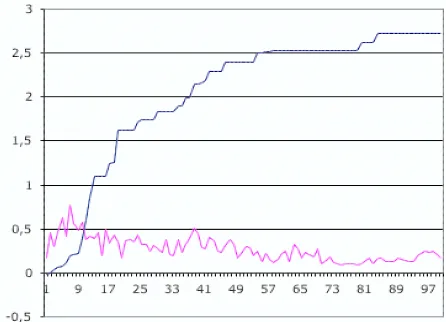
After100generations of evolution, the controller typically reached fitness levels of about 2 to3. The car behaviour looks no less random than that of the action sequence con-trollers, the main difference is that the car goes faster in this case. Most evolutionary runs found a way for the car to ac-celerate into the walls at the right angle and speed to bounce
it’s way around little more than half of the track, but none got further. An analysis of the actions produced by the con-troller reveals that the concon-troller issues the same action for several hundred time steps in a row, and only changes action once or twice per trial. At the moment we don’t know why any more intelligent behaviour refuses to evolve.
When evolving with randomized starting points it seems to be impossible to find a behaviour sequence that relies on bouncing off walls in the right way, and so evolved con-trollers tend to just run around in circles and reach very low fitness levels, barely above zero. The fitness evolution of this type of controller is shown in Figure 3.
Figure 3: Evolving open loop neural network controllers. The upper line is for a fixed starting position, the lower line for randomised starts.
6 Newtonian inputs and force fields
6.1 Methods
6.2 Results
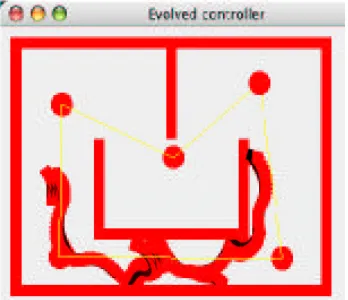
The force field controllers evolve very slowly, and after100 generations barely exceeded fitness 1; evolving for 1000 generations sometimes brought fitness up to around 4 when using fixed starting positions; when starting positions were randomised, fitness stayed at1. The cars moved around in a peculiar fashion, sometimes following a sane path around the track for a while, only to become stuck oscillating be-tween two force fields a moment later. Figure 4 shows the fitness evolution of this type of controller, and Figure 5 shows a sample trace.
Figure 4: Evolving force field controllers.
Figure 5: Movement trace of a car controlled by a force field controller.
7 Newtonian inputs and neural networks
7.1 Methods
The neural network is fed seven inputs: a constant input with value1, the x and y components of the car’s position, the x and y components of its velocity, its speed and its ori-entation. All inputs are scaled to be in the range -10 to 10. Seven hidden neurons are used in the network, and the two outputs are interpreted as described above.
7.2 Results
Evolving for100generations, best fitness varies consider-able between evolutionary runs. While most runs produced controllers with fitness values around 3, at least one run produced a controller with fitness over6. None of the con-trollers manage to the drive the car properly around the track however, the fittest controller instead drove the car into the “box” in the center of the track and exploited a glitch in the fitness function, whereby it can come close enough to the aim points on the left side of the track for the fitness function to increase without the car ever going around the left wall of the box. The cars drive fast and seem to make sensible turns, but they all eventually get stuck on a wall.
Randomising the starting position produces controllers of slightly lower fitness. Figure 6 shows the fitness evolu-tion of this type of controller, while Figure 7 shows a sample trace of the car.
Figure 6: Evolving newtonian neural network controllers.
8 Simulated sensor inputs and neural networks
8.1 Methods
In this experimental setup, the six inputs to the neural net-work consist of one constant input with the value 1, the speed of the car, and the outputs of three wall sensors and one aim point sensor. The aim point sensor simply outputs the difference between the car’s orientation and the angle from the center of the car to the next aim point, yielding a negative value if that point is to the left of the car’s orienta-tion and a positive value otherwise.
Each of the three wall sensors is allowed any forward facing angle (i.e. a range of 180 degrees), and a reach be-tween0and100pixels. These parameters are co-evolved with the neural network of the controller. The sensor works by checking whether a straight line extending from the cen-tre in the car in the angle specified by that sensor intersects with the wall at eleven points positioned evenly along the reach of the sensor, and returning a value equal to 1 divided by the position along the line which first intersects a wall. Thus, a sensor with shorter reach has higher resolution, and evolution has an incentive to optimize both reaches and an-gles of sensors. This type of sensor controller is related to the wrap-around vector histogram approach of [1], except that we are only using three sensors instead of full wrap-around.
8.2 Results
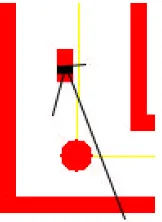
After100generations, evolution produced a controller with excellent fitness values, which equal more than three laps around the track in the allotted 500 time steps. The cars drive around the track at close to full speed, cutting corners incredibly close, crashing into walls only where they can take advantage of the rebound. The sensors vary consider-ably in the combination of angles and ranges, though often show a bias towards straight ahead and left. An example evolved sensor configuration is shown in Figure 8, which uses the short left sensor to help follow the inside wall, or take close cut corners, and the longer range sensors to help decide when to turn.
Figure 8: A sample evolved configuration of sensors.
The best final fitness value found when examining ten evolved controllers was 16.04, which narrowly beats the best human competitor so far. When evolving with ran-domised starting positions best fitness was slightly lower,
with a similar sensor setup. The lower fitness is due to the cars slowing down in corners. Figure 9 shows the fitness evolution of this type of controller, while Figure 10 shows a sample trace of the car’s movement.
Figure 9: Evolving sensor-based neural controllers with full inputs.
Figure 10: Movement trace of a car controlled by a sensor controller.
To investigate the relative contributions of the wall and aim point sensors, we “lesioned” the controller by disabling the sensor types one at a time. First, we disabled the wall sensors, and evolved controllers making use only of the aim point sensor, speed and the constant input. Under the fixed starting point regime this resulted in cars with fitness of-ten between 11and12; they drove well, but bumped into the wall protruding from the top of the track once every lap. When randomizing starting points, the aim sensor-only controller fared much worse, reaching medium fitness about 7. Evolution produced a controller that sometimes made its way around the track, but, depending on initial conditions, more often got stuck on a wall. Figure 11 shows the fitness evolution under this restriction.
Figure 11: Evolving sensor-based neural controllers without wall sensors.
left of straight ahead, and that drove at high speed, more or less following the outer wall. When randomizing starting points, they often have a long range sensor pointing straight forward, and medium range sensors pointing approximately 45 and 90 degrees to the left, and execute careful following of the outer wall without ever bumping into it.
Figure 12: Evolving sensor-based neural controllers with-out aim point sensors. Note that the value for the random starting point regime is actually slightly higher after gener-ation25.
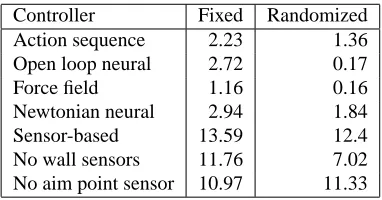
Controller Fixed Randomized
Action sequence 2.23 1.36
Open loop neural 2.72 0.17
Force field 1.16 0.16
Newtonian neural 2.94 1.84
Sensor-based 13.59 12.4
No wall sensors 11.76 7.02
No aim point sensor 10.97 11.33
Table 1: Average fitness of best individuals of 10 evolu-tionary runs of the various controller architectures under the starting point regimes.
8.3 Time consumption
Evolving 100 generations of a population of 100 sensor-based controllers, where each controller is evaluated for 500 time steps, takes 4 minutes and 22 seconds using Java 1.4.2 on a 933 Mhz Apple iBook G4. This works out to approx-imately 2.82 seconds per generation, 28 ms per controller evaluation, or 0.05 ms per time-step. A little more than half of this time is spent on propagating activations through the neural network. While the evolved networks should be fast enough to control many cars simultaneously in a com-mercial driving simulator, the process of evolving the con-trollers is probably still too slow to e.g. create new drivers adapted for arbitrary tracks on the fly.
9 Conclusions
The most consistent effect across all the experiments re-ported above is that controllers (except the sensor controller with the aim point sensor disabled) have higher fitness when starting position and orientation is kept fixed. Not surpris-ingly, evolution is able to optimize car behaviour better in these noise-free cases, and has to develop more robust be-haviour (which means longer lap times) or risk getting stuck on a wall when starting position is randomized. When rac-ing actual physical cars, startrac-ing position will necessarily vary, and so performance under this regime is the more interesting factor when evaluating the suitability of a con-troller for transfer to a physical domain.
Our experiments also point to the vast superiority of first-person to third-person information for the problem at hand. This might be because of the existence of walls, which presumably makes any mapping from third-person spatial information to appropriate first-person actions, ex-tremely nonlinear. A controller using third-person infor-mation (such as visual data from an overhead web cam-era) could get around this problem by somehow represent-ing the walls, and re-creatrepresent-ing the kind of sensors used in our sensor-based simulations described above. The prob-lems with using third-person information might also partly be due to difficulty of rotating coordinates as the car’s ori-entation changes.
We were somewhat surprised by the poor performances of the action sequence and force field controllers, both of which should theoretically be able to represent good solu-tions, at least for fixed starting points. We therefore hy-pothesize that the poor performance is because of problems with the evolutionary algorithm rather than the representa-tions per se; our main culprit here is the mutation methods, which seem to drive the action sequence into local optima and make for very slow progress in force field evolution. For a fixed starting position, it should be possible to achieve good lap times by seeding the EA with an action section ob-served by running an evolved sensor controller, but we’ve not yet tried this.
state of the car when entering a particular cell (this is not a problem for holonomic vehicles, which can be treated as stateless).
9.1 Future research
To investigate whether the evolved controllers really dis-play good driving behaviour as opposed to optimizations for one particular track, we would need to test them on more than one track. This could be done by testing each indi-vidual on several different track in each fitness evaluation, and then using a different set of tracks for testing the final evolved driving ability. Possibly a “generalist” driver could be evolved that performs reasonably on all tracks; this con-troller could then, using incremental or layered evolution [9], be specialized to perform well on a particular track — hopefully in shorter time than it would take to evolve a spe-cialized controller from scratch.
The neural networks in these experiments are quite sim-ple; recurrent neural networks, or even learning, plastic net-works could improve track times and generality of driving skills further. Several times, the Newtonian input neuro-controller evolved to exploit certain weak spots in the fitness function; these must be rectified.
So far we have only evolved controllers for a time-trial task, involving driving a single car at maximum speed. There is much work to be done, however, on competitive racing, involving two or more cars on the track simultane-ously, with interesting adversarial collision strategies to be evolved. An interesting difference between this and other forms of competitive coevolution is the existence of an ab-solute, and not just a relative fitness function.
While the car model used in this paper is adequate for the experiments mentioned above, we plan to investigate the ap-plication of our evolutionary methods to commercial driving simulators and physical radio-controlled cars. An important research question for the latter context is how the evolu-tionary methods handle the time-lag in the physical control cycle, as reported by Tanev et al. [8]
But the most challenging and interesting future develop-ment is using raw visual data as input to the controllers. Vi-sual input for controlling a first-person car game has already been explored by Floreano et al., but much work certainly remains to be done here. In particular, Floreano et al.’s con-trollers made use only of a minuscule part of the visual field; we aim to use convoluted modular neural networks [10] as the basis for controllers that make use of raw visual data, from a first person or a third person perspective, for con-trolling both physical and simulated cars. Currently, we are working on evolving controllers for the simulated car whose input is the400∗300track image rotated and translated so that the car is always in the centre of the picture and fac-ing upwards. There are some indications that it is possible to train perceptrons to control the car based on such input data.
Bibliography
[1] J. Borenstein and Y. Koren. The vector field his-togram and fast obstacle-avoidance for mobile robots. IEEE Journal of Robotics and Automation, 7:278– 288, 1991.
[2] J¨org Denzinger, Kevin Loose, Darryl Gates, and John Buchanan. Dealing with parameterized actions in be-havior testing of commercial computer games. In Pro-ceedings of the IEEE 2005 Symposium on Computa-tional Intelligence and Games CIG05, pages 37–43, 2005.
[3] Dario Floreano, Toshifumi Kato, Davide Marocco, and Eric Sauser. Coevolution of active vision and fea-ture selection. Biological Cybernetics, 90:218–228, 2004.
[4] Kwang-Young Im, Se-Young Oh, and Seong-Joo Han. Evolving a modular neural network-based behavioral fusion using extended vff and environment classifica-tion for mobile robot navigaclassifica-tion. IEEE Transacclassifica-tions on Evolutionary Computation, 6:413–419, 2002.
[5] Stefano Nolfi and Dario Floreano. Evolutionary robotics. MIT Press, Cambridge, MA, 2000.
[6] Dean A. Pomerleau. Neural network vision for robot driving. In The Handbook of Brain Theory and Neural Networks, 1995.
[7] Kenneth O. Stanley. Efficient evolution of neural networks through complexification. PhD thesis, De-partment of Computer Sciences, University of Texas, Austin, TX, 2004.
[8] Ivan Tanev, Michal Joachimczak, Hitoshi Hemmi, and Katsunori Shimohara. Evolution of the driv-ing styles of anticipatory agent remotely operatdriv-ing a scaled model of racing car. In Proceedings of IEEE Congress on Evolutionary Computation, 2005.
[9] Julian Togelius. Evolution of a subsumption architec-ture neurocontroller. Journal of Intelligent and Fuzzy Systems, 15:15–20, 2004.
[10] Julian Togelius and Simon M. Lucas. Forcing neuro-controllers to exploit sensory symmetry through hard-wired modularity in the game of cellz. In Proceedings of the IEEE Symposium on Computational Intelligence and Games, pages 37–43, 2005.