XLinguae, Volume 12 Issue 2, April 2019, ISSN 1337-8384, eISSN 2453-711X 17
Development of speaking at primary schools through CLIL
Elena Kovacikova DOI: 10.18355/XL.2019.12.02.02
Abstract
The paper deals with the popular methodology of content and language integrated learning (CLIL). It pinpoints the relationship between the CLIL methodology and the development of a speaking skill at a primary level of schooling. The research comprising observation and questionnaire methods was carried out at primary schools in Latvia, Lithuania, and Slovakia. The observation aimed to map, compare and evaluate the scope of learning opportunities providing the space for speaking development. The questionnaire summarized the attitudes of the learners and their view of speaking development at CLIL lessons. The results of the research proved that the CLIL methodology is applied inadequate balance of the professional terms stemming from the content of the instructed subject (CALP) through practicing general language phrases (BICS), supported with appropriate scaffolding techniques, the speaking activities in the classroom environment using various forms of work, thus guarantee the effectiveness of successful development in speaking. Moreover, the questionnaire revealed that although most of the learners consider the professional vocabulary and pronunciation challenging, their attitudes towards CLIL application proved to be positive and they realize the benefits and the added value of CLIL lessons in their foreign language speaking development.
Key words: speaking development, Content and language integrated learning (CLIL), language teaching and learning
Introduction
forms of work, tasks, and techniques. Secondly, the attitudes of pupils were mapped through questionnaires to find out the opinions of the pupils on attending CLIL lessons stating the benefits, challenges, and drawbacks.
Speaking in EFL and CLIL
XLinguae, Volume 12 Issue 2, April 2019, ISSN 1337-8384, eISSN 2453-711X 19
from accuracy objectives more to fluency ones might be seen in CLIL as “more scaffolded” to “less scaffolded” tasks (Ibid.). Referring to scaffolding techniques these aim towards language support. The CLIL research in Basque country comparing CLIL as an experimental group versus non-CLIL group in history and science proves that the results in declarative knowledge were higher, however, in cognitive functions such as analysing, interpreting, evaluating, etc. achievement were also higher than in a control group (Ball,2016: 30). Other researchers claim that “CLIL groups significantly outstripped their non-CLIL counterparts in productive skills, i.e., speaking and writing (Ball, 2018).
The basic difference in preparation for CLIL vs. non-CLIL lessons is ´conceptual sequencing in subject lessons. That is not present in language lessons. There are no thematic connections. CLIL should have conceptual sequencing in implementing thematic content, moving language back to the role as a vehicle. Inherent language should progress, recycle and grow in complexity. Actively involved in the language; they are immersed in it, surrounded and engulfed in it. They are using the language, but the context, theme, and task are the driving forces. When the students are engaged and interested in the topic, they are more motivated to use and learn the language needed to communicate (Ball, 2016).
Based on the theoretical background, the practical part aims at searching for the development of speaking in CLIL lessons in primary schools through observation and questionnaire.
Research part
Referring to the scope of the research described below directed to the development of speaking skills within CLIL lessons the research questions were designed as follows: Research questions:
1. What is the scope of “speaking opportunities” and forms of work provided through CLIL lessons in order to enhance communication? (identified through observation)?
2. What are student opinions on their speaking progress during CLIL lessons? (questionnaire)
The research design employed two methods - observation and questionnaire. A semi-structured observation schedule was created for collecting observation data. During the research process, data were collected and categorized, with the focus on the common features, differences, and relationships between them. An observation scheme was prepared with the main categories. The observation scheme categories focus on the types and sequence of activities and techniques, scaffolding techniques to develop speaking skills. Moreover, the forms of work and evaluation of students the language used for developing either language or content knowledge within the topics were observed. Then, the learners´attitudes through the questionnaires. For data processing, a system of categorizing and coding was applied. Observation schedule served for the systematization of final categories and codes for analyses, which increases the reliability of data. The aim is to develop and unfold the understanding of issues, find relationships among the codes (causes, contexts, consequences, and conditions). The findings have to be measured against the empirical materials and answers provided by coding and comparison (Gavora, 1998, Cohen, Manion, Morrison, 2007, Flick 2009).
Proficiency (CALP, i.e., language in terms of vocabulary or phrases used for communication as well as the content language in order to find out the balance of the CLIL lesson. Language scaffolding techniques used in the CLIL lessons, as well as teaching techniques, materials used, types of activities, teachers´instructions and pupils´responses were observed. Above that, code-switching within using a mother tongue and target foreign language aiming towards whether their code-switching occurs and if yes, description of the particular situations. The last point was devoted to the forms of assessment. The aim was to find out the forms of assessment, if any possible, ranging from positive feedback such as a smile, head nod, spoken evaluation to graphic representations such as smileys, grades or percentage.
The questionnaire as a complementary method was also used in this research. It contained five open questions comprehensible for the learners at the primary level of education. The aim was to find out their attitudes towards CLIL lessons, the benefits, and drawbacks from the addressed learners. Concerning the objectives stated in this paper, we pinpoint statements directed towards speaking development through CLIL. It was anonymous, and pupils were allowed to respond in their mother tongue in order to get their genuine responses. The answers of the learners were afterward analyzed and interpreted.
This paper focuses on the communication. Therefore, we will summarize just the codes and categories relevant to the research questions defined in the theoretical part of the paper, i.e., use of BICS and CALP, the scope of speaking activities enhancing communication, and students’ attitude towards speaking development in CLIL lessons. The questionnaire consisted of the six questions on the opinions of the students with identification data from which we could identify the content subject in CLIL lessons, the year of their study and several years attending CLIL lessons. Then, the opinions on which skills they like to develop opting from writing, reading, watching videos, discussions, working in groups, doing projects, etc. Then, what they find difficult in CLIL lessons and what they expect from them? The last question discussed their further directions, if and if yes, which other subjects they would like to study in English.
Procedure
The number of observed lessons: 2 CLIL lessons in Latvian, two lessons in Lithuanian, two lessons in Slovakian primary schools with the age of learners ranging from 10 to 15 with the language competence A1-A2 according to CEFR. Both the methods were employed from September 2016 to June 2017.
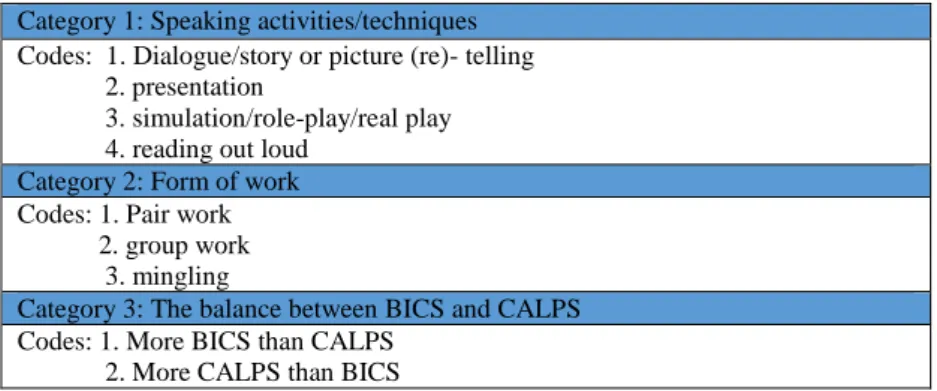
The categories created in the observation for identifying “speaking opportunities” in CLIL lessons are displayed in the following table 1 below.
Table 1: speaking opportunities” in CLIL lessons Category 1: Speaking activities/techniques Codes: 1. Dialogue/story or picture (re)- telling 2. presentation
3. simulation/role-play/real play 4. reading out loud
Category 2: Form of work Codes: 1. Pair work 2. group work 3. mingling
Category 3: The balance between BICS and CALPS Codes: 1. More BICS than CALPS
XLinguae, Volume 12 Issue 2, April 2019, ISSN 1337-8384, eISSN 2453-711X 21
Because a language lesson consists of a set of activities with certain aims and procedures, the activities aiming at speaking development were taken into consideration in this study. These were observed, later evaluated and followingly interpreted. Category 1 helped us eliminate speaking activities directed towards communication among pupils promoting speaking interaction or reading out loud. These activities require relevant lexis, pronunciation and responding grammar structures in order to be comprehended.
The second category stems from the assumption that a speaking activity or task performed in pair- or group- work proves to be more effective in terms of fluency based activity. The tasks in which the pupils were asked to talk to several colleagues in the classroom based on the given instructions were coded as mingling activities. Provided that the teacher succeeds in monitoring pupils´ performance, in a pair or group work, more pupils are engaged at the same time. Therefore, the conclusion is drawn to the fact that almost everybody in the classroom is practicing the task and thus developing their speaking skill simultaneously.
Referring back to the theoretical part, category 3 comes out of the fact that these are all CLIL lessons, and thus the balance should be sensitively put between the introduced and practiced language. It means that so-called basic interpersonal communication skills (BICS), simply as a common language used in every-day communication in L2 within spoken utterances of grammatical and semantic phrases, and on the opposite, the cognitive academic language proficiency (CALP), i.e., the lexis typical for the relevant subject, should be balanced. This aspect was observed within the used speaking tasks in particular lessons and their content areas. The codes mentioned above were observed based on the 6 CLIL lessons performed in different primary schools in Lithuania, Slovakia, and Latvia.
Results
The observations of the lessons were performed in the period from September 2015 – August 2017. CLIL lessons in Latvia instructed Science/English, and Mathematics/English, Lithuanian CLIL lessons covered music/French, science/English, Slovakian CLIL lessons consisted of 2 lessons from Music/English. In total, during this research six lessons were observed in order to find out the stated aims.
Table 2
Category 1: Speaking activities/tasks
Codes: 1. Dialogue/story or picture (re)- telling (15/6) 2. presentation (3/6)
3. simulation/role-play/real play (2/6) 4. reading out loud (3/6)
Category 2: Form of work Codes: 1. Pair work (17/6) 2. group work (5/6) 3. mingling (1/6)
Category 3: The balance between BICS and CALPS Codes: 1. More BICS than CALPS (4/6)
Within the category 1, the mostly used speaking technique was a picture description, in several lessons, it was more than twice (in total 15/6), then individual presentations were performed in a Science lesson, Maths, and Music with the following discussion (3/6). Then, simulation techniques were used in speaking development in Music/French and Music/English (2/6). Reading out loud as a technique was used in Science/English in Latvia and also Lithuania and in the Slovak Music/English CLIL lesson (3/6). This technique is concerned more with accuracy in pronunciation which is also a crucial aspect in speaking development.
As for the results of the second category, each CLIL lesson employed a form of a pair work twice during the lesson; Music/French used it three times. 5 CLIL lessons also employed group work with three or more pupils working on a speaking task at the same time, and 1 CLIL lesson (math/English) used mingling, i.e., searching for information (information gap) within the whole classroom.
Category 3 was focusing on the vocabulary used in CLIL lessons, as well as on finding the balance between BICS and CALPS. The lexis which was intentionally introduced and practiced every-day, i.e., the vocabulary or phrases such as: “It consists of... What does….look like? Can we compare…? faster than, the same as…
etc. On the other hand, CALP as the specific vocabulary connected with the content subjects such as ´piano, forte, rhythm, beat, dynamics, division, divided evenly, multiplied by, decimal, anthills, lay eggs´, were put in comparison. Eventually, it appeared that the two, Science and Maths teachers employed more content words and thus the lessons were unbalanced from the point of view of the used active lexis. The Science lesson in Lithuania was literally “overloaded” with the content vocabulary which was very difficult for pupils to master. The students lacked a positive attitude, and therefore their attention was in decrease. Similarly, the Math lesson in Latvia used more CALPS than BICS. Surprisingly, the teacher in this lesson used much more scaffolding techniques and students have no problems to cover them. Interestingly, we could observe how can be the same classroom disadvantages managed differently. A questionnaire as another method used in this research contained the questions comprehensible for the learners at the primary level of education. The aim was to find out their attitudes towards CLIL lessons, CLIL benefits, and drawbacks. Concerning the objectives stated above, we pinpoint statements directed towards speaking development through CLIL. The simple questionnaire consisted of the following open questions. It was anonymous, and pupils were allowed to respond in their mother tongue in order to get their genuine responses.
Table 3
Questionnaire with open questions:
1. Which subject do you study at CLIL lesson? 2. How long have you attended CLIL lessons? 3. Which activities do you like doing at CLIL lessons? 4. What is the most difficult for you at CLIL lessons? 5. What do you expect from CLIL lessons?
XLinguae, Volume 12 Issue 2, April 2019, ISSN 1337-8384, eISSN 2453-711X 23
(Latvia). It is important to note that in all the inspected countries, CLIL lessons were not compulsory, the learners were chosen as the prosperous ones, achieving generally good or very good results at school. After the approval of their parents, they took CLIL lessons as extracurricular ones. For our research, the most significant questions were number 3, 4, and 5. Regarding the research questions, responses were coded with the items identified in the theoretical part, i.e., the items connected to speaking, such as lexis (vocabulary), pronunciation, and speaking tasks leading either to fluency or accuracy. Out of 116 questionnaires, the question number 3 was answered by 72 learners mentioning that they are in favor of speaking activities or tasks, such as discussions (20), dialogues (16), performed projects (43) and individual presentations (33). These were open questions; therefore, the answers were multiplied in some occasions.
Replies of the pupils to question 4 asking for difficulties in CLIL, the learners mentioned vocabulary and pronunciation. 56 learners pinpointed content vocabulary as the most difficult focus in CLIL lessons. 43 learners listed that they found content or professional vocabulary as quite challenging. 11 learners explicitly stated that they had difficulties in understanding and pronouncing the words from science and maths. 20 of the respondents put down ´speaking´ as the most difficult skill at CLIL lessons.
As for question 5 on learners ‘expectations from CLIL lessons, 23 learners stated that they would like to become more fluent in English, 15 alluded to the benefit of learning a subject through the language. 35 learners put down that they find CLIL lessons much more interesting than regular language lessons and that these lessons are more “fun”.
In order to summarize the questionnaire results, the learners find speaking activities motivating and challenging. At the same time, they find speaking and CALP vocabulary demanding to comprehend and pronounce. Although the questionnaire did not directly ask whether the learners approve or confirm specifically their positive attitude towards CLIL, 30 percent of the respondents explicitly favored the CLIL lessons stating that these lessons are more interesting and amusing than other classes. None of the learners mentioned grammar difficulties which may be due to the reason that they had not been particularly asked about the grammar. The positive issue is that according to this in CLIL lessons the learners consider more important development of a speaking skill even though they found it quite challenging.
Conclusion
Content and language integrated learning have become an integral part of schooling in several European countries. The methodology of CLIL lessons has been introduced through the theoretical works of Marsh, Mehisto, Kelly, Ball, and other CLIL experts. The truth is though that finding good CLIL practice seems to be quite difficult due to the various conditions in educational systems, cultural backgrounds, schools management, and teacher preparation.
This paper focused on speaking development in CLIL lessons at primary schools as a part of the project examining CLIL implementation in several countries, particularly Lithuania, Latvia, and Slovakia. Six lessons were observed in total, two in each of the respective countries. The methods of observation and questionnaire were employed. The research questions aimed at
1. finding the scope of speaking opportunities and forms of work provided through CLIL lessons in order to enhance communication which was possible to be identified through observation,
The structured observation sheet was divided into the categories and codes with regards to speaking development with the focus on three key issues, i.e., speaking tasks, a form of work and the balance between the use of vocabulary (BICS and CALP). Answers in observation sheets were categorized and coded. The above mentioned research questions were answered and interpreted as follows:
1. What is the scope of “speaking opportunities” and forms of work provided through CLIL lessons in order to enhance communication?
Mostly used speaking activities and tasks utilized in CLIL lessons at primary schools were dialogues, picture descriptions and story retellings aimed at practicing the vocabulary of the content subjects focusing mostly on fluency. Then, reading the texts out loud focused on accurate pronunciation. These speaking opportunities provide the learners with effective use of vocabulary, pronunciation and language structures needed for communication and speaking interaction. In addition to the theoretical presupposition that effective use of speaking activities in the classroom is when more than one learner speaks at the same time which is possible only if the teacher employs pair or group work. Therefore, another issue of the observation was to find out the preferable form of work during speaking activities. The mostly enhanced form of work was a work in pairs. This form of work enabled the learners to communicate actively, preferably in a pair with a partner sitting beside. The third issue was to observe the balance of BICS and CALP, i.e., common English words and phrases versus specific vocabulary connected with the subject. Four lessons out of six used reasonably balanced scope of vocabulary either in a presentation or practice phases of the lessons. The success and balance were also reflected in the atmosphere and eagerness of learners willing to work and cooperate. In two of the lessons CALP language prevailed and due to lack of scaffolding techniques the learners easily dropped their attention and motivation to learn.
2. What are student´s opinions on their speaking progress during CLIL lessons?
Out of 116 questionnaires distributed to the learners of the observed CLIL lessons, 72 mentioned as their favorite activities the ones aiming at speaking development, such as discussions, dialogues, presentations, and oral projects. However, they also claimed that they find difficulties in comprehension and pronunciation of specific vocabulary. The learners´ attitudes towards CLIL lessons were positive in terms of their speaking development, some of them claiming they favor these lessons more than regular language lessons as they realize the importance and benefits of learning the content subjects through the language. Geographically CLIL education differs in the cultural, educational and institutional aspects, i.e., with the teachers’ preparation, school support, and cultural patterns transformed in education. We may conclude that speaking development in CLIL lessons should be promoted through providing numerous learning opportunities via different speaking tasks, and forms of work, with the balanced exposition of BICS and CALPS, provided that the scaffolding techniques are enhanced towards the learners’ needs and understanding. Further research might be enriched with finding out the code switching and its reflection to speaking development of learners in CLIL lessons.
Acknowledgment
XLinguae, Volume 12 Issue 2, April 2019, ISSN 1337-8384, eISSN 2453-711X 25
The research was funded by the Scientific Grant Agency of the Ministry of Education, Science, Research and Sport of the Slovak Republic (VEGA 1/0062/17)
Bibliographic references
BALL, P. 2018. Innovations and Challenges in CLIL Materials Desig. In Journal. Theory into Practice, Volume 57 (3). Available on the internet: https://doi.org/10.1080/00405841.2018.1484036
BALL, P. 2016. Putting CLIL into Practice. Oxford University Press. ISBN 978 019 442105 8
Common European Framework of Reference for Langauge Learning, Teaching, Assesment. Council of Europe.2001. Available online: http://www.coe.int/t/dg4/linguistic/Source/Framework_EN.pdf.2001
COHEN, L. – MANION, L. – MORRISON, K. 2007. Research Methods in Education. Routledge, ISBN: 978 041 5368780
CUMINS, J. 2015. BICS and CALP: Empirical and Theoretical Status of the Distinction, In book: Literacies and Language Education. DOI: 10.1007/978-3-319-02321-2_6-1
DONALD, R. 2008. Teaching Speaking Skills. Available online: https://www.teachingenglish.org.uk/article/teaching-speaking-skills-1.
FLICK, U. 2009. An introduction to Qualitative Research.SAGE Publications.2009. ISBN: 9781847873218
GAVORA, P. 1998. Metoda verbalnych vypovedi v edukacnom vyskume. In: Metodologia vied o vychove, svec, S. Et al. Bratislava: IRIS, 1998. ISBN 80-88778-73-5
HARMER, J. 2015. The Practice of English Language Teaching. Pearson. ISBN 978-1447980254.
HORVATHOVA, B. ET AL. 2017. Teaching Strategies in the Context of Foreign Language Lessons. UKF. ISBN 978 80558 1225 0
HURAJOVA, G. – CHMELIKOVA, G. 2018. ESP vs. CLIL in higher education. In: Convergence of ESP with other disciplines, Vernon Press. 2018. ISBN 978-1-62273-429-0
LARSEN-FREEMAN, D. 2000. Techniques and Principles in Language Teaching. Oxford: University Press. ISBN 0-19-4335574-8
MEHISTO, P. – MARSH, D. – FRRIGOLS, M.J. 2008. Uncovering CLIL. London:Macmillan Education.
KOVACIKOVA, LUPRICHOVA, J. 2018. A good CLIL practice among European educational institutions. https://doi.org/10.18844/ijlt.v10i1.3145.In: International Journal of Learning and Teaching. - ISSN 1986 4558, vol. 10, issue 1. pp. 50-60 SCRIVENER, J. 2011. Learning Teaching. The Essential Guide to Language Teaching. Macmillan. ISBN 978 0 230 72984 1.
SORADOVA, D. – KRALOVA, Z. 2016. Correlation of motivation and achievement in learning a foreign language pronunciation.CIEAE 2016: The 2nd International Congress Students Engagement in School:Perspectives of Psychology and Education – Motivation for Academic PErformance, Lisboa 11-13 June – Lisboa, 2017. ISBN 978 989 875634 2
UR, P. 1991. A course in Language Teaching. Practice and Theory. CUP: 1991. ISBN 978052144994 6
Words: 4647
Mgr. Elena Kovacikova, PhD.
Department of Language Pedagogy and Intercultural Studies, Faculty of Education, Constantine the Philosopher in Nitra
Drazovska 4, 949 74 Nitra, Slovakia