Prevalence and Impact of In
fl
ammatory Bowel Disease
–
Irritable
Bowel Syndrome on Patient-reported Outcomes in CCFA Partners
Maisa I. Abdalla, MD, MPH,*
,†Robert S. Sandler, MD, MPH,* Michael D. Kappelman, MD, MPH,
‡Christopher F. Martin, MSPH,* Wenli Chen, MA, MS,* Kristen Anton, MS,
§and Millie D. Long, MD, MPH*
Background:Inflammatory bowel disease (IBD) patients with persistent symptoms despite no or minimal inflammation are frequently described as having an overlap of IBD and irritable bowel syndrome (IBD–IBS). Limited data are available on how IBS impacts the individual patient with IBD. In this study, we aimed to evaluate the prevalence of IBD–IBS and investigate its impact on patient-reported outcomes.
Method:We performed a cross-sectional analysis within the CCFA Partners Study. Bivariate analyses and logistic regression models were used to investigate associations between IBD–IBS and various demographic, disease factors, and patient-reported outcomes including anxiety, depression, sleep disturbances, pain interference, and social satisfaction.
Results:Of the 6309 participants included, a total of 1279 (20%) reported a coexisting IBS diagnosis. The prevalence of IBD–IBS in this cohort was similar within disease subtypes. A diagnosis of IBD–IBS was associated with higher narcotic use compared with those with no IBS diagnosis for both Crohn’s disease, 17% versus 11% (P,0.001) and ulcerative colitis/indeterminate colitis, 9% versus 5% (P,0.001). Quality of life, as measured by Short Inflammatory Bowel Disease Questionnaire (SIBDQ) was lower in patients with IBD–IBS compared with those without. IBD–IBS diagnosis was associated with anxiety, depression, fatigue, sleep disturbances, pain interference, and decreased social satisfaction.
Conclusions:In this sample of patients with IBD, high prevalence of concomitant IBS diagnosis was observed. IBD–IBS diagnosis was associated with increased narcotic use and adverse patient-reported outcome. Appropriate diagnosis, treatment, and counseling may help improve the functional status of IBD–IBS patients and decrease narcotic use.
(Inflamm Bowel Dis 2017;23:325–331)
Key Words:irritable bowel syndrome in IBD, health care utilization, patient-reported outcomes
M
any patients with inflammatory bowel disease (IBD) con-tinue to experience symptoms of abdominal pain and diarrhea despite minimal or no active inflammation. These pa-tients are frequently described as having an overlap between IBD and irritable bowel syndrome (IBD–IBS). The awareness of IBD–IBS has increased over time as several studies have reported a higher prevalence of IBS among patients with IBD compared with the general population.1–5In a meta-analysis byHalpin et al,6pooled data from 13 studies revealed an overall
prevalence of IBS of 35% in patients with IBD who were in apparent remission.
Less is known about the impact of IBS on the individual IBD patient’s care and functional status. IBS has been linked to disproportionate excessive health care utilization with total direct and indirect annual expenditures exceeding $20 billion.7,8
How-ever, it remains unclear what additional health burden it may inflict on patients with IBD. In a study by Ramos-Rivers et al,9
patients with IBD who were higher users of health resources, namely telephone encounters, were more likely to have chronic abdominal pain and psychiatric comorbidities, both features fre-quently seen in patients with IBS. Furthermore, it is often difficult to clinically differentiate between symptoms of IBS and those of active inflammation. Hence, patients with IBD–IBS may unnec-essarily undergo repeated gastrointestinal (GI) procedures and abdominal imaging, have unnecessary escalation of immunosup-pressive therapies, or a delay in initiating needed therapies. IBD– IBS may also impact medication utilization, particularly rates of narcotic use, which have been shown to be higher for IBD pa-tients with concomitant IBS diagnosis compared with those with-out IBS in inpatient settings.10
Although both IBD and IBS have been independently linked to reduced health-related quality of life (HRQOL) measures and have been associated with several psychiatric comorbidities, such as depression, anxiety, fatigue, and sleep Received for publication September 16, 2016; Accepted December 1, 2016.
From the *Department of Medicine, Division of Gastroenterology and Hepatol-ogy, University of North Carolina at Chapel Hill, Chapel Hill, North Carolina; †Department of Medicine, Division of Gastroenterology and Hepatology, Loma
Linda University, Loma Linda, California;‡Department of Pediatrics. Division of Pediatric Gastroenterology, University of North Carolina, Chapel Hill, North Carolina; and§Geisel School of Medicine at Dartmouth, Hanover, New Hampshire. Supported by the Crohn’s and Colitis Foundation of America, Patient Centered Outcomes Research Institute, NIH P30 DK34987 and NIH 1K08DK088957-01.
M. D. Long has consulted for Abbvie, Salix, Pfizer and Theravance pharmaceuticals. M. D. Kappelman has consulted for Abbvie, Janssen, and GlaxoSmithKline. The remaining authors have no conflict of interest to disclose.
Address correspondence to: Maisa I. Abdalla, MD, MPH, Department of Medicine, Division of Gastroenterology and Hepatology, 11234 Anderson Street, MC 1556, Loma Linda, CA 92354 (e-mail: [email protected]).
DOI10.1097/MIB.0000000000001017
each of the PROMIS measures. The items are then calibrated using T-score metric to provide a mean value for the measure assessed. In the general US population, the mean for each domain is 50 with a SD of 10. A priori thresholds of $52 (anxiety, depression, fatigue, pain interference, and sleep disturbances) and#48 (social satisfaction) were selected to define the presence of adverse PRO within each measure. We have chosen these threshold points to allow for a clinically meaningful separation from the general pop-ulation. Minimal important differences in PROMIS measures for patients with IBD have not been defined. However, research in patients with cancer, patients with chronic pain, and healthy pedi-atric population revealed a range of minimal important differences of 2 to 6 for several of the PROMIS measures.23–25Numbers of
clinic visits to the primary care physician (PCP) and GI physician within the previous year were used as indicators for health care utilization. High utilization was defined by$5 visits to the PCP or GI physician within the previous year.
Statistical Analysis
Wefirst performed bivariate analyses to evaluate associa-tions between IBD–IBS and the various demographic and disease-related variables stratified by disease subtypes. Continuous variables were presented as means and SD, whereas the categor-ical variables were reported as percentages. Comparisons were made using Pearson’s chi-square test for categorical variables and Student’sttest or Mann–Whitney test for continuous varia-bles. Logistic regression models were then used to investigate independent associations between IBD–IBS and each of the 6 PROs while controlling for participants’age, body mass index, disease subtype, disease duration, sex, narcotics use, smoking status, and IBD therapies. All statistical analyses were performed using SPSS version 22.0 (IBM Corp., Armonk, NY).
Ethical Considerations
The study protocol was approved by the Institutional Review Board at the University of North Carolina.
RESULTS
Study Population
A total of 6309 participants met the inclusion criteria for the study. Of these, 3947 reported having CD and 2362 reported UC or IC. Most participants were women (71.9%) and whites (94.1%). The mean age of the study cohort was 44 years, and the average time between the initial diagnosis and the time of the survey completion was 14 years.
A total of 1279 (20.3%) participants reported a coexisting IBS diagnosis. The proportion of patients reporting concomitant IBS diagnosis was similar among patients with CD (20.0%) and UC/IC (20.7%)P¼0.49. In both CD and UC/IC groups, patients with IBD–IBS were more likely to be women and have higher body mass index and were less likely to have graduated college, as compared with those with no concomitant IBS diagnosis (Table 1). In UC/IC group, the mean age for patients with disturbances,little isknownaboutthe impactofcombinedIBD
andIBSonpatients’ functionalstatus.11,12Fewstudieshave
con-sistentlyshownreducedHRQOLscoresinpatientswithIBD–IBS comparedwithIBDpatientswithnoconcomitantIBSdiagnosis. However,variableresultswereseeninregardtoassociationswith anxietyanddepression.2–4,13–19Thesestudiesincludedarelatively
small number of patients (range: 50–276), and varied in their inclusioncriteriaandtheinstrumentsusedtoassessthedifferent aspects of a patients’ functional status. Wetherefore aimed to evaluatethe epidemiologic and disease-relatedcharacteristicsof patients with IBD–IBS within a large sample of patients with IBD.Inaddition,weaimedtoinvestigatetheimpactofthis diag-nosis on various patient-reported outcomes (PROs), including measuresoffunctionalstatus,andspecificmedicationutilization.
MATERIALS
AND
METHODS
Study
Design
We performed a cross-sectional analysis of a subset of patients withinthe Crohn’s and Colitis Foundation of America (CCFA)Partnerscohort.
Study
Population
CCFA Partners is a longitudinal internet-based cohort of adultpatientswithIBD,whichhasbeenongoingsince2011.The developmentofthe cohortwas previously described.20Inbrief,
after a baseline survey, participants are invited to complete follow-up surveys every 6 months. At baseline and every follow-up interval, data on demographics, disease subtype and characteristics,medications,measuresofdiseaseactivity,and var-iousPROsarecollected.Alldataareself-reported.
In2014,thesurveyswereupdatedtoincludethefollowing question: “AfteryouwerediagnosedwithIBDhasadoctorever toldyouthatyou hadIrritableBowelSyndrome(IBS)?” with3 possibleanswers:(1)Yes,(2)No,or(3)Don’tknow.Participants whoansweredthisquestionwitheitheryesornowereincludedin thisanalysis(n¼ 6309).
Study
Variables
Diseaseactivity wasassessedusing shortCrohn’s Disease ActivityIndex(sCDAI)forCrohn’sdisease(CD)andSimple Clin-ical Colitis Activity Index (SCCAI) for ulcerative colitis (UC)/ indeterminate colitis (IC). Activedisease wasdefined as sCDAI
IBD–IBS was significantly higher compared with those with no IBS diagnosis (47 versus 43, respectively, P ¼ ,0.001). No significant age differences were noted between the 2 groups in patients with CD. The proportion of patients with at least one previous abdominal surgery was lower in patients with IBD–IBS compared with those with no IBS diagnosis in both CD and UC/ IC participants. Patients with IBD–IBS had lower rates of current ileal/Kock pouch and current ostomy compared with those with no IBS diagnosis in UC/IC and CD groups, respectively. In both CD and UC/IC groups, patients with IBD–IBS were more likely to have a sCDAI score$150 (CD) or SCCAI.2 (UC/IC) com-pared with those with no concomitant IBS (48.9% versus 34.8% [CD] and 63.7% versus 48.3% [UC/IC]).
Health Resources and Medications Utilization
In both CD and UC/IC, patients with concomitant IBS diagnosis were more likely to report$5 visits to their PCP and GI physician within the previous year compared with those with no concomitant IBS diagnosis (Table 2). Furthermore, using logistic regression models to assess the impact of IBD–IBS diagnosis on the likelihood that participants would report$5 visits to their PCP and GI physicians within the previous year while controlling for age, sex, disease subtype, current narcotics use, and current use of various IBD therapies, IBD–IBS was an independent predictor for both out-comes (odds ratio [OR] 1.76, 95% confidence interval [CI], 1.45–2.14 for PCP visits and for GI visits, OR 1.36, 95% CI, 1.13–1.64.
Participants with IBD–IBS diagnosis were more likely to report current narcotic use compared with those with no IBS diagnosis, in both disease subtypes (Fig. 1). Among patients in clinical remission (defined by sCDAI score ,150 for CD and SCCAI #2 for UC/IC), higher rates of narcotic use among
patients with IBD–IBS were still observed in both CD (7.2%) and UC/IC (4.7%). No significant differences were seen in regard to IBD therapies (5-aminosalicylates, immunomodulators, and bi-ologics) utilization between patients with IBD–IBS and those with no concomitant IBS diagnosis in both disease subtypes. In addi-tion, IBD–IBS diagnosis was not associated with higher rates of current corticosteroids use (Table 2).
Impact on Quality of Life and PROs
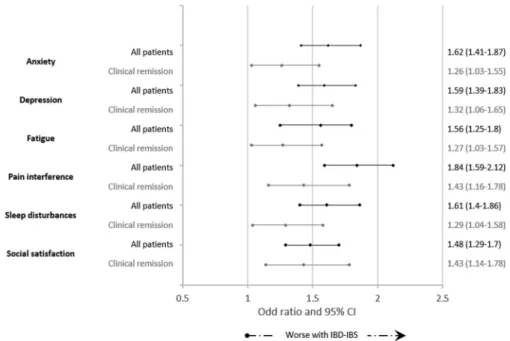
On bivariate analyses stratified by disease activity, patients with IBD–IBS had lower SIBDQ scores compared with those with no concomitant IBS diagnosis. The difference was signifi-cant for both disease subtypes (Table 3). Furthermore, patients with IBD–IBS had significantly higher mean values for anxiety, depression, fatigue, pain interference, and sleep disturbances and lower social satisfaction means compared with those with no concomitant IBS diagnosis in both disease subtypes (Table 3). Using logistic regression models to investigate independent asso-ciations between IBD–IBS and the presence of each of the 6 PROs, IBD–IBS was an independent predictor for anxiety (OR 1.62, 95% CI, 1.41–1.87), depression (OR 1.59, 95% CI, 1.39–1.83), fatigue (OR 1.56, 95% CI, 1.35–1.8), pain interfer-ence (OR 1.84, 95% CI, 1.59–2.12), sleep disturbances (OR 1.61, 95% CI, 1.4–1.86), and decreased social satisfaction (OR 1.48, 95% CI, 1.29–1.70). Analyses were repeated within strata of dis-ease activity, with similar results (Fig. 2).
DISCUSSION
In this large sample of self-reported patients with IBD, one in every 5 participants had a concomitant IBS diagnosis. After sex
TABLE 1.
Demographic and Disease-related Characteristics of Patients with IBD Strati
fi
ed by Disease Subtype
and Concomitant IBS Diagnosis
Characteristics
CD (n¼3947) UC/IC (n¼2362)
IBD (n¼3158) IBD/IBS (n¼789) IBD (n¼1872) IBD/IBS (n¼490)
Age, yr 43.7 (15) 44 (16) 43.7 (15) 47 (16)
Female sex 71.2 78.3 69.3 75.5
Body mass index, kg/m2 25.5 (6) 26.2 (6) 25.6 (6) 26.4 (6)
Current smoker 2.4 3 1 2.7
Patients with college degree 72.8 65.3 76.7 71.1
Disease duration, yr 15.9 (14) 15.4 (13) 11.5 (11) 12.7 (12)
University-academic GI settings 22.8 22.6 19.2 16.6
History of$1 bowel surgery 53.3 47.9 15.5 10
Current ileal or Koch pouch 3 4 9.4 3.7
Current ostomy 10 6 4 2.5
sCDAI (CD) and SCCAI (UC/IC) 82 (34) 90 (35) 1.03 (0.8) 1.2 (0.8)
Proportion of patients who met the criteria of active diseasea 34.8 48.9 48.3 63.7
Data presented as mean (SD) and percentages.
a
adjustment, the IBS prevalence remained almost 75% higher than the prevalence in the general US population, 19% versus 11%, respectively. Contrary to the findings from several previous studies, which suggested higher IBS prevalence in CD compared with patients with UC, in our study, the prevalence was comparable within the 2 disease subtypes.2,4,13,14,26,27The
differ-ent epidemiologic distribution in our study may be related to the distinct characteristics of the studied population. Our cohort is
internet based, with predominantly white females and may not represent the general IBD population. Alternatively, the small sample size in the previous studies may have influenced their reported results. Regardless of the exact prevalence in each dis-ease subtype, it remains evident that patients with IBD have con-siderably higher prevalence of IBS compared with the general population.
Several other important findings were observed in this study. First, patients with IBD–IBS were more likely to have$5 annual office visits to their PCP and GI physicians compared with those with no concomitant IBS diagnosis. This is consistent with the pattern of resource utilization in the general IBS population as IBS is estimated to be responsible;3.6 million physician visits in the Unites States annually.28Although clinic visits represent only
one indicator of the disease burden, those visits frequently gener-ate a trail of health expenditures relgener-ated to medication prescrip-tions and diagnostic procedures/tests. Furthermore, it has been previously shown that patients tend to underestimate the number of physician office visits,29,30 hence, the burden may be even
higher.
The second important observation in this study is the noted high rate of narcotic utilization in association with IBD–IBS. This is of particular significance for patients with IBD as the use of narcotic-based analgesia has been linked to a number of adverse effects, including higher rate of infectious complications, surgical complications, and even mortality.31–33In a study by Long et al10
assessing risks of narcotic use in hospitalized patients with IBD, all patients with previous IBD–IBS diagnosis received narcotic-based analgesia during their hospitalization. Having CD, disease duration, previous psychiatric comorbidities, outpatient narcotic use, current smoking, and previous IBD-specific surgery were also associated with narcotic use in hospitalized patients with
TABLE 2.
Comparison of the Health Resources and Medication Utilization Between IBD Patients with and
Without Concomitant IBS Diagnosis Strati
fi
ed by Disease Subtype
Characteristics
CD (n¼3947) UC/IC (n¼2362)
IBD (n¼3158) IBD/IBS (n¼789) Pa IBD (n¼1872) IBD/IBS (n¼490) P
Patients with$5 GI clinic visit within the previous year
15.7 20.0 0.01 12 15 0.09
Patients with$5 PCP clinic visit within the previous year
10.9 19.1 ,0.001 8.7 14.8 ,0.001
Narcotics 10.5 16.5 ,0.001 4.7 9.3 ,0.001
Corticosteroids 12.7 9 0.01 11.8 13.3 0.41
5-aminosalicylatesb 26.1 25.1 0.58 56.1 60.8 0.08
Immunomodulator 28.8 25.6 0.08 21.8 18.8 0.17
Biological therapyc 43 43 0.9 23 23.2 0.98
Data presented are percentages.
a
Comparisons were made using Pearson’s chi-square test for categorical variables.
b
Azathioprine, 6-mercaptopurine, and methotrexate.
c
Anti–tumor necrosis factor agents and antiadhesions (vedolizumab and natalizumab).
IBD. In the outpatient setting, several factors were linked to increased narcotic use in patients with IBD, including psychiatric comorbidities, female sex, history of abuse, and clinical disease activity.34–36However, the impact of IBD–IBS on outpatient
nar-cotic use has not been previously assessed. In our study, patients with IBD–IBS had higher rates of narcotic use compared with those with no IBS diagnosis. The differences in narcotic use remained significant even after we excluded those who met clin-ical criteria of active disease. Lastly, consistent with the previous reports, IBD–IBS in our cohort was associated with reduced HRQOL as measured by SIBDQ in both disease subtypes. More-over, IBD–IBS diagnosis was found to be an independent pre-dictor for all 6 PROs; anxiety, depression, fatigue, pain
interference, sleep disturbances, and reduced social satisfaction. Those effects remain significant after we excluded patients who met clinical criteria for active disease.
There are several strengths to this study. It is the largest study to date that examines the prevalence and impacts of IBS in patients with IBD. The large sample size allowed for data stratification and separate analyses within disease subtypes. It also allowed for adequate statistical power and meaningful assessments of the different associations between IBD–IBS and PROs while taking into account many of the confounding fac-tors. The use of validated scales for the various PROs, HRQOL, and self-reported measurement of disease activity is another strength.
TABLE 3.
Quality of Life Measures and PROs in IBD Patients with and Without IBS Diagnosis Strati
fi
ed by Disease
Subtype
Outcome
CD (n¼3947) UC/IC (n¼2362)
IBD (n¼3158) IBD/IBSa(n¼789) IBD (n¼1872) IBD/IBSa(n¼490)
SIBDQb 5 (1) 4 (1) 5.2 (1) 4.7 (1)
Anxiety 51.9 (10) 54.7 (10) 51.3 (9) 54.3 (10)
Depression 50.3 (9) 52.7 (10) 49.4 (9) 52.2 (10)
Fatigue 54.7 (11) 57.6 (11) 52.4 (11) 55.8 (11)
Pain interference 51.2 (10) 54.4 (10) 49.8 (9) 54.5 (10)
Sleep disturbances 51.4 (8) 53.6 (9) 49.9 (8) 52.3 (8)
Social satisfaction 49.3 (10) 47.1 (10) 50.4 (10) 47.2 (10)
Data presented as mean (SD).
a
For every evaluated outcome, the mean value was significantly different for IBD–IBS compared with IBD with no IBS diagnosis.Pvalue,0.001 (Student’sttest).
b
SIBDQ, short IBD questionnaire.
We also recognize a number of limitations to our study. First, all data in our cohort are reported with inability to verify self-reported information in each participant. Nevertheless, a recent validation study revealed 97% accuracy rate of self-reported IBD status and disease subtypes within the CCFA Partners cohort.37
Another limitation concerning the self-reported nature of the study is the IBS diagnosis. In our cohort, patients with IBD–IBS were identified on the basis of the participants’report that they were told they had IBS by their treating physician. Hence, the exact IBS criteria used to confirm the diagnosis are unknown. In addition, it is unclear whether other potential causes of the patient’s symptoms were ruled out or treated before IBS diagnosis (e.g., small intestinal bacterial overgrowth and celiac disease). Those uncertainties in the diagnosis make this a potentially heterogeneous group of IBD tients with IBS-like symptoms rather than a unified cohort of pa-tients with IBD–IBS. Another limitation to this study is the inability to objectively confirm the presence and severity of active inflam-mation. This is important as active disease can independently impact the individual patient’s quality of life and functional status and may be a source of bias in our analyses. In addition, the clinical measures of disease activity, sCDAI and SCCAI, can be elevated in patients with IBS who have no active inflammation. Hence, using these indices to define clinical disease activity may result in mis-classification of some patients with IBD–IBS. Nevertheless, con-comitant IBS diagnosis remains a significant predictor for adverse PROs even after excluding patients with significant GI symptoms meeting the clinical criteria of active IBD suggesting that those associations are true.
In conclusion, in this cross-sectional study of patients with IBD, there was a high prevalence of coexisting IBS diagnosis in both patients with CD and UC/IC. Furthermore, concomitant IBS diagnosis was associated with high rates of narcotic use, increased health resources utilization, lower quality of life, and adverse PROs. As each of these influences can negatively impact an IBD patient’s care, it is important to identify patients with a concomitant IBS diagnosis and provide the appropriate counseling and medical therapy.
REFERENCES
1. Isgar B, Harman M, Kaye MD, et al. Symptoms of irritable bowel syn-drome in ulcerative colitis in remission.Gut. 1983;24:190–192. 2. Minderhoud IM, Oldenburg B, Wismeijer JA, et al. IBS-like symptoms in
patients with inflammatory bowel disease in remission; relationships with quality of life and coping behavior.Dig Dis Sci.2004;49:469–474. 3. Ansari R, Attari F, Razjouyan H, et al. Ulcerative colitis and irritable
bowel syndrome: relationships with quality of life.Eur J Gastroenterol Hepatol.2008;20:46–50.
4. Barratt SM, Leeds JS, Robinson K, et al. Reflux and irritable bowel syndrome are negative predictors of quality of life in coeliac disease and inflammatory bowel disease.Eur J Gastroenterol Hepatol.2011;23: 159–165.
5. Fukuba N, Ishihara S, Tada Y, et al. Prevalence of irritable bowel syndrome-like symptoms in ulcerative colitis patients with clinical and endoscopic evidence of remission: prospective multicenter study.Scand J Gastroenterol.2014;49:674–680.
6. Halpin SJ, Ford AC. Prevalence of symptoms meeting criteria for irritable bowel syndrome in inflammatory bowel disease: systematic review and meta-analysis.Am J Gastroenterol.2012;107:1474–1482.
7. Grover M, Herfarth H, Drossman DA. The functional-organic dichotomy: postinfectious irritable bowel syndrome and inflammatory bowel disease-irritable bowel syndrome.Clin Gastroenterol Hepatol.2009;7:48–53. 8. Quigley EM. Overlapping irritable bowel syndrome and inflammatory
bowel disease: less to this than meets the eye?Therap Adv Gastroenterol. 2016;9:199–212.
9. Ramos-Rivers C, Regueiro M, Vargas EJ, et al. Association between telephone activity and features of patients with inflammatory bowel dis-ease.Clin Gastroenterol Hepatol.2014;12:986–994. e1.
10. Long MD, Barnes EL, Herfarth HH, et al. Narcotic use for inflammatory bowel disease and risk factors during hospitalization.Inflamm Bowel Dis. 2012;18:869–876.
11. Kappelman MD, Long MD, Martin C, et al. Evaluation of the patient-reported outcomes measurement information system in a large cohort of patients with inflammatory bowel diseases.Clin Gastroenterol Hepatol. 2014;12:1315–1323. e2.
12. Chey WD, Kurlander J, Eswaran S. Irritable bowel syndrome: a clinical review.JAMA. 2015;313:949–958.
13. Simren M, Axelsson J, Gillberg R, et al. Quality of life in inflammatory bowel disease in remission: the impact of IBS-like symptoms and asso-ciated psychological factors.Am J Gastroenterol.2002;97:389–396. 14. Keohane J, O’Mahony C, O’Mahony L, et al. Irritable bowel
syndrome-type symptoms in patients with inflammatory bowel disease: a real asso-ciation or reflection of occult inflammation?Am J Gastroenterol.2010; 105:1789–1794. quiz 1795.
15. Piche T, Ducrotte P, Sabate JM, et al. Impact of functional bowel symp-toms on quality of life and fatigue in quiescent crohn disease and irritable bowel syndrome.Neurogastroenterol Motil.2010;22:626–e174. 16. Jelsness-Jorgensen LP, Bernklev T, Moum B. Fatigue and disease-related
worries among inflammatory bowel disease patients in remission; is it a reflection of coexisting IBS-like symptoms? A short report.J Psychosom Res.2012;73:469–472.
17. Berrill JW, Gallacher J, Hood K, et al. An observational study of cognitive function in patients with irritable bowel syndrome and inflammatory bowel disease.Neurogastroenterol Motil.2013;25:918–e704.
18. Jonefjall B, Strid H, Ohman L, et al. Characterization of IBS-like symptoms in patients with ulcerative colitis in clinical remission. Neurogastroenterol Motil.2013;25:756–e578.
19. Vivinus-Nebot M, Frin-Mathy G, Bzioueche H, et al. Functional bowel symptoms in quiescent inflammatory bowel diseases: role of epithelial barrier disruption and low-grade inflammation.Gut. 2014;63:744–752. 20. Long MD, Kappelman MD, Martin CF, et al. Development of an
internet-based cohort of patients with inflammatory bowel diseases (CCFA partners): methodology and initial results.Inflamm Bowel Dis.2012;18:2099–2106. 21. Rothrock NE, Hays RD, Spritzer K, et al. Relative to the general US
population, chronic diseases are associated with poorer health-related quality of life as measured by the patient-reported outcomes measurement information system (PROMIS).J Clin Epidemiol.2010;63:1195–1204. 22. Cella D, Yount S, Rothrock N, et al. The patient-reported outcomes
measurement information system (PROMIS): progress of an NIH road-map cooperative group during itsfirst two years.Med Care.2007;45(5 suppl 1):S3–S11.
23. Yost KJ, Eton DT, Garcia SF, et al. Minimally important differences were estimated for six patient-reported outcomes measurement information system-cancer scales in advanced-stage cancer patients.J Clin Epidemiol. 2011;64:507–516.
24. Swanholm E, McDonald W, Makris U, et al. Estimates of minimally important differences (MIDs) for two patient-reported outcomes measure-ment information system (PROMIS) computer-adaptive tests in chronic pain patients.J Appl Biobehavioral Res.2014;19:217–232.
25. Thissen D, Liu Y, Magnus B, et al. Estimating minimally important difference (MID) in PROMIS pediatric measures using the scale-judgment method.Qual Life Res.2016;25:13–23.
26. Farrokhyar F, Marshall JK, Easterbrook B, et al. Functional gastrointes-tinal disorders and mood disorders in patients with inactive inflammatory bowel disease: prevalence and impact on health. Inflamm Bowel Dis. 2006;12:38–46.
28. Agarwal N, Spiegel BM. The effect of irritable bowel syndrome on health-related quality of life and health care expenditures.Gastroenterol Clin North Am.2011;40:11–19.
29. Ritter PL, Stewart AL, Kaymaz H, et al. Self-reports of health care utili-zation compared to provider records.J Clin Epidemiol.2001;54:136–141. 30. Roberts RO, Bergstralh EJ, Schmidt L, et al. Comparison of self-reported and medical record health care utilization measures.J Clin Epidemiol. 1996;49:989–995.
31. Hirsch A, Yarur AJ, Dezheng H, et al. Penetrating disease, narcotic use, and loop ostomy are associated with ostomy and IBD-related complica-tions after ostomy surgery in crohn’s disease patients.J Gastrointest Surg. 2015;19:1852–1861.
32. Lichtenstein GR, Feagan BG, Cohen RD, et al. Serious infections and mortality in association with therapies for crohn’s disease: TREAT regis-try.Clin Gastroenterol Hepatol.2006;4:621–630.
33. Targownik LE, Nugent Z, Singh H, et al. The prevalence and predictors of opioid use in inflammatory bowel disease: a population-based analysis. Am J Gastroenterol.2014;109:1613–1620.
34. Cross RK, Wilson KT, Binion DG. Narcotic use in patients with crohn’s disease.Am J Gastroenterol.2005;100:2225–2229.
35. Edwards JT, Radford-Smith GL, Florin TH. Chronic narcotic use in inflammatory bowel disease patients: prevalence and clinical character-istics.J Gastroenterol Hepatol.2001;16:1235–1238.
36. Hanson KA, Loftus EV Jr, Harmsen WS, et al. Clinical features and outcome of patients with inflammatory bowel disease who use narcotics: a case-control study. Inflamm Bowel Dis. 2009;15: 772–777.