FEATURED ARTICLE
MULTIPARENTAL POPULATIONS
Whole Genome Sequencing and Progress Toward
Full Inbreeding of the Mouse Collaborative
Cross Population
John R. Shorter,* Maya L. Najarian,†Timothy A. Bell,*,‡Matthew Blanchard,* Martin T. Ferris,* Pablo Hock,* Anwica Kashfeen,†Kathryn E. Kirchoff,†Colton L. Linnertz,* J. Sebastian Sigmon,† Darla R. Miller,* Leonard McMillan,†and Fernando Pardo-Manuel de Villena*,‡,1
*Department of Genetics,†Department of Computer Science, and‡Lineberger Comprehensive Cancer Center, University of North Carolina, Chapel Hill, North Carolina 27599
ORCID IDs: 0000-0003-4732-5526 (J.R.S.); 0000-0002-9546-6334 (T.A.B.); 0000-0003-1241-6268 (M.T.F.); 0000-0002-5738-5795 (F.P.-M.d.V.)
ABSTRACT Two key features of recombinant inbred panels are well-characterized genomes and re-producibility. Here we report on the sequenced genomes of six additional Collaborative Cross (CC) strains and on inbreeding progress of 72 CC strains. We have previously reported on the sequences of 69 CC strains that were publicly available, bringing the total of CC strains with whole genome sequence up to 75. The sequencing of these six CC strains updates the efforts toward inbreeding undertaken by the UNC Systems Genetics Core. The timing reflects our competing mandates to release to the public as many CC strains as possible while achieving an acceptable level of inbreeding. The new six strains have a higher than average founder contribution from non-domesticusstrains than the previously released CC strains. Five of the six strains also have high residual heterozygosity (.14%), which may be related to non-domesticus founder contributions. Finally, we report on updated estimates on residual heterozygosity across the entire CC population using a novel, simple and cost effective genotyping platform on three mice from each strain. We observe a reduction in residual heterozygosity across all previously released CC strains. We discuss the optimal use of different genetic resources available for the CC population.
KEYWORDS
whole genome sequence heterozygosity Multiparent
Populations MPP
inbreeding GenPred Shared data
resources Genomic
Prediction
The Collaborative Cross (CC) is a mouse multiparent population (MPP) designed for studying complex traits, modeling human diseases, and is the original stock of the Diversity Outbred population (Iraqiet al. 2008; Chesleret al. 2008; Morahanet al. 2008; Churchillet al.2012; Svenson
et al.2012). Over the past several years, the CC has been used to model a wide range of biomedically relevant traits including: allergy (Orgel
et al.2018), asthma (Donoghueet al.2017), behavior (Chesler 2014; Schoenrocket al.2018; Molenhuiset al.2018), bone development (Levy
et al.2015), cancer (Dormanet al.2016; Reilly 2016), cellular immune phenotypes (Grahamet al.2017), drug disposition (Nachshonet al.
2016), exercise (McMullanet al.2018), fertility (Shorteret al.2017), glucose tolerance (Abu-Toamih Atamniet al.2017; Nashefet al.2017), infectious disease susceptibility (Durrantet al.2011; Ferriset al.2013; Rasmussen et al. 2014; Gralinski et al. 2015; Graham et al. 2015; Graham et al. 2016; Gralinski et al.2017; Green et al.2017; Abu Toamih Atamniet al. 2018; Zhanget al.2018; Collinet al.2019), motor performance and body weight (Maoet al.2015), spontaneous colitis (Rogalaet al.2014), and toxicology (Cichockiet al.2017; Hartmanet al.
2017; Mosedaleet al.2017; Venkatratnamet al.2017).
The CC is derived from eight inbred strains:five classical strains (A/J, C57BL/6J, 129S1/ SvImJ, NOD/ShiLtJ, and NZO/HILtJ) and three wild-derived strains that represent three Mus musculus subspecies (WSB/EiJ fromMus m. domesticus, PWK/PhJ fromM. m. musculus, and CAST/EiJ fromM. m. castaneus) (Collaborative Cross Consortium 2012). We previously reported on the genome sequence of 69 CC strains (Srivastavaet al.2017). We identified a significant reduction in overall genomic contribution from the two strains with non-domesticus Copyright © 2019 Shorteret al.
doi:https://doi.org/10.1534/g3.119.400039
Manuscript received January 28, 2019; accepted for publication March 8, 2019; published Early Online March 11, 2019.
This is an open-access article distributed under the terms of the Creative Commons Attribution 4.0 International License (http://creativecommons.org/ licenses/by/4.0/), which permits unrestricted use, distribution, and reproduction in any medium, provided the original work is properly cited.
Supplemental material available at Figshare:https://doi.org/10.25387/g3.7814399. 1Corresponding author: Department of Genetics, University of North Carolina,
subspecific origin, CAST/ EiJ and PWK/PhJ. These observations are consistent with the expectation that genetic incompatibilities between the three mouse subspecies contribute to the large-scale extinction of the CC lines during inbreeding (Shorteret al.2017). We also reported on the overrepresentation of the wild-derived strains in regions of residual heterozygosity present within individual CC strains. Residual (i.e., segregating) heterozygosity in the CC refers to regions where more than one founder haplotype at a locus can be found within a single strain.
Publicly available whole genome sequence (WGS) is the new stan-dard for widely used mouse inbred strains (Doranet al.2016; Lilueet al.
2018). In MPPs, sequencing helps to resolve recombination break-points between consecutive haplotypes, assign the most likely founder haplotype in identical by descent (IBD) regions, and identify strain specific variants (Srivastavaet al.2017). However, the sequence of a single individual may provide an incomplete and biased view of an in-bred strain, especially when residual heterozygosity remains at relatively high levels. Multiple individuals from a strain need to be analyzed in order to accurately determine the level of residual heterozygosity. The Most Recent Common Ancestors (MRCA/MRCAs) are the best descrip-tion of residual heterozygosity at the time when a CC strain is released to the public (Welshet al.2012). In most cases, the MRCAs are the com-plete set of obligate ancestors. In a few cases, the ancestors were not available and additional individuals were added to better capture patterns of residual heterozygosity. As inbreeding has continued during the main-tenance and distribution of the CC, residual heterozygosity is expected to decrease. The time elapsed between the MRCAs and the present should be proportional to the reduction in residual heterozygosity.
Here, we publicly release genetic information (MRCA and whole genome sequence) on six previously unreported CC strains completed by the Systems Genetics Core Facility (SGCF) at the University of North Carolina (UNC). These six genomes have an increased frequency of haplotypes from the two non-domesticusinbred wild-derived strains compared to the previously reported 69 strains. The analysis of the inbreeding progress using genotypes from three recent mice from 72 CC strains reveals a decrease in residual heterozygosity across all strains. We discuss the strengths of the available CC genomic resources and plans from the SGCF to track inbreeding progress and residual heterozygosity.
MATERIALS AND METHODS
Mouse Strains
All CC mice were obtained from the SGCF at UNC (Welshet al.2012). CC mice are publicly available and can be obtained from the SGCF at UNC (http://csbio.unc.edu/CCstatus/index.py) or from The Jackson Laboratory. The MRCAs for the six new strains were born between May 2014 and August 2015. Mice used for sequencing were all males and born between April 2016 and July 2016. Mice used for MiniMUGA genotyping were mostly born between 2017 and 2018. For strains that were extinct or not available at UNC at the time of this study, mice genotyped for MiniMUGA were born between 2015 to 2016 (Table S1).
Genotyping
All sequenced samples and MRCAs were genotyped using GigaMUGA (Morgan et al.2015). Three additional mice (two females and one male) were selected from 72 CC strains and were genotyped using the MiniMUGA platform (Neogen, Lincoln NE). To ensure the correct mice were sequenced and genotyped on MiniMUGA, each sample’s genotype was compared to the sequenced mouse’s genotype for con-cordance (Table S2).
Estimation of residual heterozygosity
To estimate residual heterozygosity in the autosomes and theX chro-mosome in the CC, we used a subset of MiniMUGA markers. These markers are biallelic and informative in the CC founders. The geno-types in the CC founders are consistent among biological replicates and do not contain H or N calls. Finally, genotypes in the founders perfectly predict the genotypes in F1 hybrids. There are 6,293 such markers distributed across the genome. Markers where the three samples per strain had one or more H calls or do not share the same genotype call were treated as evidence of residual heterozygosity. Within each strain, clusters of markers with evidence of residual heterozygosity were combined to conservatively estimate the fraction of the genome with residual heterozygosity. To estimate relatedness between samples gen-otyped in MiniMUGA and their corresponding CC strain, we used a subset of 3,295 markers that overlapped between GigaMUGA and MiniMUGA genotyping platforms.
Haplotype reconstruction
Haplotype reconstruction for the MRCAs and each sequenced sample was performed as previously described in Srivastava et al.2017 to identify the founder haplotype contribution across the genome. Foun-der haplotypes are reported as a probability vector for each of the 36 possible founder states (8 inbred, and 28 founder-pairs) at each marker position.
The obligate ancestors for each line were genotyped using a com-bination of MegaMUGA and GigaMUGA platforms as described pre-viously (Morgan et al. 2015). In the case where an ancestor was genotyped using the more dense GigaMUGA platform, MegaMUGA founder probabilities were imputed from a forward-backward Hidden Markov Model (HMM) that was used to estimate the 36-state proba-bility at each GigaMUGA marker based on its genotype (Srivastava
et al.2017). MegaMUGA probabilities were imputed via linear inter-polation at MegaMUGA marker positions. For samples genotyped on MegaMUGA a forward-backward HMM was used to directly estimate the founder-state probabilities.
The founder-state probabilities for each strain are estimated by combining the probabilities of the strain’s obligate ancestors using the following rules. At each marker, a maximum probable founder-state was determined for each of the obligate ancestors. If the maximum likelihood was inbred, but from different founder states, then those probabilities were redistributed (added) to all combinations of hetero-zygous states involved (ex.pfor AA, was added to the AB probability if BB was the highest probability for the marker in any other obligate ancestor for the strain and the probability of AA was set to 0. Likewise the sample or samples with BB as the maximum probability with value
r,rwas added to AB and BB set to 0). Once the discordant inbred probabilities were redistributed within a sample’s marker, the maxi-mum probability for each founder-state was then selected from the set of obligate ancestors and the resulting vector of 36 maximum proba-bilities were normalized. These normalized probaproba-bilities are reported as the strain’s haplotype reconstruction.
There are small differences in how sex chromosomes are treated by the pipeline. For males, the forward-backward HMM has only 8-states for the
X-chromosome, but when merged with the female obligate ancestors they are extended to 36 with the heterozygous states set to 0 probabilities, and they are then combined into strain probabilities as before.
Sequencing
Whole genomic DNA was isolated as described in Srivastava et al.
strains: CC078/TauUnc, CC079/TauUnc, CC080/TauUnc, CC081/ Unc, CC082/Unc and CC083/Unc. Samples were sequenced at the UNC High Throughput Sequencing Facility (HTSF). DNA was sheared by ultrasonication, and size selection was targeted at 350 bp using a PippinPrep system. The HTSF generated sequencing libraries using Kapa (Kapa Biosystems) DNA Library Preparation Kits for Illumina sequencing. Each CC sample was run in two lanes of HiSeq4000 (Illu-mina). Paired end 150-bp sequencing was performed on these samples.
Burrows-Wheeler transforms
FastQC (v0.11.5) was used to confirm the quality of the raw sequencing reads. Multi- string Burrows-Wheeler transforms (msBWTs) were then constructed using the raw fastq sequencing reads of each CC sample. The msBWTs were constructed using ropeBWT (Li 2014) and the msBWT merge algorithm (Holt and McMillan 2014). The msBWT data struc-ture is a lossless compressed representation of the raw sequenced reads that can be efficiently queried for any specific subsequence. The msBWTs were employed in two pipelines. Thefirst was to query each genome against the set of annotated variants from the Sanger Institute (Keaneet al.2011) that are informative among the CC founders. This set of queries was described in Srivastavaet al.2017. The msBWTs were then queried against 45 base pair subsequences (both forward and re-verse complement) from the Mus musculus reference genome (GRCm38.68) overlapping by 15 base pairs. The resulting read counts were archived as a data matrix and used for deletion discovery.
Large deletions
We identified homozygous genomic deletions greater than 500 base pairs in non- repetitive genomic regions that were unique to each strain. This was accomplished using msBWT queries of overlapping 45-mers shifted by 15 base pairs from the GRCm38v68 reference genome. The msBWT reports the number of reads containing each 45-base substring in both forward and reverse-complement orientations. In order to mitigate for random sequencing errors and contamination due to“ in-dex-hopping” (van der Valk et al. 2018), we selected a minimum threshold of at least 3 reads as sufficient evidence of a 45-mer’s presence in each sample. Once missing 45-mer intervals were identified the msBWT was used to extract theflanking non-zero reads at the interval boundaries, and a consensus sequence was constructed for 45 to 60 ba-ses inside of the missing interval. If this consensus was consistent with a simple polymorphism the new consensus sequence was used to ex-tend theflanking sequence, and the msBWT was used to further extend into the near-zero interval until either the gap closed, or the new consensus’edit distance from the reference was inconsistent with a simple polymorphism.
Data availability
Genotypes for MiniMUGA and GigaMUGA are available at the MMRRC-UNChttps://www.med.unc.edu/mmrrc/genotypes. The 36 state probabilities and haplotype reconstruction of the MRCAs
for the six additional CC strains are publicly available at http://
csbio.unc.edu/CCstatus/index.py?run=FounderProbs. Sequenced genomes
can be queried using the msBWT tools available at http://
www.csbio.unc.edu/CEGSseq/index.py?run=MsbwtTools. The sequenced
samples are available at ENA accession PRJEB31495 as FASTQfiles. Zenodo accession no. 2586963 provides access to the genotypes from MiniMUGA and GigaMUGA, ideogram and haplotypefiles based on GigaMUGA genotypes, whole genome sequence, and MRCAs. Supplemental material available at Figshare:https://doi.org/10.25387/g3.7814399.
RESULTS AND DISCUSSION
The six strains reported here were not included in the initial report of the CC genomes (Srivastavaet al.2017) because of differences in health status and high levels of residual heterozygosity. Three strains (CC078/ TauUnc, CC079/TauUnc and CC080/TauUnc) were quarantined to remove potential pathogens. Five strains (CC078/TauUnc, CC080/ TauUnc, CC081/Unc, CC082/Unc and CC083/Unc) had levels of re-sidual heterozygosity over 10%. Typically,,10% residual heterozygos-ity was recommended before distribution of a CC strain independent of residual heterozygosity levels. While not fully inbred, many CC users willfind that these new strains are valuable for genetic mapping, val-idation experiments, and disease modeling because they add haplotypes from underrepresented CC founder strains.
Based on the MRCAs, the average residual heterozygosity of the six new strains is 19.9%, compared to 8.0% in the previously released strains. Among all 75 CC strains sequenced,five of the new strains are among the seven least inbred strains. In four of these new strains, over 20% of the genome is segregating in the MRCAs (Table 1). CC083/Unc has the unique distinction among CC strains, where three haplotypes are seg-regating at a locus. Specifically, 129S1/SvImJ, NOD/ShiLtJ and CAST/ EiJ haplotypes are present in a 17 Mb region on chromosome 15
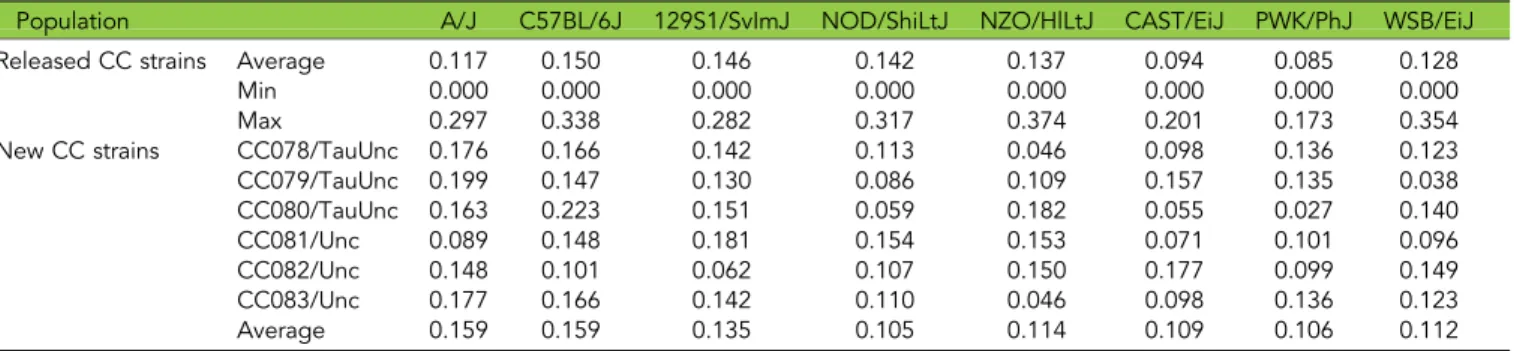
(31,869,802-58,735,934). All six new strains have haplotype contribu-tions from all eight founders while almost 20% of the previously re-leased strains have only six or seven founders (Table 2). Overall, three founder haplotypes (A/J, CAST/EiJ, PWK/PhJ) are overrepresented and two (NOD/ShiLtJ, NZO/HlLtJ) are underrepresented in the six new strains (Table 2). Importantly, two of the overrepresented founders (CAST/EiJ, PWK/PhJ) are of non-domesticusorigin (Table 1 & 2). These two founders were underrepresented in the previous report (Srivastavaet al.2017). We also previously reported that wild derived founder haplotypes were significantly overrepresented in regions of residual heterozygosity in the CC (Srivastavaet al.2017). We observe the same pattern in the new CC strains where wild-derived haplotypes are enriched in regions of residual heterozygosity (P,0.0001).
The six new CC strains contribute at least one CAST/EiJ or PWK/PhJ haplotype to 62% and 54% of the genome, respectively. This partially relieves the deficit of these underrepresented haplotypes in the CC population. For example, chromosome 5 contains a locus between 127Mb and 137Mb where currently only one CC strain has a CAST/ EiJ founder haplotype (Figure 1). The new CC strains add an extra
n Table 1 MRCA information for the six new sequenced strains
Strain and mouse ID
% Heterozygous in MRCA
% Heterozygous in sequenced sample
% Heterozygous in 3 miniMUGA genotypes
CC078/TauUnc_M1502 14.29996 1.7 5.52
CC079/TauUnc_M1086 6.766071 4.5 8.62
CC080/TauUnc_M1283 22.18861 3.77 17.11
CC081/Unc_M332 21.91887 3.7 18.81
CC082/Unc_M505 22.76935 5 18.84
homozygous CAST/EiJ haplotype into the CC population on chromo-some5. Another example is chromosomeXwhere the previously re-leased CC strains have a low frequency (, 5%) of haplotypes from CAST/EiJ or PWK/PhJ. The six new CC strains add at least one hap-lotype from CAST/EiJ or PWK/PhJ, spanning 70% and 41% of the entireXchromosome, respectively. The addition of strains with un-derrepresented haplotypes is important for different reasons. First, it
increases power for genetic mapping in the CC simply by increasing the number of tested haplotypes. Additional strains with the relevant hap-lotypes also enable independent validation experiments in the CC (Shorteret al.2017). Interestingly, there are regions in the CC popu-lation where non-domesticus haplotypes are not represented at all (chromosome 5: 61Mb to 64Mb; Figure 1). These areas have a de-creased non-domesticushaplotype frequency on the periphery of the
n Table 2 Founder haplotype frequency in sequenced samples
Population A/J C57BL/6J 129S1/SvImJ NOD/ShiLtJ NZO/HlLtJ CAST/EiJ PWK/PhJ WSB/EiJ
Released CC strains Average 0.117 0.150 0.146 0.142 0.137 0.094 0.085 0.128
Min 0.000 0.000 0.000 0.000 0.000 0.000 0.000 0.000
Max 0.297 0.338 0.282 0.317 0.374 0.201 0.173 0.354
New CC strains CC078/TauUnc 0.176 0.166 0.142 0.113 0.046 0.098 0.136 0.123
CC079/TauUnc 0.199 0.147 0.130 0.086 0.109 0.157 0.135 0.038
CC080/TauUnc 0.163 0.223 0.151 0.059 0.182 0.055 0.027 0.140
CC081/Unc 0.089 0.148 0.181 0.154 0.153 0.071 0.101 0.096
CC082/Unc 0.148 0.101 0.062 0.107 0.150 0.177 0.099 0.149
CC083/Unc 0.177 0.166 0.142 0.110 0.046 0.098 0.136 0.123
Average 0.159 0.159 0.135 0.105 0.114 0.109 0.106 0.112
Figure 1 Genomic contribution of new strains to the CC resource on chromosome 5. (A) Haplotype structure for the 6 new sequenced strains.
highlighted area, suggesting selection is acting against those particular haplotypes in the CC.
The eight founder strains of the CC have been sequenced at high depth, their variants annotated, and their genome recentlyde novo
assembled (Keaneet al.2011; Doranet al.2016; Lilueet al.2018). Previous genetic variation analyses have used sequence from these founders to infer haplotype specific genetic variation in the CC (Durrantet al.2011; Ferriset al.2013; Gralinskiet al.2015; Oreper
et al.2017). By directly sequencing CC strains, we can define founder specific variants across multiple CC strains sharing a founder haplo-type at each locus, and identify strain specific variation unique to a CC strain. Wefirst compared the sequenced samples’GigaMUGA geno-types and confirmed that they are consistent with the corresponding MRCA. Next, we queried variation within identical founder haplo-type regions at any given locus across the CC to identify de novo
mutations. We identified four uniquede novodeletions larger than 500bp in the newly sequenced mice that are not present in the as-sembled reference genome of the CC founders or in the previous cohort of 69 sequenced CC mice (Table 3). Figure 2 shows a 19.8kb deletion in CC079/TauUnc that is predicted to delete theGm14515
gene. The breakpoints were resolved using msBWTs to locally assem-ble sequence flanking the deletion. A PCR assay was designed to discriminate between the presence or absence of this deletion, and the deletion was fixed in both the MRCA and the three CC079/ TauUnc mice tested. We conclude that this mutation arose before or during the early CC inbreeding stages. Mutation and genetic drift may cause distinct variation to arise and becomefixed in individual CC strains leading to genetic differences between founder strains and their haplotypes in the CC population.
To better characterize inbreeding progress in the CC, we performed a colony survey using the newly developed MiniMUGA array to geno-type three mice (two females and one male) for 72 CC strains, including the six newly sequenced strains. We selected this sex ratio to sample theYchromosome in each colony and to increase theXchromosome representation in the analysis. First, we confirmed that all sampled mice had consistentYand mitochondria with their respective MRCA and sequenced sample. Next, we confirmed that all sampled mice had au-tosomal genotypes that matched with their respective sequenced sam-ple using 3,295 markers common to MiniMUGA and GigaMUGA (Figure S1, Table S2, Table S3). We observe that each of the 216 samples most closely match their respective sequenced sample. This set of markers is sufficient to distinguish two closely related CC strains (CC051/TauUnc and CC059/TauUnc) (Figure S1). The colony survey also allows us to estimate current levels of corresponding MRCA (Figure 3A). The four clear outliers that have both a high level of current heterozygosity and a small decrease in residual heterozygosity are four of the six new CC strains. We hypothesize that the overrepre-sentation of non-domesticus haplotypes combined with high initial residual heterozygosity and small number of generations between MRCAs and genotyped samples contributes to the low change in re-sidual heterozygosity.
The CC population now has three distinct resources that describe their genomes. Thefirst resource is genotype and haplotype reconstruc-tions for the MRCAs of each CC strain. The second resource is whole genome sequence from a single male for 75 CC strains. The third resource is a colony survey of 72 CC strains using MiniMUGA. On average, 2.4 years separate MRCAs from sequenced samples and three years separate sequenced samples from the colony survey. However, there is considerable variation for the lengths of these periods among CC strains (Table S1). These three resources have complementary strengths
that can help users of the CC. nTab
The MRCAs, being the most conservative estimate of haplotype composition from the CC colony, are the most robust for genetic mapping, especially when mice were acquired from a wide time range, or sampled from colonies maintained by individual investigators. Users of the CC should be aware that genetic drift has likelyfixed regions of residual heterozygosity in the MRCAs, as shown by the MiniMUGA residual heterozygosity analysis (Figure 3A). At regions with residual heterozygosity in the MRCAs, experimental mice could have any of the three combinations of the two segregating haplotypes. However, exper-imental mice will not contain any additional haplotypes not already in the MRCAs. Mapping power will be reduced in analyses where the MRCAs shows residual heterozygosity that is actuallyfixed in an ex-perimental population, but one of the two haplotypes will be correctly classified. The MRCAs can be accessed throughhttp://csbio.unc.edu/
CCstatus/index.py?run=FounderProbsas genotype probabilityfiles for
genetic mapping. The probability files are downloadable for each
individual MRCA as well as a strain consensus probabilityfile in the GRC mouse build 38.
The whole genome sequence from a single male for 75 CC strains is an excellent resource to define consistent founder haplotype specific variants, identifyde novomutations not present in the genomes of the eight CC founder strains, and improve resolution in the transition regions between founder haplotypes. However, attempting to conduct genetic mapping based on the sequenced sample would lead to sys-temic under-sampling of haplotypes segregating in the SGCF colony. For 51 strains (72% of the sampled CC), the sequenced sample un-derestimates residual heterozygosity compared to the three more re-cent samples genotyped in MiniMUGA (Table 1, Figure 3B). On the other hand, identification of potential causative variants within can-didate intervals following genetic mapping should rely on the se-quenced CC mice relative to the sese-quenced founder strains. This alleviates potential differences between the sequences of the founders
Figure 2 De novoprivate deletions in the new CC sequenced strains. (A) A deletion on theXchromosome in CC079/TauUnc not shared with
(Keaneet al.2011; Doranet al.2016; Lilueet al.2018) and the CC (Srivastava et al. 2017), and includes strain specific variants. We created a search tool for comparing sequence across the CC to provide CC users with easy access to sequence data. The msBWT k-mer search is a fast and user-friendly tool to query any k-mer shorter than read length and returns matching sequence http://www.csbio.unc.edu/
CEGSseq/index.py?run=MsbwtTools.
The colony survey of 72 CC strains using the set of 6,293 markers defined in the Materials and Methods is a resource that will allow CC users to confirm the strain ID of their CC mice through genotyping. The genotypes of these strains are available athttps://www.med.unc.edu/
mmrrc/genotypes. Using a subset of 3,295 markers that overlap
be-tween MiniMUGA and GigaMUGA, we verified that genotypes of these mice were consistent with the sequenced samples and can be used as a comparison resource (Figure S1, Table S2, Table S3). We recom-mend that users of the CC preserve tissue samples from all CC mice (and derivatives) used in an experiment. Genetic mapping using geno-types from parental mice (i.e., breeders) would provide the most accu-rate estimation of current segregating haplotypes for that population. This will also facilitate the correction of potential errors in mouse iden-tity, and serve as a validation of key resources. Our colony sampling of the CC at the SGCF highlights that residual heterozygosity is decreas-ing, but still present. For experiments where residual heterozygosity could disrupt analysis (i.e.vQTL mapping studies, F2mapping studies,
recombinant inbred crosses), accurate analyses and interpretation of
experimental results will likely benefit from genotyping individual ex-perimental animals to ensure accurate haplotype assignment. Residual heterozygosity may also influence genetic mapping and the presence of QTL, if only one of the two haplotypes at a locus influences a trait (Rogalaet al.2014). QTL that have residual heterozygosity may be a double-edged sword. Fixation of a haplotype (or population subsam-pling) may impede experimental replication in later studies. Alter-nately, residual heterozygosity can allow for QTL validation studies utilizing a segregating locus within a strain.
Given the level and potential effects of residual heterozygosity in many of the CC strains, regular and comprehensive updates on the heterozygosity still remaining within the SGCF’s colony of CC mice would improve the value of the CC resource. Therefore, the SGCF plans on heterozygosity segregating in the colony over time. Finally, it would be helpful to expand whole genome sequencing beyond a single mouse per strain to ensure that mutations that arise in the colony are taken in to account and potentially exploited in genetic analyses (Kumaret al.2013).
ACKNOWLEDGMENTS
This work was supported in part by the following grants from the National Institutes of Health: 4U19AI100625 (FPMV, MTF), 1P01AI132130 (FPMV, MTF), 5U42OD010924 (FPMV, LM), U24HG10100 (LM, FPMV), and T32HD040127 (JRS). The Collab-orative Cross project is also supported by the University Cancer Research Fund granted to Lineberger Comprehensive Cancer Center (MCR012CCRI) and a contract to FPMV by Neogen Corporation.
LITERATURE CITED
Abu-Toamih Atamni, H. J., Y. Ziner, R. Mott, L. Wolf, and F. A. Iraqi, 2017 Glucose tolerance female- specific QTL mapped in collaborative cross mice. Mamm. Genome 28: 20–30. https://doi.org/10.1007/s00335-016-9667-2
Abu Toamih Atamni, H. J., A. Nashef, and F. A. Iraqi, 2018 The Collab-orative Cross mouse model for dissecting genetic susceptibility to infec-tious diseases. Mamm. Genome 29: 471–487.https://doi.org/10.1007/ s00335-018-9768-1
Collin, R., L. Balmer, G. Morahan, and S. Lesage, 2019 Common Heritable Immunological Variations Revealed in Genetically Diverse Inbred Mouse Strains of the Collaborative Cross. J. Immunol. 202: 777–786.https:// doi.org/10.4049/jimmunol.1801247
Chesler, E. J., 2014 Out of the bottleneck: the diversity outcross and collaborative cross mouse populations in behavioral genetics re-search. Mamm. Genome 25: 3–11. https://doi.org/10.1007/s00335-013-9492-9
Chesler, E. J., D. R. Miller, L. R. Branstetter, L. D. Galloway, B. L. Jackson
et al., 2008 The collaborative cross at Oak Ridge National Laboratory: developing a powerful resource for systems genetics. Mamm. Genome 19: 382–389.https://doi.org/10.1007/s00335-008-9135-8
Churchill, G. A., D. M. Gatti, S. C. Munger, and K. L. Svenson, 2012 The Diversity Outbred mouse population. Mamm. Genome 23: 713–718. https://doi.org/10.1007/s00335-012-9414-2
Cichocki, J. A., S. Furuya, A. Venkatratnam, T. J. McDonald, A. H. Knap
et al., 2017 Characterization of Variability in Toxicokinetics and Tox-icodynamics of Tetrachloroethylene Using the Collaborative Cross Mouse Population. Environ. Health Perspect. 125: 057006.https://doi.org/ 10.1289/EHP788
Collaborative Cross Consortium, 2012 The genome architecture of the collaborative cross mouse genetic reference population. Genetics 190:
389–401.https://doi.org/10.1534/genetics.111.132639
Donoghue, L. J., A. Livraghi-Butrico, K. M. McFadden, J. M. Thomas, G. Chenet al., 2017 Identification oftransprotein QTL for secreted airway mucins in mice and a causal role forBpifb1. Genetics 207: 801–812.
Figure 3 Residual heterozygosity levels in CC populations. (A) Change
Dorman, A., D. Baer, I. Tomlinson, R. Mott, and F. A. Iraqi, 2016 Genetic analysis of intestinal polyp development in Collaborative Cross mice carrying the Apc (Min/+) mutation. BMC Genet. 17: 46 (erratum: BMC Genet 17: 147).https://doi.org/10.1186/s12863-016-0349-6
Doran, A. G., K. Wong, J. Flint, D. J. Adams, K. W. Hunteret al., 2016 Deep genome sequencing and variation analysis of 13 inbred mouse strains defines candidate phenotypic alleles, private variation and homozygous truncating mutations. Genome Biol. 17: 167.https://doi.org/ 10.1186/s13059-016-1024-y
Durrant, C., H. Tayem, B. Yalcin, J. Cleak, L. Goodstadtet al.,
2011 Collaborative Cross mice and their power to map host suscepti-bility toAspergillus fumigatusinfection. Genome Res. 21: 1239–1248.
https://doi.org/10.1101/gr.118786.110
Ferris, M. T., D. L. Aylor, D. Bottomly, A. C. Whitmore, L. D. Aicheret al., 2013 Modeling host genetic regulation of influenza pathogenesis in the collaborative cross. PLoS Pathog. 9: e1003196.https://doi.org/10.1371/ journal.ppat.1003196
Graham, J. B., J. L. Swarts, C. Wilkins, S. Thomas, R. Greenet al., 2016 A Mouse Model of Chronic West Nile Virus Disease. PLoS Pathog. 12: e1005996.https://doi.org/10.1371/journal.ppat.1005996
Graham, J. B., S. Thomas, J. Swarts, A. A. McMillan, M. T. Ferriset al., 2015 Genetic diversity in the collaborative cross model recapitulates human West Nile virus disease outcomes. MBio 6: e00493–e00515. https://doi.org/10.1128/mBio.00493-15
Graham, J. B., J. L. Swarts, M. Mooney, G. Choonoo, S. Jenget al., 2017 Extensive Homeostatic T Cell Phenotypic Variation within the Collaborative Cross. Cell Reports 21: 2313–2325.https://doi.org/10.1016/ j.celrep.2017.10.093
Gralinski, L. E., M. T. Ferris, D. L. Aylor, A. C. Whitmore, R. Greenet al., 2015 Genome wide identification of SARS-CoV susceptibility loci using the collaborative cross. PLoS Genet. 11: e1005504.https://doi.org/ 10.1371/journal.pgen.1005504
Gralinski, L. E., V. D. Menachery, A. P. Morgan, A. Totura, A. Beallet al., 2017 Allelic variation in the toll-like receptor adaptor protein ticam2 contributes to SARS-coronavirus pathogenesis in mice. G3 (Bethesda) 7: 1653–1663.https://doi.org/10.1534/g3.117.041434
Green, R., C. Wilkins, S. Thomas, A. Sekine, D. M. Hendricket al., 2017 Oas1b-dependent immune transcriptional profiles of west nile virus infection in the collaborative cross. G3 (Bethesda) 7: 1665–1682.
Hartman, J. H., G. P. Miller, A. A. Caro, S. D. Byrum, L. M. Orret al., 2017 1,3-Butadiene- induced mitochondrial dysfunction is correlated with mitochondrial CYP2E1 activity in Collaborative Cross mice. Toxi-cology 378: 114–124.https://doi.org/10.1016/j.tox.2017.01.005 Holt, J., and L. McMillan, 2014 Merging of multi-string BWTs with
ap-plications. Bioinformatics 30: 3524–3531. https://doi.org/10.1093/bioin-formatics/btu584
Iraqi, F. A., G. Churchill, and R. Mott, 2008 The collaborative cross, de-veloping a resource for mammalian systems genetics: a status report of the Wellcome Trust cohort. Mamm. Genome 19: 379–381.https:// doi.org/10.1007/s00335-008-9113-1
Keane, T. M., L. Goodstadt, P. Danecek, M. A. White, K. Wonget al., 2011 Mouse genomic variation and its effect on phenotypes and gene regulation. Nature 477: 289–294.https://doi.org/10.1038/ nature10413
Kumar, V., K. Kim, C. Joseph, S. Kourrich, S.-H. Yooet al., 2013 C57BL/6N mutation in cytoplasmic FMRP interacting protein 2 regulates cocaine response. Science 342: 1508–1512.https://doi.org/10.1126/
science.1245503
Levy, R., R. F. Mott, F. A. Iraqi, and Y. Gabet, 2015 Collaborative cross mice in a genetic association study reveal new candidate genes for bone mi-croarchitecture. BMC Genomics 16: 1013.https://doi.org/10.1186/ s12864-015-2213-x
Li, H., 2014 Fast construction of FM-index for long sequence reads. Bio-informatics 30: 3274–3275.https://doi.org/10.1093/bioinformatics/btu541 Lilue, J., A. G. Doran, I. T. Fiddes, M. Abrudan, J. Armstronget al.,
2018 Sixteen diverse laboratory mouse reference genomes define
strain-specific haplotypes and novel functional loci. Nat. Genet. 50: 1574– 1583.https://doi.org/10.1038/s41588-018-0223-8
Mao, J. H., S. A. Langley, Y. Huang, M. Hang, K. E. Bouchardet al., 2015 Identification of genetic factors that modify motor performance and body weight using Collaborative Cross mice. Sci. Rep. 5: 16247. https://doi.org/10.1038/srep16247
McMullan, R. C., M. T. Ferris, T. A. Bell, V. D. Menachery, R. S. Baricet al., 2018 CC002/Unc females are mouse models of exercise-induced para-doxical fat response. Physiol. Rep. 6: e13716.https://doi.org/10.14814/ phy2.13716
Molenhuis, R. T., H. Bruining, M. Brandt, P. E. van Soldt, H. J. Abu-Toamih Atamniet al., 2018 Modeling the quantitative nature of neurodeve-lopmental disorders using Collaborative Cross mice. Mol. Autism 9: 63. https://doi.org/10.1186/s13229-018-0252-2
Morahan, G., L. Balmer, and D. Monley, 2008 Establishment of“The Gene Mine”: a resource for rapid identification of complex trait genes. Mamm. Genome 19: 390–393.
Morgan, A. P., C.-P. Fu, C.-Y. Kao, C. E. Welsh, J. P. Didionet al., 2015 The mouse universal genotyping array: from substrains to sub-species. G3 (Bethesda) 6: 263–279.https://doi.org/10.1534/
g3.115.022087
Mosedale, M., Y. Kim, W. J. Brock, S. E. Roth, T. Wiltshireet al., 2017 Editor’s Highlight: Candidate Risk Factors and Mechanisms for Tolvaptan-Induced Liver Injury Are Identified Using a Collaborative Cross Approach. Toxicol. Sci. 156: 438–454.
Nachshon, A., H. J. Abu-Toamih Atamni, Y. Steuerman, R. Sheikh-Hamed, A. Dormanet al., 2016 Dissecting the Effect of Genetic Variation on the Hepatic Expression of Drug Disposition Genes across the Collaborative Cross Mouse Strains. Front. Genet. 7: 172.https://doi.org/10.3389/ fgene.2016.00172
Nashef, A., H. J. Abu‐Toamih Atamni, Y. Buchnik, H. Hasturk, A. Kantarci
et al., 2017 Collaborative Cross Mouse Population for Studying Alve-olar Bone Changes and Impaired Glucose Tolerance Comorbidity After High‐Fat Diet Consumption. J. Periodontol. 88: e150–e158.https:// doi.org/10.1902/jop.2017.170075
Oreper, D. G., Y. Cai, L. M. Tarantino, F. Pardo-Manuel de Villena, and W. Valdar, 2017 Inbred Strain Variant Database (ISVDB): a repository for probabilistically informed sequence differences among the collabo-rative cross strains and their founders. G3 (Bethesda) 7: 1623–1630. https://doi.org/10.1534/g3.117.041491
Orgel, K., J. M. Smeekens, P. Ye, L. Fotsch, R. Guoet al., 2018 Genetic diversity between mouse strains allows identification of the CC027/ GeniUnc strain as an orally reactive model of peanut allergy. J. Allergy Clin. Immunol. pii: S0091–6749(18)31448–9.https://doi.org/10.1016/ j.jaci.2018.10.009
Rasmussen, A. L., A. Okumura, M. T. Ferris, R. Green, F. Feldmannet al., 2014 Host genetic diversity enables Ebola hemorrhagic fever patho-genesis and resistance. Science 346: 987–991.https://doi.org/10.1126/ science.1259595
Reilly, K. M., 2016 Using the Collaborative Cross to Study the Role of Genetic Diversity in Cancer-Related Phenotypes. Cold Spring Harb Protoc. 2016(3):pdb.prot079178.https://doi.org/10.1101/
pdb.prot079178
Rogala, A. R., A. P. Morgan, A. M. Christensen, T. J. Gooch, T. A. Bellet al., 2014 The collaborative cross as a resource for modeling human disease: CC011/Unc, a new mouse model for spontaneous colitis. Mamm. Genome 25: 95–108. https://doi.org/10.1007/s00335-013-9499-2
Schoenrock, S., D. Oreper, J. Farrington, R. McMullan, R. Ervinet al., 2018 Perinatal nutrition interacts with genetic background to alter be-havior in a parent-of-origin-dependent manner in adult Collaborative Cross mice. Genes Brain Behav. 17: e12438.https://doi.org/10.1111/ gbb.12438
Srivastava, A., A. P. Morgan, M. L. Najarian, V. K. Sarsani, J. S. Sigmonet al., 2017 Genomes of the mouse Collaborative Cross. Genetics 206: 537–
556.https://doi.org/10.1534/genetics.116.198838
Svenson, K. L., D. M. Gatti, W. Valdar, C. E. Welsh, R. Chenget al., 2012 High-resolution genetic mapping using the Mouse Diversity out-bred population. Genetics 190: 437–447.https://doi.org/10.1534/ genetics.111.132597
van der Valk, T., F. Vezzi, M. Ormestad, L. Dalén, and K. Guschanski, 2018 Low rate of index hopping on the Illumina HiSeq X platform. BioRxiv.https://doi.org/10.1101/179028
Venkatratnam, A., S. Furuya, O. Kosyk, A. Gold, W. Bodnaret al., 2017 Editor’s Highlight: Collaborative Cross Mouse Population Enables Refinements to Characterization of the Variability in Toxicokinetics of
Trichloroethylene and Provides Genetic Evidence for the Role of PPAR Pathway in Its Oxidative Metabolism. Toxicol. Sci. 158: 48–62.https:// doi.org/10.1093/toxsci/kfx065
Welsh, C. E., D. R. Miller, K. F. Manly, J. Wang, L. McMillanet al., 2012 Status and access to the Collaborative Cross population. Mamm. Genome 23: 706–712 (erratum: Mamm. Genome 25: 192).https:// doi.org/10.1007/s00335-012-9410-6
Zhang, J., D. Malo, R. Mott, J. J. Panthier, X. Montagutelliet al., 2018 Identification of new loci involved in the host susceptibility to
Salmonella typhimuriumin collaborative cross mice. BMC Genomics 19:
303.https://doi.org/10.1186/s12864-018-4667-0