211
TECHNICAL UNIVERSITY OF CLUJ-NAPOCA
ACTA TECHNICA NAPOCENSIS
Series: Applied Mathematics, Mechanics, and Engineering Vol. 62, Issue I, March, 2019
SUCTION-CUP MANIPULATOR CONCEPT DEVELOPMENT FOR THIN
SHEET METAL
Monica STEOPAN, Florin POPIȘTER, Cornel CIUPAN, Bogdan AGRIJAN, Grigore Marian POP
Abstract: The general objective of the authors of present paper was to develop a concept for a thin sheet
metal semi-automated manipulator, using competitive design tools and techniques like AHP, QFD and TRIZ. Using the framework of Design for 6 Sigma, by implementing the tool and based on specialty calculus, a concept for an articulated arm for handling thin metal sheets and a gripping device with suction cups that can manipulate metal sheets of different sizes was developed. The competitive design tools were used to identify the requirements of the end-user - S.C. European Fabrications S.R.L., to analyze and filter the specific characteristics and functions, to achieve the proposed topic: the design of a simple mechanism, easily achievable with the lowest possible costs and the highest possible safety. The final concept was designed based on a SCARA type robot having a modular and flexible suction coup gripper. To employ and solve the engineering calculus regarding the motors and the needed amount of valves the Mathcad software was used. For strength checking the gripping device, Dassault Systemes’s Catia was used. Based on the final concept functionality and characteristics, the end-user acquired a manipulation system that fulfills most of the results of the analysis.
Key words: competitive development, automated manipulator, sheet metal, six sigma
1. INTRODUCTION
The industrial automation represents a research filed that keeps on developing and benefits constantly from the technological progresses that were recorded in the past years. The exponential development of the calculation systems and that of electronic equipment and devices, the almost constant growth of the processors calculation strength, but also the capabilities of the storage devices, has led to the development of more and more performing automation equipment, which offers real-time control of the governing processes. [1]
The necessity to have a constant, flexible and safe production, to fulfill all the orders, to have a quality of a high and guaranteed level, are just a few arguments to include automated equipment in the modern production lines.
In the present paper, the authors wish to resolve through automation, the problem of manipulating some thin metallic tables, within a company specialized in the processing of metal
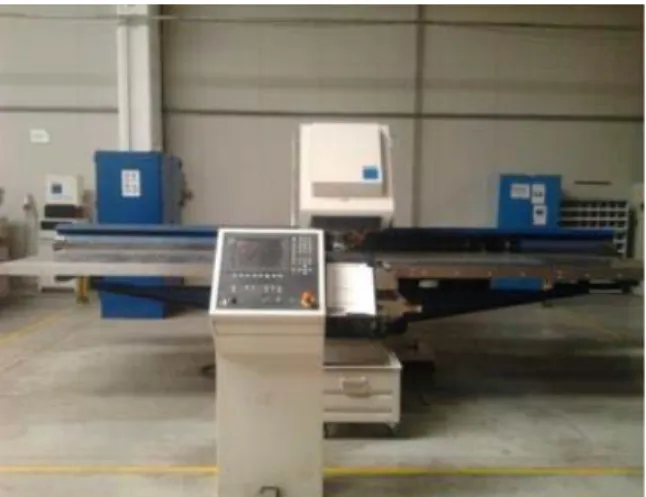
sheet elements. Presently the metal sheet is lifted from the load board by a worker with his bare hands, which most of the times due to the sheet’s big size and weight, during the positioning on the cutting table (Fig.1) the sheet will be deteriorated or scratched. Due to these reasons, there are many throw-outs, and the company’s costs increase significantly and the profit margin is lowered.
212
The robotized manipulation of the materials is one of the frequent industrial applications of the robots. This is usually performed by articulated industrial robots which implement the "pick-and-place'' type of activities, or by relatively simple manipulators.
Using industrial robots to manipulate the materials leads to:
• reducing the costs for the workforce;
• replacing the human operators for the working tasks which involve a high risk or monotonous work;
• reducing the piece’s deterioration during the manipulation process comparing to the classic version which implies human operators.
Industrial robots can be quite effective and efficient in fulfilling manipulation tasks, but they also tend to be expensive for a small to medium size enterprise, both financially and with respect to the time required to train personnel in operating, programming and maintaining the robot.
There are manual manipulators used in thin sheet metal manufacturing, but usually they are custom made to fit specific types of parts. During the first phase of the research several such manipulators were studied together with the representative of the end-user. They were cumbersome, inflexible or expensive to acquire or operate. [1][2][3]
Thus, a custom-made solution was to be developed, using competitive design tools like AHP (Analytic Hierarchy Process) and QFD (Quality Function Deployment), and the TRIZ 40Principles to solve a conflict that was identified.
2. CONCEPT DEVELOPMENT
To solve the problem of manipulating thin sheet metal parts, the authors considered the idea that it can be done with the help of an automated manipulator and a suction coup gripper to ensure a more precise and secure handling of the metallic sheet.
During the elaboration of the articulated arm for manipulating thin metallic sheets, the following requirements were considered:
• positioning in relation to the machine tool;
• work space of the machine tools;
• place where the metallic sheet is taken from; • ergonomics of handling;
• way the sheet is placed for manufacturing; Using a dedicated method called “Voice of the customer table” (figure 3), the critical characteristics were determined together with the functions that the manipulator must fulfill. The “Voice of the customer table” as a process transforms the identified and recorded the requirements, needs, preferences and expectations of the customer/user related to the product into the product’s critical characteristics. [4][5][6]
The list of requirements that was prepared after consulting with the representatives of European Fabrications – EFR, as well as per the research regarding the needs of the manufacturing process and manipulation equipment. For each requirement, a short “use” scenario was devised. The scenario building is also successfully used in software development. For each scenario “measurable” characteristics were identified.
Having registered the requirements, the Analytic Hierarchy Process (AHP) was used to determine the relative importance of each requirement. The AHP method works by comparing the requirements individually inside the group, through a set of correlations, establishing a hierarchy. The formula used is [5, 6], described as being a method of analytical classification which is a reliable solution used in many fields [7, 8, 9].
(1)
Where:
• Ri - represents the importance index of requirement “i”
• aij - represents the relation between element “i” and element “j”
Final classification of the requirements based on AHP. The Qualica QFD software was used. The first three most relevant requirements (accounting for 36.2%) are:
213
j
The next step was to determine the relations between the requirements and the characteristics and functions respectfully. To evaluate the relative importance of the characteristics and the functions the Quality Function Deployment was used to correlate the characteristics with the requirements and then the functions with the characteristics. Thus, the relative importance of each requirement is cascaded down to functional level. The importance value of each element is obtained with the formula [6]:
n
The ideas were gathered into viable concepts through combining. For example, one concept was built up of an articulated arm having a flexible gripping device, while another concept consisted of an articulated arm having a fixed gripping device. In the end five concepts were considered based on elements that influence a mechanical structure [10]. To pick the final concept the PUGH method for selection was used. A baseline concept was selected while the others were evaluated considering the baseline and the requirements. Two concepts were considered for further study.
Where:
W R
i1 i a ij j=1,...,m (2)
The next step consisted in correlating the dentified main parts of each of the two concepts with the required functions, using a worldwide
‘aij’ represents the relation between element “i” and element “j”;
‘Ri’ represents the requirement importance index ‘i’, i=1,...,n,
‘Wj’ the value weight of characteristic ‘j’, j=1,...,m
The relative importance value of each element is obtained with the formula:
method, QFD [11, 12, and 13]. This had the purpose of identifying the importance of each part in the equipment. Considering the cost of each part in the concept, a relative cost index was determined. The total cost for the main parts of the automated arm with flexible gripping device was 1597 EUR, while the second concept totaled 632 EUR.
W rel j Wj 100 m
W
t1 t j=1,...,m (3) 3. SUCTION CUP GRIPPING
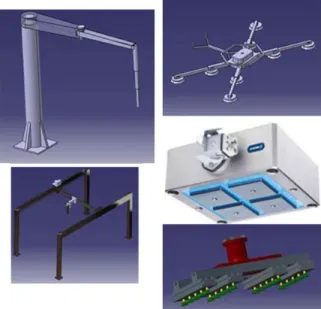
Having analyzed the functions, a series of ideas were put forward as possible means to solve the required tasks. For each idea were noted the associated requirements and functions (Fig.2.).
Fig. 2. Concept development phase
CONFIGURATION
To manipulate the thin metallic sheets a gripper with suction cups will be used (Fig. 3). It has the capability to manipulate metallic sheets with sizes ranging between 1000x1000[mm] and up to 2500x1500 [mm] using extendable arms, and can manipulate the metallic sheet without buckling or deteriorating them during the process.
Fig.3. The final concept of the suction cup gripper
214
which has an absorption capability of 75l/min, and the distribution in each suction cap is performed by a pneumatic solenoid valve distributor.
The suction cup gripper calculation entry data: -lifting mass: 20 [Kg]
- maximum speed on the articulation = 3 [m/s]
- acceleration time 0-> max= 1.26 [s] - positioning accuracy =1.5 [cm] - acceleration = 3 [m/s2]
Negative force required for pressure and suction cups calculation:
- lifting mass M:=20 [Kg] - safety factor k:=2
- max movement acceleration a:=3 [m/s2] - friction coefficient between rubber and
coated aluminum sheet μ:=0.5
a
This arm has a range of 2000 [mm] and can manipulate metallic sheets from heights of about 600 to 1500[mm], without the worker having to exert the effort of lifting heavy weights.
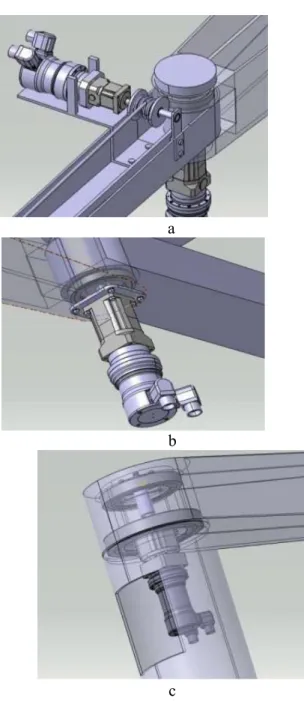
Within Fig. 11a, 11b and 11c are presented the internal and/or external elements design for the automated concept, for the equipment to be able to control the translation/rotation movements.
F
k
M
g
N
(4) The resulting negative force required is
F=632.4 [N]. a
Foreword it is calculated the vacuum surface of the 8 cups of 200mm diameter. For safety reasons the contact area coefficient was considered a=0.6.
2
d
A
a
n
2
Thus, the vacuum surface is A=0,151 m2. Based on the force and minimum area, the negative pressure required is: Pneg=0,042 [bar]
Considering, among other aspects, the negative pressure required, the suction coups can be chosen from a manufacturer’s catalog. Fig. 10 presents a 3D model of the articulated arm which will be placed next to the machine tool to simplify the worker’s job.
Fig.10. 3D model of the suction gripper’s articulated arm
b
c
Fig.11. a) Actuator and harmonic gear required to achieve
the translation movement, b) actuator and harmonic gear required to achieve the rotation movement between the two arms, c) actuator, the harmonic gear and the two ball
215 In figure 12 is the final concept agreed
by the company is presented. Because implementing lifting equipment in a manufacturing environment requires special permits and validations, the option to acquire an already built device was considered by the end user. The acquisition request was based on the detailed functionality and characteristics of the second selected concept: the non-automated flexible griping equipment.
a
b
Fig.12. a) Final concept of the manipulator and
b) Equipment acquired by the European Fabrications company 4. CONCLUSIONS
Competitive design is not a novel approach to product development [14]. It proved useful in numerous cases. The implementation of quality specific tools like Quality Function Deployment, Analytic Hierarchy Process, benchmarks, etc. leads to a more detailed view of the concept then otherwise possible. Using competitive development tools and techniques, two viable
concepts were developed. After detailing the concepts, it was concluded that the mechanisms developed and designed can be reliably implemented within the European Fabrications company. Since implementing lifting equipment in a manufacturing environment requires special permits and validations, of the two concepts the end-user chose a final concept as bases for acquiring lifting equipment for thin sheet metal parts made from a rotating arm and a flexible gripping device with suction cups. The acquired equipment closely responds to the functionality and characteristics of the developed concept and can easily be automated by attaching motors and an Arduino Controller [15].
8. REFERENCES
[1]http://www.dalmec.com/ing/applications/me chanics/pneumatic_balancers_metal_sheets. html [2]http://www.atismanipolatori.com/en/Solutio
ns-photos/Metal-sheets/Metal-Sheets
[3] Nedezki C.M., The maximal workspace with constant orientation of the 3 dof rpr parallel manipulator, ACTA TECHNICA NAPOCENSIS, Sesies: Applied
Mathematics and Mechanics, ISSN 1221 – 5872, Vol. 56, 2013
[4] Mihai, Steopan, Norbert, Lovasz, Virgil, Ispas, Grigore, Pop, Concept generation and mockup of a bipedal mobile platform, International conference: ICPR-AEM – QIEM, 2014
[5] M Steopan, T Gyorke, F Popister, S Gal, Competitive design of an anthropomorphic gripper, Proceedings of 2012 IEEE International Conference on Automation, Quality and Testing, Robotics, 2012
[6] Dan M.C., Prica C.D., Implication of tqm, lss, iatf 16949 approach within automotive industries, ACTA TECHNICA NAPOCENSIS, Sesies: Applied Mathematics and Mechanics, ISSN 1221 – 5872, Vol 61, No 3_Spe (2018)
[7] Mihai Dragomir, Diana Pitic, Dorin Țifrea, Cristian Codre, Reengineering of a graduate level educational programme, Proceedings of the 5 Balkan Region Conference on Engineering and Business Education & 2nd International Conference on Engineering and Business Education, Sibiu, Romania, 15-17 October, 2009 Vol. II, pp. 355-358, ISBN 978-973-739-848-2, ISSN 1843-6730
[8] Popescu, T. Stanciu, M. Dragomir, Quality in the extended life cycle of educational projects, Proceedings of The 6th International Conference Management of Technological Changes, 3-5 September
216
329, ISBN (Vol. II) 978-960-89832-8-1
[9] Iamandi, O., Popescu, S., Dragomir, M., Morariu, C, A critical analysis of project management models and its potenttial risks in software development. Quality - Access to Success Volume 16, Issue 149, 1 December 2015, Pages 55-61 ISSN: 1582- 29
[10] Corigliano, A., Ardito, R., Comi, C., Frangi, A., Ghisi, A., Mariani, S.2012. Microsystems and mechanics. 23rd International Congress of Theoretical and Applied Mechanics: Mechanics for the World, ICTAM 2012; Beijing; China. ISSN: 22109838
[11] Solcan S., et.al., Using TRIZ method for support innovation in developing plastic parts, ACTA TECHNICA NAPOCENSIS, Sesies: Applied Mathematics and
Mechanics, ISSN 1221 – 5872, Vol 58, No 4 (2015) [12] Rusan R., Blebea I., Estimating the importance of the
attributes of a new product in development process, Acta Tehnica Napocensis MME, Vol. 59, 2016
[13] Cavallucci, D., Cascini, G., Duflou, J., Livotov, P., Vaneker, T..2015. TRIZ and knowledge-based innovation in science and industry. World Conference: TRIZ FUTURE 2011-2014; Lausanne; Switzerland. Procedia Engineering Volume
131, 2015, Pages 1-2. ISSN: 1877-7058
[14] Mocan, B., Fulea, M., Olaru, M., Buchmüller, M., From intuitive programming of robotic systems to business sustainability of manufacturing SMEs, The AMFITEATRU ECONOMIC journal, 2016, Volume 18, Issue 41, 2016, Pages 215-231, ISSN: 1582-9146 [15] Antal, T., Considerations on the serial pc - arduino uno
r3 interaction, in java, using jdeveloper, for a 3r serial robot, based on the ardulink library, ACTA TECHNICA NAPOCENSIS, Sesies: Applied Mathematics and Mechanics, ISSN 1221 – 5872, Vol. 61, 2018
DEZVOLTAREA CONCEPTULUI MANIPULATOR DE ASPIRA
Ț
IE PENTRU TABLA
SUB
Ț
IRE
Abstract: Obiectivul general al autorilor prezentei lucrări a fost de a dezvolta un concept pentru un manipulator
subȚire automat sub formă de tablă, folosind instrumente Și tehnici de design competitive precum AHP, QFD
Și TRIZ. Folosind cadrul Design pentru 6 Sigma, prin implementarea instrumentului Și pe baza calculului de specialitate, a fost dezvoltat un concept pentru un braȚ articulat pentru manipularea foilor metalice subȚiri Și un dispozitiv de prindere cu ventuze care să poată manipula foi de metal de dimensiuni diferite. Instrumentele de design competitive au fost utilizate pentru a identifica cerinȚele utilizatorului final - SC European Fabrications SRL, de a analiza Și de a filtra caracteristicile Și funcȚiile specifice, pentru a atinge tema propusă: proiectarea unui mecanism simplu, uȘor de realizat cu cea mai mică posibilitate Costurile Și cea mai mare siguranȚă posibilă. Conceptul final a fost conceput pe baza unui robot de tip SCARA care are o prindere modularăȘi flexibilă de aspiraȚie. Pentru a angaja Și a rezolva calculul de inginerie în ceea ce priveȘte motoarele Și cantitatea necesară de supape, sa folosit programul Mathcad. Pentru verificarea rezistenȚei dispozitivului de prindere, sa folosit Catia de la Dassault Systemes. Pe baza funcȚionalităȚii Și caracteristicilor finale ale conceptului, utilizatorul final a dobândit un sistem de manipulare care îndeplineȘte majoritatea rezultatelor analizei.
Monica STEOPAN, eng., PhD student, Technical University of Cluj-Napoca, Department of Industrial Design and Robotics, [email protected], ph: +40747201092 Florin POPISTER, eng., Lecturer PhD, Technical University of Cluj-Napoca, Department of
Industrial Design and Robotics
Cornel CIUPAN, eng. Prof. PhD, Technical University of Cluj-Napoca, Department of Industrial Design and Robotics
Bogdan AGRIJAN, eng., master student, Technical University of Cluj-Napoca, Department of Industrial Design and Robotics