THE MIDDLE SCHOOL EXPERIENCE AND SUBSTANCE USE
IN EARLY ADOLESCENCE
Lei Zhang
A dissertation submitted to the faculty of the University of North Carolina at Chapel Hill in partial fulfillment of the requirements for the degree of Doctor of Philosophy
in the School of Education
Chapel Hill 2009
Approved by: Jill Hamm, Ph.D. Patrick Akos, Ph.D. Matt Irvin, Ph.D. Susan Ennet, Ph.D.
©2009 LEI ZHANG
ABSTRACT
Lei Zhang: The Middle School Experience and Substance Use in Early Adolescence (Under the direction of Jill Hamm)
The present study examined the relationship between early adolescents’ schooling experience and substance use behavior (cigarette lifetime use and alcohol lifetime use) in early adolescence. The purpose of this study was to examine to what extent middle school experience and adjustment in the first-year of middle school (i.e., sixth grade), and overall middle school adjustment from sixth grade to eighth grade, were associated with
cigarette/alcohol use in middle school. Specifically, this study was conducted in two steps. First, it investigated the extent to which adjustment in middle school associated with cigarette and alcohol use concurrently and longitudinally for individual adolescents; then it explored the extent to which exposure to risks residing in early adolescents’ social contexts in sixth grade associated with cigarette and alcohol use initiation longitudinally throughout the middle school years.
and cigarette/alcohol lifetime use; and survival analysis was conducted to examine the relation between the risk factors and cigarette/alcohol use initiation.
ACKNOWLEDGEMENTS
I thank my dissertation committee for their guidance and feedback on my work in progress and my final document. In particular, my committee chair and advisor Jill Hamm has provided thoughtful and incisive feedback that has facilitated my professional development
TABLE OF CONTENTS
LIST OF TABLES……….viii
LIST OF FIGURES………...………...………...x
Chapter I. INTRODUCTION……… ………...……….…...1
II. THEORETICAL FRAMEWORK……….…...………...8
Middle school and experiences in school context..…….………… ...8
Family and peer contexts during the middle school years…...…...18
Approach to assess multiple contexts…..………...…………...20
School experiences during the middle school years………..………...22
Risk factors in family environment…...…..………...29
Risk factors in peer context……..……...………...32
Summary………...………...35
III. STUDY QUESTIONS…...………...………...…...37
Study purpose……...………...……..……. ………...……….37
Research questions and hypotheses…....………..…….…………..……...37
IV. METHODS………..…..………..……….…..42
Study design……….……….………….42
Study sample………..43
Analysis plan………..…………49
V. RESULTS……….………..………64
Demographic characteristics of the sample………...……….……....64
Hypotheses testing………..…………65
VI. DISCUSSION………….……….…………...94
Middle school experiences and substance use behavior……….94
Risk factors in early adolescent social ecology and substance use behavior…100 Methodological considerations..………...105
Limitations of the study….………...109
Implication for prevention and intervention…….………112
LIST OF TABLES
Table4.1 Analysis of Missing Data in Cigarette Use in Relation to School Connectedness and School Disengagement………..……61 4.2 Analysis of Missing Data in Alcohol Use in Relation to School
Connectedness and School Disengagement……….62 4.3 Analysis of Missing Data in School Connectedness and School
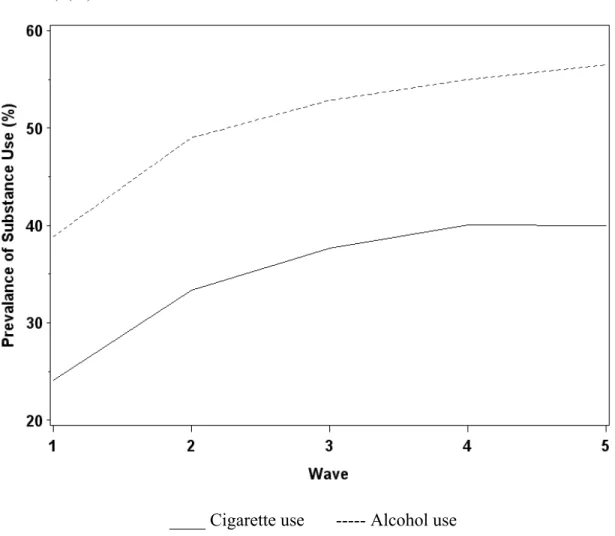
Disengagement in Relation to Cigarette/ Alcohol Use………63 5.1 Sample Characteristics in sixth grade by Ethnic Group………..75 5.2 Proportions of Lifetime Cigarette/Alcohol User, Standard Deviation across Five Time Points……….76 5.3 Means and Standard Deviations for the Predictors and Control Variables of the Whole Sample………...77 5.4 Logistic Regression Predicting Sixth Grade Concurrent Cigarette use……….78 5.5 Logistic Regression Predicting Sixth Grade Concurrent Alcohol use………...79 5.6 Logistic Regression Predicting Eighth Grade Cigarette Use……….80 5.7 Logistic Regression Predicting Eighth Grade Alcohol Use………...81 5.8 Growth Curve Modeling for Cigarette Use from Sixth Grade to Eighth
Grade………..82 5.9 Growth Curve Modeling for Alcohol Use from Sixth Grade to Eighth
Grade………..84 5.10 Logistic Regression Predicting Seventh Grade Cigarette Use Regarding
Risk-group Status………..…86 5.11 Logistic Regression Predicting Seventh Grade Alcohol Use Regarding
Risk-group Status………..87 5.12 Survival Analysis Predicting Cigarette Use Initiation Regarding Risk-
LIST OF FIGURES
Figure5.1 Cigarette Use and Alcohol Use from Sixth Grade (Wave 1) to Eighth
CHAPTER 1 INTRODUCTION
Adolescence is a key life stage for shaping health in adulthood and in later life. A broad view of health held by World Health Organization (WHO, 2006) and scholars (e.g., Call, Riedel, Hein, Mcloyd, Petersen & Kipke, 2002; Hurrelamnn, 1989) regards health as both a personal and a collective variable, and influenced by physical, psychological and social aspects. This view recognizes contributions to adolescent health coming from adolescent behaviors as well as their social experiences. As one has observed, in today’s rapidly changing society, adolescents’ health is constantly shaped by biological, personal, and sociocultural influences. The most significant factors to adolescents’ health are found in their environments, and in the opportunities for health-enhancing or health compromising behaviors that reside in these contexts (Call et al., 2002). As adolescents continuously interact with their environments andwith the people in their daily lives they are exposed to a variety of health risks that are embedded in these social contexts. Health risk refers to any threat to one’s immediate or future health and well-being. It constitutes a broad category that can include both health risk factors (e.g., poverty, social isolation) and health risk behaviors1 (e.g., substance use, violence) (Schulenberg, Maggs, & Hurrelmann, 1997).
of substance use initiation affects later substance use behavior. Smokers who initiate smoking at 12 to 13 years of age reach their peak smoking levels earlier and smoke an average of 11-20 cigarettes per day (Chassin, Presson, Pitts, & Sherman, 2000). Early onset of alcohol use is associated with problematic substance use in later adolescence and an increased likelihood of alcohol-related disorders in adulthood (e.g., Grant & Dawson, 1997; Hawkins, Graham, Maguin, Abbott, Hill, & Catalano, 1997). Initiation of cigarette/alcohol use before age 13 is usually the measure of early onset of cigarette/alcohol use, which roughly corresponds to the transition from elementary school to middle school or the beginning of early adolescence. Extensive studies (e.g., Duncan, S., Duncan T., Biglan, & Ary, 1998; Duncan S., Duncan T., & Strycker, 2006) and national surveys (e.g., National Youth Risk Behavior Survey [YRBS], 2007a, 2007b; Johnston, O'Malley, Bachman, & Schulenberg, 2009) have documented that cigarette and alcohol use increases as grade level increases, yet the synchronization process between these substance use behaviors and the experiences in middle school remains unclear, given that the middle school years signify substantial importance in the course of child/adolescent development as a developmental transition period to early adolescence that provides the opportunity for taking on new roles that can alter developmental trajectories, for better or worse (Schulenberg et al., 1997; Seidman & French, 2004).
from studying identity development also takes a direct-effect approach and views that health risk behaviors and risk-taking behaviors are components of negotiating
developmental transitions (Schulenberg et al., 1997). The present study took an indirect approach, adopting the Stage-environment Fit model to assess the effect of the middle school experience on health risk behaviors during the transition to early adolescence. The Stage-environment Fit model proposed by Eccles and her colleagues (Eccles & Midgley, 1989; Eccles et al., 1993), emphasizes that the mismatch between the developmental needs of early adolescents and perceived middle school contexts creates early adolescents’ adjustment difficulties. Developmentally appropriate school contexts, that provide opportunities that are sensitive to the developmental tasks, are crucial for positive adaptation and development. From the Stage-environment Fit stand point, the middle school environment fails to support adolescent developmental needs; to some degree, it even undermines positive adjustment (Eccles et al., 1993; Eccles, Flanagan, Lord, Midgley, Roeser & Yee, 1996).
Creed & McGregor, 2006; Schmakel, 2008). Evidently, educational studies suggest that lack of school connection and school disengagement are at least partly responsible for declines in academic-related outcome (Juvonen, 2006).
Moreover, findings from substance use research have linked lack of school connectedness with increase in substance use (Battistich & Hom, 1997; Catalan et al., 2004; McNeely & Falci, 2004; Wang, Matthew, Bellamy & James, 2005; Yan, Beck, Howard, Shattuck, & Kerr, 2008). School disengagement behavior is a reliable predictor of substance use (Bryant, Schulenberg, Bachman, O’Malley, & Johnston, 2000; Bryant & Zimmerman, 2002; Bryant, Schulenberg, O’Malley, Bachman & Johnston, 2003). What is missing in extant studies is an assessment of the linkage between the middle school experience and adjustment (as signified by school connectedness and disengagement) and substance use concurrently and longitudinally. Investigation of the effect of the middle school adjustment in relation to substance use extends the application of the Stage-environment Fit model from mainly educational adjustments to health outcomes.
Furthermore, in order to achieve a thorough understanding of proximal environmental risks presented in adolescent world during middle school, aside from examining adolescent experience in school contexts, adolescent family and peer contexts need to be taken into consideration. Drawing from Bronfenbrenner’s ecological
Herman, Phillips, & Settersten, 2002).
As adolescents transform physically and psychologically, the adolescents’ families undergo transformation during adolescence as well. Family relationships, parenting style and practice are the significant influence that might enhance adolescent health and psychological adjustment (Galambos & Ehrenberg, 1997). In particular, the negative parent-child relationship, authoritarian parenting style and high level of family conflict are some of the risk factors that can exacerbate adolescents’ risks of engaging substance use. Early adolescents exhibit tenuous resistance to peer influence (Steinberg & Monahan, 2007). Examination of peer contexts suggests the connection between the structural aspects of peer network and adolescent substance use (Ennett et al., 2006). In particular when adolescents affiliate with peers from out-of-school social networks or have no friends, they are at higher odds of using substances.(Ennett et al., 2006).
Given the knowledge about the relevant risks in school, family and peer contexts, the multiple-risk approach was used to summarize the risk factors in each of the contexts. Methodologically, it provides a viable summary of background information. Conceptually, this method is congruent with the ecological view about environmental influences in the sense that it helps evaluate joint influence of these contexts on adolescent substance use as well (Sameroff & Fiese, 2000). Application of the multiple-risk approach achieved
methodological simplicity and efficiency to investigate risk factors that are salient to the middle school period by moving beyond the influence of well-known risk factors in family and peer contexts.
investigate the effect of middle school adjustment, this study employed the multiple-risk model to assess early adolescents’ substance initiation with respect to their exposure to risks that are salient to the middle school period and present in their proximal social contexts. Cigarette use and alcohol use are the focus of substance use behavior in this study.
Study Purpose and Research Questions
The purpose of this study was to examine to what extent adjustment, measured by school connectedness and school disengagement, during the first-year of middle school (i.e., sixth grade), and overall middle school adjustment, were associated with cigarette/alcohol use at the end of middle school (i.e., eighth grade). This study was conducted in two steps. First, it examined the extent to which adjustment in middle school associated with cigarette and alcohol use concurrently and longitudinally for individual adolescents; then it explored the extent to which high risk of problematic adjustment in middle school associated with cigarette and alcohol use longitudinally with regard to risk-group membership that are classified based on their experiences in social contexts (i.e., school, family and peer).
This study specifically addressed the following research questions: (1) does middle school adjustment at the transition year (i.e., sixth grade), indicated by school connectedness and school disengagement, associate with cigarette and alcohol use concurrently? (2) Does middle school adjustment in the first year of middle school, indicated by school
CHAPTER 2 THEORETICAL FRAMWORK
Across the middle school years children transform from child into early adolescence. The middle school period is a developmental transition period that signifies substantial importance in the course of child/adolescent development in that it serve as a turning point that can alter developmental trajectories, for better or worse (Schulenberg et al., 1997; Seidman & French, 2004).
This chapter examines the complexity of the middle school experience and
adjustment and early adolescents’ substance use behaviors. The organization of the chapter is as follows. First, the developmental significance of the middle school period is presented. Then the link between middle school adjustments and substance use is discussed. Finally, experiences with family and peer groups as part of the broad middle school adjustments are considered in relation to substance use in early adolescence.
Middle School and Experiences in School Context
From a developmental perspective, middle school is a major developmental transition period as children are transforming into early adolescents. Like other developmental
Throughout the course of child/adolescent development, developmental process is characterized by quantitative and qualitative changes (Piaget, 1983). Quantitative changes manifest as gradual, moment-to-moment changes, taking place in various domains
simultaneously. When accumulating over time, they trigger qualitative change, which in turn lead to further changes. “Stage” has been used to describe qualitative changes in structure over a long period time, such as changes observed in biological, cognitive, self and identity process (see Erikson, 1968; Piaget, 1983).
developmental standpoint, middle school can serve as a proxy marker of transition to early adolescence in the process of individual development.
Entry to Middle School as an Embedded Ecological Transition
As the underlying biological blueprint unfolds, young people undergo ecological transition as well when they enter into middle school. According to Bronfenbrenner (1979, p. 26), ecological transition “occurs whenever a person’s position in the ecological environment is altered as a result of a change in role, setting, or both.” Seidman shares a similar view, describing ecological transition as a disturbance in one or more aspects of the constancy of relations or transactions between an individual and one or more dimensions of the context (Seidman, 1988). Ecological transition is often characterized as abrupt and discontinuous due to a change in role, setting, or both, in contrast, most individual developmental transitions are more gradual (Seidman & French, 2004). Middle school reflects the characteristics of
ecological transition. Compared with elementary school, middle school environment may seem chaotic. Students switch classrooms, teachers and classmates multiple times a day, making it hard to develop supportive contact between teachers and students (Lynch & Cicchetti, 1997; Reddy, Rhodes, & Mulhall, 2003). Accordingly, the small learning
community feeling of elementary school might be lost. In addition, students are confronted with dramatically different social contexts in middle school, which each context has its own norms, expectations, behavioral and social regularities that define the role of student
as well (Eccles et al., 1993; Lynch & Cicchetti, 1997; Reddy et al., 2003; Seidman, Allen, Aber, Mitchell, & Feinman, 1994). Self-consciousness invokes concerns of peer acceptance and peer status, and the norm of engaging in continuously social comparisons among adolescents can be quite destructive (Cillessen & Mayeus, 2007; Kiefer & Ryan, 2008; Rubin, Bukowski & Parker, 1998).
In short, discontinuity in social settings and change in roles in middle school may bring about adjustment difficulties to some early adolescents (e.g., Erath, Flanagan, & Bierman, 2008; Kiefer & Ryan, 2008; Wentzel, Barry, & Caldwell, 2004). Entry to middle school is embedded within individual development, and characterized as ecological
transition. It represents a turning point that provides an opportunity for growth and positive development, thus may also present risks for individuals with dramatic discontinuities in their roles and settings (Roser & Eccles, 1998; Seidman & French, 2004).
The Intersection of School Ecologies and Individual Development and Its Implication in Adolescent Adjustment and Health
vulnerability and difficulties, which may lead to engage in health-compromising behaviors (Schulenberg et al., 1997).
Therefore, the significance of the middle school period lies in its distinctive situation as being a developmental transition period with an embedded ecological transition. The confluence of individual development changes and social context generates a unique opportunity for understanding health risks and health-enhancing possibilities that are associated with adjustments present at the transition year and subsequent middle school years. It further provides an occasion for positive and constructive, versus negative and destructive growth, maturation and development.
Theoretical Views on the Link between the Experiences in the Developmental Transition of Middle School and Health Risks
The timing and patterns of developmental transitions associated with the
transformation from childhood to adulthood have become more diverse and thus less certain (Crockett, 1997; Shanahan, 2000). Experiences and adjustments brought by such
suggested that concurrent timing of the middle/junior high school transition and pubertal development accounted for declines in academic-related measures and self-esteem observed in the group who were in K-6 system. This Cumulative-stress model takes a direct-effect approach, emphasizing that the number of transitions may influence health risks
(Schulenberg et al., 1997). To counterbalance the multiple-transition effects, the coping capacity of early adolescents must increase.
A different model views that health risk behaviors and risk-taking behaviors are components of negotiating developmental transitions (Schulenberg et al., 1997). This perspective originates from studying identity development. The adolescent years are a time of exciting explorations in identity and looking for answer of “who I am”. Experimenting and exploring alternative identities may involve certain risk taking. Erik Erikson’s (1963, p.11) notion of the adolescent “craving for locomotion” constitutes a form of excessive
experimentation, of testing the limits of one’s self, of exploring its multiple possibilities. Failing to explore options may lead to premature identity foreclosure (Erikson, 1968). It seems that the risk-taking identity model suggests a causal link between identity exploration during the developmental transition and risk-taking behaviors. Potential adverse
consequences of curbing risk-taking behaviors lie in to what extent risk-taking plays a critical role in the formation of identity. This model also takes a direct-effect approach addressing the impact of middle school experiences on health risks. It is limited, however, in offering an understanding of how the middle school years can be indirectly related to health
opportunities.
results partly from the relation between the developmental needs of adolescents and the social contexts in which they live. Developmentally appropriate school contexts, that provide opportunities that are sensitive to the developmental tasks, are crucial for positive adaptation and development. This model gives central status to person-environment interaction,
highlighting that individuals shape their own development as their physical and psychological selves act on and are acted upon the social physical environment
(Brofenbrenner, 1979, 1993). It is essential to recognize that the mismatch between the individual’s developmental needs and what is afforded by the context may serve to aversely affect youth’s health. The model was tested in the Michigan Study of Adolescent Life Transition (see Eccles et al., 1993). The early adolescents in this study expressed a great desire to exercise their growing cognitive abilities and burgeoning skills, however, this desire to learn was often shattered by large amount of class-work requiring only lower level
cognitive skills in middle school classrooms. The mismatch between the students' needs and the teachers’ practices played a significant role in undermining adolescents' school-related interest and motivation (Eccles et al., 1993; Eccles et al., 1996).
and autonomy. The extent to which these needs are met in any specific contexts, such as the school or the family, will determine the individual’s engagement in that context. Empirical studies on school connectedness (or school social climate, school belonging) have focused on adolescents’ perceptions of multiple dimensions of school context including school social climate, teacher-student relations and teacher support, and the effect of school connection on adaptive schooling adjustment (Juvonen, 2006). And the findings have tied feelings of connectedness/belonging to academic and behavioral outcomes, including academic
achievement, school engagement, self-efficacy, task goal orientation and problem behaviors (e.g., Anderman, 2003; Battistich, Solomon, Kim & Watson, 1995; Eccles, Early Fraser, Belansky & McCarthy, 1997; Faircloth & Hamm, 2005; Furrer & Skinner, 2003; Way, Reddy & Rhodes, 2007). The gist of the inquiry places emphasis on the importance of supportive and communal school environment (Juvonen, 2006, 2007). Yet conversely, what early adolescents often experienced in school after advancing to middle school is a less personal, more anonymous and departmentalized environment that fails to support developmental needs (Eccles et al., 1993; Eccles et al., 1996). Consequently, students’ feelings of being connected with school plummet as the middle school years go on and the developmental transition process proceeds (Anderman, 2003; Eccles et al., 1993; Eccles et al., 1996; Way, Reddy & Rhodes, 2007). Taken together, it becomes evident that early adolescents’ perception of school connectedness can serve as a valid indication of their experiences and adjustments in school to indicate the fit between perceived school contexts and their developmental needs.
clearly show that school context (e.g., teachers and teacher behaviors) has an influence on students’ perception, which in turn can affect their school engagement and academic
achievement (Schunk & Meece, 1992), and self-report of students’ perception is predictive of their academic performance (Assor & Connell, 1992). It lends support that the adolescents’ perceptions or experiences of the classroom/school environment rather than a more objective account of the school is most relevant for understanding adolescents’ adjustment (Connell, 1990; Connell & Wellborn,1991).
Finally, substantial declines have been documented in academic motivation and interest across adolescence (e.g., Barber & Olsen, 2004; Dotterer, McHale & Crouter, 2009). Such decline in academic interest was often accompanied with school disengagement as indicted by decline in GPA in early adolescence (Dotterer et al., 2009). The
behaviorally, they become less engaged in school work. What remains less clear is whether or not these difficult developmental adjustments (i.e., lack of school connectedness and school disengagement) in middle school are related to health risks as the young people advance through the middle school years after the transition year has occurred.
In sum, the Stage-environment Fit model integrates theory about individual psychological development with lived experience in key social/institutional setting like school. It delineates one avenue of indirect effects between the developmental transition — the middle school period and health risks, highlighting two possible directions of health development. One is to provide opportunities to enhance health by matching developmental needs or appropriating challenges for the young person to develop health enhancing
behaviors, the other is to minimize the match thus aversely affect health (Schulenberg et al., 1997). It underscores the indirect path among the developing adolescent, the developmental transition and health risks, and can account for health opportunities as well as health risks. As Bronfenbrenner and Crouter (1983) argue, an analysis of the mesosystem, which includes the interacting processes that involve two or more settings containing the developing adolescent, enables researchers to conceive a comprehensive picture about behavior changes as a
individual. Guided by this line of thinking, one can identify features of contexts that allow for healthy choices or (mis)match adolescents’ developmental needs with challenges and encouragement in school contexts.
Family and Peer Contexts during the Middle School Years
In the area of substance research, the influence of family and peer contexts on adolescent substance use are two vital components. Bronfenbrenner’s ecological model is relevant in addressing the importance of taking these two contexts into consideration, in addition to the school context, during the middle school years. From an ecological point of view,individual behavior and development are regarded as processes that are inextricably embedded in multiple interrelated social contexts (Bronfenbrenner, 1979). There are four types of embedded contexts affecting development: microsystems, mesosystems, exosystems and macrosystems (Bronfenbrenner, 1979). The microsystems are proximal contexts,
participation in positive interactions with their environment.Directing attention to multiple contexts allows for detecting both additive and interactive effects of influences radiating from school, family and peer.Moreover, inBronfenbrenner’s (1979) ecological typology a mesosystem is the next higher nested structure, involving the linkages and processes taking place among the microsystems that contains the developing adolescent. The implication for research using ecological paradigm is that adolescents’ social contexts may be correlated through both proximal environmental influences and the adolescent who resides in these contexts (Wachs, 2000). As Cook and his colleagues argue (Cook, 2003; Cook et al., 2002) ignorance of such correlation may lead to overestimate the effect of the single measured context.
Similarly, according to the Developmental Science framework, Cairns and his colleagues (Cairns, Gariepy, & Hood, 1990; Mangusson & Cairns, 1996) conceptualize that development proceeds as an integrated system. The development system consists of
correlated constraints that are associations between social, environmental and biological force determining individual behavior. These constraints promote stability in development within the system and tend to co-vary, thus the impact of risk factors will be strengthened by the cumulative influences of correlated factors (Farmer, Quinn, Hussey & Holahan, 2001; Wachs, 2000). To lessen the effects of correlated risks and reestablish adaptive behavioral patterns, it is critical to address relevant factors in correlated sub-systems simultaneously (Wachs, 2000). There are ample evidence documenting a variety of risks posed by adolescent family and peer contexts on adolescent substance use (Avenevoli & Merikangas, 2003; Kobus, 2003), the view of correlated constraints suggests that, along with school
thorough understanding of the association betweenthe middle school adjustment and adolescent substance.
Therefore, within Bronfenbrenner’s ecological paradigm, one can expect that during the middle school years, adolescents’ school, family and peers work collectively and exert a joint influence on the development of adolescents at a given developmental period. They may present positive factors to facilitate the developmental transition and adaptive development, or impose negative factors to impede the transition and development. Depending upon how the developing adolescent acts on and is acted upon by the social contexts, the joint
contextual influence may well extend beyond the transition year. Wachs’ (2000)
comprehensive review articulates that no single factor is sufficient to explain developmental outcomes and only the study designed to assess biological, psychological, and social
influences produces sufficient explanatory power. By identifying and addressing risks in school, family and peer contexts the proposed investigation are inherently grounded regarding theoretical conceptualization and methodological concern.
Approach to Assess Multiple Contexts
Methodologically, to investigate multiple contexts simultaneously presents daunting challenges to researchers (Cook, 2003). The multiple-risk model, which is widely applied in risk research, appears to be an effective and parsimonious approach (Gutman, Sameroff, & Cole, 2003; Sameroff, Seifer, Baldwin, & Baldwin, 1993). This model intends to examine the effects of the environmental adversity across nested environmental systems within the
views the factors that produce maladaptive variations and the factors that produce adaptive behaviors in development are no different in kind; both of them are represented in the lives of the well developed and the poorly developed (Sameroff, 2000). Identifying risk factors is to evaluate their probability of leading to certain undesirable behaviors; such process can lead to a selection of a population in need for intervention treatment (Sameroff, 2000).
This model also assumes that joint influence of the multiple contexts is additive (Cook et al., 2002). Observation is made that proximal environmental influences in multiple contexts have a tendency to co-vary (Wachs, 2000), and risk factors are more likely to cluster in the same individuals (Sameroff et al., 1993; Sameroff & Fiese, 2000). Accordingly risk factors become cumulative in the sense that the presence of clustered risk factors is more likely to be linked to negative outcomes (Gutman et al., 2003). The assertion that it is the number of risk factors in the child’s life that lead to negative outcomes rather than a single factor, has won support from risk research literature (e.g., Kraemer, Kazdin, Offord & Kupfer, 2001; Rutter, 1979; Sameroff, 2000; Sameroff & Fiese, 2000; Sameroff & Gutman, 2004; ). The Philadelphia Family Management Study conducted by Furstenberg and his colleagues (Furstenberg, Cook, Eccles, Elder, & Sameroff, 1999) serves as a good example of using the multiple-risk model to assess the effects of multiple environmental risks on adolescent development. The results showed that the relative risk in the high-risk group for negative outcomes (e.g., psychological adjustment, problem behaviors and academic
performance) was substantially higher than in the low-risk groups (Furstenberg et al., 1999). Applying the multiple-risk model to investigate the effects of multiple contexts on substance use presents not only conceptual consistency but also methodological simplicity. The
ecological framework (Sameroff & Fiese, 2000), which is coherent in the overarching ecological framework applied in the present study. Methodologically, the current
investigation is interested in the risks to which early adolescents are exposed across contexts during the middle school years. If using a single indicator to represent each risk factor, a large number of predictors in regression analysis would be required, which in turn, require a large sample size to ensure statistical power in analysis (Howell, 2002). The multiple-risk score is used as a single variable and offers a good summary of background variables without sacrificing power (Gutman et al., 2003).
To achieve the purpose of a single multiple-risk indicator, the common practice is to dichotomize the continuous scores on each adversity condition into two groups to represent the presence (1) or absence (0) of risk and then add all dichotomized scores (Sameroff et al., 1993). For example, if a student was assigned 1 to two out of three family risk factors and 0 to the remaining family factor, then this student’s risk score is 2. By adopting the multiple-risk model, one can capture developmental vulnerability experienced during the middle school years. Early adolescents can be classified into high- and low-risk groups based on their risk scores. Accordingly, the developmental trajectories of two risk groups can be depicted with respect to substance use.
School Experiences during the Middle School Years
School Experiences and Perceived School Contexts Identified by Educational Studies
school-related academic achievement, motivation and self-esteem. Eccles and her colleagues (e.g., Eccles et al., 1993; Eccles, Lord, Roeser, Barber, & Jozefowicz, 1997) explored the effect of first-year middle school experience and revealed that students’ negative perceptions of the middle school environment had a profound influence on students in the first year, for instance, declines in academic motivation/interest and self-esteem (Eccles et al., 1993; Eccles et al., 1996; Eccles, Lord et al., 1997; Roeser, Eccles, & Freedman-Doan, 1999; Roeser, Eccles, & Sameroff, 1998, 2000). These negative perceptions resulted from school context and practice, including school climate, teacher-student relationship, teacher support, and classroom decision-making. They manifested in students’ adjustment of feeling not to be part of school, showing less academic interest and less engaging in schoolwork (Eccles et al., 1996). Barber and Olsen (2004) also tested the linkages between perceived school
environment and student functioning in the transition year. Overall, their finding indicated perceived change in support from teachers significantly predicted a change in a range of outcome variables including self-esteem and depression. In addition to the transition research on school contexts, Roeser and his collaborators (Roeser & Eccles, 1998; Roeser et al., 1998) labored to examine middle school adjustment and experiences beyond the transition year, they reported that students’ perceptions of positive teacher regard and support, comprised of school connectedness research interests, were associated with increases in self-esteem, school motivation and achievement, and inversely related to school truancy in the middle school years.
of middle school or junior high school were more likely to report lower self-esteem and higher depression when assessed in 10th and 12th grades (e.g., Eccles, Lord et al., 1997; Roeser et al., 1998, 1999, 2000). In the classic Milwaukee study by Simmons and Blyth (1987), students whose self-esteem and GPA declined between the sixth- and seventh-grade transitions tended to experience further declines by the time they reached 10th grade.
Seidman and French (2004) have investigated subgroups of adolescents who showed unique configurations of psychosocial functioning and middle school adjustment, and revealed seven trajectories of self-esteem concerning different adaptive behavioral patterns at the transition and beyond. Members of “transition vulnerable” trajectories (“bounce back” and “immediate decline” trajectories) suffered increased stress not only in school but also in their family across the transition year. Five years later, they continued to report lower levels of self-esteem and an increasing engagement in more serious delinquent behaviors.
These studies explored short- and long-term relations among perceived school context changes, the middle school adjustment and school-related outcomes, with a strong focus on self-issues. Yet students’ sense of being connected with school and school disengagement over the middle school years—important indicators of middle school developmental
adjustment—have not been fully examined in relation to its long-term effect on adolescents’ middle school adaptation, especially on health outcomes, even though their short-term effects on academic-related outcomes has been documented (Eccles et al., 1993). Some students may or may not immediately experience loss of belongingness in the first year of middle school, there is evidence indicating substantial decline among students in perceived school
2004; Hamm & Faircloth, 2005). Even after these students moved to eighth grade, they did not perceive much of positive changes in terms of school environment, and their academic performance and participation in school activities were not improved significantly (Barber & Olsen, 2004). Juvonen (2006) concludes that school environment characterized by alienated interpersonal relationship and lack of support do not motivate students to engage in school work, conversely it may increase educational risks. It becomes clear that, of the middle school adjustments and experiences, early adolescent sense of school connectedness and school engagement behaviors can either become protective factors that promote resiliency or serve as risk factors that increase individual vulnerabilities during the middle school years. Subsequently maladaptive adjustments can be exacerbated to lead to negative outcomes later in adolescence (Eccles et al., 1996). There is still much to be learned about the interplay among perceived school contexts in middle school, the middle school adjustment
(characterized by school connectedness and school disengagement behavior) and health risks. Examination of substance use literature on perceived school contexts provides further
guidance to clarify the linkage between the middle school adjustment and early adolescent substance involvement.
Effects of School Experiences Identified by Substance Use Studies
Investigation of developmental trajectories of substance use in adolescence reveals that the middle school period is critical in the development of substance use. Research demonstrated that a group of rapid-escalating smokers showed first escalation in middle school years around age 13 (Stanton, Flay, Colder, & Mehta, 2004), while a subgroup of early adolescents with low level of initial alcohol use in sixth grade exhibited a linear
research indicates there has been little work aimed at the influence of the middle school adjustment on substance use behaviors. A recent study by Estell and his collaborators (Estell, Farmer, Irvin, Thompson, Hutchins & McDonough, 2007) disclosed the linkage between middle school adjustments and substance use in the first year of high school. Not
surprisingly, the students with positive adjustment patterns during middle school years had lower substance rates of substance use and better grades in the first year of high school, compared to students who had negative middle school experience. Yet the results were limited by the fact that the study did not report whether or not these students had used substance at any time of the middle school years, making it impossible to comprehend substance use patterns in middle school.
alcohol misuse in 12th grade. The same held true for smoking initiation. Students who were more attached to school in fifth and sixth grade were less likely to initiate smoking by seventh grade.
Consistent with the previous studies, more recent cross-sectional studies found that being connected to school was negatively associated with substance use (e.g., cigarette and alcohol) across ethnic groups such as African American, Asian, or Latino (Wang et al., 2005; Yan et al., 2008). Furthermore, analysis of the National Longitudinal Study of Adolescent Health (Add Health), a national representative sample, displays a similar trend. Drawing two-wave data from Add Health, McNeely and Falci (2004) demonstrated that adolescents who perceived high social support (e.g., teachers caring about them) were less likely to initiate smoking or drinking.
Moreover, early adolescents who experienced decreased self-esteem, academic motivation and interest as a result of perceived negative school environment during the developmental transition may also experience negative changes in school engagement and values that are linked to motivation and self-esteem (Eccles et al., 1993; Eccles, Lord et al., 1997; Zimmer-Gembeck et al., 2006). When students are not behaviorally or
They areaccordedwith earlier studies (e.g., Hawkins, Catalano, & Miller, 1992; Petraitis, Flay, & Miller, 1995), suggesting that negative school experiences and school disengagement behaviors are risk factors for substance use.
Findings from the aforementioned studies are explicit that in schools in which students have a strong sense of community, are more strongly bonded to the school, and are engaged in school, they are less likely to engage in risky behaviors. These studies corroborate Hirsch’s (1969) proposition that weak attachments with conventional institutions are an important cause of delinquent behavior among youth. Further, loss of sense of community is heightened during middle school (Seidman & French, 1997). Taken the evidence together, what empirical evidence there is of links between negative experiences and adjustment in the school social contexts (reflected by lack of school connectedness and school disengagement) and higher odds in substance use align with the theoretical expectations proposed by the Stage-environment Fit model. For the study of interest, the question becomes the extent to which lack of school connectedness and school disengagement is accompanied by substance involvement concurrently in the first year of middle school, and longitudinally over the middle school years.
In sum, the unique risk to early adolescents in middle school is likely not only a function of non-supportive school structures but also the confluence of developmental changes occurring in students of this age. Research suggests that entry to middle school marks the beginning of a downward spiral for some early adolescents over the course of middle school, a marked decline in some early adolescents' school grades, intrinsic
although these changes are not extreme for most adolescents. Such a dynamic may extend to health outcomes, as some youth might engage in health comprising behavior as their means of renegotiating to their new environment. This underscores the significance of a caring, supportive school context to adolescent health and well-being. The extent to which the youth respond and adjust to the middle school context contributes to their academic achievement and health (e.g., Roeser et al., 1998, 1999). Empirical findings in substance use literature have noted that adolescents’ sense of school connectedness and school disengagement is predictive of substance use (e.g., Battistich & Hom, 1997; Bryant et al., 2000, 2003; Bryant & Zimmerman, 2002; McNeely & Falci, 2004). Altogether, the evidence strongly suggests that school connectedness and disengagement in school over the course of the middle school years may be associated with engagement in substance use. Given that YRBS (2007a, 2007b) estimates that for every one hundred early adolescents before age 13, almost 14 of them have starting smoking and 24 of them have starting drinking, it is worthy effort to investigate (1) if the first year adjustment of middle school had any influence on cigarette and alcohol use concurrently and longitudinally; (2) whether or not the overall middle school adjustment had any associations with cigarette and alcohol use throughout middle school. By clarifying linkages between the middle school adjustments and middle school substance use, and tracking substance involvement through the middle school years, it is also possible to develop intervention program that is responsive to the distinct needs of students with different patterns of adaptation.
In the previous sections, school experiences and perceived school contexts are examined to identify risk factors that are salient to positive development during middle school. Among a variety of risks, lack of school connectedness and school disengagement that characterize negative adjustment are recognized. Compared with perceived school contexts, research on family and peer contexts are strongly developed (see reviews
Avenevoli & Merikangas, 2003; Kobus, 2003). There is a range of known family and peer factors exerting influences on adolescent substance use such as parent/peer substance use behaviors, parenting practice or peer influence (e.g., Avenevoli & Merikangas, 2003; Bauman, Faris, Ennett, Hussong & Foshee, 2007; Ennett & Bauman, 1993; Ennett et al., 2006; Ennett, Faris, et al., 2008). However it is little known the role of family or peer contexts during the developmental transition of middle school in relation to adolescent substance use. In the following sections issues related to family and peers that may present unique challenges during this period are explored. The risks related to family will be discussed first, then proceeds the risks related to peer groups.
Family and parental influence on adolescents’ substance use are investigated under two lines of research: genetic epidemiological studies and social risk-factor research. The former identifies the role of genetic and environmental factors and their interaction in the etiology of diseases or traits, while the latter emphasizes environmental influence (Avenevoli & Merikangas, 2003). The literature relevant to the current study lies in social risk-factor research. This line of inquiry on cigarette and alcohol use has identified parental behaviors in several domains that are related to adolescents’ use of cigarette and alcohol. Parents'
parenting practice has been linked to increases in adolescent use. This broad category includes parental warmth (Hops, Davis, & Lewin, 1999; Nash, McQueen, & Bray, 2005; White, Johnson, & Buyske, 2000), autonomy granting (Herman, Dornbusch, Herron & Herting, 1997), monitoring (Ary et al., 1999; Connell, Dishion & Deater-Deckard, 2006), and engagement/involvement (Simons-Morton and Chen, 2005), and parent-child conflict (Ary et al., 1999). Yet family environment and parenting at the middle school period is still an uncommon object of study with regard to substance involvement.
While early adolescents are experiencing school changes as transiting to middle school, their family environment is undergoing transformation. Family relationships and parenting styles and practices are among the most significant influences that might enhance the adolescent’s health and well-being (Galambos & Ehrenberg, 1997). During early
and Eccles (2007) documented that negative interaction with parents in seventh grade was associated with depression and low self-esteem 5 years later when these young people were at 11th grade. In addition to parenting practice, adolescents’ conflict with parents is
heightened (Smetana, 1989; Steinberg, 1990; Steinberg, Elmen, & Mounts, 1989). High levels of parent-adolescent conflict are linked to increase levels of problem behavior, substance use, and school failure (Galambos & Ehrenberg, 1997).Yet a low-hassle and high-support family environment helped early adolescents to better prepare for class across the school transition (Seidman, Lambert, Allen, & Aber, 2003).
Clearly, the transformation of adolescents and their family during middle school has explicit implication for understanding adolescents’ substance use behaviors. Evidence from substance use and education literature, suggests certain characteristics of adolescents’ family environment in the developmental transition intensify the odds that adolescents will initiate health compromising behaviors. In particular, the negative parent-child relationship,
authoritarian parenting style and high level of family conflict are the candidates of risk factors that can exacerbate adolescents’ odds of engaging substance use in the course of
middle school, given their impact on constructing a positive, supporting family environment.
Risk Factors in Peer Context
often for support and guidance (Berndt, 1979; Steinberg & Monahan, 2007). Literature indicates that peer influence is a significant predictor of adolescent smoking (e.g., Conrad, Flay, & Hill, 1992; Ennett & Bauman, 1993; Hoffman, Sussman, Unger & Valente, 2006; Kobus, 2003; Tyas & Pederson, 1998), and document that adolescent friends share
similarities in their drinking behaviors (e.g., Dishion, Capaldi, Spracklen, & Li, 1995; Duncan, Duncan, Strycker, 2006; Hamm, 2000). Finally, the opportunities to engage in such behaviors increase as parents reduce their monitoring and adolescents spend less time at home (Windle et al., 2008).
associated with substance use. Pearson and Michell (2000) recognized that adolescents who were most peripheral in the network tended to smoke, although this finding is not replicated in Ennett et al. (2006). In comprehensive studies of peer social network features and
substance use, Ennett and her colleagues (e.g., Ennett et al., 2006; Ennett, Foshee, et al., 2008) revealed when adolescents oriented away from their school networks and nominated more friends from out-of-school networks than from school networks, they were more likely to use illicit substances. When they were isolated from the social network system, they had higher odds to report recent smoking. This out-of-school-network nomination was the most consistent predictor in the study, especially for early adolescents (i.e., ages 11 – 13).
Evidently, adolescents whose social network affiliations are characterized by such aspects are exposed to greater risks than their counterparts whose peer group is not.
As early adolescents affiliate with certain peer groups, their resistance to peer influence is especially tenuous (Steinberg & Monahan, 2007). The connection between the structural aspects of peer groups and adolescents’ substance use behaviors implies the greater vulnerability of and inclination to substance use when an individual is exposed to certain social networks. Such vulnerability might be amplified by negative middle school adjustment experience. Inclusion of characteristics of peer context in the multiple-risk model such as peer orientation toward out-of-school network or the number of friends brings necessary attention to risk factors in early adolescents’ social world.
along with the impersonal middle school environment, may pose immediate challenges for early adolescents’ successful adaptation to middle school years. Application of the multiple-risk model to examine the multiple-risk factors in family, peer and school contexts make it possible to study multiple contexts simultaneously. With a summary set of risk factors, subgroups of adolescents can be classified (e.g., high risk group vs. low risk group) and their unique developmental trajectories of substance use can be explored. This approach provides a means to directly assess multiple risks in a parsimonious way. It also helps to answer the question of whether or not students who experienced more risks had a higher propensity of engaging substance use, and elucidate if the occurrence of substance involvement was a function of the number of risk factors experienced at the beginning of middle school. Such approach is relevant to both empirical understanding of early adolescent substance use during the developmental transition period and to the design of effective intervention, as it takes the variability of developmental pathways as a function of the youth’s social contexts into consideration. Thus, for clarity in the examination on the relation between the risks at the beginning of middle school and adolescents’ substance use behaviors, it is necessary to investigate the probability of engaging in substance use by risk-group status among
adolescents who had not used substance in sixth grade. Whether or not the risk-group status is associated with occurrence of substance involvement over time will be explored as well.
Summary
transition. The confluence of individual development changes and school social context generates developmental difficulties for some early adolescents. As an alternative means of negotiating new environment, the propensity of engaging in substance use might be
increased. In addition to individual characteristics, school context, family environment and peer networks are key factors that affect adolescents’ substance use. Each of these contexts is undergoing transformation at the middle school period, posing unique challenges for early adolescents’ successful adaptation. Adjustments to these contexts comprise the middle school life experience of early adolescents. Compared to the knowledge about how the middle school transition affects academic functioning concurrently and longitudinally, however, there is less known about the implications of the middle school years as a whole on substance use. It is critical for research to examine how adolescents’ middle school
adjustments and experiences, as a result of joint effects of school, family and peers, influence substance use in middle school years3.
3 Although racial/ethnic differences are observed in a variety of substance use indicators in some national
CHAPTER 3 STUDY QUESTIONS
Study Purpose
The purpose of the study was to examine to what extent adjustment, measured by school connectedness and school disengagement, during the first-year of middle school (i.e., sixth grade), and overall middle school adjustment, are associated with cigarette/alcohol use at the end of middle school (i.e., eighth grade). In particular, the study examined:
a. the extent to which adjustment in middle school associated with cigarette and alcohol use concurrently and longitudinally for individual adolescents;
b. the extent to which high risk of problematic adjustment in middle school associated with cigarette and alcohol use longitudinally with regard to risk groups that are classified based on social contexts. It attempted to investigate risk factors that are salient to the middle school period by moving beyond the influence of well-known risk factors in family and peer contexts.
Research Questions and Hypotheses
To achieve the study purpose, the following research questions are specifically
addressed.
Does middle school adjustment at the transition year (i.e., sixth grade), indicated by school connectedness and school disengagement, associate with cigarette and alcohol use concurrently?
Eccles et al. (1993, 1996) reported that perceived negative perceptions of school context were linked to declined self-esteem and academic functioning. It was posited that similar effect may be observed in relation to cigarette and alcohol use in the first year of middle school.
Hypothesis one. Cigarette and alcohol use will concurrently positively associate with negative school adjustment, indicated by lack of school connectedness and school
disengagement during the transition year (i.e., sixth grade), after controlling for demographic variables and parental and peer influence on substance use.
In addition to controlling for demographic background, parent education was
controlled as a proxy indicator of socioeconomic status. Also research data suggest that youth living in one-parent households are at significantly greater risk for alcohol, tobacco, and drug use ((Blum et al., 2000; Barrett, & Turner, 2006; Oman, Vesely, Tolma & Aspy, 2007). Therefore family structure was included in control variables to partial out its potential influence on adolescent substance use behaviors. Parent education and family structure are routinely controlled in the studies used the same master data set (e.g., Ennett et al., 2006; Ennett, Foshee et al., 2008).
Research Question Two
A body of research (e.g., Eccles, Lord et al., 1997; Seidman & French, 2004) demonstrates that the long lasting negative effect of the middle school adjustments and experiences extended to high school years. Some of negative outcomes include, not limited to, school failure, antisocial peer orientation, and delinquent behaviors. Estell et al. (2007) found negative middle school adjustment was associated with increase in substance use in high school. It was expected to observe a similar tendency that the negative middle school adjustments would lead to a positive association with substance use at the end of eighth grade.
Hypothesis two. Cigarette and alcohol use at the end of eighth grade will positively associate with negative school adjustment in sixth grade (indicated by lack of school connectedness and school disengagement) after controlling for demographic variables and parental and peer influence on substance use.
Research Question Three
How do the trajectories of cigarette and alcohol use develop over time from the first year of middle school (sixth grade) to the end of eighth grade with respect to sense of school belonging and disengagement across the middle school years?
adaptation was taken into consideration by modeling the middle school adjustment as time-variant variables in growth curve analysis. It was expected that sense of school
connectedness and school disengagement would predict the developmental trajectories of cigarette/alcohol involvement from sixth grade to eighth grade.
Hypothesis three. Students who felt less connected with school or less engaged in schoolwork throughout the middle school years will be on average more likely to be involved in substance use over the course of middle school.
Research Question Four
What is the probability of transitioning from non-substance user to substance user from sixth grade to the end of seventh grade with regard to risk-group status?
This investigation examined the likelihood of evolving into a substance user when adolescents had exposed to multiple risks in school, family and peer contexts at the beginning of middle school, comparing with those who had fewer risks. Previous studies demonstrate that early adolescents who felt most challenged and encountered more adjustment issues in the first year of middle school were often those who experienced academic struggling, behavior problems or family hassles in one or more domains at the same time (e.g., Estell et al., 2007; Roeser et al., 1998, 1999, 2000; Seidman & French, 2004). Given the influence of the transition year adjustment, it was posited that youth who were exposed to multiple contextual risks were more likely to initiate substance use than their counterpart who had no or fewer risks.
out-of-school-social-network orientation). Then a risk score was summed across all of the risk factors and given to each student. The higher the score was, the more vulnerable the student was. High and low risk groups were then classified based on the risk factor scores.
Hypothesis four. After controlling for demography, parent education, family structure, parental and peer influence on substance use, early adolescents in the high-risk group who did not engage in substance use in sixth grade will be more likely to evolve into substance user at the end of seventh grade.
Research Question Five
Is it faster for early adolescents who were in the high-risk group than those who were in the low-risk group to initiate substance use after exposure to risk factors in sixth grade? Research interest centers around the effects of the risks on substance use onset. Literature on risk studies supports the notion that the number of risk factors affects negative outcomes (Kraemer et al., 2001; Rutter, 1979; Sameroff & Fiese, 2000). By applying the multiple-risk model, it is possible to evaluate whether and when adolescents with different number of risk factors would initiate substance use. This analysis provided information about the timing of substance use onset and its associated risks, illuminating when and under what circumstance early adolescents are at greater risk of initiation.
Hypothesis five. After controlling for demography, parent education, family
CHAPTER 4 METHODS
Study Design
The present study was a secondary analysis of data collected by the Context and Linkages Studies from Spring 2002 to Spring 2005, which were conducted in Moore, Person, and Vance Counties, North Carolina. The study was funded by the National Institute on Drug Abuse (R01 DA13459). The Context’s multiple data collection waves ideally suit the present study’s aims.
Institutional Review Board Approval and Participant Consent
The present study was exempted from Institutional Review Board (IRB) review because it was a secondary analysis of Context Study data, and all Context protocols were approved by the UNC-CH Public Health IRB and the Wake Forest University School of Medicine IRB. A Determination of IRB Approval (waiver) was submitted to the UNC-CH Public Health-Nursing IRB.
For the Context Study, a waiver of written parental consent was approved. Parents were notified about the study by letter (first class postage mailed and sent home with the child) each academic year and could refuse their child’s participation by returning a postage-paid signed form or by calling a toll-free number. Students enrolling mid-year were
Adolescent Sample and School-based Data Collection
The Context study was conducted in three North Carolina rural counties. All public schools with grades 6 – 12 were included in the study (i.e., middle schools, high schools, K-8, and alternative schools). There were seven waves of data collection. At Wave 1,
adolescents were in grades 6, 7, and 8 in 13 schools. At Wave 7 they were in grades 10, 11, and 12. New students were able to enter the study at each wave, which explains the variation in eligible students from Wave 1 to Wave 5 (5906 to 6161). At each wave, all adolescents at the grade levels targeted except for those in self-contained classrooms for Exceptional Children (EC) and those with insufficient English language reading skills to complete the questionnaire in English were eligible for the study. The racial background of students at Wave 1 included: 56% White, 37% Black, 1% Hispanic, and 6% other. The overall response rates from Wave 1 to Wave 5 were 88.4%, 81.3%, 80.9%, 79.1% and 76% respectively. School-based data collection was scheduled in advance and at least one make up day for absentee students was scheduled each wave at each school. Trained data collectors
followed a written protocol for describing the study, obtaining assent, and giving instructions for completing the adolescent questionnaires. Adolescents completed the self-administered questionnaire in classrooms or larger group settings (e.g., cafeteria) in approximately one hour.
Study Sample
The present study used the Context data from Wave 1 (sixth grade) to Wave 5 (eighth
grade) and excluded students from K-8 and alternative schools. The exact size of the
address missing data (see Analysis Plan Section). Following is a description of the study sample without addressing missing data.
Eligible adolescents include those who were in sixth grade at Wave 1 (N= 1769). Among them, there were 50.2% male and 49.8% female. Ethnic composition in this subsample was as follows: 49.4% White, 38.9% Black, and 10.2% other race4.
Study Measures
Measures included adolescent cigarette/alcohol use, indicators of middle school transition adjustment, risk factors in family and peer contexts suggested by the literature, and demographic control variables. The cigarette/alcohol use and the adjustments were collected at all five waves to allow construction of time-varying variables. All of measures including parent measures were based on adolescents’ self-report. Cronbach’s alphas reported with the measures were averaged across five waves.
Outcome measures
cigarette use initiation. This is relevant when the risk-group analysis (research question 4) and the survival analysis (research question 5) were conducted.
Alcohol use measured adolescent lifetime alcohol use. At each wave students were asked whether or not they have ever consumed alcohol and the quantity that they had used. Because responses were skewed toward never and infrequent use, a binary variable was created to indicate whether or not a student had any use in their life time. Like the measure cigarette use, this measure became the indicator of alcohol initiation when a respondent first answered YES to this question at a given point during five data collection times.
Middle School Adjustment
This measure included two scales, one addressed students’ perceptions of their affective relationships with school and the other served as behavioral indicator.
Sense of school connectedness contained three items adopted from Roberts, Hom and Battistich (1995), assessing students’ sense of school connectedness (α = .84). Students rated their agreement on a scale of 0 (strongly disagree) to 4 (strongly agree) on each item. These items were averaged to create an overall score for each participant. Scores range from 0 to 4. Higher score indicated greater sense of school connectedness. Sample items included “Students treat each other with respect”, “willing to help” “school like a family”.
Control Variables
Race was dummy coded and includes three categories: white (reference group), African American, and other race. Gender was a dummy variable that female was coded as reference group. Parent education, an indicator of family socioeconomic status, measured the highest education attained by mother and was coded as high school graduate or less versus more than high school graduate (reference group). Family structure was coded as two parents in the home (reference group) versus some other composition.
Parent smoking was a dichotomous variable that indicates whether or not the respondent’s parent has ever smoked. Parents whose child answered YES to the question whether or not the parent has ever smoked were assigned 1; parents whose child answered NO to the question were assigned 0. Parent drinking was a dichotomous variable that indicates whether or not the respondent’s parent has ever used alcohol. Parents whose child revealed that his/her parent has ever drunk alcohol were scored 1, if no they were scored 0.
Friend smoking was a dichotomous variable that indicates whether or not the respondent’s friends smoked cigarettes. It was created based on the question asking the number of friend who smoked cigarettes. Those who answered NONE of their friends smoked were assigned 0, the rest of adolescents whose answer was not NONE were assigned 1. Friend drinking was a dichotomous variable that indicates whether or not the respondent’s friends have ever consumed alcohol. It was generated in the same way as the variable friend smoking.
Risk Score
A cumulative risk score was used to assess to what extent adolescents were exposed to contextual risks in their life. Specifically, the continuous scores on each adversity
risk and then all dichotomized scores will be summed up to generate the risk score indicator. Seven conditions were identified as risk factors from school, family and peer contexts. They were described as follows.
School context. Lack of school connectedness was identified as a risk factor in relation to adjustment to middle school. Description of this variable was the same as school connectedness (see above). Students whose wave-1 score was one standard deviation below the mean were included in the risk group. They felt most disconnected from their school.
School disengagement was identified as a risk factor in relation to adjustment to middle school. See above for the description of this variable. Students whose wave-1 score was one standard deviation above the mean were assigned to the risk group. Similarly these students most frequently missed class, or school or cheated on a test than the rest of the students.
Family environment. Three scales described adolescent perception of their family environment. These scales have been widely used in substance use studies.