Unied Multiple-Access Performance
Analysis of Several Multirate
Multicarrier Spread-Spectrum Systems
R. Nikjah1
and M. Nasiri-Kenari
A unied multiple-access performance analysis and comparison of three multicarrier spread-spectrum multiple-access schemes, namely, MC-CDMA (Multicarrier Code-Division Multiple-Access), MC-FH (Multicarrier Frequency Hopping) and a hybrid of the above systems, called DS-MC-FH (Direct-Sequence MC-FH), in a multirate environment, where each user can have several multirate services, is provided. In MC-CDMA and MC-FH systems, users and their diverse services are dierentiated by means of only one kind of signature code. However, in a DS-MC-FH scheme, dierent users and dierent services of the same user are distinguished through the rst and second signature codes, respectively. The performance of the above systems are evaluated and compared, using a unied structure in synchronous and asynchronous nonfading and synchronous correlated Rayleigh fading channels, with a Maximum-Ratio Combining (MRC) receiver. The near-far eect on the systems' performance is also investigated. The (second) signature in the MC-CDMA (DS-MC-FH) scheme is considered to be either a Pseudo-Noise (PN) sequence or a Walsh code. The authors analyses indicate that MC-CDMA systems with Walsh codes outperform the other schemes in dierent synchronous and asynchronous channels. DS-MC-FH systems with Walsh codes always surpass MC-FH systems. Furthermore, all of the schemes, except synchronous MC-CDMA systems with Walsh codes, are susceptible to a near-far eect with an MRC receiver
INTRODUCTION
In combination with Code-Division Multiple-Access (CDMA) techniques, multicarrier modulation has at-tracted a lot of attention in the past decade for future-generation wireless communications, on account of countering channel frequency selectivity and remov-ing Inter-Symbol Interference (ISI), while supportremov-ing high-rate applications, providing frequency diversity, collecting the entire energy spread in the frequency do-main and simple implementation through Fast-Fourier-Transformation (FFT) techniques [1].
On the one hand, dierent congurations of Multi-Carrier CDMA (MC-CDMA) schemes, as com-binations of Direct-Sequence CDMA (DS-CDMA) and
1. Department of Electrical Engineering, Sharif University of Technology, Tehran, I.R. Iran.
*. Corresponding Author, Department of Electrical Engi-neering, Sharif University of Technology, Tehran, I.R. Iran.
Orthogonal Frequency-Division Multiplexing (OFDM), were developed after 1993 [1,2]. The performance and design of such systems have been investigated extensively in dierent nonfading and fading channels since then [2-8]. However, limited research exists in the area of asynchronous MC-CDMA (for some results, see [6-8]). In this paper, MC-CDMA systems are considered as introduced in [2].
On the other hand, Frequency-Hopping Spread-Spectrum (FH-SS) techniques, in combination with OFDM or MC-CDMA, recently received consider-able attention and, as a result, various Multi-Carrier Frequency-Hopping (MC-FH) systems were proposed [9-11,12]. MC-FH schemes, on account of fewer subcarriers transmitted in each symbol interval, have smaller Peak-to-Average-Power Ratio (PAPR) than MC-CDMA systems, making the implementation of MC-FH systems less complex than MC-CDMA schemes, especially in the uplink, where linear ampli-cation with a large dynamic range at the transmitter side is not viable. The MC-FH system studied in this
paper is the one described in [12,13], wherein the fre-quency spacing between diversity hopping subcarriers in distinct frequency subbands is implemented in such a way as to diminish the correlation of fading gains on dierent subcarriers, while keeping the region of hopping for a single subcarrier so small that Phase-Shift Keying (PSK) modulation and coherent detec-tion are practically feasible [12]. This scheme was developed from a frequency-diversity spread-spectrum system, called FD-SS [14], for countering band-limited jamming interference [12]. It has been examined in a single-user fading channel [13], as well as in multiuser nonfading and fading channels with and without cod-ing [15].
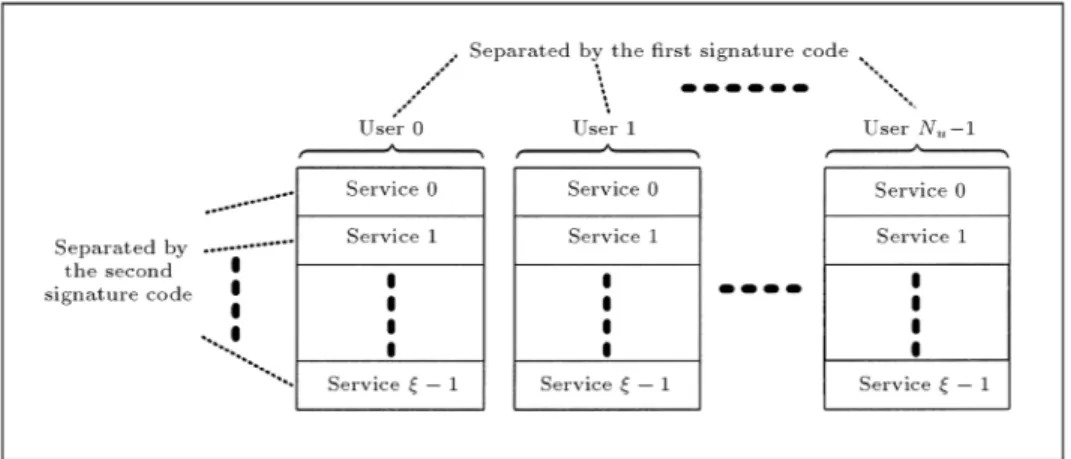
In this paper, a multirate environment, depicted in Figure 1, is introduced, in which each user has two signature codes, the rst of which serves to distinguish the user from the other Nu 1 users and the second
of which discriminates services of the same user. The results of exploring such environments are also directly applicable to any system supporting indepen-dent groups of users, in which dierent groups can be viewed as virtual users and the users of each group can be interpreted as dierent services of the same virtual user.
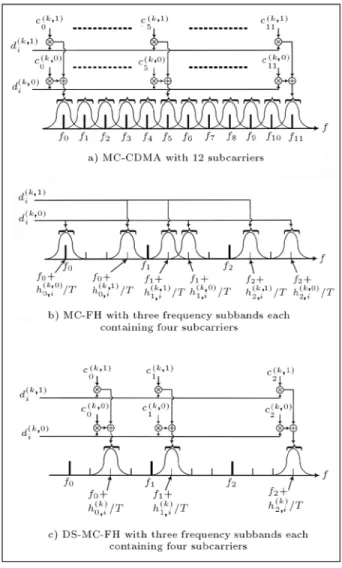
In MC-CDMA and MC-FH systems, there is only one kind of signature code serving as both the rst and second signatures. This explains the rationale for proposing a third multicarrier system as a hybrid of the previous two, called DS-FH (Direct-Sequence MC-FH), possessing, as its rst and second signature codes, the kinds of signature in MC-FH and MC-CDMA schemes, respectively. The rst signature, as in a MC-FH system, determines the set of subcarriers allotted to a user, each belonging to one frequency subband. The second signature, the length of which is equal to the number of subcarriers in each transmission interval, modulates the subcarriers selected by the rst signa-ture, as in a MC-CDMA system, providing dierentia-tion between services of the same user. Figure 2 shows the transmission frequency pattern in a DS-MC-FH system. The whole frequency band is partitioned into
Nssubbands, each of which has exactlyNhsubcarriers.
d(k;q)
i is the ith data bit of the qth service of user k;
T is the symbol duration excluding any guard interval;
n
h(k;q)
m;i
oNs 1
m=0
andn
c(k;q)
m
oNs 1
m=0
are the rst and second signatures of the qth service of user kat transmission interval i, respectively. Contrary to h(k;q)
m;i 's, c(k;q)
m 's
are identical for dierent data bit intervals. Figure 2
Figure1. Distinguishing between dierent users and services by the rst and second signature codes.
is simply particularized to thoroughly describe MC-CDMA systems, if one sets all h(k;q)
m;i 's to 0 and Nh
to 1, and MC-FH schemes, if one sets all c(k;q)
m 's to 1.
Note that in contrast to a DS-MC-FH scheme,h(k;q)
m;i 's
are independent for dierent q's in a MC-FH system. In fact, in a MC-FH system, there is only one kind of signature code utilized for dierentiating users and their dierent services alike, resulting in independent
h(k;q)
m;i 's for dierent k's and q's. However, in a
DS-MC-FH scheme, the rst signature is identical for all services of the same user and the services of each user are distinguished by the second signature code,
fc (k;q)
m g.
Figure 3 illustrates the dierences between three systems having the same bandwidth, with two services for each user ( = 2). In MC-CDMA (Figure 3a), all services of all users share the entire frequency band, with the frequency spacing between adjacent subcarriers the same as that in OFDM. Dierent services are discriminated through distinctc(k;q)
m 's. In
Figure3. Transmission of two coded services over 12=T bandwidth.
MC-FH (Figure 3b), all the services carried in the system are dierentiated by means of assigning to each an independent set fh
(k;q)
m;i g, called a hopping
pattern that selects from dierent frequency subbands the subcarriers on which d(k;q)
i is transmitted. In the
DS-MC-FH (Figure 3c) scheme, however, the hopping pattern,fh
(k;q)
m;i g, is common to all services of the same
user.
It is worth noting that in all three schemes, the whole modulated subcarriers of the ith data bit of all the same user's services are added together, in order to be transmitted simultaneously in a one-bit interval. It is also assumed that each symbol, like OFDM symbols, has head and tail guard intervals with a cyclic extension in the intervals so as to avoid ISI problems.
In this paper, the multiple-access performance of the above three multicarrier schemes are evaluated in synchronous and asynchronous nonfading and in syn-chronous correlated Rayleigh fading channels, consider-ing near-far eects and the results are compared. Even though only the use of Pseudo-Noise (PN) and Walsh codes for the signature, fc
(k;q)
m g, in MC-CDMA and
DS-MC-FH systems is addressed, the authors analysis can be utilized to easily include any other code. The unied approach adopted for the performance analysis in this paper is based on the characteristic function method, applied previously to the performance evalu-ation of MC-FH, DS-CDMA, ultra-wideband impulse radio and MC-CDMA by [8,15-17], respectively. To the best of the authors knowledge, this paper is the rst one considering and comparing the multiple-access performance of the two well-known schemes, namely MC-CDMA and MC-FH, and a generalization of these two schemes, called DS-MC-FH, in various multirate channels. The results indicate that MC-CDMA schemes with Walsh codes outperform other systems in all cases under consideration. Also, DS-FH systems with Walsh codes always surpass MC-FH systems. Note that, although frequency hopping schemes do not show any performance superiority over MC-CDMA systems, in some applications, such as military and jamming environments, they are much more plausible.
The paper is organized as follows. In the following sections, rst, the unied structure and expressions of the above schemes are described and then, performance analyses of the systems in nonfading and fading chan-nels, respectively, are provided. After that, numerical results are presented and, nally, the conclusions are presented.
SYSTEM DESCRIPTION
MC-CDMA, MC-FH and DS-MC-FH systems can be described in a unied way, provided that, referring to
Figure 2, the following equalities are taken into account for each system:
MC-CDMA: h(k;q)
m;i = 0; for allk;q;mandi;
andNh= 1; (1a)
MC-FH: c(k;q)
m = 1; for allk;q andm; (1b)
DS-MC-FH: h(k;q)
m;i =h(k)
m;i; for allk;q;mandi:
(1c) Note thath(k;q)
m;i = 0 and c(k;q)
m = 1 mean the lack of a
frequency hopping signature and MC-CDMA signature codes, respectively. Also, it is noticeable that in a MC-CDMA scheme, each frequency subband is reduced to a single frequency subcarrier. h(k;q)
m;i 's, for dierent
k's, q's, m's and i's in MC-FH, and for dierent
k's, m's and i's in DS-MC-FH, are assumed to be independent identically distributed (iid) random vari-ables with uniform distribution over the integer interval [0;Nh 1]. fc
(k;q)
m g
Ns 1
m=0's in MC-CDMA and
DS-MC-FH are supposed to be either PN or Walsh codes. In the former case, c(k;q)
m 's are iid random variables
taking on values 1 and +1 with equal probability. In the latter case,fc
(k;q)
m g
Ns 1
m=0 's, for dierent k's and
q's, are dierent Walsh codes. Let f0 throughfNs 1
be the base frequencies of non-overlapping frequency subbands (see Figure 2). For the authors' analysis, it is assumed that the whole frequency band is contiguous, i.e:
fm2 fm1 = (m
2 m1)Nh=T;
where: 0m
1< m2
Ns 1: (2)
The whole occupied bandwidth, by the system, is, thus, obtained as B = BW=T, where BW = NsNh
is the normalized bandwidth. Hence, considering Equation 1a, for a constant bandwidth, as can be seen in Figure 3, MC-CDMA systems have Nh times as
many transmitted subcarriers in a symbol interval as the other two systems do, where it is supposed that both the hopping schemes haveNhsubcarriers in each
frequency subband.
In all of the following analyses, without any loss of generality, it is assumed that each service of each user has a bit rate of 1=T. Multirate services, with bit rates higher than 1=T, are assigned more than one signature code.
Transmitted Signal
The baseband Binary-Phase-Shift-Keying (BPSK) transmitted signal for theqth service of userk can be
expressed as follows:
s(k;q)
l (t) =
X
i Ns 1
X
m=0 q
2S(k)
i d(k;q)
i c(k;q)
m exp
j[2
(t t(k)
t iT)(fm+h(k;q)
m;i =T) +(k)
i ]
p(t t(k)
t iT); (3)
whered(k;q)
i is the data bit of theqth service of userkat
theith symbol interval;d(k;q)
i 's, for dierentk's,q's and
i's, are iid random variables and take on values 1 and +1 with the same probability;S(k)
i is the transmission
power for each subcarrier of userkat symbol interval
i; t(k)
t and (k)
i are the kth user's transmitter time
origin and thekth user's transmission phase at the ith interval, respectively; andp(t) is the unit pulse in the time interval (0;T).
Model of Channel
An Additive-White-Gaussian-Noise (AWGN) nonfad-ing or a slowly correlated Rayleigh fadnonfad-ing channel is considered. The former case can be achieved from the latter by setting all fading coecients to one. Therefore, fading channels are concentrated upon. The length of each symbol is conventionally considered to be so much greater than the maximum delay spread of the channel that the presumption of at fading over each subcarrier is satised. As a result, the
mth subcarrier of the qth service of user k at the
ith symbol interval experiences a at fading gain,
g(k;q)
m;i = H(k)(f
m+h(k;q)
m;i =T), which is assumed to be
constant over at least one symbol interval. H(k)(f)
is the baseband frequency response of the transmission channel for thekth user. If
g
(k;q)i is dened as a column
vector with components h
g(k;q)
m;i
iN
s 1
m=0
, then,
g
(k;q)i is
a Proper Complex Gaussian (PCG) random vector characterized by its probability-density function (pdf)
fg (k;q)
i (
g
) =exp( gHC 1
g)
Nsdet(C) (\H" denotes Hermitian
operation and \det" stands for determinant) [18], where
C
, dened as Eng
(k;q)i
g
(k;q)Hi
o
(Ef:g denotes
expectation), is the frequency covariance matrix of the channel. Assuming that the channel is Wide-Sense Stationary Uncorrelated Scattering (WSSUS) and the frequency band of the system is contiguous, the entries of
C
are obtained as follows:C
m1;m2= H(fm1;m2)=
Z +1
1
h()exp( j2fm1;m2)d;
with fm1;m2 =Nh(m
where h() and H(f) are the power delay prole
(pdp) and the frequency autocorrelation function of the channel, respectively. fm1;m2 is the (averaged)
frequency spacing between them1th andm2th
subcar-riers. The following exponential model is adopted for the pdp [13]:
h() = 1 (1+=T)exp(m )[exp( =Tm) exp( )]
for 0< < Tm; (5)
where is a decaying factor and Tm is the maximum
delay spread of the channel.
Received Signal, Receiver Structure and
Decision Variable
The baseband received signal can be written as follows:
rl(t) =X
i Nu 1
X
k=0
1 X
q=0
Ns 1 X
m=0 q
2R(k)
i g(k;q)
m;i d(k;q)
i c(k;q)
m
exp
j[2(t t(k)
r iT)(fm+h(k;q)
m;i =T)+(k)
i ]
p(t t(k)
r iT) +z(t); (6)
where Nu is the number of active users and R(k)
i
denotes the received power at each subcarrier of userk
at the ith symbol interval. t(k)
r is the receiver time
origin and is equal to t(k)
t +t(k)
d , where t(k)
d is the
reception delay for the kth user. g(k;q)
m;i 's are assumed
to be so normalized that E
g
(k;q)
m;i 2
= 1 and z(t) is the complex zero-mean AWGN with double-sided power spectral densityN0.
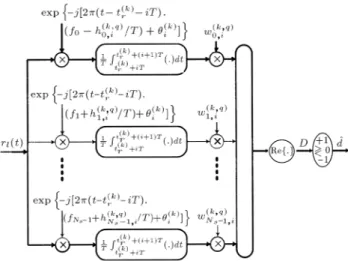
A single-user Maximum-Ratio-Combining (MRC) receiver is considered, as shown in Figure 4, with
w(k;q)
m;i =g(k;q)
m;i c(k;q)
m , where \*" stands for conjugation.
Let the signal of the 0th service of user 0 at the 0th symbol interval be the signal of interest. Without any loss of generality, it is assumed that (0)
0 = 0 and
t(0)
r = 0. Also, it is supposed that t(k)
r belongs to the
interval (0;T). With these assumptions, the following expression for the decision variable normalized by
q
2R(0)
0 is attained:
D=d(0;0) 0
Ns 1 X
m=0 g
(0;0)
m;0 2 + Re ( 1 X q=1
Ns 1 X
m=0
g(0;0)
m;0 g (0;q)
m;0 d (0;q) 0 c
(0;0)
m c(0;q)
m
Figure 4. Baseband equivalent MRC receiver for theqth service of userkat theith symbol interval.
:T1 Z T 0
exp
"
j2 h(0;q)
m;0
T h
(0;0)
m;0 T !# dt ) + Re (
Nu 1 X
k=1
1 X
q=0
Ns 1 X
m=0
Ns 1 X
=0 q
R(k) 1=R
(0) 0 g
(0;0)
;0 g (k;q)
m; 1d (k;q)
1 c (k;q)
m c(0;0)
:T1 Z t (k)
r 0 exp ( j2 "
fm+h
(k;q)
m; 1
T
!
(t t(k)
r )
f+h
(0;0)
;0
T
!
t
#
+j(k) 1
)
dt
+
q
R(k) 0 =R
(0) 0 g
(0;0)
;0 g (k;q)
m;0 d (k;q) 0 c
(k;q)
m c(0;0)
1
T
Z T
t(k)
r exp
(
j2
"
fm+h
(k;q)
m;0
T
!
(t t(k)
r )
f+h
(0;0)
;0
T
!
t
#
+j(k) 0 ) dt ) +n; (7) where Ref:gstands for the real part. Also,nrepresents
the noise term, which, conditioned on the fading coecients g(0;0)
m;0 's, is a zero-mean Gaussian random
variable with variance equal to the following:
2
njg (0;0)
m;0
= NsNs
1 X m=0 g
(0;0)
m;0 2 !
=2b;
where : b=Nsbs with bs=R
(0) 0 T
N0
; (8)
bsis the received Signal-to-Noise Ratio (SNR) per bit
per bit. In deriving Equation 7, it is assumed that
fm:T, for anym, is an integer.
Detection and Probability of Bit Error
Detection at the receiver is accomplished by comparing the decision variable, D, with the threshold, zero. Consequently, the Bit-Error Rate (BER) of the system is obtained as follows:
Pbe= Pr
n
D <0jd (0;0) 0 = +1
o
=FU(0);
where : U ,Dj+ 1; (9)
FU(u) stands for the cumulative-distribution function
(cdf) ofU andDj+1 denotes the decision variable,D,
conditioned on transmitting +1.
PERFORMANCE EVALUATION IN
NONFADING CHANNELS
Synchronous Systems
For a synchronous nonfading system, there isg(k;q)
m;i = 1,
t(k)
r = 0 and (k)
i = 0, for any k, q, m and i. Now,
from Equations 7 and 8, with the denition of U in Equation 9, one obtains the following:
U =Ns+ MAI +n with MAI =Nu
1 X
k=0
MAI(k);
(10a) where:
MAI(0)=
1 X
q=1
MAI(0;q);
MAI(k)=
1 X
q=0
MAI(k;q) for k 1;
and:
MAI(k;q)=
Ns 1 X
m=0 q
R(k) 0 =R
(0) 0 d
(k;q) 0 c
(0;0)
m c(k;q)
m (k;q)
m;0
for anykandq; (10b)
in which:
(k;q)
m;i =
h
h(k;q)
m;i h(0;0)
m;0 i
; (10c)
also,
2
n=N2
s=(2b): (10d)
MAI(k)is the interference, due to userk, and MAI(k;q)
is the interference term caused by the qth service of
userk. n in Equation 10a is the Gaussian noise term with zero mean and variance that can be obtained from Equation 10d. in Equation 10c indicates the Kronecker delta. As the h(k;q)
m;i 's are iid random
variables, with uniform distribution over the integer interval [0;Nh 1], from Equation 10c, the(k;q)
m;i 's are
iid random variables with the following distribution:
(k;q)
m;i =
(
0; with probability,1 1=Nh
1; with probability,1=Nh
: (11) From Equations 10, assuming thatR(k)
0 =Rfor anyk,
MAI is a discrete random variable with the pdf given by the following:
fMAI(x) =
P
X
a= P
pMAI[a](x a);
with P =Ns(Nu 1); (12)
wherepMAI[a] is the probability function of MAI. From
Equations 9 and 10, one can write the following:
Pbe= PrfMAI +n < Nsg: (13)
The pdf of the \interference plus noise" is obtained as follows:
f(MAI+n)(x) =f MAI(x)
f
n(x)
= XP
a= P
pMAI[a]fn(x a); (14)
where fn(x) is the pdf of n. Now, the BER from
Equations 13 and 14 can be acquired as follows:
Pbe=
Z N
s
1
f(MAI+n)(x)dx
= XP
a= P
pMAI[a]Q
Ns+a
n
; (15)
in which Q(x) = R +1
x 1
p
2exp( w
2=2)dw is the
Gaussian-tail function. In the Appendix, using the theorem proposed in [19], it is proven that:
pMAI[a] = 1
L
2L 1 X
k=1
k odd
MMAI(e
jk=L)e jak=L;
with L= 2P+ 1; (16)
where MMAI(z) is the moment-generating function
(mgf) of MAI. The exact BER is then obtained using Equations 15 and 16.
Now, for studying the near-far eect, it is assumed that R(k)
0 = R for k
1 and that R (0)
0 < R.
In other words, all the interfering users' signals are received with the same power which is greater than the desired signal power. From Equations 10, supposing that A ,
q
R=R(0)
0 is an integer (note that this
assumption, not aecting the nal result, is made only for computational simplicity and does not impose any restriction on the subsequent analyses), one can follow the same above steps to reach Equations 15 and 16, except that P =Ns[ 1 +A(Nu 1)]. Also, note
that, in this case, MAI(0)is the same as the MAI(0)with
R(0)
0 =R, but, MAI
(k)fork
1 isAtimes the MAI (k)
withR(0) 0 =R.
For performance evaluation, one needs only to calculate MMAI
(k)(z). As the MAI
(k)'s are
indepen-dent, MMAI(z) is easily acquired from the product of
allMMAI
(k)(z)'s. In the succeeding sections, assuming
that R(0)
0 = R, MMAI
(k)(z) is evaluated for MC-FH
and DS-MC-FH systems. MMAI
(k)(z) for MC-CDMA
schemes is derived from that of DS-MC-FH systems, if
Nh= 1 is set.
MC-FH System
For this scheme, combining Equations 1b and 10 results in:
MAI(0)=
1 X
q=1
MAI(0;q);
and: MAI(k)=
1 X
q=0
MAI(k;q) for k
1; (17)
with:
MAI(k;q)=d (k;q) 0
Ns 1 X
m=0
(k;q)
m;0 :
MAI(k;q), conditioned on d (k;q)
0 , is the sum of Ns iid
random variables, i.e., the d(k;q)
0
(k;q)
m;0 's. Therefore,
from Equations 10 and 11 and the fact that the MAI(k;q)'s are independent, one has following:
MMAI (0)(z) =
1 Y
q=1
MMAI (0;q)(z)
= 1 Y
q=1 n
Prfd (0;q)
0 = 1
gM MAI
(0;q) jd
(0;q) 0
= 1(z)
+ Prn
d(0;q) 0 = +1
o
MMAI (0;q)
jd (0;q) 0
=+1(z) o
= 1 Y
q=1 n1
2MMAI (0;q)
jd (0;q) 0
= 1(z)
+ 12MMAI (0;q)
jd (0;q) 0
+1(z) o
=
1
2(+z 1)Ns
+ 12(+z)Ns
1
;
and, in the same way,
MMAI (k)(z) =
1
2(+z 1)Ns
+ 12(+z)Ns
for k1; (18)
where= 1 is equal to 1 1=Nh.
DS-MC-FH System
In this system, from Equation 1c, h(k;q)
m;i and, thus,
(k;q)
m;i dened in Equation 10c, do not depend on
q and are, thereby, represented by h(k)
m;i and (k)
m;i,
respectively. From Equation 10c, it can easily be concluded that(0)
m;i's are all equal to 1. Consequently,
from Equations 10 one can write the following: MAI(0) =
1 X
q=1
d(0;q) 0
Ns 1 X
m=0
c(0;0)
m c(0;q)
m ; (19a)
and: MAI(k)=
Ns 1 X
m=0
MAI(k)
m
=Ns 1 X
m=0
(k)
m;0
1 X
q=0
d(k;q) 0 c
(0;0)
m c(k;q)
m ;
for k1; (19b)
PN Second-SignatureCodes
In this case, MAI(0), given in Equation 19a, consists of
( 1)Nsiid random variables taking on values 1 and
+1 with the same probability. Therefore, one has the following:
MMAI (0)(z) =
z 1
2 +z2
( 1)Ns
: (20)
From Equations 11 and 19b, it is apparent that MAI(k)
m
is zero, with probability = 1 = 1 1=Nh;
otherwise, it is equal to the sum of independent uni-formly distributed binary-valued (with values 1 and +1) random variables. Also, (k)
for dierent m's. Therefore, one easily obtains the following:
MMAI
(k)(z) = (
+
z 1
2 +z2
)Ns
;
for k1: (21)
WalshSecond-Signature Codes
For this case, as any two dierent Walsh codes are orthogonal, MAI(0)(see Equation 19a) completely
van-ishes. Now, from Equation 19b, one has the following: MAI(k)=
1 X
q=0
MAI(k;q);
with:
MAI(k;q)=
Ns 1 X
m=0
d(k;q) 0 c
(0;0)
m c(k;q)
m (k)
m;0;
for k1: (22)
Three cases are considered. First, ifNu = 1, then, no
multiple-access interference exists and, therefore,
Pbe= PrfU <0g= Prfn < Nsg=Q
Ns
n
: (23) Second, if Nu > 1 and = 1, one only needs to
calculate the mgf of MAI(k)
fork 1, which is equal
to MAI(k;0), dened in Equation 22. Let E
1 be the
set ofk's (k1), for which [c (k;0)
m ]Ns 1
m=0 = [c (0;0)
m ]Ns 1
m=0 ,
with the cardinality ofuand letE2be the complement
of E1 with respect to the set
f1;2;;Nu 1g. On
the one hand, MAI(k2E1) has a form just similar to
MAI(k;q) for MC-FH schemes (see Equation 17), so,
from Equation 18, one has the following:
MMAI (k2E
1
)(z) = 12(+z 1)Ns
+ 12(+z)Ns:
(24) On the other hand, fork2E
2, fd
(k;0) 0 c
(0;0)
m c(k;0)
m gNs 1
m=0
has an equal number of 1's and +1's. As (k)
m;0's
for dierent m's are independent, with the statistics given in Equation 11, from Equation 22, the following is obtained:
MMAI (k2E
2
)(z) = (+z
1)Ns=2(+z)Ns=2: (25)
Therefore, from Equations 24 and 25, one obtains the following:
MMAI(z) = n1
2(+z 1)Ns
+ 12(+z)Nsou n
(+z 1)(+z) oNs
2
(Nu 1 u)
: (26)
Now, substituting Equation 26 in Equation 15 and applying the result to Equation 16 leads to Pbeju
(the BER conditioned on u). Before investigating how to determine the unconditional bit-error rate,Pbe,
from the conditional bit-error rate, Pbeju, rst, the
remaining case, i.e., Nu > 1 and > 1 is considered.
For this case, as the exact analysis is very complicated and cumbersome, a Gaussian distribution approxi-mation is utilized for the multiple-access-interference term, according to the Central-Limit Theorem (CLT). Under this assumption, using Equation 13 one has the following:
Pbe=Q
Ns
(MAI+n)
with 2
(MAI+n)= 2 MAI+
2
n;
(27)
2
MAI is the variance of MAI and 2
n is obtained from
Equation 10d. In order to evaluate2
MAI, it is assumed
that there areudistinct pairs (k;q), for any of which, theqth service of userkhas the same Walsh code as the desired service. For such pairs, the mgf of MAI(k;q)has
a form just the same as the one given in Equation 24. The variance of MAI(k;q) is then obtained, via the
second derivative of the mgf evaluated at z = 1 as
Ns(Ns+). For the other services (with a dierent
Walsh code from that of the desired service), the mgf of MAI(k;q) has a form exactly similar to the mgf in
Equation 25. Then, the variance of such MAI(k;q)'s is
acquired asNs. Consequently, one can write:
2 MAI
ju=ufNs(Ns+)g+f(Nu 1) ug(Ns):
(28) Note that MAI(0) is equal to zero and that one has
a total of (Nu 1) interfering services. u services
have the same code as the desired service and (Nu
1) u services have dierent codes from the desired service. Equations 27 and 28 lead to Pbeju, i.e., the
BER conditioned on u. Note that when taking the near-far eect into account, the variance in Equation 28 is easily multiplied byA2, whereA=
q
R(k) 0 =R
(0) 0 .
For extractingPbefrom Pbeju, it is assumed that
the Walsh codes are assigned to dierent services in the system in a cyclic fashion. In other words, noting that there are totally Ns distinct Walsh codes used
in the system, if e, dened as k+q, is a counting index for the services in the system, the services with indicese0ande0+Nshave the same Walsh codes and
any Ns services with sequential indices have distinct
Walsh codes. With this assignment and dening r
as mod(Nu;Ns), where \mod" denotes the remainder
operation, three cases can be considered: 1)Nu Ns
implies that u = 0 and Pbe = Pbej(u = 0); 2)
Nu > Ns and r = 0 implies that Pbe = Pbej(u =
u = u1 = [Nu=Ns] 1, with probability 1 r=Ns
andu=u2= [Nu=Ns], with probabilityr=Ns, where
[x] denotes the largest integer not greater than x; therefore,Pbe= (1 r=Ns)Pbeju
1+ (r=Ns)Pbe ju
2.
Asynchronous Systems
For an asynchronous nonfading system, using Equa-tions 2 and 7, and the denition of U in Equation 9, one obtains the following:
U =Ns+ MAI +n;
where:
MAI =Nu 1 X
k=0
MAI(k); (29a)
which: MAI(0)=
1 X
q=1
MAI(0;q);
with:
MAI(0;q)=
Ns 1 X
m=0
d(0;q) 0 c
(0;0)
m c(0;q)
m (0;q) (m;0):
Also,
MAI(k)= MAI (k)
1+ MAI (k) 0 fork
1;
where: MAI(k)
1=
1 X
q=0
MAI(k;q) 1 ;
with: MAI(k;q)
1 =
Ns 1 X
m=0
Ns 1 X
v=0
MAI(k;q) 1;m;;
which: MAI(k;q)
1;m;= q
R(k) 1=R
(0) 0 d
(k;q) 1 c
(k;q)
m c(0;0)
: 8 > > > > > > > > < > > > > > > > > :
(k)cos n
(k)
1 2
(k)(Tf
m+h(k;q)
m; 1) o
for
(
m=; and
h(k;q)
m; 1=h (0;0)
;0 sin
f (k)
1 2
(k) (Tf+h
(0;0)
;0 )
g sin
f (k)
1 2
(k) (Tfm+h
(k;q)
m; 1 )
g 2
f
(m )Nh+h (k;q)
m; 1 h (0;0)
;0 g
otherwise (29b)
Also, one has MAI(k)
0 =
P 1
q=0MAI (k;q) 0 with
MAI(k;q)
0 =
PN
s 1
m=0
Ns 1 P
=0
MAI(k;q)
0;m;, which:
MAI(k;q) 0;m;=
q
R(k) 0 =R
(0) 0 d
(k;q) 0 c
(k;q)
m c(0;0)
: 8 > > > > > > > > < > > > > > > > > :
(1 (k))cos n
(k)
0 2
(k)(Tf
m+h(k;q)
m;0 ) o
for
(
m=; and
h(k;q)
m;0 =h (0;0)
;0 sin
f (k) 0
2 (k)
(Tfm+h (k;q)
m;0 )
g sin
f (k) 0
2 (k)
(Tf+h (0;0)
;0 )
g 2
f
(m )Nh+h (k;q)
m;0 h (0;0)
;0 g
otherwise (29c)
:
(k)in Equation 29 is equal tot (k)
r =T and is assumed to
be uniformly distributed in the interval (0;1). Also, the
(k)'s are independent. The (k)
i 's for dierentk's are
independent uniformly distributed random variables in the interval ( ;). MAI(k)
1 and MAI (k)
0 are parts of
MAI(k)related to 1th and 0th transmission intervals
of userk, each consisting of MAI(k;q)
1 's and MAI (k;q) 0 's
(interference terms due to dierent services of userk), respectively. MAI(k;q)
1;m; is the interference caused
by the mth subcarrier of the qth service of user k
at the 1th symbol interval in the th subcarrier of the desired service. MAI(k;q)
0;m; denotes the same
interference caused by the 0th symbol interval of userk. Note that the variance of the noise term in this case is the same as in the case of synchronous channels (see Equation 10d). As the exact BER calculation for the asynchronous case is very complicated, the BER is derived based on the Gaussian distribution for the MAI using Equation 27. Thus, one only needs to compute the variance of the MAI, which is obtained as follows:
2 MAI=
2 MAI
(0)+
Nu 1 X
k=1
1 X
q=0
(2 MAI
(k;q) 1
+2 MAI
(k;q) 0
):
(30) Now, by variable changes,0(k)= 1 (k) and
0(k)
0 =
(k)
0 in Equation 29c and noting that
0(k) and 0(k) 0
have the same statistics as (k) and (k)
0 , respectively
and, assuming thatR(k) 1 =R
(k)
0 andTfmis an integer
for anym, it can be easily realized that 2 MAI
(k;q) 1
and
2 MAI
(k;q) 0
are equal. Hence, from Equation 30, in order to derive the BER of each system using Equation 27, one only needs to calculate 2
MAI
(0) and 2 MAI
(k;q) 1
for
R(k) 1 = R
(0)
0 , which are computed in the succeeding
sections. For considering the near-far eect, it is sucient to multiply 2
MAI (k;q)
1
(computed for R(k) 1 =
R(0) 0 ) byR
(k) 1=R
(0) 0 .
MC-CDMA System
For this scheme, applying Equations 1a and 29b sim-plies to:
MAI(k;q) 1;m; =d
(k;q) 1 c
(k;q)
m c(0;0)
:
8 < :
(k)cos( (k)
1 2
(k)Tf
m); form=
sin( (k)
1 2
(k)Tf
)sin( (k)
1 2
(k)Tf
m)
2(m ) otherwise
:
(31)
PNSignatureCodes
Just as in the synchronous case, MAI(0)
, in this case, is equal to the sum of ( 1)Nsindependent uniformly
distributed binary-valued random variables and, there-fore, one has2
MAI
(0) = ( 1)Ns. From Equation 31,
it can simply be realized that MAI(k;q)
1;m;'s, for
dif-ferent m's and 's, are uncorrelated and, therefore, from Equation 29, 2
MAI (k;q)
1
is easily obtained as
Ns 1 P
m=0
Ns 1 P
=0
2 MAI
(k;q) 1;m;
. From Equation 31, after some simple statistical calculations, 2
MAI (k;q)
1;m;
is acquired as follows:
2 MAI
(k;q) 1;m;
=
(
1=6 form=
1 4 2
1 (m )
2; otherwise
: (32)
WalshSignatureCodes
In this case, just as in the synchronous case, MAI(0)
vanishes and 2 MAI
(0) = 0. In contrast to the
PN-signature case, MAI(k;q)
1;m;'s in Equation 31, for
dif-ferentm's and's, are correlated. After some lengthy calculations, which are dropped here for briefness, the following result is easily attained:
2 MAI
(k;q) 1
= N6 +s 412
Ns 1 X
m=0
Ns 1 X
v=0
v6=m
:c(k;q)
m c(k;q)
(2c(0;0)
m c(0;0)
1) c(0;0)
m c(0;0)
+ 1
(m )2
+ 182
Ns 1 X
m=0
Ns 1 X
1 =0
16=m
Ns 1 X 2 =0 26=m 26= 1
:c(0;0)
1 c (0;0)
2 +c (k;q)
1 c (k;q)
2 +4c (k;q)
m c(0;0)
m c(k;q)
1 c (0;0)
2
(m 1)(m 2)
: (33)
Hopping Systems (MC-FH and DS-MC-FH)
In hopping systems, contrary to MC-CDMA schemes, the frequency spacing between neighboring subcarriers is so large (this spacing in hopping systems on average isNh times greater than that of MC-CDMA schemes)
that the subcarrier spectra can well be assumed to be disjoint. In other words, MAI(k;q)
1;m; can well
be assumed to be zero for m 6= . For shortness,
hereafter, MAI(k;q)
1;m;m is denoted by MAI (k;q)
1;m. Now,
from Equation 29b, one has the following: MAI(k;q)
1
Ns 1 X
m=0
MAI(k;q)
1;m; (34a)
with: MAI(k;q)
1;m=d (k;q)
1 c (k;q)
m c(0;0)
m : 8 > > > > > < > > > > > :
(k)cos n
(k) 1 2
(k)(Tf
m+h(k;q)
m; 1) o
forh(k;q)
m; 1=h (0;0)
m;0 sin
f (k)
1 2
(k)(Tfm +h
(0;0)
m;0) g
sin f
(k) 1
2 (k)(Tfm
+h (k;q)
m; 1) g 2(h
(k;q)
m; 1 h (0;0)
m;0)
otherwise (34b)
DS-MC-FH withPN Second-SignatureCodes
For this scheme, MAI(0) is just the same as in
MC-CDMA systems with PN codes and, therefore,2 MAI
(0)
is obtained as ( 1)Ns. As the MAI(k;q) 1;m's are
uncorrelated, 2 MAI
(k;q) 1
is equal to the sum of the
2 MAI
(k;q) 1;m
's over all m's. Knowing the statistics of the
d(k;q)
i 's, h(k;q)
m;i 's, c(k;q)
m 's, (k)'s and (k)
i 's and noting
that h(k;q)
m; 1 is equal toh (0;0)
m;0 with probability 1=Nh, it
can easily be shown that the following is true:
2 MAI
(k;q) 1;m = 1 6 + 8 > < > : 1 42N
2
h Nh 1
X
a=0
Nh 1 X
b=0
b6=a
1 (a b)2
9 > = > ; : (35) From Equation 35, 2
MAI (k;q)
1;m
does not depend on m, so,2
MAI (k;q)
1
is obtained asNs:2 MAI
(k;q) 1;m
.
DS-MC-FH withWalshSecond-SignatureCodes
In this case, MAI(0)vanishes like the synchronous case
and one only needs to compute2 MAI
(k;q) 1
, which, from Equation 34a, is acquired as follows:
2 MAI
(k;q) 1
=Ns 1 X
m=0
2 MAI
(k;q) 1;m
+Ns 1 X
m1 =0
Ns 1 X
m2 =0
m26=m 1
En
MAI(k;q) 1;m
1:MAI (k;q)
1;m 2
o
;
2 MAI
(k;q) 1;m
is obtained just the same as in Equa-tion 35. However, in contrast to the PN-signature case, MAI(k;q)
1;m's for dierent m's are correlated and,
from Equation 34b, after some simple statistical calcu-lations, one obtains the following:
En
MAI(k;q) 1;m
1:MAI (k;q)
1;m 2
o
= c(k;q)
m1 c (0;0)
m1 c (k;q)
m2 c (0;0)
m2
42N 3
h
:nNh 1 X
a=0
Nh 1 X
b=0
Nh
f(m
1 m2)Nh+a b g
2
+Nh 1 X
a=0
Nh 1 X
b1=0
Nh 1 X b2=0 b2 6=b 1 :
f(m
1 m2)Nh+ b1 gf(m
1 m2)Nh+a b2 g
o
:
(37)
MC-FH
In this case, MAI(0) is the same as the corresponding
term in synchronous MC-FH and, thus, 2 MAI
(0) is
obtained as ( 1)Ns(Ns +) from Equation 18.
Applying Equation 1b in Equation 34b, 2 MAI
(k;q) 1
is attained, via Equation 35 to 37, with c(k;q)
m 's all set
to one.
PERFORMANCE EVALUATION IN
FADING CHANNELS
For the performance evaluation in fading channels, syn-chronous single-service ( = 1) systems are considered. From Equations 7 and 8, withR(k)
0 =R (0)
0 for any k,
one can write the following:
U =S+ MAI +n; where S=
g
(0)Hg
(0);MAI = Re[I]; I=
g
(0)HNu 1 X
k=1
d(k)
V
(k)g
(k);and:
2
njg (0) =
Ns
2b
g
(0)H
g
(0); (38a)with:
g
(k) ,h
g(k) 0 g
(k) 1
g (k)
Ns 1 iT
;
V
(k) ,diagn
(k) 0 ;
(k) 1 ;
; (k)
Ns 1 o
; (k)
m ,c (0)
mc(k)
m (k)
m : (38b)
2
njg
(0) is the variance of n conditioned on
g
(0). InEquation 38 and throughout this section, as is equal to 1 and all the parameters are related to 0th symbol intervals, the indices,qandi, have been dropped. Note that(k)
m has the same denition and statistics as given
in Equations 10c and 11, withq= 0 and i= 0. From Equation 38, U conditioned on
g
(0) and(k)
m 's is a
Gaussian random variable with the following mgf:
M
Ujg (0);(k)
m (s)=
M
Sjg (0)(s)M
MAIjg (0);
(k)
m (s)
M
n((39)s):Using the mgf of a Gaussian variable, from Equa-tions 38 and 39 and having that MAI is a zero-mean variable, one has the following:
MUjg (0);
(k)
m (s) = exp
(
g
(0)Hs
I
Ns+s2
4 Nbs
I
Ns
g
(0)+s2
22 MAIjg
(0); (k)
m
)
; (40)
wherein
I
Ns is the identity matrix of order Ns.2 MAIjg
(0); (k)
m is, obviously, half of the variance of
Ij
g
(0);(k)
m , dened in Equation 38a. Now, using the
fact that
g
(k)'s are independent, one can write asfollows:
2 MAIjg
(0); (k)
m = 12E
n
IIHj
g
(0);
V
(k) o= 12
g
(0) "Nu 1 X
k=1
d(k)
V
(k)E fg
(k)
g
(k)H gV
(k)d(k) #
g
(0)H= 12
g
(0)Nu 1 X
k=1
V
(k)CV
(k) !g
(0)H= 12
g
(0)(X
C
)g
(0)H;
where:
X
=Nu 1 Xk=1
X(k) and :
X
(k) ,h
(k) 0
(k) 1
(k)
Ns 1 iTh
(k) 0
(k) 1
(k)
Ns 1 i
:
(41)
C
andV
(k) are dened in Equations 4 and 38b,respectively. \" is the matrix-matrix dot product
operator and the superscript, \T", stands for trans-position. Note that
X
(k)C
is, in fact, the covariancematrix of
V
(k)g
(k), conditioned onV
(k). As for anythe unconditional distribution of
V
(k)g
(k)as Gaussiandistribution is well approximated. Hence, removing conditionality on(k)
m from Equation 40, for calculating
MUjg
(0)(s), one needs only to compute 2 MAIjg
(0). From,
Equation 41 one easily obtains the following:
2 MAI jg
(0)= 12
g
(0)(Ef
X
gC
)g
(0)H: (42)
From the denition of
V
(k) andX
in Equations 38band 41, respectively, it is easy to show that:
Ef
X
g= (Nu 1)I
Ns+ 2Ef
LL
T
g; (43)
where = 1 = 1=Nh and
L
is an Ns(Nu 1)matrix with its entry, (m;k), equal to c(0)
mc(k)
m. From
Equations 40 (after removing conditionality on v(k)
m ),
42 and 43, one obtains the following:
MUjg
(0)(s) = exp n
g
(0)HQ
(s)g
(0) o;
with:
Q
(s) =sI
Ns+s2
4
(
2E f
LL
T
g
C
+
(Nu 1)+Nbs
I
NS)
: (44)
As
g
(0)is a PCG random vector, taking the expectationof Equation 44 results in the following [20]:
MU(s) = detf
I
NsQ
(s)C
g 1: (45)
In cases where Equation 45 leads to an explicit expres-sion for the pdf of U, the BER can be computed by evaluating the cdf of U at zero. Otherwise, one can make use of the Beaulieu series [21] in the following manner, in order to obtain the BER directly from the mgf ofU:
Pbe= PrfU <0g= lim
L!1
N!1
FU(0;L;N);
where:
FU(0;L;N) = 12 XN
n=1
nodd
2
nIm
MU
j2nL
:
(46) Imf:g denotes the imaginary part. From the error
bounds given in [21], FU(0;L;100), with L = juj+
20U, where U and U are the mean and standard
deviation ofU, respectively, is a very good approxima-tion ofPbe.
In the subsequent sections, the mgf of U is evaluated for the hopping schemes. The pertinent expressions for MC-CDMA are derived from those of DS-MC-FH systems by substitutingNh= 1.
DS-MC-FH
PNSignatureCode
In this case, from the statistics ofc(k)
m , it can simply be
shown that Ef
LL
Tg= (Nu 1)I
Ns. Therefore, fromEquations 44 and 45 one has the following:
MU(s)=det
I
Ns
s+14 [(Nu 1)+Ns=b]s2
C
1:(47) Assuming that the eigenvalues of
C
are distinct, after some simplications, one obtains the following:MU(s) =MU(s) +M+
U(s);
where:
MU(s) =Ns 1 Y
m=0
4 1
m
(Nu 1) + Nbs
!
Ns 1 X
m=0
am; 1
s pm; 1
;
and:
M+
U(s) =Ns
1 Y
m=0
4 1
m
(Nu 1) + Nbs
!
Ns 1 X
m=0
am;+1
pm;+1 s:
m's are eigenvalues of
C
. pm; 1, pm;+1, am; 1 andam;+1 are given by:
pm;1= 2 1
s
1 +
(Nu 1) +Nbs
=m
! 1
;
and:
am;1=
1
pm;+1 pm; 1
Ns 1 Y
n=0
n6=m
1
(pm;1 pn; 1)(pn;+1 pm;1)
: (48) As
C
is positive denite,m's are all positive.There-fore, pm; 1's are all negative and pm;+1's are all
positive. Since the region of convergence of MU(s)
includes the axis s = j!, MU(s) and M+
U(s) are the
right-sided and left-sided parts ofMU(s), respectively
and, therefore, the BER is equal to MU(0). After some algebraic manipulations, the BER is obtained as follows:
Pbe=12
(
1 Ns 1 X
m=0
1+
(Nu 1)+Nbs
=m
1 2
Ns 1 Y
n=0
n6=m
(1 n=m) 1 )
:
(49) ForNh = 1 and Nu = 1, the result in Equation 49 is
WalshSignatureCode
In this case,
L
is deterministic and EfLL
Tg=LL
T.An explicit expression for the BER cannot be derived, so, the Beaulieu series is exploited (see Equation 46) for extracting the probability of error.
MC-FH
For this system, all the elements of
L
are equal to 1, so, from Equations 44 and 45, one obtains the following:MU(s)=det
(
I
Nsh
s+14
(Nu 1)
+Nbs
S2 i
C
24 (Nu 1)s2
C
2 )1
;
(50) which, following similar steps from Equations 47 to 49, gives the BER as:
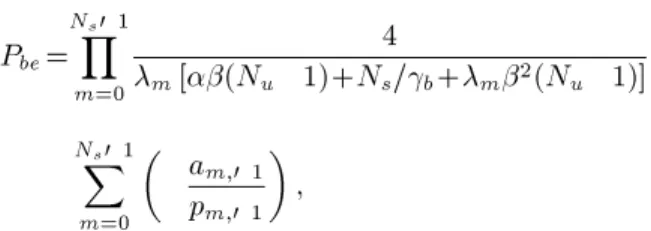
Pbe=Ns
1 Y
m=0
4
m[(Nu 1)+Ns=b+m2(N
u 1)] Ns 1
X
m=0
am; 1
pm; 1
;
where am; 1 is as given in Equation 48, with the
parameterspm; 1 andpm;+1 dened as:
pm;1=
2
m
(
1 s
1+2(N
u 1)+ 1
m
(Nu 1)+Nbs
)
1
:
(51) For studying the near-far eect, one needs only to mul-tiply the variance of the multiple-access interference by
R=R(0) (like the analyses in nonfading channels) and
modify Equations 38 to 51, accordingly.
NUMERICAL RESULTS
In this Section, some numerical results are provided to compare the three multicarrier schemes, namely, MC-CDMA, MC-FH and DS-MC-FH, in nonfading and fading channels. Comparisons are made within a constant bandwidth. In all the graphs presented (Figures 5 to 13), Ns, Nh, Nu, , BW and SNR
signify the number of frequency subbands, the number of subcarriers in each frequency subband, the number of users, the number of services of each user, the normalized bandwidth (product of Ns and Nh) and
b (as dened in Equation 8), respectively. Also, Tr,
dened as Tm=T (Tm is the maximum delay spread
used in Equation 5), denotes the relative delay spread
of the channel. is the decaying factor in Equation 5. (P) and (W) stand for the PN and Walsh schemes, respectively. The pair, (x;y), after the name of a hopping system, indicatesNs and Nh for that system
(Ns=x andNh=y). In the cases where Walsh codes
are utilized, the cyclic assignment of Walsh codes have been used, as described in the section of `MS-MC-FH System'.
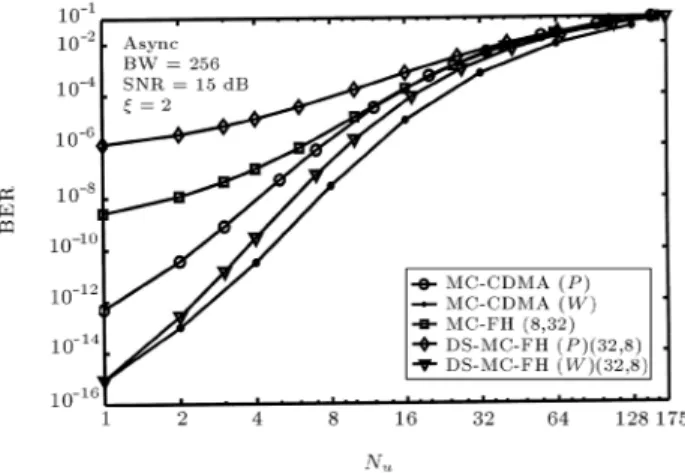
Figures 5 to 7 present plots of the BER versus the number of active users in dierent systems, separately. For comparison, in synchronous cases, the plots of the BER have also been included, based on the Gaussian distribution assumption for the multiple-access inter-ference using Equation 27. The exact and Gaussian plots for MC-CDMA and DS-MC-FH systems with PN codes almost coincide. This uniformity is justied when noting that the multiple-access interference term generally contains sums of iid random variables and the CLT is, thus, applicable. The same is true for asynchronous environments and, therefore, the validity of the Gaussian approximation is retained. From
Figure 5. Performance of synchronous and asynchronous MC-CDMA systems in nonfading channels versusN
u with constant BW, SNR and.
Figure 6. Performance of synchronous and asynchronous MC-FH systems in nonfading channels versusNuwith constantNs,N
h, SNR and .
Figure7. Performance of synchronous and asynchronous DS-MC-FH systems in nonfading channels versusN
uwith constantN
s, N
h, SNR and .
these gures, except in the case of MC-CDMA with Walsh codes (where the synchronous system, as a result of a complete orthogonality between signatures, out-performs the asynchronous system), an asynchronous scheme (because of the lower variance of the multiple-access interference term) has a better performance of up to two orders of magnitude than the synchronous scheme. Also, from Figure 7, both the synchronous and asynchronous DS-MC-FH systems with PN codes, perform much worse than the DS-MC-FH systems with Walsh codes, verifying the inappropriateness of PN codes as the second signature in DS-MC-FH schemes.
In Figure 8, the performance of MC-FH schemes versusNsis evaluated when the bandwidth is constant.
The phenomenon of having an optimum value forNs
is observed for synchronous and asynchronous cases alike. In fact, an increase in Ns, on the one hand,
would enhance the frequency diversity of the system and, on the other hand, would augment the variance of the multiple-access interference dramatically as a result of modulating all the transmitted subcarriers
Figure8. Performance of synchronous and asynchronous MC-FH systems in nonfading channels versusN
s with constant BW, SNR,Nuand.
with an identical uncoded bit, as shown in Figure 2, thus, causing a great correlation among the signals carried by the transmitted subcarriers. For example, in the synchronous case, according to Equation 18, the variance induced, due to a single interfering service, is equal to Ns(Ns +), which is a fourth-degree
function of Ns, when taking the bandwidth constant.
As a result of the above trade-o, the existence of an optimum Ns is foreseeable. Similar results in fading
environments, dropped here due to space limitation, retain this phenomenon. An optimum Ns, however,
will not be obtained for the other schemes and the performance is constantly improved by increasingNs.
In the other schemes, in contrast to MC-FH systems, the data stream is coded by a signature before being sent over transmitted subcarriers.
In Figures 9 and 10, the three schemes have been compared in asynchronous nonfading and synchronous fading channels, respectively. From these gures, it can be realized that the systems with Walsh codes perform much better than the systems with PN codes.
Figure9. Performance of dierent asynchronous systems in nonfading channels versusN
uwith constant BW, N
s, Nh, SNR and.
Figure10. Performance of dierent synchronous systems in fading channels versusN
uwith constant BW, N
s, N
h, SNR,Trand.
Also, MC-CDMA schemes with PN codes outperform MC-FH schemes. MC-CDMA systems with PN codes always perform better than DS-MC-FH schemes with PN codes. However, the performance of the latter ob-viously approaches that of the former, asNsincreases
for a given bandwidth. This can be seen in Figure 10, where the DS-MC-FH system with PN codes almost has the same performance as the MC-CDMA system with PN codes.
For studying the near-far eect, Figure 11 presents the plots of the BER versusR(k)
0 =R (0) 0 in dB
for dierent systems in a synchronous fading environ-ment. From this gure, it is apparent that, for the single-user MRC detector under consideration, except for MC-CDMA schemes with Walsh codes, where the orthogonality among the codes is retained under the near-far eect but not in fading environments, the other systems are not near-far resistant. Note that in DS-MC-FH schemes with Walsh codes, the hopping itself rather distorts the orthogonality among the codes. In Figures 12 and 13, the performances of dierent
Figure11. Performance of dierent synchronous systems in fading channels considering the near-far eect with constant BW,N
s, N
h, SNR, N
u, T
r and .
Figure12. Performance of dierent asynchronous systems in nonfading channels versus SNR with constant BW,Ns,Nh,Nuand.
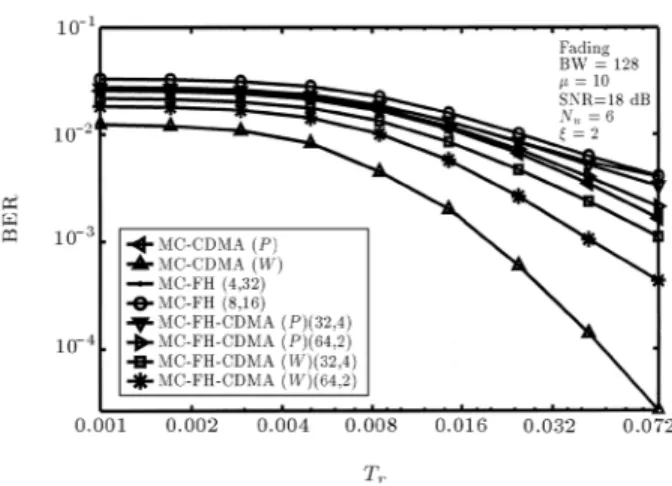
Figure 13. Performance of dierent systems in fading channels versusTrwith constant BW,, SNR,Nuand.
systems are compared versus SNR andTrin nonfading
and fading channels, respectively. The performance priority order of dierent schemes is much clearer in these gures. These gures show a noticeable im-provement in performance by augmenting SNR or Tr.
In DS-MC-FH schemes with PN codes, the multiple-access interference term is dominant in relation to the noise term. The variance of the MAI term that is obtained from Equation 30 as Ns( 1) + 2(Nu
1)Ns2 MAI
(k;q) 1;m
with 2 MAI
(k;q) 1;m
given in Equation 35, is quite large, with respect to the variance of the noise term, which is equal toN2
s=(2b) (see Equation 10d).
Therefore, as can be seen in Figure 12, the performance improvement with SNR in the DS-MC-FH system is not as evident as that of the other schemes. In Figure 13, an increase in Tr is simply translated into
narrowing the spectrum of the pdp of the channel described in Equation 5, thereby, diminishing the corre-lation between the fading gains at adjacent transmitted subcarriers.
CONCLUSION
A unied multiple-access performance analysis of sev-eral multimedia multicarrier CDMA systems in syn-chronous and asynsyn-chronous nonfading and synsyn-chronous correlated Rayleigh fading channels, considering the near-far eect, was provided. The authors analysis has rst indicated that MC-CDMA systems have the best performance. Furthermore, it has been found that the schemes with Walsh codes outperform the other systems in both nonfading and fading channels. Also, it has been realized that for the single-user MRC detector considered in this paper, MC-CDMA schemes with Walsh codes have considerable robustness against the near-far eect in synchronous channels. However, the other systems are vulnerable to the near-far eect.
REFERENCES
1. Hara, S. and Prasad, R. \Overview of multicarrier CDMA", IEEE Commun. Mag., pp 126-33 (Dec. 1997).
2. Yee, N., Linnartz, J.P. and Fettweis, G. \Multi-carrier CDMA in indoor wireless radio networks", Proc. of IEEE PIMRC 1993, Yokohama, Japan, pp 109-13 (Sept. 1993).
3. Hara, S. and Prasad, R. \Design and performance of multicarrier CDMA system in frequency-selective Rayleigh fading channels",IEEE Trans. on Vehicular Tech.,48(5), pp 1584-94 (Sept. 1999).
4. Schulze, H. \The performance of multicarrier CDMA for the correlated Rayleigh fading channel",AEU Int. J. Electron. Commun.,X, pp 1-8 (2000).
5. Tsumura, S. and Hara, S. \Design and performance of quasi-synchronous multi-carrier CDMA system",
IEEE VTC 2001,2, pp 843-7 (2001).
6. Yip, K.W. and Ng, T.S. \Tight error bounds for asynchronous multicarrier CDMA and their applica-tion", IEEE Communications Letters, 2(11), pp 295-297 (Nov. 1998).
7. Gui, X. and Ng, T.S. \Performance of asynchronous orthogonal multicarrier CDMA system in frequency selective fading channel", IEEE Trans. Commun., 47(7), pp 1084-91 (Jul. 1999).
8. Smida, B., Despins, C.L. and Delisle, G.Y. \MC-CDMA performance evaluation over a multipath fad-ing channel usfad-ing the characteristic function method",
IEEE Trans. Commun.,49(8), pp 1325-8 (Aug. 2001). 9. Ohkawa, M., Kohno, R. and Imai, H. \Orthogonal multi-carrier FH-CDMA scheme for frequency selective fading", Proc. ICCS Conf., Singapore, 2, pp 612-9 (Nov. 14-18, 1994).
10. Ong, C.T. and Leung, C. \Code diversity transmission in a slow-frequency-hopped spread spectrum multiple-access communication system", IEEE Trans. Com-mun.,43(12), pp 2897-9 (Dec. 1995).
11. Elkashlan, M. and Leung, C. \Performance of frequency-hopping multicarrier CDMA in Rayleigh fading", IEEE 56th VTC, Vancouver, Canada, 1, pp 341-5 (Sept. 2002).
12. Lance, E. and Kaleh, G.K. \A diversity scheme for a phase-coherent frequency-hopping spread-spectrum system", IEEE Trans. Commun., 45(9), pp 1123-9 (Sept. 1997).
13. Shin, O.S. and Bok, K. \Performance comparison of FFH and MCFH spread-spectrum systems with optimum diversity combining in frequency-selective Rayleigh fading channels", IEEE Trans. Commun., 49(3), pp 409-16 (Mar. 2001).
14. Kaleh, G.K. \Frequency-diversity spread-spectrum communication system to counter bandlimited gaus-sian interference",IEEE Trans. Commun.,44(7) (Jul. 1996).
15. Ebrahimi, M. and Nasiri-Kenari, M. \Performance analysis of multicarrier frequency-hopping (MC-FH) code division multiple-access systems: Uncoded and coded schemes", IEEE 55th VTC, 2, pp 630-4; and under revision in IEEE Trans. on Vehicular Technology (2002).
16. Liu, D., Despins, C.L. and Krzymien, W.A. \E-cient and accurate DS-SSMA deterministic signature sequence performance evaluation over wireless fading channels",Proc. IEEE ICC'97, Montreal, PQ, Canada (Jun. 1997).
17. Forouzan, A.R., Nasiri-Kenari, M. and Salehi, J.A. \Performance analysis of ultrawideband time-hopping code division multiple access systems: Uncoded and coded schemes",Proc. IEEE Intl. Conf. Communica-tions, pp 3017-3021 (Jun. 11-14, 2001).
18. Neeser, F.D. and Massey, J.L. \Proper complex ran-dom processes with applications to information the-ory", IEEE Trans. Information Theory, 39(4), pp 1293-302 (Jul. 1993).
19. Gubner, J.A. and Hayat, M.M. \A method to recover counting distributions from their characteristic func-tions",IEEE Signal Processing Letters,3(6), pp 184-6 (Jun 1996).
20. Turin, G.L. \The characteristic function of Hermi-tian quadratic forms in complex normal variables",
Biometrika,47(1/2), pp 199-201 (Jun. 1960).
21. Beaulieu, N.C. \An innite series for the computation of the complementary probability distribution function of a sum of independent random variables and its application to the sum of Rayleigh random variables",
IEEE Trans. Commun., 38(9), pp 1463-74 (Sept. 1990).
APPENDIX
In this Appendix, the result given in Equation 16 is derived. According to [19], if X is an integer-valued random variable with cdfFX[n] =EfXngand mgf
MX(z) =EfzXg, then:
FX[n] = limL
!1
FX[n;L];
with:
FX[n;L] = 12L
2L 1 X
k=0
L[k]MX
ejk=L
e jnk=L;
(A1) where:
L[k] =
8 > < > :
L k= 0
1 +jcos[k=(2L)] kodd
0 otherwise; (A2)
and, furthermore, one has the following error bounds [19]:
PrfX > L+ngFX[n] FX[n;L]
Now, ifpX[n] is the probability function ofX(pX[n] =
PrfX = ng), from pX[n] = FX[n] FX[n 1] and
Equations A1 to A3, one may easily conclude that:
pX[n] = limL
!1
pX[n;L];
where:
pX[n;L] = 1L
2L 1 X
k=1
k odd
MX
ejk=L
e jnk=L; (A4)
with the following error bounds:
PrfjX nj> LgpX[n] pX[n;L]
PrfjX njLg: (A5)
Therefore, if pX[n] is nonzero for a nite set of
integers, then, choosing a suciently large L re-sults in pX[n;L] = pX[n]. Now, as pMAI[a] is
zero for jaj greater than P = Ns(Nu 1) (see
Equation 12), one has pMAI[a] = pMAI[a;2P + 1]
for any a with jaj P; thus, Equation 16 is