Sharif University of Technology
Scientia IranicaTransactions A: Civil Engineering www.scientiairanica.com
A methodology for value based seismic design of
structures by the endurance time method
M.Ch. Basim
a;, H.E. Estekanchi
band A. Vafai
ba. Department of Civil Engineering, Sahand University of Technology, Tabriz, P.O. Box 51335-1996, Iran. b. Department of Civil Engineering, Sharif University of Technology, Tehran, P.O. Box 11155-9313, Iran. Received 19 February 2015; received in revised form 18 August 2015; accepted 15 September 2015
KEYWORDS Earthquake engineering; Value based seismic design;
Life cycle cost analysis; Structural optimization; Endurance time method;
Nonlinear dynamic analysis.
Abstract.A new design methodology based on the total value of structures is introduced. This methodology, namely Value Based Design of structures (VBD), uses the advantages of Endurance Time (ET) method. While prescriptive and earlier generations of performance based design approaches commonly try to nd structures with the least initial cost, a design approach to directly incorporate the concept of value in design procedure has been formulated here. Reduced computational eort in ET analysis provides the prerequisites to practical use of optimization algorithms in seismic design. A genetic algorithm is used with the objective of minimizing total cost of the building during its lifespan. ET method is used to estimate the structural responses of each candidate design to probable earthquakes and the expected costs of earthquake consequences are calculated using Life Cycle Cost Analysis (LCCA). A prototype steel frame is optimally designed according to a prescriptive, performance based and the proposed value based design method. Then, their seismic performance and expected cost components are investigated. The results provide a pathway towards practical value based design and show that conformance to design code requirements or performance objectives does not assure achieving the best design regarding the overall design values.
© 2016 Sharif University of Technology. All rights reserved.
1. Introduction
In recent decades, large economic losses following earthquakes have revealed the need for improved design criteria intended to reduce damages and economic impacts to an acceptable level along with life pro-tection. The prescriptive and also earlier generations of performance based seismic design approaches try to design structures satisfying minimal requirements under seismic actions in a number of intensity levels
*. Corresponding author.
E-mail addresses: [email protected] (M.Ch. Basim); [email protected] (H.E. Estekanchi); [email protected] (A. Vafai)
and a design having lower initial cost is commonly preferred. Such approaches will not necessarily result in an economical design with lower total cost in lifetime of the structure. Thus, Life Cycle Cost Analysis (LCCA) has been applied in construction industry to account for economic concerns in decision making procedures. The expected costs caused by future earthquakes during the design life of a structure can be estimated using LCCA. This analysis, implemented in an optimization algorithm, can be used to nd a design with the least total cost. Basically, this analysis can provide a baseline to incorporate technical, economic, and social or any other intended measures in design procedure. By using this method, the expected total cost of a structure, including the initial cost
and losses caused by probable earthquakes, during its lifespan can be considered as the main measure for the priority of design alternatives. Here, LCCA is used to determine the total cost of a structure to be used in optimum design procedure. Readily introduced value based design can provide a wider description of design target by dening the earthquake consequences such as structural damages, loss of contents, losses due to downtime, human injuries, and fatalities in the form of quantiable parameters. In this way, it is expected that the resultant design will perform with desired post-earthquake capabilities with manageable disruption.
LCCA demands the calculation of cost compo-nents associated with the performance of the structure in multiple hazard levels [1]. In order to have a reliable seismic performance assessment of a struc-tural system to be used in the LCCA methodology, response-history based incremental analyses and re-alistic numerical models of the structure should be used. However, the huge computational demand re-quired in these procedures and sophistications involved may make optimization algorithms impractical due to the repetitive nature of these algorithms, or the simplications used will decrease the reliability of the results. In this research study, Endurance Time (ET) method, as a dynamic procedure requiring reasonably reduced computational eort, is applied to estimate the performance of the structure in all levels of hazard intensity [2]. The main procedure in ET method is to analyze structures subjected to predesigned intensify-ing accelerograms and assess their performance based on structural responses at dierent excitation levels. Using this method, performance of the structure can be monitored in a full range of hazard intensities by each single response-history analysis instead of progressively scaled up ground motions in IDA. Thus, the required huge computational demand of incremental dynamic analyses is considerably reduced while maintaining the major advantages of it, i.e. accuracy and insensitivity to model complexity [3]. The idea of using ET analysis results to calculate the simple expected cost was in-troduced by Basim and Estekanchi [4]. This potential capability will be used here to extend the application of detailed loss reduction metrics in a practical design procedure. This can pave the way for practical value based seismic design of structures.
Mirzaee et al. [5] and Hariri-Ardebili et al. [6] have studied the applications of the ET method in performance assessment of structures. Correlating the dynamic characteristics of ET intensifying excita-tions with those of ground moexcita-tions at various hazard levels has resulted in reasonably accurate estimates of expected seismic responses at various excitation intensities through ET analysis [7].
In order to demonstrate the method, a
ve-story and three-bay steel special moment frame is optimally designed based on three distinct philoso-phies: rst, according to Iranian National Building Code (INBC) as a prescriptive design code, which is almost identical to the ANSI/AISC360 [8] LRFD design recommendations; second, according to FEMA-350 [9] limitations as performance based design criteria; and third, using the introduced value based method to have the minimum total cost during its lifetime, which is assumed 50 years. A cost model appropriate for the studied building is dened and used to quantify the consequences of probable earthquakes. Although the proposed methodology is general and can be used for any type of constructions, the used cost model is dened for this specic case study of steel frame based on judgmental assumptions and more research is needed to provide generalized models for other types of buildings. Seismic performance and expected cost components of the resultant prescriptive, performance based, and value based designs of the frame are investigated and discussed.
2. Background
Although signicant progresses have been made in the last two decades in the area of earthquake engineering, currently, most of the seismic design codes belong to the category of the prescriptive design codes, in which a number of limit state checks are recommended to provide safety. Indeed, prescriptive building codes aim at ensuring adequate strength of structural members and overall structural strength and, hence, they do not provide warrantable levels of building life cycle performance [1]. Thus, design codes are migrating from prescriptive procedures intended to preserve life safety to reliability based design methodologies and most of them have attempted to advance their design criteria towards new generations of Performance Based Design (PBD) of structures. In performance based earthquake engineering, the performance of the building in its lifetime is inspected in order to ensure reliable and predictable seismic performance. Several guidelines on this concept have been introduced over the last decade for assessment and rehabilitation of existing buildings and analysis and design of new ones. FEMA-350 [9] provides a probability based guideline for performance based design of new steel moment resisting frames con-sidering uncertainties in seismic hazard and structural analyses.
In performance based design, after selecting the performance objectives and developing a preliminary design, seismic response of the design is evaluated and, afterwards, the design is revised until the acceptance criteria for all intended performance objectives are met. More time-consuming analysis procedures are employed in PBD to estimate the non-linear structural
responses in dierent levels of excitation. Optimization methods have been eectively used for PBD to achieve optimal designs with acceptable performance while the structural performances and also structural weight are treated as objectives or constraints of the optimization problem [10]. Among many others, Pan et al. [11] used a constraint approach to incorporate several design requirements into a multi-objective optimization problem and Liu et al. [12] formulated the performance based design procedure subjected to uncertainties as a multi-objective optimization problem and used ge-netic algorithm to provide a set of Pareto-optimal designs.
Recently, researchers have tried to introduce -nancial concerns in structural design area to reduce the amount of economic losses caused by earthquakes and hurricanes. As a result, LCCA has become an important part of structural engineering to assess the performance of the structures during their lifespan in economic terms. As one of the impressive works in this area, Wen and Kang [13] formulated long-term benet versus cost considerations for evaluation of the expected life cycle cost of an engineering system under multiple hazards. Later, Liu et al. [14] used a multi-objective genetic optimization algorithm to automate the design procedure and nd optimal design alterna-tives with respect to three objecalterna-tives. They used static pushover analyses to assess the performance of steel frame design alternatives. Takahashi et al. [15] used a renewal model for the occurrence of earthquakes in a seismic source to formulate the expected life cycle cost of design alternatives and applied the methodology to an actual oce building as a decision problem. Liu et al. [16] used a multi-objective optimization method to automate the performance based seismic design of steel frame structures considering the seismic risk in terms of maximum inter-story drift. Fragiadakis et al. [17] com-pared single-objective optimal design with minimum initial weight and a performance based two-objective optimum design of a steel moment resisting frame; meanwhile, they presented a framework to obtain a Pareto front of the design alternatives. Mitropoulou et al. [18] investigated the eect of the behavior factor in the design of reinforced concrete buildings under earthquake loading in terms of safety and economy by comparing initial and damage cost components of each design. Mitropoulou et al. [1] explored the eect of some analysis characteristics on the life cycle cost analysis of reinforced concrete structures. Jennings [19] used a multi-objective optimization algorithm with socioeconomic and engineering objectives to identify optimal retrot plans for wood-frame building stock of a community in order to improve community re-siliency. Four contributors of losses were considered in this reference: initial cost, economic loss, number of morbidities, and recovery time and some other
complementary measures were used to account for the loss in quality of life for the population.
3. Endurance Time method (ET)
ET excitation functions are in the form of articial accelerograms generated in such a way that response spectrum of any time window of them from zero to a particular time matches a template spectrum with a scale factor which is an increasing function of time. Numerical optimization procedures have been used to achieve this interesting characteristic [20]. Various sets of ET acceleration functions have been produced with dierent template response spectra and are publicly available through the website of ET method [21]. A typical ET accelerogram used in this work, ETA40h, is depicted in Figure 1. These records are optimized to t average response spectrum of 7 records (longitudinal accelerograms) used in FEMA-440 for soil type (C) as template spectrum.
As it can be veried in Figure 2, the response spectrum of a window from tET= 0 to tET= 10 sec of
the used accelerogram matches the template spectrum. Furthermore, the produced response spectra by other time windows of the record also match the template spectrum with a scale factor, providing a correlation between analysis time and induced spectral intensity.
Figure 1. Acceleration function for ETA40h01.
Figure 2. Acceleration response spectra for ETA40h01 at dierent times of excitation.
Therefore, each ET analysis time can be attributed to a particular seismic intensity and analysis results can be more eectively presented by substituting equivalent hazard return period for ET analysis time considering the fact that hazard levels are well presented by acceleration response spectra in the current codes [22]. This can provide an appropriate baseline to calculate expected damages and costs.
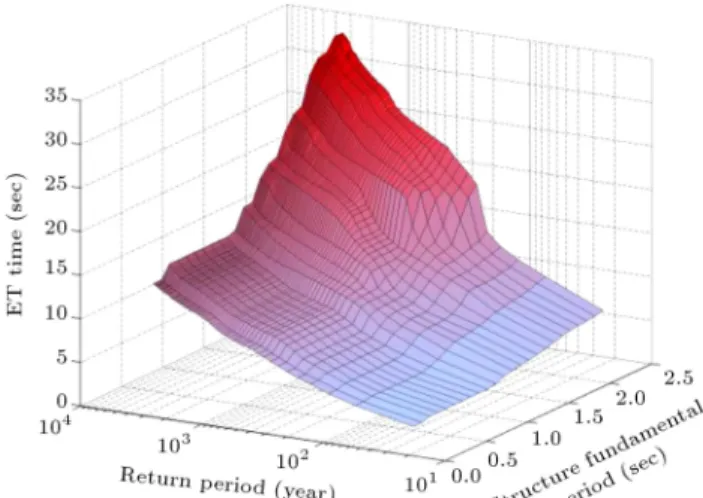
In a work by Mirzaee et al. [5], application of the ET method in performance based design was studied introducing \Performance Curve" and \Target Curve", which respectively expressed the seismic performance of a structure along various seismic intensities and their limiting values according to code recommendations. Hazard return periods corresponding to any particular time in ET analysis are calculated here by matching the response spectra obtained from the ET accelerogram at dierent times and response spectra dened for Tehran at dierent hazard levels. The procedure is based on the coincidence of response spectra at eective periods, i.e. from 0.2 to 1.5 times of structure's fundamental period of vibration. The results show that substitution of the return period or annual probability of exceedance for time in ET analysis and performance curves will make the results more explicit and also increases the usefulness of these curves in calculating expected costs. The variation of the return period with the structural period and analysis time in ET analysis is illustrated in Figures 3 and 4. This correlation provides the corresponding ET time for each hazard level for a specic structure.
In the following sections, ET curve is used to assess the performance of the obtained design for the ve-story structure compared with the target curve. In these gures, ET analysis time has been mapped into return period on horizontal axis and moving average is applied to smooth ET results for inter-story drift envelope curve. The performance of the structure at various hazard return periods can be veried on these gures. The code limitations on structural responses at various hazard levels can also be checked as the target curve. This is one of the advantages of the ET method that the performance of a structure in all hazard levels can be properly depicted in an easy to read gure.
4. Prescriptive seismic design
Commonly, in prescriptive seismic design procedures, structures are checked in one or two deterministically expressed limit states (i.e., ultimate strength and serviceability). In these procedures, the elastic base shear is reduced by a behavior factor (R) to incorporate the inelastic deformation capacity of the structure.
At rst, a ve-story structure is optimally de-signed according to the Iranian National Building
Figure 3. Return period vs. structural period and ET analysis time.
Figure 4. Equivalent ET analysis time vs. hazard return period for dierent structural periods.
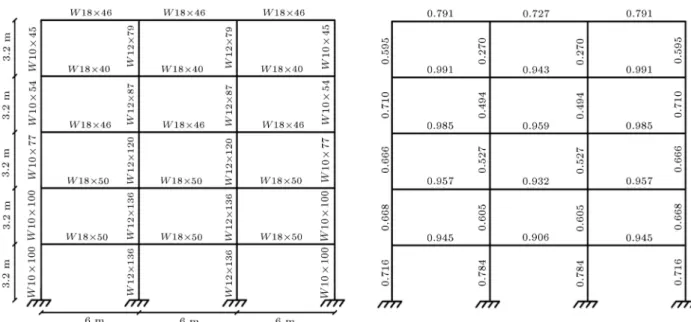
Code (INBC) as a prescriptive design code, which is almost identical to the ANSI/AISC360-10 LRFD design recommendations. The prototype structure is a ve-story and three-bay special moment resisting steel frame. All supports are xed and the joints are all rigid. The beams and columns are selected among seismically compact standard W proles according to Table 1. The geometry of this model can be found in Figure 5. Loading is set according to Iranian National Building Code, Section 6. The structural steel material has yielding stress, Fy = 235:36 MPa, and elastic
modulus, E = 200 GPa. The strong-column/weak-beam design requirement has been considered in design of the structure. According to Iranian Seismic Design Code, seismic loading base shear is determined upon design response spectrum of the 475-year return period hazard level and the elastic base shear is reduced by the behavior factor to allow the structure to absorb energy through inelastic deformations. Demand/capacity ra-tios for an optimum prescriptive design are depicted in Figure 5. As can be seen in this gure, other
Table 1. List of alternative section properties for beams and columns. Beams W 18
35 W 18
40 W 18
46 W 18
50 W 18
55 W 18
60 W 18
65 W 18
71 Side
columns W 10
39 W 10
45 W 10
54 W 10
60 W 10
68 W 10
77 W 10
88 W 10 100
W 10 112 Inner
columns W 12
79 W 12
87 W 12
96 W 12 106
W 12 120
W 12 136
W 12 152
W 12 170
W 12 190
W 12 210
W 12 230
W 12 252
W 12 279
W 12 305
Figure 5. Schematics of steel frames under investigation and demand/capacity ratios according to prescriptive design criteria.
Figure 6. Performance curve (ET curve) for the prescriptive design.
limitations such as drift limits or strong-column/weak-beam limitation have dominated the design in some elements.
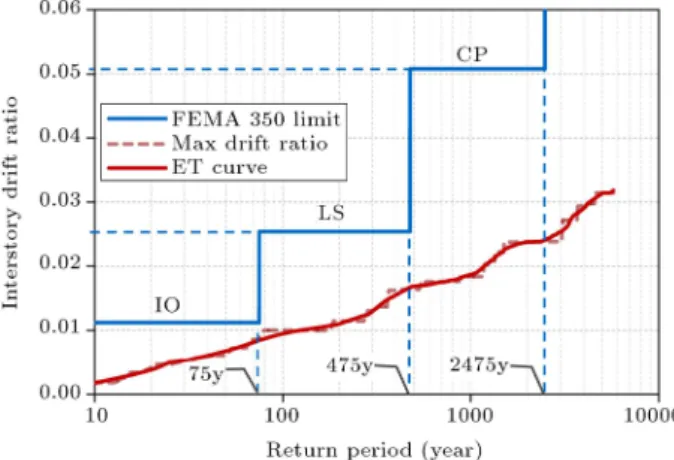
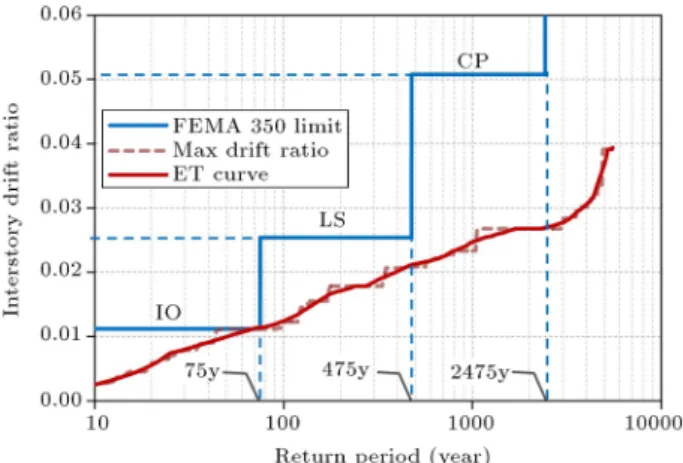
In Figure 6, the seismic performance of the prescriptive design has been investigated according to FEMA-350 limitations on inter-story drift ratios by the ET method. Performance curve (ET curve) and also target curve for this structure are compared in this
gure. FEMA-350 criteria for performance assessment are explained in the next section. It can be veried that the structure has violated IO level limitation but has a proper performance in LS and CP levels.
5. Performance based design
Prescriptive design procedures do not assure reliable performance of the structure in multiple hazard levels during its lifespan since these procedures merely intend to keep the ultimate strength of structural members at an acceptable level. Compared to these procedures, in Performance Based Design (PBD), a more general structural design philosophy is used in which the design criteria are expressed in terms of achieving multiple performance requirements when the structure is subjected to various seismic hazard levels. In most of the currant performance based design criteria, the objective performance of an ordinary building is usually dened to resist a signicant accidental earthquake without structural damage, allow repairable structural damage against a rare major earthquake, and resist the maximum credible earthquake without collapse [11]. In order to assess the performance of structures, various
response estimation methods, such as push-over analy-sis which is widely used in this area, have been used by researchers and also engineers; however, time history analysis is so far believed to be the most accurate methodology for evaluating structural performance. Optimization methods in design procedures have also been used to achieve safe and economical designs which can satisfy the performance based measures. An optimum performance based design methodology is introduced in a work by Estekanchi and Basim [3] utilizing ET method as analysis tool.
The performance based design measures imple-mented in this work are based on FEMA-350 [9]. FEMA-350 has provided a guideline for performance based design of new steel moment resisting frames. In these criteria, a probability based approach is used to explicitly consider the ground motion variability and the uncertainty in the structural analysis. Two discrete structural performance levels, Collapse Prevention (CP) and Immediate Occupancy (IO), are considered in FEMA-350. Limitations on inter-story drifts and forces in various elements, especially in columns, are dened in these criteria for each of these performance levels. Other structural performance levels can be determined on a project-specic basis by interpolation or extrapolation from the criteria provided for the two performance levels. For the purpose of this work, Life Safety (LS) performance level has been dened by interpolating the IO and CP levels. In LS level, the structure experiences signicant damages resulted by the hazard, although some margin remains against either partial or total collapse. The performance objective in this study assuming \seismic use group I" for the prototype special moment frame structure is dened as achieving IO, LS, and CP performance levels in the case of ground motion levels of 50%, 10%, and 2% probability of being exceeded in 50 years, respectively.
Many uncertainties are involved in behavior and response of a building ranging from uncertainties in seismic hazard due to the attenuation laws employed and record to record variability to uncertainties in structural modeling due to simplications and assump-tions used in the numerical analysis [12]. To account for these uncertainties, FEMA-350 uses a reliability based probabilistic approach to dene performance measures that explicitly acknowledge these inherent uncertain-ties. These uncertainties are expressed in terms of a condence level. A high level of condence means that the building will very likely be capable of meeting the desired performance. Considering a minimum condence level of 90% for IO and CP performance levels, the upper-bound limits for the calculated inter-story drift demand obtained from structural analysis would be 0.0114 and 0.0508 and interpolation will result in an upper bound of 0.0254 for LS level.
OpenSees [23] is used to perform structural re-sponse analyses. Concentrated plastic hinges by zero-length rotational springs with elastic beam-column elements are used to model the nonlinear behavior of elements. Plastic regions follow a bilinear hysteretic response based on the Modied Ibarra Krawinkler Deterioration Model [24,25]. To represent shear dis-tortions in the panel zones, they are modeled as rectangles composed of eight very sti elastic beam-column elements with one zero-length rotational spring in the corner based on the approach of Gupta and Krawinkler [26]. P-Delta Coordinate Transformation object embedded in the platform is used to consider the second-order eects.
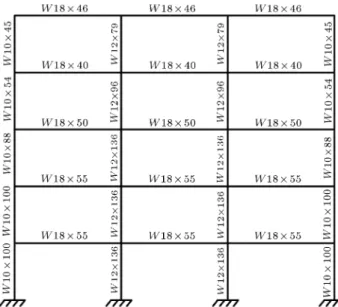
A single-objective optimization problem is dened to nd a design having the minimum initial steel material weight as optimization objective. The limita-tions on inter-story drift demand and axial compressive load on columns and also strong-column/weak-beam criterion according to FEMA-350 recommendations are formulated as optimization constrains. The design vari-ables are the steel section sizes selected among standard W sections. As indicated in FEMA-350, structures should, as a minimum, be designed in accordance with the applicable provisions of the prevailing building codes, such as specications of AISC360 [8] and AISC Seismic [27]. Thus, the AISC360 requirements and FEMA-350 acceptance criteria are implemented as initial design constraints. Optimum design sections have been determined using GA algorithm adopted for performance based design purposes using ET method introduced in a work by Estekanchi and Basim [3]. The optimum design sections can be found in Figure 7. A comparison between performance of the designed frame and the limiting curve according to FEMA-350 in various seismic intensities can be performed using the
Figure 8. Performance curve (ET curve) for the performance based design.
ET curve presented in Figure 8. As could be expected, the optimum design meets the limitations (i.e., code requirements) with the least margins.
6. Value based design
While value can be dened and considered in its broad sense for design purposes, for clarity of explanation, in this research, we consider the structure that is more economical to construct and maintain to be the most valued. As it will be demonstrated in this section, ET analysis provides a proper baseline to per-form economical analyses on design alternatives with acceptable computational cost. Initial construction cost and expected seismic damage cost throughout the lifetime of the structure are usually the two most important parameters for decision making [1]. Pro-viding a reliable estimation of structural responses in multiple intensities is one of the major obstacles in seismic damage cost assessment of structures. Various simplied procedures for seismic analyses have been used by researchers in order to overcome the huge computational demand involved in assessment of sev-eral design alternatives. Nevertheless, cost assessment has been mostly used in comparative studies among a limited number of design alternatives and, recently, direct incorporation of life cycle cost in design process has attracted the attention of researchers [1,28,29]. Push-over analysis has been widely used as seismic assessment tool in this area. However, well known limitations of this analytical tool besides its weak-nesses in estimating oor accelerations to quantify non-structural cost components have increased the need for more realistic and reliable dynamic analysis procedures with tolerable computational demand. In this section, a procedure to calculate the expected cost components using ET analysis results has been formulated. Application of this method in opti-mum design of structures in the framework of next-generation performance based seismic design
consid-ering inherent uncertainties is studied by Basim and Estekanchi [30].
The total cost CTOT of a structure can be
con-sidered as the sum of its initial construction cost, CIN,
which is function of design vector, s, and the present value of the life cycle cost, CLC, which is function of
lifetime, t, and the design vector, s [1]:
CTOT(t; s) = CIN(s) + CLC(t; s): (1)
6.1. Initial costs
Initial cost is the construction cost of a new structure or the rehabilitation cost of an existing facility. In our design example, which is a new moment resisting steel frame, the initial cost is related to the land price, material, and the labor cost for the construction of the building. As the land price and non-structural compo-nents cost are constant for all design alternatives, they can be eliminated from the total cost calculation and the initial steel weight of the structure with a labor overhead can be considered as representor of the initial cost. Thus, an initial cost equal to $500 per m2over the
700 m2 total area of the structure for the prescriptive
design is considered and for other design alternatives, it will be calculated according to their steel weight dierence by a material plus labor cost of 2 $/kg. 6.2. Life cycle cost
Life cycle cost in this study refers to the costs resulting from earthquakes that may occur during lifetime of the structure. Based on the recent literature, multiple limit states according to inter-story drift ratio are considered. These limit states and damages depend on the performance of both structural and nonstructural components. In order to calculate the life cycle cost of the structure, the following cost components are involved: the damage repair cost, the cost of loss of contents due to structural damage quantied by the maximum inter-story drift and also oor acceleration, the loss of rental cost, the loss of income cost, the cost of injuries, and the cost of human fatalities [18,31]. Some other factors have been dened and used by researchers to characterize earthquake consequences. Some of these factors try to quantify the impacts in the whole community level such as losses due to morbidity or loss in quality of life for the population [19] or resiliency measures [32]. In this study, since the main objective is to introduce the value based design methodology and explore the advantages of the ET method in this context, a simple cost model is used and readers are encouraged to refer to the provided references for more detailed models of earthquake consequences.
A correlation is required to quantify these losses in economic terms. Several damage indices have been used to quantify seismic performance of structures. Commonly, inter-story drift () has been considered as a measure of both structural and non-structural
Table 2. Drift ratio and oor acceleration limits for damage states. Performance level Damage states Drift ratio limit (%)
ATC-13 [33] Floor acceleration limit (g) [34]
I None 0:2 aoor 0:05
II Slight 0:2 < 0:5 0:05 < aoor 0:10
III Light 0:5 < 0:7 0:10 < aoor 0:20
IV Moderate 0:7 < 1:5 0:20 < aoor 0:80
V Heavy 1:5 < 2:5 0:80 < aoor 0:98
VI Major 2:5 < 5 0:98 < aoor 1:25
VII Destroyed 5:0 < 1:25 < aoor
damage. In this study, seven limit states according to drift ratios based on ATC-13 [33] are used to describe structural performance as shown in Table 2. On the other hand, maximum oor acceleration is used to quantify the loss of contents. The relation between oor acceleration values and damage states is shown in Table 2 based on a work by Elenas and Meskouris [34]. The addition of the maximum oor acceleration com-ponent in life cycle cost calculation is introduced by Mitropoulou et al. [18]. Piecewise linear relation has been assumed in order to establish a continuous relation between damage indices and costs [7].
Expected annual cost has been found to be the most proper intermediate parameter to calculate life cycle cost of structures using ET method. The proce-dure and formulation to calculate the expected cost components in ET framework are described here in details based on a common framework whose validity is investigated by Kiureghian [35]. The framework for performance based earthquake engineering, used by researchers at the Pacic Earthquake Engineering Re-search (PEER) Center, can be summarized by Eq. (2), named as PEER framework formula. By use of this equation, the mean annual rate (or annual frequency) of events (e.g., a performance measure) exceeding a specied threshold can be estimated by [35]:
(dv) = Z
dm
Z
edp
Z
imG(dvjdm)jdG(dmjedp)jj
dG(edpjim)jjd(im)j; (2) where:
im An intensity measure (e.g., the peak ground acceleration or spectral intensity);
edp An engineering demand parameter (e.g. an inter-story drift);
dm A damage measure (e.g. the accumulat-ed plastic rotation at a joint);
dv A decision variable (e.g., Dollar loss, duration of downtime).
Here, G(xjy) = P (x < XjY = y) is the Condi-tional Complementary Cumulative Distribution
Func-tion (CCDF) of random variable X, given Y = y, and (x) is the mean rate of fx < Xg events per year. The deterioration of the structure has been ignored here and it has been assumed that it is instantaneously restored to its original state after each damaging earthquake.
A fundamental assumption made is that, con-ditioned on EDP, DM is independent of IM, and, conditioned on DM, DV is independent of EDP and IM. Thus, it would be possible to decompose the earthquake engineering task into subtasks presented in Figure 9. The ET method is used in response analysis box in this owchart and it will create a proper baseline to calculate the following boxes.
By considering various cost components as the decision variable, dv, in Eq. (2), (dv), i.e. the annual rate that the cost component values DV exceed a value dv, can be obtained. Results can be presented by a curve with cost values of dv on the horizontal axis and
Figure 9. Performance based earthquake engineering framework [36].
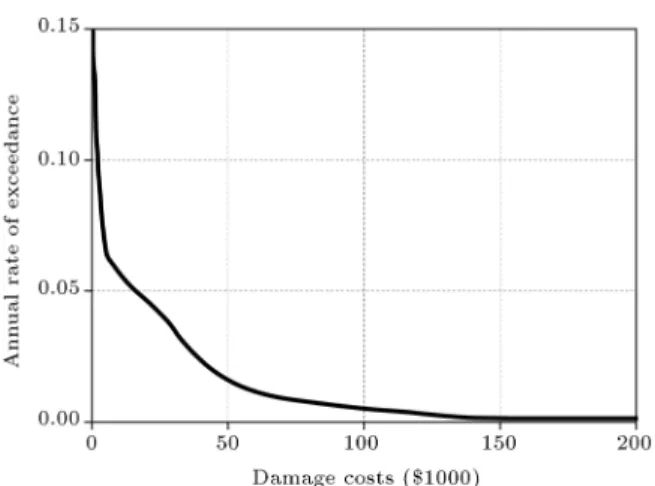
Figure 10. A sample loss curve due to damage cost.
annual rate of exceedance on the vertical axis, known as \Loss Curve" [36].
For variable X, the dierential quantity j(x + dx) (x)j = jd(x)j describes the mean number of events fx < X x + dxg per year. Thus, assuming that X is non-negative, its expected cumulative value in one year is:
E[XX] = Z 1
0 xjd(x)j =
Z 1
0 (x)dx: (3)
Therefore, the area underneath (x) versus x curve gives the mean cumulative value of X for all earth-quake events occurring in one year. In our problem, where x is the cost component values as the deci-sion variable, the area under (dv) versus dv curve
(i.e., Loss Curve) represents the mean cumulative annual component cost for all earthquake events in one year.
Loss Curve can be obtained from ET curve presented above in a practical procedure. First, the annual probability of exceedance of drift ratios should be determined. By reversing the return period on the x-axis to obtain the mean annual rate of exceedance and using it on the y-axis, the annual rate of exceedance of the story drift can be obtained. If the inter-story drift is replaced by component cost applying the linear relationship discussed previously using Table 2, the annual rate of exceedance for the cost component, namely Loss Curve, can be obtained. The procedure to calculate Loss Curve for losses caused by oor acceleration is similar. In Figure 10, a sample loss curve due to damage cost is depicted. The area under the loss curve represents the mean annual component cost caused by all earthquakes in one year.
As mentioned, life cycle cost consists of several components and can be calculated as follows:
CLC=Cdam+ Ccon+ Cren+ Cinc+inj+ Cfat; (4)
Ccon= Ccon + Cconacc; (5)
where 5Cdam is the damage repair cost; Ccon the loss
of contents cost due to structural damage quantied by inter-story drift; Cacc
can the loss of contents cost due to
oor acceleration; Crenthe loss of rental cost; Cincthe
cost of income loss; Cinj the cost of injuries; and Cfat
Table 3. Formulae for calulation of the cost components in Dollars [1,31,33].
Cost component Formula Basic cost
Damage repair (Cdam)
Replacement cost oor area
mean damage index 400 $/m2
Loss of contents (Ccon)
Unit contents cost oor area
mean damage index 150 $/m
2
Loss of rental (Cren)
Rental rate gross leasable area
loss of function time 10 $/month/m
2
Loss of income (Cinc)
Income rate gross leasable area
down time 300 $/year/m
2
Minor injury (Cinj;m)
Minor injury cost per person oor area
occupancy rate expected minor injury rate 2000 $/person Serious injury
(Cinj;s)
Serious injury cost per person oor area
occupancy rate expected serious injury rate 20000 $/person Human fatality
(Cfat)
Human fatality cost per person oor area
Table 4. Damage state parameters for cost calculations [33,37]. Damage
states
Mean damage index (%)
Expected minor injury rate
Expected serious injury rate
Expected death rate
Loss of function time (days)
Down time (days)
(I)-None 0 0 0 0 0 0
(II)-Slight 0.5 0.00003 0.000004 0.000001 1.1 1.1
(III)-Light 5 0.0003 0.00004 0.00001 16.5 16.5
(IV)-Moderate 20 0.003 0.0004 0.0001 111.8 111.8
(V)-Heavy 45 0.03 0.004 0.001 258.2 258.2
(VI)-Major 80 0.3 0.04 0.01 429.1 429.1
(VII)-Destroyed 100 0.4 0.4 0.2 612 612
the cost of human fatality. The formulae to calculate each cost component can be found in Table 3. The rst term of each formula is presented in the last column of the table as the basic cost. The values of the mean damage index, loss of function, downtime, expected minor injury rate, expected serious injury rate, and expected death rate used in this study are based on ATC-13 [33] restated in FEMA-227 [37]. Table 4 provides these parameters for each damage state. Loss of function time and down time are considered as the time required to recover the full functionality of the building based on a table from ATC-13 [33] for earth-quake engineering facility classication 16 and medium rise moment resisting steel frame. Also, Occupancy rate is taken 2 persons per 100 m2. Note that these
are an estimation of cost components and a detailed assessment is necessary to evaluate the expected cost. The method, with no limitation, has the capability of incorporating detailed calculation of cost components. According to Eq. (1), the total life cycle cost is considered as the sum of the initial construction costs and the present value of the annual damage costs summed up through the lifetime of the structure. A discount rate equal to 3% over 50 years life of the building has been considered to transform the damage costs to the present value. This total cost is used as the objective function in optimization algorithm seeking a design with the least total cost.
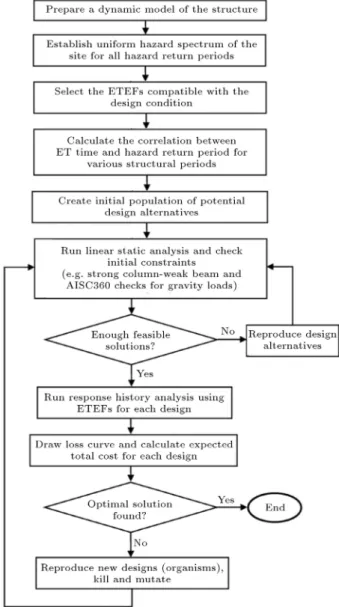
As in the previous sections, Genetic Algorithm (GA) has been used to nd the optimum design. Al-ternative designs should meet some initial constraints. Strong-column/weak-beam criterion should be checked and strength of columns should preserve a decreasing trend along the frame height. Besides these constraints, all AISC360 checks must be satised for the gravity loads. Once the expressed constraints are satised, the LCC analysis is performed. It is important to note that each of these feasible organisms is acceptable design according to the code ignoring seismic actions. In order to reach the optimum solution, the algorithm will reproduce new design alternatives based on the initial population and will mutate until the stop criterion
is met. The owchart of the applied methodology is presented in Figure 11.
Genetic algorithm with an initial population size of 200 leads to an optimum design after about 2600 ET
Figure 11. Flowchart of the value based design by the ET method.
response history analyses. Figure 12 shows the total costs for feasible design alternatives in optimization procedure. The optimum design sections are presented
Figure 12. Total costs for feasible design alternatives in optimization procedure.
Figure 13. Value based design sections of the frame.
Figure 14. Performance curve (ET curve) for the value based design.
in Figure 13. The seismic performance of the optimum design according to FEMA-350 measures is investi-gated in Figure 14. According to this gure, this design satises performance limitations of FEMA-350 with a margin that can be justied by economic concerns.
7. Comparative study
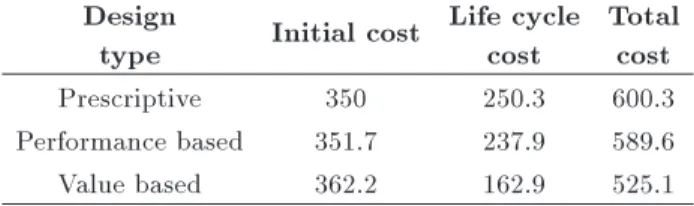
In this section, components of life cycle cost for the three structures (i.e. prescriptive, performance based, and value based designs) are compared. These structures are designed optimally based on various design philosophies. In Figure 15, cost components for the three structures are provided in 1000$. Each bar presents contribution of various cost components and the value of total cost for each design can be found above the bars. Components in bars are in the same order as that of the legend for the sake of clarity. As it can be seen, the prescriptive design has the least initial cost but the largest total cost among three designs and the value based design, having a larger initial cost, has the least total cost in long term. Also, the value based design has a larger cost of content loss due to oor acceleration. It may rearm the sophistications involved in selecting a desired design alternative. In Table 5, initial costs based on the used initial material, present value of life cycle costs due to seismic hazards with various exceedance probabilities, and the determinative part, i.e. total cost of three structures, are presented. It can be veried that a value based design has the least total cost and would be an economical alternative in long term. An extra initial cost of 12200$ over the prescriptive design will
Figure 15. Cost components and total cost for the three designs (1000$).
Table 5. Values of life cycle cost terms for the three designs (1000$).
Design
type Initial cost Life cyclecost
Total cost
Prescriptive 350 250.3 600.3
Performance based 351.7 237.9 589.6
Value based 362.2 162.9 525.1
lead to a decrease by 87400$ in the expected life cycle cost totally having 75200$ of prot. Although performance based design has less expected total cost than the prescriptive design, neither the prescriptive design criteria nor the performance based ones will necessarily lead to an economical design in long term.
8. Conclusions
A framework that directly acknowledges the concept of value in the structural design procedure is established using the advantages of Endurance Time (ET) method. Application of the ET analysis in Life Cycle Cost Analysis (LCCA) has been formulated in a general form which has the capability to be extended using more detailed cost models of the construction. ET method and the resultant performance curve have provided a proper baseline to calculate expected life cycle costs, while the required computational eort is in an ac-ceptable range to be used in conventional optimization techniques. This will provide the means to extend the economic concerns from a merely appraisal tool to a more impressive role which directly denes the design targets. To demonstrate the method and compare it with other common design methods, a ve-story moment frame has been optimally designed according to three distinct design philosophies: a prescriptive design code, a performance based design guideline, and the introduced methodology named Value Based Design of structures (VBD). A case-specic cost model has been dened to quantify the consequences of probable earthquakes. The procedure to calculate life cycle cost of the structure using ET results has been presented and used in an optimum design algorithm. Structural performance and life cycle cost components for the three optimum designs have been compared using ET curve. Results show that the code based design of the structure will not necessarily result in an economical design with less total cost in lifetime of the structure. For the studied building, performance based design requires more initial material cost than the prescriptive design because of its more restricting limitations and, as expected, it has better performance in various hazard intensities. However, the value based design has the least total cost among the three de-signs, although it demands the highest initial material cost. The proposed methodology provides a pathway
towards practical value based seismic design. It also shows that conventional design procedures based on compliance to design code requirements or performance objectives do not assure achievement of the best nal design regarding the overall applicable design concerns. However, this study aimed to introduce a methodology for optimum design based on nancial considerations, and more research is required for dening appropriate models of earthquake consequences, especially models to account for uncertainties.
Nomenclature
aoor Floor acceleration
ATC Applied technology council CCDF Conditional Complementary
cumulative Distribution Function CP Collapse Prevention
Ccon Loss of contents cost
Cacc
con Loss of contents cost due to oor
acceleration C
con Loss of contents cost due to inter-story
drift
Cdam Damage repair cost
Cfat Cost of human fatality
Cinc Loss of income cost
Cinj Cost of injuries
Cinj;m Cost of minor injuries
Cinj;s Cost of serious injuries
Cren Loss of rental cost
CIN Initial cost
CLC Life cycle cost
CT OT Total cost
dm A damage measure threshold dv A decision variable threshold DM Damage Measure
DV Decision Variable
edp An engineering demand parameter threshold
E Elastic modulus
EDP Engineering Demand Parameter ET Endurance time
ETEF Endurance Time Excitation Function FEMA Federal Emergency Management
Agency Fy Yielding stress
g Acceleration of gravity GA Genetic Algorithm
im An intensity measure threshold IDA Incremental Dynamic Analysis
IM Intensity Measure IO Immediate Occupancy
INBC Iranian National Building Code LCCA Life Cycle Cost Analysis LRFD Load Resistance Factor Design LS Life Safety
PBD Performance Based Design PEER Pacic Earthquake Engineering
Research center R Behavior factor s Design vector t Lifetime of structure tET ET excitation time
VBD Value Based Design Inter-story drift ratio
References
1. Mitropoulou, C.C., Lagaros, N.D. and Papadrakakis, M. \Life-cycle cost assessment of optimally designed reinforced concrete buildings under seismic actions", Reliability Engineering & System Safety, 96(10), pp. 1311-1331 (2011).
2. Estekanchi, H.E., Vafai, A. and Sadeghazar, M. \En-durance time method for seismic analysis and design of structures", Scientia Iranica, 11(4), pp. 361-370 (2004).
3. Estekanchi, H.E. and Basim, M.C. \Optimal damper placement in steel frames by the Endurance Time method", The Structural Design of Tall and Special Buildings, 20(5), pp. 612-630 (2011).
4. Basim, M.C. and Estekanchi, H.E. \Application of endurance time method in value based seismic design of structures", Second European Conference on Earth-quake Engineering and Seismology, Istanbul (2014). 5. Mirzaee, A., Estekanchi, H.E. and Vafai, A.
\Ap-plication of endurance time method in performance-based design of steel moment frames", Scientia Iranica, 17(6), pp. 361-370 (2010).
6. Hariri-Ardebili, M., Sattar, S. and Estekanchi, H. \Performance-based seismic assessment of steel frames using endurance time analysis", Engineering Struc-tures, 69, pp. 216-234 (2014).
7. Mirzaee, A. and Estekanchi, H.E. \Performance-based seismic retrotting of steel frames by the endurance time method", Earthquake Spectra, 31(1), pp. 383-402 (2015).
8. AISC360, Specication for Structural Steel Buildings (ANSI/AISC 360-10), American Institute of Steel Construction, Chicago-Illinois (2010).
9. FEMA-350, Recommended Seismic Design Criteria for New Steel Moment-Frame Buildings, USA Federal Emer-gency Management Agency (2000).
10. Ganzerli, S., Pantelides, C. and Reaveley, L. \Per-formance-based design using structural optimiza-tion", Earthquake Engineering & Structural Dynamics, 29(11), pp. 1677-1690 (2000).
11. Pan, P., Ohsaki, M. and Kinoshita, T. \Constraint ap-proach to performance-based design of steel moment-resisting frames", Engineering Structures, 29(2), pp. 186-194 (2007).
12. Liu, Z., Atamturktur, S. and Juang, C.H. \Per-formance based robust design optimization of steel moment resisting frames", Journal of Constructional Steel Research, 89, pp. 165-174 (2013).
13. Wen, Y. and Kang, Y. \Minimum building life-cycle cost design criteria. I: Methodology", Journal of Struc-tural Engineering, 127(3), pp. 330-337 (2001). 14. Liu, M., Burns, S.A. and Wen, Y. \Optimal seismic
design of steel frame buildings based on life cycle cost considerations", Earthquake Engineering & Structural Dynamics, 32(9), pp. 1313-1332 (2003).
15. Takahashi, Y., Kiureghian, A.D. and Ang, A.H.S. \Life-cycle cost analysis based on a renewal model of earthquake occurrences", Earthquake Engineering & Structural Dynamics, 33(7), pp. 859-880 (2004). 16. Liu, M., Burns, S.A. and Wen, Y. \Multiobjective
opti-mization for performance-based seismic design of steel moment frame structures", Earthquake Engineering & Structural Dynamics, 34(3), pp. 289-306 (2005). 17. Fragiadakis, M., Lagaros, N.D. and Papadrakakis, M.
\Performance-based multiobjective optimum design of steel structures considering life-cycle cost", Structural and Multidisciplinary Optimization, 32(1), pp. 1-11 (2006).
18. Mitropoulou, C.C., Lagaros, N.D. and Papadrakakis, M. \Building design based on energy dissipation: a critical assessment", Bulletin of Earthquake Engineer-ing, 8(6), pp. 1375-1396 (2010).
19. Jennings, E.N. \A multi-objective community-level seismic retrot optimization combining social vulner-ability with an engineering framework for community resiliency", PhD Dissertation, Colorado State Univer-sity (2015).
20. Nozari, A. and Estekanchi, H. \Optimization of en-durance time acceleration functions for seismic as-sessment of structures", International Journal of Op-timization in Civil Engineering, 1(2), pp. 257-277 (2011).
21. Estekanchi, H.E. \Endurance time method website", https://sites.google.com/site/etmethod/ (2014). 22. Mirzaee, A., Estekanchi, H.E. and Vafai, A. \Improved
methodology for endurance time analysis: From time to seismic hazard return period", Scientia Iranica, 19(5), pp. 1180-1187 (2012).
23. Mazzoni, S., McKenna, F., Scott, M.H., Fenves, G.L. and Jeremic, B., Open System for Earthquake Engi-neering Simulation (OpenSees), Berkeley, California (2006).
24. Ibarra, L.F., Medina, R.A. and Krawinkler, H. \Hys-teretic models that incorporate strength and stiness deterioration", Earthquake Engineering & Structural Dynamics, 34(12), pp. 1489-1511 (2005).
25. Lignos, D.G. and Krawinkler, H. \Deterioration mod-eling of steel components in support of collapse pre-diction of steel moment frames under earthquake loading", Journal of Structural Engineering, 137(11), pp. 1291-1302 (2011).
26. Gupta, A. and Krawinkler, H., Seismic Demands for Performance Evaluation of Steel Moment Resisting Frame Structures, in Technical Report 132 Stanford University: The John A. Blume Earthquake Engineer-ing Research Center, Department of Civil EngineerEngineer-ing (1999).
27. AISC341, Seismic Provisions for Structural Steel Buildings (ANSI/AISC 341-10), American Institute of Steel Construction, Chicago, IL (2010).
28. Kaveh, A., Laknejadi, K. and Alinejad, B. \Per-formance-based multi-objective optimization of large steel structures", Acta Mechanica, 223(2), pp. 355-369 (2012).
29. Frangopol, D.M., Strauss, A. and Bergmeister, K. \Lifetime cost optimization of structures by a com-bined condition-reliability approach", Engineering Structures, 31(7), pp. 1572-1580 (2009).
30. Basim, M.C. and Estekanchi, H.E. \Application of en-durance time method in performance-based optimum design of structures", Structural Safety, 56, pp. 52-67 (2015).
31. Wen, Y. and Kang, Y. \Minimum building life-cycle cost design criteria. II: Applications", Journal of Struc-tural Engineering, 127(3), pp. 338-346 (2001). 32. Bruneau, M., Chang, S.E., Eguchi, R.T., Lee, G.C.,
O'Rourke, T.D., Reinhorn, A.M., Shinozuka, M., Tierney, K., Wallace, W.A. and von Winterfeldt, D. \A framework to quantitatively assess and enhance the seismic resilience of communities", Earthquake Spectra, 19(4), pp. 733-752 (2003).
33. ATC-13, Earthquake Damage Evaluation Data for California, Applied Technology Council (1985). 34. Elenas, A. and Meskouris, K. \Correlation study
between seismic acceleration parameters and damage indices of structures", Engineering Structures, 23(6), pp. 698-704 (2001).
35. Kiureghian, A.D. \Non-ergodicity and PEER's frame-work formula", Earthquake Engineering & Structural Dynamics, 34(13), pp. 1643-1652 (2005).
36. Yang, T.Y., Moehle, J.P. and Stojadinovic, B., Perfor-mance Evaluation of Innovative Steel Braced Frames, University of California, Berkeley (2009).
37. FEMA-227, A Benet-Cost Model for the Seismic Rehabilitation of Buildings, Federal Emergency Man-agement Agency, Building Seismic Safety Council Washington, DC (1992).
Biographies
Mohammad Charkhtab Basim is an Assistant Professor of Civil Engineering at Sahand University of Technology. He received his PhD in Earthquake and Structural Engineering from Sharif University of Technology in 2015. He had been identied as exceptional talent at SUT and is an honorary mem-ber of Iranian Construction Engineers Society. His research interests include performance based design of structures, structural reliability and optimization, and rehabilitation methods.
Homayoon E. Estekanchi is Professor of Civil Engi-neering at Sharif University of Technology. He received his PhD in Civil Engineering from SUT in 1997 and has been a Faculty Member at SUT since then. He is a member of Iranian Construction Engineers Or-ganization, ASCE, Iranian Inventors Association, and several other professional associations. His research interests include a broad area of topics in structural and earthquake engineering with a special focus on the design of tall buildings and industrial structures. Abolhassan Vafai, PhD, is a Professor of Civil Engineering at Sharif University of Technology. He has authored/co-authored numerous papers in dier-ent elds of engineering, including applied mechanics, biomechanics, and structural engineering (steel, con-crete, timber, and oshore structures). He has also been active in the area of higher education and has delivered lectures and published papers on challenges of higher education, the future of science and technology, and human resources development.

![Figure 9. Performance based earthquake engineering framework [36].](https://thumb-us.123doks.com/thumbv2/123dok_us/8380485.2226375/8.892.482.808.695.1110/figure-performance-based-earthquake-engineering-framework.webp)