INTRODUCTION
In an earlier search for the appropriate number and type
of outgroups to recover monophyletic classes in the
dia-toms (Medlin 2014), there were a group of sequences in
the Silva database (SSUREF_96 and SSUREF_199_128)
that did not fall within the Raphidophyceae, although they
were labeled in Genbank as being new species of
Raphi-dophyceae (Suppl Table I). A revised taxon sampling of
the heterokonts with a reduced number of diatoms for the
18S SSU rRNA gene showed that this group of
sequenc-es consistently fell into a well supported clade separated
from the raphidophytes and thus would appear to be a
new microalgal class in the pigmented heterokonts.
MATERIALS AND METHODS
rRNA sequences from the Chloromorum spp. in Suppl Table I were uploaded from Genbank and aligned to the SILVA SSU rRNA sequence alignment in the ARB program Version 5.5 using maximum primary and secondary structural simi-larity (Ludwig et al. 2004). No filter was applied to the align-ment and full length SSU sequences (2029 bases) from 59 taxa were exported for further analysis, Phylogenetic analyses were performed on the SSU alignment with RAxML (Randomized Axelerated Maximum Likelihood, Stamatakis et al. 2014) and a GTR + G model from the CIPRES online analysis portal (https://www.phylo.org/, Miller et al. 2010). Tree robustness was assessed with a bootstrap procedure with 1000 replicates. This tree was compared with a constrained phylogeny built with all putative raphidophytes forced as a monophyletic group. The comparison was performed with a SH-test (Shimodaira & Hasegawa 1999) using PAUP* (Swofford 2003) with the Ful-lOpt setting and 1000 bootstrap replicates in the testing proce-dure. The phylogenetic tree was also reconstructed by Bayesian inference with MrBayes 3.2.6 (Ronquist et al. 2012) using 4 chains of 2.106 generations, trees sampled every 1000
genera-tions, and burnin value set to 20 % of the sampled trees (400). We checked that standard deviation of the split frequencies fell below 0.01 to ensure convergence in tree search.
RESULTS AND DISCUSSION
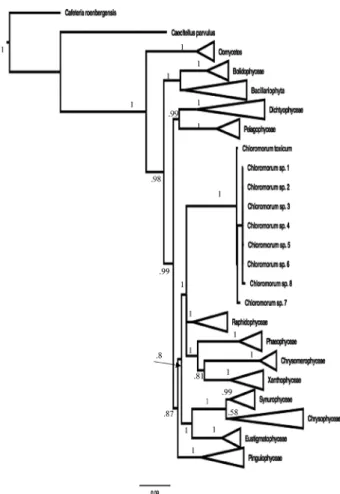
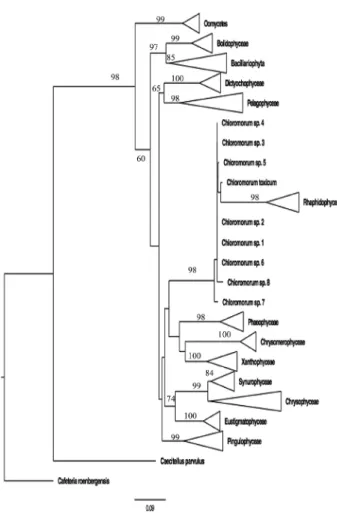
The Chloromorum sequences fell into a well-supported
clade (bootstrap support in % (bt) = 100, posterior
prob-abilities pp = 1) that was sister with no support to a
mod-erately supported larger clade (bt = 61) containing the
Rhaphidophyceae, Chrysomerophyceae, Xanthophyceae,
Phaeophyceae (Figs 1, 2), basically the SI clade of the
pig-mented heterokonts of Yang et al. (2012). This “SI” clade
was collapsed into a polytomy with a posterior probability
of 1 with the BI analysis (Fig. 2) and all other sister
rela-tionships were the same as the RAxML tree. Shimodaira–
Hasegawa tests using a constrained tree (Fig. 3) to place
these new sequences inside the rhapidophytes yielded
a significantly worse tree (P = 0.0001). Based on these
preliminary analyses, it is concluded that this group of
sequences is not raphidophytes but belongs to a new class
of microalgae with at least three species based on SSU
analysis. There are twelve strains in culture at the Marbi-
Marbi-oNC Living Algal Resource Collection (Larc) at the
Uni-versity of North Carolina, Wilmington, which should be
examined in more detail and with other genes sequenced
to ascertain conclusively that they represent a new algae
class with their own set of distinct morphological
charac-ters separating them from the other pigmented heterokont
microalgae and how many new species are present.
This is not the first time that a new algal class has been
identified first with sequence data and to be later defined
taxonomically with morphological/physiological features
from cultured cells. In 1995, Cavalier-Smith et al. revised
the Ochristan (pigmented heterokont) algae and defined
several new classes based on sequence analysis alone,
such as the Chrysomerophyceae. Before that, the Pelago-
Chrysomerophyceae. Before that, the Pelago-
. Before that, the
Pelago-SEqUENCE ANALYSIS CONFIRMS A NEW ALGAL CLASS
l. K. medlin
1, Y. desdeVises
21 marine Biological association of the uK, the Citadel, Plymouth Pl1 2PB, uK 2 sorbonne université, Cnrs, umr 7232, Biologie intégrative des Organismes marins, BiOm, Observatoire Océanologique,
66650 Banyuls/mer, France ABSTRACT. – As �udged by its position in an SSU rRNA tree, a new algal class in the heter-As �udged by its position in an SSU rRNA tree, a new algal class in the heter-okonts has been recovered from a Bayesian phylogenetic analysis of 12 heterokont algal classes. The sequences were deposited in Genbank as raphidophytes, possibly because cells of these species resemble raphidophytes. A constrained tree placing them in the raphidiophytes yielded a significantly worse tree as determined by the Shimodaira-Hasegawa test (P = 0.0001). New efforts should be made to describe this class formally because cultures do exist for these microal-gae.
MICROALGAL CLASS
CHlOrOmOrum
phyceae were described from sequence data and little
sup-portive morphological data (Andersen et al. 1993,
Saun-ders et al. 1997), and after that several other microalgal
classes were described, all with sequence data providing
the strongest and usually the initial support for the new
class: Bolidophyceae (Guillou et al. 1999),
Pinguiophy-ceae (Kawachi et al. 2002), and PhaeothamniophyPinguiophy-ceae
(Bailey et al. 1998). The picobiliphytes were recognized
first as a new class with molecular data (Not et al. 2007)
and it was several years and with much effort before
cul-tures could be established to show conclusively that this
was not a new algal class as originally predicted but a new
heterotrophic protist phylum (Seenivasan et al. 2013).
Nor is it the first time that algal species first believed
to be raphidophytes have been shown with molecular data
to be more closely related to other groups (Bowers et al.
2006). In the Bowers et al. study, Chattonella verreculosa
was found to be a dictyochophyte and later moved into
a new genus Pseudochattonella (Edvardsen et al. 2007,
Hosoi-Tanabe et al. 2007).
The sterols of fatty acids of Chloromorum toxicum
have already been examined (Giner et al. 2008) referring
to its original identification as a species of Chattonella,
a valid member of the Raphidophyceae and compared to
two other microalgae that had originally been described
as Chattonella spp. Its sterols were significantly different
from the other two algae and from those found in another
study by Marshall et al. (2002) who suggested that sterols
and fatty acids were conserved within a genus and thus
more informative phylogenetically than pigments, which
have been traditionally used to define groups of
raphido-phytes.
Yang et al. (2012) studied the evolution of the
pig-mented heterokonts and recovered basically three ma�or
clades in their analyses, which could primarily be defined
by carotenoid pigments. Taxa in the SIII clade have only
the diatoxanthin-diadinoxanthin cycle (D-D cycle) caro-
diatoxanthin-diadinoxanthin cycle (D-D cycle) caro-
diatoxanthin-diadinoxanthin cycle (D-D cycle)
caro-tenoid cycle, as do some taxa in the SI clade, whereas the
SII clade is defined by taxa with the
violaxanthin-anther-axanthin cycle (V-A) cycle). Based on our phylogenetic
analysis, it could be hypothesized that this new algal
class contains diatoxanthin-diadinoxanthin cycle (D-D
cycle), something that could easily be tested to support
their placement in this ma�or clade of the pigmented
het-erokonts.
The one sequence that has a name, Chloromorum
toxicum Tomas, has been used without being validly
pub-lished (Giner et al. 2008), having no Latin description or
Fig. 1. – Phylogenetic analysis of the Chloromorum sequences using a RAxML analysis of selected members of each algal class in the Heterokonta to place them in a phylogenetic context. Bootstrap support values > 50 % are placed at each node.
Fig. 2. – Phylogenetic analysis of the Chloromorum sequences using a Bayesian analysis of selected members of each algal class in the Heterokonta to place them in a phylogenetic con-text.
designation of type material, and thus is a nomen nudum,
which would make also a class name of
Chloromoro-phyceae also illegal. Thus this species will have to be
renamed and another class name linked to the new genus
name for a valid description of all taxa.
REFERENCES
Andersen RA, Saunders GW, Paskind MP, Sexton JP 1993. Ultrastructure and 18S rRNA gene sequence for Pelagomo-nas calceolatagen. et sp. nov. and the description of a new algal class, the Pelagophyceae classis nov. J Phycol 29: 701-715.
Bailey JC, Bidigare RR, Christensen SJ, Andersen RA 1998. Phaeothamniophyceae classis nova: a new lineage of chro-mophytes based upon photosynthetic pigments, rbcL sequence analysis and ultrastructure. Protist 149: 245-263. Cavalier-Smith T, Chao EE, Allsopp MTEP 1995. Ribosomal
RNA evidence for chloroplast loss within Heterokonta: Ped-inellid relationships and a revised classification of Ochristan algae. arch Protistenk 145: 209-220.
Edvardsen B, Eikrem W, Shalchian-Tabrizi K, Riisberg I, Johns-en G, Naustvoll L, ThrondsJohns-en J 2007. Verrucophora farci-men gen. et sp. nov. (Dictyochophyceae, Heterokonta) – a
bloom-forming ichthyotoxic flagellate from the Skagerrak, Norway. J Phycol 43: 1054-1070.
Giner JL, Zhao H, Thomas C 2008. Sterols and fatty acids of three harmful algae previously assigned as Chattonella. Phy- Phy-tochem 69: 2167-2171.
Guillou L, Chrétiennot-Dinet MJ, Medlin LK, Claustre H, Loi-seaux-de Goër S, Vaulot D 1999. Bolidomonas: a new genus with two species belonging to a new algal class, the Bolido-phyceae (Heterokonta). J Phycol 35: 368-381.
Hosoi-Tanabe S, Honda D, Fukaya S, Otake I, Inagaki Y, Sako S 2007.Proposal of Pseudochattonella verruculosa gen. nov, comb. nov. (Dictyochophyceae) for a former raphidophycean alga Chattonella verruculosa, based on 18S rDNA phyloge-ny and ultrastructural characteristics. Phycologia 55. Kawachi M, Inouye I, Honda D, O’Kelly Ch J, Bailey JC,
Bidi-gare RR, Andersen RA 2002. The Pinguiophyceae classis nova, a new class of photosynthetic stramenopiles whose members produce large amounts of omega-3 fatty acids. Phy-col res 50: 31-47.
Ludwig W, Strunk O, Ralf Westram R, Richter L, Meier H, Yad-hukumar Buchner, Lai T, Steppi S, Jobb G, Förster W, Brettske I, Gerber S, Ginhart AW, Gross O, Grumann S, Her-mann S, Jost R, König A, Liss T, LüßHer-mann R, May M, Non-hoff B, Reichel B, Strehlow R, Stamatakis AP, Stuckmann N, Vilbig A. Lenke M, Ludwig T, Bode A, Schleifer KH 2004. ARB, a software environment for sequence data. nucleic acids res 32: 1363-1371.
Marshall JA, Nichols PD, Hallegraeff GM, 2002. Chemotaxo-nomic survey of sterols and fatty acids in six marine raphido-phyte algae. J appl Phycol 14: 255–265.
Medlin LK 2014. Evolution of the Diatoms: VIII. Re-Examina-tion of the SSU-Rrna Gene Using Multiple Outgroups and a Cladistic Analysis of Valve Features. J Biodivers Biopros dev 1: 129.
Miller MA, Pfeiffer W, Schwartz T 2010. Creating the CIPRES Science Gateway for inference of large phylogenetic trees. in Proceedings of the Gateway Computing Environments Workshop (GCE), 14 Nov. 2010, New Orleans, LA: 1-8. Not F, Valentin K, Romari K, Massana R, Vaulot D, Medlin LK
2007. Picobiliphytes: a marine picoplanktonic algal group with unknown affinities to other eukaryotes. science 315: 253-255.
Ronquist F, Teslenko M, van der Mark P, Ayres DL, Darling A, Höhna S, Larget B, Liu L, Suchard MA, Huelsenbeck JP 2012. MrBayes 3.2: efficient Bayesian phylogenetic infer-ence and model choice across large model space. syst Biol 61: 539-542.
Saunders GW, Potter D, Andersen RA 1997. Phylogenetic affin-ities of the Sarcinochrysidales and Chrysomeridales (Heter-okonta) based on analyses of molecular and combined data. J Phycol 33: 310-318.
Seenivasan R, Sausen N, Medlin LK, Melkonian M 2013. Picomonas judraskeda gen. et sp. nov.: the first identified member of the Picozoa phylum nov., a widespread group of picoeukaryotes, formerly known as ‘Picobiliphytes’. Plos One 8: e59565.
Shimodaira H, Hasegawa M 1999. Multiple comparisons of log-likelihoods with applications to phylogenetic inference. mol Biol evol 16: 1114-1116.
Stamatakis A, Ludwig T, Meier H 2005. RAxML-III: a fast pro-gram for maximum likelihood-based inference of large phyl-ogenetic trees. Bioinformatics 21: 456-463.
Swofford DL 2002. PAUP*. Phylogenetic Analysis Using Parsi-mony (*) and other methods. Version 4.0b10. Sinauer Asso-ciates Sunderland MA.
Fig. 3. – Phylogenetic analysis forcing the Chloromorum sequences into the Rhapidophyta for testing the validity of these sequences as members of that microalgal class. Bootstrap sup-port values > 50 % are placed at each node.
Yang EC, Boo GH, Kim HJ, Cho SM, Boo SM, Andersen RA, Yoon HS 2012. Supermatrix data highlight the phylogenetic relationships of photosynthetic stramenopiles. Protist 163: 217-231.
received on October 25, 2017 accepted on January 31, 2018 associate editor: e magnanou
Suppl Table I. – Summary of taxa used in this analysis.
Accession Number Taxon
Bicoecea unpigmented heterokonts
AF174364 Cafeteria roenbergensis Fench., Pat.
AY642126 Caecitellus parvulus (Greiss) Pat, Nyg. Steinb, Turl.
Oomycetes water molds
M32705 Achlya bisexualis Cok., Couch
X54266 Lagenidium giganteum Couch
New Algal Class
EU038275 Chloromorum toxicum Tomas
EU038278 Chloromorum sp. 1
EU038280 Chloromorum sp. 2
EU038274 Chloromorum sp. 3
EU038277 Chloromorum sp. 4
EU038279 Chloromorum sp. 5
EU038276 Chloromorum sp. 6
AY788946 Chloromorum sp. 7
EU038273 Chloromorum sp. 8
Bacillariophyceae
M87326 Cylindrotheca closterium (Ehr.) Reim., Lewin
M87329 Rhizosolenia setigera Brightw.
M87334 Tryblionella apiculata Greg.
Bolidophyceae
AF123596 Triparma mediterranea(Guil., Chret.-Din.) Ich., Santos
AF123595 Triparma pacifica (Guil., Chret.-Din.) Ich., Santos
Chrysophyceae
AF123282 Chromophyton rosanoffii Woronin
AF123291 Dinobryon sociale var. americanum (Brun.) Bach.
AF123293 Ochromonas tuberculata Hibb.
Chrysomerophyceae
AJ295822 Antarctosaccion applanatum (Gain) Del.
U78034 Giraudyopsis stellifera Dang.
Dictyochophyceae
U14384 Apedinella radians (Lohm.) Campb.
U14385 Dictyocha speculum Ehr.
AY254857 Florenciella parvula Eik.
U14387 Pseudopedinella elastica Skuj.
Eustigmatophyceae
U41051 Eustigmatos magus (Pet.) Hibb.
Accession Number Taxon
U41092 Nannochloropsis granulata Karl, Pot.
U41052 Pseudocharaciopsis minuta (Braun) Hibb.
AF045051 Vischeria helvetica (Vis., Pas.) Hibb.
Pelagophyceae
U40257 Aureococcus anophagefferens Harg., Sieb.
U14386 Pelagococcus subviridis Norr.
U78033 Sarcinochrysis marina Geit.
Pinguiophyceae
AF123284 Chrysochaete britannica (God.) Ros.
AF438325 Glossomastix chrysoplasta O’Kel.
AF438324 Pinguiococcus pyrenoidosus And, Pot, J. Bail.
AF438322 Polypodochrysis teissieri Magne
Phaeophyceae
X53229 Costaria costata (C. Ag,) D. Saunders
L43062 Ectocarpus siliculosus (Dill.) Lyng.
AB011423 Fucus distichus L.
L43066 Scytosiphon lomentaria (Lyng.) Link
Rhapidophyceae
AY788922 Chattonella antiqua (Hada) Ono
AY788944 Chattonella subsalsa Bieche.
U41649 Chattonella subsalsa
AY788931 Fibrocapsa japonica Tor., Tak.
U41650 Heterosigma akashiwo (Hada) Hada
AB217629 Pseudochattonella verruculosa (Har., Chi.) Tan, Hon, Fuk, In,, Sako
U41651 Vacuolaria virescens Cienk.
Synurophyceae
U73228 Mallomonas caudata (Iw.) Iv.
U73220 Synura mammillosa Tak.
U73219 Tessellaria volvocina (Play.) Play.
Xanthophyceae
AF083398 Bumilleriopsis filiformis Vis.
U43277 Heterothrix debilis Vis.
AF083399 Heterococcus caespitosus Vis.
AF083400 Mischococcus sphaerocephalus Vis.
U73219 Tessellaria volvocina (Play.) Play.
M55286 Tribonema aequale Pas.
AF083397 Tribonema intermixtum Geit.