ISSN 1479-4403 173 ©Academic Conferences Ltd Reference this paper as:
Balcaen, P. L. and Hirtz, J. R. “Developing Critically Thoughtful e-Learning Communities of Practice.” The Electronic Journal of e-Learning Volume 5 Issue 3, pp. 173-182, available online at www.ejel.org
Developing Critically Thoughtful e-Learning Communities of
Practice
Philip L. Balcaen and Janine R. Hirtz
University of British Columbia Okanagan, Kelowna, Canada
[email protected]
[email protected]
Abstract: In this paper, we consider an approach to developing critically thoughtful e-Learning communities of practice— where participants are deliberate about the use of specific intellectual tools supporting critical thinking. We address Garrison & Anderson’s (2003) argument that such critical thinking should play a central role within the ecology of e-Learning communities and provide our view of what such communities might look like. To do this, we offer four categories of strategies helping to develop such communities—collaborative agreement on goals; facilitator(s) modelling and teaching the tools supporting critical thinking; and shaping communicative interactions within the e-Learning environment to encourage thinking. We provide examples from a current study involving 36 kindergarten to grade 12 teachers’ blended use of information and communication technologies (ICT) and face-to-face sessions to illustrate our view.
Keywords: critical thinking, communities of practice, tools for thought, e-Learning.
1. Introduction
We believe the development of critically thoughtful communities of learners is an essential element for successful e-Learning. Despite its value, there is evidence, within conventional classrooms, that developing communities of thoughtfulness (COT) is more wish than practice (Goodlad 1994; Paul, Elder and Bartell 1997; Case 2006). We have not seen convincing evidence that e-Learning environments are any different in this respect. Fortunately, there are features of e-leaning that are particularly suitable for promoting critical thinking (CT). For example, Garrison & Anderson (2003) claim that the “collaborative yet reflective process of e-Learning has great potential for facilitating critical thinking as a core goal of education” (p 58). However, we cannot simply assume that these potential opportunities will lead to tangible results. The literature suggests that rather than improving thoughtfulness, participation in e-Learning often leads to confusion and loss of interest unless there are strategies designed to enhance CT opportunities (MacKnight 2000). Drinkwater et. al. (2004) add that one of the challenges for ICT users is to understand how e-Learning technologies can “improve thinking”—and this is the focus of this paper.
More specifically we describe efforts to adapt The Critical Thinking Consortium’s (TC2) method of teaching CT for use within an e-Learning community of 36 teachers. The teachers are currently participating in a two-year project to use CT within a newly mandated social studies curriculum. We use preliminary findings collected during the first four months of the implementation project to illustrate our view of COTs. Our purposes are to offer (1) a view of what critically thoughtful e-Learning communities might look like and (2) provide anecdotal indicators of participants’ thoughtful interactions within the e-community we are currently studying.
We begin with a brief overview of the TC2 method, which provides our conceptual framing of CT. While the model offers four fronts for teaching CT, our primary focus is on the community of thoughtfulness aspect of the model. Then, we define and discuss our view of critically thoughtful e-Learning communities of practice, add the four categories of strategies used to support COT, and then use these strategies to illustrate what such a community looks like. Finally, we offer concluding comments.
2. Conceptual framework (the TC2 model)
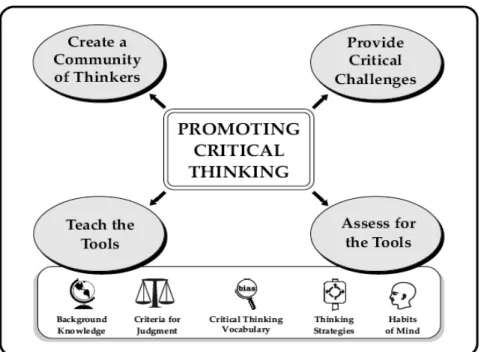
The TC2 method of teaching CT is founded on the belief that people are attempting to think critically when they thoughtfully seek to assess what would be sensible or reasonable to believe or do in a given situation (Case & Daniels in press). This need to reach reasoned judgments may arise in countless kinds of problematic situations and can inform a routine approach to supporting interactions and making decisions within an e-community. Such situations require CT because “there is some doubt as to which is the most appropriate of several plausible responses and because these situations involve criterion thinking.” The power of the model is that it offers four coherent fronts providing a method for encouraging, teaching, and assessing the qualities of good thinkers. In the discussion of each front (sections 3-6) below we include examples taken from the dialogue between participants involved in the study described in section 7.
Figure 1: The four fronts (Used with permission from TC2)
3. Providing critical challenges
The first front is infusing opportunities to think critically, what we refer to as challenging questions. This involves the development of a question form that:
̇ requires judgment;
̇ involves meaningful subject matter; ̇ addresses key aspects of the inquiry;
̇ and requires that participants either possess or can reasonably acquire the needed intellectual tools.
These critical challenges differ from two other commonly asked kinds of questions that focus on knowledge acquisition or mere opinion such as: Who invented the microscope? Or Which novel do you prefer?
Examples of critical challenges using content from typical school curriculum are: Who has the greatest mind: da Vinci, Newton or Einstein? Or in Hamlet, who is the more noble character: Laertes or Hamlet? We argue that these kinds of question play a key role in engaging students in a topic and include use of criteria for judgment i.e. greatest mind and more noble character.
One such challenging question arising early on within the e-community considered here is - What would the most effective name for our group be? This question came about as participants in the study discussed the community’s shared goals and identity and at first appears to be superficial and unimportant. As illustrated later, this question ignited a substantial discussion within the e-community resulting in the development of a clear focus for our work together. We use this example below to elaborate on the other aspects of the model.
4. Teaching the tools
The second and most crucial front is helping participants nurture the use of five categories of intellectual tools (hereafter referred to as the tools) used by competent thinkers. These include: criteria for judgement, background knowledge, critical thinking vocabulary (concepts), and habits of mind. Below, we define each category and provide examples based on the challenging question asked by members of the study after their first face-to-face meeting. The “group name” in question was eventually resolved through on-line discussion before the second meeting a month later. The consensus name is “Project CSI”—Critical Thinking in social Studies Inquiry group—which identifies the focus and nature of their work together.
Criteria for judgment — the grounds for deciding between viable alternatives. Consideration of useful criteria resulted in an on-line discussion/debate characterized by the following posting about the question: What would the most effective [criteria for judgement] name for the professional group be?
Philip L. Balcaen and Janine R. Hirtz
www.ejel.org 175 ISSN 1479-4403
Hi Everyone,
As you're thinking of names, perhaps we could consider these as criteria to guide us: 1) memorable (catchy, fun, quirky or ...)
2) succinct (not too long like the one we started with in September)
3) representative (should be indicative of our collective identity and/or purpose) Participant #14
Background knowledge — the information about a topic required for thoughtful reflection. For a conventional course this includes the objectives typically outlined in the syllabus. In the above example, group members purposefully researched and eventually found out what made for an effective title, knowledge that later informed individual and small group decisions about titles for various curriculum development projects. Critical thinking vocabulary — the range of concepts and distinctions that are helpful when thinking critically. It is important to distinguish between this vocabulary and content specific vocabulary. The CT vocabulary referred to here includes thinking-related concepts such as bias, inference, fact, opinion, etc.
For example, within the challenge considered here, understanding assumptions, or inferences associated with various suggestions was important. Indeed, during the “name-game” discussion referred to above, several participants questioned why certain names were considered and then offered counter arguments. In the end, the group came to a consensus and now use the agreed upon title often when referring to their work together.
Thinking strategies — the heuristics, organizing devices, models, and algorithms useful in making a decision. These include the strategies effective teachers use to help students organize and make sense of subject matter. These include listing positive and negative factors, graphing, collecting and assessing evidence, debating, ranking, etc.
For example, participants offered various pros and cons associated with different possible titles suggested in response to the “group name” question.
Habits of mind — the values and attitudes of a careful and conscientious thinker. These include such dispositions as open, fair and independent mindedness, as well as being circumspect, empathic, reflective, critical and humble among many others.
Within our group name example, participants appeared to be open-minded as they considered alternative ideas and were fair-minded as they assessed the advantages of different proposals.
Together, these five categories of intellectual tools provide for a comprehensive list of intellectual tools that support the development of sound thinking abilities. While this is a limited explanation, TC2 has identified many such tools including examples of how to teach them that will be published by TC2.ca as “the tool kit.”
5. Assessing the tools
The third front is regular assessment of competence in using the intellectual tools. For formal education situations (courses) this requires the careful development and use of appropriate criteria and clearly articulated standards to assess students’ use of the tools for thought. Within informal education environments, such as the one described below, the facilitators engage in on-going formative assessment to decide when to teach the tools for thoughtful participation in a COT and how to shape communicative interactions within the e-Learning environment that encourage and support thoughtfulness.
6. Conceptualizing communities of thoughtfulness (COTs)
The fourth and final front is building communities of thoughtfulness where the focus here is on developing thoughtful e-Learning communities. We begin our description of what this looks like by defining and elaborating on the notions of thoughtfulness, community, practice, and e-Learning community used throughout the paper. We then use examples from our current study to illustrating what such communities look like.
Case and Daniels (in press) provide the definition of thoughtfulness underpinning the conception. They argue that someone is being critically thoughtful when “thinking through problematic situations about what to believe or how to act where the thinker makes reasoned judgments that embody the qualities of a competent thinker”—(use the intellectual tools described earlier).
We also borrow from Lipman (1991) and Newman (1991) to provide an understanding of the community aspect and offer four constitutive features that define a community. Communities arise when participants:
̇ are committed to a common goal;
̇ interact in collaborative pursuit of their goal; ̇ agree on the general procedures;
̇ and assume individual responsibility.
This suggests that decision-making within an effective e-community is not an either/or proposition, rather it is a shared responsibility. As Barell (1995) and Resnick (1989) point out, participants’ sense of being able to influence their learning, as opposed to relying exclusively on someone else to direct them, is a significant factor in encouraging community members to “think for themselves.”
Building on the above principles, we also take account of Wenger, McDermott & Snyder’s (2002 p 9) understanding of practice. Participants in such a community of practice share frameworks, ideas, tools, information, style, language, stories and documents as knowledge and resources enabling the community to proceed with their inquiries. Within our study, both, the periodic face-to-face sessions and the variety of ICT mediated interactions, involve aspects of such practical knowledge participants bring to their work together. Finally, we take account of Rogoff’s (1994) understanding of learning-oriented communities. Rogoff observes that collaborative participation and decision-making involving differentiated roles and responsibilities underpin learning communities. She concludes that for such environments to be effective, the following additional principles inform interactions:
̇ decision making—facilitator and participants negotiate mutually acceptable decisions;
̇ teaching/learning methods—facilitator orients, and mentors while participants engage rigorously with the subject matter in concert with others;
̇ practices—facilitator teaches the “tools” to enable participants to reach thoughtful responses to structured, but open-ended tasks;
Within such an environment, the facilitator’s roles are to frame the tasks, actively mentor participation, and provide support in developing the tools needed in order to reach thoughtful conclusions. For their part, participants work within various negotiated structures and shared norms as they engage seriously with the subject matter.
A critically thoughtful e-Learning community of practice requires taking account of the above defining aspects resulting in the need for use of the following categories of strategies within such communities:
̇ collaborative agreement on goals, routines and activities; ̇ facilitator(s) personally modelling critical thinking;
̇ facilitator developing/identifying and teaching the tools supporting a critically thoughtful community;
̇ participants shaping communicative interactions to encourage thinking.
7. Considering the strategies for supporting thoughtful e-Learning communities of
practice
7.1 Background and the learning environment
In this section, we use the categories of strategies to organize and explore examples of dialogue from our current study to illustrate what such thoughtful communities looks like. The examples used are taken from the first six months of a current two-year study where 36 practicing pre-school to grade 12 teachers have volunteered to participate in professional development aimed at implementation of a new social studies curriculum within the Province of Alberta, Canada. The teachers are drawn from a large geographical area
Philip L. Balcaen and Janine R. Hirtz
www.ejel.org 177 ISSN 1479-4403
about half the size of Great Britain and working situations ranging from a one-room Hutterite Colony school to Public Secondary Schools in cities of about 80,000 inhabitants.
Professional development (pro-d), as used here, refers to participation in activities (typically workshops) focused on introducing teachers to new curriculum and teaching methods. The approach taken includes monthly fact-to-face session (large and small groups) with between-session use of various ICTs to support learning. In addition, the three facilitators supporting the e-Learning use the concept of communities of thoughtfulness outlined above to inform their work. It is also important to note that a central aspect of the pro-d program is teaching teachers about the TC2 method.
The ongoing use of ICT includes WebCT discussions and chat rooms, e-mail, video, live classroom and video/telephone conferencing. The face-to-face sessions are planned by facilitators as occasions for teachers to learn about aspects of the TC2 method. The small group sessions are intended as opportunities for participants to plan and develop collaborative inquiry projects like those outlined below. The variety of ICTs used is intended to help teach and extend understanding of CT and to support participants’ various inquiries.
Our overall study involves inquiry into these teachers’ developing understanding of CT methods and their use of various ICTs to support their small group inquiries. Dialogue about these small group inquiries forms the basis of the e-Learning community and is the source of examples offered. Below we briefly describe the group inquires and then elaborate on the four categories of strategies using examples from participants e-discussions.
7.2 Participants’ inquiries
The participants quoted below are involved in developing, piloting and refining curriculum products as a critical inquiry oriented approach to implementing the new Alberta Social Studies curriculum. It is their shared inquiry that underpins the community of practice or as Lipman (1991) and Newman (1991) suggest, constitutes or defines the community. The kinds of curriculum products take varied forms including:
̇ developing lessons to adapt textbook resources for different learning abilities; ̇ assembling exemplars for use in guiding assessment of critical thinking;
̇ creating lessons using literature that integrates social studies and language arts with critical thinking;
̇ integrating ICTs such as smart boards, social learning software, web quests and with critical thinking.
For example, one group calling themselves 7 for Socials 7 are developing a set of resources for teaching and assessing grade seven students’ habits of mind. Another group has decided on a critical question involving comparison of different cultural groups from the region. One participant proposes:
Hi Group;
I've gathered some info and ideas on [First Nations] Potlatches and developed activities comparing the traditions of potlatches to [European] Christmas traditions.
I don't know how to word the critical challenge or even if this is a good task. I need some feedback! Please! Thanks a bunch #10
This group meets weekly using ICTs to share and critique aspects of their progress. The dialogue between groups such as the 7 for social 7s and among the whole group provides the examples used below to illustrate or view of a thoughtful e-Learning community of practice. As indicated earlier, we use the four categories of practices to organize and illustrate our view.
7.3 Collaborative decision making
The first category of supporting practice is collaborative agreement on, and implementation of, appropriate goals, routines and activities. From the beginning of the project, participants have collaborated to decide everything from the name of the group (CSI: Collaborative Social Studies Inquiry), to the dates and time of face-to-face and virtual sessions, to the focus and nature of their small group inquires. This has required that participants:
̇ provide reasons supporting different positions;
̇ consider several possible options or pros and cons for aspects of the project. All this within an environment where:
̇ respect and sincerity are expected; ̇ use of the CT vocabulary is normal;
̇ participants solicit ideas and suggestions from others;
̇ participants are encouraged to explore or defend positions from various points of view;
̇ praise is offered for thoughtful, insightful or empathic responses over merely correctly recalled ones.
The following excerpt from a group working to develop an inquiry into use of criteria to help focus on re-naming categories of tools in “kid Language” is typical of the strings both within small groups and between the entire group. The tone of appreciation, the use of CT tools and the critical give and take of ideas are typical within the community.
#17 ... this is awesome. Can I say that I am jealous of you being able to have such fun with this stuff. I did a similar thing with
Background Knowledge...I call it "What do you know?" Criteria for Judgment ... I call it “How will you decide?" Critical Thinking Vocab .... "How will you say it?"
and so on, I don't have the document right here in front of me but I have found it increasingly effective to pare down the vocab to an understandable level for young students. I will send you the whole list of my ideas when I return to school. Participant #11
While we will not complete a comprehensive analysis of data until later this year, it is commonplace throughout the data to find lengthy exchanges between both the whole group and the smaller inquiry groups where participants are engaging in exchanges about their goals and activities
7.4 Facilitator modelling
The second category of practices involves the facilitator(s) personally modeling the attributes—the intellectual tools---of a good critical thinker. We have found that it is important for facilitators to be explicit about their use of sound thinking and respectful discussion within their postings. Both facilitators working within the study try to do so whether they are discussing use of the technology, aspects of critical thinking, or providing feedback about other ideas being considered within the community.
We have learned from classroom experience (Case & Balcaen, 2007) that at the very least, facilitators need to:
̇ Not be dogmatic and not always have “the” answer” ̇ Provide “good” reasons for decisions and actions;
̇ Be willing to change their mind when other good reasons are offered; ̇ Acknowledge the existence of different positions on issues.
In the posting that follows, the facilitator is trying to not be dogmatic while still raising a thoughtful question for the participant who has asked about the effectiveness of her ideas. He is also attempting to model the existence of different perspectives on the issues by placing himself in a student’s position.
Hello Participant # 9
I sure agree that there is a lot of great work going on and wish that I could be closer to and part of the fun. The characters you are developing to represent different habits of mind are great and the graphics engaging. When I looked at Jack Rabbit, for example, I wondered about using kid language for the criteria that would better compliment the rest of the graphic? I might just be soooo far out of context for this suggestion/question to be meaningful---I was just trying to put myself in a student's place.
Philip L. Balcaen and Janine R. Hirtz
www.ejel.org 179 ISSN 1479-4403
In another posting, the facilitator responds to a technology related problem when a participant asks for clarification. She offers a helpful source of background knowledge, takes a non-dogmatic position, and encourages a collaborative approach to problem solving.
Hi # 4, Thank you for letting me know that you had a problem. I will be creating a help document for posting discussions in the coming day or two and will post it in the tutorials area. If you could look at this and see where the thing falls apart - that may be helpful for sorting out what happened. Facilitator # 2
As is the case throughout much of the data reviewed so far, both facilitators are making efforts to model and be explicit about the attributes of good critical thinking.
7.5 Teaching the tools for participation
What we have learned from previous work is that without teaching and assessing for the tools for critically thoughtful participation, we cannot reasonably expect the emergence of a critically thoughtful e-community. Here the tools for thought are often learned within the context of experiential face-to-face sessions augmented by video/audio interactions and various forms of e-dialogue. The e-discussions play a significant role in teaching and extending the thinking tools used by participants. These include but are not limited to:
̇ use of criteria such as relevance and clarity;
̇ developing the essential background knowledge needed to participate;
̇ developing or extending understanding of key thinking vocabulary such as unanimous, consensus, minority position, or inference;
̇ developing thinking strategies such as critiquing in a non threatening manner (using questions, beginning with a positive);
̇ and supporting the development of the habits of mind used by a critical thinker such as being independent minded, sensitive to others and self-monitoring.
The following note, like many others, illustrates one member of the 7 for social 7 group’s modeling of several of these tools. She extends the thinking strategy of comparison to include students role-playing of pro and con positions and suggests going beyond this to a debate. She also uses questions effectively to provide feedback about areas lacking clarity and needing further elaboration. Her tone indicates that she is quite sensitive to the person she is responding to.
Hi # 10
I liked your idea of relating Potlatches to Xmas. The comparison would make Potlatch a lot more real to students. I thought the write up on Potlatches would be easy for grade five students to understand. I didn't quite understand gifts as payments. Could you explain that for me?
I was also wondering about adding an extra activity to follow the comparison. What about having some groups of students being pro Xmas/potlatch and other groups being not so sure about the celebrations. Groups, based on the point of view that they are asked to take could rate the different aspects of Xmas/Potlach and then write an argument for their stance. This could possibly be turned into a debate (I have the rules for debating). I am not sure what the big question would be or whether there needs to be one. # 32
While the facilitators periodically take on an instructional role within the e-discussions, most often it is other group members, such as 32, who extend understandings considered during previous face-to-face sessions to help advance others.
7.6 Facilitator designing a communicative environment to support thinking
The central role of a facilitator in such a community is that of designing and shaping the communicative interactions within the e-Learning environment to encourage thinking. Case and Balcaen (2007) identify whole group discussions, facilitator interactions with individual participants and communications among participants as three categories of interactions that support thinking
Whole group discussions--occur within the face-to-face sessions and frame the whole group e-discussions within a Main folder established on the first day of work together as well as several others (the name game, assessment, and future chat room topics) established after subsequent face-to-face sessions. Small inquiry
groups have established their own folders where they carry on focused discussions about their work together. Following Case and Balcaen (2007), we argue that effective whole group discussions are encouraged by:
̇ limited input from the facilitator;
̇ the use of questions that invite debate and require the use of criteria to make judgments; ̇ contributions that are substantive and worthwhile;
̇ and when all participants are invited to participate equally.
In the study we find that facilitators often limit their input to teaching and advancing use of the tools, providing clarification in response to questions, or raising challenging questions for the community at large. The following posting from a discussion about assessment issues illustrates the kind of facilitator input within the general community dialogue. Here, in a typical note, the facilitator provides limited input, identifies other useful sources of information and invites all participants to respond to a substantive and worthwhile question.
Attached is a document produced by teachers in BC that is focused on assessment issues and portfolios that might be of some use. You might also be interested in an online discussion on assessment with Prof. Rob Tierney from UBC planned for this week at the Community Updates cite. I wonder what the most important assessment challenges facing you and others are as we begin to consider assessing critical thinking as part of our projects? Facilitator3
Communication with individuals — While much of the facilitators’ input to the discussions is intended for the general audience, at times they must respond to individuals. The following three strategies generally help students answer questions for them themselves and we find these techniques in several facilitator postings.
̇ Turn the question back by asking questions like; What is your best guess? or How would you respond if asked this question?
̇ Prompt with clues or hints or offer an example or new situation that might help them see their response as problematic.
̇ Suggest tentative answers, including those that many participants would see as flawed such as, I’m wondering if it might be? or I’m not certain, some people might think….
In the following posting, the facilitator uses these strategies when responding to a request about whether a particular board game would work as a critical challenge.
I don't know if any of what I have offered is even helpful. What do you think? I'm wondering if the students could be asked to design their own board game for grade 5's? Would that work? Facilitator # 1
Communications among participants — Peers provide most of the individual feedback within the study. This kind of feedback is essential within a critically thoughtful community because it involves thinking critically about another’s work. That is, participants are offering assessment based on identifiable criteria such as engaging, interesting, well organized, or justifiable. Within the study, participants were offered the following suggested strategies about feedback that supports thoughtfulness.
̇ Emphasize positives as well as things needing improvement
̇ Frame things needing improvement in the form of a query such as “I am unclear why you did it this way. Could you explain?”
̇ Initially, encourage suggestions for improvement that are low risk, easy to perform and have obvious benefits.
For example, the following anonymous posting was in response to a video-conference where small groups presented the inquiry ideas they were working on.
I am very appreciative of the presenters who bravely opened their inner workings to the group. I wonder if for critique purposes it would have been helpful to have the written materials available beforehand. I was impressed by the thought behind and quality of both projects presented.
These three forms of communications supporting thoughtful communities together with collaborative decision making, facilitator modeling, teaching the tools for participation provide a practical view of a thoughtful e-leaning community of practice in action. However, we must acknowledge that like most e-Learning
Philip L. Balcaen and Janine R. Hirtz
www.ejel.org 181 ISSN 1479-4403
environments, not all interactions involve what we would characterize as thoughtfulness. We are impressed by the changes we see as the project proceeds and will report on these when the study concludes.
8. Discussion and conclusions
In our paper, we have argued for and outlined a view of critically thoughtful e-Learning communities of practice. Our initial review of data indicate that the professional development facilitators are practicing the four categories of strategies that we believe are useful in developing thoughtful e-Learning communities by: encouraging collaborative agreement on goals, routines and activities; modelling critical thinking; teaching the tools supporting a critically thoughtful community; and shaping communicative interactions within the e-Learning environment to encourage thinking. Dialogue within the large and smaller inquiry groups of participating teachers indicates that at least some of the participants are using the identified tools demonstrating the thoughtful form of participation that we hope for. The most telling demonstration of the emerging critical community is that many participants are volunteering to present their curriculum products at a symposium within a forum where they will be open to peer critique.
References
Barell, J. (1995) Teaching for thoughtfulness: Classroom strategies to enhance intellectual development, Longman, New York.
Case, R. & Wright, I. (1999) “Taking seriously the teaching of critical thinking”, R. Case & P. Clark (Eds.) The Canadian Anthology of Social Studies, Pacific Educational Press: Vancouver, pp179-193.
Case, R. (2005) “Moving critical thinking to the main stage”, Education Canada, 45(2), pp45-49.
Case, R. and Balcaen, P. (2007) "Supporting a community of critical thinkers", R. Case & P. Clark (Eds.) The Canadian Anthology of Social Studies: Issues and Strategies for Elementary Teachers, Pacific Educational Press, Vancouver. Case, R. and Daniels, R. (in press) "Teaching the tools to think critically", R. Case & P. Clark (Eds.) The Canadian
Anthology of Social Studies: Issues and Strategies for Elementary Teachers, Pacific Educational Press, Vancouver. Drinkwater, P., Adeline, C., French, S., Papamichail, K., Richards, T. (2004) “Adopting a Web-Based Collaborative Tool
to Support the Manchester Method Approach to Learning”, [online], ©Academic Conferences Limited, http://www.ejel.org
Garrison, D. and Anderson, T. (2003) e-Learning in the 21st century. A framework for research and practice, Rutledge Falmer, London.
Goodlad, J. (1994) A place called school: Twentieth anniversary edition, McGraw-Hill, Whitby, ON. Lipman, M. (1991) Thinking in education, Cambridge University Press, Cambridge.
MacKnight, C. (2000) “Teaching Critical Thinking through Online Discussions”, Educause Quarterly, Vol 4, pp38-41. MCCombs, B. and Vakili, D. (2005) “A learner=centered framework for e-Learning”, Teachers College Record, 107(8),
pp1582-1600.
Newman, F.W. (1991) “Promoting higher order thinking in teaching social studies: an overview of sixteen high school departments”, Theory and Research in Social Education, 19(4), pp324-340.
Paul, R. Elder, L. & Bartell, T. (1997) “Study of 38 Public Universities and 28 Private Universities To Determine Faculty Emphasis on Critical Thinking In Instruction”, The Center for Critical Thinking, Sanoma, CA.
Rogoff’, B. (1994) “Developing understanding of the idea of communities of learners”, Mind Culture and Activity, 1(4), pp209-229.
Wenger, E., McDermot, R., & Snyder, W. (2002) Cultivating Communities of practice: a guide to managing knowledge, Harvard Business School Press, Boston.
ISSN 1479-4403 183 ©Academic Conferences Ltd Reference this paper as:
Leyking, K. Chikova, P. and Loos, P. “Competency - and Process-Driven e-Learning – a Model-Based Approach.” The Electronic Journal of e-Learning Volume 5 Issue 3, pp 183-194, available online at www.ejel.org
Competency - and Process-Driven e-Learning – a Model-Based
Approach
Katrina Leyking, Pavlina Chikova, and Peter Loos
German Research Center for Artificial Intelligence, Saarbruecken, Germany
[email protected]
[email protected]
[email protected]
Abstract: As a matter of fact e-Learning still has not really caught on for corporate training purposes. Investigations on the reasons reveal that e-Learning modules like WBTs often miss any relevance for the tasks to be accomplished in the day-to-day workplace settings. The very learning needs both from an organizational and individual perspective are neglected. Content brought to the learner very often meets neither the individual competency gaps nor the organizational learning goals. Time passed between acquisition and application of knowledge is too long. In short, business processes on the one side and learning-related processes on the other are not aligned adequately. Thus, we see an urgent need for concepts on how to derive corporate training actions from business tasks in order to improve employees’ business performance. This paper presents an integrated approach for competency- and business process-driven learning management supported by information technology (IT), developed within two projects named PROLIX and EXPLAIN. Keywords: authoring, business process management, competency development, learning content, learning objectives, learning processes
1. The need for business relevant content
Investigating reasons why Learning does not really catch on for corporate training purposes reveals that e-Learning modules like WBTs exhibit only little significance for actual learning needs both from an organizational and individual perspective, and is often irrelevant for the tasks to be accomplished in daily workplace settings. Content brought to the learner very often meets neither the individual competency gaps nor the organizational learning goals. Time passed between acquisition and application of knowledge is too long. Altogether, business processes on the one side and learning-related processes on the other are not interlinked adequately. As a consequence, employees are little motivated to pursue online courses which do not help them, neither to improve their performance on current tasks nor to solve any recent problems. Thus, there is an urgent need for concepts on how to adjust corporate training actions to the context of business tasks in order to improve employees’ business performance. Only if they are closely coupled to business operations and their respective need for learning, innovative technology-enhanced learning (TEL) will be adopted at the workplace. Without a sufficient integration of business requirements into e-Learning authoring, any corporate training solution is doomed to fail.
The idea pursued proposes business process models as a requirements basis for the production of learning modules providing problem- or task-oriented content. Enhanced by additional information like employees responsible, supportive software, business goals and most of all competencies required, they represent the context of business situations. Matched with individual competency profiles, they provide information about those very competency gaps that constitute the personal learning objectives. This competency- and process-based context information is used to answer didactical and structural questions for the learning module to be produced. Furthermore, it facilitates the search for suitable material based on metadata. Hence, a learning module can be developed that fulfils the learner’s immediate needs in his specific working role as an employee. Supported by easy-to-use and low-cost IT-systems, the approach enables instant learning activities by reducing the time-to-competency. The concept is demonstrated along the prototypes of two ongoing research projects, PROLIX and EXPLAIN, both dedicated to process-oriented integration of core business and learning-related functions in general and authoring activities in particular.
This paper presents an integrated approach that allows for business-relevant learning content by leveraging business process management to enhance training material with competencies required for improving employees’ business performance.
2. Business processes as context for competency-driven learning
Business Process Management (BPM) has become an established approach in business management theory and practice over the last twenty years, the two most important concepts being Business Process Reengineering (BPR) and Continuous Process Improvement (CPI) (Hammer & Champy 1993) (Scheer
2005). Implementing new or enhanced processes, which are usually supported by IT, aims at improving efficiency and effectiveness of business operations.
On the search for connections between learning and business concepts, the process entity reveals itself as intersection between both areas of analysis. A business process is defined as “a continuous series of enterprise tasks, undertaken for the purpose of creating output” (Scheer 2005). Overcoming functional isolation of departments imposed by structural or hierarchical organizations, process orientation has brought to business management a more dynamic, customer-oriented perspective on the operative, tactic and strategic activities. Today, most organizations and their supporting ICT systems have incorporated processes as central business objects. They use process-driven ICT architectures such as ERP, SCM, CRM and Business Intelligence tools that support employees in the process execution. Companies manage their businesses along their processes, starting from design over execution to controlling and monitoring of the processes what in the end feeds back into improved business process design. As this process lifecycle has become the central instrument of business management, it lends to be the leverage for a process-driven learning management as well.
The execution of business processes and thus their performance are decisively influenced by the knowledge and competencies of the employees involved (Remus 2002). Vice versa, changes in business processes have an impact on the required competencies, employees have to hold for an adequate execution of the business tasks. The employees thus become a central resource for companies since they possess the relevant know how or the “intellectual assets” (North 1998). The continuous enhancement of employees’ competencies is therefore an important precondition for process optimisation.
The significance of employees as potential knowledge carriers indicates the high importance of a competency-related approach to the planning and management of business processes. This leads to the conclusion that in business process modelling, an integrated view of business processes, organizational structures, information systems etc. with knowledge and competency is needed. Questions that are to be gathered from competency-oriented business process models are:
̇ Which knowledge categories are present in a company (implicit/explicit)?
̇ What competency is needed for the execution of a certain function or process?
̇ Which organizational unit or which employee needs and uses the necessary knowledge?
̇ Which information systems contain stored knowledge?
Competency-oriented BPM has to take into consideration existing approaches and systems for BPM, learning and knowledge management (Bullinger & Schreiner 2001) (Gronau 2005). Currently, many different information systems exist in the market, which support a broad spectrum of functionalities in the respective fields of BPM, knowledge management and e-Learning. However, they lack the integration across the fields necessary to support the requirements described above.
2.1 A process-driven learning lifecycle
Being the semantic interface of business ICT infrastructure, business processes represent the potential linkage between learning and business systems. A business process provides the context information necessary to identify learning needs and design matching learning material that is meaningful for organizational business goals and individual learning goals (Specht 2006). This paper aims to position the thesis of a reciprocal relationship between business and learning processes leveraging future workplace learning and competency development. Hence, the process lifecycle serves as a conceptual framework to add business relevance to the most innovative learning infrastructures and thus making them economically sustainable.
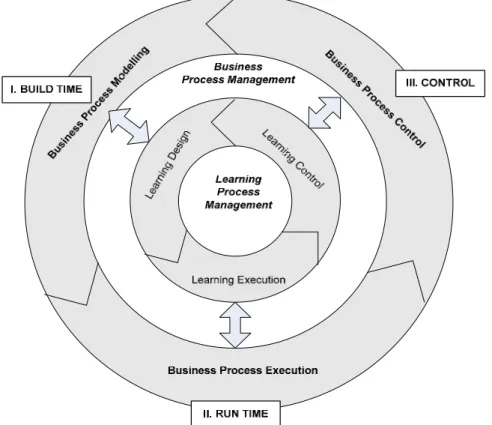
As Figure 1 illustrates, a business process lifecycle encompasses the following three steps (Scheer & Schneider 2006): At first, in order to master complexity of an enterprise environment, business processes are modelled according to business requirements. As the term implies, a business process model reflects business operations by focusing on relevant activities, their timely or logical interdependences while leaving out secondary details. Thus, it serves as a basis for the second phase of implementing business processes into software systems. Therefore, the modelling phase is often assigned to build time of business application software. Having the business logic embedded, enterprise systems – most prominently ERP solutions such as SAP R/3 – automate business processes accordingly ensuring their execution as process instances (run time). Last but not least, such a software-based process automation allows for measuring business key
Katrina Leyking, Pavlina Chikova, and Peter Loos
www.ejel.org 185 ISSN 1479-4403
performance indicators (KPI) within the systems which provide information that feeds back into business process (re)design (control time).
Figure 1: Integrated business and learning process lifecycles
Throughout the lifecycle, the process model represents business requirements, i.e. the factors that drive an organization’s success or failure. As a business process focuses on functions which are to be carried out in order to achieve a certain output, an enterprise’s success depends on the proficiency of the employees in charge of these activities. This is where learning enters the stage: Functions of a business process model determine learning goals. They define competencies for both individual employees and the entire organization necessary for smooth process execution. Moreover, organizational roles assigned to process functions are made up by a set of skills and competencies. Given this demand-driven linkage between business processes and organizational learning, the process lifecycle suggests to be applied to learning processes as well. Structuring learning process management in analogous phases of design, execution and control provides a common ground for interlinking business and learning processes. However, it must be understood that these interdependencies do not only occur within the phases but also across them. Thus, correlations as indicated in the figure are primarily of illustrative, rather simplifying purpose.
Given the close linkage between learning and business process as well as the advanced automation of both concepts, combining business systems and learning systems promises to leverage a series of synergies:
̇ Learning needs identified at the point of action within a business process can be directly translated from the given context to adequate learning processes that help to close the competency gap and therefore improve the individual performance in the process.
̇ Information and explicit knowledge generated and used within business processes such as
product development can be directly transferred to the content development (authoring systems)
instead of laboriously collected ex-post.
̇ Personalized, adapted learning activities are integrated into ongoing business tasks and
challenges (ambient workplace learning).
̇ The impact of accomplished learning processes on the business process performance can be
closely measured, compared to business goals and provide feedback for future training design, ranking of available learning objects for that business context, etc.
To achieve these objectives, innovative and extended methodologies, architectures, frameworks and tools that support the process-oriented deduction, retrieval as well as the distribution of relevant knowledge to the workplace learner are needed. The fulfilment of this vision will be tackled by the activities of the EU/IST IP on
“Process-oriented Learning and Information eXchange (PROLIX)” (URL:http://www.prolixproject.org). PROLIX’s major goal is to align people and processes in complex and dynamic working situations by addressing the needs of employees and companies at the same time. Due to this, it is aimed at creating and implementing an open, service-oriented technology enhanced learning architecture for process-driven learning and information exchange that supports a complete organizational and individual learning process lifecycle. (Martin & Wolpers 2005)
This paper focuses on modeling business processes and enhancing them with competencies as well as process- and competency-driven development of content within the build-time of a lifecycle. The following sections are to delineate potential synergies of combining both concepts and its implications further.
2.2 Existing methods for representing competencies in business processes
Best practices of BPM include modeling business processes in semi-formal diagrams that are easy to understand by business analysts and at the same time sufficiently formal to provide a technical basis for software implementation. The Architecture of Integrated Information Systems (ARIS) has become a widespread approach for business process modelling and management. The ARIS approach takes knowledge and competencies into consideration based on the assumption that all knowledge present in a company is related to business processes. Knowledge management encompasses the development, monitoring, support and improvement of strategies, processes, organizational structures and technologies. This includes all activities relating to the acquisition, preparation, transmission, and utilization of knowledge. Most of these aspects can be depicted using ARIS methods such as EPCs, organizational charts, function allocation diagrams, eERMs, etc.
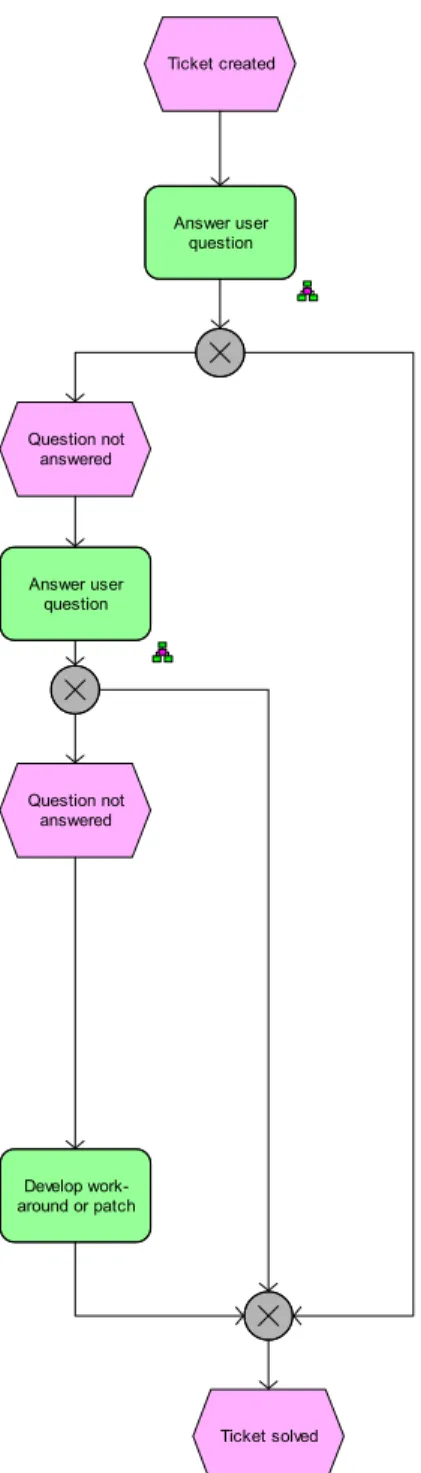
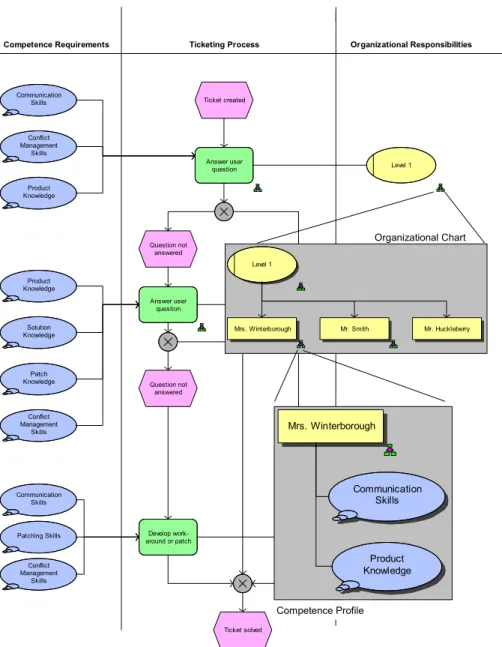
Among a multitude of notations, the event-driven process chain (EPC) has become a de-facto standard for business process modelling. For an example see the ticketing process of a call center modelled as an EPC in Figure 2. Its strengths persist in the ease of use, i.e. simple syntax and clear symbolic representation that account for a wide field of applications ranging from process documentation, process optimization, cost control, up to implementation and configuration of standard software (Keller, Nüttgens, & Scheer 92 A.D.). An EPC consists of two basic constructs, namely functions and events. Functions are triggered by events and both are connected alternately to form a business process. Conjunctive, exclusive and disjunctive operators allow for a non-linear flow of control. Such rather simple EPC diagrams may be extended by other constructs, i.e. input/output data or organizational units. Modeling tools such as the ARIS Business Architect by IDS Scheer AG provide even a bigger variety of EPC entities to be assigned to process functions. Thus, the business process model goes beyond specifying which activities must be done and when. It gives additional details on further circumstances, which make up an employee’s reality. Being enriched in such a way, the business process becomes the context of learning, i.e. acquiring those skills needed to perform the process effectively. As process models have proved to be efficient and sustainable storages and references of organizational knowledge, there have been some approaches to integrate knowledge and business process management [8].
Katrina Leyking, Pavlina Chikova, and Peter Loos
www.ejel.org 187 ISSN 1479-4403
Ticket created
Answer user question
Question not answered
Answer user question
Question not answered
Develop work-around or patch
Ticket solved
Figure 2: Ticketing process documented as EPC
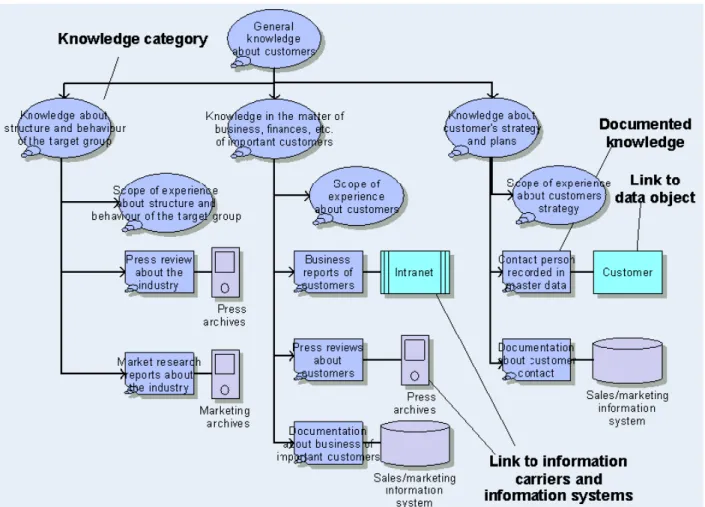
However, if accurate representation, analysis, and improvement are required, additional means of representation are needed in order to identify and structure the content of relevant knowledge categories, to describe the distribution of knowledge within an organization, and to model knowledge creation and utilization in business processes. The current ARIS method provides two model types which make it possible to specify which kind of knowledge (general or documented) is necessary to perform a function and which knowledge is created and/or documented when the function is actually performed. This type of representation allows business processes to be studied in terms of the knowledge processing involved. For example, gaps in necessary knowledge can be discovered. Besides, the qualification profile needed to perform a function can be determined. ARIS proposes models for knowledge structures and knowledge maps which can be connected to business process models through the entity “knowledge” which is required for individual functions of a process (see Figure 3) (Allweyer & Jost 1999). However, such concepts have remained limited to knowledge structuring and modelling as the following sections will illustrate.
Knowledge Structure Diagram: Using a knowledge structure diagram, knowledge categories can be structured into subgroups. A knowledge category can include other knowledge categories or documented knowledge. Documented knowledge can again be divided into documented knowledge subcategories. The
knowledge structure diagram can show the information media on which knowledge is documented and the application systems which serve to manage the knowledge.
A knowledge category aims at classifying the knowledge a company possesses or needs. Examples of knowledge categories are project management knowledge, specific industry knowledge, specific technology knowledge, customer and competitor knowledge, etc. Knowledge categories can contain implicit knowledge, i.e. knowledge that cannot be fully documented, employee or group knowledge in the form of skills, and explicit knowledge, i.e. knowledge that can be documented in the form of descriptions or technical drawings. Figure 3 shows an example of a knowledge structure diagram.
Figure 3: Example of a knowledge structure diagram
2.2.1 Knowledge Map:
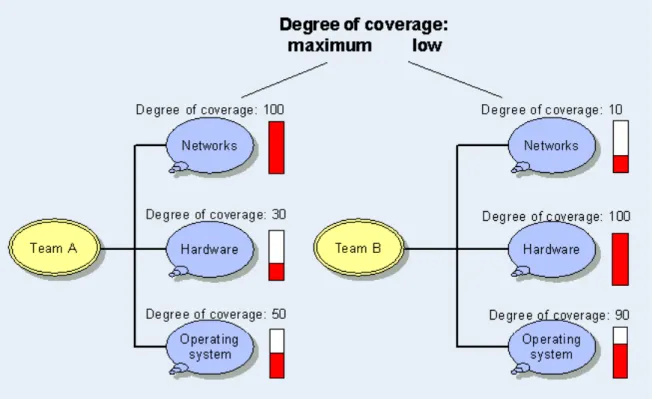
A knowledge map shows the distribution of the various knowledge categories within an organization. To do so, knowledge categories can be connected with various organizational objects such as organizational unit, position, person, group etc. In addition, the degree of knowledge coverage can be specified for each organizational unit. A value of 100% stands for maximum knowledge coverage in a particular knowledge category. Next to this quantitative measure, a qualitative evaluation (low, medium, high, maximum) can be displayed in the form of a graph. There is no direct connection between the values for the degree of coverage and coverage quality attributes. If both attributes are used, it is suggested that the qualification “low” shall be used for a degree of coverage of up to 25%, medium for 25-50%, high for 50-75%, and maximum for 75-100%. Figure 4 shows a knowledge map that is organizational unit-oriented, i.e. for each organizational unit all relevant knowledge categories are indicated. It is also possible to select the knowledge categories as the central object and model the relevant organizational units around them.
Katrina Leyking, Pavlina Chikova, and Peter Loos
www.ejel.org 189 ISSN 1479-4403
Figure 4: Example of a knowledge map
Even though the knowledge diagrams belong to the existing ARIS method, they cannot provide a sufficient representation basis of competencies and competency profiles. An important issue that has to be taken into consideration is the nondisclosure of personal, i.e. of employee-related data. When knowledge or competencies are allocated to specific employees, process experts have to be aware that the collection, documentation, and particularly the electronic processing of such employee-related data are subject to many restrictions due to laws and company agreements. These have to be complied with when creating, using, or distributing information of this kind. Also the existing diagram types do not recognize the linkage to knowledge or skill requirements within a business process. Though, the contextual information given by a business process into learning goals provides the basis for translation of business-oriented requirements into corporate learning and training.
2.3 Competency-enhanced business process models
Using business processes for the distillation of learning requirements, i.e. competency gaps pose the question of how business process models can be extended by learning-relevant information, i.e. information that helps identifying companies’ training requirements as well as learners’ needs.
When reengineering business processes or offering new services, companies have to evaluate their organizational structure to staff the new processes. First, the competencies needed to execute the functions of the process have to be defined. At the same time, the competencies of existing employees have to be evaluated. These competencies are usually documented in the personnel file. Provided that competency-related information is documented in the process models, competency gaps can additionally be measured by analyzing the process flow in the operational systems. In addition, the different learning activities required to acquire new competencies should be described. By analyzing competency gaps and learning opportunities available, the organization can arrange training and staffing to get the best support for their processes. Ideally, a company has already documented their business processes as a series of events and functions. From the perspective of competence modelling, this must be enhanced by information on the following aspects:
̇ Organizational roles and responsibilities: To specify which employee is responsible for what function / has to perform what task within a business processes, organizational role symbols are to be assigned to the functions.
̇ Competencies needed:To specify competency requirements, functions must be analyzed for the prerequisites an employee must exhibit to perform a task successfully. This leads to the definition of roles though a set of competencies needed to execute the role’s responsibilities.
̇ Competencies available: To identify the learning need, the existing competencies of the individual employees must be gathered and documented in the model before they can be matched against the competency requirements.
Figure 5 and 6 show how competency-related information can be documented in a business process in a multi-level approach. Whereas Figure 2 exhibits the raw business process, figure 5 extends it by organizational roles and competencies needed. Enhancing the process model by competencies needed and employees involved is the first step towards an improved ticketing performance. Competence artefacts assigned to functions display what an employee being in charge of this activity must know or which skill he must be proficient in to perform the process according to the business goals. These competencies are the business requirements for corporate training in the short-term and personnel development in the long. Organizational charts assigned to the organizational units reveal who is in charge and again what are his/her current competence profiles.
Ticket created Answer user question Question not answered Answer user question Question not answered Develop work-around or patch
Ticket solved Level 1 Level 2 Communication Skills Conflict Management Skills Product Knowledge Product Knowledge Solution Knowledge Patch Knowledge Conflict Management Skills Communication Skills Patching Skills Conflict Management Skills Software Development
Competence Requirements Ticketing Process Organizational Responsibilities
Level 1
Mrs. Winterborough Mr. Smith Mr. Huckleberry
Mrs. Winterborough Communication Skills Product Knowledge Competence Profile Organizational Chart
Figure 5: Notation for competency-oriented modelling
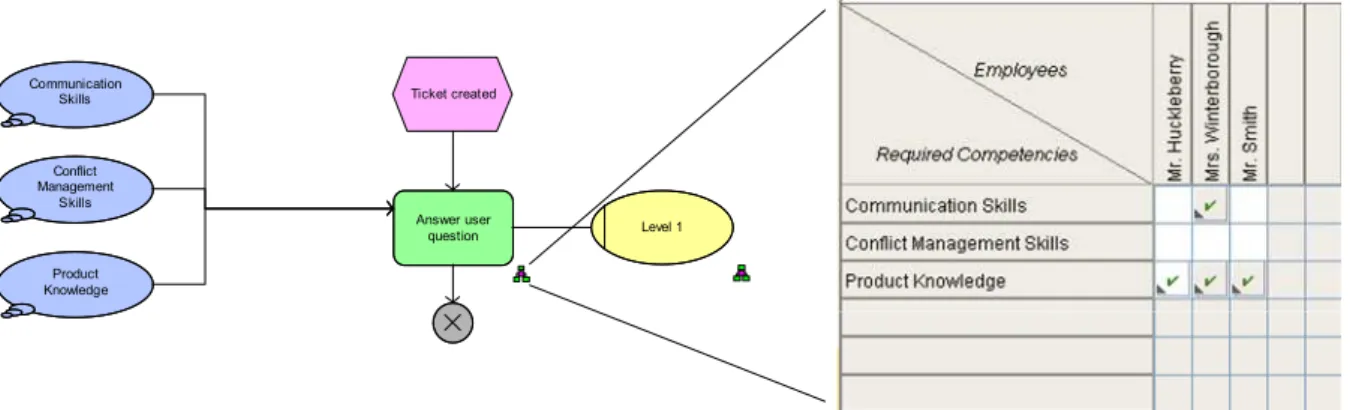
Figure 6 illustrates how the matching of documented as-is and to-be competencies delivers the individual competency gaps resp. learning goals of each employees. The competence gap matrix reveals that generally employees of the First Level need to develop their conflict management and communication skills as well as enhance their product knowledge. This issue is mitigated by setting up a knowledge management base on all resolved tickets.
Katrina Leyking, Pavlina Chikova, and Peter Loos
www.ejel.org 191 ISSN 1479-4403
Ticket created
Answer user
question Level 1 Communication
Skills
Conflict Management
Skills
Product Knowledge
Figure 6: Competency Matching Matrix
2.4 Process- and competency-driven content development
The competency-enhanced business process models, which are created in the design phase of the lifecycle, are used to answer didactical and structural questions as well as to enable the search for suitable content within the learning process. Having identified the competency gaps these can be taken over by the authoring team as learning goals to be addressed by individual e-Learning courses. Thus, a learning module can be adjusted to the learner’s immediate needs what facilitates instant authoring activities by reducing the time-to-competency.
Furthermore, the processes of learning material development are business processes themselves with multiple departments involved. Many interdisciplinary competencies and detailed knowledge (technique, tools, project management, media production, and didactic expertise) are needed to produce learning objects, WBTs or other training material. Existing tools support only singular aspects of the learning process production, but do not provide holistic process integration within the overall ICT landscape of an organization.
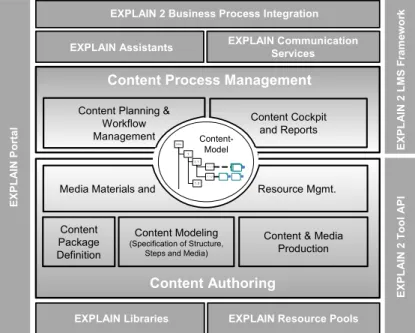
These issues have been elaborated within the research project EXPLAIN (http://www.explain-project.de) funded by the German Federal Ministry of Economy and Technology. EXPLAIN focuses on content development processes and aims at an intelligent ICT environment that empowers organizations to flexibly implement their learning objects in the course of their major business processes. The main objective of the innovative cooperative project is to develop a new generation of authoring management platform (Zimmermann et al. 2005). This will facilitate a simplified proprietary learning material development process and will enable organizations to produce their own multimedia trainings. The project’s development approach is based on a systematic analysis and reengineering of as-is content development processes in cooperation with professional authoring companies and industrial enterprises. From here, an integrated platform supporting the processes of content process management and content authoring including open interfaces to learning management systems and authoring tools is being prototypically implemented step-by-step (see Figure 7). Beyond process integration, a variety of additional services will further facilitate designing, producing and managing media and content (Chikova, Leyking, & Loos 2006).
The platform follows the thesis that it does not make sense for corporate training managers to run and maintain an own learning infrastructure within the enterprise and have all the skills in an internal team – unless the volume of media production is on a very high level. Therefore, the approach of EXPLAIN is to enable enterprises to produce their own learning material independently as well as to respond to ad-hoc learning needs in a cost-effective and time-saving manner. In doing so, a closed self-supply of e-Learning actions would be unrealistic and economically not reasonable. The intelligent integrated solution will instead provide a multitude of authoring tools, assistants and services on-demand over a web-based platform. The idea is that enterprises can use these services whenever they need it. So, services and tools can also be provided at the newest level of technology (Chikova, Leyking, & Loos 2006).
This demand-oriented approach provides a number of advantages for the user: On the one hand, corporate training departments avoid pre-investments into own infrastructures. Instead, appropriate tools can be utilized on-demand over the web-based platform and can be integrated into the overall project. In a similar way, this applies also for media production, which can be outsourced to external service providers or carried out in-house over the platform. Thus, even small education departments will be released from the necessity to provide all expertise, technology and resources by themselves, but nevertheless, they will still keep their
leading position within the learning projects. The central element in the overall process is represented by the content model, which, similar to a bill of materials used in product design and development, integrates all required activities along the structure of a learning module. Thus, it provides an interface between the processes of content management and authoring. Furthermore, the platform offers value-added services to the project team, like support in didactic issues, in selecting appropriate tools, in retrieving external media experts (photographers, audio studios, translation agencies, etc.) within a resource pool, as well as the provision of ready-made template and media asset libraries. These services will also support communication and collaboration activities within the team and by this increase the process efficiency for review and creative team processes (Zimmermann, Bergenthal, Chikova, Hinz, Lehmann, Leyking, Martin, & Rensing 2005), (EXPLAIN Consortium 2006).
Content Process Management Content Planning &
Workflow Management Content Cockpit and Reports Learning Content Management (LCMS) Learning Management Content Authoring
Content & Media Production Content Package Definition C L IX F in a n c ia l C o n tr o lli n g
EXPLAIN Report Designer
Content Modeling (Specification of Structure,
Steps and Media)
Media Materials and Resource Mgmt. Content Model1 .1
1 .2 In tro
1 . 1 .1 1 . 1 .2 1 Content-Model 1 .1 1 .2 In tro
1 . 1 .1 1 . 1 .2 1 Content-Model EXPLAIN Libraries EX PL A IN 2 L MS F ra m e w o rk
EXPLAIN Resource Pools EXPLAIN Assistants EXPLAIN Communication
Services EXP L A IN P o rt a l EX PL A IN 2 T o o l A P I
EXPLAIN 2 Business Process Integration
Figure 7: EXPLAIN Authoring Management Platform
2.5 Process performance monitoring
Combined business and learning process control allows measuring the impact of learning and training on the execution of business processes within the organization. It is important to get a feedback about the learning process in order to improve adaptive, individualized learning material and learning design. Controlling learning processes from a business perspective is of great importance in order to know about the impact of the training on the business process execution and the process performance, as it is the main purpose of training to lead to improved processes. This means, employees who are already trained should perform better in their daily work. If not, the training is not sufficiently adjusted to the learning goals which correlate with business goals. Then the training content has to be (re-)engineered in order to optimize its effects on business process execution. In order to reveal the impact of workplace learning on the overall process, training measures must be added to the already common KPI of process monitoring system. This is where the true ROI (“Return on Investment”), i.e. the added value, is quantified and provides feedback for process improvement.
A business integrated learning design, learning material production and distribution to the learner create a comprehensive learning experience embedded in learner-oriented business process flows. This supports the understanding of transaction-oriented cause-effect relations, which aligns individual and organizational learning goals. Flexible knowledge distribution on the basis of an improved technology support provides only relevant information and learning material to the employees. Thus, it reduces time lags caused by competency deficiencies while enabling faster readiness for business tasks, faster decision making as well as a shorter response time to stakeholders. This generates a better performance in the business execution by the employee and an added value for the customer that contributes to a higher customer satisfaction. Learning process control is regarded as a permanent activity and integrated into business process management, which is initiated on time, ideally before a competency gap will appear. IT is able to steer planning, information and controlling processes of a learning management life cycle. As a result, not only direct learning success is measured, but also indirect effects to the business processes. The identified