Macroprudential Policy: What Instruments and
How to Use Them?
Lessons from Country Experiences
C. Lim, F. Columba, A. Costa, P. Kongsamut,
A. Otani, M. Saiyid, T. Wezel, and X. Wu
© 2011 International Monetary Fund WP/11/238
IMF Working Paper
Monetary and Capital Markets Department
Macroprudential Policy: What Instruments and How to Use Them? Lessons from Country Experiences1
Prepared by C. Lim, F. Columba, A. Costa, P. Kongsamut, A. Otani, M. Saiyid, T. Wezel, and X. Wu
Authorized for distribution by Jan Brockmeijer October 2011
Abstract
This paper provides the most comprehensive empirical study of the effectiveness of macroprudential instruments to date. Using data from 49 countries, the paper evaluates the effectiveness of macroprudential instruments in reducing systemic risk over time and across institutions and markets. The analysis suggests that many of the most frequently used instruments are effective in reducing pro-cyclicality and the effectiveness is sensitive to the type of shock facing the financial sector. Based on these findings, the paper identifies conditions under which macroprudential policy is most likely to be effective, as well as conditions under which it may have little impact.
JEL Classification Numbers: G28, E58
Keywords: macroprudential, instruments, systemic risk, procyclicality, interconnectedness, credit, liquidity, capital.
Authors’ E-Mail Addresses: [email protected], [email protected], [email protected],
[email protected], [email protected], [email protected], [email protected], and [email protected]
1We would like to thank J. Brockmeijer and J. Osinski for their guidance and valuable comments. We are also grateful to D. Igan, F. Unsal, R. Baqir, and Y. Miao for their contributions to the paper, and to the IMF Interdepartmental Working Group on Macroprudential Policy and the Advisory Group on the Development of Macroprudential Policy for their support and encouragement.
This Working Paper should not be reported as representing the views of the IMF.
The views expressed in this Working Paper are those of the author(s) and do not necessarily represent those of the IMF or IMF policy. Working Papers describe research in progress by the author(s) and are published to elicit comments and to further debate.
CONTENTS PAGE
Abstract ...
Executive Summary ...4
I. Introduction ...7
II. Country Experiences with Macroprudential Instruments ...8
A. What Instruments Are Used? ...8
B. Why Use Macroprudential Policy and What Affects the Choice of Instruments? ..10
C. How Are Instruments Applied? ...12
III. Effectiveness of Macroprudential Instruments ...15
A. The Case Study ...17
B. The Simple Approach...18
C. The Panel Regression ...19
IV. Lessons and Policy Messages ...26
V. Next Steps ...31
TABLES 1. Effectiveness of Macroprudential Instruments in Reducing the Procyclicality of Credit ...25
2. Effectiveness of Macroprudential Instruments in Reducing the Procyclicality of Leverage25 3. Effectiveness of Macroprudential Instruments in Reducing Cross-Sectional Risks ...26
4. Use of Macroprudential Instruments ...30
FIGURES 1. Macroprudential Instruments ...6
2. Objectives of Macroprudential Policy Instruments ...9
3. Use of Macroprudential Policy Instruments ...12
4. How Instruments Are Used ...13
5. Intensity of Use ...16
6. Change in Credit Growth After the Introduction of Instruments ...18
7. Credit Growth and GDP Growth ...20
BOXES 1. Macroprudential Instruments in the European Union ...10
2. Monetary and Macroprudential Policy: Are They Mutually Reinforcing? ...24
APPENDIXES I. Macroprudential or Capital Flow Measures ...32
II. Selected Case Studies ...34
III. The Simple Approach ...53
V. Managing Risk with Select Macroprudential Instruments ...64
VI. The Conceptual Basis for the Macroprudential Instruments ...72
VII. Use of Macroprudential Instruments – Country Experiences ...73
APPENDIX TABLES AND FIGURES Table II.1 Macreconomic Indicators, average 2003–08 (in percent) ...34
Table II.2 Prudential Measures Imposed During the Boom Period, 2003-early 2008 ...35
Table II.3 Reserve Requirement Features During the Boom Period, 2003-early 2008 ...36
Table IV.1 Effectiveness of Macroprudential Instruments in Reducing Credit and Leverage Growth ...60
Table IV.2 Effectiveness of Macroprudential Instruments in Reducing Credit and Leverage Growth during Booms...61
Table IV.3 Effectiveness of Macroprudential Instruments in Reducing Credit Growth (both Level and Pro-cyclicality) ...62
Table IV.4 Effectiveness of Macroprudential Instruments in Reducing Leverage Growth (both Level and Pro-cyclicality) ...63
Table V.1 Summary of Use of Reserve Requirements as a Macroprudential Tool in Selected Countries ...70
Table V.2 Measures to Address Credit Risk Arising from Foreign Currency Lending ...71
Figure II.1 Croatia: Private External Debt/GDP ...38
Figure II.2 Serbia: Private External Debt/GDP ...38
Figure II.3 Total Short-term External Debt, 2009 ...38
Figure II.4 Shares of Domestic and Non-resident Funding by New Zealand Banks ...39
Figure II.5 New Zealand Banks’ Non-resident Funding by Residual Maturity ...39
Figure II.6 Central Bank Balance Sheet Sizes ...39
Figure II.7 New Zealand Banks’ Bond Issuance ...39
Figure II.8 Liquidity Mismatch Ratios ...41
Figure II.9 Credit and Deposit ...42
Figure II.10 House Prices ...42
Figure II.11 Coverage Ratio ...43
Figure II.12 Total Provisions ...44
Figure II.13 Size of DP Funds (% of loans)...45
Figure II.14 The Use of Reserve Requirements ...46
Figure II.15 Non-Resident Assets/Liabilities ...48
Figure II.16 NPL Growth ...48
Figure II.17 Banks’ Short-Term External Borrowing (in US$ billion) ...49
Figure II.18 Leverage of Large International Banks and Hedge Funds ...52
Figure III.1 Change in Risk Variables after the Implementation of Instruments ...53
EXECUTIVE SUMMARY
This paper aims to contribute to the international debate on how to make
macroprudential policy operational. In the wake of the 2008 financial crisis, there has been burgeoning interest in macroprudential policy as an overarching framework to address the stability of the financial system as a whole rather than only its individual components.
However, incorporating systemic oversight in the financial stability framework poses considerable analytical and operational challenges for most countries given that there is relatively limited experience in testing the effectiveness of macroprudential policies. In response to a request by the IMF Board, the paper provides a review of the cross-country experience in choosing and applying macroprudential instruments and draws lessons on which instruments—and under what conditions—appear to have been most effective.
Macroprudential instruments are typically introduced with the objective of reducing systemic risk, either over time or across institutions and markets. Countries use a variety of tools, including credit-related, liquidity-related, and capital-related measures to address such risks, and the choice of instruments often depends on countries’ degree of economic and financial development, exchange rate regime, and vulnerability to certain shocks. Countries often use these instruments in combination rather than singly, use them to complement other macroeconomic policies, and adjust them countercyclically so that they act in much the same way as “automatic stabilizers.”
Many of the macroprudential instruments are found to be effective in mitigating systemic risk. A cross-country regression analysis, using data from a group of 49 countries, suggests that the following instruments may help dampen procyclicality: caps on the loan-to-value ratio, caps on the debt-to-income ratio, ceilings on credit or credit growth, reserve requirements, countercyclical capital requirements and time-varying/dynamic provisioning. In addition, limits on net open currency positions/currency mismatch and limits on maturity mismatch may help reduce common exposures across institutions and markets. The
effectiveness of the instruments does not appear to depend on the exchange rate regime nor the size of the financial sector, but the analysis does suggest that the type of shocks do matter. Different types of risks call for the use of different instruments.
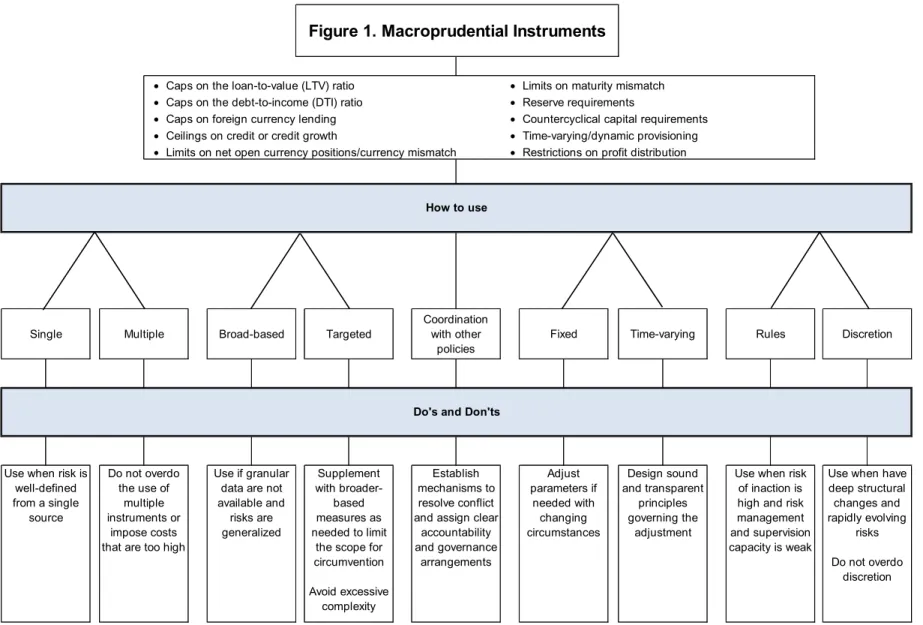
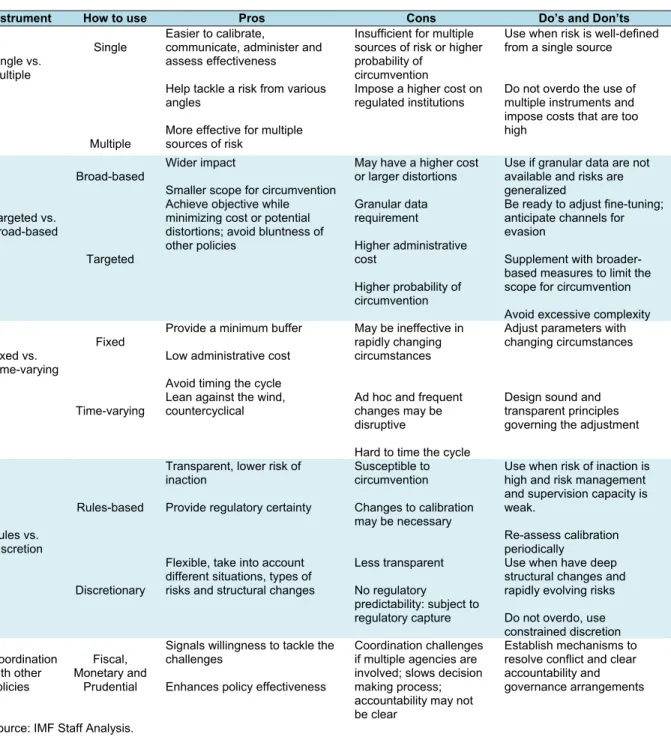
Policymakers face a menu of options in using macroprudential instruments. While no one size fits all, some approaches may have advantages. Figure 1 summarizes the situations that are more likely to lead to success and those that should be avoided:
Single versus multiple. The use of multiple instruments has the advantage of tackling different aspects of the same risk, reducing the scope for circumvention and providing a greater assurance of effectiveness.
Broad-based versus targeted. The ability to target specific risks by differentiating types of transactions makes the instruments more precise and potentially more effective.
Fixed versus time-varying. Adjusting the instruments at different phases of the cycle makes them more effective in smoothing out the financial cycle.
Rules versus discretion. Rules-based adjustments such as dynamic provisioning have clear advantages and are effective. Yet, rules can be difficult to design, especially for some instruments, and policymakers need to retain discretion to adjust the stance of macroprudential polices. Clear public communication is essential when making discretionary adjustments.
Coordination with other policies. The instruments tend to be more effective when used in conjunction with monetary or fiscal policy tools as they can be mutually reinforcing in achieving the same macroprudential objectives. Stand-alone policies tend to be inferior to those that are well coordinated with other policies.
Important caveats apply to these conclusions, however. There are costs involved in using macroprudential instruments, as is the case with regulation more generally, and the benefits of macroprudential policy should be weighed against these costs. In addition, calibrating the instruments may be difficult, which could lower growth unnecessarily or generate unintended distortions if not done appropriately. The empirical analysis presented here does not address these issues. Additional work with better quality, more granular and longer time series data is needed to corroborate the initial assessment and confirm the causal relationships identified. Moreover, certain pre-conditions should be in place for the successful implementation of macroprudential policy. A strong regulatory framework is essential, along with high-quality supervision, and good macroeconomic policies. An appropriate institutional framework for macroprudential policy is also vital.
In addition to these caveats, important questions remain to be answered. These include the issues posed by regulatory or cross-border arbitrage, data gaps that prevent a more careful analysis of the cross-sectional dimension of systemic risk, and the side-effects of applying macroprudential instruments. The relationship between macroprudential policy and microprudential regulation also needs to be further clarified in order to ensure close coordination between the oversight of the whole financial system and that of its individual components in order to adequately capture systemic risk.
6
Source: IMF staff analysis.
Caps on the loan-to-value (LTV) ratio Limits on maturity mismatch
Caps on the debt-to-income (DTI) ratio Reserve requirements
Caps on foreign currency lending Countercyclical capital requirements
Ceilings on credit or credit growth Time-varying/dynamic provisioning
Limits on net open currency positions/currency mismatch Restrictions on profit distribution
Single
Do's and Don'ts
Broad-based Targeted
Coordination with other
policies
Adjust parameters if
needed with changing circumstances
Design sound and transparent
principles governing the
adjustment
Use when risk of inaction is high and risk management and supervision capacity is weak
Use when have deep structural changes and rapidly evolving
risks Do not overdo
discretion Multiple
Use when risk is well-defined from a single
source
Do not overdo the use of
multiple instruments or
impose costs that are too high
Use if granular data are not available and risks are generalized
Supplement with
broader-based measures as needed to limit
the scope for circumvention Avoid excessive
complexity
Establish mechanisms to resolve conflict and assign clear
accountability and governance
arrangements How to use
Fixed Time-varying Rules Discretion
I. INTRODUCTION
This paper is prepared at the request of the IMF Board. Macroprudential policy is quickly gaining traction in international circles as a useful tool to address system-wide risks in the financial sector.2 Yet, the analytical and operational underpinnings of a
macroprudential framework are not fully understood and the effectiveness of the instruments is uncertain. In April 2011, the Board initiated a discussion of these issues in the context of the paper “Macroprudential Policy: An Organizing Framework” (SM/11/54). In concluding, the Board asked for further work on several fronts.3 This paper responds to the specific
request for a review of country experiences to better understand the design and calibration of macroprudential instruments, their interaction with other policies, and their effectiveness.
While macroprudential policy is widely seen as a useful policy response to changes in the global financial environment,views on the contours of macroprudential policy can vary substantially among policymakers. The IMF—in conjunction with the Bank for International Settlements and the Financial Stability Board—has characterized
macroprudential policy with reference to three defining elements:4
Its objective: to limit the risk of widespread disruptions to the provision of financial services and thereby minimize the impact of such disruptions on the economy as a whole. Systemic risk is largely driven by fluctuations in economic and financial cycles over time, and the degree of interconnectedness of financial institutions and markets.
Its analytical scope: the focus is on the financial system as a whole (including the interactions between the financial and real sectors) as opposed to individual components.
Its instruments and associated governance: it primarily uses prudential tools that have been designed and calibrated to target systemic risk. Any non-prudential tools that are part of the framework need to be specifically designated to target systemic risk
through their governance arrangements.
2See, for example, Borio (2010), Galati and Moessner (2011), and Viñals (2010 and 2011).
3The IMF Board asked for four strands of work: (i) identifying indicators of systemic risk; (ii) reviewing
country experiences on the use and effectiveness of macroprudential instruments; (iii) assessing the effectiveness of different institutional setups for macroprudential policy; and (iv) assessing the multilateral aspects of macroprudential policy. The first issue is addressed in IMF (2011h); the second issue in this paper; the third issue in IMF (2011c); and work on the fourth issue is currently underway.
Against this organizing framework, the objective of the paper is to identify conditions under which macroprudential policy is most effective. The assessment uses data provided by the 2010 IMF Survey on financial stability and macroprudential policy, as well as an internal survey of desk economists.5 Relative to previous studies, this approach has the
advantage of examining a much broader range of instruments,6 risks, and countries, taking
greater account of the implications of cyclical disturbances and interconnectedness. The goal is to help policymakers make more informed decisions about macroprudential policy and to guide the Fund’s policy advice and technical assistance in this area.
The paper is structured as follows. Section II reviews country experiences with
macroprudential policy, focusing on the objectives, types of instruments and how they have been chosen and applied. Section III presents the empirical analysis based on case studies and panel regressions. Section IV draws common lessons and policy messages, noting the conditions under which the instruments appear to have been most effective. Section V concludes with next steps for further research and analysis.
II. COUNTRY EXPERIENCES WITH MACROPRUDENTIAL INSTRUMENTS
A. What Instruments Are Used?
Country authorities have used a variety of policy tools to address systemic risks in the financial sector. The toolkit contains mostly prudential instruments, but also a few
instruments typically considered to belong to other public policies, including fiscal,
monetary, foreign exchange and even administrative measures.The IMF survey identified 10 instruments that have been most frequently applied to achieve macroprudential objectives. There are three types of measures:
Credit-related, i.e., caps on the loan-to-value (LTV) ratio, caps on the debt-to-income (DTI) ratio, caps on foreign currency lending and ceilings on credit or credit growth;
Liquidity-related, i.e., limits on net open currency positions/currency mismatch (NOP), limits on maturity mismatch and reserve requirements;7
Capital-related, i.e., countercyclical/varying capital requirements, time-varying/dynamic provisioning, and restrictions on profit distribution.
5See IMF (2011b) for details of the survey.
6For the purpose of this paper, policy tools capable of addressing systemic risk are considered macroprudential
instruments.Appendix V describes details of some of the instruments. Appendix VI provides the conceptual
basis underpinning the instruments as macroprudential tools and Appendix VII shows the instruments that countries have been using.
0 20 40 60 80 100
credit growth/ asset price inflation
excessive leverage
systemic liquidity risk capital flows/ currency
fluctuation
Caps on LTV Limits on maturity mismatch
Limit on net open currency positions/currency mismatch Restrictions on profit distribution
Figure 2. Objectives of Macroprudential Policy Instruments
Source: IMF Financial Stability and Macroprudential Policy Survey, 2010. There is usually a clearly
stated policy objective when the instruments are applied.
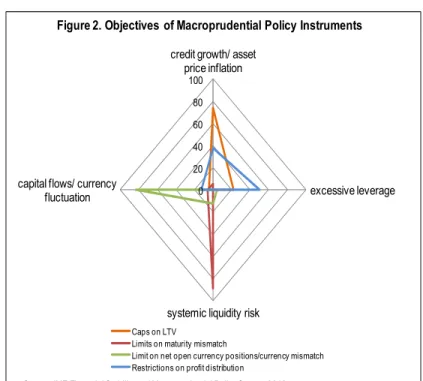
Specifically, the instruments have been used to mitigate four broad categories of systemic risk (Figure 2):8
Risks generated by strong credit growth and credit-driven asset price inflation;
Risks arising from excessive leverage and the consequent de-leveraging;
Systemic liquidity risk; and
Risks related to large and volatile capital flows, including foreign currency lending.
The recent financial crisis has prompted an increasing number of countries to use the instruments, and with greater frequency. According to the IMF survey, two-thirds of the respondents have used various instruments for macroprudential objectives since 2008. Emerging market economies have used the instruments more extensively than advanced economies, both before and after the recent financial crisis. Elements of a macroprudential framework existed in some emerging market economies in the past, when they started to use some of the instruments to address systemic risk following their own financial crises during the 1990s. For these countries, the instruments are part of a broader “macro-financial” stability framework that also includes the exchange rate and capital account management.9
The recent crisis has also led to an increase in the number of advanced countries that deploy the instruments within a more formal macroprudential framework. The work of the European Systemic Risk Board is an example (Box 1).
8Systemic liquidity risk arises when the financial system has an aggregate shortage of liquidity and financial
institutions and other market players are not able to obtain short-term funding. Leverage is the amount of debt borrowed to acquire assets, defined as assets/equity. The amount of leverage more than one standard deviation from its historical trend is generally considered excessive.
9Appendix I shows some macroprudential instruments that may also be considered capital flow measures
(CFMs). In these “hybrid cases,” clarity of the primary objective of the macroprudential instrument is important to ensure the policy is used appropriately to target systemic risk, and not the exchange rate or capital flows. Macroprudential instruments should not be confused with capital controls.
Box 1. Macroprudential Instruments in the European Union10
Work on selecting and applying macroprudential instruments is a priority in the European Union (EU), both at a national and at a Union level. The European Systemic Risk Board (ESRB) was established as of January 1, 2011, in order to provide warnings of
macroprudential risks and to foster the application of macroprudential instruments. Macroprudential instruments have a particular relevance in the EU context, given the
constraints on macroeconomic and microprudential policies and their coordination, including the absence of national monetary policies and policies to harmonize capital standards. The ESRB has an additional role to foster “reciprocity” through its “comply or explain” powers amongst the national authorities, so that all banks conducting a particular activity in a country will be subject to the same macroprudential instrument irrespective of the bank’s home country.
The European Commission has been focusing on countercyclical capital as the main macroprudential instrument. Other agencies, as well as some national authorities, propose casting the net much wider, to take account of regional, national, sub-national, or sectoral conditions. For instance, with real estate lending having been central to past financial crises, there is likely to be a focus on instruments such as the loan-to-value ratio.
B. Why Use Macroprudential Policy and What Affects the Choice of Instruments? Macroprudential policy has several advantages compared with other public policies to address systemic risk in the financial sector. In their survey responses, country authorities indicate that macroprudential instruments are less blunt than monetary tools, and are more flexible (with smaller implementation lags) than most fiscal tools. Many instruments (e.g., caps on the LTV, DTI, foreign currency lending, and capital risk weights) can be tailored to risks of specific sectors or loan portfolios without causing a generalized reduction of
economic activity, thus limiting the cost of policy intervention. Some countries have imposed caps on foreign currency lending, for example, because these target excessive lending in foreign currency directly in a way that no other policies can. These instruments are especially useful when a tightening of monetary policy is not desirable (e.g., when inflation is below target).
Country authorities indicate that they choose instruments that are simple, effective, and easy to implement with minimal market distortions. They consider it necessary that the choice of macroprudential instruments be consistent with other public policy objectives (fiscal, monetary, and prudential).
They also believe it important to choose macroprudential instruments that minimize
regulatory arbitrage, particularly in advanced economies with large nonbank financial sectors and complex and highly interconnected financial systems.
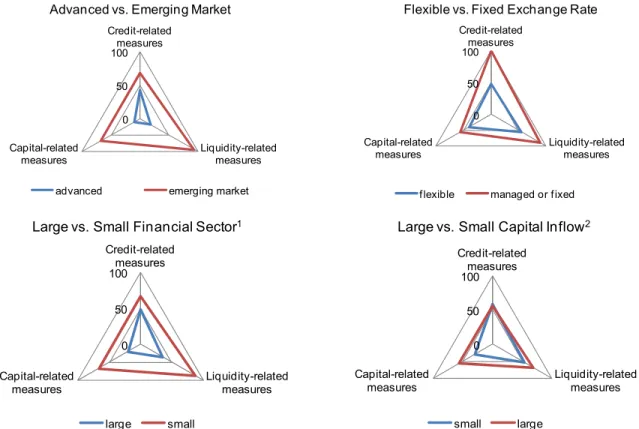
A number of factors seem to influence the choice of instruments. The stage of economic and financial development is one such factor (Figure 3). In general, emerging market economies have used macroprudential instruments more extensively than advanced economies. This may reflect a greater need to address market failures where financial markets are less developed and banks usually dominate relatively small financial sectors. Emerging market economies are more concerned about systemic liquidity risk and tend to use liquidity-related measures more often. Advanced economies tend to favor credit-related measures, although more of them are beginning to use liquidity-related measures after the recent crisis.11
The exchange rate regime appears to play a role in the choice of instruments. Countries withfixed or managed exchange rates tend to use macroprudential instruments more since the exchange rate arrangement limits the room for interest rate policy. In these countries, credit growth tends to be associated with capital inflows as the implicit guarantee of the fixed exchange rate provides an incentive for financial institutions to expand credit through
external funding.12 Credit-related measures (e.g., caps on the LTV and ceilings on credit
growth) are often used by these countries to manage credit growth when the use of interest rates is constrained. They also tend to use liquidity-related measures (e.g., limits on NOP) to manage external funding risks.
The type of shocks is another factor that may influence the choice of instruments.
Capital inflows are considered by many emerging market economies to be a shock with a large impact on the financial sector, given the small size of their domestic economy and their degree of openness. Some Eastern European countries have used credit-related measures (e.g., caps on foreign currency lending) to address excessive credit growth resulting from capital inflows. In Latin America, several countries (e.g., Argentina, Brazil, Colombia, Peru, and Uruguay) have also used liquidity-related measures (e.g., limits on NOP) to limit the impact of capital inflows. In the Middle East, some oil exporters with fixed exchange rates have also used credit-related measures to deal with the impact of volatile oil revenue on credit growth. Unlike other policy tools aimed at the volume or composition of the flows (e.g., taxes, minimum holding periods, etc.), macroprudential instruments are more directly aimed at the negative consequences of inflows, i.e., excessive leverage, credit growth and exchange rate induced credit risks that are systemic.
11Advanced countries may prefer capital-related measures but are waiting for Basel III rules to be finalized, as
these measures are price-based and tend to be less “distortionary” for financial institutions.
Figure 3. Use of Macroprudential Policy Instruments
(% of countries in each group using each type of instruments)
1/ The ratio of credit/financial claims to GDP. Countries with the ratio at or above the medium are classified as “large,” otherwise “small.”
2/ The ratio of net capital inflow to GDP. Countries with the ratio at or above the medium are classified as “large,” otherwise “small.”
Sources: IMF Financial Stability and Macroprudential Policy Survey, 2010.
C. How Are Instruments Applied?13
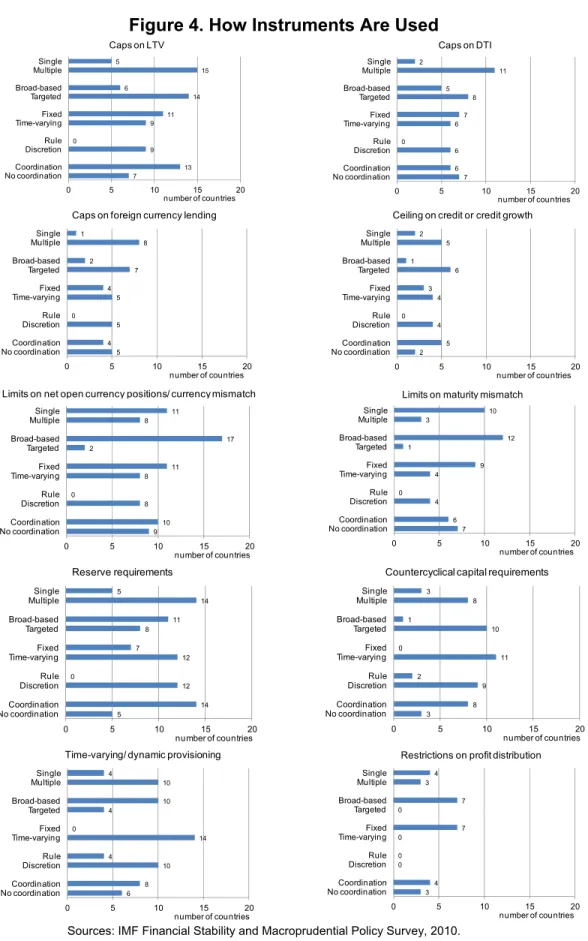
Country experiences show thata combination of several instruments is often used to address the same risk. Caps on the LTV and DTI, for instance, are frequently applied together by country authorities to curb rapid credit growth in the real estate sector. Sometimes a range of measures are implemented (Figure 4). On the other hand, using a single instrument to address systemic risk is rare.14 The rationale for using multiple
instruments seems simple—to provide a greater assurance of effectiveness by tackling a risk from various angles. While this may be true, there may be a higher regulatory and
administrative burden of enforcing multiple instruments.
13Appendix II contains case studies of countries using the instruments.
14The survey reports only two countries that use single instruments, and for one of them (Canada), the objective
of using the LTV is microprudential. 0
50 100 Credit-related
measures
Liquidity-related measures Capital-related
measures
advanced emerging market
Advanced vs. Emerging Market
0 50 100 Credit-related
measures
Liquidity-related measures Capital-related
measures
flexible managed or fixed Flexible vs. Fixed Exchange Rate
0 50 100 Credit-related
measures
Liquidity-related measures Capital-related
measures
large small Large vs. Small Financial Sector1
0 50 100 Credit-related
measures
Liquidity-related measures Capital-related
measures
small large Large vs. Small Capital Inflow2
Figure 4. How Instruments Are Used
Sources: IMF Financial Stability and Macroprudential Policy Survey, 2010.
7 13 9 0 9 11 14 6 15 5
0 5 10 15 20
No coordinationCoordination DiscretionRule Time-varyingFixed Targeted Broad-based MultipleSingle
number of countries
Caps on LTV
7 6 6 0 6 7 8 5 11 2
0 5 10 15 20
No coordinationCoordination DiscretionRule Time-varyingFixed Targeted Broad-based MultipleSingle
number of countries
Caps on DTI
5 4 5 0 5 4 7 2 8 1
0 5 10 15 20
No coordinationCoordination Discretion Rule Time-varyingFixed Targeted Broad-based MultipleSingle
number of countries
Caps on foreign currency lending
2 5 4 0 4 3 6 1 5 2
0 5 10 15 20
No coordinationCoordination DiscretionRule Time-varyingFixed Targeted Broad-based MultipleSingle
number of countries
Ceiling on credit or credit growth
9 10 8 0 8 11 2 17 8 11
0 5 10 15 20
No coordinationCoordination Discretion Rule Time-varyingFixed Targeted Broad-based MultipleSingle
number of countries
Limits on net open currency positions/ currency mismatch
7 6 4 0 4 9 1 12 3 10
0 5 10 15 20
No coordinationCoordination DiscretionRule Time-varyingFixed Targeted Broad-based MultipleSingle
number of countries
Limits on maturity mismatch
5 14 12 0 12 7 8 11 14 5
0 5 10 15 20
No coordinationCoordination DiscretionRule Time-varyingFixed Targeted Broad-based MultipleSingle
number of countries
Reserve requirements 3 8 9 2 11 0 10 1 8 3
0 5 10 15 20
No coordinationCoordination DiscretionRule Time-varyingFixed Targeted Broad-based MultipleSingle
number of countries
Countercyclical capital requirements
6 8 10 4 14 0 4 10 10 4
0 5 10 15 20
No coordinationCoordination DiscretionRule Time-varying Fixed Targeted Broad-based MultipleSingle
number of countries
Time-varying/ dynamic provisioning
3 4 0 0 0 7 0 7 3 4
0 5 10 15 20
No coordination Coordination DiscretionRule Time-varyingFixed Targeted Broad-based MultipleSingle
number of countries
Many instruments, particularly credit-related, are calibrated to target specific risks.
Macroprudential instruments are generally more targeted than monetary and fiscal policy tools, and they are frequently further differentiated for specific types of transactions. Caps on the LTV and DTI, for example, have been applied according to the loan size, the location and the value of the property (Hong Kong SAR and Korea). Reserve requirements used for macroprudential purposes have been differentiated by currency, types of liabilities, and applied within a band or on a marginal basis, or if credit growth exceeds the official limit (Argentina, Chile, China, Indonesia, Peru, Russia, Serbia, and Turkey). Sometimes social and other developmental aspects are taken into account when the instruments are calibrated (Canada). Many countries apparently find it useful to take full advantage of the targeted nature of macroprudential instruments, but others also apply the instruments broadly with no further differentiation.
Making countercyclical adjustments of macroprudential instruments is a common practice. Instruments aimed at credit growth, such as caps on the LTV, the DTI and reserve requirements, are adjusted most frequently. The adjustments are usually made to give the instruments a progressively larger countercyclical impact, but in some cases they also reflect the need to proceed cautiously on a trial and error basis. Capital-related measures, such as countercyclical capital requirements and dynamic provisioning, are designed to work through the cycle by providing a buffer, but some countries have adjusted them at different phases of the cycle to give them a more potent countercyclical impact.15
The design and calibration of the instruments are usually based on discretion and judgment, as opposed to rules. The use of rules-based instruments has the advantage of less regulatory uncertainty, preventing political economy pressures and overcoming policy inertia when systemic risk is building up.16 However, most countries that participated in the IMF
survey have used judgment almost entirely when designing and calibrating the instruments. The implementation of the instruments is a learning-by-doing process, in which judgment on how to calibrate an instrument is often formed by trial and error, depending on the type of shock the system is facing. A few exceptions include dynamic provisioning as used in Spain and several Latin American countries, where the amount of provisioning is based on a formula and varies with the economic cycle.
Macroprudential instruments are sometimes applied in conjunction with other macroeconomic policies. Some Asian and Latin American country authorities have used macroprudential instruments such as caps on the LTV with other policies, for example, monetary and fiscal policies.17 Some Eastern European countries have kept fiscal policy
15Brazil has used a formula tied to cyclicality for the adjustment in capital requirements (see Sinha (2011)), and
India has made countercyclical adjustments in risk weights and in provisioning.
16See Borio and Shim (2007) and CGFS (2010).
17China, Hong Kong SAR and Singapore also imposed taxes on real estate transactions when lowering the LTV
loose, but tightened monetary policy and attempted to contain banks’ foreign currency lending through various macroprudential measures. The combined use of policy tools typically occurs when the credit cycle coincides with the business cycle and there is a generalized risk of excessive credit growth and economic overheating. In such cases,
macroprudential instruments are implemented as part of a larger policy action to curb excess demand and the build-up of systemic risk, so they play a complementary role to
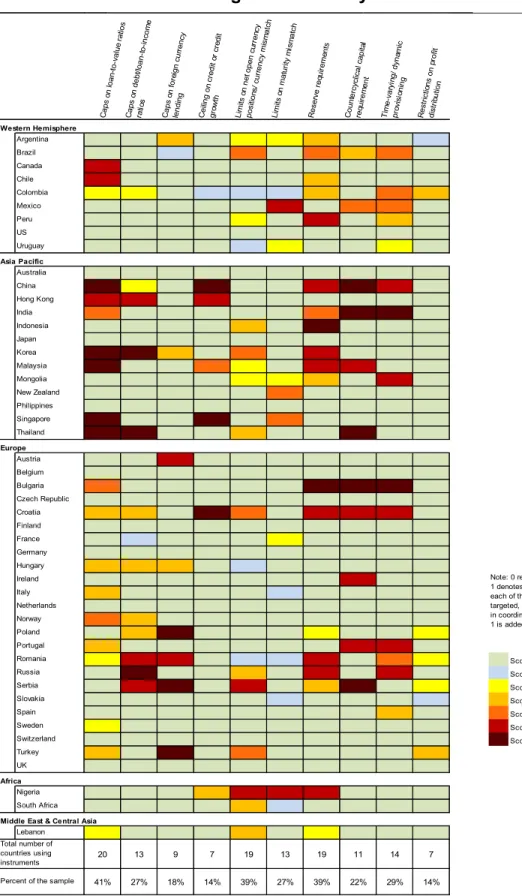
macroeconomic policies.18 Figure 5 summarizes the intensity of use of the instruments. III. EFFECTIVENESS OF MACROPRUDENTIAL INSTRUMENTS
Macroprudential instruments may be effectively applied to address specific risks if used appropriately. According to the IMF survey, most country authorities who have used
macroprudential instruments believe that they are effective. To assess the effectiveness of macroprudential instruments more thoroughly, this paper uses three different approaches. The first is a case study, involving an examination of the use of instruments in a small number of countries to see if they have achieved the intended objectives. The second is a simple approach, involving an examination of the performance of the target (risk) variables before and after an instrument is introduced. The third is a more sophisticated approach, which uses panel regression to assess the effect of macroprudential instruments on various target risk variables by comparing the introduction of an instrument with a “counterfactual” scenario where no macroprudential instrument is implemented.
The usual caveats, of course, apply to the evaluation. First, data availability and quality present challenges. Firm level data are preferable since many of the macroprudential instruments are aimed at the balance sheet of financial institutions, but these are not readily available or consistent over time or across countries. Moreover, the number of countries that have used macroprudential instruments in a systematic way is small since macroprudential policy frameworks have been put in place only recently, limiting the degree of confidence in any statistical analysis. In addition, establishing causality is not straightforward, or even feasible in some cases, with a selection bias that favors high risk countries where policies are implemented in reaction to adverse economic or market developments. The empirical
analysis also does not take into account issues such as costs and distortions, important factors to consider when using the instruments. These caveats notwithstanding, the evaluation still provides valuable insights into the effectiveness of macroprudential instruments.
18There are few examples where macroprudential policy is widely seen as a substitute rather than a complement
to macroeconomic policies. Two cases that are commonly cited are Turkey and some Eastern European countries where macroprudential instruments were used in place of a tight fiscal policy.
Figure 5. Intensity of Use
Sources: IMF Financial Stability and Macroprudential Policy Survey, 2010.
Cap s on
loa n-to -va lue ratio s Cap s on
de bt/lo an-t o-in com e ratio s Cap s on
fore ign cu rren cy lend ing Cei ling
on c red
it or cre
dit
grow th
Lim its o
n n et o pen cur renc y posi tions
/ cur renc
y m ism
atch
Lim its o
n m atur
ity m ism atch
Res erve
requ ir em ents Cou nte rcyc lica l cap
ital requ irem ent Tim e-va ryin g/ d
ynam ic prov isio ning Res tric tions on pro fit dist ribu tion Western Hemisphere Argentina Brazil Canada Chile Colombia Mexico Peru US Uruguay Asia Pacific Australia China Hong Kong India Indonesia Japan Korea Malaysia Mongolia New Zealand Philippines Singapore Thailand Europe Austria Belgium Bulgaria Czech Republic Croatia Finland France Germany Hungary Ireland Italy Netherlands Norway Poland Portugal
Romania Score is 0
Russia Score is 1
Serbia Score is 2
Slovakia Score is 3
Spain Score is 4
Sweden Score is 5
Switzerland Score is 6
Turkey UK
Africa
Nigeria South Africa
Middle East & Central Asia
Lebanon
20 13 9 7 19 13 19 11 14 7
41% 27% 18% 14% 39% 27% 39% 22% 29% 14%
Note: 0 represents no use of instruments, and 1 denotes the use of a single instrument. For each of the following attributes, i.e., multiple, targeted, time-varying, discretionary and used in coordination with other policies, the value of 1 is added.
Percent of the sample Total number of countries using instruments
A. The Case Study
Experiences of a few countries suggest some success in using the instruments to achieve their intended objectives. The case study covers a small but diverse group of countries, including China, Colombia, Korea, New Zealand, Spain, the United States and some Eastern European countries. While small, the sample seems representative. Some countries use the instruments singly while others in combination (and in coordination with other policies); instruments are both broad-based and targeted; some keep the instruments fixed while others make adjustment (both rules-based and discretionary). Their experience suggests that, to various degrees, the instruments may be considered effective in their respective country-specific circumstances, regardless of the size of their financial sector or exchange rate regime. Appendix II presents the case studies, which are summarized briefly below.
In China, the authorities managed to lower credit growth and housing price inflation by taking a series of steps in 2010 that also included fiscal and monetary measures.
In Colombia, the authorities took measures in 1999 to limit banks’ exposure to default risk. The measures seem to have been effective. Non-performing loans declined and remained low while credit to the private sector recovered after an initial reduction.
In Eastern Europe, the authorities adopted several measures to curb bank lending in foreign currency. The instruments appear to have been effective in slowing credit growth and building capital and liquidity buffers, although they were circumvented partly as lending activity migrated to nonbanks (leasing companies) and to direct cross-border lending by parent banks.
In Spain, the authorities introduced dynamic provisioning as a macroprudential tool in 2000. The instrument appears to have been effective in helping to cover rising credit losses during the global financial crisis, but the coverage was less than full because of the severity of the actual losses.
In Korea, theauthorities adopted measures after the financial crisis to deal with the build-up of vulnerabilities associated with capital flows. They appear effective in curbing banks’ short-term external borrowing, which remained some 30 percent below its pre-crisis levels as of 2010.
In New Zealand, the authorities introduced two liquidity mismatch ratios and a core funding ratio in 2010 to limit banks’ liquidity risk. The ratios had an effect even before they were formally implemented—banks began to lengthen their wholesale funding structure after the ratios’ announcement.
In the United States, the authorities adopted a minimum leverage ratio for banks in 1991. The requirement was not adjusted over time in response to changing circumstances, but a key weakness was the fact that it did not apply to investment banks after 2004. As result of the divergence in regulatory requirements, leverage rose noticeably at investment banks but remained lower at commercial banks.
B. The Simple Approach
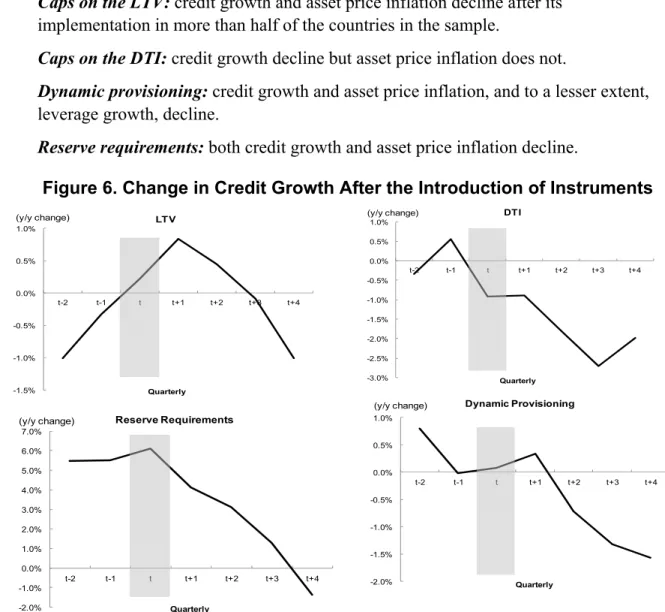
Some targeted risk variables show a change of course after the instruments are introduced. An examination of the performance of the target risk variables during the periods before and after the implementation of an instrument indicates that a number of them may have had the intended effect. Some instruments, e.g., caps on the LTV, caps on the DTI, dynamic provisioning, and reserve requirements, seem to have an impact on credit growth (Figures 6), but the effect of other instruments is less obvious.19 Specifically,
Caps on the LTV: credit growth and asset price inflation decline after its implementation in more than half of the countries in the sample.
Caps on the DTI: credit growth decline but asset price inflation does not.
Dynamic provisioning: credit growth and asset price inflation, and to a lesser extent, leverage growth, decline.
Reserve requirements:both credit growth and asset price inflation decline.
Figure 6. Change in Credit Growth After the Introduction of Instruments
19See Appendix III for a complete set of charts.
Notes:
1/ Average of sample countries’ y/y growth in credit (detrended). 2/ t denotes the time of the introduction of instruments.
3/ For details, see charts in Appendix III. Source: International Financial Statistics. -1.5%
-1.0% -0.5% 0.0% 0.5% 1.0%
t-2 t-1 t t+1 t+2 t+3 t+4
Quarterly LTV
(y/y change)
-2.0% -1.0% 0.0% 1.0% 2.0% 3.0% 4.0% 5.0% 6.0% 7.0%
t-2 t-1 t t+1 t+2 t+3 t+4
Quarterly
Reserve Requirements
(y/y change)
-2.0% -1.5% -1.0% -0.5% 0.0% 0.5% 1.0%
t-2 t-1 t t+1 t+2 t+3 t+4
Quarterly
Dynamic Provisioning (y/y change)
-3.0% -2.5% -2.0% -1.5% -1.0% -0.5% 0.0% 0.5% 1.0%
t-2 t-1 t t+1 t+2 t+3 t+4
Quarterly DTI
Macroprudential instruments seem to have been effective in reducing the correlation between credit and GDP growth. In countries that have introduced caps on the LTV, DTI and reserve requirements, the correlation is positive but much smaller than in countries without them, as shown by the flattening of the curve in Figure 7. In countries that have introduced ceilings on credit growth or dynamic provisioning, the correlation between credit growth and GDP growth becomes negative as shown by an inverted curve. The difference in the correlations is also statistically significant, except in the case of caps on foreign currency lending and restrictions on profit distribution. A more sophisticated analysis is described below to try to demonstrate causality and to disentangle the effects of other macroeconomic policies.20
C. The Panel Regression
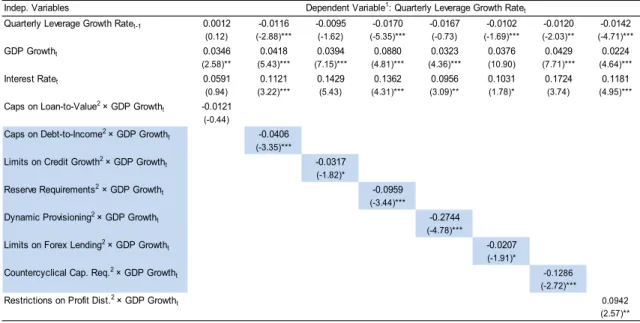
A panel regression analysis suggests that macroprudential instruments may have an impact on four measures of systemic risk—credit growth, systemic liquidity, leverage, and capital flows.21 Specifically, eight instruments22 are estimated to see if they limit the
procyclicality of credit and leverage—their tendency to amplify the business cycle. Procyclicality is captured in this case by the respective correlation of growth in credit and leverage with GDP growth. This specification has the advantage of showing the effect of the instruments in both the expansionary and recessionary phases of the cycle without “timing” the cycle. In addition, the effects of the other two instruments23 on common exposure are
estimated, using proxies for risks related to liquidity and capital flows, although the scope is limited by data availability. Dummy variables for factors such as the degree of economic development, the type of exchange regimes and the size of the financial sector are used to see if the instruments are effective across countries. The regressions use data from 49 countries during a 10-year period from 2000 to 2010 collected in the IMF survey.
20The change in credit growth in a small number of countries partially coincided with the financial crisis, so
Figure 6 may exaggerate the correlation between the instruments and credit growth. The change in most of the countries in the sample did not coincide with the crisis.
21In this section, credit growth is measured as the logarithm change of claims on the private sector from both
banks and non-bank financial institutions (source: IFS); Systemic liquidity is approximated by banks’ credit as a
fraction of total deposits to capture non-core funding (source: IFS); Leverage is defined as assets over equity for
both banks and non-bank financial institutions (source: IMF and FSIs); Capital flows are represented by the
ratio of liabilities to non-residents to claims on non-residents, which is meant to capture the banking sector’s
dependence on external funding (source: IFS).
22These are caps on the LTV, caps on the DTI, caps on foreign currency lending, ceilings on credit or credit
growth, reserve requirements, countercyclical/time-varying capital requirements, time-varying/dynamic provisioning and restrictions on profit distribution.
The specification of the panel regressions addresses several challenging issues, including:
How to disentangle the effect of macroprudential instruments from that of other policies. For monetary policy, an interest rate variable is introduced, and for fiscal policy, GDP growth is used as a proxy. Using fiscal deficit has the disadvantage of introducing multicollinearity given its high correlation with GDP growth, and there seems no direct linkage between fiscal policy and procyclicality of credit or leverage. Any indirect linkage would be captured by interest rates and GDP growth.24
How to infer the general effect of macroprudential instruments in the context of country-specific characteristics. This is addressed by introducing dummy variables to control for the type of exchange rate regime, the size of the financial sector and the degree of economic development. The panel regressions’ fixed effect takes into account other unobserved country-specific characteristics.
How to avoid estimation biases to ensure a correct quantification of the effect of macroprudential instruments.25This is addressed by using the System Generalized
Method of Moments,26 widely used to deal with panel data with endogenous
explanatory variables.
Results of the panel regressions suggest that the majority of the 10 instruments may be effective. The empirical analysis finds no evidence to suggest that the degree of economic development, the type of exchange rate regimes or the size of the financial sector affects the effectiveness of the instruments—the estimated coefficients of their dummy variables are all statistically insignificant—even though these factors may influence their choice. The results also show that the instruments remain effective after controlling for macroeconomic policies. As indicated by an impulse response analysis of an open economy DSGE model, a
combination of policies may have lower welfare costs than monetary or macroprudential policy used alone (Box 2). In addition, instruments that are rules-based have a larger effect, although there is not enough evidence to indicate whether individual or multiple instruments are more effective due to the lack of granular data. Results of the regressions are summarized as follows:
24In DSGE models with financial frictions and a role for fiscal policy, fiscal shocks are transmitted through both
demand (GDP) and risk premia in the lending rate, the two control variables used in the panel regression. See, for instance, Fernández-Villaverde (2010).
25Biases may arise from a spurious correlation or endogeneity among the instruments, control variables and risk
variables. Three forms of endogeneity are possible. First, countries with a high degree of procyclicality may be more likely to use the instruments, potentially overstating their effectiveness. Second, the risk variables may be correlated with the control variables for macroeconomic policies. Third, the dynamic specification (with lagged terms of the dependent variable) may result in autocorrelation.
On credit growth (yoy change in inflation-adjusted claims on the private sector), the coefficients of five of the 10 instrument dummy variables (caps on the LTV, DTI, ceilings on credit growth, reserve requirements and time-varying/dynamic
provisioning) are statistically significant (Table 1).27 This indicates that these
instruments may reduce the correlation between credit growth and GDP growth. Caps on the LTV, for example, reduce the procyclicality of credit growth by 80 percent.28
This is in line with findings of previous studies that associate higher LTV ratios with higher house price and credit growth over time.29 The coefficient of the dummy
variable for a subgroup of countries that have adjusted the LTV caps over time is also significant.
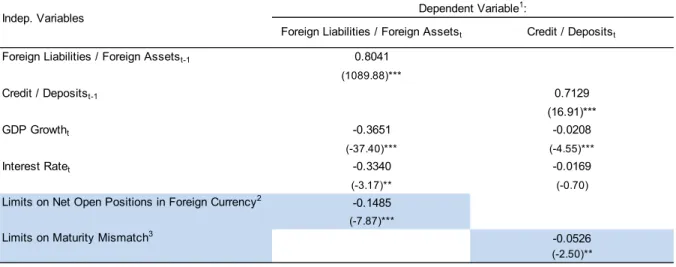
On systemic liquidity, credit expansion funded from sources other than deposits (credit/deposit) is used as a proxy for wholesale funding in the estimation of the effectiveness of limits on maturity mismatch. The estimation is intended to see if this instrument limits wholesale funding, considered a source of systemic risk with a cross-sectional dimension. The coefficient of the dummy variable for limits on maturity mismatch is statistically significant, and the credit/deposit ratio is 5 percent lower in countries with the instrument than in countries without it.
On leverage (assets/equity), the coefficients of six of the 10 instrument dummy variables (caps on the DTI, ceilings on credit growth, reserve requirements, caps on foreign currency lending, countercyclical/time-varying capital requirements30 and
time-varying/dynamic provisioning) are statistically significant (Table 2). This
indicates that, while capital-related measures are expected to reduce the procyclicality of leverage, other instruments aimed at limiting credit growth may also have an impact on leverage growth. Dynamic provisioning appears to reduce the
procyclicality of both credit growth and leverage. The effect of other capital-related measures is not obvious probably because the number of observations available is limited as only a few countries have implemented them in the last two years.
On capital flows and currency fluctuation, external indebtedness (foreign
liabilities/foreign assets) is used as a proxy for common exposure to risks associated
27See Appendix IV for a complete description of the model specification and an analysis of the results.
28The coefficient of GDP growth is 0.0791 and the coefficient of LTV caps is -0.0634 (first column, Table 1).
For every 1 percent increase in GDP growth, credit growth increases by 0.08 percent, but it is offset by 0.06 percent when LTV caps are introduced, leaving an overall net effect of 0.02 percent.
29See IMF (2011e).
30This instrument, as used by countries in the sample, is not the countercyclical capital buffer proposed under
Basel III. These countries typically adjust capital requirements by changing capital risk weights
countercyclically as opposed to the adjustment in common equity or other loss absorbing capital based on a threshold of credit to GDP under Basel III.
with them. The only dummy variable that has a statistically significant coefficient is limits on NOP. The results suggest that for every dollar of foreign assets held, the foreign liabilities of countries with this instrument are 15 percent lower than those without it (Table 3).
The regression results are independently confirmed by other studies.A separate study that focuses more on the structural determinants of credit growth corroborates the initial findings of the panel analysis. This study uses a different model and assumption on endogeneity, and the coefficients of caps on the DTI, caps on foreign currency lending, reserve requirements and time-varying/dynamic provisioning have a negative sign on credit to GDP and are statistically significant.31
This paper’s finding that the effectiveness of the instruments does not depend on the type of exchange rate regime is also independently confirmed by a structural model used in IMF (2011h), which shows that the impact of macroprudential instruments is virtually identical in economies with either fixed or floating exchange rates. The regression results need to be interpreted with caution. Statistically, the coefficients of the dummy variables for the instruments are averages of country performances. Their magnitude is affected by the number of countries in the sample that have used the instruments as well as the effectiveness in individual countries, and their statistical significance is not an indication that the
instruments are equally effective in all countries. Country-specific circumstances, such as the quality of supervision, the phase of the credit cycle in which the instruments are
implemented, the extent to which circumvention and arbitrage are possible, the ability of the authorities to take coordinated policy actions to limit circumvention and their responsiveness to changed conditions are among factors that determine whether an instrument is effective when applied in a particular country.
While the panel regression yields promising results, more work is needed to confirm its findings. The use of macroprudential instruments is still relatively new. The short experience with macroprudential policy limits the number of observations available for a more
comprehensive evaluation of its effectiveness. Further research with longer time series and better quality data is therefore necessary to corroborate the initial assessment and to evaluate an instrument’s effectiveness in country-specific contexts. Factors such as the costs involved in using macroprudential instruments, the degree of calibration, and the potential for
regulatory and cross-border arbitrage, which can easily circumscribe the effectiveness of macroprudential policy, should be taken into account in future analysis.
Box 2. Monetary and Macroprudential Policy: Are They Mutually Reinforcing?1/ Should macroprudential measures be used in conjunction with monetary policy to mitigate risks associated with large capital inflows? To address this question, an open-economy, New
Keynesian DSGE model is used to assess whether a combination of the two policies is superior to stand-alone policies.
In the model, firms can finance their investment through retained earnings or borrowing from domestic or foreign sources. Macroprudential policy is assumed to impose a higher cost of borrowing for firms, defined as an additional “regulation premium” to the cost of borrowing. Monetary policy is assumed to follow a Taylor rule, with the central bank reacting to changes in inflation and output gaps. An initial shock, modeled as a decline in investors’ perception of risk, triggers capital inflows, leading to a decline in financing costs; firms borrow and invest more. Eventually, higher leverage triggers an increase in risk premium, and financial conditions normalize. But both monetary and macroprudential policies have a nontrivial role in mitigating the impact of the shock.
Source: IMF staff analysis.
The simulations suggest that macroprudential measures could be a useful complement to monetary policy in stabilizing the economy after the initial shock. When policymakers adopt macroprudential measures that directly counteract the increase in leverage and the easing of underwriting standards, the responses of domestic and foreign debt to the shock become more muted. Output and inflation therefore respond less, and the welfare loss, computed as the sum of inflation and output volatilities in percent of steady state consumption, decreases by almost half (1.3) compared with the simple Taylor rule (2.5), where only monetary policy is implemented. In the scenario where macroprudential measures alone are implemented and the policy interest rate is kept unchanged, output and inflation become more volatile, and the welfare loss is large (31.5).
In conclusion, the combination of monetary and macroprudential policies are superior to stand-alone policies.
1/ See Unsal (2011).
Dynamic Responses to a Positive Financial
Shock (percent deviations from steady state)
-0.2 0.0 0.2 0.4 0.6 0.8
0 2 4 6 8 10 12
Output gap
Taylor rule
Taylor rule and macroprudential policy
Quarters
-0.6 0.0 0.6 1.2 1.8 2.4
0 2 4 6 8 10 12
Aggregate borrowing
Indep. Variables
Quarterly Credit Growth Ratet-1 0.0819 0.0909 0.1034 0.0817 0.0855 0.0825 0.0855 0.0779
(8.19)*** (15.16)*** (30.07)*** (33.60)*** (2.81)*** (17.95)*** (20.02)*** (17.08)***
GDP Growtht 0.0791 0.0889 0.0667 0.0869 0.0729 0.0436 0.0487 0.0454
(5.89)*** (10.44)*** (9.39)*** (6.17)*** (5.47)*** (4.50)*** (5.46)*** (5.59)***
Interest Ratet -0.0777 -0.0804 N/A
2
-0.0839 -0.0618 -0.0779 -0.0843 -0.0804
(-11.35)*** (-10.48)*** (-19.74)*** (-10.07)*** (-18.38)*** (-17.84)*** (-17.04)***
Caps on Loan-to-Value3 × GDP Growth
t -0.0634
(-3.01)**
Caps on Debt-to-Income3 × GDP Growth
t -0.0976
(-4.96)***
Limits on Credit Growth3 × GDP Growth
t -0.1227
(-4.17)***
Reserve Requirements3 × GDP Growth
t -0.0800
(-4.27)***
Dynamic Provisioning3 × GDP Growth
t -0.1776
(-2.12)**
Limits on Forex Lending3 × GDP Growth
t 0.0055
(0.21)
Countercyclical Cap. Req. 3 × GDP Growth
t 0.0438
(0.63)
Restrictions on Profit Dist.3 × GDP Growth
t 0.0664
( 4.21)
Dependent Variable1: Quarterly Credit Growth Rate t
***, **, * indicate statistical significance at 1%, 5%, and 10% (tw o-tail) test levels, respectively.
1/ The dependent variable is credit grow th, the log change in the real level of credit. Credit is measured as claims on private sector from both bank and non-bank financial institutions (source: IFS). The interest rate is the nominal long-term interest rate on prime lending, from the IMF’s International Financial Statistics. The estimation period is 2000–2010. The sample is composed of 48 countries. The regression includes dummy variables to correct for different degrees of flexibility in the exchange rate regime, individual (country) effects, a time trend (year effect) and a dummy variable for the use of other MPP instruments. Instrumental variables for the policy instrument and the GMM Arellano-Bond estimator are used to address selection bias and endogeneity.
Source: IMF staff estimates.
Table 1. Effectiveness of Macroprudential Instruments in Reducing the Pro-cyclicality of Credit
2/ Non-Significant Results w hen Interest Rate included.
3/ The coefficient corresponds to the interaction term betw een GDP grow th and a dummy for the respective macroprudential instrument.
Indep. Variables
Quarterly Leverage Growth Ratet-1 0.0012 -0.0116 -0.0095 -0.0170 -0.0167 -0.0102 -0.0120 -0.0142
(0.12) (-2.88)*** (-1.62) (-5.35)*** (-0.73) (-1.69)*** (-2.03)** (-4.71)***
GDP Growtht 0.0346 0.0418 0.0394 0.0880 0.0323 0.0376 0.0429 0.0224
(2.58)** (5.43)*** (7.15)*** (4.81)*** (4.36)*** (10.90) (7.71)*** (4.64)***
Interest Ratet 0.0591 0.1121 0.1429 0.1362 0.0956 0.1031 0.1724 0.1181
(0.94) (3.22)*** (5.43) (4.31)*** (3.09)** (1.78)* (3.74) (4.95)***
Caps on Loan-to-Value2 × GDP Growth
t -0.0121
(-0.44)
Caps on Debt-to-Income2 × GDP Growth
t -0.0406
(-3.35)***
Limits on Credit Growth2 × GDP Growth
t -0.0317
(-1.82)*
Reserve Requirements2 × GDP Growth
t -0.0959
(-3.44)***
Dynamic Provisioning2 × GDP Growth
t -0.2744
(-4.78)***
Limits on Forex Lending2 × GDP Growth
t -0.0207
(-1.91)*
Countercyclical Cap. Req.2 × GDP Growth
t -0.1286
(-2.72)***
Restrictions on Profit Dist.2 × GDP Growth
t 0.0942
(2.57)**
Source: IMF staff estimates.
1/ The dependent variable is leverage grow th, the log change in the level of leverage. Leverage is measured as assets over capital (source: IMF FSIs). The interest rate is the nominal long-term interest rate on prime lending, from the IMF’s International Financial Statistics. The estimation period is 2000–2010. The sample is composed of 48 countries. The regression includes dummy variables to correct for different degrees of flexibility in the exchange rate regime, individual (country) effects, a time trend (year effect) and a dummy variable for the use of other MPP instruments. Instrumental variables for the policy instrument and the GMM Arellano-Bond estimator are used to address selection bias and endogeneity.
2/ The coefficient corresponds to the interaction term betw een GDP grow th and a dummy for the respective macroprudential instrument.
Dependent Variable1: Quarterly Leverage Growth Rate t
Table 2. Effectiveness of Macroprudential Instruments in Reducing the Pro-cyclicality of Leverage
IV. LESSONS AND POLICY MESSAGES
A number of instruments may be effective in addressing systemic risks in the financial sector. The effectiveness does not seem to depend on the stage of economic development or type of exchange rate regime. Emerging market economies with fixed or managed exchange rates, where room for interest rate policy is limited, facing large capital inflows or having thin financial markets and a bank dominated financial system tend to use macroprudential instruments more extensively, but the instruments seem equally effective when used by countries with flexible exchange rate regimes and by advanced economies. However, there are costs involved in using macroprudential instruments, as is the case with regulation more generally, and the benefits of macroprudential policy should be weighed against these costs. Moreover, calibrating the instruments may be difficult, which could lower growth
unnecessarily or generate unintended distortions if not done appropriately. These issues are not addressed in the paper but are important considerations to take into account when using macroprudential instruments.
Underpinning the assessment of effectiveness is the assumption of a sound regulatory framework and high quality supervision. These are the foundation for the effective application of macroprudential instruments.32 In addition, institutional arrangements for
32The objective of microprudential policy is to improve the resilience of individual institutions while
macroprudential policy aims to improve the resilience of the financial system as a whole. Both share
instruments that have the same root. There is also growing recognition that microprudential regulations—unless carefully designed—can encourage procyclical behavior (See Viñals et al (2010)).
Foreign Liabilities / Foreign Assetst Credit / Depositst Foreign Liabilities / Foreign Assetst-1 0.8041
(1089.88)***
Credit / Depositst-1 0.7129
(16.91)***
GDP Growtht -0.3651 -0.0208
(-37.40)*** (-4.55)***
Interest Ratet -0.3340 -0.0169
(-3.17)** (-0.70)
Limits on Net Open Positions in Foreign Currency2 -0.1485
(-7.87)***
Limits on Maturity Mismatch3 -0.0526
(-2.50)** Table 3. Effectiveness of Macroprudential Instruments in Reducing Cross-Sectional Risks
Source: IMF's staff estimates.
***, **, * indicate statistical significance at 1%, 5%, and 10% (tw o-tail) test levels, respectively.
1/ The dependent variables are the ratio of financial system liabilities w ith foreign residents to claims on foreign residents (1) and the ratio of banking institutions claims to deposits (2), obtained from the IMF’s International Financial Statistics. The interest rate is the nominal long-term interest rate on prime lending, also from IFS. The estimation period is 2000–2010. The sample is composed of 48 countries. The regression includes dummy variables to correct for different degrees of flexibility in the exchange rate regime, individual (country) effects, a time trend (year effect) and a dummy variable for the use of other MPP instruments. Instrumental variables for the policy instrument and the GMM Arellano-Bond estimator are used to address selection bias and endogeneity.
Dependent Variable1: Indep. Variables
3/ The coefficient corresponds to a dummy variable w ith a value of 1 for countries w ith limits on maturity mismatches, and zero otherw ise.
macroprudential policy need to ensure a policymaker’s ability and willingness to act— including clear mandates; control over instruments that are commensurate with those mandates; arrangements that safeguard operational independence; and provisions to ensure accountability, supported by transparency and clear communication of decisions and decision-making processes.33
While care is needed to avoid one-size-fits-all approaches, there are common lessons on what instruments should be used to address specific risks that are considered systemic:
To address systemic risks generated by credit growth or asset price inflation,
credit-related instruments may be useful. Of these, LTV and DTI caps can be kept in place, adjusted counter cyclically or targeted at specific sources of risk. They may be supplemented by reserve requirements or capital-related instruments, such as dynamic provisioning, should the credit boom become more generalized; these in turn can be targeted by currency if foreign currency lending proves to be the source of risk.
To address systemic liquidity risk, liquidity-related instruments such as limits on liquidity mismatch may be used, or limits on the net foreign currency position if the liquidity risk stems from foreign currency funding. A core (or stable) funding ratio, or a levy on non-core liabilities, which are not examined by this paper, could also be good candidates if wholesale funding is a significant funding source. The ratio or levy can be kept in place to prevent the buildup of systemic liquidity risk, or adjusted in response to a sudden liquidity shock.
To address risks arising from excessive leverage, capital-related instruments may be a good choice. These measures provide a buffer that can be made countercyclical through adjustments in the capital requirement, the risk weights of assets or the provisioning requirement, and can thus help curtail excessive growth in leverage. If leverage growth stems from banks’ drive to expand credit, capital-related measures can be supplemented by credit-related instruments to go to the source of the risk.
If the above mentioned risks arise due to capital flows, all three types of instruments can be used. Liquidity-related instruments, like limits on net open positions in foreign currency, are shown to be effective in limiting the financial sector’s dependence on foreign sources of funding.These instruments can be supported by credit-related instruments if excessive credit growth is what drives banks to borrow abroad.In this context, capital-related instruments may also be useful by limiting credit growth and providing a buffer.
Several considerations are relevant for the successful design and calibration of instruments. Countries have tailored the design and calibration of the instruments to their