Sharif University of Technology
Scientia IranicaTransactions D: Computer Science & Engineering and Electrical Engineering www.scientiairanica.com
Eciently computing the smallest axis-parallel squares
spanning all colors
P. Khanteimouri
a, A. Mohades
a;, M.A. Abam
b, M.R. Kazemi
aand S. Sedighin
c a. Department of Mathematics and Computer Science, Amirkabir University of Technology, Tehran, Iran.b. 716 CE Building, Sharif University of Technology, Tehran, Iran.
c. 3204 A.V. Williams Building, University of Maryland, College Park, Maryland, USA. Received 12 November 2015; received in revised form 22 August 2016; accepted 19 December 2016
KEYWORDS Algorithm; Location planning; Dynamic data structure; Color-spanning objects.
Abstract. For a set of colored points, a region is called color-spanning if it contains at least one point of each color. In this paper, we rst consider the problem of maintaining the smallest color-spanning interval for a set of n points with k colors on the real line, such that the insertion and deletion of an arbitrary point takes O(log2n) the worst-case time.
Then, we exploit the data structure to show that there is O(n log2n) time algorithm to
compute the smallest color-spanning square for a set of n points with k colors in the plane. This is a new way to improve O(nk log n) time algorithm presented by Abellanas et al. [1] when k = !(log n). We also consider the problem of computing the smallest color-spanning square in a special case in which we have, at most, two points from each color. We present O(n log n) time algorithm to solve the problem which improves the result presented by Arkin et al. [2] by a factor of log n.
© 2017 Sharif University of Technology. All rights reserved.
1. Introduction
Background. Suppose that there are k dierent types of facilities such as banks, police oces, etc. and we are given n facilities of these types. A basic problem arising here is to nd a region in which there is at least one representative from each type of facilities. This suggests the problem of computing the smallest area/perimeter color-spanning objects. Another moti-vation comes from discrete imprecise data [3,4]. In this context, each imprecise point is dened with a set of discrete possible locations. Then, for a given set of k imprecise points, we have a set of n points colored with k colors, where for each color, the points of that color represent an imprecise point. The basic problem on a
*. Corresponding author. Tel.: +98 21 6454-2542 E-mail addresses: [email protected] (P. Khanteimouri); [email protected] (A. Mohades);
[email protected] (M.A. Abam); [email protected] (M.R. Kazemi); [email protected] (S. Sedighin)
set of imprecise points is to locate each imprecise point within its dening set in which a measure becomes optimized [5]. This is equivalent to choosing exactly k points with dierent colors in which a property, e.g. di-ameter, closest pair, bounding box, etc. gets minimized or maximized. Beside these two applications, this problem has other applications in statistical clustering, pattern recognition, and generalized range searching [6-8].
Related works. There are several works on colored points. Motivated from imprecise data, Ju et al. [4] showed some results on hardness of the largest closest pair and the minimum planar spanning tree. Fan et al. [9] also proposed O(n2log n) time algorithm to
compute the expected area of convex hulls of the color-spanning sets.
In the view of location problems, for a given set of n colored points with k colors in the plane, one of the most studied problems is to nd the smallest color-spanning rectangle. For the axis-parallel case,
algorithm running in O(n log k) time. For the problem of computing the smallest axis-parallel rectangle that spans specied number of points from each color, Barba et al. [11] presented an algorithm running in O(n2k)
time. The results are near ecient with respect to testing all minimal objects. A minimal color-spanning object contains at least one point from each color, and any sub-region of the same type does not contain all colors.
For the problem of computing the smallest color-spanning circle, Abellanas et al. [12] proposed an al-gorithm with O(n2(k) log k) time using Farthest
Col-ored Voronoi Diagram (FCVD). The other approach mentioned by Abellanas et al. [1] is to obtain the smallest spanning circle and the smallest color-spanning axis-parallel square in O(kn log n) time using the upper envelope of Voronoi surfaces [13]. In case there are exactly two points of each color, Arkin et al. [2] presented O(n log2n) time algorithm to compute
the smallest color-spanning square.
Our results. In Section 2, we rst consider the problem of maintaining the smallest color-spanning interval for a dynamic set of colored points with k colors on the real line. We propose a data structure which spends O(log2n) update time per insertion and
deletion using the structure designed by Overmars and van Leeuwen [14]. Next, in Section 3, we exploit the data structure to compute the smallest color-spanning axis-parallel square. The algorithm sweeps the points from top to bottom by two horizontal lines while the points between the lines are vertically projected. Then, we use the dynamic data structure to maintain the SCSI of the projected points when insertion or deletion occurs. The algorithm runs in O(n log2n) time and
does not test every minimal candidates (in fact, we show that there may be (kn) minimal color-spanning axis-parallel squares in the worst case). Hence, this result is an improvement to the result proposed by Abellanas et al. [1] in case k = !(log n)6. (We
have recently realized that the algorithm given by Arkin et al. [2] can be generalized to get the same result.) In Section 4, we study the computation of the SCSS under the assumption that there are, at most, two points from each color. We propose O(n log n) time algorithm by reducing the problem to the 2-SAT problem. This improves the result [2] by a factor of log n. Moreover, the reduction can be simply generalized to any xed dimension, d > 2.
coordinates are dierent. We rst show some properties of color-spanning intervals for a static set of colored points on the real line. Next, we consider the problem of maintaining the smallest color-spanning interval for dynamic points in which the points are permitted to be inserted or deleted.
2.1. Minimal color-spanning intervals for static points
A minimal color-spanning interval for a set of colored points on the real line is an interval containing all colors, and any sub-interval of it does not contain all colors. As a simple observation, the endpoints of a minimal color-spanning interval have dierent colors and their colors are unique in the interval.
Suppose that we are given a set P of n colored points with k colors on the real line. It is easy to show that the number of minimal color-spanning intervals is linear, and they can be found with a simple algorithm in linear time and space apart from sorting. The algorithm sweeps the points from left to right with two sweep lines which stop at the endpoints of an interval. It uses an array for keeping the number of points from each color and a variable for the number of dierent colors between the two sweep lines. Since the sweep lines never go back, the algorithm takes O(n) time and space. We omit the details due to the simplicity and conclude the following theorem.
Theorem 1. For a given set of n points with k colors on the real line, the smallest color-spanning interval can be computed in O(n) time and space apart from sorting.
In the following, we show a new view of minimal color-spanning intervals. Gupta et al. [6] used a transformation to perform generalized range report-ing/counting for a given set of colored points on the real line. Indeed, they map the original given points on the real line to points in the plane and perform the standard 3-sided range reporting/counting in the plane. We exploit the same transformation to give a new view of minimal color-spanning intervals. Let P = fp1; p2; ; png be a given set of colored points
with k colors on the real line. For each color c, we rst sort the points with color c (c-colored points, for short) in an increasing order. Then, for arbitrary point pi with color c, let pred(pi) be the previous
point of pi in the list of the ordered c-colored points.
Figure 1. The ordered lists of c-colored points for each color c.
Figure 2. The smallest color-spanning interval on the staircase of maximal points.
leftmost point with color c. Moreover, we insert k additional points, fpn+1; pn+2; ; pn+kg, from each
color at 1-(see Figure 1). A point, pi, is mapped
to the point p
i = (pi; pred(pi)) in the plane. Let
P = fp
1; p2; ; pn+kg be the transformed points {
Figure 2 shows the transformed points of Figure 1. Furthermore, an interval I = [l; r] on the real line is mapped to point I = (r; l). This transformation has
several interesting properties.
Consider an arbitrary point, p = (px; py), in
the plane. The vertical and horizontal lines passing through p divide the plane into four quadrants. Let (p) be the right-bottom quadrant, precisely (p) = fq 2 R2jp
x qx; py qyg. In the following, we give
some related denitions.
Denition 1. For a set of points, Q = fq1; ; qng,
and point q in the plane, (q) is Q-empty if there is no point qi2 Q in the interior of (q).
Denition 2. For a set of points Q in the plane, point q 2 R2is maximal with respect to Q if (q) is Q-empty,
and there is no other Q-empty (p) for some point p 2 R2, such that (q) (p).
Denition 3. For a set of points Q in the plane, point qi2 Q is a skyline point if (qi) is Q-empty.
In order to see how the maximal points in the plane are related to the minimal color-spanning inter-vals, we present the following lemma.
Figure 3. A not color-spanning interval I = [l; r] where (I) is not empty.
Lemma 1. For a given set P of colored points on the real line, I = [l; r] is a minimal color-spanning interval if and only if the point I = (r; l) is maximal
with respect to points P on the plane.
Proof. First, suppose that I = [l; r] is a minimal color-spanning interval. For the sake of contradiction, assume that I= (r; l) is not maximal. We distinguish
two cases:
1. (I) is not empty;
2. (I) is empty but it is not maximal.
In case (1), assume that point (pi; pred(pi)) is inside
(I) where both p
i and pred(pi) have color c - (see
Figure 3). This gives us l > pred(pi) and r < pi, which
means [l; r] is a proper subinterval of [pred(pi); pi].
Therefore, [l; r] does not contain any point of color c which is a contradiction. Now, consider case (2). In this case, there is a point q = (r0; l0), such
that (I) (q). This means that there is a
smaller color-spanning interval, q = [l0; r0], contained
in I = [l; r], which is a contradiction. Moreover, additional points at innity make any minimal color-spanning interval covered by maximal points on the plane. The converse implication can be proved in a similar way.
To summarize, a minimal color-spanning interval I is a maximal point on the plane with respect to P. In fact, vertical and horizontal rays extending
to +y and x directions starting at skyline points dene the maximal points (see Figure 2 for more illustration). Consider I as a maximal point between
two consecutive skyline points p
ci = (pci; pci 1) and
p c0
j = (pc0j; pc0j 1) on the plane. The minimal
color-spanning interval dened by I is I = [p c0
j 1; pci].
Furthermore, the length of an interval is the vertical distance of its transformed point to the line y = x. The smallest color-spanning interval is the minimum maximal point on the plane (see Figure 2).
spanning interval.
In the previous section, we showed that the minimal color-spanning intervals for a set of colored points on the real line can be considered as the maximal points on the plane. Therefore, maintaining the min-imal color-spanning intervals reduces to maintaining the skyline points on the plane. Overmars and van Leeuwen [14] proposed a data structure for maintaining the skyline. In the following, we briey go over their data structure.
Overmars and van Leeuwen [14] used a binary search tree, T , which stores all points in its leaves in the sorted order by their y-coordinates. Moreover, an internal node, v, is augmented with a concatenable tree, e.g. 2-3 trees, which stores the skyline of points in the subtree rooted at v that is not contained in the skyline of points in the subtree rooted at v's parent. The skyline of all points in Q is augmented in the root of T . In addition, the cut point is where the skyline split is stored in v. If point p is inserted, a procedure Down(T; p) goes downwards the tree to locate p and construct the skyline of points for subtrees of children of each internal node u on the path. Suppose that Down(T; p) is running, and the skyline of u's subtree has been computed in u's parent in the previous step. Then, from the cut point of u's children, it is possible to split u's skyline at that point and to merge split parts with the lists stored in augmented trees of u's children. After inserting point p to a leaf of tree T , the other procedure Up(T; p) goes up the tree to the root of T and reconstructs the augmented trees and the cut points for children of each internal node placed on the path. If a point is deleted, the procedures work similarly. These procedures split or merge two concatenable queues in O(log n) time in each internal node on the path from root to inserted or deleted leaf, and they totally need O(log2n) time. In addition, they showed that their
data structure and algorithms use linear space [14]. Now, we exploit the described structure to main-tain the smallest color-spanning interval which is the maximal point with the minimum distance to the line y = x (the minimum maximal point) on the plane (see Figure 2). Let T be the same augmented binary search tree in Overmars and van Leeuwen's data structure. We modify the augmented 2-3 trees as follows. For each internal node v in augmented trees, we set two pointers, p
m1 and pm2, to the consecutive leaves which denote
the minimum maximal point in the subtree rooted at v. In fact, p
m1 and pm2 indicate the endpoints of the
smallest color-spanning interval for the points in the
Figure 4. Two sets of skyline points, one of which is dominated by the other.
subtree rooted in v. In addition, let p
l and pr be
pointers, respectively, to the leftmost and the rightmost leaves in the subtree rooted in v.
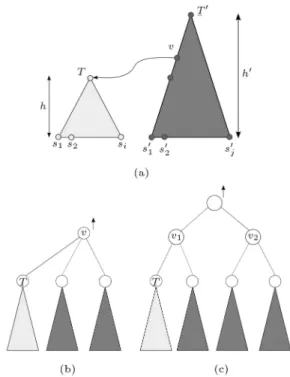
Now, consider two cases of 2-3 trees of skyline points T and T0 with heights h and h0 (h < h0) in
which all points in T are dominated by any point in T0; 8(s 2 T; s0 2 T0) : s
x < s0x; sy < s0y (see Figure 4).
We have the following lemma.
Lemma 2. Merging skylines T and T0 with the above
condition and maintaining the minimum maximal point takes O(h0 h) time.
Proof. Assume that without loss of generality, h < h0. Let v be the parent of the node with height h0
h on the leftmost path in T (see Figure 5(a)). We insert T into the left child of v. The node v can be either 2-node or 3-node. If v is 2-node (see Figure 5(b)) it becomes 3-node, and for updating the pointers of v, we compare the minimum maximal point of T and minimum maximal point of the subtree rooted in v.
Moreover, the new maximal point which is dened by the rightmost point of T , and the leftmost point of leftchild(v) should be considered. It is easy to update p
l of node v (pl(v) = pl(T )). If v is 3-node (see
Figure 5(c)) v should be split. It is easy to dene the pointers for the newly-dened internal nodes v1 and v2
in constant time. After updating the pointers of v, we go up to the root of T0, and for each internal node on
the path to the root, we update the pointers similarly. Therefore, this procedure takes O(h0 h) time.
Now, let T be 2-3 trees of skyline points. We show how we can split T into two 2-3 trees T0 and T00
of skyline points with respect to some vertical line and maintain the minimum maximum point for trees T0and
T00.
Lemma 3. Splitting a skyline T into skylines T0 and
T00 with respect to some vertical line and maintaining
the minimum maximal points in T0 and T00 takes
O(log n) time.
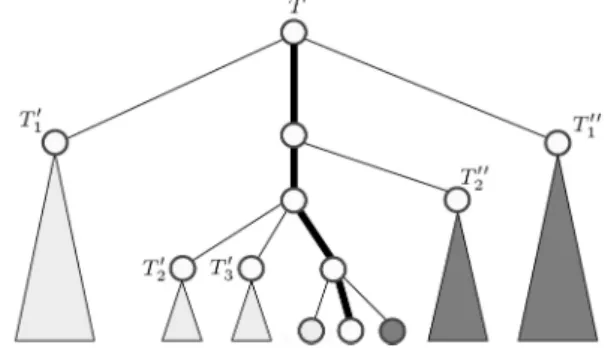
Proof. Consider the path going down the tree with respect to x-coordinate of the vertical line (see Fig-ure 6). It is clear that T0 can be obtained by merging
all subtrees T0
i on the left side of the path (similarly,
T00 by merging the right subtrees T00
i ). By Lemma 2,
we can update the pointers to maintain the minimum maximal points for each of T0 and T00. Therefore,
the total computation time is O(log n) as splitting 2-3 trees.
In fact, the procedures Down(T; P ) and UP(T; P ) in Overmars and van Leeuwen's data structure per-form merge and split in the children (and their augmented trees) of each node on the path to the inserted/deleted point. Therefore, procedures Down(T; P ) and UP(T; P ) in modied conditions still take O(log2n) time.
Theorem 2. For a given set of n points with k colors on the real line, the smallest color-spanning interval can be maintained in O(log2n) update time per
insertion and deletion and O(n) space.
Proof. When a new point p with color c is inserted
Figure 6. Splitting of a skyline T into skylines T0 and T00.
between points pci 1 and pciin the c-colored list, point
p
ci = (pci; pci 1) should be deleted from the plane, and
two new points p
ci = (pci; p) and p = (p; pci 1) are
inserted. Deletion of a point similarly needs a constant number of insertions and deletions.
We showed how we can maintain the smallest color-spanning interval for dynamic points on the real line. This is an important tool which helps us in the next section to compute the smallest color-spanning square for a given set of colored points in the plane.
3. The smallest color-spanning square
In this section, we focus on computing the small-est area/perimeter color-spanning axis-parallel square. Suppose that we are given a set of n points with k colors on the plane. The smallest color-spanning square is an axis-parallel square which contains all colors, and its area/perimeter is minimum.
Recall that this problem can be solved using the upper envelope of Voronoi surfaces [13] in O(kn log n) time. In fact, all the previously used methods for computing the smallest color-spanning objects, such as rectangle, circle, etc. generally test all the minimal objects. We show that there are (kn) minimal color-spanning squares in the worst case. This indicates that any algorithm testing all minimal color-spanning squares runs in (kn) worst-case time. Next, we present an algorithm running in O(n log2n) time that computes the smallest color-spanning square without testing all minimal color-spanning squares.
We rst explain how a minimal color-spanning square can be represented. As illustrated in Fig-ure 7, a minimal color-spanning square is dened with two, three, or four points with dierent colors on its edges under the assumption that point coordinates are dierent (recall that this assumption is just for the ease of the presentation). In all cases, the minimal color-spanning square is bounded by two points on opposite sides. Then, it suces to consider only the minimal color-spanning squares of case 1 instead of all. Moreover, we are interested in counting the minimal color-spanning squares with dierent contained points. We rst give a lower bound for the number of minimal color-spanning squares.
Lemma 4. There is a conguration of n points with k colors in the plane, in which there are (kn) minimal color-spanning squares.
Figure 8. (k2) minimal color-spanning squares with 2k
points.
Proof. Let's place a set of 2k points with k colors in the conguration, shown in Figure 8. In this pattern, we have to x the left and the right edges in a way that they span the half of the colors (1 to k
2). So,
there are k
2+ 1 choices for xing the right and the left
edges. Similarly, for a pair of xed left and right edges, it is possible to obtain k
2 + 1 pairs to be the top and
the bottom sides. Therefore, there are (k2) minimal
color-spanning squares in the pattern of Figure 8 using 2k points. By repeating this pattern n
2k times, we
achieve (kn) minimal color-spanning squares for a set of n points with k colors.
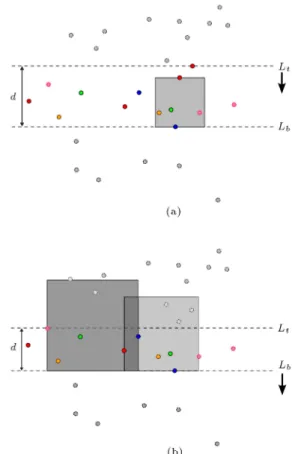
Now, we start describing the steps of our main algorithm. Suppose that the points are sorted in a descending order according to their y coordinates. The algorithm sweeps the points with two lines Lb and
Lt from top to bottom, and variable d denotes the
vertical distance of the sweep lines (see Figure 9 for more illustration). In fact, lines Lband Lt, respectively,
dene the bottom and the top edges of the desired square. In the beginning, Lb and Ltpass through the
topmost point. We move downwards the sweep lines as follows:
- Move downwards line Lt to the next point if there
exists at least one color-spanning square in the strip bounded by Lb and Lt(see Figure 9(a));
- Move downwards line Lb to the next point if there
is no color-spanning square in the strip bounded by Lb and Lt (see Figure 9(b)).
Now, it remains to show how we can nd out if there is a minimal color-spanning square in the strip of lines Lb
and Lt. Suppose that the points in the strip are
pro-jected onto the real line; let P be the union of this set of projected points and the additional points from each color at innity as dened in the previous section. The following simple but important observation describes
Figure 9. Sweeping the points with two lines Lband Lt.
the necessary and sucient conditions that a minimal color-spanning square exists inside the strip bounded by Lb and Lt.
Observation 1. There is a minimal color-spanning square in the strip of lines Lb and Lt if and only if for
the points in P the length of the smallest color-spanning interval is at most d.
According to this observation, the algorithm only considers the projected points, P. Indeed, when Lb
reaches a new point or a point goes out of the strip when Lt moves downwards, we insert or respectively
delete a point from the dynamic structure of maintain-ing the smallest color-spannmaintain-ing interval, described in the previous section. In addition, while Lt is moving
downwards, at the time the smallest color-spanning interval becomes greater than d, the solution should be updated. We give the following theorem.
Theorem 3. For a given set of n points with k colors in the plane, the smallest color-spanning axis-parallel square can be computed in O(n log2n) time.
Proof. Let s be the smallest color-spanning square in which its top and bottom sides are dened with points pt and pb, respectively. Suppose that t1 is the time
Lb reaches pb, and t2 is the time Lt stops at point
means that Lb is at point pb, while Lt is above point
pt. Since there is at least one color-spanning square
between the sweep lines, Ltmoves downwards until it
reaches point pt. When Lt leaves out pt, the length
of the smallest color-spanning interval becomes greater than d, and s has been visited. Otherwise, s is not the solution which is a contradiction. Similarly, if t1 > t2,
Lt stops at point pt, while Lb moves downwards until
it reaches point pb. Since s is the solution, Lb must
stop at point pb. Therefore, we visit the smallest
color-spanning square in both cases. To analyse the running time of our algorithm, we noted that each point p enters the strip and is eliminated from it once when Lb
and Lt, respectively, reach it. Therefore, in total, we
have O(n) insertions and deletions, and by Theorem 2, each operation spends O(log2n) time to maintain the
smallest color-spanning interval for the points in P. So, the algorithm runs in O(n log2n) time.
4. The smallest color-spanning square for pairs of points
In this section, we restrict ourselves to the case in which we have only two points from each color. Thus, the variant that we are considering is as follows.
Problem statement. Suppose that we are given n pairs (pi; qi) of points in the plane where points pi and
qi are colored with color i. The goal is to compute the
smallest color-spanning axis-parallel square. Arkin et al. [2] proposed an algorithm with O(n log2n) running
time. We present an algorithm not only running faster by a factor of O(log n), but also being applicable to any xed dimension.
Overall idea. Let the square-side length be d. Then, computing the smallest color-spanning square is re-duced to the decision problem \Does there exist a square with size d covering all colors". We will introduce an O(n) reduction from this decision version to the 2-SAT problem which is decidable in linear time. By this result, we can perform a binary search over the side length of the square.
Fix the side length of the square to be d. In order to nd a satisfying square of the side length d, we must select at least one point from each color, such that the following two constraints hold for the selected set of points:
- The x-coordinate dierence of every two selected points is at most d;
- The y-coordinate dierence of every two selected points is at most d.
We associate each input point, p, with a Boolean variable, vp. Variable vp is true if p is a selected point.
As there are 2n points, we have 2n Boolean variables. To get a valid selection, for any two points p and q (p and q may have the same color) that violate one of the above constraints, we add the following clause to the instance of the 2-SAT problem in order to ensure that at most one of them gets selected:
(vp_ vq) :
Furthermore, for each input pair of points (pi and qi),
we add the following clause in order to ensure that at least one of them gets selected:
(vpi_ vqi):
Since the running time of the ecient 2-SAT algorithm is O(N + M) where N and M are the number of variables and clauses, respectively, the above modeling gives us an O(n2)-time algorithm. In the remainder,
we show that the number of clauses can be reduced to O(n). The main idea is to add 4 additional Boolean variables Lp, Rp, Up, and Dp to each input point p
with the following properties:
1. If Lpis true, then none of the points q with x(q)
x(p) gets selected;
2. If Rpis true, then none of the points q with x(q)
x(p) gets selected;
3. If Dpis true, then none of the points q with y(q)
y(p) gets selected;
4. If Up is true, then none of the points q with y(q)
y(p) gets selected.
where x(p) and y(p) are x and y-coordinates of p. In order to force the constraints of type 1, we add the following clauses:
Lp_ vp; Lp_ Ll(p);
where l(p) is a point whose x-coordinate rank is immediately before that of p. Note that if Lp is true
for some point p, (Lp_Ll(p)) forces Lq to be true for all
q where x(q) < x(p). And, this together with (Lq_ vq)
forces vq is not selected. We add similar clauses to the
constraints of types 2, 3, and 4, as well. Using the new variables, we can avoid selecting the violating points done by O(n) clauses. More precisely, for every point p, we add the following 4 clauses:
vp_ Ll(d;p); vp_ Rr(d;p);
vp_ Uu(d;p); vp_ Dd(d;p);
where l(d; p) is the rightmost point whose x-coordinate is less than x(p) d, r(d; p) is the leftmost point whose x-coordinate is more than x(p) + d, u(d; p) is the bottommost point whose y-coordinate is more than y(p) d, and d(d; p) is the topmost point whose
y-and is simply extendible to any constant dimension d > 2.
Now, we perform a binary search on d to com-pute the smallest color-spanning square. Let X = fx1; ; xng be a sorted set of n points on the real line.
The set of interdistances is dened by fxj xijxi; xj 2
X; i < jg. We use matrix searching to select the ith element of the interdistances. An mn matrix is sorted if each row and column of it is in a non-decreasing order. Frederickson and Johnson [16] presented an algorithm to select the ith smallest element of an mn sorted matrix in O(m log(2n
m)) time where m n. By
implicitly dening an n n sorted matrix M based on the interdistances of P in each dimension, we can select the ith interdistance in O(n) time. Let:
Mi;j=
8 < :
xi xn j+1: i > n j + 1
0 : otherwise:
Since the reduction can be simply generalized to any xed dimension d > 2 and binary search takes O(log n) steps, we conclude the following theorem.
Theorem 4. For a set P of n colored points in the d-dimensional space where there are exactly two points from each color, the smallest color-spanning hyper-cube can be computed in O(n log n) time.
5. The smallest color-spanning two squares In this section, we dedicate our attention to the problem of computing the smallest color-spanning two squares (SCS2S, for short). Precisely, we are given n points with k colors in the plane and the goal is to compute two axis-parallel squares which together span all colors, and the larger one is as small as possible. Similar to the previous section, we rst consider the decision version of the problem where we are also given a distance d and the problem is deciding if there are two squares together spanning all colors and the side length of the larger one is at most d. Then, we use a binary search on interdistances to solve the problem.
Suppose that we are given n points with k colors in the plane. Let S
1 and S2 be two squares which
solve the problem of SCS2S, such that S
1 is the larger
one with side length d. Moreover, without loss of
generality, we assume that points ptand pb are located
in the top and the bottom sides of S
1, respectively (see
Figure 10).
Figure 10. Two squares which solve the problem SCS2S.
Figure 11. There are at most 2k 2 squares with dierent colors when Lbreaches point p.
In the following, for a given distance d, we show how to decide if d d. In order to decide, we sweep
the points with two horizontal lines Lt and Lb which
their vertical distance is exactly d (see Figure 11). In fact, Lt and Lb represent the top and bottom sides of
the larger square, S1, respectively. When Lb reaches
point p, we consider all the squares from left to right having p in their bottom sides. Among these squares, it suces to consider only the squares covering dierent sets of colors.
Let S1 be the leftmost square having p on its
bottom side. We horizontally move S1to the right until
its left side reaches p. During the motion C(S1), the
color set covered by S1changes if its right side reaches
the rst occurrence q of some color or its left side passes the last occurrence q of some color. Otherwise, C(S1)
remains unchanged. As there are at most k colors and C(S1) keeps the color of p in all squares, C(S1) may
change at most 2k 2 times. When C(S1) changes,
we create an instance of the smallest color-spanning square problem with colors not covered by S1and apply
our algorithm in Section 3 to this instance in order to compute S2. Whenever we nd a square, S2, whose side
length is at most d, we stop searching, and we conclude that d d. At the end of the sweep, if we fail nding
S2 with the side length of at most d, we conclude that
d> d.
Lemma 5. For given n points with k colors in the plane and a distance d, we can decide in O(kn2log2n)
if there are two squares together spanning all colors whose side length of the larger one is at most d. Proof. Let Tc be a balanced binary search tree that
stores the point of color c in the strip bounded by Lt
and Lb, according to their x-coordinates. We perform
an insertion (deletion) into Tc when Lb (respectively
Lt) reaches point p of color c in O(log n) time.
Fur-thermore, we are able to compute the mentioned 2k 2 points in increasing order by their x-coordinates in O(k logn
k + k log k) time. Next, updating C(S1) takes
O(1) time while S1 is moving to the left. To compute
S2 for the points of colors not covered by S1, we run
the algorithm described in Section 3 in O(n log2n) time according to Theorem 3. Therefore, for each point p, the computation takes O(log n + k logn
k + k log k +
kn log2n) = O(kn log2n) time; in total, the running time of the algorithm is O(kn2log2n).
Now, we use a binary search algorithm in the way described in the previous section to solve the problem of SCS2S. Therefore, we present the following theorem. Theorem 5. For given n points with k colors in the plane, we can compute the smallest color-spanning two axis-parallel squares in O(kn2log3n) time.
6. Conclusion
In this paper, we have presented an algorithm to maintain the smallest color-spanning interval for a set of n colored points on the real line at a cost of O(log2n) time for each insertion or deletion. As an application, we used this data structure to propose O(n log2n) time algorithm to compute the smallest color-spanning axis-parallel square for a set of n points with k colors in the plane. This improves the algorithm proposed by Abellanas et al. [1] where k = !(log n). However, the algorithm presented in [2] for this problem is a special case where there are only two points from each color which can be simply applied to the general case in the same running time. Nevertheless, we independently considered the problem in this special case. We mod-eled the problem with 2-SAT and presented O(n log n) time algorithm to solve the problem which improves the result presented in [2] by a factor of log n and can be generalized to any xed dimension d > 2. Finally, we considered the problem of computing two axis-parallel squares, which altogether includes all colors, and the larger one is as small as possible. We proposed an algorithm running in O(kn2log3n) time using a binary
search on the area of the larger one.
References
1. Abellanas, M., Hurtado, F., Icking, C., Klein, R., Langetepe, E., Ma, L., Palop, B. and Sacristan, V. \Smallest color-spanning objects", In Proc. 9th Annu. European Sympos. Algorithms (ESA-2001), Springer-Verlag (2001).
2. Arkin, E.M., Daz-Ba~nez, J.M., Hurtado, F., Ku-mar, P., Mitchell, J.S., Palop, B., Perez-Lantero, P., Saumell, M. and Silveira, R.I. \Bichromatic 2-center of pairs of points", Computational Geometry, 48(2), pp. 94-107 (2015).
3. Daz-Ba~nez, J.M., Korman, M., Perez-Lantero, P., Pilz, A., Seara, C. and Silveira, R.I. \New results on stabbing segments with a polygon", In International Conference on Algorithms and Complexity, pp. 146-157, Springer (2013).
4. Fan, C., Ju, W., Luo, J. and Zhu, B. \On some geometric problems of color-spanning sets", In FAW-AAIM, pp. 113-124 (2011).
5. Loer, M. \Data imprecision in computational geom-etry", PhD Thesis, Utrecht University (2009).
6. Gupta, P., Janardan, R. and Smid, M. \Further results on generalized intersection searching problems: counting, reporting, and dynamization", Journal of Algorithms, 19(2), pp. 282-317 (1995).
7. Matousek, J. \On enclosing k points by a circle", Information Processing Letters, 53(4), pp. 217-221 (1995).
8. Smid, M. \Finding k points with a smallest enclosing square", Report MPI-I-92-152, Max-Planck-Institut Inform., Saarbrucken, Germany (1993).
9. Fan, C., Luo, J., Zhong, F. and Zhu, B. \Expected computations on color spanning sets", In Frontiers in Algorithmics and Algorithmic Aspects in Information and Management, pp. 130-141, Springer (2013).
10. Das, S., Goswami, P.P. and Nandy, S.C. \Smallest color-spanning object revisited", Int. J. Comput. Ge-ometry Appl., 19, pp. 457-478 (October, 2009).
11. Barba, L. Durocher, S., Fraser, R., Hurtado Daz, F.A., Mehrabi, S., Mondal, D., Morrison, J.M., Skala, M. and Wahid, M.A. \On k-enclosing objects in a coloured point set", In Proceedings of the 25th Cana-dian Conference on Computational Geometry, pp. 229-234 (2014).
12. Abellanas, M., Hurtado, F., Icking, C., Klein, R., Langetepe, E., Ma, L., Palop, B. and Sacristan, V. \The farthest color voronoi diagram and related problems", Tech. Rep., University of Bonn (2006).
13. Huttenlocher, D.P., Kedem, K. and Sharir, M. \The upper envelope of voronoi surfaces and its applica-tions", Discrete & Computational Geometry, 9(3), pp. 267-291 (1993).
14. Overmars, M.H. and Van Leeuwen, J. \Maintenance of congurations in the plane", Journal of computer and System Sciences, 23(2), pp. 166-204 (1981).
Biographies
Payam Khanteimouri received his MS degree in Computer Science from Sharif University of Technology in 2010. He is a PhD student in Amirkabir University of Technology, and his current research interests in-clude computational geometry, robotics, and categori-cal data.
Ali Mohades is a Manager of the Computer Science Group in the Faculty of Mathematics and Computer Science in Amirkabir University of Technology in Tehran, Iran. He is the Dean of the Laboratory of Algorithms and Computational Geometry in the Faculty of Mathematics and Computer Science. His main elds of interest are computational geometry, motion planning, and facility location.
and 2001, and PhD degree in Computer Sciences from the Eindhoven University in the Netherlands in 2007. He was a Postdoc Researcher at Aarhus university in Denmark and Dortmund University in Germany from 2008 till 2010.
Mohammad Reza Kazemi received the MS degree in Computer Science from Sharif University of Tech-nology in 2010. He is a PhD student in Amirkabir Uni-versity of Technology. His research interest has been focused on algorithms, complexity of hard problems, and approximation algorithms.
Saeed Sedighin is a third-year PhD student in the University of Maryland working under the supervision of Mohammad Taghi Hajiaghayi. His research has been mainly focused on algorithmic game theory and online algorithm design. He received his master degree from Sharif University in Computer Science.