Program Review Report
Master of Social Work Program
Division of Social Work
College of Professional Studies
Florida Gulf Coast University
2
Table of Contents
Introduction……….3
Program Description……….3
Program Implementation………..18
SWOT Analysis……….35
Recommendations……….37
3
Introduction
This document contains the Program Review for the Division of Social Work in the College of Professional Studies at Florida Gulf Coast University. The last Program Review report was submitted in January, 2003. This review provides a dynamic and ongoing assessment of major components of the MSW Program. It is used by the faculty and other constituents to develop recommendations for revisions, corrections, and/or improvements to the Program. The MSW program review provides an opportunity for Continuous Improvement based upon data obtained from Outcome Measures. These Outcome Measures provide an assessment of the Foundation Year Curriculum, integration of Foundation Year Curriculum and the Foundation Year Field Education experience.
This Report contains evaluative information and data contained in a Self-Study prepared for the accrediting agency for the MSW program’s reaffirmation.
Program Description Filling a Demand: A Community Analysis
A needs assessment was initiated in spring 1998 by Dr. Patricia Washington, who was Division Chairperson at that time, to compile data from the five counties served by FGCU to determine whether there was a need for Master’s levelsocial work professionals in those counties. Thirty-six agencies across five counties were surveyed and only 13 of the 36 agencies had Master’s prepared social workers as administrators. Fifty-three percent of the survey respondents stated their agency needed additional staff with specialized clinical skills and staff with supervisory skills was needed by fifty-eight percent of the agencies. The analysis of these data
indicated that a clinical MSW program with a specialization in
supervision/administration and program evaluation skills would be highly valued by respondents.
Mission and Goals
The program’s mission and goals are aligned with those of the university and the College of Professional Studies and program goals conform to institutional purposes as described below.
University Mission Statement
Established on the verge of the 21st century, Florida Gulf Coast University
infuses the strengths of the traditional public university with innovation and learning-centered spirit, its chief aim being to fulfill the academic, cultural, social, and career expectations of its constituents.
Outstanding faculty uphold challenging academic standards and balance research, scholarly activities, and service expectations with their central
4
responsibilities of teaching and mentoring. Through these efforts, the faculty and University transform students’ lives and the southwest Florida region.
Florida Gulf Coast University continuously pursues academic excellence, practices and promotes environmental sustainability, embraces diversity, nurtures community partnerships, values public service, encourages civic responsibility, cultivates habits of lifelong learning, and keeps the advancement of knowledge and pursuit of truth as noble ideals at the heart of the university’s purpose.
College of Professional Studies Mission Statement
The College of Professional Studies is committed to developing students' abilities to successfully address social, political, and economic problems, as well as to educating and training broad-based service professionals in the public and private sectors. Recognizing the rapidly changing environments in which such efforts must be carried out, the College's curricula are oriented toward lifelong approaches to professional and personal development integrating theory, practice, and technology. All programs in the College link students' learning experiences to the needs of the communities and their members.
Master of Social Work Program Mission Statement
The mission of the MSW program is the preparation of competent and effective professional clinical community practitioners to develop critical thinking skills, promote lifelong learning, advance social work knowledge, and to provide leadership in the development of service delivery systems. The program educates students with specialized skills for advanced clinical community practice (CCP) with diverse client systems of various sizes. The MSW program is grounded in the profession’s history, purposes, and philosophy and is based on a body of knowledge, values and skills of the social work profession.
Division of Social Work Goals
1. To prepare social workers for advanced clinical community practice (CCP) in the public and non-profit sector agencies with diverse clients systems of various sizes.
2. To prepare social workers for competent agency-based practice with a strong commitment to professional social work values and ethics, promotion of social and economic justice, diversity, alleviation of oppression and discriminating skills to address ethical dilemmas.
3. To prepare students with knowledge and skills for informed practice including the development of critical thinking and lifelong learning based upon a solid liberal arts foundation.
5
4. To provide students with knowledge and skills to evaluate their own practice and programs based upon critical analysis and assessment.
5. To educate students about the behavior of communities and organizations within the social contexts of social work practice, and the dynamics of change from a local, regional and international perspective.
Alignment of Goals
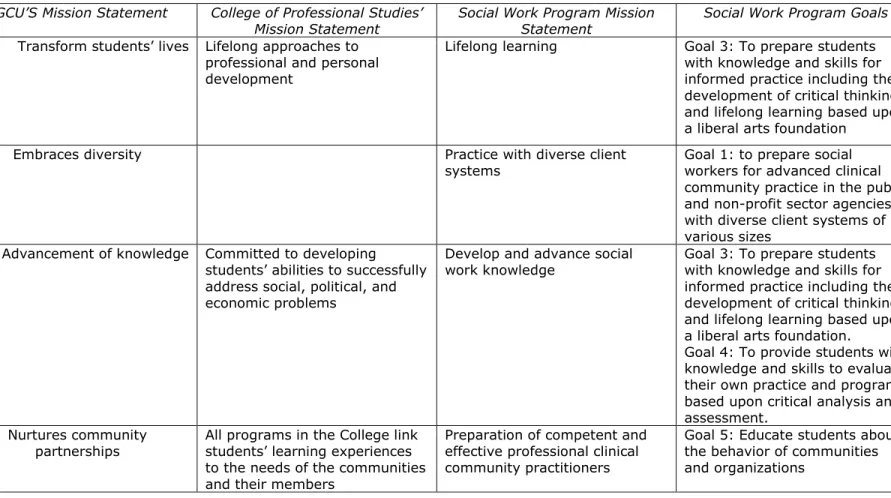
The Social Work program’s mission statement is derived from and consistent with the institution’s mission and the mission of the College of Professional Studies and is appropriate to the purpose of professional social work education at the master of social work level. The Social Work program’s mission statement connects with the university’s mission by the inclusion of student knowledge development and advancement, embracing diversity, community partnerships and lifelong learning. Key terms that link the three mission statements and the Division of Social Work’s goals are described below in Table 1.
6
Table 1 Key Terms and Phrases Connecting FGCU’s Mission and the Social Work Program Mission and Goals
FGCU’S Mission Statement College of Professional Studies’
Mission Statement Social Work Program Mission Statement Social Work Program Goals Transform students’ lives Lifelong approaches to
professional and personal development
Lifelong learning Goal 3: To prepare students with knowledge and skills for informed practice including the development of critical thinking and lifelong learning based upon a liberal arts foundation
Embraces diversity Practice with diverse client
systems Goal 1: to prepare social workers for advanced clinical community practice in the public and non-profit sector agencies with diverse client systems of various sizes
Advancement of knowledge Committed to developing
students’ abilities to successfully address social, political, and economic problems
Develop and advance social
work knowledge Goal 3: To prepare students with knowledge and skills for informed practice including the development of critical thinking and lifelong learning based upon a liberal arts foundation.
Goal 4: To provide students with knowledge and skills to evaluate their own practice and programs based upon critical analysis and assessment.
Nurtures community
partnerships All programs in the College link students’ learning experiences to the needs of the communities and their members
Preparation of competent and effective professional clinical community practitioners
Goal 5: Educate students about the behavior of communities and organizations
7
Governance Faculty
The social work program has the necessary autonomy and administrative structure to achieve its goals and objectives. The Director of the Division of Social Work is the chief academic officer of the Division. Dr. Salahu-Din has a full-time time appointment to the social work program with a 50%-75% reduced teaching load to accommodate her administrative duties. The Director is appointed by and reports to the Dean of the College of Professional Studies (CPS). The Director meets regularly with the CPS Dean to discuss issues pertaining to program implementation, and administration. The Director of the Social Work Program is one of 4 Directors responsible for specific divisions within the College of Professional Studies. Directors meet regularly with the Dean for updates, and to plan and coordinate College and University business. The Director is responsible for making decisions about development, administration, preservation of program quality and for recruitment, promotion and contract renewal of faculty within standard policies and procedures of the Collective Bargaining Agreement (CBA) and the State University System of Florida. The Director is also responsible for resource development and budget management.
The accrediting body for schools of social work, the Council on Social Work Education, requires that social work programs have a minimum of 6 faculty with major assignment to the MSW program. The Division of Social Work has 6 positions with the majority of their assignment to the MSW Program, which is sufficient to carry out the program’s goals and objectives.
Within University policies (and in relation to the guidelines established by the Florida Board of Governors, FGCU Board of Trustees, and the agreements with the United Faculty of Florida), the program administrator and faculty of the Social Work Program have the authority to formulate, modify and implement policies and procedures on a program level that pertain to recruiting, hiring, and promotion. This authority conforms to the expectations of the Council on Social Work Education (CSWE), the accrediting body for social work programs, regarding specific academic and experience qualifications. Personnel policies are University-wide, regarding position grades, salary levels, and overall policies for promotion, retention, affirmative action and benefits.
The Division of Social Work faculty is responsible for recruitment and hiring. When vacant positions occur the Director appoints a search committee chair from among social work faculty to work with Human Resources to advertise the position. The search committee chair selects committee members, the majority from social work, and one member from outside the Division of Social Work, from within the College of Professional Studies, and usually a representative from the Social Work Advisory Board. The committee screens applications and selects finalists for telephone interviews. Two or three finalists are selected from among those interviewed by telephone for campus interviews. The Division Director is the hiring
8
official who sends recommendations to the Dean of the College of Professional Studies.
Faculty rights are further defined in the Collective Bargaining Agreement that includes definitions of academic freedom, appointment, reappointment and non-reappointment, academic ranks, promotion and contract renewal, evaluations, workload, grievance procedures, termination, and personnel matters. All policies for the Social Work Program regarding faculty are in accordance with the Collective Bargaining Agreement and are subject to the general policies of the University and the College of Professional Studies.
Students
The program has policies and procedures specifying students’ rights and responsibilities to participate in formulating and modifying policies affecting
academic and student affairs. It provides opportunities and encourages students to organize in their interests. MSW students are viewed as competent adults who have not only the right but also the responsibility to participate in the decision-making process about the educational program in which they have enrolled. Students regularly contribute to the continued development and growth of
programs in the Division. Student input is highly valued across the continuum of the program. For example:
All students enrolled at FGCU have an opportunity at the end of each course to evaluate their instructors. Students are given standardized faculty evaluation forms to complete. These evaluations are confidential. Results are provided to the faculty to utilize in strengthening content, teaching, and learning methods to facilitate more effective instruction.
Through their elected and/or volunteer representatives, MSW students provide input to and learn from each of the following committees: Diversity, Student Services, Distance Learning, and various others which might be convened throughout the year. Student representatives are viewed as especially valuable members of these committees.
Students have the opportunity to meet both informally and formally with any candidates being considered for faculty positions. Additionally, a student representative is selected to be a member of any screening committee commissioned in the hiring of new faculty. Students are asked to provide written assessments of each candidate to be included as a part of the recommendation package prepared by the Division for employment purposes (MSW Student Handbook).
Besides information in the MSW Student Handbook regarding students’ rights and responsibilities, the Florida Gulf Coast University 2007-2008 Catalog (pp 40)
provides information about students rights as outlined in the Family Education and Privacy Act, 1972, (FERPA).
9
Student Organizations
All students in the MSW Program are encouraged to participate in the governance of the program. Consequently, students have an autonomous organization, the MSW Student Association (MSWSA) with elected officers. In order to obtain recognition and funding from the University’s Office of Student affairs, the MSWSA students select a faculty advisor from the MSW Program. The MSWSA receives funds from the Office of Student Affairs for their organizational and operational expenses. The Program recognizes this student organization as integral to students’ organizing in their own best interests. Officers of MSWSA meet with the Director to discuss student interests, concerns or suggestions.
The primary mechanism of governance and policy making for the Master of Social Work Program occurs at the monthly meetings. MSWSA student representatives are encouraged to attend the meetings. Faculty and MSWSA student representatives review and develop policies pertaining to, but not necessarily limited to: recommending criteria for recruitment, selection, admission and evaluation of students; curriculum; field practicum, advisement and other matters pertaining to students at the MSW Program meetings. Other activities for MSWSA include fundraising for a daycare center for the children of migrant workers in a low income community in Collier County, attending the NASW Lobby Day in Tallahassee, participation in the MSW Information Workshop and 2nd year members
organizing a session for the fall MSW Orientation, organizing of a MSW Student Alumni Association (MSW Student Handbook).
External Linkages
The program has ongoing exchanges with external constituencies that may include social work practitioners, social service recipients, advocacy groups, social service agencies, professional associations, regulatory agencies, the academic community, and the community at large. These connections are maintained through participation in various organizations and activities such as board memberships, task forces, interagency councils, and collaborative service learning experiences for students. Examples of activities in these areas include:
Membership on Board of Directors:
Our Mothers Home of Southwest Florida Catholic Diocese of Venice, Inc.
Lutheran Services Florida
Children’s Advocacy Center of Southwest Florida Children’s Network of Southwest Florida
Quality Life Center
Immokalee Friendship House
Other Advocacy Groups, Agencies, and Organizations that Faculty Collaborate With on Research and Other Projects:
10
Health Park of Lee County Lee County School District
Human Service Information Network
Agencies and Groups that Connect Faculty with Clients: Florida Migrant Interstate Program
Coalition of Immokalee Workers
National Conference on Human Trafficking. A faculty member participated in the planning of this event attended by law enforcement, professional social workers and criminal justice personnel from different states. Consequently, the Coalition against Human Trafficking gained national recognition and financial support to serve human trafficking victims in a coherent manner. Public School Systems
Quality Life Center
Program Overview: Main Features
The Master of Social Work (MSW) Program has a Full-Time, Part-Time and Advanced Standing curriculum. The Division of Social Work admitted its first MSW students fall 2001 to the Full-Time, two-year clinical community practice MSW Program. A Part-Time four-year clinical community practice MSW program began during the second year of operation (Fall 2002) in order to meet the needs of employed professionals who have an interest and a need for the MSW degree.
Students take a total of 60 credit hours that can be completed in two years of full-time study. The educational process of Clinical Community Practice begins within the professional foundation and continues throughout the concentration year as outlined by the Educational Policy and Accreditation Standards (EPAS) of the Council on Social Work Education, as well as the principles and values included in the NASW Code of Ethics. Building on a liberal arts perspective, the program’s objectives are implemented through the foundation and advanced curricula. The generalist foundation curriculum provides content on social work values and ethics, human diversity, social and economic justice, populations-at-risk, human behavior in the social environment, social welfare policy and services, social work practice, research and field education. The advanced or concentration curriculum provides the breadth and depth of knowledge and practice skills through one practice method: Clinical Community Practice. Additionally, students are given the option to specialize in one field of practice, administration.
The clinical community practice social work program culminates with a CCP project that students develop in concert with their internship agencies. These projects are presented, at the end of the concentration year, to faculty, students and the community.
11
Program Objectives
Foundation Year Program Objectives
By the end of the foundation year students will:
1. Understand the forms and mechanisms of oppression and discrimination and apply strategies of advocacy and social change that advance social and economic justice.
2. Understand the value base of the profession and its ethical standards and principles, and practice accordingly.
3. Practice without discrimination and with respect, knowledge, and skills related to clients’ age, class, color, culture, disability, ethnicity, family structure, gender, marital status, national origin race, religion, sex, and sexual orientation.
4. Use theoretical frameworks supported by empirical evidence to understand individual development and behavior across the life span and the interactions among individuals and between individuals and families, groups, organizations, and communities.
5. Apply the knowledge and skills of a generalist social work perspective to practice with systems of all sizes.
6. Use communication skills differentially across client populations, colleagues, and communities.
7. Understand and interpret the history of the social work profession and its contemporary structures and issues.
8. Use supervision and consultation appropriate to social work practice. 9. Apply critical thinking skills within the context of professional social work practice.
10. Analyze, formulate, and influence social policies.
11. Evaluate research studies, apply research findings to practice, and evaluate their practice interventions.
12. Function within the structure of organizations and service delivery systems and seek necessary organizational change.
12
By the end of the concentration year students will:
1. Practice using advanced clinical community practice skills, including highly differentiated intervention skills, without discrimination and with respect, knowledge, and skills related to clients’ age, class, color, culture, disability, ethnicity, family structure, gender, marital status, national origin race, religion, sex, and sexual orientation.
2. Synthesize and apply a broad range of theoretical frameworks supported by empirical evidence to understand individual development and behavior across the life span and the interactions among individuals and between individuals and families, groups, organizations, and communities using advanced clinical community social work practice skills.
3. Use supervision and consultation appropriate to advanced clinical community social work practice while maintaining a high degree of autonomy and proficiency.
4. Analyze, formulate, and influence/advocate for social policies in ways that are highly differentiated.
5. Evaluate research studies, apply research findings to practice, and evaluate their own practice interventions in ways that are highly discriminating and self-critical while increasing the knowledge base for practice and improved service delivery.
6. Function within the structure of organizations and service delivery systems and seek necessary organizational change by refining and advancing the quality of their advanced clinical community practice and that of the larger social work profession.
7. Apply a broad range of knowledge and skills of an advanced/specialized social work perspective to practice with systems of all sizes.
Program objectives are derived from the program goals as outlined in Table 2 below.
Table 2 Linking Program Objectives to Program Goals
Program Goal 1: To prepare social workers for advanced clinical community practice (CCP) in the public and non-profit sector agencies with diverse clients systems of various sizes.
Related Foundation Year Objectives:
5. Apply the knowledge and skills of a generalist social work perspective to practice with systems of all sizes.
13
8. Use supervision and consultation appropriate to social work practice.
12. Function within the structure of organizations and service delivery systems and seek necessary organizational change.
Related Concentration Year Objectives:
1. Practice using advanced clinical community practice skills, including highly differentiated intervention skills, without discrimination and with respect, knowledge, and skills related to clients’ age, class, color, culture, disability, ethnicity, family structure, gender, marital status, national origin race, religion, sex, and sexual orientation.
3. Use supervision and consultation appropriate to advanced clinical community social work practice while maintaining a high degree of autonomy and proficiency.
7. Apply a broad range of knowledge and skills of an advanced/specialized social work perspective to practice with systems of all sizes.
Program Goal 2: To prepare social workers for competent agency-based practice with a strong commitment to professional social work values and ethics, promotion of social and economic justice, diversity, alleviation of oppression and discriminating skills to address ethical dilemmas.
Related Foundation Year Objectives
1. Understand the forms and mechanisms of oppression and discrimination and apply strategies of advocacy and social change that advance social and economic justice.
2. Understand the value base of the profession and its ethical standards and principles, and practice accordingly.
3. Practice without discrimination and with respect, knowledge, and skills related to clients’ age, class, color, culture, disability, ethnicity, family structure, gender, marital status, national origin race, religion, sex, and sexual orientation.
7. Understand and interpret the history of the social work profession and its contemporary structures and issues.
Related Concentration Year Objectives
4. Analyze, formulate, and influence/advocate for social policies in ways that are highly differentiated.
14
Program Goal 3: To prepare students with knowledge and skills for informed practice, including the development of critical thinking and lifelong learning based upon a solid liberal arts foundation.
Related Foundation Year Objectives
4. Use theoretical frameworks supported by empirical evidence to understand individual development and behavior across the life span and the interactions among individuals and between individuals and families, groups, organizations, and communities.
9. Apply critical thinking skills within the context of professional social work practice.
Related Concentration Year Objectives
7. Apply a broad range of knowledge and skills of an advanced/specialized social work perspective to practice with systems of all sizes.
Program Goal 4: To provide students with knowledge and skills to evaluate their own practice and programs based upon critical analysis and assessment.
Related Foundation Year Objectives
11. Evaluate research studies, apply research findings to practice, and evaluate their practice interventions.
Related Concentration Year Objectives
5. Evaluate research studies, apply research findings to practice, and evaluate their own practice interventions in ways that are highly discriminating and self-critical while increasing the knowledge base for practice and improved service delivery.
Program Goal 5: Educate students about the behavior of communities and organizations within the social contexts of social work practice, and the dynamics of change from a local, regional and international perspective.
Related Foundation Year Objectives
6. Use communication skills differentially across client populations, colleagues, and communities.
10. Analyze, formulate, and influence social policies. Related Concentration Year Objectives
15
empirical evidence to understand individual development and behavior across the life span and the interactions among individuals and between individuals and families, groups, organizations and communities using advanced clinical community social work practice skills.
6. Function within the structure of organizations and service delivery systems and seek necessary organizational change by refining and advancing the quality of their advanced clinical community practice and that of the larger social work profession.
Course Offerings: Curricula
The mission statement and program goals of the MSW program at Florida Gulf Coast University provide a framework for the overall conceptualization of the program’s vision and curriculum. The mission statement represents the amalgamation and analysis of extensive dialogue with faculty, active practitioners, community leaders, and literature on trends in the profession.
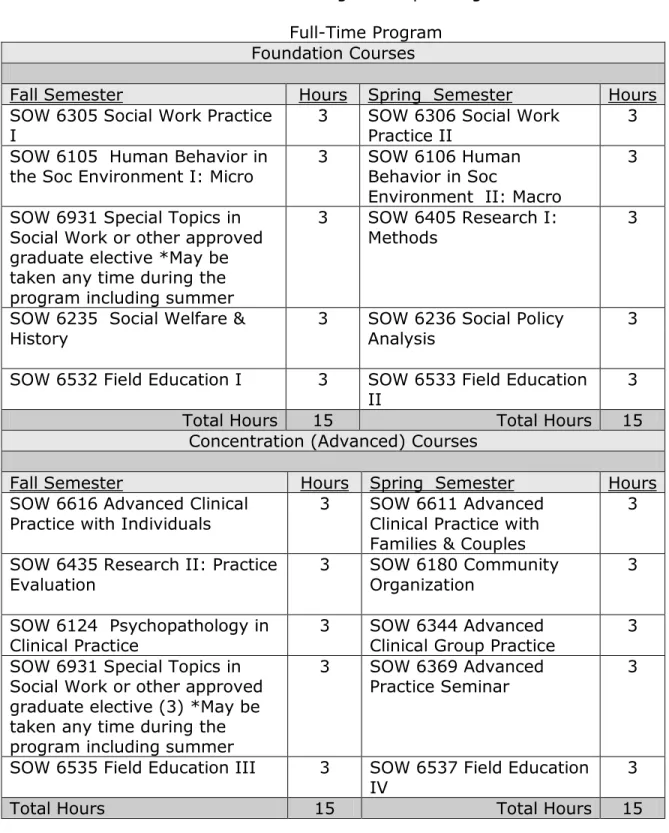
Program goals are derived from the mission statement and help link the program to its purpose. Both the Foundation and Concentration Year objectives help define how goals are achieved. Sequencing of courses is structured to provide integrated learning both horizontally and vertically. This includes consideration for course assignments appropriate to current field education experiences and cooperation among faculty to reinforce learning constructs between courses. Program objectives serve as the rationale upon which course objectives are built.
16
Table 3 Master of Social Work Program Sequencing of Courses Full-Time Program
Foundation Courses
Fall Semester Hours Spring Semester Hours
SOW 6305 Social Work Practice
I 3 SOW 6306 Social Work Practice II 3 SOW 6105 Human Behavior in
the Soc Environment I: Micro
3 SOW 6106 Human Behavior in Soc
Environment II: Macro
3
SOW 6931 Special Topics in Social Work or other approved graduate elective *May be taken any time during the program including summer
3 SOW 6405 Research I:
Methods 3
SOW 6235 Social Welfare &
History 3 SOW 6236 Social Policy Analysis 3 SOW 6532 Field Education I 3 SOW 6533 Field Education
II 3
Total Hours 15 Total Hours 15
Concentration (Advanced) Courses
Fall Semester Hours Spring Semester Hours
SOW 6616 Advanced Clinical
Practice with Individuals 3 SOW 6611 Advanced Clinical Practice with Families & Couples
3
SOW 6435 Research II: Practice
Evaluation 3 SOW 6180 Community Organization 3 SOW 6124 Psychopathology in
Clinical Practice 3 SOW 6344 Advanced Clinical Group Practice 3 SOW 6931 Special Topics in
Social Work or other approved graduate elective (3) *May be taken any time during the program including summer
3 SOW 6369 Advanced
Practice Seminar 3
SOW 6535 Field Education III 3 SOW 6537 Field Education
IV 3
Total Hours 15 Total Hours 15
17
Part Time Program
Foundation Sequencing Part-time
Year 1 Fall Semester Hours Year 1 Spring Semester Hours SOW 6235 Social Welfare &
History 3 SOW 6236 Social Policy Analysis 3 SOW 6105 Human Behavior in
the Soc Environment I: Micro
3 SOW 6106 Human Behavior in
Soc Environment II: Macro 3 Year 2 Fall Semester Hours Year 2 Spring Semester Hours SOW 6931 Special Topics in
Social Work or other approved graduate elective *May be taken any time during the program including summer
3 SOW 6405 Research I:
Methods 3
SOW 6305 Social Work Practice I
3 SOW 6306 Social Work Practice II
3 SOW 6553 Field Education I A 2 SOW 6554 Field Education I B 2 Year 2 Summer Hours
SOW 6555 Field Education IC 2
Total Hours 16 Total Hours 14
Concentration (Advanced) Sequencing Part-time
Year 3 Fall Semester Hours Year 3 Spring Semester Hours SOW 6616 Advanced Clinical
Practice with Individuals 3 SOW 6180 Community Organization 3 SOW 6124 Psychopathology in
Clinical Practice 3 SOW 6611 Advanced Clinical Practice with Families & Couples
3
Year 3 Summer Semester Hours SOW 6556 Field Education II A 2
Year 4 Fall Semester Hours Year 4 Spring Semester Hours SOW 6931 Special Topics in
Social Work or other approved graduate elective *May be taken any time during the program including summer
3 SOW 6344 Advanced Clinical
Group Practice 3
SOW 6435 Research II: Practice
Evaluation 3 SOW 6369 Advanced Practice Seminar 3 SOW 6553 Field Education II B 2 SOW 6554 Field Education II C 2
Total Hours 16 Total Hours 14
18
Program Implementation Benchmarks
Student Achievement and Performance
The program has an assessment plan and procedures for evaluating the outcome of each program objective. The plan specifies the measurement
procedures and methods used to evaluate the outcome of each program objective. The assessment plan for the Division of Social Work consists of continuous monitoring and evaluating, using multiple tools, both summative and formative, and diverse data sources. For example, MSW students evaluate their learning at the end of the foundation year and again at the end of the concentration year using summative measurement tools developed by the division. The field instructors’ evaluation of students’ performance in the internship agency is another summative evaluation measure. Results of these summative evaluations are analyzed using the SPSS data analysis program and discussed in division meetings where plans are made to revise curriculum, assignments or evaluation tools if indicated by
assessment outcomes. Consequently, tasks are assigned to division teams or individual faculty to modify the curriculum, assignments, etc.
Class assignments, examinations, papers, observation of classroom participation, and individual discussions with students are among the formative assessment tools. Additional formative evaluations are verbal assessments during site visits with the student and faculty liaison, which reflect supervisors’
observations of student interactions, review of case files and weekly supervision with students. Stakeholders’ participation is another valuable formative evaluation resource. Faculty continually review assignments to determine whether they reflect program objectives. Some of the major assignments, such as the Capstone
Project, are discussed in faculty meetings and needed changes made. Stakeholders participate in strategic planning meetings, new student orientation and the
information workshop. Their participation in strategic planning meetings was especially useful in imparting suggestions about needed changes in the program. Many of their comments were incorporated into changes made by the division. The outcomes of formative and summative evaluations often direct changes in
program. Program objectives dictate the structure, content and delivery of the program, while outcome evaluations determine program success. Together, each of these assessment instruments plays an important role in the systematic
assessment and continuous improvement of our program.
Measurement tools, procedures, and methods for evaluating the outcome of each program objective are described below. The program uses the following summative assessment tools: Student Evaluation of the MSW Program Survey— Foundation Year, Student Evaluation of the MSW Program Survey—Concentration Year, and the Field Evaluation Assessment Tool, both foundation and concentration year. The 12 foundation year and all 7 concentration year objectives are covered in the evaluation tools.
19
The program implements its plan to evaluate the outcome of each program objective by administering summative evaluations at the end of each academic year. These summative evaluations, based on the program objectives, include The Student Evaluation of the MSW Program Survey during the foundation year and the concentration year. The summative Field Evaluations, also anchored in the
program objectives, of students’ performance in their internships are conducted at the end of each academic year to foundation and concentration year students by the field practicum supervisor. Data from these measures are analyzed using the SPSS data analysis system.
Formative evaluation measures consist mostly of embedded measures in the form of major class assignments such as research papers and a Capstone Project. Strategic planning sessions, including Strengths, Weaknesses, Opportunities and Threats (SWOT) analyses, are additional approaches to assessing the program. A major strategic planning meeting was held in August 2005 which included some of the divisions’ major stakeholders: students, alumni, advisory board members, field supervisors and, of course, division faculty.
Summative Evaluation Results
Students assess perceptions of their learning in the program at the end of the foundation year and again at the end of the concentration year, using self-administered evaluations developed by the program: The Student Evaluation of the MSW Program Survey—Foundation Year, and the Student Evaluation of the MSW Program Survey—Concentration Year. Questions on these measures cover the 5 program goals and each goal reflects the twelve foundation year objectives and the seven concentration year objectives met through classroom activities, required reading, course assignments, and field practice. Likert scale response categories are:
1—Strongly Disagree 2—Disagree
3—Agree
4—Strongly Agree 5—Not Applicable (N/A)
Program Objectives Covered: All 12 for the foundation year and all 7 for the concentration year
Analysis of results from student evaluations of the program conducted in 2003-2004, 2004-2005, 2005-2006, and 2006-2007 were used to affirm as well as improve the program. A narrative description is provided of the outcomes of
evaluations for both foundation and concentration year students from 2004 through 2007. Tables are provided that show the mean scores for measures administered to foundation and concentration year students during the 2006 and 2007 academic years.
20
Program Evaluation Outcomes: 2003-2004
In 2004, results from both the foundation and concentration year evaluations provided strong evidence that program goals were met. In summary, 80% to 100% of both foundation and concentration year student cohorts reported that they "agree or strongly agree"with each item in the surveys with an overwhelming majority of responses in the "strongly agree" category. Although a relatively few "disagree"responses were registered, the Division faculty did identify strategies for addressing student concerns in these areas
2005-2006 Foundation Year Results
Results of the 2005 student assessments of their learning in the program cannot be interpreted without taking into consideration that our region was assaulted by four major hurricanes during the fall 2004 semester, severely impacting students, faculty, administrators, field agencies, and field instructors, whose life was not turned upside down. Despite the assaults of Charley, Frances, Ivan, and Jeanne, life continued and everyone strived to regain a sense of
normalcy. While all students were touched, the foundation year cohort was most strongly affected, because they did not have a frame of reference for what was "normal" for first year graduate students. That year, for example, the program did not host its annual New Student Orientation which was canceled due to Hurricane Charley. Subsequent attempts to reschedule were thwarted by other storms.
Consequently, Foundation Year student assessment results indicated that students agreed that courses provided them with knowledge about diverse populations(program objectives 3, 4, 5 & 6) and about working with individuals (program objectives 4 & 5) and with communities (program objectives 5 & 7). They also confirmed that field placements were providing them with opportunities to work with diverse populations (program objectives 3, 4, 5 & 6), with individuals (program objectives 4 & 5), and with families (program objectives 4 &5).
Program Evaluation Outcome: 2005-2006
In spring 2006, program goal evaluation measures were revised to be more congruent with the curriculum and with field education learning objectives for each student cohort. For the foundation year, the overall analysis was quite favorable. On a scale of 1-4 (where 1 = Strongly Disagree, 2 = Disagree, 3 =Agree, and 4 = Strongly Agree), the item with the highest mean score overall of 3.79 corresponded to Program Goal 1, item #4: My field placement provides opportunities for me to work with people from diverse backgrounds (program objectives, 3-6). The item with the lowest mean score overall of 3.21 corresponded to Program Goal 1, item #3: My courses are preparing me to work with families (program objectives 4&5).
To assess Program Goal #1, program objectives 1-3 asked foundation year students to rate their courses in preparing them to: (1) communicate effectively
21
with people from diverse backgrounds (program objectives 3-6), (2) work with individuals (program objectives 4 & 5), and (3) work with families (program objectives 4 & 5); and program objectives 4-6 asked students to rate their field experience in providing them with opportunities to work with these three same populations (program objectives, 3-6). Overwhelmingly (93-100%; n = 13), students agreed or strongly agreed with each of the survey program objectives.
Program Goal #2 consisted of five program objectives (My courses are preparing me: (1) for competent agency-based practice with a strong commitment to professional social values and ethics (program objectives2, 7, & 12); (2) to address ethical dilemmas in practice (program objectives 1 & 2); and to (3) promote social and economic justice (program objectives 1, 3, 7, & 12), (4) diversity (program objective 3), and (5) the alleviation of oppression and
discrimination in practice (program objectives 1 & 7). An overwhelming majority of students (93-100%; n = 13) agreed or strongly agreed with these statements. The MSW program is meeting Program Goal #2 for foundation year students.
Program Goal #3 consisted of four program objectives My courses are:(1) providing me with knowledge about human development throughout the life span (program objectives 4); (2) providing me with knowledge about how people relate to and interact with their environments (program objectives 4 & 5); (3) equipping me with skills needed for critical thinking (program objective 9); and (4) preparing me to be a life- long learner (program objectives 1-12). To these statements all (100%) respondents rated their responses in the as agree or strongly agree. Based on these findings, the MSW program has met Program Goal #3 for foundation year students.
Program Goal #4 consisted of two program objectives regarding whether courses are providing students with: (1) knowledge about the scientific approach, methods, designs, measurements, and statistical techniques used for building social work knowledge and skill base (program objective 11); and (2) opportunities to apply knowledge about the scientific approach and methodology in building social work knowledge and skill base (program objective 11). Ninety-three percent (n = 13) responded agreed or strongly agreed. These results suggest that Program Goal #4 was met.
To evaluate Program Goal #5, foundation year students rated their responses to five program objectives about how their courses were providing them with
knowledge about: (1) the history of social work (program objective 7), (2) the history of social policy (program objective 10), (3) and the impact of social policy and programs on vulnerable populations (program objective 10); and (4) whether their courses were providing them with the tools needed for developing skills to effectively influence social policy to better reflect social work values (program objectives 2 & 10) and (5) the needs of diverse client system of various sizes (program objectives 5 & 10). Eighty-six percent (n=12) agreed or strongly agreed with item #1; 100% foundation year students agreed or strongly agreed with statements 2-5. These findings provide strong support that the program met
22
Program Goal #5. See Table 8.0 for 2006 foundation year mean scores of Students’ Evaluation of the MSW Program.
2005-2006 Concentration Year Results
Overall the analysis of the 2005-2006 Concentration Year MSW Program Evaluations (N = 23), suggests that the MSW program is achieving its goals and objectives. On a scale of 1-4 (where 1= Strongly Disagree, 2= Disagree, 3= Agree, and 4= Strongly Agree), the item with the highest mean score overall of 3.74
corresponded to Program Goal 2, item #3: Courses are preparing me for competent agency based practice with a strong commitment to diversity (program objective 1). The item with the lowest mean score overall of 3.00 corresponded to Goal 1, statement #2: My courses are preparing me for clinical community practice using comparative theories of clinical practice (program objectives 1, 2, & 7).
The assessment of Program Goal #1 for concentration year students consisted of two sets of statements. The first four asked students to rate their responses about whether their courses were preparing them: (1) with knowledge, skills, and values for CCP in public and non-profit sector agencies(program
objectives 6 & 7 ); (2) for CCP using comparative theories of clinical practice (program objectives 1, 2, & 7 ); (3) for CCP with groups (program objectives 1 & 2); and (4) for CCP with community organizations (program objectives 2, 6, & 7). The other four statements asked students to rate their responses to whether their field experience was providing them with opportunities to apply in the field what they are learning in the classroom in these four areas (program objectives 1, 2, 6, & 7).
All students (100%) agreed or strongly agreed that their field placement provided them with opportunities to apply this knowledge, skills, and values in public and non-profit sector agencies(program objectives 6 & 7 ). Ninety-six percent (n=22) responded that they agreed or strongly agreed that their field placement provided them with opportunities to apply CCP with community
organizations (program objectives 2, 6, & 7). The majority of students responding (87%; n = 20) agreed or strongly agreed that their courses were preparing them with knowledge, skills, and values for CCP in public and non-profit sector agencies; that their field placement provided them with opportunities to apply CCP with groups (program objectives 1 & 2); that their field placement provided them with opportunities to apply CCP using comparative theories of clinical practice (program objectives 1, 2, & 7 ); and that their courses prepared them for CCP with
community organizations (program objectives 2, 6, & 7). Sixty-five percent (n = 15) responded agreed or strongly agreed that their courses prepared them for CCP using comparative theories of clinical practice (program objectives 1, 2, & 7); and that their courses are preparing them for CCP with groups (program objectives 1 & 2).
Program Goal #2 consisted of five program objectives. To the statement ―My courses are preparing me for competent agency based practice with a strong
23
commitment to professional social work values and ethics (program objective 7),‖ almost all (96%; n=22) students indicated that they either agreed or strongly agreed; one student disagreed. All (100%) responded agreed or strongly agreed with the two following program objectives: My courses are preparing me for
competent agency based practice with a strong commitment to: (1) the promotion of social and economic justice (program objective 1); and (2) diversity (program objective 3 ). Finally, to the statement my courses are preparing me for competent agency based practice with: (1) a strong commitment to the alleviation of
oppression and discrimination (program objective 1); and (2) with skills to address ethical dilemmas in practice (program objectives & 5), close to 96% and 87% agreed or strongly agreed with these program objectives, respectively. These scores reflect that the program met this program goal and objectives.
To evaluate Program Goal #3, students rated their responses to whether their courses prepared them with knowledge and skills for the development of: (1) critical thinking (program objectives 4 & 5) and (2) life-long learning (program objectives 1, 2, 3, 4, 5, 6 & 7). Regarding critical thinking, 91.3% (n = 21) responded agreed or strongly agreed with both program objectives. The program goal and objectives are being met.
Program Goal #4 consisted of two program objectives and 91.3% (n = 21) responded agreed or strongly agreed with both My courses are preparing them to use research to: (1) critically evaluate their own practice interventions (program objective 5) ; and (2) evaluate programs based upon critical analysis and
assessment (program objective 5). This program goal is being met.
Finally, to assess Program Goal #5, students were asked to assess if their courses were preparing them: (1) for CCP with communities and organizations (program objectives 2 & 6); and (2) with knowledge and skills about the dynamics of change at the community level from a local, national, and international
perspective (program objectives 2 & 6) . About 87% (n=20) agreed or strongly agreed with the first item; and 78% (n = 18) responded agreed or strongly agreed with the second statement. Generally speaking, this goal is being met, but the second item suggests an area for continuous improvement.
Overall, based on the findings, it appears that the program achieved its foundation and concentration year goals and objectives for the 2005-2006
academic years. Finally, improvements in the measurement instrument resulted in more congruent findings of program achievement of its educational goals.
Program Evaluation Outcome: 2006-2007 2006-2007 Foundation Year Results
The most recent student program goal evaluations were conducted in April 2007 at the conclusion of the 2006-2007 academic year. Analysis of the
24
overall program goals and objectives are being met. On a scale of 1-4 (where 1 = Strongly Disagree, 2 = Disagree, 3 = Agree, and 4 = Strongly Agree), the following two program objectives had the highest overall mean score overall of 3.69 among foundation year respondents: Courses are preparing me to promote diversity in practice, Program Goal 2, (program objective 3)); and Courses are providing me with tools needed to develop skills to effectively influence social policy to better reflect needs of diverse client systems of various sizes, Program Goal 5 (program objectives 5 & 10). The lowest mean score overall of 3.20 corresponded to: My courses are preparing me to work with individuals, Program Goal #1, (program objectives 4 &5).
Foundation Year Program Goal #1 data provided mixed findings. All respondents (100%; N=16) agreed or strongly agreed with, My courses are preparing me to communicate effectively with people from diverse backgrounds (program objectives 3, 4, 5 & 6) and, My courses are preparing me to work with individuals (program objectives 4 &5) . To My courses are preparing me to work with families (program objectives 4 & 5), 87.5% (n=14) agreed or strongly agreed; 6.3% (n=1) disagreed; and 6.3% (n=1) responded not applicable. To both My field placement provides opportunities for me to: (1) work with people from diverse backgrounds (program objectives 3, 4, 5 &6) and (2) work with individuals,
(program objectives 4 &5), respectively 68.8 (n=11) responded agree or strongly agree while 31.3% (n=5) responded not applicable. Finally, only 43.8% (n=7) responded agree or strongly agree to item My field placement provides
opportunities for me to work with families (program objectives 4 &5) with 6.3% (n=1) responding disagree and 43.8 (n=7) responding not applicable. The majority of students (87.5-100%) responded agreed or strongly agreed with all Program Goal #2 program objectives. Finally, 100% (N= 16) responded that they agreed or strongly agreed with Program Goal #3, Program Goal #4, and Program Goal #5 and the corresponding program objectives. See Table 8.2 for 2007 foundation year mean scores of Student Evaluation of the MSW Program.
Field Evaluation Assessment Tools
The field evaluation tools, Master of Social Work Program Foundation Year Evaluation, and Master of Social Work Program Concentration Year Evaluation assess students’ performance in their field practicum. Both are administered at the end of the first semester and again at the end of the second semester. The field instructor completes the evaluation with input from the MSW student. Both forms use three categories that contain program specific objectives: ―The Agency,‖
―Knowledge and Skill in Service Delivery,‖ and ―Professional Development.‖ Response categories are:
1=Does not meet 2=Marginal
3=Meets
4=Above expectations 5=Not applicable
25
Mean score results for 2006 and 2007 indicate that students’ performance in the field range in the high ―meets standard‖ category and that students show
improvement in their field activities from the time of the mid-year evaluation to the final evaluation. See Tables 8.4 for 2006 Foundation Year; 8.5 for 2006
Concentration Year; 8.6 for 2007 Foundation Year; and 8.7 for 2007 Concentration Year results.
2005-2006 Foundation Year Outcomes
Foundation year students realized the most gain or understanding in
knowledge in the 2005-2006 academic year in their field placements on objectives 4 (3.3-3.7) and 6 (3.4-3.8) from mid-year to the final evaluation at the end of the year. Program objective 4: ―Use theoretical frameworks supported by empirical evidence to understand individual development and behavior across the life span and the interactions among individuals and between individuals and families,
groups, organizations, and communities (3.3-3.7).‖ This increase may be related to students’ gaining knowledge in their HBSE I course relating to this objective and having increased contactwith clients, groups and organizations by the end of the internship. Program objective 6: ―Use communication skills differentially across client populations, colleagues, and communities (from 3.4-3.8)‖ may relate to students’ learning in the Human Diversity course and diversity content in other foundation year courses which increased their ability to relate to divers clients. See Table 8.4
2005-2006 Concentration Year Outcomes
Concentration year students, in the 2005-2006 academic year demonstrated increased knowledge in program objectives 1 and 2. Program objective 1: ―Practice using advanced clinical community practice skills, including highly differentiated intervention skills, without discrimination and with respect, knowledge, and skills related to clients’ age, class, color, culture, disability, ethnicity, family structure, gender, marital status, national origin, race, religion, sex, and sexual orientation‖ rating increased from 3.4-3.7. Integration of knowledge from the foundation year, higher expectations for students in the concentration year for using more advanced skills, and increased contact with diverse clients may explain this increase.
Concentration year students also gained knowledge in program objective 2: ―Synthesize and apply a broad range of theoretical frameworks supported by empirical evidence to understand individual development and behavior across the life span and the interactions among individuals and between individuals and families, groups, organizations, and communities using advanced clinical
community social work practice skills.‖ Ratings on this objective also increased from 3.4-3.7. This increase could be related to students learning in the about evidence-based practice theories and increased contact with clients diverse clients. See Table 8.5.
26
There was a decrease in concentration year students’ rating on program objective 3: ―Use supervision and consultation appropriate to advanced clinical community social work practice while maintaining a high degree of autonomy and proficiency.‖ The score on this objective decreased from 3.9-3.7. The division needs to determine with the field supervisors whether this decrease is negative or positive. Does a lower score mean that students are functioning effectively with less supervision, which is expected of concentration year students or does it mean that they are not requesting needed supervision? See Table 8.5
2006-2007 Foundation Year Outcomes
During the 2006-2007 academic year, foundation year students gained more knowledge in areas relating to program objectives 1 and 4. Program objective 1 ratings increased from 3.4-3.7. Program objective 1 states, ―Understand the forms and mechanisms of oppression and discrimination and apply strategies of advocacy and social change that advance social and economic justice.‖ Increased knowledge and application may relate to students’ applying learning from foundation year courses including Human Diversity and Oppression, Social Welfare History and Programs and Social Policy and Programs and their participation in Lobby Day in Tallahassee. In addition, students have had opportunities in their internships to work directly with people who are oppressed and discriminated against.
The lowest rating for these students related to program objective 7 (3.3-3.4). Program objective 7 is, ―Understand and interpret the history of the social work profession and its contemporary structures and issues.‖ Students may not have opportunities to demonstrate their knowledge regarding this objective. See Table 8.6
2006-2007 Concentration Year Outcomes
The most significant increases for concentration year students during this academic year related to program objectives 1 and 2. Students also witnessed improved ratings on program objectives 1 and 2 in the 2005-2006 academic year. See Table 8.7.
Overall, it appears that students are progressing in their internships and integrating their classroom learning with field experiences in both the foundation and concentration years.
Analysis is used continuously to affirm and improve the educational program
27
Foundation Year
7% of foundation year respondents disagreed with items stating that:
o My courses are preparing me to work with groups (Program objective 5)
o Field practicum provides opportunities for me to work with families (Program objectives 4 & 5)
20% of foundation year respondents disagreed with items stating that: o Field practicum provides opportunities for me to work with
communities (Program objective 5)
o Field practicum provides opportunities for me to work with groups (Program objective 5)
A disconnect between about when content on group, family, and community work was emphasized in the curriculum
When the program expects the field experience to provide increased opportunities for students to engage in these practice methods in field.
Action to improve the educational program:
A clear explanation of sequencing of courses and expectations for students during the foundation and concentration years is provided during new student orientation at the beginning of the student's first semester in the program. This clarification is also presented to students in the classroom. In addition, objectives that are not relevant to foundation year students were removed from the assessment tool.
Concerns--2004-2005 Student Evaluation of the MSW Program Foundation Year
Foundation year students were more likely to disagree (where 30% or more students disagreed with an item) that courses were preparing them to: work with families (program objectives 4 &5)) and with groups (program objectives 5 &7)); and that the field practicum was providing them with opportunities to work with families (program objectives 4 &5), work with communities (program objectives 5 & 7), and work with groups (program objectives 5 & 7). This is a pattern that is similar to what was found in the 2004 results. As a result of these findings, the plan called for the following recommendations:
Action to improve the educational program:
1. Significant changes to the curriculum are planned beginning fall 2008 that address these points that include having distinct courses for working with families and for working with individuals.
2. The Division Field Committee is to devise strategies to assure that the internship experience includes opportunities for students to work with
28
communities and groups if those experiences are to occur during the foundation year.
3. Groups and communities were removed from the foundation year survey because these are not expectations for foundation year students.
Concerns 2004-2005 Student Evaluation of the MSW Program Concentration Year
The 2005 Concentration Year student assessment results revealed that, overall, students agreed that their courses were preparing them for: advanced Clinical Community Practice (CCP) in the public and non-profit sector; work with groups (program objectives 2 & 7); work with community organizations (program objectives, 2, 6 & 7), and work with diverse groups of people (program objectives, 1, 2, 6 & 7).
Concerns: Students were most likely to disagree (where 15% or more students disagreed with the item) that their courses were preparing them for advanced CCP through clinical activism or that their field practicum was providing them with opportunities to use clinical activism, to work with groups, or work with community organizations.
Action to improve theeducational program:
1. Improve definition of terms used in the program such as "advanced practice" for students at orientation, in class) and field instructors (at field instructor training, during site visits).
2. A written definition of clinical practice is provided to students in their orientation packets.
1. Division Field Committee was tasked with assessing ability of internships to provide opportunities for advanced CCP with groups, communities, and diverse populations.
2. Integrate these issues into field instructor training and other meetings with field instructors.
In addition, plans were made for ongoing discussion of findings at Division meetings and retreats; revision of instruments to better reflect sequencing of courses and field education objectives including the addition of qualitative question(s) to elicit additional information from students; and ongoing analysis, discussion, and integration of findings as needed.
29
Concerns 2005-2006 Student Evaluation of the MSW Program Foundation Year
While overwhelmingly meeting all five program goals and the foundation program objectives, these findings suggest areas for continuous improvement in: 1. Ensuring that field placements provide opportunities for students to work
with families (or to help students better understand the scope of what family work entails);
2. Ensuring that the significance of working to promote social justice and to alleviate oppression and discrimination is infused throughout the curriculum. 3. Highlighting for students that research does not just take place in research
class, but across the curriculum as well; and, finally.
4. Connecting historical events in the profession to what is learned across the curriculum.
Action to improve theeducational program:
1. Faculty discuss this criteria with field supervisors during site visits.
2. Syllabi have been revised and the majority includes materials on promoting social justice and alleviating oppression and discrimination.
3. Faculty discuss this issue with each class.
4. Faculty discuss with students and field supervisors.
Faculty Achievement and Performance
The program’s faculty engages in the development and dissemination of research, scholarship and many creative activities relevant to the profession. The program Director published a social work research textbook and has a second textbook in progress. In addition, she presents at regional and national
conferences. The faculty published in professional journals such as: Omega Journal of Death & Dying, Child and Adolescent Social Work Journal; CSWE publications, HaPI-CD (Data base for instruments); Reflections, Narratives of Professional
Helping, Journal of Poverty, Journal of Gerontological Social Work. Additional papers are published in Working Paper Series - Pepper Institute on Aging and Public Policy, Social Work with Groups Newsletter, and Responses to an Aging Florida. Besides presentations at regional, and national conferences, faculty have presented papers in London, Canada, Mexico, India, Chile, Guyana, Jamaica, Italy and Germany.
30
In addition Dr. Perez, accompanied by Dr. Washington, led a group of six MSW students to Puerto Rico, from March 1-11, where they were hosted by the Graduate School of Social Work at the University of Puerto Rico-Rio Piedras (UPR-RP). This trip consisted of educational activities including site visits, and lectures. Fun activities (some guided tours) were also incorporated into the itinerary. Dr. Perez is planning a program to host the Puerto Rico contingency next year.
The faculty of the Master of Social Work Program is among the most racially and ethnically diverse academic unit within FGCU. Active and deliberate efforts are used to recruit diverse faculty and to insure equity in retention, promotion and contract renewal. At present, the faculty consists of two African American females (29%), one Puerto Rican female (14%), one White male (14%) and three White females (43%). Thus, 43% of the faculty are of color.
There are three staff members in the Program: one African American female Executive Secretary (33.33%) and one White female secretary (33.33%). During the academic year, there is one Puerto Rican work study student (33.33%), and White Graduate Research Assistant (33.33%).
Entering Students: Background, Description, Profiles
Continuing MSW (N=16) students consist of 25% (4) students of color (3 Hispanics and 1 African American). The 2007 incoming class (N=24) consisted of 21% (5) students of color. Males (N=5) constitute 21% of the incoming class. Thus, of the forty students in the program, 23% (9) are students of color. There are 6 males in the program which constitutes 15% of the student body. In social work programs male and the social work progression (on certain levels) males are usually in the minority. In the foundation year class there are 5 males, 31%. The one male in the concentration year program constitutes less than 1% of the class. These numbers reflect increases in the diversity among the Social Work Program’s student body. No data exists regarding the number of students who are lesbian women, gay men or transgendered persons. Data are not available on the incoming 2008 MSW class.
There is a high admission rate for qualified students from racial or ethnic backgrounds applying to the MSW program. The Division Director is on the University’s Minority Recruitment Committee. At the request of the Director, the Assistant Director of Graduate Studies visited two historically Black colleges and universities (Florida Memorial College in Miami, Florida and Bethune Cookman College in Daytona Beach, Florida) to recruit students of color. In addition, faculty made presentations at diversity classes at FGCU to recruit students. Besides these efforts, one faculty member, using minority recruitment funds from the Office of Graduate Studies, visited Albany State University, another historically Black school, to recruit students of color. Through active involvement with community agencies with significant numbers of minority staff, the faculty increased recruitment efforts with agencies that have diverse staff and clients to diversify the applicant pool in order to achieve a more diverse student body (i.e. Quality Life – African American & Latino, Catholic Hispanic Social Services – Latino and Haitian; Redlands Migrant