Report 10-3 February 2010
An Evaluation
Virtual Charter Schools
Department of Public Instruction
2009-2010 Joint Legislative Audit Committee Members
Senate Members: Assembly Members:
Kathleen Vinehout, Co-chairperson Peter Barca, Co-chairperson Robert Jauch Andy Jorgensen
Mark Miller Mark Pocan Robert Cowles Bill Kramer
LEGISLATIVE AUDIT BUREAU
The Bureau is a nonpartisan legislative service agency responsible for conducting financial and program evaluation audits of state agencies. The Bureau’s purpose is to provide assurance to the Legislature that financial transactions and management decisions are made effectively, efficiently, and in compliance with state law and that state agencies carry out the policies of the Legislature and the Governor. Audit Bureau reports typically contain reviews of financial transactions, analyses of agency performance or public policy issues, conclusions regarding the causes of problems found, and
recommendations for improvement.
Reports are submitted to the Joint Legislative Audit Committee and made available to other committees of the Legislature and to the public. The Audit Committee may arrange public hearings on the issues identified in a report and may introduce legislation in response to the audit recommendations. However, the findings, conclusions, and recommendations in the report are those of the Legislative Audit Bureau. For more information, write the Bureau at 22 East Mifflin Street, Suite 500, Madison, WI 53703, call (608) 266-2818, or send e-mail to [email protected]. Electronic copies of current reports are available at www.legis.wisconsin.gov/lab.
State Auditor – Janice Mueller
Audit Prepared by
Paul Stuiber, Deputy State Auditor and Contact Person
Kate Strom Hiorns Briana Kleidon Allison La Tarte Justin Martin
Director of Publications – Jeanne Thieme
CONTENTS
Letter of Transmittal 1
Report Highlights 3
Introduction 9
Virtual Charter School Enrollment 12
Enrollment Process 15
Legal Challenges 16
Virtual Charter School Operations 19
Attendance Requirements 19
Social Interaction 22
Special Education 23
Revenue and Expenditures 27
Revenue Sources 27
Expenditures 31
Per Pupil Expenditures 36 Cost Comparisons with Other Public Schools 39 Fiscal Effects of Open Enrollment 41
Teaching in Virtual Charter Schools 45
Teacher Licensing 45
Frequency of Pupil-Teacher Interaction 49
Academic Achievement 53
Pupil Test Scores 53
Test Scores of Pupils Continuing in Virtual Charter Schools 57 Other Academic Measures 59
Individual Online Classes 63
Future Considerations 67
Open Enrollment Limit 67
Satisfaction with Virtual Charter Schools 69 Expansion of Online Learning 70
Appendices
Appendix 1—Descriptions of Virtual Charter Schools Appendix 2—Virtual Charter School Pupils
Appendix 3—Virtual Charter Schools’ Estimated Other Revenue Appendix 4—Estimated Virtual Charter School Expenditures Appendix 5—Supplemental Online Programs
Appendix 6—Satisfaction with Virtual Charter Schools
Response
February 9, 2010
Senator Kathleen Vinehout and
Representative Peter Barca, Co-chairpersons Joint Legislative Audit Committee
State Capitol
Madison, Wisconsin 53702
Dear Senator Vinehout and Representative Barca:
As required by 2007 Wisconsin Act 222, we have completed an evaluation of virtual charter schools. Pupils enrolled in these nonsectarian public schools typically attend from their homes and take a majority of their classes online. In the 2007-08 school year, 15 virtual charter schools enrolled 2,951 full-time pupils. We found that 7.6 percent of pupils attended virtual schools that were chartered by their school district of residence, while 91.1 percent attended through open enrollment, which requires payment from the district of residence (the “sending district”) to the district chartering the virtual school (the “receiving district”).
Virtual charter schools spent an estimated $17.8 million in the 2007-08 school year. They were funded by a mix of federal charter school grants; fees; general district revenue, including
property tax revenue; and $14.2 million in state aid, which represented 79.0 percent of their total revenue. The availability of state aid affects both sending and receiving districts, and receiving districts have a financial incentive to attract additional virtual charter school pupils through open enrollment. We found that in the 2007-08 school year, 8 of the 15 virtual charter schools’ per pupil expenditures were less than the $6,007 payment per full-time open enrollment pupil. 2007 Wisconsin Act 222 established a virtual charter school open enrollment limit of 5,250. This limit will likely be reached within the next few years, which will prompt continued legislative debate. We make a number of recommendations for the Department of Public Instruction (DPI) to provide information that can inform this debate and enhance compliance with program rules. We appreciate the courtesy and cooperation extended to us by DPI; the teachers, high school pupils, and parents and guardians who spoke with us and responded to our surveys; and the virtual charter school administrators who responded to our requests for information. A response from DPI follows the appendices.
Respectfully submitted,
Janice Mueller State Auditor JM/PS/ss
3
Virtual charter schools are publicly funded nonsectarian schools that are exempt from many regulations that apply to traditional public schools and that offer the majority of their classes online. They began operating in Wisconsin during the 2002-03 school year. Pupils typically attend from their homes and communicate with teachers using e-mail, by telephone, or in online discussions. During the 2007-08 school year, 15 virtual charter schools enrolled 2,951 pupils. Most were high schools.
A Wisconsin Court of Appeals ruling in December 2007 prevented the Department of Public Instruction (DPI) from providing state aid payments to a virtual charter school through the open enrollment program, which allows pupils to attend public schools outside of their school districts of residence. 2007 Wisconsin Act 222, which was enacted to address concerns raised in the lawsuit, also required us to address a number of topics related to virtual charter schools. Therefore, we evaluated:
enrollment trends, including the potential effects of a limit on open enrollment in virtual charter schools that was enacted in 2007 Wisconsin Act 222; virtual charter school operations, including attendance requirements, opportunities for social development and interaction, and the provision of special education and related services;
Report Highlights
Enrollment in virtual charter schools has increased in every school year since 2002-03. Virtual charter schools
spent an estimated $17.8 million in the 2007-08 school year. In the 2007-08 school year, 161 virtual charter school teachers were licensed
in Wisconsin. On statewide assessment
exams, virtual charter school pupils typically scored higher than other public school pupils in reading and lower in mathematics. The 5,250 pupil statutory limit on open enrollment in virtual charter schools
will likely be reached within the next few years.
4
REPOR T HIGHLIGHTSfunding and expenditures, including the fiscal effects of open enrollment on “sending” and “receiving” districts;
teaching in virtual charter schools, including teacher licensing and pupil-teacher interaction; and
academic achievement, including test scores and other measures, as well as pupils’, parents’, and teachers’ satisfaction with virtual charter schools.
Full-time Enrollment
As shown in Table 1, the number of virtual charter schools in Wisconsin increased from 4 schools operating in 3 school districts during the 2002-03 school year to 15 schools operating in 11 school districts during the 2007-08 school year.
Table 1
Growth in Virtual Charter Schools
School Year Virtual Charter Schools Chartering Districts 2002-03 4 3 2003-04 5 4 2004-05 7 6 2005-06 9 8 2006-07 11 9 2007-08 15 11
Full-time enrollment in virtual charter schools increased from 265 pupils in the 2002-03 school year to 2,951 pupils in the 2007-08 school year. In the five largest schools, which enrolled 92.2 percent of all pupils in 2007-08, total enrollment ranged from 245 to 865 pupils. The smallest school enrolled two full-time pupils. In the 2007-08 school year, 7.6 percent of virtual charter school pupils attended schools that were chartered by the districts in which they resided, as shown in Figure 1. In contrast, 91.1 percent attended
REPORT HIGHLIGHTS
5
through open enrollment, which requires payment from the district of residence (the sending district) to the district that chartered the virtual school (the receiving district). For the 2007-08 school year, the required payment was $6,007 per full-time pupil.
Figure 1
Enrollment in Virtual Charter Schools
2007-08 School Year All Others 39 Pupils 1.3% District Residents 224 Pupils 7.6% Open Enrollment 2,688 Pupils 91.1%
Revenue and Expenditures
Virtual charter schools are funded by a mix of federal charter school grants; fees; general district revenue, including property tax
revenue; and state aid, which represented 79.0 percent of their total revenue in the 2007-08 school year. State aid payments were
$14.2 million. Revenue from all sources totaled $18.0 million. Virtual charter schools spent an estimated $17.8 million in the 2007-08 school year, primarily for online curriculum materials and staffing. Reported advertising expenditures increased from $4,500 in the 2002-03 school year to $714,900 in the 2007-08 school year. Five large virtual charter schools engaged four principal contractors to provide online curriculum materials, computers and Internet subsidies for pupils, and assistance with administrative operations. Their payments to these contractors totaled $8.6 million in 2007-08. Chartering districts have a financial incentive to attract additional pupils through open enrollment. For example, in the 2007-08 school year, 8 of the 15 virtual charter schools’ per pupil expenditures were less than the $6,007 payment per full-time open enrollment pupil. In
6
REPOR T HIGHLIGHTScontrast, most sending districts experience negative financial effects when resident pupils attend virtual charter schools in other districts, because the loss of enrollment is not sufficient to reduce their fixed costs to operate traditional schools.
Teaching in Virtual Charter Schools
We reviewed licensing data to ensure that all virtual charter school teachers were properly licensed to teach in the 2007-08 school year. We found that all 161 virtual charter school teachers were licensed in Wisconsin and taught subjects and grade levels that wereappropriately authorized by their professional Wisconsin teaching licenses: 112 of the licensed teachers were employed by chartering school districts, and 49 were employed by contractors. Eleven virtual charter schools also reported using teaching assistants employed by contractors.
Since July 1, 2009, virtual charter school teachers have been required by 2007 Wisconsin Act 222 to be licensed for the subject area and grade level at which they are teaching, regardless of whether they hold a charter school instructional staff license. Teachers in the Monroe School District who hold charter school instructional staff licenses do not meet the new requirement.
Academic Achievement
The Wisconsin Knowledge and Concepts Examination isadministered each year in public schools, including virtual charter schools, to pupils in grades 3 through 8 and grade 10.
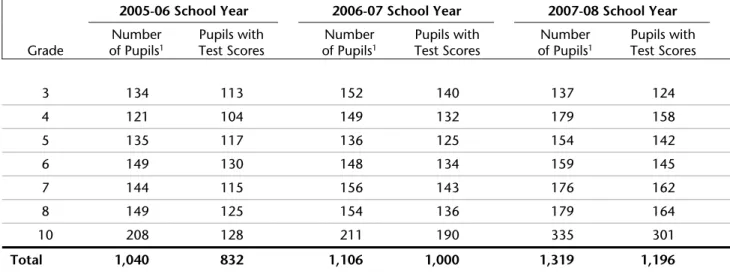
We analyzed test scores for the three-year period from 2005-06 through 2007-08. We found that virtual charter school pupils had higher
median reading scores than other public school pupils, but their mathematics scores were generally lower. Only a small number of pupils were continuously enrolled in virtual charter schools for the past several years, and performance varied.
Future Considerations
2007 Wisconsin Act 222 limits the number of full-time pupils who may attend virtual charter schools through open enrollment to 5,250 per year, beginning in the 2009-10 school year. The open enrollment limit will likely be reached in the near future.
In response to our survey, parents and guardians, teachers, and high school pupils reported widespread satisfaction with their virtual charter schools.
REPORT HIGHLIGHTS
7
Our report includes a number of recommendations for DPI to provide information that can inform continued legislative debate about the program’s size and scope, and enhance compliance with program rules.
Recommendations
We include recommendations for DPI to:compile statutorily required attendance and pupil participation information and report it annually to the Joint Legislative Audit Committee and the relevant standing committees of the Legislature (p. 21);
continue to facilitate the exchange of information on the provision of special education services among virtual charter school districts (p. 25); verify that all virtual charter school and online program teachers teach subjects and grade levels that are appropriately authorized by their
professional teaching licenses (p. 48 and p. 66); analyze the academic performance of virtual charter school pupils relative to other public school pupils and annually report the results of its analysis to the Joint Legislative Audit Committee and the relevant standing committees of the Legislature (p. 61);
complete the annual open enrollment report that is required by s. 118.51(15)(c), Wis. Stats., including the number of open enrollment applications, the number of denials, and the reasons for the denials (p. 69); and
report to the Joint Legislative Audit Committee and the relevant standing committees of the Legislature by July 1, 2010, on its efforts to form an advisory group to review online education issues and counsel the State Superintendent of Public Instruction and other policymakers (p. 72).
9
Virtual charter schools are designed to expand learning options for pupils in kindergarten through high school (K-12), as well as to provide alternatives for pupils who may not be performing well in traditional public schools. School districts have opened virtual charter schools in order to attract new pupils, discourage pupils from transferring to other districts, and help address overcrowding in classrooms. Pupils enrolled in virtual charter schools typically attend school from their homes and can “attend” classes at any time of day from anywhere they have a computer and an Internet connection.
In Wisconsin, virtual charter schools are required by statute to: adopt academic standards for pupils in
mathematics, science, reading and writing, geography, and history;
develop policies for promotion from grade to grade and for high school graduation;
measure pupil achievement by administering a standardized test—the Wisconsin Knowledge and Concepts Examination—to all pupils in grades 3-8 and grade 10;
ensure that all teachers are licensed by DPI; and comply with state and federal audit requirements.
Introduction
Virtual charter schools provide an educational option for pupils in grades K-12.
Virtual Charter School Enrollment Legal Challenges
10
INTRODUCTIONMost of the 15 virtual charter schools that operated in Wisconsin during the 2007-08 school year were high schools, but three served pupils in grades K-8. Appendix 1 provides descriptions of each school, identifies each school’s contractors, and provides 2007-08 school year enrollment information. The schools’ locations are shown in Figure 2.
Figure 2
Virtual Charter Schools and Chartering Districts
2007-08 School Year ! ! ! ! ! ! ! ! ! ! ! Grantsburg Virtual School and
Insight School of Wisconsin
Rural Virtual Academy
Appleton eSchool and Wisconsin Connections Academy
Kiel eSchool
Northeast Wisconsin Online Charter School Wisconsin Virtual Academy and
Honors High Online of Wisconsin
Kenosha eSchool iQ Academy Wisconsin JEDI Virtual High School
Janesville Virtual Academy Monroe Virtual High School and
Monroe Virtual Middle School Monroe School District Grantsburg School District
Medford Area School District
Appleton Area School District
Kiel Area School District
Kohler School District
Northern Ozaukee School District
Cambridge School District
Janesville School District
Waukesha School District
Kenosha Unified #1 School District
Virtual charter schools have been established by charters, or contracts, between local “sponsoring” school districts and other entities,
including multi-district consortia, Cooperative Educational Service Agencies (CESAs), and a for-profit business. Table 2 lists the chartering school district, years of operation, and grades served by
INTRODUCTION
11
the 15 virtual charter schools that operated during the 2007-08 school year. The chartering school districts employed all school staff and administered 12 of those virtual charter schools. Contractors employed staff and administered the three remaining schools:
Insight Schools, Inc., a for-profit company based in Portland, Oregon, administered Insight School of Wisconsin;
JEDI (Jefferson-Eastern Dane Interactive) Network Consortium, a consortium formed by nine school districts within the boundaries of CESA 2, administered JEDI Virtual High School; and
CESA 7 administered Northeast Wisconsin Online Charter School for participating school districts within its boundaries.
Table 2
Virtual Charter Schools Operating in the 2007-08 School Year
Virtual Charter School Chartering School District Years of Operation
Grades Served
Appleton eSchool Appleton Area 2002-03—present 9-12
Grantsburg Virtual School Grantsburg 2005-06—2007-08 9-12
Honors High Online of Wisconsin Northern Ozaukee 2007-08—2008-09 9-11
Insight School of Wisconsin Grantsburg 2007-08—present 9-12
iQ Academy Wisconsin Waukesha 2004-05—present 9-12
Janesville Virtual Academy Janesville 2007-08—present 9-12
JEDI Virtual High School Cambridge 2006-07—present 9-12
Kenosha eSchool Kenosha Unified #1 2007-08—present 9-12
Kiel eSchool Kiel Area 2002-03—present 7-12
Monroe Virtual High School Monroe 2002-03—present 9-12
Monroe Virtual Middle School Monroe 2006-07—present 6-8
Northeast Wisconsin
Online Charter School Kohler 2004-05—present 7-12
Rural Virtual Academy Medford Area 2005-06—present K-8
Wisconsin Connections Academy Appleton Area 2002-03—present K-8
12
INTRODUCTIONGrantsburg Virtual School closed after the 2007-08 school year, but Insight School of Wisconsin, which began operating in the 2007-08 school year, was chartered by the same school district to serve the same grades. Additional changes occurred in the 2009-10 school year:
the Northern Ozaukee School District ended the contract with its contractor and closed Honors High Online of Wisconsin and the Wisconsin Virtual Academy. It instead began operating the Wisconsin Virtual Learning Academy to serve pupils in grades K-12;
the McFarland School District began operating the Wisconsin Virtual Academy, utilizing the same contractor previously used by the Northern Ozaukee School District, to serve pupils in grades K-12; and the Waukesha School District’s iQ Academy
Wisconsin expanded to serve middle school pupils.
Virtual Charter School Enrollment
DPI reports the number of full-time pupils enrolled on the third Friday in September in each public school in Wisconsin. As shown in Figure 3, enrollment in virtual charter schools has increased every school year since 2002-03, when they began operating in Wisconsin.Figure 3
Enrollment in Virtual Charter Schools1
By School Year 2,951 2,303 1,972 1,471 882 265 2002-03 2003-04 2004-05 2005-06 2006-07 2007-08 0 500 1,000 1,500 2,000 2,500 3,000 3,500
1Full-time pupils on the third Friday of September, as reported by DPI.
Enrollment in virtual charter schools has increased every school year since 2002-03.
INTRODUCTION
13
Five virtual charter schools accounted for 92.2 percent of the 2,951 full-time K-12 pupils enrolled in virtual charter schools on the third Friday of September 2007. As shown in Table 3, enrollment ranged from 2 full-time pupils at Kiel eSchool to 865 full-time pupils at Wisconsin Virtual Academy.
Table 3
Enrollment in Virtual Charter Schools1
By School Year
Virtual Charter School 2002-03 2003-04 2004-05 2005-06 2006-07 2007-08
Appleton eSchool 9 24 33 13 13 12
Kiel eSchool 8 4 2 4 5 2
Monroe Virtual High School 10 29 63 147 270 337
Wisconsin Connections Academy 238 375 468 432 451 432
Wisconsin Virtual Academy 450 684 759 764 865
iQ Academy Wisconsin 211 589 739 841
Northeast Wisconsin
Online Charter School 10 15 14 8
Grantsburg Virtual School 3 6 4
Rural Virtual Academy 10 9 11
JEDI Virtual High School 6 14
Monroe Virtual Middle School 26 37
Honors High Online of Wisconsin 86
Insight School of Wisconsin 245
Janesville Virtual Academy 31
Kenosha eSchool 26
Total 265 882 1,471 1,972 2,303 2,951
1Full-time pupils on the third Friday of September, as reported by DPI.
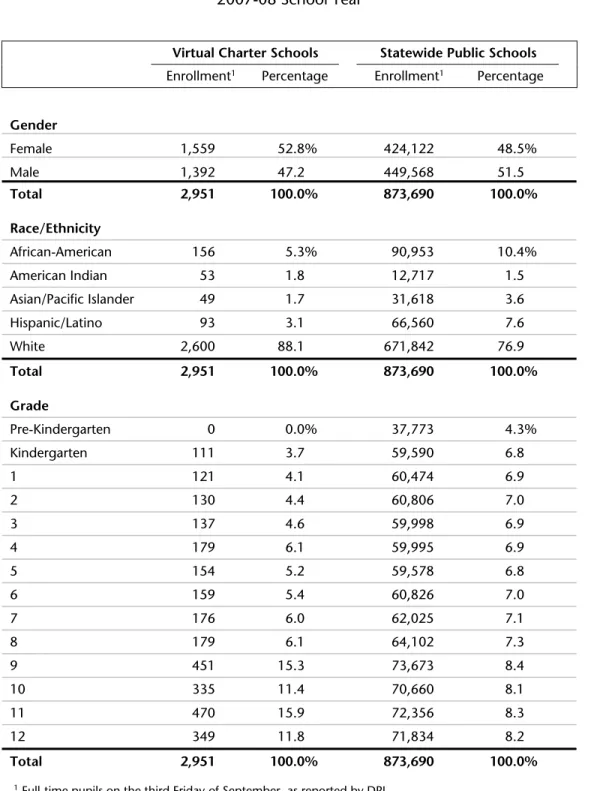
Larger percentages of female and white pupils attended virtual charter schools than public schools statewide, and as shown in Table 4, more than one-half of all virtual charter school pupils were in high school. Despite its growth, virtual charter school
enrollment represented less than 1.0 percent of the 873,690 public school pupils statewide in the 2007-08 school year. Appendix 2 provides additional enrollment data for all school years from 2002-03 through 2007-08.
Virtual charter school pupils are predominantly female, white, and in high school.
14
INTRODUCTIONTable 4
Pupil Profiles
2007-08 School Year
Virtual Charter Schools Statewide Public Schools
Enrollment1 Percentage Enrollment1 Percentage
Gender Female 1,559 52.8% 424,122 48.5% Male 1,392 47.2 449,568 51.5 Total 2,951 100.0% 873,690 100.0% Race/Ethnicity African-American 156 5.3% 90,953 10.4% American Indian 53 1.8 12,717 1.5 Asian/Pacific Islander 49 1.7 31,618 3.6 Hispanic/Latino 93 3.1 66,560 7.6 White 2,600 88.1 671,842 76.9 Total 2,951 100.0% 873,690 100.0% Grade Pre-Kindergarten 0 0.0% 37,773 4.3% Kindergarten 111 3.7 59,590 6.8 1 121 4.1 60,474 6.9 2 130 4.4 60,806 7.0 3 137 4.6 59,998 6.9 4 179 6.1 59,995 6.9 5 154 5.2 59,578 6.8 6 159 5.4 60,826 7.0 7 176 6.0 62,025 7.1 8 179 6.1 64,102 7.3 9 451 15.3 73,673 8.4 10 335 11.4 70,660 8.1 11 470 15.9 72,356 8.3 12 349 11.8 71,834 8.2 Total 2,951 100.0% 873,690 100.0%
INTRODUCTION
15
Although pupils typically have access to virtual charter school classes at home, pupils are not enrolled in home-based private education programs, which are more commonly known as home schools. Section 115.001(3g), Wis. Stats., defines a home-based private education program as educational instruction provided to a child by the child’s parent or guardian or by a person designated by the parent or guardian. Based on data reported by DPI, the number of home-schooled pupils increased each school year from 1984-85 through 2002-03, which was the first year virtual charter schools were in operation. Since then, the number of home-schooled pupils has decreased every year, from 21,288 pupils in the 2002-03 school year to 19,358 pupils in the 2008-09 school year. This 9.1 percent decline is likely due, in part, to the availability of the virtual charter school option.
Enrollment Process
Growth in virtual charter schools was facilitated by 1997 Wisconsin Act 27, the 1997-1999 Biennial Budget Act, which allows interdistrict public school open enrollment. Because they may attend any public school located outside of their school districts of residence, pupils may enroll in virtual charter schools operated by the school districts in which they reside, enroll in virtual charter schools outside of their school districts of residence through open enrollment, or request an interdistrict cooperative agreement, authorized by s. 66.0301, Wis. Stats., between their school districts of residence and districts that have chartered virtual charter schools. Virtual charter school pupils who are not Wisconsin residents, who are adults returning to school for a high school diploma, or who miss the annual open enrollment application deadline must pay tuition to the chartering school district.
As shown in Table 5, we found that 7.6 percent of full-time pupils in the 2007-08 school year were enrolled in the virtual charter schools chartered by their districts of residence. In contrast, 91.1 percent attended virtual charter schools through the open enrollment option. Of the 24 pupils who paid tuition, 19 did not reside in Wisconsin and 5 were Wisconsin residents who had either missed the open enrollment deadline or were adults returning to earn a degree.
The number of home-schooled pupils has declined since virtual charter schools were established.
In the 2007-08 school year, 91.1 percent of pupils attended virtual charter schools outside their school districts of residence.
16
INTRODUCTIONTable 5
Type of Enrollment in Virtual Charter Schools1
2007-08 School Year
Virtual Charter School
District Resident Open Enrollment Interdistrict Cooperative Agreement Other2 Total Enrollment Appleton eSchool 6 4 2 0 12
Grantsburg Virtual School 0 4 0 0 4
Honors High Online of Wisconsin 2 84 0 0 86
Insight School of Wisconsin 0 245 0 0 245
iQ Academy Wisconsin 49 787 0 5 841
Janesville Virtual Academy 30 1 0 0 31
JEDI Virtual High School 14 0 0 0 14
Kenosha eSchool 26 0 0 0 26
Kiel eSchool 1 1 0 0 2
Monroe Virtual High School 42 280 2 13 337
Monroe Virtual Middle School 2 31 0 4 37
Northeast Wisconsin
Online Charter School 8 0 0 0 8
Rural Virtual Academy 11 0 0 0 11
Wisconsin Connections Academy 28 392 11 1 432
Wisconsin Virtual Academy 5 859 0 1 865
Total 224 2,688 15 24 2,951
1 Estimated, based on data provided by school administrators and DPI. 2
Includes tuition-paying pupils who did not reside in Wisconsin, those who missed the open enrollment deadline, and adults.
Legal Challenges
In January 2004, the Wisconsin Education Association Council (WEAC), which represents teachers and other educators, filed a lawsuit arguing that Wisconsin’s charter school and open
enrollment laws had been violated by the Northern Ozaukee School District; its Board of Education; and its contractor, K12, Inc., which provided curriculum materials and other services. WEAC’s
complaint argued that because the Northern Ozaukee School District’s virtual charter school, Wisconsin Virtual Academy, was not located inside the district’s boundaries, pupils were not
attending school within the district. The complaint also stated that teacher certification laws had been violated because the school
INTRODUCTION
17
allowed parents who were not licensed teachers to assume primary education duties.
In July 2006, the Ozaukee County Circuit Court ruled in favor of the defendants. WEAC appealed, and in December 2007 the Wisconsin Court of Appeals for District II reversed the Circuit Court’s decision and prevented DPI from providing open enrollment payments to Wisconsin Virtual Academy.
In April 2008, 2007 Wisconsin Act 222 was enacted to address concerns raised in the lawsuit and allow existing virtual charter schools to continue operating as public schools in Wisconsin. The Act:
defines a virtual charter school as a charter school under contract with a school board in which all or a portion of the instruction is provided through means of the Internet, and the pupils enrolled in and instructional staff employed by the school are geographically remote from each other;
determined that virtual charter schools exist within the boundaries of the chartering school district or of a CESA that has an agreement with a school district;
clarifies that Wisconsin pupils may enroll in any public school, including all charter schools, through open enrollment; and
limits the number of full-time pupils who may attend virtual charter schools through open enrollment to 5,250 beginning in the
2009-10 school year. Current pupils who attend virtual charter schools through open enrollment are guaranteed places the following school year if they choose to enroll, and their siblings may also attend virtual charter schools regardless of the enrollment limit. Enrollment in virtual charter schools by district residents has not been limited.
2007 Wisconsin Act 222 also required this evaluation of virtual charter schools. To complete the evaluation, we interviewed staff from DPI and administrators at all 15 virtual charter schools in operation in the 2007-08 school year, visited 9 virtual charter schools and observed teachers working with pupils at 3 schools, reviewed virtual school policies in other states, and interviewed groups interested in virtual charter schools. In addition, we surveyed In April 2008,
2007 Wisconsin Act 222 defined virtual charter schools for the first time.
18
INTRODUCTIONvirtual charter school teachers, high school pupils, and parents or guardians of pupils who attended virtual charter schools in the 2007-08 school year based on lists obtained from school
administrators. Our survey response rates were 74.0 percent for teachers, 21.3 percent for high school pupils, and 45.8 percent for parents or guardians.
19
As public schools, all virtual charter schools must meet both state and federal requirements, including requirements for providing special education services, but each has the flexibility to develop its own attendance criteria and social activity offerings. We reviewed:
how virtual charter schools ensure that pupils are attending and progressing through their classes; opportunities for social interaction; and
available information on the extent to which special education services are provided.
Attendance Requirements
Virtual charter school pupils may focus on one or many subjects during the school day and may spend as much time as needed to work through specific lessons. Some class work is recorded for broadcast over the Internet at any time, while other scheduled class periods provide opportunities for pupils to interact with teachers. Younger pupils often receive a packet of textbooks and other materials at the beginning of the school year and submit paper assignments by mail for their teachers’ review. They are also likely to receive assistance from a parent or guardian. Pupils attending virtual high schools do a larger percentage of school work at their computers and are more likely to work with greater independence.
Virtual Charter School Operations
Pupils may spend as much time as needed during the school day to work through specific lessons.
Attendance Requirements Social Interaction Special Education
20
VI R TUA L CH ART ER SCHOOL OPERATIONSMany virtual charter schools require classes to be completed by the end of a typical semester, although some allow pupils who have not completed a class to continue it during the next semester and throughout the summer. In addition, pupils who finish a class early may be allowed to begin a new one before the start of the next semester. For example, Kenosha eSchool administrators reported that their high school pupils take three or four classes at a time and may add new classes mid-semester if they finish early. In contrast, iQ Academy Wisconsin administrators reported that their high school pupils follow the school year calendar and enroll in five to seven classes that they must finish by the end of a semester, and that they typically may not add classes mid-semester.
2007 Wisconsin Act 222 clarified that the compulsory school
attendance requirement in s. 118.15(1)(a), Wis. Stats., does not apply to pupils enrolled in virtual charter schools. The Act also gives virtual charter school administrators authority to address any pupils who fail to attend school regularly.
Each of the 15 virtual charter schools included in our evaluation had established attendance criteria, which are summarized in Table 6. If a pupil fails to respond appropriately to an assignment or a directive from a teacher within five school days, 2007 Wisconsin Act 222 requires the virtual charter school’s governing body to notify the pupil’s parent or guardian. If a pupil fails to respond appropriately for the third time in the same semester, the governing body must notify the pupil’s parent or guardian, the school board that
chartered the virtual charter school, the school board of the pupil’s district of residence if the pupil attends through open enrollment, and DPI, and the pupil may be assigned or transferred to another school or program within the school district of residence. The
pupil’s parent or guardian may, however, appeal the transfer to DPI. Virtual charter school administrators indicated to us that few pupils fail to participate in classes for long periods of time, in part because they attempt to meet with families to assess potential problems before pupils fall behind or fail to attend. We could not quantify compliance with attendance criteria because readily available data do not exist for the number of pupils who have failed to respond to virtual charter school directives or for the number of pupils who have been assigned or transferred to another school or program. 2007 Wisconsin Act 222
gives virtual charter schools the authority to address any pupils who fail to attend school regularly.
VIR TUAL CHA RTER SCHOOL OPERATIONS
21
Table 6
Attendance Criteria Established by Virtual Charter Schools
Virtual Charter School Attendance Criteria
Appleton eSchool Pupils must submit at least one assignment per class per week.
Grantsburg Virtual School Pupils must show activity in online classes at least three times per week. Honors High Online of Wisconsin The time signed in to the school’s Web site is recorded.
Insight School of Wisconsin Pupils must sign in to the school’s Web site and/or communicate with a teacher at least once every three days.
iQ Academy Wisconsin Pupils must show activity in every class online at least twice each week and average at least one hour of work per day per class.
Janesville Virtual Academy Pupils must submit three assignments per week. JEDI Virtual High School Pupils must submit at least one assignment per week.
Kenosha eSchool Pupils must submit at least one assignment per class per week and progress in their classes according to each pupil’s predetermined pace.
Kiel eSchool Pupils must progress in their classes according to each pupil’s predetermined pace. Monroe Virtual High School Pupils must progress in their classes according to each pupil’s predetermined pace. Monroe Virtual Middle School Pupils must progress in their classes according to each pupil’s predetermined pace. Northeast Wisconsin
Online Charter School
Pupils must sign in to each class at least three times per week and e-mail or telephone teachers at least once per week.
Rural Virtual Academy Pupils must “communicate frequently” with teachers.
Wisconsin Connections Academy Pupils must complete daily assignments, and parents or other adults must submit a daily notice of attendance.
Wisconsin Virtual Academy Sign-in times to the school’s Web site are recorded and parents are asked to report the amount of time that pupils spend on other activities.
Recommendation
We recommend the Department of Public Instruction: compile statutorily required information submitted by virtual charter schools on the number of pupils who do not respond appropriately to school assignments or directives from teachers and the number of pupils who have been transferred to a school or program within their school districts of residence as a result of their failure to participate; and
annually report its findings on virtual charter school attendance and participation to the Joint Legislative Audit Committee and relevant standing committees of the Legislature.
22
VI R TUA L CH ART ER SCHOOL OPERATIONSSocial Interaction
To address the absence of opportunities for their pupils to interact and develop socially, the virtual charter schools that enroll pupils primarily from their chartering districts or from a consortium of districts allow those pupils to participate in school clubs and extracurricular activities through traditional schools in the districts. Seven schools do so: Appleton eSchool, Janesville Virtual Academy, JEDI Virtual High School, Kenosha eSchool, Kiel eSchool, Northeast Wisconsin Online Charter School, and Rural Virtual Academy. All except for Rural Virtual Academy teach high school pupils and have held social events such as bowling nights and field trips to local businesses. Kenosha eSchool has a mascot and school colors, elects a pupil president, and has a graduation ceremony. Rural Virtual Academy has established times for pupils to meet one another and recently began offering virtual field trips to events such as the Iditarod sled race in Alaska and locations such as a zoo in Australia. The larger virtual charter schools, which enroll most of their pupils through open enrollment, vary in the extent to which they offer their own extracurricular activities, and pupils’ districts of residence are under no obligation to provide activities to pupils who attend school outside their districts through open enrollment. Monroe Virtual High School and Monroe Virtual Middle School do not organize any clubs for their pupils, while Wisconsin Connections Academy reported having reading, poetry, yearbook, and chess clubs and planning field trips throughout Wisconsin during the 2007-08 school year. Wisconsin Virtual Academy, the largest virtual charter school serving elementary and middle school pupils in the 2007-08 school year, reported similar activities that included community service days; spelling bees; and trips to museums, parks, and zoos.
Some level of satisfaction with the services and activities offered by virtual charter schools was reported by 96.9 percent of the 569 parents and guardians who responded to our survey question. They cited examples of activities such as online book club discussions and in-person tours of cranberry bogs and state parks. In addition,
93.9 percent of 243 responding high school pupils were satisfied with the services and activities offered by their virtual charter schools, which included trips to museums, the Wisconsin Dells, and
Milwaukee Brewers games; pizza parties and dances; and yearbook, photography, and science clubs. However, 6.1 percent of high school pupils reported some level of dissatisfaction with the services and activities provided, in part because they were either unable to attend or were not interested in attending the activities provided.
Most virtual charter schools offer some extracurricular activities.
Most parents and pupils reported being satisfied with the services and activities offered by virtual charter schools.
VIR TUAL CHA RTER SCHOOL OPERATIONS
23
Special Education
School districts are required by federal and state law to provide special education services, as needed, for all pupils enrolled in their districts. When pupils attend virtual charter schools through open enrollment, the districts that chartered the schools are responsible for providing special education services, but the pupils’ districts of residence are responsible for open enrollment payments as well as any additional costs incurred to provide special education services, regardless of whether receiving districts provide the services directly or arrange with the sending districts, CESAs, or private entities to provide them.
School districts report the number of pupils in every school who receive special education services to DPI on the third Friday in September. As shown in Table 7, 3.3 percent of virtual charter school pupils and 14.2 percent of all public school pupils received special education services in the 2007-08 school year, and the percentage of pupils who received special education services at virtual charter schools was consistently lower in every school year shown. The number of virtual charter school pupils receiving special education services may be slightly understated based on efforts to prevent the disclosure of confidential information related to pupils at five virtual charter schools with small enrollments.
Table 7
Special Education Services1
Virtual Charter Schools All Wisconsin Public Schools
School Year Total Enrollment Pupils Receiving Special Education Services Percentage of Total Enrollment Total Enrollment Pupils Receiving Special Education Services Percentage of Total Enrollment 2002-03 257 8 3.1% 879,225 123,991 14.1% 2003-04 878 12 1.4 878,217 125,210 14.3 2004-05 1,459 35 2.4 863,495 116,661 13.5 2005-06 1,940 86 4.4 874,098 122,385 14.0 2006-07 2,263 78 3.4 875,543 122,612 14.0 2007-08 2,912 97 3.3 873,690 124,122 14.2
1Information was not included for Grantsburg Virtual School, JEDI Virtual High School, Kiel eSchool, Northeast Wisconsin Online
Charter School, and Rural Virtual Academy to prevent the disclosure of confidential information related to individual pupils enrolled in these schools.
In the 2007-08 school year, approximately 3.3 percent of virtual charter school pupils received special education services.
24
VI R TUA L CH ART ER SCHOOL OPERATIONSDPI reported that 26 of the 97 virtual charter school pupils who received special education services in the 2007-08 school year had a “specific learning disability,” which is a learning disorder that manifests itself in school as an impaired ability to listen, reason, speak, read, write, spell, or do mathematical calculations. The second most commonly reported disability was “emotional behavioral disability,” which is social, emotional, or behavioral functioning that so departs from generally accepted, age-appropriate ethnic or cultural norms that it adversely affects a child’s academic progress, social relationships, personal adjustment, classroom adjustment, self-care, or vocational skills. In the 2007-08 school year, 23 virtual charter school pupils were reported to have had an emotional behavioral disability.
All virtual charter school administrators indicated they are able to provide special education services, although the cost of providing the services specifically to virtual charter school pupils is not well documented. Services also differ based on the types and severity of pupils’ disabilities. However, they have included class content modifications, allowing slower progression through classes, having teachers read exams aloud, and providing assistive technology such as books on tape and computer screen readers.
Administrators at six virtual charter schools—Honors High Online of Wisconsin, Insight School of Wisconsin, iQ Academy Wisconsin, Monroe Virtual High School, Monroe Virtual Middle School, and Wisconsin Virtual Academy—reported employing special education teachers in the 2007-08 school year. Other virtual charter schools use special education teachers who serve multiple schools within their school districts. Each of the school districts involved in the consortia that administer the JEDI Virtual High School, Northeast Wisconsin Online Charter School, and Rural Virtual Academy provide services to the virtual charter school pupils who are district residents. Fifty-three of the 577 parents and guardians who responded to our survey question, or 9.2 percent, reported that their children received special education services in the 2007-08 school year, and
47 indicated some level of satisfaction with the special education services their children received. The remaining six indicated they were dissatisfied because teachers did not contact their children as often as expected.
Thirty of the 39 parents who indicated in our survey that their child had previously received special education services through
traditional public schools, or 76.9 percent, were more satisfied with the special education services provided through virtual charter schools, while 8, or 20.5 percent, were equally satisfied with the special education services provided by virtual charter schools and Most parents and
guardians expressed satisfaction with the special education services their children received.
VIR TUAL CHA RTER SCHOOL OPERATIONS
25
by traditional public schools. One responding parent reported greater satisfaction with the special education services provided through traditional public schools.
It is important for school districts to identify the most effective and least costly means of providing special education services. As a means to convey and share information, DPI indicated that it conducts an annual workshop for virtual charter school administrators.
Recommendation
We recommend the Department of Public Instruction continue to facilitate the exchange of information on the provision of special education services among school districts chartering, or considering chartering, virtual schools.
27
Questions have been raised about the revenue used to support virtual charter schools, how open enrollment aid financially affects districts that send and districts that receive pupils, and how the costs of educating pupils in virtual charter schools compare to those of other public schools. We used the best available information on virtual charter schools’ revenue and expenditures to address these questions.
Revenue Sources
In Wisconsin, public school districts derive their revenue from a combination of state aid, property taxes, federal aid, and other miscellaneous revenue, such as pupil fees and interest earnings. State aid to school districts includes:
general aid provided through a formula known as either the “equalization aid formula” or the “general school aid formula,” which distributes aid based on a district’s per pupil value of taxable property; and
categorical aid, which funds specific program costs such as special education.
When pupils attend schools outside of their districts of residence through open enrollment, the amount of general aid that school districts receive is affected. A school district receives additional aid if it has a net gain in the number of pupils who attend through open
Revenue and Expenditures
School districts may lose or gain state aid based on pupil transfers through open enrollment.
Revenue Sources Expenditures Fiscal Effects of Open Enrollment
28
REVENUE AND EXPENDITUR ESenrollment, and it loses aid if it has a net loss in the number of pupils who transfer to other districts through open enrollment. Revenue received by a school district is typically aggregated and then allocated among district accounts. Each school district then determines how it will distribute funds to each of its schools,
including virtual charter schools. Once most funds are distributed to individual schools, their sources cannot be specifically identified. DPI likewise collects and reports revenue received by each school district, but not revenue information for individual schools. We therefore contacted virtual charter school administrators to obtain more specific information about district revenue used to support virtual charter schools. The available data they provided were sometimes incomplete or based on estimates because of limitations in district accounting systems. When a specific revenue source could not be identified to support a virtual charter school’s expenditures, we categorized the funding source as general district revenue. As shown in Table 8, virtual charter schools received an estimated $18.0 million in revenue in the 2007-08 school year, of which 79.0 percent was the result of state aid received through open enrollment. Federal charter school grants that provided 4.4 percent of total revenue are competitively awarded to assist in planning and operating charter schools. Other revenue sources include pupil fees and tuition; school consortium membership fees; and general district revenue, which could include property tax revenue.
Table 8
Estimated Virtual Charter School Revenue
2007-08 School Year
Revenue Amount Percentage
of Total
Open Enrollment Aid $14,186,200 79.0%
Federal Charter School Grants 794,400 4.4
Other Revenue 2,970,800 16.6
Total $17,951,400 100.0%
The second largest virtual charter school in the 2007-08 school year—iQ Academy Wisconsin—received the most revenue. As shown in Table 9, $4.3 million of its total revenue was derived from open enrollment aid. Grantsburg Virtual School, which served only When district revenue is
distributed to individual schools, its sources typically cannot be identified.
Virtual charter schools received $18.0 million
in revenue in the 2007-08 school year.
REVEN UE AND EXPENDITUR ES
29
four pupils during the 2007-08 school year, operated with the least revenue.
Seven of the 15 virtual charter schools operating in the 2007-08 school year received more than 80.0 percent of their revenue from open enrollment aid. The open enrollment per pupil aid amount is the same for all public schools, including virtual charter schools, and was $6,007 for the 2007-08 school year. When pupils attend a school through open enrollment for less than a full school term, DPI prorates aid payments after the school year has ended.
Table 9
Estimated Virtual Charter School Revenue
2007-08 School Year
Virtual Charter School
Open Enrollment
Aid
Federal Charter School
Grants Other Revenue1 Total
iQ Academy Wisconsin $ 4,301,700 $ 0 $ 915,700 $ 5,217,400
Wisconsin Virtual Academy and
Honors High Online of Wisconsin2 5,189,400 0 27,600 5,217,000
Wisconsin Connections Academy 2,414,900 0 315,800 2,730,700
Insight School of Wisconsin 1,203,200 0 250,600 1,453,800
Monroe Virtual High School and
Monroe Virtual Middle School2 992,900 0 117,400 1,110,300
Kenosha eSchool 0 234,400 427,200 661,600
Appleton eSchool 48,100 150,000 191,800 389,900
Kiel eSchool3 6,000 150,000 178,400 334,400
Janesville Virtual Academy3 6,000 175,900 134,000 315,900
Northeast Wisconsin
Online Charter School 0 0 157,500 157,500
JEDI Virtual High School 0 84,100 56,300 140,400
Rural Virtual Academy 0 0 137,400 137,400
Grantsburg Virtual School3 24,000 0 61,100 85,100
Total $14,186,200 $794,400 $2,970,800 $17,951,400
1 Other revenue includes pupil fees and tuition, school consortium membership fees, and general district revenue, which may
include property tax revenue. At Insight School of Wisconsin, general revenue was provided by its contractor, Insight Schools, Inc., not the Grantsburg School District.
2
These schools are combined because of their district’s accounting practices.
3 Open enrollment aid amounts are Audit Bureau estimates because districts’ financial records did not identify these schools’ open
30
REVENUE AND EXPENDITUR ESDPI administers federal charter school grants, which provide supplemental funding to groups that are planning new charter schools and to operators of existing charter schools. Grant amounts differ depending on grant type and the number of years a charter school has been operating. Grant types include:
planning grants that provide $10,000 initially and up to an additional $40,000 in supplemental funds for planning, chartering, and opening a charter school;
initial implementation grants and implementation renewal grants that each provide $150,000 per project and up to an additional $200,000 in supplemental funds for assistance in achieving the school’s educational goals and the provision of instructional services; and
dissemination grants and dissemination renewal grants that each provide $150,000 per year during a two-year grant duration period for assisting other schools in adapting the charter school’s program or for disseminating best practices about the charter school.
From the 2001-02 school year, when Appleton eSchool and Kiel eSchool were preparing to open, through the 2007-08 school year, DPI awarded a total of $3.7 million in federal charter school grant funds to nine virtual charter schools. During the 2007-08 school year, five schools—Appleton eSchool, Janesville Virtual Academy, JEDI Virtual High School, Kenosha eSchool, and Kiel eSchool—received $794,400 in federal charter school grants. Six virtual charter schools have never received any federal charter school grants: Honors High Online of Wisconsin, iQ Academy Wisconsin, Insight School of Wisconsin, Monroe Virtual Middle School, Wisconsin Connections Academy, and Wisconsin Virtual Academy.
All 15 virtual charter schools also support their operations with other revenue, such as pupil fees and school consortium
membership fees. Pupil fees are charged in accordance with district policies for supplies or administrative costs. A few full-time pupils paid tuition in the 2007-08 school year only because they missed the open enrollment application deadline, enrolled from out of state, or were adults returning to obtain high school diplomas. Appendix 3 provides additional detail on each school’s sources of other revenue in the 2007-08 school year.
Five virtual charter schools received $794,400 in federal charter school grants in the 2007-08 school year.
REVEN UE AND EXPENDITUR ES
31
Expenditures
DPI reports expenditures for each school district, but it does not collect expenditure information for individual schools. We requested school-level information from virtual charter school administrators, but complete information was unavailable because districts do not typically track all expenditures at the school level or maintain cost accounting data needed to determine all administrative and operational expenditures of the schools that incur them. In addition, school districts often provide virtual charter schools with a variety of services that, in most instances, are not reflected in the schools’ operating budgets. For example:
The Janesville Virtual Academy principal in the 2007-08 school year was also the Janesville School District’s coordinator of professional development and its curriculum director, as well as the principal of another charter school, and the district did not allocate a specific portion of her salary to the Janesville Virtual Academy. Rural Virtual Academy is housed within the Medford Area Public School District’s
administration building, but no expenditures for rent, utilities, or custodial costs were charged to the school.
Guidance counseling at Appleton eSchool is provided and paid for by the Appleton School District, which also provides working space for the virtual charter school staff.
Despite these limitations, we compiled all available data on those virtual charter school expenditures that could be identified. As shown in Table 10, identified expenditures increased from $64,200 in the 2001-02 school year, when the Appleton eSchool began planning its operations, to $17.8 million in the 2007-08 school year.
Appendix 4 provides staffing, curriculum, and other available expenditure information for each virtual charter school since it began operating.
School districts do not typically track all expenditures at the school level.
Available data indicate that virtual charter schools spent $17.8 million in the 2007-08 school year.
32
REVENUE AND EXPENDITUR ESTable 10
Estimated Virtual Charter School Expenditures1
By School Year
Virtual Charter School 2001-022 2002-03 2003-04 2004-05 2005-06 2006-07 2007-08
Appleton eSchool $64,200 $ 338,700 $ 285,600 $ 282,600 $ 232,300 $ 444,100 $ 389,900
Grantsburg Virtual School – – 40,100 242,700 337,300 135,200 85,100
Insight School of Wisconsin – – – – – – 1,453,800
iQ Academy Wisconsin – – 208,600 1,493,000 3,699,800 4,450,300 5,217,400
Janesville Virtual Academy – – – – – 25,300 315,900
JEDI Virtual High School – – – – 158,300 252,500 140,300
Kenosha eSchool – – – – – 280,100 661,600
Kiel eSchool – 113,900 218,900 440,900 406,100 307,700 334,400
Monroe Virtual High School and
Monroe Virtual Middle School3 – 59,100 163,900 538,900 626,900 894,800 1,110,300
Northeast Wisconsin
Online Charter School – – 7,100 150,100 119,000 135,700 157,500
Rural Virtual Academy – – – 27,200 100,200 198,100 137,400
Wisconsin Connections Academy – 1,240,900 1,906,900 2,321,600 2,468,500 2,416,600 2,730,700
Wisconsin Virtual Academy and
Honors High Online of Wisconsin3 – – 2,259,800 3,264,400 3,469,400 3,835,700 5,061,600
Total $64,200 $1,752,600 $5,090,900 $8,761,400 $11,617,800 $13,376,100 $17,795,900
1 Based on available expenditure information. Not all school districts were able to allocate all administrative and operating expenditures to their
respective schools.
2 No virtual charter schools were operating in the 2001-02 school year, but Appleton eSchool incurred expenditures in that year to prepare for
opening the following year.
3 These schools are combined because of their district’s accounting practices.
Increasing expenditures generally reflect increases in enrollment over time. In some cases, however, expenditures have fluctuated because schools incur large periodic expenses in one year but not annually, such as:
purchasing office equipment and computers for staff and pupils;
upgrading Web sites and networks to broadcast classes over the Internet;
purchasing curriculum material from contractors; and
REVEN UE AND EXPENDITUR ES
33
For example, Appleton eSchool’s expenditures almost doubled from the 2005-06 school year to the 2006-07 school year, when they
reached $444,100, largely because of costs associated with the purchase of new curricula, computer equipment, and Web site development. Grantsburg Virtual School’s expenditures were highest in the 2004-05 and 2005-06 school years, when it spent $67,600 on advertising and $34,200 to create a computer lab within the Grantsburg High School building.
We grouped virtual charter school expenditures into three broad categories:
curriculum-related costs; staffing costs; and
other expenditures, which consist largely of advertising expenses, computer equipment and maintenance, and office supplies.
In the 2007-08 school year, virtual charter schools spent an estimated $8.4 million for curriculum-related costs, which accounted for
47.5 percent of total expenditures, as shown in Table 11. Most virtual charter schools purchase at least a portion of their online class curricula from contractors. They can purchase individual online classes or a license to own and modify a class for use from year to year. Curriculum-related expenditures at six schools—Honors High Online of Wisconsin, Insight School of Wisconsin, iQ Academy Wisconsin, Rural Virtual Academy, Wisconsin Connections
Academy, and Wisconsin Virtual Academy—also included the cost of providing pupils with their own computers and Internet
subsidies, which totaled $1.8 million in the 2007-08 school year. Staffing expenditures were an estimated $8.2 million, which was 45.8 percent of total expenditures. These expenditures included staff salaries and fringe benefits; travel to meet with pupils in or near their homes, to conduct pupil orientation sessions around the state, and to attend training events; and staff professional development, training, and dues and fees related to memberships in professional associations.
Concerns have been raised about public school funds being used for newspaper, radio, billboard, and television advertisements rather than for school costs such as class materials or staffing. In general, neither statutes nor administrative code restrict the use of public school funds for such advertising. Reported advertising
expenditures increased from $4,500 in the 2002-03 school year, when 4 virtual charter schools were in operation, to $714,900 in the 2007-08 school year, when the number of virtual charter schools was 15.
Curriculum-related costs were 47.5 percent of virtual charter schools’ total expenditures in the 2007-08 school year.
Staffing costs were 45.8 percent of virtual charter schools’ total expenditures in the 2007-08 school year.
Virtual charter schools spent an estimated $714,900 on advertising in the 2007-08 school year.
34
REVENUE AND EXPENDITUR ESTable 11
Estimated Virtual Charter School Expenditures
2007-08 School Year Expenditures Amount Percentage of Total Curriculum-related Costs Purchased Curriculum $ 6,490,800 36.5%
Computers, Printers, and Internet Subsidies for Pupils 1,764,700 9.9
Supplemental Class Materials and Teacher Guides 46,400 0.3
Web Site Design, Maintenance, and
Internal Curriculum Development 138,100 0.8
Subtotal 8,440,000 47.5
Staffing Costs
Teacher Salaries 4,249,500 23.9
Administrative and Support Staff Salaries 1,486,300 8.4
Fringe Benefits 2,087,100 11.7
Employee Travel 223,000 1.2
Professional Development and Staff Dues and Fees 111,200 0.6
Subtotal 8,157,100 45.8
Other Expenditures
Advertising 714,900 4.0
Office Supplies 202,400 1.1
Computer Equipment and Maintenance 197,000 1.1
Rent, Utilities, and Insurance 67,500 0.4
Pupil Field Trips and Events 17,000 0.1
Subtotal 1,198,800 6.7
Total $17,795,900 100.0%
In the 2007-08 school year, five large virtual charter schools— Honors High Online of Wisconsin, Insight School of Wisconsin, iQ Academy Wisconsin, Wisconsin Connections Academy, and Wisconsin Virtual Academy—contracted with four principal contractors for online curriculum materials, pupil computers and Internet subsidies, and assistance with administrative operations. As shown in Table 12, those schools’ payments to contractors ranged from $1.2 million to $3.3 million and accounted for one-half or more of each school’s total expenditures in the 2007-08 school year. Amounts paid to
contractors at five large virtual charter schools ranged from $1.2 million to $3.3 million in the 2007-08 school year.
REVEN UE AND EXPENDITUR ES
35
Table 12
Payments to Principal Contractors at Five Virtual Charter Schools
2007-08 School Year
Virtual Charter School Contractor
Total Expenditures Amount Paid to Contractor Percentage of Total Expenditures
Insight School of Wisconsin Insight Schools, Inc. $1,453,800 $1,162,000 79.9%
iQ Academy Wisconsin KC Distance Learning, Inc. 5,217,400 3,327,600 63.8
Wisconsin Connections Academy Connections Academy, LLC 2,730,700 1,590,100 58.2
Honors High Online of Wisconsin
and Wisconsin Virtual Academy K12, Inc. 5,061,600 2,482,900 49.1
Total $14,463,500 $8,562,600 59.2%
In our review of the contracts executed between virtual charter schools and their principal contractors, we found that payment amounts depended on factors such as the number of pupils served and the type and amount of equipment and other services provided. For example, the Appleton Area School District paid $1.6 million to its contractor, Connections Academy, LLC, to serve 432 pupils attending the Wisconsin Connections Academy in the 2007-08 school year. Its payments covered Internet subsidies, computers, printers, textbooks, and science and art supplies for pupils, and support services such as development and maintenance of a Web site to make instructional material available to pupils. The Waukesha School District paid its contractor, KC Distance Learning, Inc., $3.3 million to serve 841 pupils attending iQ Academy Wisconsin and to provide similar supplies and support services. KC Distance Learning, Inc., is also responsible for providing promotional advertising services, for which iQ Academy Wisconsin reported spending $424,700 in the 2007-08 school year, and technical support. Teachers for both schools are employed directly by their respective school districts and are not provided through the private
contractors. Among the five large schools, only Insight School of Wisconsin’s teachers are employed by a contractor.
As shown in Table 13, 85.6 percent of contractor payments for large virtual charter schools were for curriculum-related costs, including pupil computers, printers, and Internet subsidies.
36
REVENUE AND EXPENDITUR ESTable 13
Payments to Principal Contractors at Five Virtual Charter Schools, by Purpose
2007-08 School Year
Expenditure Type Total
Percentage of Total
Curriculum-related
Purchased Curriculum $5,551,500 64.8%
Computers, Printers, and Internet Subsidies for Pupils 1,723,500 20.1 Web Site Design, Maintenance, and
Internal Curriculum Development 55,100 0.7
Subtotal 7,330,100 85.6
Staffing
Teacher Salaries 312,100 3.6
Administrative and Support Staff Salaries 342,300 4.0
Subtotal 654,400 7.6
Other
Advertising 578,100 6.8
Subtotal 578,100 6.8
Total $8,562,600 100.0%
Per Pupil Expenditures
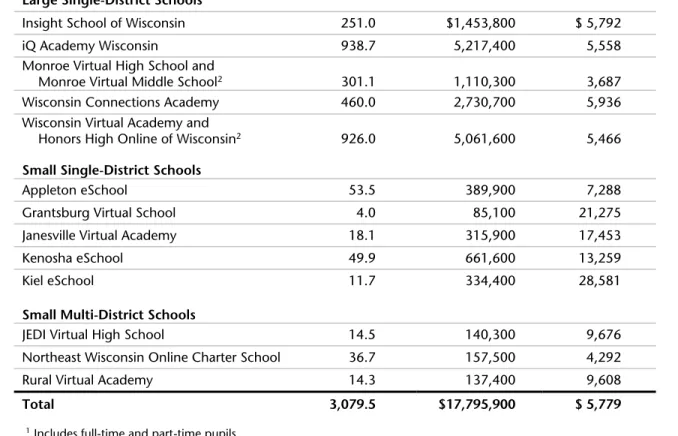
In order to compare per pupil expenditures among similar types of virtual charter schools, we grouped schools into three categories:
large single-district schools, which enrolled most pupils through open enrollment;
small single-district schools, which may have had open enrollment pupils but focused on pupils who were district residents; and
small multi-district schools, which enrolled only pupils who were district residents.
We estimated the number of full-time equivalent (FTE) pupils, which includes full-time and part-time pupils, at each virtual charter school based on data provided to us by the schools. Our FTE pupil estimates may be higher than the pupil enrollments reported by DPI, which include only full-time pupils in attendance on the third Friday in September, because they include part-time pupils as well as pupils enrolled at any point of the school year. In contrast, the