International Journal of Advances in Management, Economics and Entrepreneurship
Available online at:
www.ijamee.info
RESEARCH ARTICLE
Research on the Whole Process Quality Management of MBA Education-Taken
Changchun University of Science and Technology as an Example
Chen L-xia
1, MA H-yong
LI T-Y-mei
21School of Economics and Management, Changchun University of Science and Technology, Changchun 130022, China.
2School of Continuing Education, Tsinghua University, Beijing 100084, China.
*Correspondence: Author: Email: [email protected]
Abstract
The study pays attention to the quality management of MBA education in China under
the circumstance of fierce market competition. The paper discusses the necessarily of
the MBA education in China to perform whole process quality management (WPQM)
and designs a five-step WPQM system practiced in Changchun University of Science
and Technology (CUST) including market attractiveness, enrollment, entrance guide,
teaching & training and employment service processes. The practice of the MBA
education program of CUST has proven that the WPQM method proposed in the paper
not only guarantees the cultivation quality of MBA students, but also gets credit from
MBA students and the organizations they work for. The authors believe that the
practice of WPQM for the MBA program will do benefit to the sustainable development
of MBA education in China.
Acknowledgement
The paper is sponsored by the teaching research project “MBA Education Quality
Management System based on Excellent Performance Model” approved by the
Education Department of Jilin Province (No. GH11115).
Introduction
The concept of whole process quality management comes from the thoughts of total quality management (TOM), which was put forward by Dr. A. V. Feigenbaum in 1961, who was the chief of quality management department of USA General Electrics [1]. From then on, researchers in the countries all over the world began to research on TQM comprehensively and deeply, which made its ideas, methods and theories apply and develop continuously. Professor Lennart Sandholm described the principles and methods of total quality management used for modern industrial enterprises and service organizations in his book “total quality management” published in 1997 [2]. He also analyzed the differences between traditional quality management and total quality management in the book; it specially emphasized practical-minded thought to deploy total quality management so as to realize double targets of effectiveness and efficiency.
The characteristics of TQM is mainly represented by “total”, which means total staff involvement, whole process control and all methods for the quality object of zero defect, and therefore comes the concept of whole process quality management (WPQM). According to the theory of WPQM, product quality management should cover the whole process of product production; it first forms
in design process and is realized in manufacturing process, which is transferred to customers by sales and services finally. The whole process of the generation, form and realization of product quality consists of all processes of market investigation, design, manufacturing, sales and after-sales service. At the end of 1980s, the theory began to be used to the field of high education along with people’s attention on it, which became an effective means and method for guaranteeing the quality of high education and put positive influence on its continuous improvement [3].
The Necessity of the MBA Education in
China to Practice Whole Process Quality
Management
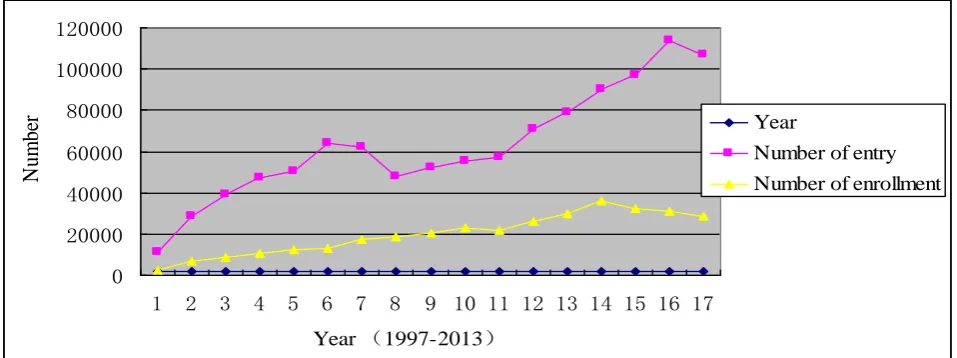
From the beginning of 1990s, the scale of Chinese high education has been expanding for more than twenty years, which results in the conflict of number and quality becoming increasingly serious, especially for the MBA education, which has been expanding at fast rate as shown in Fig. 1. According to the theory of WPQM and the development experience of Chinese MBA education, the paper believes it is necessary for Chinese MBA education to practice WPQM for the reasons as follow.
0 20000 40000 60000 80000 100000 120000
1 2 3 4 5 6 7 8 9 10 11 12 13 14 15 16 17
Year (1997-2013)
N
um
be
r Year
Number of entry
Number of enrollment
Fig. 1: The entry and enrollment number of Chinese MBA Education from 1997 to 2013
WPQM is the Only Way for the
Market-oriented MBA Education in China
As it is well-known that MBA education is market
oriented, at present there are more than 200
Chen L-xia
et. al.| March-April 2014 | Vol.1| Issue 1|23-28 25 from society, enterprises and individuals are
higher and higher. Universities in the fierce competition MBA market must take the quality of MBA education as their lifeline, or else they will not only lose their market share but also their reputation.
The MBA Education in China has been Facing More and More Questions
As shown in figure 1, there are so many universities undertake MBA education and manage so many MBA students in short time, how they can ensure teaching quality? On one hand,
MBA universities increase their tuition
continuously under the circumstance that more and more people enter MBA examination, for example, the tuition of MBA education of Shanghai Jiaotong University in 2011 was RMB 118000 Yuan, which was increased to 188000 Yuan in 2012; on the other hand, the quality of MBA education haven’t been improved obviously, which means that excellent universities are still excellent, but some universities that are approved to undertake MBA education latterly with relatively weaker schooling capability are facing serious problems of student source, many of them can’t attract enough students to register for MBA examination and in the face of the dilemma of no students to teach despite of their much cheaper tuition (for example, the tuition of MBA education of Harbin University of Commerce has been RMB 26000 Yuan, which is the lowest).
It is Time for MBA Education in China to Change from Quantitative Expanding to Qualitative Improvement
As shown in figure 1, the number of entry and enrollment of MBA student in 2013 decreased for the first time in the history of Chinese MBA education, so it is time for Chinese MBA education to change from quantitative expanding to quality improving. For more than twenty years, the tuition of MBA education has been increasing, but the quality has not kept pace with that of the tuition, so it is necessary for it to perform WPQM to realize sustainable development.
The Practice of whole Process Quality Management in MBA Education in CUST
The MBA Education Center of CUST was established in 2009 when it applied to China Education Department for undertaking MBA education and approved in the same year as one of the eighth batch universities. At the beginning of its establishment, we all realized that the approval not only gave us a chance, but also put us in face of serious challenge, so we designed WPQM for MBA education in 2010 and has practiced it from then on in order to ensure and improve the quality MBA education.
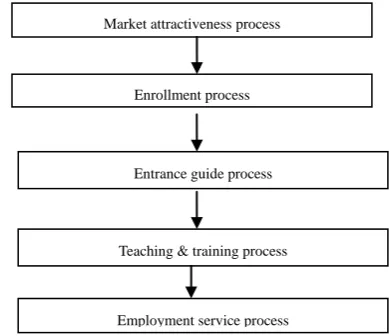
The MBA Education Guide Committee established in 2010 by the Graduate School and Economic and Management School of CUST is in full charge of managing the whole process of MBA education and gives strong support for human, financial and material resources required. The MBA education center established the expert guidance committee in order to guarantee the implementation of the MBA program with high quality. The teaching department of MBA education center consists of four full-time administrators is responsible for establishing and performing WPQM system to effectively monitor the whole process of the training of MBA students and put the critical factors and processes concerning the quality MBA education under control from beginning to end.We design the WPQM for MBA education by dividing it into five processes that connect with
each other closely as shown in Fig. 2.
Fig. 2: WPQM for MBA education
Market Attractiveness Process Market attractiveness process
Enrollment process
Entrance guide process
Teaching & training process
Although market competition in MBA education is so fierce, we plan to take in students with higher quality, so the first process step is designed to help MBA project to attract excellent, ambitious and promising person with some degree work experience to fix their attention on, long for it and positively apply for it.
Enrollment Process
In the enrollment process, we specially pay attention to a candidate’s education background (such as the university or college he/she graduated from and his or her major), learning ability (including english level, quantitative analysis ability, logical reasoning ability and expression ability), personal characteristics (ethical standard and moral faith, social responsibility, personal cultivation, behavior habit, respect and sharing
consciousness, passion and achievement
motivation, learning attitude, cooperation
tendency, innovation consciousness) and career development potential (professional history, management experience, working performance and communication ability), so that we can select suitable candidate to learn MBA courses.
Entrance Guide Process
Entrance guide process is designed to increase the sense of acceptance of new MBA students on our MBA project and help them realize the transformation from person in work to a MBA student by adjusting their attitude and defining their new career object. We provide project introduction materials to new students and call meetings to invite graduated MBA students to give a speech, organize them to take part in outdoor physical activity to make them be familiar with new classmates as soon as possible, and thus to improve their cohesive force.
Teaching and Training Process
We define our object is to cultivate MBA talents with technical and practical skills, which is embodies in our cultivation scheme. We reinforce MBA students’ technical skills in two ways; first we design courses such as “data and modeling” and “management statistics” to emphasize the
application capacity of a quantitative
management technology; second, we design
several optional courses such as “advanced manufacturing technology” and “technology innovation” by drawing support from the advantages of CUST in engineering to improve MBA students’ technical capacity to meet the requirements of manufacturing enterprises.
Therefore we improve MBA students’
decision-making capacity in management by their capacity in both general management and technical fields.
In addition to scientifically designed course system, we strictly manage the cultivating process.
Strict Student Administration System
(1) Study attendance checking system. Course teachers must perform roll-call, the teacher in charge of a class and the teaching department of MBA education center implement spot check. When attending class, MBA student should be seated by the desk with his or her name on it, which on one side makes it convenient for a course teacher to perform roll-call and on the other side improves the consciousness of MBA student to attend classes. MBA education center will cancel the test qualification of students whose attendance rate is lower than two-thirds according to the attendance sheet provided by the teacher at the end of a course.
(2) Strengthen the assessment of student performance at ordinary times, such as class participation (including asking questions and answering questions), individual work at ordinary times, case analysis report (including group assignments, group class oral report and speech), which make both teachers and students pay more attention to the involvement at ordinary times and improve the process quality of MBA education.
Strict Teacher Administration System
(1)Teacher certification and teaching
Chen L-xia
et. al.| March-April 2014 | Vol.1| Issue 1|23-28 27 teaching committee consists of seven senior
professors of CUST, Northeast Normal University and Jilin University employed by the MBA Education Guide Committee for teaching level evaluation. Only he teachers who pass a trail lecture can become a MBA course candidate teacher and at least two such teachers for one course. The teacher with highest score in the evaluation is appointed as senior course instructor, the second as chief course instructor and others who pass the evaluation as backup instructors, and all of them consist of a course team in the charge of the senior course instructor.
(2) Teacher supervision system:In addition to the system of teacher certification and teaching demonstration, we establish MBA teaching supervision system including various forms of visiting and criticizing classes. Firstly, MBA education center organizes the members of MBA teaching committee to visit to classroom and evaluate a class in each term that is an important activity for teachers to raise their teaching level. Secondly, MBA education center organizes all MBA students to grade course teachers anonymously whenever a course is finished. Thirdly, MBA education center organizes student symposium in each semester to ask for their comments and suggestions on MBA teaching activity, feedbacks the information to the course teacher in time, and takes actions to solve the problems suggested by students. Fourthly, MBA education center adopts the results of above mentioned supervision procedures as important basis for year-end assessment of course teachers. If a course teacher was found incompetent in his or her course, the center will supervise and urge him or her to improve. If he or she is still unqualified, his or her qualification of teaching MBA students will be cancelled, who can not tech MBA students anymore until he or she pass the teacher certification and teaching demonstration procedure again.
(3) Teaching supervision system:We reinforce the supervision and control of MBA teaching process by means of teaching supervision system. MBA education center strictly monitors the whole
process of teaching from the selection of textbooks and reference books, classroom teaching, the updates of teaching content, homework case, question number of a test, the form of test paper to make sure of the teaching quality of MBA education.
(4) Teacher training and communication: MBA education center provides various forms of training and communications for the course instructors of MBA students to continuously increase their teaching ability and practical skills. MBA education center requires that each course team must organize collective learning and discussion every two weeks and submit the meeting minutes to the teaching department for record and review, which is proved an effective way for teachers to broaden their horizon and improve teaching quality. At present, MBA course teacher have gotten used to the regular meeting and are willing to take part in.
MBA education center selects course teachers to take part in all training held by China National MBA Education Supervisory Committee and all teachers who teach core courses have taken part in the training, which greatly improves the teaching quality and skills of teachers.
MBA education center encourages MBA teachers to attend international academic conference held domestically and abroad since MBA education comes originally from abroad. Up to now, there are seven MBA teachers took part in international conferences on business management, which on one side broaden their global vision to a large extent and on the other side improve their skills in bilingual teaching.
other hand, they help enterprises solve their problems, which is win-win. It is proved that the teachers with rich experience in practice are more popular among MBA students and the attendance rates are much higher than that of the teacher with less practical experience. In addition to the benefits mentioned above, the enterprises that our teacher gave support to are more willing to dispatch their employees to take part in the MBA program of CUST, which does benefits to the enrollment because they believe they can learn practical knowledge and skills from the teachers.
(5) Strict quality control on the dissertation for MBA degree: MBA education center stipulated a detailed document to control the quality of MBA dissertation that covers the whole process of dissertation including the two-way tutor selection, literature reading, dissertation proposal, writing, submission to external review, pre-defense and defense of dissertation. The center requires that all dissertations must be combined with the practical work and solve practical problems. Especially, during the pre-defense of the dissertation of 2010 grade MBA students, fourteen of seventy nine students that were approved to take part in dissertation defense by external reviewers were requested to delay for half a year to attend dissertation defense not because of the quality problems of their dissertation but due to their performance show that they were not enough familiar with the subjects concerned and did not reach the requirements of MBA education center on graduation. The fourteen students will take part in the dissertation defense held in March 2014.
Employment Service Process
Although our MBA students are all on their jobs, we design employment service process to enhance MBA students’ understanding of enterprises and look for suitable practical opportunities so as to help them grasp opportunities and advance their career [1-3].
Conclusion
The MBA education center of CUST has practiced the WPQM proposed in the paper for four and a half year, which proved that it does benefits in three aspects: (1) The dissertations of 2010 grade MBA students who graduated in June 2013 got credit from external referees; (2) According to our investigation, the satisfaction degree of most MBA students is relatively high although they thought we were stricter than others, which did benefits to their development both in culture and career; (3)
When interviewed with the human resource supervisors of the organizations that the MBA students work for, they also expressed their satisfaction with the MBA program of CUST and they were willing to recommend their employees to apply for our MBA program.
Although CUST is not a well-know university for MBA program, we have been practicing the WPQM from the beginning, which help us establish a good reputation in MBA education, we believe that our practice of WPQM for the MBA program will do benefit to the sustainable development of MBA education in CUST and even in China.
References
1. Feigenbaum V (1991) Total Quality Management. Beijing: China Machine Press.
2. Berkeley-Sandholm (2003) Total Quality
Management. Beijing: China Economic
Publishing House.
3. Zhang Dayou (2010) A comparative study of