ISSN: 2278-3369
International Journal of Advances in Management and Economics
Available online at:
www.managementjournal.info
RESEARCH ARTICLE
Yang Xue-jun & Wang Miao-miao | Jan.- Feb. 2019 | Vol.8| Issue 1 |01-14 1
An Empirical Study of the Impact of Multinational Corporations'
Use of Foreign Exchange Derivatives on Corporate Value
Mediating-Role of Agency Cost
Yang Xue-jun, Wang Miao-miao*
International Business School,Jinan University, Qianshan, Zhuhai, Guangdong, China.
*Correspondent Author: Email:[email protected]
Abstract: Based on the perspective that hedging can reduce agency costs, this paper uses stata12 to empirically analyze the relationship between multinational companies whose overseas export revenue accounts for 10% of total operating income (Jorion, 1990; He & Ng, 1998) using foreign exchange derivatives to company value, collecting 2017 financial data from Shenzhen Stock Exchange and the Shanghai Stock Exchange A-share listed company. It turns out that multinational companies using foreign exchange derivatives can improve agency efficiency, reduce agency costs, and increase company value.
Keywords: Corporate value, Foreign exchange derivatives, Agent cost, MNC.
Article Received: 30 Oct. 2018 Revised: 10 Nov. 2018 Accepted: 15 Dec. 2018
Introduction
China as a developing emerging market, with the development of financial markets, its market risks are gradually increasing. The need for risk management is becoming more and more urgent. Multinational companies in this environment face exchange rate and interest rate fluctuations, looking for financial instruments for hedging.
The classic MM theory holds that value has nothing to do with financial policy, and hedging is a financial policy and therefore has nothing to do with corporate value. But in the real world, the market is not perfect, such as taxation, transaction costs, information asymmetry, agency problems, etc., so MM theory is difficult to use in reality. Therefore, most scholars discuss the relationship between hedging and company value from violating the assumption of MM theorem.
According to the company's value maximization hedging theory, when the market is not perfect, hedging can increase the company's value by reducing various friction costs. However, due to the influence of different mechanisms and other possible factors, there is an inconsistency in the empirical test.
Yang Xue-jun & Wang Miao-miao | Jan.- Feb. 2019 | Vol.8| Issue 1 |01-14 2
This is a question worthy of attention. There are some relevant literatures at home and abroad on the research on the impact of companies using derivatives on company value. However, in these documents, there are few studies using Chinese multinational companies as samples.
In addition, these papers focus on the antecedent variables of using derivatives and the impact of using derivatives on company value, lacking the relevant research on exploring the mechanism of action between companies using foreign exchange derivatives and company value. According to relevant research at home and abroad, this paper is mainly based on the theory of company value maximization and hedging can reduce agent costs. It is intended to explore whether multinational companies can use foreign exchange derivatives to increase the value of the company.
If it can increase value, how it can increase the value of the company. By exploring the relationship between foreign exchange derivatives and the value of multinational corporations, the black box of the mechanism of action between the two is opened to enrich the research of relevant domestic aspects.
Literature Review and Hypothesis
The Impact of Derivative Usage
Behavior on Company Value
What is the impact of companies using derivatives on corporate value? The earliest proposed is the irrelevance of the as the theoretical cornerstone. However, the perfect market assumed in this theory does not exist in reality. Therefore, in an imperfect market, the use of derivatives by enterprises will have an impact on corporate value.
Foreign scholars Allanannis and Weston [1] used the data of large non-financial companies in the country as samples to empirically test the impact of the application of foreign exchange derivatives on corporate value.
The results showed a significant positive correlation between corporate value and the use of foreign exchange derivatives. Companies using foreign exchange derivatives increased their value by 4.9% compared to companies that did not use foreign exchange derivatives [1]. Jose and used Brazilian company's 1997-2004 exchange rate derivatives data and found that companies using exchange rate derivatives hedged values 67%-78% higher than unhedged companies.
Clark & Judge [2] found that the use of foreign exchange derivatives can increase the company's value by 11% - 34%, and different types of foreign exchange derivatives have different value effects. Bartram [3] found that the use of foreign exchange derivatives has a significant positive effect on company value [4] conducted a study of data from 28 Spanish life insurance companies in 2002. The results show that companies using derivatives for hedging tend to get more returns. There is a positive correlation between hedging decisions and corporate value.
Relatively compared with foreign research, China's research on the relationship between derivatives and company value started late. Domestic selected 32 US life insurance companies from 2000 to 2006 to sample about 5,000 data samples, using panel data models to empirically study the relationship between the use of derivatives and company value and performance. The empirical results show that the use of derivatives brings a significant boost effect of 2.6% to the company's value, and a significant increase effect of 25.4% on the total return on assets representing the company's performance.
Yang Xue-jun & Wang Miao-miao | Jan.- Feb. 2019 | Vol.8| Issue 1 |01-14 3
Used Chinese enterprises as research objects to test the effectiveness of foreign exchange risk management of forward foreign exchange derivatives. The research conclusions show that enterprises can avoid the impact of exchange rate fluctuations on enterprises by using forward foreign exchange trading to lock in forward prices, which will help the value of enterprises to improve.
Takes the data of A-share non-financial enterprises in China's Shanghai and Shenzhen stock markets from 2011 to 2013 as the research object. The empirical analysis shows that the use of foreign exchange derivatives is positively related to the corporate value of listed companies in China, indicating the use of foreign exchange derivatives can enhance corporate value. From these more mature empirical studies at home and abroad, it can be found that most of the research conclusions support the use of derivatives to enhance the company's value. Therefore, this paper proposes the hypothesis one: multinational companies can use derivative instruments to enhance the company's value.
The way Derivatives Affect the Value of the Company
There are several theories about the use of derivatives to maximize the value of a company: reducing expected taxes, reducing the cost of financial distress, avoiding “under-investment” 、“asset replacement” and reducing agency costs.
Using Derivatives Can Reduce
"Insufficient Investment" and "Asset Replacement"
Due to the information asymmetry between shareholders and creditors, the company often faces the problem of “insufficient investment” and “asset replacement”. The essence of this is the debt agency cost problem. When the company's income is unstable and the cost of external capital financing is high, the company's shareholders will abandon the net present value of the project because of
fluctuations in internal retained earnings, resulting in insufficient investment, and these investment opportunities may increase the market value of the company [7-8].
Argue that the use of derivatives can avoid the company's "under-investment" problem and make the company willing to accept projects with positive net present value. Studies by have shown that hedging can prevent companies from abandoning positive net present value projects under debt conditions. Uses a two-stage state preference model to show that corporate hedging can reduce incentives for underinvestment.
Nance analyzed the 1986 US 169 companies using financial derivatives surveys and found that companies using financial derivatives have more growth options, convertible bonds and preferred stocks. Fewer, the ratio of investing in liquid assets is smaller, and dividends are distributed more, indicating that companies use financial derivatives to reduce debt agency costs.
Leland [8] uses a model that considers both debt tax returns and debt agency costs, demonstrating that the existence of debt agency costs reduces the company's optimal debt ratio, and the use of derivatives helps to reduce debt agency costs. also consider the role of hedging in controlling underinvestment and over-investment. Their model uses optimal leverage to reflect the trade-off between underinvestment and over-investment, pointing out that hedging can affect financial leverage by controlling costs in two areas and ultimately increase company value.
Yang Xue-jun & Wang Miao-miao | Jan.- Feb. 2019 | Vol.8| Issue 1 |01-14 4
In 2009, the empirical data of listed companies in the manufacturing industry were empirically tested. It was also found that companies with high growth tend to use derivatives to reduce the volatility of the company's future cash flows to reduce the probability of underinvestment.
On the other hand, due to the asymmetry of information, in the face of risky investment projects, shareholders are motivated to pursue these high-risk projects. Even in many cases, these projects will reduce the company's value, thus creating the problem of “asset replacement”. This kind of "asset replacement" stems from the uneven distribution of income between shareholders and creditors.
If the investment project is successful, the creditor can only obtain the principal and interest, and the shareholders can enjoy the benefits of the value added of the company. If the investment fails, the creditor loses the principal and Interest, while shareholders only lose the amount of capital. It is precisely because creditors are aware of the opportunistic tendencies of shareholders that they demand higher income or sign protection clauses.
These additional costs reduce corporate value. Believes that the use of derivative hedging can stabilize the risk of the enterprise (project) and reduce the expected risk assumed by the creditor, so that the company can strive for more favorable debt contracting conditions, thereby reducing the cost of debt.
And argue that risk management can stabilize company value and thus reduce the probability of asset substitution, so the company's hedging will reduce agency costs. Argue that companies that hedge can benefit from both hedging and debt-issuing negotiations.
Use Derivatives to Reduce Shareholder and Management Agent Conflicts
Due to the separation of management rights and ownership, shareholders do not participate in the management of the company but entrust the management to conduct, so there will be information asymmetry between the shareholders and the management of the company to create a proxy conflict.
De Marzo and Duffie [10] Reeden and Vishwanathan [11] focus on the role of hedging in derivatives on the “information effect”. De Marzo and Duffie [10] argue that there are often “noises” in the various accounting indicators that convey the quality of the company's management, including income, profit, and cash flow, and the use of hedging can reduce the noise of these accounting indicators and increase their Information content, reducing agency conflicts and increasing company value [10]. Argue that because hedging may reduce risk volatility, management's additional compensation may be reduced. That is to say, the hedging method of derivatives can stabilize the profits of enterprises and reduce the risks borne by managers, thereby reducing the conflict between shareholders and management and improving the value of enterprises.
A study by, Comment and, argue that hedging helps reduce management's incentive to pursue expensive diversification strategies, thereby reducing management agency costs. Pointed out that the use of financial derivatives can reduce agency costs, reduce information asymmetry between counterparties, delegates and agents to improve economic efficiency. Gregory spent a year investigating the foreign exchange risk management system of a US manufacturing multinational company.
Yang Xue-jun & Wang Miao-miao | Jan.- Feb. 2019 | Vol.8| Issue 1 |01-14 5
that there are three internal motivations for enterprise hedging, namely information asymmetry between enterprise investors and managers, internal transactions, convenience and competitive pricing. Lookman [12] studied some oil and gas exploration companies and found that hedging of secondary risks meant effective management and lower agency costs [2].
Took the A-share listed companies in Shanghai and Shenzhen as the research objects, and studied the determinants of the use of derivative hedging by enterprises. The results showed that management compensation, management shareholding and risk management were significantly positive correlation; verification of hedging reduces information asymmetry motives.
Based on the above-mentioned research on the relationship between derivatives, debt agency costs and principal-agent costs, in general, enterprises use derivatives to smooth cash flow and profit fluctuations, reduce the operational risks of enterprises, and increase the consistency of interests among different stakeholders, and thus reduce agency costs. Therefore, this paper proposes hypothesis 2: the use of derivatives by multinational companies can reduce agency costs.
Agency Cost and Company Value
In the case of highly dispersed equity, there will be a first type of agency problem, that is, the manager makes a decision to damage the shareholders in the absence of major shareholder supervision. The conflict of interest between the shareholders and the operator will trigger the equity agent cost.
On the other hand, in the case of relatively concentrated equity, it will lead to another type of agency problem, that is, the large shareholders' interest groups plunder external shareholders. Generally speaking, the major share holders' interest group control manifests mainly in asset replacement and underinvestment. On the two fronts, the resulting agency conflict
between the major shareholder interest groups and external shareholders will trigger debt agency costs. There are many studies on the relationship between agency cost and enterprise value at home and abroad.
A large number of empirical studies show that there is a significant negative correlation between agency cost and enterprise value, that is, the larger the agency cost, the smaller the enterprise value. Jensen and Meckling [13] used the principal-agent theory to study the relationship between the shareholding ratio of managers and the value of enterprises, and proposed the “shared interest hypothesis”.
Research shows that managers holding more equity can reduce the principal-agent problem between managers and owners. The greater the shareholding of managers, the more consistent with the objective function of shareholders, and the tendency to deviate from shareholders' interests will be weakened, which can reduce agency costs and enhance company value.
Have shown that if the controlling shareholder's shareholding ratio is too large or too small, it will detract from the enterprise value. There is an optimal ratio. At this time, the enterprise value is the largest, that is, the two are in an inverted U-shaped relationship. Argue that the control of large shareholders has two effects.
The first effect is the “incentive effect”, that is, the relatively concentrated equity solves the “free rider” problem, and the majority shareholder has the motivation and ability to supervise the company. The management layer, thereby enhancing the company's value; t the second effect is the “infringement effect”.
Yang Xue-jun & Wang Miao-miao | Jan.- Feb. 2019 | Vol.8| Issue 1 |01-14 6
shareholder are not completely consistent with other stakeholders, which would harm the interests of other stakeholders and reduce the value of the company.
La Porta, Lopez. Pointed out that in companies with relatively concentrated equity; there is a conflict of interest between the major shareholder and the external shareholders, which will reduce the company's value. As the shareholding ratio of major shareholders increases, their interests with external shareholders tend to be consistent, agency costs are reduced, and company value is increased. research shows that agency conflict reduces corporate value.
Zheng Jiaqin [9] obtained the model analysis to find that the agency cost generated by the majority shareholder control significantly reduced the enterprise value. Zhang Jin [9] took the GEM listed company as a research sample. The results show that the ownership agency conflict is its main problem, mainly reflected in the nature of the actual controller or its equity concentration is not conducive to enterprise value creation.
Empirical results show that there is a significant negative correlation between agency costs and corporate value. The results of Zheng Junge [9] show that high-quality
internal control can improve agent efficiency, reduce agency costs, and enhance corporate value [18].
According to the above-mentioned research and analysis by domestic and foreign scholars, the agency cost can affect the value of the enterprise. According to the analysis of the second part of the literature review, the use of foreign exchange derivatives by multinational corporations can reduce the agency cost. There is a relationship between them. According to the analysis of the first part of the literature review, the use of foreign exchange tools by multinational companies can enhance the value of the company.
Therefore, this paper initially believes that in the interaction between multinational corporations using foreign exchange derivatives, agency costs and corporate value, agency costs play a mediating role between multinational corporations using foreign exchange derivatives and corporate value.
The use mechanism of foreign exchange derivatives affects corporate value through agency costs, that is, multinational companies use foreign exchange derivatives to enhance corporate value by suppressing agency conflicts. The mediation model of agency costs is shown in the figure:
Based on this, the hypothesis 3 is proposed: agency costs reduce the value of multinational corporations, and play a mediating role in the use of foreign exchange derivatives by multinational corporations and corporate value.
Sample Selection, Variable Definition,
and model Settings
Sample Selection and Data Source
Yang Xue-jun & Wang Miao-miao | Jan.- Feb. 2019 | Vol.8| Issue 1 |01-14 7
operating income are identified as multinational companies [6]. In order to study the impact of foreign exchange derivatives on company value, this paper selects these multinational companies as research objects, because this type of company has potential foreign exchange risk exposure and is motivated to use foreign exchange instruments to manage exchange rate risk.
The sample in this paper excludes financial companies and public utility companies. Because financial companies are both providers and users of derivatives, the motivation for using derivatives may differ from that of non-financial companies. Public utility companies are often subject to strict price controls and are therefore not suitable for research [14-9]. Taking into account the abnormal financial data of ST and *ST companies, they were excluded from the sample; the companies listed in the year and the companies with missing financial data were excluded. The financial data of listed companies in this paper comes from the CSMAR database.
The use status of foreign exchange derivatives is obtained from the annual report of listed companies. The sample company's 2017 annual report is downloaded from Juchao. Search keywords (forward, foreign exchange, swap, Options, NDF, etc.) manually collect and collate relevant data.
Since some companies do not explicitly disclose the use of foreign exchange derivatives in their annual reports, they cannot determine whether they use foreign exchange derivatives to manage foreign exchange risk. Therefore, this article also removes these companies from the sample. Finally, 484 sample companies were obtained.
Variable Definition Company Value (TQ)
Tobin Q is used as a proxy variable for company value in most domestic and foreign research companies' values [14]. Guo Fei [5] Bartram, Brown and Fehle, [4].
Tobin Q represents the ratio between the company's market value and the company's asset replacement cost. The market value includes the company's stock market value and debt market value. The asset replacement cost represents the company's basic value.
This article uses simple Tobin Q as the company's value. The agent variable, that is, (the equity market value of the total assets book value - equity book value) / total asset book value [5].
Use of Foreign Exchange Derivatives (FCD)
This article uses dummy variables (FCD) to represent whether a multinational company uses foreign exchange derivatives. If the listed company mentions in the annual report that it uses foreign exchange derivatives to manage (hedge) exchange rate risk, and confirms or discloses the fair value or nominal value of the derivative, or confirms in the relevant items of the income statement such as financial expenses or investment income. The gains or losses arising from the use of foreign exchange derivatives are assigned a value of l even if they no longer hold the relevant derivative positions at the end of the year; otherwise, they are 0[5].
Agency Costs
Since this paper focuses on the comprehensive agency cost, this paper chooses the total return on assets (ROA) as a surrogate variable for agency costs, and responses the agent efficiency [6- 15].
Control Variables
See [16-1-5] and the research on the determinants of company value. This paper chooses the following control variables:
Growth
Yang Xue-jun & Wang Miao-miao | Jan.- Feb. 2019 | Vol.8| Issue 1 |01-14 8
positively correlated with the growth rate of operating income [15].
Capital structure (Debt). A reasonable level of debt is conducive to the use of financial leverage, while reducing agency costs, thereby enhancing the company's value. According to Jensen and Meckling [13], debt financing can curb the company's management's personal value objectives, reduce the company's agency costs, and thus improve the company's operating performance and corporate value.
However, some scholars have shown that excessive debt is also more likely to cause financial crisis in enterprises, which will damage the company's value. based on the data of China's real estate listed companies; the research shows that there is a negative correlation between asset-liability ratio and corporate value. This paper measures the capital structure by asset-liability ratio [7-8]. Shareholding concentration (Share1). In the experimental study of corporate governance structure, it was found that the ownership structure affects company performance and value.
Found that the shareholding ratio of the largest shareholder is significantly positively correlated with the company's value. This paper uses the shareholding ratio of the largest shareholder to measure the concentration of ownership, and it is expected that the concentration of ownership will be positively correlated with the value of the company [17].
Company size (Size). A lot of literature has empirically studied the relationship between company size and corporate value. Lang and Stulz [7] studied the value of the firm and the size of the firm and found that there was a significant negative correlation between the two. Allayannis & Ofek [16] found that the size of the company and the company value (Tobin Q) were negatively correlated, Guo Fei [5] showed a significant negative correlation
between the size of the company and Tobin Q.
This paper uses the logarithm of total assets to measure the size of the firm, and it is expected that there will be a reverse relationship between firm size and firm value [3-18]. Industry diversity (Industry). Lang and Stulz [7], and argue that industry diversification is the development of agency problems between managers and shareholders, and cross-industry operations can damage company value.
In order to control the impact of industry diversification, this paper uses dummy variables (two or more industries with 10% operating income, with a value of 1 and vice versa) to represent the industry's diversification [18], and industry diversification is expected to be inversely related to company value [18]. Capital constraints (Divdum). If companies using foreign exchange derivatives are not better able to capitalize on capital markets and thus face capital constraints, then they will only invest in projects with positive net present value, and their market value may be higher [5].
This paper uses the virtual variable Divdum agent capital constraints that company may face, when the company has cash dividends, the value of 1, when there is no dividend, the value of 0, the principle is that the company can adjust the level of cash dividends to improve the degree of capital constraints [6].
Model Settings
According to the previous variable setting, this paper uses Tobin Q as the explanatory variable, FCD and ROA as the independent variables, and Size, Growth, Debt, Share1, Industry, Divdum as the control variables. To verify hypothesis 1 to hypothesis 3, the design model of this paper is as follows.
Model 1
TQ=α0+α1FCD+α2Growth+α3Debt+α4Share1+
Yang Xue-jun & Wang Miao-miao | Jan.- Feb. 2019 | Vol.8| Issue 1 |01-14 9 Model 2
ROA=α0+α1FCD+α2Growth+α3Debt+α4Share1
+α5Size+α6Industry+α7Divdum+ε Model 3
TQ=α0+α1FCD+α2ROA+α3Growth+α4Debt+α5
Share1+α6+α7Industry+α8Divdum+ε
Where: α0 is a constant term, αi is the
regression coefficient of the corresponding index, i=1, 2, 3…, and ε is the residual term. Model 1 examines the relationship between multinational companies using foreign exchange derivatives and corporate value; model 2 examines the relationship between multinational companies using foreign exchange derivatives and agency costs; Model 1, 2, and 3 together forms a test model for the mediating effect of agency costs.
Empirical Results and Discussion
Descriptive Statistics
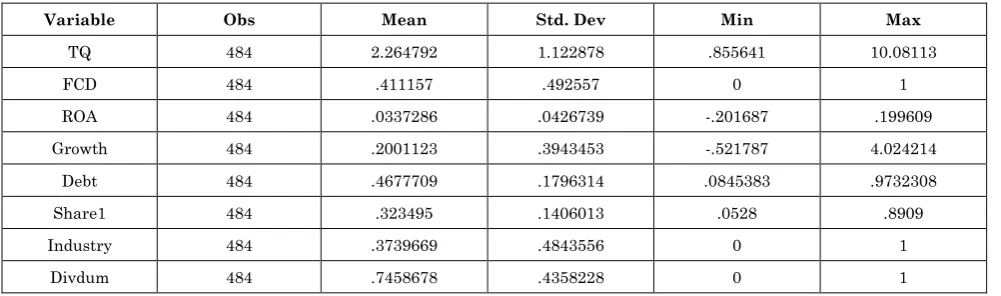
Descriptive statistics are shown in Table 1. It can be seen that 41.12% of the 484 sample companies in the statistics use foreign exchange derivatives. The maximum value of Tobin Q is 10.08, and the minimum value is 0.86, indicating that the value difference between different samples is large. The minimum value of the agent efficiency variable is -0.20, the maximum value is 0.20, and the average value is 0.03, indicating that the operating efficiency of different enterprises is quite different, and the comprehensive agency cost is significantly different. Among the control variables, there is a big difference between the growth rate of operating income and the sample ratio of the largest shareholder.
Table 1: Descriptive statistics
Variable Obs Mean Std. Dev Min Max
TQ 484 2.264792 1.122878 .855641 10.08113
FCD 484 .411157 .492557 0 1
ROA 484 .0337286 .0426739 -.201687 .199609
Growth 484 .2001123 .3943453 -.521787 4.024214
Debt 484 .4677709 .1796314 .0845383 .9732308
Share1 484 .323495 .1406013 .0528 .8909
Industry 484 .3739669 .4843556 0 1
Divdum 484 .7458678 .4358228 0 1
Single Factor Test
In this paper, a one-factor test is carried out by means of parametric test and non-parametric test. The company using derivative hedging is compared with the company without derivative instruments to determine whether there is a difference between the company value and agency cost of the two types of companies. First, the company value is tested by parameters.
Table 2 is the group statistics of the enterprise value indicators of the companies using derivatives and the unused companies. It can be seen that there are some differences between the average values of the two groups of enterprises. Multinational companies using
derivatives have higher Tobin Q values, the parameter test results have a t-value of -5.8806, and the two-tailed significance level is 0.0000.
Explain that there is a significant difference between the two variables, that is, there is a significant difference between the multinational companies using derivatives and the Tobin Q of unused multinational
Yang Xue-jun & Wang Miao-miao | Jan.- Feb. 2019 | Vol.8| Issue 1 |01-14 10
multinational company. First, the company value is tested by parameters.
Table2 is the group statistics of the enterprise value indicators of the companies using derivatives and the unused companies. It can be seen that there are some differences between the average values of the two groups of enterprises. Multinational companies using derivatives have higher Tobin Q values, the parameter test results have a t-value of -5.8806, and the two-tailed significance level is 0.0000.
This explains that there is a significant difference between the two variables, that is, there is a significant difference of Tobin Q between the multinational companies using derivatives and the unused multinational companies. Secondly, the non-parametric test of the company value, the non-parametric Z statistic of the company value of the sample is - 4.187, and the significance probability P is 0.0000, indicating that there is a significant difference in the value of the multinational company using the derivative and the unused multinational company.
Table 2: Single factor test of company value
FCD mean Sd median N T z
0 1.989678 0.564159 1.965286 285 -5.8806 -4.187
1 2.6588 1.534352 2.301253 199
For the parameters of the comprehensive agency costs, the non-parametric test is
shown in Table3.
Table 3: Single factor test of comprehensive agency cost
FCD mean sd median N T z
0 .0308922 .0370132 .026491 285 -1.6676 -1.575
1 .0377908 .0426739 .031182 199
It can be seen from the table that the parameter and non-parametric tests are performed on the comprehensive agent cost variable.
Although the average agent efficiency of companies using foreign exchange derivatives is greater than that of companies that do not use foreign exchange derivatives, the difference is not significant (corresponding P values are respectively is 0.0963, 0.1153).
Since the univariate test does not consider the effect of other variables on the comprehensive agent cost variable, the persuasive power may be limited.
Correlation Analysis
Before the regression, the correlation analysis of each variable is first carried out to initially understand the relationship between the variables to be tested.
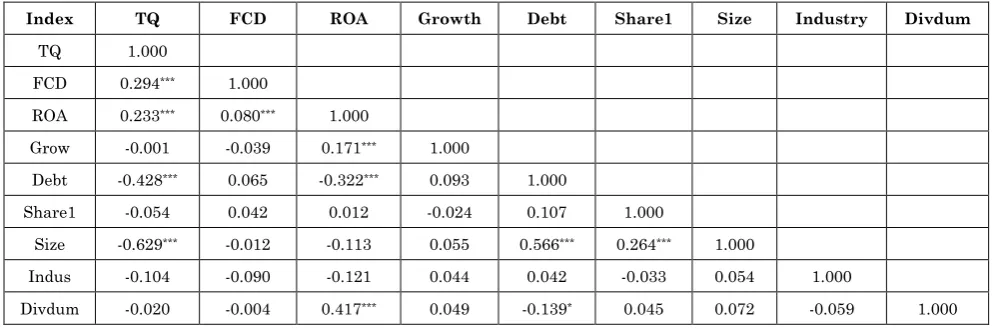
The results are shown in Table 4. It can be seen from the table that the correlation coefficient between the variables is less than 0.5, indicating that there is no obvious co linearity problem between the variables. The use of foreign exchange derivatives (FCD) is positively correlated with company value and total return on assets, indicating that the use of foreign exchange derivatives by multinational companies can enhance the company's value, and can improve agency efficiency; thereby reducing agency costs; capital constraint variables and comprehensive agency cost variables are significant Positive correlation.
Yang Xue-jun & Wang Miao-miao | Jan.- Feb. 2019 | Vol.8| Issue 1 |01-14 11
is significantly negatively correlated with company value, indicating that Chinese listed companies may have excessive borrowing resulting in financial. Excessive risk makes the company's value impaired; the company's size is significantly negatively correlated with
the company's value, indicating that the larger the company's size, the more difficult the supervision, the more likely the manager may have rent-seeking behavior, which is not conducive to the company's value added.
Table 4: Correlation analysis
Index TQ FCD ROA Growth Debt Share1 Size Industry Divdum
TQ 1.000
FCD 0.294*** 1.000
ROA 0.233*** 0.080*** 1.000
Grow -0.001 -0.039 0.171*** 1.000
Debt -0.428*** 0.065 -0.322*** 0.093 1.000
Share1 -0.054 0.042 0.012 -0.024 0.107 1.000
Size -0.629*** -0.012 -0.113 0.055 0.566*** 0.264*** 1.000
Indus -0.104 -0.090 -0.121 0.044 0.042 -0.033 0.054 1.000
Divdum -0.020 -0.004 0.417*** 0.049 -0.139* 0.045 0.072 -0.059 1.000
Standard errors in parentheses *** p<0.01, ** p<0.05, * p<0.1
Multiple Regression Results and
Analysis
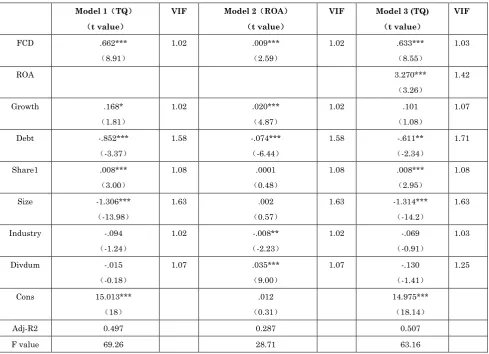
In this paper, multiple regression analysis is performed on the above hypothesis, and the regression results are shown in Table 5. The significance probability level of F value in the model 1to model 3 is 0.0000, indicating that the overall regression effect of the model is significant, and variation expansion factor in the model 1to model 3 is less than 2, indicating that there is no multi-co linearity.
According to the results of Model 1, the use of foreign exchange derivative variables is significantly positively correlated with the company value at the 1% level, indicating that the use of foreign exchange derivatives by multinational companies can help to enhance the company's value, assuming that hypothesis1 is verified.
Among the control variables, growth is significantly positively correlated with company value, which is consistent with the findings of most scholars, that is, companies with better growth have higher valuations; the shareholding ratio of the largest shareholder is significantly positively
correlated with company value. It shows that in the companies with relatively concentrated equity, when the majority of the company's wealth is in the hands of the largest shareholder, the controlling shareholder's motivation to absorb personal interests is weakened, the agency cost is reduced, and the company's value is increased [13]; capital structure Significantly negatively correlated with the company's value, indicating that excessive debt will cause the company to fall into financial crisis, which is not conducive to the company's value; the company's size is negatively correlated with the company's value.
Which is consistent with some studies that the small company has a value premium ; industry diversification and capital constraints are negatively correlated with company value, which is consistent with some research results, but not significant.
Yang Xue-jun & Wang Miao-miao | Jan.- Feb. 2019 | Vol.8| Issue 1 |01-14 12
companies can improve the agency efficiency of the company and suppress the agency costs.
Among the control variables, the regression coefficient of the company's growth is positive and significant, indicating that the company's growth has a significant impact on improving agency efficiency and reducing agency costs. The regression coefficient of capital results is negative and significant, indicating that companies with high asset-liability ratio are facing higher financial risks and not conducive to improving operational efficiency.
The industry regression coefficient is negative and significant, indicating that industry diversification is the development of agency problems between shareholders and managers, reducing agency efficiency, and the regression coefficient of capital constraints is positive. Significantly, it shows that the distribution of dividends can reduce the cost of management agents.
Models 1 and 2 pass the significance test in turn, indicating that the model 3 can be tested, and the mediating effect of the agent cost is tested by comparing the significant changes of the coefficient in models 1 and 3. According to the results of Model 3, the regression coefficient of the comprehensive agency cost variable (ROA) in Model 3 is positive and significant, and the regression coefficient using the foreign exchange derivatives is positive and significant, but the coefficient is lower than the coefficient in Model 1.
It shows that the comprehensive agency cost plays an incomplete intermediary role in the path of multinational companies using foreign exchange derivatives and corporate value. Hypothesis 3 is verified. This result is consistent with the theoretical analysis that multinational companies use foreign exchange derivatives to increase the value of the company by increasing the efficiency of the agency.
Table 5: Multiple regression
Model 1(TQ)
(t value)
VIF Model 2(ROA)
(t value)
VIF Model 3 (TQ)
(t value)
VIF
FCD .662***
(8.91)
1.02 .009***
(2.59)
1.02 .633***
(8.55)
1.03
ROA 3.270***
(3.26)
1.42
Growth .168*
(1.81)
1.02 .020***
(4.87)
1.02 .101
(1.08)
1.07
Debt -.852***
(-3.37)
1.58 -.074***
(-6.44)
1.58 -.611**
(-2.34)
1.71
Share1 .008***
(3.00)
1.08 .0001
(0.48)
1.08 .008***
(2.95)
1.08
Size -1.306***
(-13.98)
1.63 .002
(0.57)
1.63 -1.314***
(-14.2)
1.63
Industry -.094
(-1.24)
1.02 -.008**
(-2.23)
1.02 -.069
(-0.91)
1.03
Divdum -.015
(-0.18)
1.07 .035***
(9.00)
1.07 -.130
(-1.41)
1.25
Cons 15.013***
(18)
.012
(0.31)
14.975***
(18.14)
Adj-R2 0.497 0.287 0.507
F value 69.26 28.71 63.16
Yang Xue-jun & Wang Miao-miao | Jan.- Feb. 2019 | Vol.8| Issue 1 |01-14 13 Research Limitations and Implications
Whether the use of derivatives can increase the value of the company has always been concerned. Many scholars have theoretically analyzed that the use of derivatives can bring value to the company, but the empirical results have been controversial. China's research on this aspect started late, most likely because of the difficulty in obtaining data, because before 2007, China did not require companies to disclose the use of derivatives.
Since China's exchange rate reform, many domestic multinational companies have begun to use foreign exchange derivatives to avoid foreign exchange risks, but the academic community still lacks in-depth research. This article uses 484 Chinese multinational companies in 2017 as a sample to try to answer whether multinational companies use foreign exchange derivatives to increase the value of the company, and how to increase the value if it can increase value.
Through model research, it is found that the use of foreign exchange derivatives by multinational companies can increase the value of the company and achieve it by reducing agency costs. Previous studies have mostly explored the relevance of using foreign exchange derivatives to corporate value, with little attention to intermediate intermediaries. For many investors, this is very important.
Many investors usually make inappropriate investment decisions when they find companies use derivatives, because they think using derivatives will increase the company's risk. Therefore, the advice of this article to investors is whether to invest in a company, using the annual report, information disclosure and other content to judge whether the company uses derivatives
for risk management or speculative arbitrage. If the company is for hedging, then the company may therefore reduce the agency cost to obtain a hedging premium.
The advice to companies is to encourage companies to use foreign exchange derivatives. From the analysis of this paper, it can be seen that using derivatives to avoid risks can reduce the fluctuation of profits, reduce the conflict between shareholders and creditors, and enable the company to better use the external capital market to develop.
On the other hand, the company's use of derivatives to reduce the risk of business operations can avoid the high compensation costs that managers take on high risks, which will indirectly increase the company's value. In view of the limited theoretical level of the author, the conclusions of the study have the following limitations.
The research sample only selected the cross-sectional data of the 2017 A-share listed companies, and lacked the longitudinal comparative analysis, which limited the credibility of the conclusions.
In terms of the measurement of agency cost, the total return on assets that measure the efficiency of agency is chosen as the substitute variable of comprehensive agency cost. Further analysis is needed for the problem of agency cost measurement.
The literature on the use of derivatives, agency costs and corporate value in existing research is very rich, but there are few results that can be referenced in terms of the intermediary role of agency costs. At the same time, the author's theoretical level is limited, and the factors that may be considered in the research and analysis are not deep enough, thus affecting the depth of the research conclusions [19-20].
References
Yang Xue-jun & Wang Miao-miao | Jan.- Feb. 2019 | Vol.8| Issue 1 |01-14 14 Operational Strategies [J].American Economic,
1:391-395.
2. Clark E, A Judge (2009) “Foreign Currency
Derivatives versus Foreign Currency Debt and
the Hedging Premium ”,European Financial
Management,15:606 -642
3. Bartram SM, Brown GW, F Fehle (2003)
International Evidence on Financial Derivatives Usage[R].Working paper.
4. Bartram SM (2008) “What Lies Beneath:
Foreign Exchange Rate Exposure Hedging and
Cash Flows”,Journal of Banking and Finance
32,1508-1521.
5. Guo Fei (2012) Foreign Risk Hedge and
Corporate Value-An Empirical Study Based on
Chinese Multinational
Corporations[J].Economic Research, (9):18-31.
6. LinYouzhi, Zhang Yafen (2007) The
Relationship between Information
Transparency and Business Performance [J].Accounting Research, (9):26-34.
7. Lang L, Stulz R (1994) Tobin’s, Corporate
Diversification and Firm Performance [J]. Journal of Political Economy, 102:1248-1280.
8. Leland HE (1998) Agency costs, risk
management, and capital structure [J]. The Journal of Finance, , 53(4): 1213-1243.
9. Zheng Junge (2014) the impact of internal
control on corporate value-based on the intermediary effect of agency cost. Master's thesis. Southwestern University of Finance and Economics.
10. De Marzo,Peter M, Darrell Duffie (1995)
“Corporate Incentives for Hedging and Hedge
Accounting”,Review of Financial Studies8
(3):743-771.
11. Breeden,Douglas Viswanathan (1998) “Why do
Firms Hedge? An Asymmetric Information
Model”,Working Paper, Duke University.
12. Aziz A, Lookman (2004) does hedging increase
firm value? Evidence from oil and gas producing firms, [R], Working paper.
13. Jensen MC, Meckling WH (1976) Theory of the
firm: Managerial behavior, agency costs and ownership structure [J]. Journal of financial economics,3(4): 305-360
14. Sheng xuan (2015) Empirical research on the
impact of multinational companies using foreign exchange derivatives on company value. Master's thesis. Beijing foreign language university.
15. Yu Liang (2013) Financing constraints, agency
costs and incentive policy governance effects. PhD thesis. South China University of Technology.
16. Allayannis G, Ofek (2001) Exchange-Rate
Exposure, Hedging, and the use of foreign currency Derivatives[J].Journal of International Money and Finance, 20:273-296.
17. Rozeff M (1982) Growth, beta and agency costs
as determinants of dividend payout ratios [J]. Journal of Financial Research, 5(3):249-259, Fall.
18. Nain A (2004) The Strategic Motives for
Corporate Risk Management[R] ,University of
Michigan Working Paper.
19. Cater D, Rogers D, Simkins B (2003) Does Fuel
Hedging Make Economic Sense? The Case of the US Airline Industry[R].Working paper .Ok lahoma State University.
20. Hoa Nguyen, Robert Faff (2007) Are Financial
Derivatives Really Value Enhancing?