University of Mazandaran, Iran http://cjms.journals.umz.ac.ir ISSN: 1735-0611
CJMS.4(1)(2015), 95-105
Parallel computing using MPI and OpenMP on self-configured platform, UMZHPC
V. Sabet1 and A. Valinejad2
Department of Computer Science, University of Mazandaran, P.O. Box 47416-95447, Babolsar, Iran
Abstract.
Parallel computing is a topic of interest for a broad scientific community since it facilitates many time-consuming algorithms in different application domains. In this paper, we introduce a novel platform for parallel computing by using MPI and OpenMP pro-gramming languages based on set of networked PCs. UMZHPC is a free Linux-based parallel computing infrastructure that has been developed to create rapid high-performance computing clusters. It can convert heterogeneous PCs which interconnected by using a pri-vate Local Area Network(LAN) into a high-performance computing cluster. In this operating system, you can monitor your cluster and build it utilizing low-cost hardware. In addition, programs can be run in parallel by simply booting the portable UMZHPC from fronted node by using only a CD or USB-flash drive. All the requi-site configurations to build a cluster and to run your programs will be carried out automatically via UMZHPC. We made the operating system publicly for research purposes.
Keywords: Parallel computing, MPI, OpenMP, HPC.
2014 Mathematics subject classification: 65Y05, 68W10.
1. Introduction
Nowadays, parallel computing has become a significant topic of inter-est in complex multidisciplinary applications, in particular in computer
2Corresponding author: [email protected] Received: 21 July 2015
Revised: 23 November 2015 Accepted: 5 December 2015
sciences which enables us not only to accelerate the implementation of algorithms, but also reduce many compute-intensive processes in dif-ferent sciences. Parallel computing refers to the concept of speeding up the execution of large programs by dividing them into smaller frag-ments that can run simultaneously [13]. UMZHPC which is the ab-breviation of University of Mazandaran High Performance Computing, is a self-configured and bootable Beowulf-class [1] HPC system which provides parallel computing environment by utilizing inexpensive com-putational resources. It is a free GNU/Linux operating system which is originally based on Pelican HPC [4] source code that let us to set up a high-performance computing cluster by using MPI [15] and OpenMP [6] language-independent libraries. However, parallelize an algorithm requires a meticulous restructuring of existing program to achieve high-performance improvement over sequential version [5].
Building a Beowulf-class cluster requires advanced skills in operating systems and entails sophisticated software configuration which is a la-borious process for beginners and non-computing-researchers.
The aims of this work is to simplify these processes by using automatic configuration and built-in softwares. UMZHPC is an improvement over Pelican HPC because it uses a monitoring system to examine cluster nodes in detail. It is customized to conventionally work with an het-erogeneous set of computers and does not require to an even hard-disc drive or installed operating system because fronted node boots from a CD image or USB(Universal Serial Bus)-flash drive and computational nodes boot by PXE(Preboot Execution Environment) via LAN connec-tion using the fronted node as a cluster server. Instead of installing on the hard-disk drive, UMZHPC operating system is installed in the RAM(Random Access Memory) which guaranteed that the installed op-erating system is not used. We use a tool called Ganglia [10] for moni-toring our high-performance computing system which indicates what is the status of computational nodes in detail.
Master-Slave computing paradigm and it emulates the parallel comput-ing environment. birgHPC [2] is developed to create high-performance clusters for bioinformatics and molecular dynamics studies. Hai Jin .et.al [7] discussed the incentive for using clusters as well as the tech-nologies available for building clusters. However, our system has ability to monitor cluster nodes and focused on mathematical operations. Since implementing matrix multiplication program is a computation-intensive application and can be effectively parallelized, we demonstrate the per-formance of our system achieved through parallel computing utilizing MPI to handle the problem. The rest of the paper is organized as fol-lows: Section 2 describes speedup and efficiency which clarify how we can measure performance of programs. Cluster architecture and setup a cluster are in section 3. Section 4 describes parallel computing using UMZHPC . Next section 5 analyze results. Finally, section 6 concludes this paper.
2. Speedup and Parallel efficiency
We design parallel programs in the hope of speeding them up and they run faster in comparison with sequential execution. This can be done by dividing a program into multiple fragments and each one executes on its own processor concurrently. Hence the time taken to solve our problem can reduce drastically.
Definition 2.1. The parallel speedup is a ratio between sequential ex-ecution time and parallel exex-ecution time:
Sp = Ts Tp
(2.1)
Which Ts is sequential execution time and Tp is parallel execution
time.
Definition 2.2. The efficiency of a parallel program is obtained through dividing the speedup by the number of processors:
Ep = Ts P∗Tp
(2.2)
WhichTsis sequential execution time, P is number of processors and Tp is parallel execution time [8, 12]. By these definitions, we test our
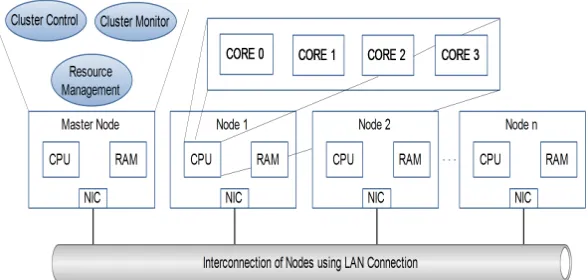
Figure 1. Architecture of UMZHPC. Master node
con-trol the whole cluster.
3. System design
UMZHPC is designed to facilitate parallel programing and to achieve high-performance computing. In this system, master node is developed in order to conduct entire cluster management and control connection among slaves. At first, it prepares some requisite services for the clus-ter and then scans the network and identifies available slaves. In the next stage, a evaluation script will be accomplished which indicates the approximate power of the cluster. Finally, your cluster is ready to im-plement parallel programs written in MPI and OpenMP.
On the other hand, slave node is developed to receive the problem or sub-problem from the master node and then computes its proportion of the problem. When the slave node prepares the computed sub-problem, it will send the result back to the master node and as a consequence, it shows the outcome.
Figure 2. cluster usage status using Ganglia monitoring system.
The computing nodes have to support PXE (Preboot Execution En-vironment) boot feature and if any of them does not support PXE fea-ture, a specify implementation of PXE called gPXE [16] will be use-ful. At first, the umz setup script is used to configure the cluster. The umz restart hpc will be run when additional nodes are added or removed from the existing cluster. All settings which are needed for running MPI and OpenMP programs is configured automatically via UMZHPC. Sta-tus of the cluster can be monitored utilizing Ganglia monitoring system (Figure 2).
After configuration of cluster, a directory will be share among the nodes by using NFS (Network File System) protocol to run jobs. Users must put their files in /home/user directory located in the master node and in order to run programs on the cluster nodes, you can refer to the nodes’ list in /home/users/tmp/bhosts file which consists of cluster node IPs and number of available slots per node.
Since UMZHPC is loaded into RAM, all the user files in the shared directory will be lost when fronted node is rebooted. You can mount a peripheral storage device to save your files or as a second solution, you can connect the master node to the internet via a subsidiary network card and send the result to your e-mail.
4. Parallel computing using UMZHPC
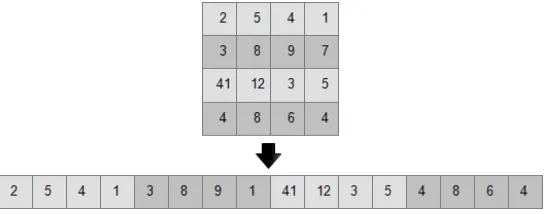
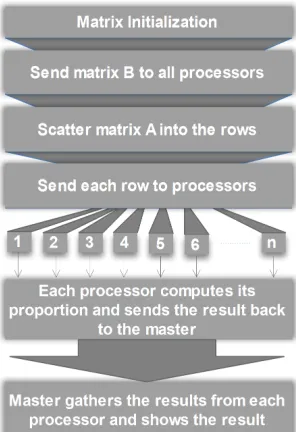
in multiplication are square in shape. We used C++ programming lan-guage for the implementation since this lanlan-guage use row-major place-ment approach [14], we further assume that three matrices are stored in row-major order, as shown in Figure 3. Consider two n*n matrices A and B which their multiplication will generate matrix C. The master node divides matrix A into set of rows depending upon the number of available slave nodes and send each row proportion to the slaves. In addition, the entire matrix B is sent to all slave nodes. Each slave node computes its proportion and sends back a set of rows of resultant matrix to the master. Then the master node gathers the result’s portions from each slave node and put them into pertinent order in resultant matrix. Figure 4 illustrates the parallel Matrix multiplication procedure.
Figure 3. Layout of a 4*4 matrix in row major order.
5. Results and Discussion
In this section, we present experimental results of parallel comput-ing uscomput-ing UMZHPC. We analyzed the performance of parallel method against serial method of matrix multiplication problem. The test per-formed on the following system configuration for all slave nodes:
• Processor: Intel Core i5-4460 (3.20 GHz) • RAM: 4GB
• Network: LAN connection using 1000 Mb FULL DUPLEX switch
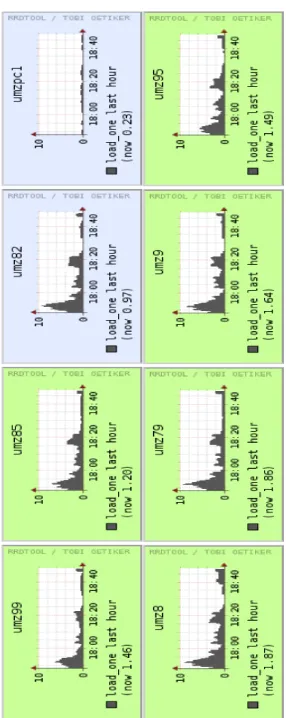
Considering these configuration, calculation of the problem performed on 7 PCs and overall, 25 cores. Figure 5 illustrates workload status per slave node.
Figure 4. Parallel Matrix Multiplication procedure
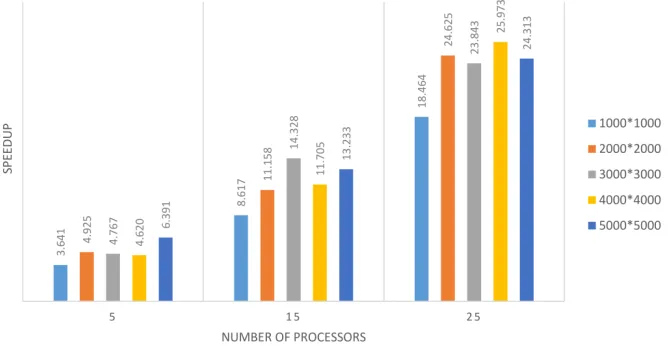
using different number of processors. The performance of the problem has compared to different number of processors in the cluster and the speedup and efficiency, which are illustrated in Figures 6 and 7 respec-tively, have calculated according to aforementioned formulas in section 2. Analyzing the execution of matrix multiplication problem on UMZHPC reveals a clear fact that the more computational nodes exist in your cluster, the better speed and performance will be achieved.
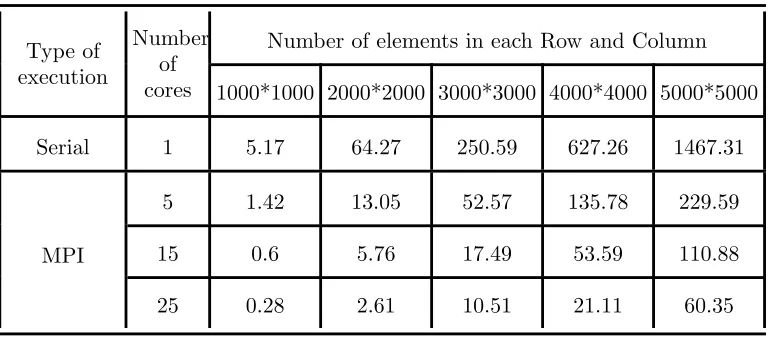
Generally program acceleration is our anticipation of parallel execu-tion. For instance, when we use n CPUs in our cluster, we expect that our program speedup being n times faster than serial execution. How-ever, the result of parallel execution of matrix multiplication problem with 1000 elements in each row and column with 25 processors shown in the Table 1 depicts that the speedup is about 18 times faster. It is because of the communication latency and overhead [11] that prevent us from a perfect achievement.
6. conclusion
Figure 5. cluster’s nodes load status. umzpc1 is the
master node which has excluded from the computation.
Figure 6. Parallel speedup of matrix multiplication
problem with different number of elements and proces-sors over UMZHPC
Figure 7. The efficiency of parallel execution of matrix
multiplication problem with different number of elements and processors over UMZHPC
achieve desirable performance. We made the operating system publicly for research and academic purposes.
7. Availability
Project name: UMZHPC
Table 1. Execution time of Matrix Multiplication
prob-lem on the UMZHPC in seconds
Type of execution
Number of cores
Number of elements in each Row and Column
1000*1000 2000*2000 3000*3000 4000*4000 5000*5000
Serial 1 5.17 64.27 250.59 627.26 1467.31
5 1.42 13.05 52.57 135.78 229.59
MPI 15 0.6 5.76 17.49 53.59 110.88
25 0.28 2.61 10.51 21.11 60.35
Provided programming language: MPI and OpenMP License: GNU GPL
Price: Free
References
[1] D. J. Becker, T. Sterling, D. Savarese, J. E. Dorband, U. A. Ranawak, and C. V. Packer, BEOWULF: A parallel workstation for scientific computation, In Proceedings, International Conference on Parallel Processing,95(1995).
[2] T. H. Chew, K. H. Joyce-Tan, F. Akma, and M. S. Shamsir, birgHPC: cre-ating instant computing clusters for bioinformatics and molecular dynamics. Bioinformatics, 27(9)(2011), 1320-1321.
[3] A. Chhabra, and G. Singh, A Cluster Based Parallel Computing Framework (CBPCF) for Performance Evaluation of Parallel Applications,International Journal of Computer Theory and Engineering, 2(2)(2010), 226
[4] M. Creel, PelicanHPC tutorial, 2008.
[5] D. D’Agostino, A. Clematis, E. Danovaro, E. Jeannot, and J. Zilinskas, Het-erogeneous Parallel Computing Platforms and Tools for Compute-Intensive Algorithms: A Case Study, High-Performance Computing on Complex Envi-ronments, (2014), 193-213.
[6] L. Dagum, and R. Enon, OpenMP: an industry standard API for shared-memory programming, Computational Science and Engineering,IEEE 5(1)(1998), 46-55.
[7] H. Jin, R. Buyya, and M. Baker, Cluster computing tools, applications, and Australian initiatives for low cost supercomputing,MONITOR Mag.(The Institution of Engineers Australia), 25(4)(2001).
[8] G. E. Karniadakis? and R. M. Kirby, Parallel scientific computing in C++ and MPI: a seamless approach to parallel algorithms and their implementa-tion, Cambridge University Press, (2003).
[10] M. L. Massie, B. N. Chun, and D. E. Culler, The ganglia distributed mon-itoring system: design, implementation, and experience,Parallel Computing.
30(7)(2004), 817-840.
[11] R. P. Martin, A. M. Vahdat, D. E. Culler, and T. E. Anderson, Effects of communication latency, overhead, and bandwidth in a cluster architecture, ACM, 25(2)(1997), 85-97.
[12] J. Q. Michael, Parallel Programming in C with MPI and OpenMP, Dubuque, IA: McGraw-Hill, 2003.
[13] W. P. Petersen, and P. Arbenz, Introduction to parallel computing, Oxford University Press, 2004.
[14] J. G. Siek, and A. Lumsdaine, The matrix template library: A generic programming approach to high performance numerical linear algebra, Com-puting in Object-Oriented Parallel Environments,Springer Berlin Heidelberg, (1998), 59-70.
[15] M. Snir, MPI–the Complete Reference: The MPI core, Vol.1, MIT press, 1998.