Rediscovery and amended descriptions of Begonia
kingdon-wardii (Begoniaceae) from North Myanmar
Wen-Hong Chen1, Xiao-Hua Jin2,3, Yu-Min Shui1,3
1 Key Laboratory for Plant Diversity and Biogeography of East Asia, Kunming Institute of Botany, Chinese Academy of Sciences, Kunming 650201, Yunnan, China 2 Institute of Botany, Chinese Academy of Sciences, Beijing 100093, China 3 Southeast Asia Biodiversity Research Institute, Chinese Academy of Sciences, Yezin, Nay Pyi Taw 05282, Myanmar
Corresponding author:Yu-Min Shui ([email protected])
Academic editor:K. Ming | Received 19 October 2017 | Accepted 15 December 2017 | Published 29 January 2018 Citation: Chen W-H, Jin X-H, Shui Y-M (2017) Rediscovery and amended descriptions of Begonia kingdon-wardii
(Begoniaceae) from North Myanmar. In: Jin X-H, Shui Y-M, Tan Y-H, Kang M (Eds) Plant diversity in Southeast Asia. PhytoKeys 94: 59–64. https://doi.org/10.3897/phytokeys.94.21753
Abstract
Begonia kingdon-wardii Tebbitt was rediscovered in 2014 from Myanmar after 67 years based on its last col-lection in 1937. Its previously unknown female flower and inaccurate morphology of leaf and ovary have
been additionally described. This species belongs to Begonia sect. Sphenanthera (Hassk.) Warb. due to its
di-oecious habit, 3-locular ovary, berry fruits and thick placenta segments. Morphologically, it is similar to
Be-gonia gulinqingensis S. H. Huang & Y. M. Shui in the leaf shape, placentation and fruit shape, but different in its dioecious plants, pliciform leaves, two-petalled female flowers and berry fruits. The rediscovery of this amazing living species will attract significant interest for scientific research and horticultural application.
Keywords
Begonia, Begonia kingdon-wardii, Begonia sect. Sphenanthera, Myanmar, Rediscovery
Introduction
Begonia L. includes more than 1800 species which are widely distributed in tropical and subtropical areas (Ku et al. 2007; Hughes et al. 2015). During a recent botanic survey on plant diversity of Hkakaborazi National Park in North Myanmar in 2014, a dioecious species was collected of Begonia with 3-loculed berry fruits and was
un-http://phytokeys.pensoft.net
Copyright Wen-Hong Chen et al. This is an open access article distributed under the terms of the Creative Commons Attribution License (CC BY 4.0), which permits unrestricted use, distribution, and reproduction in any medium, provided the original author and source are credited.
Wen-Hong Chen et al. / PhytoKeys 94: 59–64 (2017) 60
known by the comparison with the report of the floristic report in this region (Khin and Aung 2002). According to the treatment of sections in Begonia (Doorenbos et al. 1999; Shui et al. 2002), this species should belong to Begonia sect. Sphenanthera (Hassk.) Warb. Based on further comparison with all the previously published species in Begonia sect. Sphenanthera (Smith et al. 1986; Ku et al.1997; Pham1999; Huang and Shui 2006; Hughes 2008; Averyanov and Nguyen 2012), its two-petalled female flower and the serpentinous adaxial leaf surface are distinct and unique in this section.
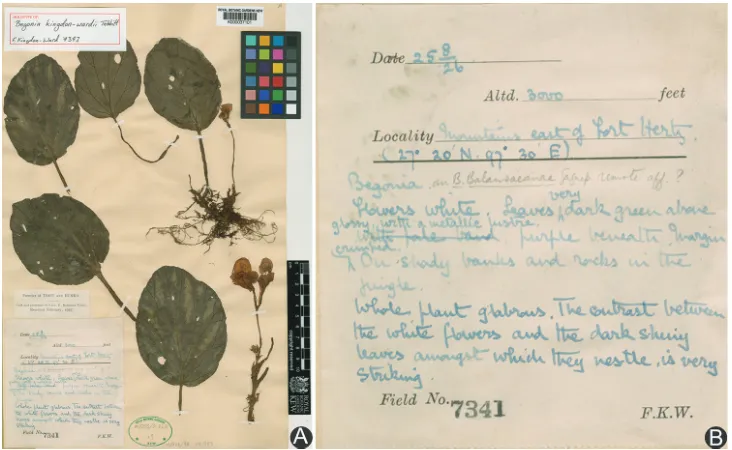
Begonia kingdon-wardii was first reported in 2007 based on the holotype specimen collected from Northern Myanmar in 1926 (Fig. 1) and a paratype specimen collected near its type locality in 1937. Thereafter, no more specimens of this species had been found until 2014 subsequent to examination of the main herbaria worldwide which pos-sessed rich collections from the regions, such as E, K, NY and so on (Hughes et al. 2015). Therefore, the species was rediscovered 67 years later in the field after the last specimens had been collected in 1937 (Tebbitt 2007). In the protologue, there were no detailed descriptions of petals on the female flower and a wrong description with 4-locular ovary, which is actually 3-locular ovary according to the authors’ observation in the field.
Begonia kingdon-wardii was named after Frank Kingdon-Ward, a famous plant hunter in the earlier period of the 20th century. For the purpose of collecting seeds of
beautiful hardy plants and of dried specimens for English gardens, he carried out many expeditions in N Myanmar, NE India (Assam) and SW China (SE Tibet and NW Yun-nan) from 1911 (Lyte 1989, Tebbitt 2007). Furthermore, he wrote and published 25 books, such as “On the Road to Tibet" (1910), “In Furthest Burma” (1921), “Riddle of the Tsangpo Gorges” (1926), “Plant Hunting on the Edge of the World” (1930), “Burma’s Icy Mountains” (1949) etc. Up to now, more than 100 species have been named after him, such as Aralia kingdon-wardii J. Wen, Lowry & Esser, Cinnamomum kingdon-wardii Kosterm., Daphne kingdon-wardii Halda., Euphrasia kingdon-wardii Pugsley, Lilium wardii Stapf ex W. W. Sm., Impatiens kingdon-wardii Nob. Tanaka & T. Sugaw., Ixora kingdon-wardii Bremek., Mussaenda kingdon-wardii Joyaweera, Rho-dodendron wardii W. W. Sm., and Vaccinium kingdon-wardii Sleumer.
Begonia kingdon-wardii Tebbitt in Kew Bulletin 62: 143, 2007
Figs 1A, 2
Type. Myanmar, Kachin Mts E of Fort Hertz, 27°20'N, 97°30'E, alt. 900 m, Aug. 1926, Kingdon-Ward 7341 (holotype, K000037101!; isotype, K000037102!).
Handwriting annotation from the holotype specimens (Fig. 1B): “Begonia ass. B. Balansaeanae Gagnep. almost aff.?. Flowers white. Leaves very dark green above, glossy, with a metallic lustre, purple nervation, margin crenated. On shady banks and rocks in the jungle. Whole plant glabrous. The contrast between the white flowers and the dark shining leaves amongst which they nestle is very striking”.
Figure 1. Holotype of Begonia kingdon-wardii Tebbitt (A) and the annotation on the holotype
specimens (B).
Stipules caducous, lanceolate, 1.1–1.3 × 0.4–0.5 cm, margin entire, apex acuminate. Leaf alternate, pliciform, rotund, 10–16 cm diam., margin entire, symmetric on base, usually 4–7-palmatifid venation; adaxially glabrous and serpentinous, green lines and 3–5 spots along each main nerve, abaxially red and pubescent along the main nerves. Petiole 10–18 cm long, densely pubescent. Inflorescences axillary, cymose, dichasial, with separate male and female individuals; peduncles 3–5 cm long; bracts greenish, ovate, 8–9 × 3–4 mm, persistent during flowering. Bracteoles similar to and slightly smaller than bracts; petals white, glabrous on both sides. Male flower: petals 4; outer 2, ovate, 1.2–1.4 × 0.6–0.7 cm, inner 2, elliptic, 0.5–0.6 × 0.2–0.3 cm; androecium actinomorphic, 0.5–0.6 cm diam., filaments free below, anthers oblong, almost equal to the filaments, dehiscent with laterally and obliquely longitudinal slits, connective slightly extended and truncate on the top. Female flower: petals 2, broadly elliptic, 0.9–1× 1.1–1.3 cm; ovary wingless, obtusely 3-hooked, 3-locular, placentation axial, placenta segments thick, 2 per locule, ovules present on both sides of placental branch-es; styles 3, forked twice, caducous in fruit, stigmas spiralled into a band. Fruit trian-gularberry-like, pendulous, with an in distinct beak. Flowering Oct. to Nov., Fruiting from the first of Nov. to Oct. of the next year.
Distribution. Only seen in Kachin State, Myanmar.
Wen-Hong Chen et al. / PhytoKeys 94: 59–64 (2017) 62
27°30'09"N, 97°11'45"E, near the stream in the Musa forests, occasional, Oct. 15, 2014, Putao Exped. 311 (KUN!, PE!); Myanmar, Kachin State, Putao, Wasadam vil-lage, alt. 900 m, 27°30'06"N, 97°11'44"E, along the moist slope in the Musa forests, occasional, Oct. 25, 2014, Putao Exped. 1230 (PE!).
Figure 2. The images of Begonia kingdon-wardii Tebbitt (Putao Exped. 311 in PE and KUN) A Male plant
B Male inflorescences C Face view of male flower D Female plant E Female inflorescences F Face view of
female flower G Leaf blade adaxially H Leaf blade abaxially I Middle section of ovary in flower showing two
placenta segments per locule J Inferior section of ovary in flower K Middle section of mature berry-like fruit
showing thick placenta segments. Scale bars: A, D 10 cm B, E 1 cm C, F 1 cm G, H 4 cm I, J, K 1 cm. All
Discussion. In Begonia sect. Sphenanthera, Begonia kingdon-wardii is unique in the pliciform leaf and female flower with two tepals (Doorenbos et al. 1999; Shui et al. 2002). It is obviously different from Begonia burkillii Dunn in B. sect. Sphenanthera and B. rockii Irmsch. in B. sect. Platycentrum in the locules of ovary and leaf shape. Morphologically, this species is also similar to B. gulinqingensis S. H. Huang & Y. M. Shui (Begonia sect. Diploclinium) in the leaf shape, placentation and fruit shape, but different in its dioecious plant, pliciform leaf, female flower with two sepals and berry fruit. It is also similar to B. leprosa (Begonia sect. Leprosae) in the leaf shape, especially the texture of the leaf blade and B. zhengyiana Y. M. Shui (Begonia sect. Coelocentrum) in shape of the leaf blade and fruit.
The rediscovery of its living plants provides researchers an opportunity to explore its taxonomic description and horticultural value in North Myanmar. This species with very rare individuals is distributed in a restricted area in Northern Myanmar and grows in the very shady and dark places under the forests. Its flowers are near the ground under the leaves, so that this habit influences the pollination and fruit setting. Another important and interesting habit may be that the fruits need over one year to become mature as some species [B. handelii Irmsch. and B. silletensis (A. DC.) C. B. Clarke] in Begonia sect. Sphenanthera. Besides, the pliciform leaf of the living plant is difficult to be observed on the holotype (Figs 1, 2). Now, the rediscovery not only reveals the need to undertake more surveys in North Myanmar, but also fills the gap about the deficient data of the species indicated by Tebbitt (2007) and so can bring an amazing plant to mankind for research and horticultural use (Fig. 2).
Acknowledgement
We are thankful to Professor Zhi-Duan Chen, Dr. Sheng-Xiang Yu and Dr. Bing Liu in the Institute of Botany, Chinese Academy of Sciences, Mr. Han Kyaw Kyaw and Mr. Han Nyi Zaw in Hkakaborazi National Park, Putao, Kachin State, Myanmar, for their help during the field survey. This study is supported by National Natural Science Foun-dation of China (grant no. 31370228, 31770251, 31070174, 30270109), the fund-ing from Southeast Asia Biodiversity Research Institute, Chinese Academy of Sciences (2015CASEABRI001) and Science and Technology Basic Work (2013FY112100).
References
Averyanov LV, Nguyen HQ (2012) Eleven new species of Begonia L. (Begoniaceae) from Laos and Vietnam. Turczaninowia 15(2): 5–32.
Doorenbos J, Sosef MSM, de Wilde JJFE (1998) The Sections of Begonia, including descrip-tions, keys and species lists (Studies in Begoniaceae VI). Wageningen Agricultural Univer-sity Papers 98(2): 1–266.
Wen-Hong Chen et al. / PhytoKeys 94: 59–64 (2017) 64
Hughes M (2008) An Annotated Checklist of Southeast Asian Begonia. Royal Botanic Garden Edinburgh, Edinburgh, 176 pp.
Hughes M, Moonlight P, Jara A, Tebbitt M, Pullan M (2015) Begonia Resource Centre. The Royal Botanic Gardens, Edinburgh. http://elmer.rbge.org.uk/begonia [30 Nov 2016] Khin M, Aung S (2002) Vegetation and Key Floristic Features of Hkakaborazi National Park.
In: Chen GW (Ed.) Biodiversity in the Eastern Himalayas: Conservation through Dia-logue. International Center for Integrated Mountain Development (ICIMOD). Kath-mandu, Nepal, 55–79.
Ku TC, Peng CI, Turland NJ (2007) Begoniaceae. In: Wu ZY, Raven PH (Eds) Flora of China. Science Press, Beijing; Missouri Botanical Garden Press, St. Louis, Vol. 13, 153–207. Lyte C (1989) Frank Kingdon-Ward–Last of the Great Plant Hunters. John Murray Publishers
Ltd, London, 256 pp.
Pham HH (1999) An Illustrated Flora of Vietnam, vol. 1.Youth Publishing House, Ho Chi Minh City, 577–588.
Shui Y-M, Chen W-H (2006) Seed Plants of the Karst Region in China.Vol. 1. Science press, Beijing, 665 pp.
Shui Y-M, Peng C-I, Wu C-Y (2002) Synopsis of the Chinese species of Begonia (Begoniaceae), with a reappraisal of sectional delimitation. Botanical Bulletin of Academia Sinica 43: 313– 327.
Smith LB, Wasshausen DC, Golding J et al. (1986) Begoniaceae, Part I: Illustrated Key, Part II: An-notated Species List. Smithsonian Contributions to Botany 60: 1–584. https://doi.org/10.5479/ si.0081024X.60