New Strategy For Cache Replacement In Manets
Amneh Alamleh &
Ghassan Samara
Department of Computer ScienceZarqa University, Zarqa, Jordan
ABSTRACT
In Mobile Ad hoc Networks (MANETs) data access applications suffer from dynamic network connections and
restricted resources. However, cooperative data caching can clearly improve information access process, which acts
as an efficient solution for this problem. Research in cooperative caching of MANETs has many directions. In this
paper we will focus on cache replacement strategies and propose a new vigorous one, the proposed strategy will
achieve better utilization of the cache space, minimize cache duplications, and increase data availability, which
results in a better performance in the overall system.
KEYWORDS
MANETs, cooperative caching, cache replacement.
1.
INTRODUCTION
Mobile Ad Hoc Networks (MANETs) is a Wireless mobile communication network which augmented or replaced
wired communications in many places of today’s network communications, in MANETs there is no pre-existing
infrastructure or service subscription available, it is a self-configured wireless network, consisting of nodes
responsible for its creation, operation and maintenance, each node of the network acts as forwarding router. Some
nodes have interfaces to the other networks, as they act like gateways to enable MANET nodes to connect to the
other networks. MANETs have some special features [1]:
Wireless network channel: because of the broadcast nature, the nodes within range have to share with each other
the network channel.
Dynamic topological structure: the high mobility thence changing of network topology may cause route breaks
and introduce extra overhead for establishing new routes.
Multi-hop routing: the number of hops between a server and a client increases, the throughput will decrease and
the response delay will increase.
Limited resources: A node usually has limited power supply, computing ability, and cache size.
These features bring some problems for data access applications, and data availability, figure.1, shows MANET’s
environment.
A.
Cooperative Caching:
cooperative caching environment, the mobile nodes can obtain data items not only from its own cache but also
from their neighboring nodes caches. This will reduce the server delays and decreases the response time for the
client. In many applications of MANET like automated highways, smart homes, smart classrooms, nodes share
common interest. So sharing cache contents between mobile nodes provides substantial benefits.
Figure 1: MANET architecture [1].
B.
Important issues in cooperative caching:
C.
Cache resolution
A mobile node decides where to bring a data item requested based on cache resolution. Cooperative caching tries to
discover a data source which induces less communication cost by using historical profiles and forwarding nodes.
1)
Cache Management
A mobile node decides which data item to be placed or deleted in its local cache based on cache replacement
strategy.
Cooperative Caching minimizes caching duplications between adjacent nodes and allows the nodes to store more
different data items to improve the overall performance. Choosing a good cache replacement policy remarkably
contributes in better utilization of the cache space and improving the system performance in overall. Her we are
reviewing some cache replacement strategies in the literature and propose a new policy aiming for a better using of
replacement parameters which are considered for data caching.
2.
LITERATURE REVIEW
In [5], a modified version of LRU that tries to minimize the number of items replaced. It is similar to LRU in implementation take in account the size of the data during replacement. The data is sorted based on the access time, if a data item of size S needs to be cached it will search for items least recently accessed with size larger than S.
In [6], a local replacement policy which considers the data size and access frequency for replacement. Larger sized data items are removed first as they take more cache space. By replacing bigger objects, more cache space can be made available. The other parameter taken is data access frequency, replacement is done by combining the two parameters, and the advantage of this scheme is that the parameters used are easily available.
In [7], an energy efficient cache replacement policy for cooperative caching in mobile ad hoc networks used, the replacement decision here is taken based on the energy utilization for each data access. To do this; the authors considered the energy for: in zone communication, sending and receiving the object and energy cost for forwarding the object. Based on this they proposed two dynamic algorithms to replace data of the mobile node cache.
3.
CACHE DISCOVERY AND MANAGEMENT
A. Chace discovery
Based on the idea of cooperative caching, each node in the Cooperation Zone (CZ) maintains a data table with its neighboring nodes within the same zone, each table contain information about the data of each node cache, when some node in the CZ request a specific data item, it firs checks its local cache, if the data is not found in its local cache it checks the CZ data table, if it is found then the request will be forwarded to the node which caching the requested data, otherwise the request will be forwarded hob by hob to the data server [1, 4].
B. Cache Management
When the new data requested and not found in the CZ, the will be fetched from the data server, this new data should be stored in the requester node cache, if there is home for this data it will be stored as new data and access count for this data will be set to zero. However when the cache is full then a cache replacement policy should be used, the following new policy is proposed.
4.
PROPOSED STRATEGY
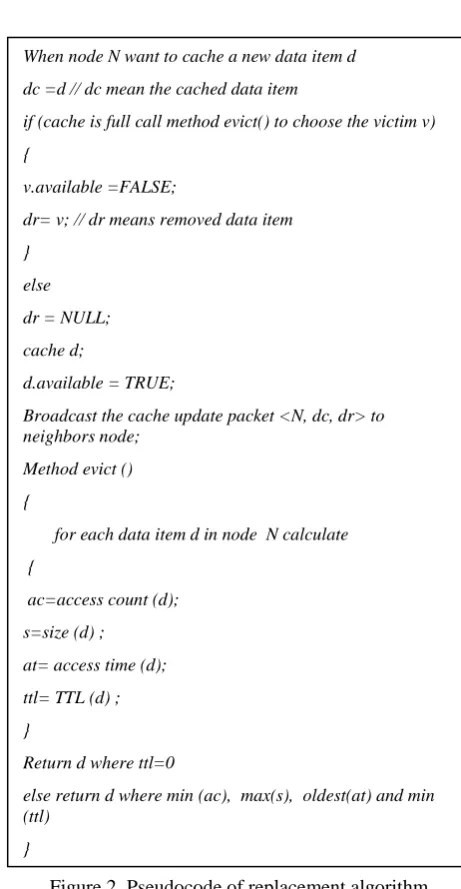
When caching a data item is needed; if the cache is full the system will call method evict to remove some data item from the cache to make home for the new data item, the eviction decision is based on the following parameters:
Access count: the node with the maximum access count will be chosen because it has the highest probability to be found in the neighbor’s nodes caches.
Size: the removal of the largest data will give more space for the coming data.
Figure 2. Pseudocode of replacement algorithm When node N want to cache a new data item d
dc =d // dc mean the cached data item
if (cache is full call method evict() to choose the victim v)
{
v.available =FALSE;
dr= v; // dr means removed data item
}
else
dr = NULL;
cache d;
d.available = TRUE;
Broadcast the cache update packet <N, dc, dr> to neighbors node;
Method evict ()
{
for each data item d in node N calculate
{
ac=access count (d);
s=size (d) ;
at= access time (d);
ttl= TTL (d) ;
}
Return d where ttl=0
else return d where min (ac), max(s), oldest(at) and min (ttl)
6.
REFERENCES
[1] Y. Du, S. Gupta, and G. Varsamopoulos, “Improving on-demand data access efficiency in MANETs with cooperative caching”, Ad Hoc Networks, (579–598), 2009.
[2] P. Joy and K. Jacob, “Cache replacement policies for cooperative caching in mobile ad hoc networks”, IJCSI International Journal of Computer Science Issues, Vol. 9, No 2, May 2012.
[3] P. Kuppusamy, K. Thirunavukkarasu, and B. Kalaavathi “A review of cooperative caching strategies in mobile ad hoc networks”, International Journal of Computer Applications (0975 – 8887) Volume 29, No.11, September 2011.
[4] P. Kumar, N. Chauhan, L. Awasthi, and N. Chand “Proactive approach for cooperative caching in mobile ad hoc networks”, IJCSI International Journal of Computer Science Issues, Vol. 7, Issue 3, No 8, May 2010.
[5] M.K. Denko and J. Tian, “Cross-layer design for cooperative caching in mobile ad hoc networks”, in Proceedings of IEEE Consumer Communications and Networking Conference, 2008.
[6] L. Yin and G. Cao, “Supporting cooperative caching in ad hoc networks”, IEEE Transactions on Mobile Computing, 5(1):77-89, 2006.
![Figure 1: MANET architecture [1].](https://thumb-us.123doks.com/thumbv2/123dok_us/7825942.2088357/2.595.194.401.212.305/figure-manet-architecture.webp)