Research Article
a
April
2018
Special Issue: National Conference on Emerging Trends in Engineering 2018
Conference Held at Sri Venkatesa Perumal College of Engineering & Technology, Puttur, A.P., India
Computer Science and Software Engineering
ISSN: 2277-128X (Volume-8, Issue-4)
Performance and Emission Characteristics of Bio-Diesel
Blends with Diesel Using Ceramic Coated Piston on 4-
Stroke Single Cylinder Engine
V. Jyotsna Kalpana1, R. Bhaskar Reddy2
1
Assistant Professor, Department of Mechanical Engineering, SOET,SPMVV, Tirupati, Chittoor (dt)r, A.P, INDIA 2
Assistant Professor, Department of Mechanical Engineering, SOET,SPMVV, Tirupati, Chittoor (dt), A.P, INDIA.
Abstract: Diesel engines are being used extensively for fuel economy but due to gradual depletion of Petroleum re-sources and the impact on the environment by increase in exhaust gas emissions, there is an urgent need for suitable alternative fuels for the diesel engines. Now-a-days our country is spending lot amount of foreign exchange for the petroleum fuels. As our country is an agricultural country, if the alternate fuels are produced by our farmers it will be beneficial for the country and the farmers also. In recent studies, researchers studied various vegetable oils like cano-la oil, jatropha, karnja oil, rice ban oil, aloveera oil, soya been oil, sunflower oil, fcano-laxseed oil and honne oil etc. Out of all canola oil play an important role as an alternative fuel. But the properties of canola oil are not suitable for the usage of the existing diesel engines without any modifications. Hence in the present work an attempt is made to assess the suitability of vegetable oil for diesel engine operation, without any change in its old construction.
Further the performance of the engine depends on the material used for the insulation. So in the present work it is planned to develop an insulated engine with various materials like PSZ, TIO2 and Y2O3 etc. In general more amount
of heat is transferred to the cooling medium through the piston. Hence to retain the heat inside the combustion cham-ber, in the present work it is planned with various piston material like brass, cupper, Mnemonic alloy etc.,
An attempt is made to analyze the performance and emission characteristics of different blends of canola oil like 10% ,20% ,30% ,40% etc., using Titanium oxide coated piston on a four stroke single cylinder water cooled diesel engine. Experiments were carried out on a diesel engine using different blends of canola oil on volume basis. Performance parameters are calculated based on experimental analysis of the engine. Emissions such as carbon monoxide, carbon dioxide, NOX and unburned hydrocarbon are measured. The test results indicates that the piston which is coated with
TiO2 using canola oil blends gives better performance and emission results compared to all fuel mixtures and diesel
under this study.
Key words: Bio-diesel, Performance and Emission parameters, Ceramic coating piston.
I. INTRODUCTION
ISSN(E): 2277-128X, ISBN: 978-93-87396-07-4, pp. 276-280
emit low levels of gaseous and particulate pollutants in internal combustion engines. In the case of agricultural applica-tions, fuels that can be produced in rural areas in a decentralized manner, near the consumption points will be favored. The permissible emission levels can also be different in rural areas as compared to urban areas on account of the large differences in the number density of engines. Fuels like vegetable oils, biodiesel (transesterified vegetable oils- methyl esters of vegetable oils), alcohols, natural gas, biogas, hydrogen, liquefied petroleum gas (LPG), etc. are being investi-gated by researchers for engine applications.
Ceramic coatings are used in diesel engine combustion chambers are aimed to reduce heat transfer to the cooling water. Engine cooling systems are planned to be removed from internal combustion engines by the development of advanced technology. One can expect that engine power can be increased and engine weight and cost can be decreased by remov-ing coolremov-ing system elements (coolant pump, ventilator, water jackets and radiators etc.). More silent engine operation can be obtained considering less detonation and noise causing from uncontrolled combustion. Another important topic from the view point of internal combustion engines is exhaust emissions. Increased combustion chamber temperature of ce-ramic coated internal combustion engines causes a decrease in soot and carbon monoxide emissions.When increased ex-haust gases temperatures so volumetric efficiency decrease.
II. LITERATURE REVIEW
Helmisyah A.J., Ghazali M.J [2] has studied the high temperature and pressure produced in an engine that uses com-pressed natural gas with direct injection system (CNGDI) which may lead to high thermal stresses. The piston crown fails to operate effectively with insufficient heat transfer. In this study, partially stabilized zirconia (PSZ) ceramic thermal barrier coatings were plasma sprayed on CNGDI piston crowns (AC8A aluminum alloys) to reduce thermal stresses. Several samples were deposited with NiCrAl bonding layers prior to the coating of PSZ for comparison purposes. De-tailed analyses of microstructure, hardness, surface roughness, and interface bonding on the deposited coating were con-ducted to ensure its quality. High stresses were mainly concentrated above the pinhole and edge areas of the piston. In short, the PSZ/ NiCrAl coated alloys demonstrated lesser thermal stresses than the uncoated piston crowns despite a rough surface. Extra protection is thus given during combustion operation.
AydinHuseyin [1]examined the combined effects of thermal barrier coating and blending with diesel fuel on usability of vegetable oils in diesel engines. The possibility of using pure vegetable oils in a thermally insulated diesel engine has been experimentally investigated. Initially, the standard diesel fuel was tested in the engine, as base experiment for com-parison. Then the engine was thermally insulated by coating some parts of it, such as piston, exhaust and intake valves
surfaces with zirconium oxide (ZrO2). The main purpose of engine coating was to reduce heat rejection from the walls of
combustion chamber and to increase thermal efficiency and thus to increase performance of the engine that using vegeta-ble oil vegeta-blends. Pure inedivegeta-ble cottonseed oil and sunflower oil were vegeta-blended with diesel fuel. Blends and diesel fuel were then tested in the coated diesel engine. Experimental results proved that the main purpose of this study was achieved as the engine performance parameters such as power and torque were increased with simultaneous decrease in fuel con-sumption. Furthermore, exhaust emission parameters such as CO, HC, and Smoke opacity were decreased. Also, sun-flower oil blends presented better performance and emission parameters than cottonseed oil blends.
H. Hazar, U. Ozturk [3]studied the effect of Al2O3-TiO2 coating in a diesel engine on performance and emission of corn oil methyl ester, the piston, cylinder head, exhaust and inlet valves of a diesel engine were coated with the ceramic
ma-terial Al2O3-TiO2 by the plasma spray method. Thus, a thermal barrier was provided for the parts of the combustion
chamber with these coatings. The effects of corn oil methyl ester that produced by the transesterification method and ASTM No. D2 fuels performance and exhaust emissions‟ rates were studied by using equal in every respect coated and uncoated engines. Tests were performed on the uncoated engine, and then repeated on the coated engine and the results were compared. A decrease in engine power and specific fuel consumption, as well as significant improvements in ex-haust gas emissions (except NOx), were observed for all test fuels used in the coated engine compared with that of the uncoated engine.
III. CANOLA OIL
„Can‟ stands for „CANADA‟, „O‟ stands for „OIL‟, „La‟ stands for „LOW ACID‟. The scientific name is “Brassica Napus” and it belongs to the mustard family. The oil is taken from the crushed seeds from the canola flowers. It have high oil content and also low acids (6%) that is saturated fat & poly unsaturated fat. Canola also contains 10% oxygen by weight. This oxygen that leads to a reduction in emissions of HC, CO, Toxic compounds and PM.
ISSN(E): 2277-128X, ISBN: 978-93-87396-07-4, pp. 276-280 IV. EXPERIMENTAL WORK
In order to analyze the performance and emission characteristics of internal combustion engine, an experimental set-up
was developed. In the present work,titanium oxide (TiO2)was coated on piston crown andflax seed oil was used as
bio-diesel on volume basis. The experiment was carried out on a single cylinder water cooled direct injection bio-diesel engine. Eddy current dynamometer is used for loading i.e. electrical loading.Fig.2 Titanium Oxide Coated Piston
Fig.3. Titanium Oxide Coated Piston
Table 1:Test Engine Specifications
V. RESULTS AND DISCUSSIONS
It can observe that at rated load, the performance and emission levels of Canola oil and Aloevera oil blend with diesel on the normal piston and ceramic coated piston engine and compare these values with normal piston diesel engine by plot-ting the graphs as shown below.
Graph-1. Variations of Brake Thermal Efficiency with loads
Graph.1 Variations Brake Thermal Efficiency with loads
The variation of brake thermal efficiency with respect to load for aloveera and canola oil with diesel blends are shown in graph.1. It can be observed from the results that the coated piston improves the thermal efficiency when compared with uncoated piston engine. This may be due to increased temperature of the piston crown which increases the temperature of cylinder hence increase the temperature at combustion chamber. The combustion conditions become more favorable
which results in shortening ignition delay time in coated engine affecting both the chemical and physical reactions positively.
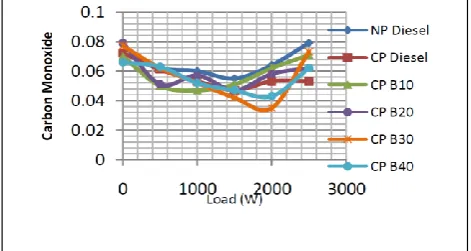
Grop-2. Variation of Carbon Monoxide Emissions with loads
Grop-2. Variation of Carbon Monoxide Emissions with loads
Particulars Specifications
Make Kirloskar oil Engine Ltd.
Arrangement of cylinders Vertical
No of cylinders 1
Bore 85mm
Stroke length 110mm
Rated speed 1500 rpm
Rated power 5HP
Starting Hand start with crank handling
ISSN(E): 2277-128X, ISBN: 978-93-87396-07-4, pp. 276-280
From graph.2 the variation of carbon monoxide with respect to load can be observed for both coated and normal piston engines. It is clear that CO is decreased after the coating due to the complete combustion. CO emission from diesel e n-gine is related to the fuel properties as well as combustion characteristics. It is well known that better fuel combustion usually resulted in lower CO emission. The carbon monoxide, which arises mainly due to incomplete combustion, is a measure of combustion efficiency. Generally, oxygen availability in diesel fuel and biodiesel blends is high so at high temperatures carbon easily combines with oxygen and reduces the CO emission. The results show that CO emissions of
standard engine (diesel) slightly higher than TiO2 coated piston engine at full load condition. Carbon monoxide from the
exhaust gas for the diesel fuel (standard engine) is 0.079% by vol. and for TiO2 coated piston engine using blends B0,
B10, B20, B30 and B40 are 0.053, 0.071, 0.062, 0.073, and 0.062% by vol. respectively at full load.
Grop-3. Variation of Carbon Dioxide with loads
Grop-3. Variation of Carbon Dioxide with loads
As shown in graph.3, the variation of carbon dioxide emissions with respect to load can be observed. From the results, it
is observed that the amount of CO2 produced while using aloveera and canola oil with diesel blends are higher than diesel
at full load condition, this indicates the complete combustion of fuel. Carbon dioxide from the exhaust gas for the diesel
fuel on normal piston engine is 3.2% vol. and for TiO2 coated piston engine for different blends aloveera and canola oil
with diesel fuel are 3.7, 3.2, 3, 3.3 and 3.8% by vol. respectively. As a general rule, the higher the carbon dioxide read-ing, the efficiency of the engine is more.
Grop-4. Variation of Hydrocarbon Emissions with loads
Grop-4. Variation of Hydrocarbon Emissions with loads
The variation of hydrocarbons with respect to load for tested fuels is depicted in graph.4. From the results, it can be no-ticed that the concentration of hydrocarbon of aloveera and canola oil with diesel is slightly lower than diesel. Unburnt hydrocarbon from the exhaust gas at full load for the diesel fuel (normal piston engine) is 32ppm and for coated piston engines using flaxseed oil blends B0, B10, B20, B30, B40 are 28ppm, 26ppm 25ppm, 28ppm, and 29ppm respectively. It
can be observed from the results that thermal barrier coating (TiO2) in piston crown decreasing HC when compared with
uncoated engine. The HC emission reduces because of an increase in residual gas temperature with in the cylinder and decrease in flame quenching thickness at higher load in the engine.
Grop-5. Variation of Nitrogen Oxides with loads
ISSN(E): 2277-128X, ISBN: 978-93-87396-07-4, pp. 276-280
From graph.5, the variation of nitrogen oxides with respect to load can be observed for both coated and normal piston engine for different blends. The formation of nitrogen oxide emissions depends on the heat transfer rate and evaporation rate of the fuel. This increases further, with the availability of oxygen and the higher prevailing temperatures in the chamber. With the ceramic coating the heat in the chamber is higher which further increases the evaporation rate of the fuel.
VI. CONCLUSIONS
In this experimental investigation the performance and emission characteristics of diesel (C.I) engine with biodiesel of aloveera and canola oil with diesel blends and Titanium oxide coating on piston are compared with the normal piston diesel engine From this investigation, it can be concluded that aloveera and canola oil with diesel blends on ceramic coated piston gives better performance and emission results compared to the all blends and diesel. The results of this study may be summarized as follows.
It is observed that reduction of BSFC for engine with Titanium oxide using aloveera and canola oil with diesel
blends as compared to the normal engine with diesel at rated load conditions.
Brake Thermal efficiency of the tested diesel engine is improved when it is fuelled with aloveera and canola oil
with diesel blends operating on TiO2 coated piston.
CO emissions of biodiesel are less compared to diesel; it is likely due to oxygen content present in the biodiesel.
It is observed that the amount of CO2 produced while using biodiesel blends are higher than diesel at rated load
condition, this indicates the complete combustion of fuel hence it gives the less exhaust emissions.
It can be observed from the results that thermal barrier coating (TiO2) in piston crown decreasing HC when
compared with uncoated piston engine. The HC emission reduces because of an increase in residual gas temper-ature with in the cylinder and decrease in flame quenching thickness at higher load in the engine.
The formation of nitrogen oxide emissions depends on the heat transfer rate and evaporation rate of the fuel.
This increases further, with the availability of oxygen and the higher prevailing temperatures in the chamber. With the ceramic coating the heat in the chamber is higher which further increases the evaporation rate of the fuel.
REFERENCES
[1] AydinHuseyin examined the “Combined effects of thermal barrier coating and blending with diesel fuel on
usa-bility of vegetable oils in diesel engines”Applied Thermal Engineering 51(2013) 623e629.
[2] Helmisyah A.J.,Ghazali M.J “Characterization of Ther mal barrier coating on piston crown for compressed
natu-ral gas direct injection (CNGDI) engines” AIJSTPME (2012) 5(4):73-77.
[3] H. Hazar, U.Ozturk “The effect of Al2O3-TiO2 coating in a diesel engine on performance and emission of
me-thyl ester”Renewable Energy 35 (2010) 2211e2216.
[4] T. Karthikeya Sharma “Performance and emission cha racteristics of the thermal barrier coated SI engine by
adding argon inert gas to intake mixture”Journal of Ad vanced Research (2014).
[5] VinayKumar.D, Ravi Kumar.P, M.SantoshaKumari “Prediction of Performance and emissions of a biodiesel
fueled Lanthanum Zirconate coated direct injection diesel engine using Artificial Neural Networks”Procedia Engineering 64 (2013) 993 – 1002.
[6] John B.Heywood, “Internal Combustion Engine fundamentals”,McGraw-Hill Series in Mechanical Engineering.
[7] Uzun, A.,Çevik, İ. &Akçil, M. (1999), “Effects of Thermal barrier coating on a Turbocharged diesel engine
per-formance”, Surface and Coating Technologies 16-119, 505-507
[8] V.Ganesan, “Internal Combustion Engines”, Tata McGraw-Hill Publishing Company Limited.
[9] R.Bhaskar Reddy, B.SiddeswaraRao. Performance characteristics and analysis of 4-stroke single cylinder diesel
engine blend with 50% of hone oil at various fuel injection pressures. Published in IJREA journal, volume-4,issue-8, august 2014.
[10] R.BHASKAR REDDY, Effect of F.I.P on Performance characteristics and Emission Analysis of D.I Diesel