Volume 41 (2011)
Proceedings of the
Tenth International Workshop on
Graph Transformation and
Visual Modeling Techniques
(GTVMT 2011)
Towards Test Coverage Criteria for Visual Contracts
Reiko Heckel, Tamim Ahmed Khan and Rodrigo Machado
15 pages
Guest Editors: Fabio Gadducci, Leonardo Mariani
Managing Editors: Tiziana Margaria, Julia Padberg, Gabriele Taentzer
Towards Test Coverage Criteria for Visual Contracts
Reiko Heckel1, Tamim Ahmed Khan2and Rodrigo Machado3
Department of Computer Sciences, Leicester University, UK
Department of Computer Sciences, Leicester University, UK
Univ. Federal do Rio Grande do Sul, Porto Alegre, Brazil
Abstract:When testing component-based or service-oriented applications we can-not always rely on coverage criteria based on source code. Instead, we have to ex-press our requirements for testing at the interface level. Specifying interfaces by graph transformation rules, so-called visual contracts, we define model-based cov-erage criteria exploiting the well-known relations of causal dependency and conflict on transformation rules.
To this end we establish an observational semantics for graph transformation sys-tems with rule signatures formalising a notion of test execution, and define depen-dency graphs to provide a structure on which coverage can be analysed.
Keywords:graph transformation, services, visual contracts, observable behaviour, test coverage, causal dependencies and conflicts
1
Introduction
A user’s view of a web service is through provided interfaces, which abstract from implementa-tion details and prevent us from using tradiimplementa-tional testing methods based on source code [CP06]. Testing of web services carries an additional overhead if it involves invoking external services, possibly remotely, causing delays, network traffic and cost [PBE+07]. In order to ensure that tests carried out have sufficiently exercised the system we normally rely on coverage criteria or deploy fault-seeding to assess test sets. Coverage provides a metric for completeness with re-spect to a given test requirement [PJ08]. Fault-based approaches seed random faults and attempt to find them by means of the test suite to be assessed [Pfl01]. Testing web services, we cannot rely on either approach because both require access to the source code.
and defining the criteria and their satisfaction, in this paper we illustrate their relevance by an example and discuss the limitations of the present approach.
The paper is organised as follows. Section2 covers the relevant concepts of graph transfor-mation while Section3introduces the observational semantics that form the theoretical basis for dependency graphs and model-based coverage criteria. These are then defined in Section4and Section 5, respectively. Section 6 is devoted to related work before we conclude the paper in Section7.
2
Typed Attributed Graph Transformation
This section provides the basic notions on typed attributed graph transformation, following the algebraic approach [EEPT06]. A graph is a tuple(V,E,src,tgt)whereV is a set of nodes (or vertices), E is a set of edges and src,tgt:E →V associate, respectively, a source and target node for each edge inE. Given graphsG1andG2, a graph morphism is a pair(fV,fE)of total
functions fV :V1→V2and fE :E1→E2such that source and targets of edges are preserved. An E-graph is a graph equipped with an additional setVDof data nodes (or values) and special
sets of edgesEEA(edge attributes) andENA(node attributes) connecting, respectively, edges inE
and nodes inVto values inVD. An attributed graph is a tuple(EG,D)whereEGis an E-graph and
Dis an algebra with signatureΣ= (S,OP)such thatUs∈SDs=VD, the set of data values available
for attribution. A morphisms f:(EG,D)→(EG0,D0)of attributed graphs is a pair of an E-graph morphism fEG:EG→EG0 and a compatible algebra homomorphism fD:D→D0. Fixing as
type graph an attributed graph AT G (usually over a final Σ-algebra), we define the category
AGraphATG ofAT G-typed attributed graphs [EEPT06]. Objects are pairs(G,t) of attributed graphsGwith typing homomorphismst:G→AT G. Morphisms f :G→Hare attributed graph morphisms compatible with the typing.
Let us denote byX= (Xs)s∈S a family of countable sets of variables, indexed by sortss∈S,
and write x:s∈X for x∈Xs. An AT G-typed graph transformation rule (or production) over
X is a span L←−l K −→r R wherel,r are monomorphisms, the algebra component ofL,K,R
is TΣ(X), the term algebra of Σwith variables in X, which the rule morphisms preserve, i.e.,
lD=rD=idTΣ(X). That means, variables are preserved across the rule. The class of all rules over
AT Gwith variables inX is denotedRules(AT G,X).
A typed attributed graph transformation system (TAGTS) is a tuple(AT G,P,π)whereAT Gis an attributed type graph,Pis a set of rule names andπ :P→Rules(AT G,X)maps rule names toAT G-typed graph transformation rules.
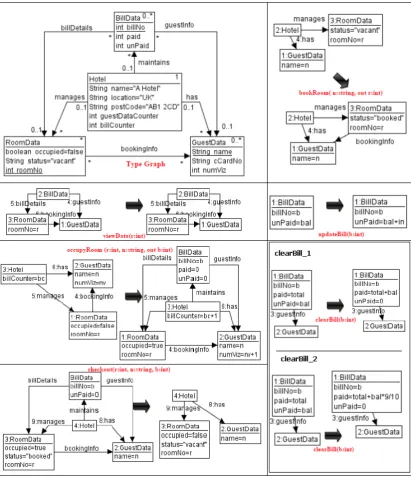
Example1 (hotel service) We consider a service for managing hotel guests. A registered guest can book a room subject to availability. There are no booking charges and the bill starts to ac-cumulate once the room is occupied. Since credit card details are already with the hotel man-agement, the bill is automatically deducted when the guest announces their intention to check out. The guest can check out successfully only when the bill is paid. The type graph and rules modelling this service are shown in Fig.1using AGG [AGG07] notation.
values are required to be unique, not just within each graph but across the entire transformation sequence.
Figure 1: Type graph and rules for the hotel service
The operational semantics of rules is defined by the double-pushout construction. Given an
graph morphism)m:L→G, adirect derivation G=p⇒,m Hexists if and only if the diagram below can be constructed, where both squares are pushouts inAGraphATGsuch thatG,C,Hshare the same algebraDand the algebra componentslD∗,rD∗ of morphismsl∗,r∗are identities onD. This ensures that data elements are preserved across derivation sequences, which allows their use as
actual parameters with global namespace. We also writeG=p⇒,d Hford= (m=dL,dK,m∗=dR)
if we want to refer to the entire DPO diagram. A derivation is a sequence G0 p=1,⇒m1 G1 p=2,⇒m2
. . .p=n,⇒mn Gnof direct derivations. The class of all derivations for a given TAGT SG is denoted
Der(G).
L
(1) m=dL
K
l
o
o r //
dK
(2)
R
m∗=dR
G C l∗ o o
r∗ // H
3
Observational Semantics
In order to define a notion of observation on rule applications we provide rule names with for-mal parameters to be instantiated by the mach and comatch. Intuitively, these rule signatures
provide the interface declaration of the system which is implemented by the rules. In order to distinguish different outcomes of the same operation, we allow several rules to implement the same signature.
Definition 1 (TAGTS with rule signatures) A typed attributed graph transformation system with rule signatures is a tupleG = (AT G,P,X,π,σ)where
• AT Gis an attributed type graph with set of node attributesENA;
• Pis a countable set of rule names,
• Xis anS-indexed family(Xs)s∈Sof sets of variables,
• π:P−→Pf in(Rules(AT G,X))assigns each rule name a finite set of rulesL l
←−K−→r R
overAT G,X,
• σ:P→({ε,out} ×X)∗assigns to each rule namep∈Pa list of formal input and output
parametersσ(p) =x¯= (q1x1:s1, . . . ,qnxn:sn)wereqi∈ {ε,out}andxi∈Xsifor 1≤i≤n.
We writep’srule signature p(x¯)and refer to the set of all rule signatures assignature of
G.
Note that we distinguish normal and output parameters, the latter being indicated by out in front of the declaration. Normal parameters are both input and output, that is they are given in advance of the application, restrict the matching and are still valid after the rule has been applied. Output parameters are only assigned values during the matching.
Since L←−l K −→r R is attributed overTΣ(X), rule parameters xi ∈Xsi are from the set of
parameters have a global name space across transformations. Using global satisfaction of key constraints we can ensure that these attribute values are globally unique.
Example2 (TAGTS with rule signatures) For the system in Fig.1, the rule signatures shown below are based on data sortsS={int,boolean,string}with the usual operations. Output pa-rameters are indicated by the prefix outin the declaration.
• bookRoom(n:string, out r:int)
• occupyRoom(r:int, n:string, out b:int)
• clearBill(b:int)
• checkout(r:int, n:string, b:int)
• updateBill(b:int)
• viewData(r:int)
We can associate several rules to the same signature to represent alternative actions inside the same operation, chosen by different input values and the system’s internal state. In our example, the hotel provides a10%discount to its guests on every tenth visit. In order to describe this, two rules are required: One is applicable if the current visit of a particular guest is the tenth one while the second is applicable otherwise. We associate the same rule signature with both of these rules, as shown in Fig.1.
The purpose of signatures is to allow observations on transformations including information about rules and their matches. Below we define the label alphabet, then the observations associ-ated with direct derivations.
Definition 2(labels) Given a rulep:L←K→Rwith signature p(q1x1:s1, . . . ,qnxn:sn)and
aΣ-algebraD, we denote byp(D)the set of all rule labelsp(a1, . . . ,an)withai∈Dsi. The label
alphabetLG,Dfor a systemG is defined as the union over all rule labels
S
p∈Pp(D). IfDand/or G are understood from the context, we writeLG or justL.
The (usually infinite) alphabet of labelsLconsists of all possible instances of rule signatures, replacing their formal parameters by values from the algebraD. Labels inLmay be interpreted as observations of direct derivations, where the instantiation is given by the algebra component of the matches. Let L∗ denote the Kleene closure over the label alphabet, providing the set of all finite sequences of labels. The following definition describes the observational semantics of TAGTS via sequences of labels produced by its derivations.
Definition 3(observations from derivations) LetG=p,⇒m H be a direct derivation of a TAGTS G with algebra componentD. The observation function obs :Der(G)→L∗G is defined on direct derivations by obs(G=p,⇒m H) = p(a1, . . . ,an) if p’s signature is p(q1x1:s1, . . . ,qnxn :sn)with
ai=m(xi). The observation function freely extends to finite sequences of derivations, yielding
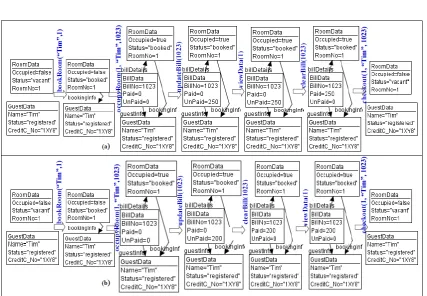
Figure 2: Two example derivations
Referring to the system in Fig. 1, consider the sequences in Fig. 2(a) and Fig.2(b). Rules names are instantiated with parameter values to represent the corresponding observation se-quence. The applications ofviewDataandclearBill are independent and can be swapped. The graphs shown represent sample states of a hotel with only one room and one registered guest.
The following definition lifts weak dependencies and conflicts to the level of labels. The rela-tions are essentially those of asymmetric event structures [BCM01]. The asymmetry arises from the interplay of deletion and preservation, which is specific to rewriting approaches with explicit read access to resources, such as graph transformation or contextual Petri nets.
Definition 4 (asymmetric dependencies and conflicts) Two labels l1 and l2 are in direct
(asymmetric) conflict, written l1 % l2, iff there exist transformations t1 = (G p=1,⇒m1 H1) and
t2= (G p2,m2
=⇒ H2) such that li =obs(ti) andt2 disables t1, i.e., in the upper diagram in Fig. 3 there exist nok:L1→D2such thatm1=l2∗◦k.
Two labelsl1 andl2 are in (asymmetric) dependency, l1≺l2, iff there exist transformations
t1= (G0 p1,m1
=⇒ G1) and t2 = (G1 p2,m2
=⇒ G2) such thatli =obs(ti) andt2 requires t1, i.e., in the lower diagram in Fig. 3there exist no j:L2 →D1 such that m2=r1∗◦j. Labels l1 andl2 are independent,l1|l2, iff they are unrelated by%and≺.
Exam-R1
m∗1
K1 r1
o
o l1 //
k1 L1 m1 ? ? ? ? ? ? k ' ' L2
m2
K2 l2 o
o r2 //
k2
R2
m∗2
H1 D1 l1∗
o
o
r∗1 // G oo l2∗ D2 r∗2 // H2
L1 m1 K1 o o l1 o
o // r1 //
k1
R1
m∗1
A A
A A
L2
m2}}}
~ ~ }}} j w w K2 o o l2 o
o // r2 //
k2
R2
m∗2
G0 l∗ D1
1
o
o
r1∗ // G1 oo l2∗ D2 r∗2 // G2
Figure 3: Asymmetric conflicts and dependencies
ple2we obtain labels by instantiating formal parameters by possible data values. As the set of all labels is usually infinite due to infinite data types, in this example we limit ourselves to a small subset sufficient to label the transformations in Fig. 2. For example,clearBill(bill no:int) is instantiated byclearBill(1023), replacing the variablebill no:intby the value1023.
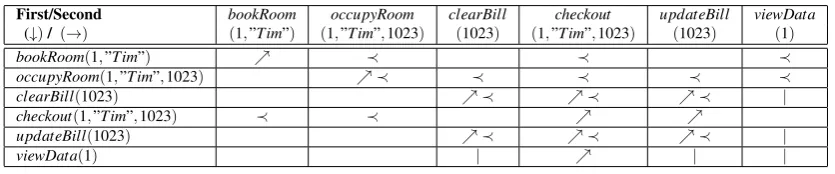
Let us analyse more closely the weak conflicts and dependencies in the derivations of Fig.2. We have represented conflicts and dependencies between these labels in Table1. For example we find a dependency
bookRoom(1,Tim)≺occupyRoom(1, Tim, 1023).
Notice the relation between the parameters for room number and client name, which determines the overlap of the transformations denoted by these labels. Similarly, there exists a conflict
updateBill(1023)%checkout(1,Tim,1023),
i.e.,updateBillreads theBillDataobject, changing theunpaidamount, whilecheckout deletes the object.
First/Second bookRoom occupyRoom clearBill checkout updateBill viewData (↓)/ (→) (1,”Tim”) (1,”Tim”,1023) (1023) (1,”Tim”,1023) (1023) (1)
bookRoom(1,”Tim”) % ≺ ≺ ≺
occupyRoom(1,”Tim”,1023) % ≺ ≺ ≺ ≺ ≺
clearBill(1023) % ≺ % ≺ % ≺ |
checkout(1,”Tim”,1023) ≺ ≺ % %
updateBill(1023) % ≺ % ≺ % ≺ |
viewData(1) | % | |
Figure 4: Critical pairs and dependencies
4
Dependency Graphs
In this section, we show how to extract a dependency graph for a system under test (SUT) from the available interface specification based on visual contracts. A dependency graph (DG) pro-vides us with a visual representation of conflicts and dependencies allowing us to study coverage criteria at the interface level.
Definition 5 (dependency graph) A dependency graph DG=hG,OP,op,labi is a structure where
• G=hV,E,src,tariis a graph.
• OPis a set of (names of) operations.
• op:V →OPmaps vertices to operation names.
• lab:E→ {c,u,r,d} × {≺,%} × {c,u,r,d}is a labelling function distinguishing source and target typescreate, update, read, deleteand dependency types≺,%.
We use the visual contracts specifying the interface to extract a dependency graph, where rules are represented by nodes labeled by operation names while edges represent dependencies and conflicts between them. Edge labels tell us whether an edge represents a dependency (≺) or a conflict (%) and what roles are played by the source and target nodes.
(V,E,src,tar)is defined by
• V = S
p∈P
({p} ×π(p))as the set of all rule spans tagged by their names. Ifs1∈π(p)we
writep1:s1∈V.
• E⊆V×V such that:
– e= (p1:s1,p2:s2)∈Eif there are stepsG p1:s1,m1
=⇒ H1 p2:s2,m2
=⇒ H2such that the second step requires the first. The role labels are defined as follows.
1. If an element created by the first step is deleted or read by the second,lab(e) =
hc,≺,di or lab(e) =hc,≺,ri, respectively. If both apply, label d takes prece-dence overr.
2. If an attribute updated by the first step is updated or read by the second,
lab(e) =hu,≺,uiorlab(e) =hu,≺,ri, respectively. If both apply, labelutakes precedence overr.
3. If an object created by the first step has an attribute updated by the second,
lab(e) =hc,≺,ui
– e= (p1:s1,p2:s2)∈Eif there are stepsH1 p1:r1,m1
⇐= Gp2=:r⇒2,m2H2such that the second disables the first. The role labels are defined as follows.
1. If an element deleted or read by the first step is also deleted by the second,
lab(e) =hd,%,diorlab(e) =hr,%,di, respectively. If both apply, labeldtakes precedence overr.
2. If an attribute updated or read by the first step is updated by the second,
lab(e) =hu,≺,uiorlab(e) =hr,≺,ui, respectively. If both apply, labelutakes precedence overr.
3. If an object’s attribute is updated by the first step and deleted by the second,
lab(e) =hu,≺,di • OP=Pis the set of rule names.
• op:V →OPis defined byop(p:s) =p
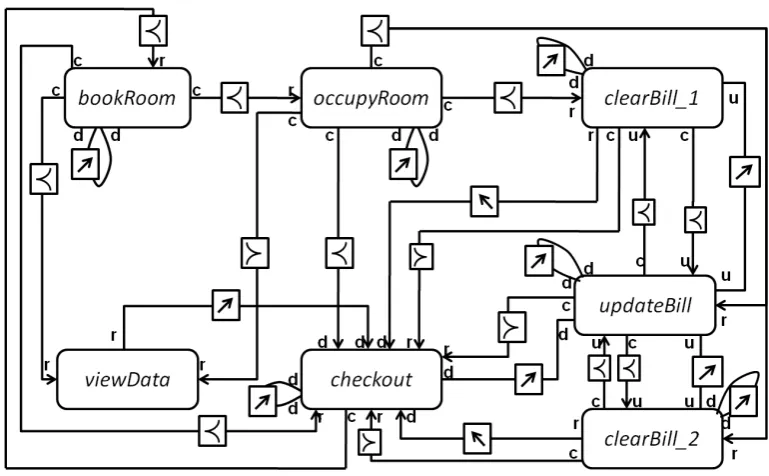
Example4 (dependency graph) Using the example in Fig.1we can draw a dependency graph as shown in Fig.5. Consider an edge between nodesbookRoom(. . .)andoccupyRoom(. . .)where the labeling ishc,≺,ri. That means, an object created during the first operationbookRoom(. . .)
is read by the second operation occupyRoom(. . .) with ≺ representing the dependency rela-tion. Similarly, consider an edge betweenclearBill(. . .)andcheckout(. . .)where the labelling is
hr,%,di. It means,clearBill(. . .)reads an object which is deleted bycheckout(. . .). An exami-nation of the rules reveals thatclearBill(. . .)operates on aBillDataobject which is deleted by
checkout(. . .).
5
Coverage Criteria
Fig. 5: dependency graph ofTAGT Srepresenting hotel web service
where data is defined and used in a program [PJ08], [CPRZ89], [TSP01]. The locations where a variable is defined are annotated byde f, use is indicated byuse, and deallocated bykill. Paths are identified through the system such that they exercise particular coverage criteria. For example,
de f−usecoverage requires to find test cases such that all edges in the dataflow graph from nodes annotated withde f to nodes annotated withuseare exercised at least once.
Our dependency graph carries information about dependencies between operations at the in-terface level. We have annotated sources and targets of edges withc(create),r(read),u(update) an d (delete), analogousy to de f, useand kill annotations for traditional versions of dataflow graphs. Using these labels on edges rather than nodes, we can focus on the type of access that gives rise to the particular dependency or conflict represented by the edge. The possibilities are summarised in Table.2.
Label Combination Conflict Dependency
cr × √
cd × √
cu × √
uu √ √
rd √ ×
dd √ ×
ud √ ×
Using the DG, we can devise different coverage criteria such as cr, cd, ud, etc. The ques-tion is, which of these pairs to include into our criteria. If we demand allcr (create-read),cu
(create-update),cd (create-delete), anduu(update-update) edges inDG(G), we exercise all de-pendencies based on data being defined and used subsequently. If we addud(update-delete) and
rd (read-delete), we also cover situations of asymmetric conflict. The case ofdd(delete-delete) represents an anomaly because we should not be able to observe a sequence where two steps are in symmetric conflict. It might still be interesting to create a test case to check that it is non-executable, but to guarantee the conflict we have to enforce a certain overlap of parameters, requiring a more detailed version of the dependency graph.
In order to see if a set of test casesT provides the required coverage, we record all the nodes and edges thatT is exercising.
Definition 7(sub-graph covered by test set) Given a TAGTS G = (AT G,P,X,π,σ)with
de-pendency graph DG(G) =hG,OP,op,labi and let T be a set of derivations in G. The graph
cov(DG,T) =hGT,OPT,opT,labTiis the subgraph ofDG(G)withGT =hVT,ET,src,tgtisuch
that:
• v∈VT iff forp=op(v)and a derivations∈T there is a step inslabelled by p(a¯).
• e∈ET iff forop(src(e)) =pandop(tgt(e)) =qand a derivations∈T there are steps in
slabelledp(a¯),q(b¯)in asymmetric conflict or dependency as specified bylab(e).
• OPT=OP|VT
• opT =op|VT
• labT=lab|ET
A coverage criterionCis defined by any subgraph ofDG(G). Test setT provides the coverage required byCifC⊆cov(DG,T).
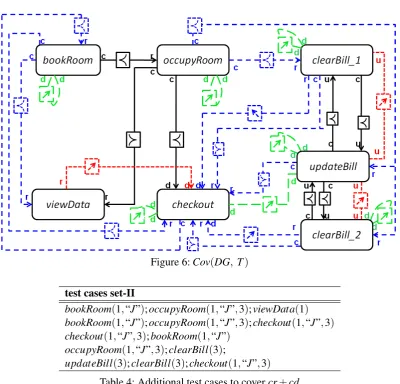
Example5 (coverage of test cases) Consider criterioncr+cdand letT be the set of test cases shown in Table.3.
test cases set-I
bookRoom(1,“J”);occupyRoom(1,“J”,3)
occupyRoom(1,“J”,3);viewData(1)
occupyRoom(1,“J”,3);checkout(1,“J”,3)
updateBill(3);clearBill(3)
clearBill(3);updateBill(3)
Table 3: Test cases providing node coverage
Figure 6:Cov(DG, T)
test cases set-II
bookRoom(1,“J”);occupyRoom(1,“J”,3);viewData(1)
bookRoom(1,“J”);occupyRoom(1,“J”,3);checkout(1,“J”,3)
checkout(1,“J”,3);bookRoom(1,“J”)
occupyRoom(1,“J”,3);clearBill(3);
updateBill(3);clearBill(3);checkout(1,“J”,3)
Table 4: Additional test cases to covercr+cd
The first two test cases in Table4are required to cover thecredges betweenbookRoom(. . .)
and viewData(. . .) and between bookRoom(. . .) and checkout(. . .) and the inclusion of
occupyRoom(1,“J”,3) is required. The third and forth test cases are required to cover the edges between checkout(. . .) and bookRoom(. . .) and between occupyRoom(. . .) and
clearBill(. . .)where the fifth test case exercises edges between updateBill(. . .),clearBill(. . .)
andcheckout(. . .). Notice that the dotted red edge betweenviewData(. . .) andcheckout(. . .) is still not covered by any of the test cases, just as the edges shown in dotted green. We need stronger criteria to include test cases covering these edges, too.
6
Related Work
graph from information for each party in a collaboration and defines conditions for regression testing.
Approaches to test services based on dataflow include [BBMP08,SP06,HXX+08]. For testing Web services compositions [BBMP08] uses BPEL specifications where dependencies between calls are established by means of input and output relationship. Paths through such a graph are extracted and criteria are defined to cover the combination of events in these test paths. In a later approach, the BPEL process is visualised as a directed graph where nodes represent activities and edges represent (control and data) flows. Annotations forde f anduseare used at inputs and outputs of service calls and coverage based is defined. BPEL is also considered in [HXX+08] and a dependency analysis for variables acquired from WSDL is used to arrive at possible paths through the process. Testing approaches for object-oriented systems are introduced in [CLN05,
BLL10].
We have made use of web service specifications by means of visual contracts for deriving a dependency graph to define coverage. Dependencies and conflicts extracted by critical pair analysis provide a simple representation of the system at the interface level, abstracting from detailed control flow specifications.
7
Conclusion
In this paper we have explored the use of graph transformation systems specifying service inter-faces for the derivation of model-based coverage criteria. While we were able to demonstrate the potential usefulness of the approach, two areas are left to be explored.
• We would like to extend our dependency graphs with data flow information to describe in more detail the conflicts and dependencies encountered. This will allow to define se-quences of labels as forbidden traces, such that tests can not only check the existence of required behaviours, but also the absence of forbidden ones.
• An approach to test coverage based on executable models may be naturally combined with the use of these models as oracles, to define when a test case conforms to the specification. This is conceptually simple, but requires the integration of a testing tool with a graph transformation engine executing the specification.
Bibliography
[AGG07] AGG. AGG - Attributed Graph Grammar System Environment. http://tfs.cs. tu-berlin.de/agg, 2007.
[BBMP08] C. Bartolini, A. Bertolino, E. Marchetti, I. Parissis. Architecting Dependable Sys-tems V. In Lemos et al. (eds.). Chapter Data Flow-Based Validation of Web Services Compositions: Perspectives and Examples, pp. 298–325. Springer-Verlag, Berlin, Heidelberg, 2008.
[BLL10] L. Briand, Y. Labiche, Q. Lin. Improving the Coverage Criteria of UML State Ma-chines Using Data Flow Analysis.Software Testing, Validation, and Reliability (Wi-ley)20(3), 2010.
[CLN05] Y. Chen, S. Liu, F. Nagoya. An Approach to Integration Testing Based on Data Flow Specifications. In Liu and Araki (eds.),Theoretical Aspects of Computing - ICTAC 2004. Lecture Notes in Computer Science 3407, pp. 235–249. Springer Berlin / Hei-delberg, 2005.
[CP06] G. Canfora, M. D. Penta. Testing Services and Service-Centric Systems: Challenges and Opportunities.IT Professional8:10–17, 2006.
[CPRZ89] L. A. Clarke, A. Podgurski, D. J. Richardson, S. J. Zeil. A Formal Evaluation of Data Flow Path Selection Criteria.IEEE Trans. Softw. Eng.15(11):1318–1332, 1989.
[EEPT06] H. Ehrig, K. Ehrig, U. Prange, G. Taentzer. Fundamentals of Algebraic Graph Transformation (Monographs in Theoretical Computer Science. An EATCS Series). Springer, 2006.
[HXX+08] J. Hou, B. Xu, L. Xu, D. Wang, J. Xu. A testing method for Web services composi-tion based on data-flow.Wuhan University Journal of Natural Sciences13:455–460, 2008.
[LCG08] L. Li, W. Chou, W. Guo. Control Flow Analysis and Coverage Driven Testing for Web Services. InWeb Services, 2008. ICWS ’08. IEEE International Conference on. Pp. 473 –480. 2008.
[PBE+07] M. Penta, M. Bruno, G. Esposito, V. Mazza, G. Canfora. Web Services Regression Testing. Pp. 205–234. 2007.
doi:10.1007/978-3-540-72912-9 8
http://dx.doi.org/10.1007/978-3-540-72912-9 8
[Pfl01] S. L. Pfleeger.Software Engineering: Theory and Practice. Prentice Hall PTR, Up-per Saddle River, NJ, USA, 2001.
[PJ08] A. Paul, O. Jeff.Introduction to Software Testing. Cambridge University Press, New York, NY, USA, 2008.
[ROL+07] M. Ruth, S. Oh, A. Loup, B. Horton, O. Gallet, M. Mata, S. Tu. Towards Auto-matic Regression Test Selection for Web Services. InCOMPSAC ’07: Proceedings of the 31st Annual International Computer Software and Applications Conference. Pp. 729–736. IEEE Computer Society, Washington, DC, USA, 2007.