ISSN: 2501 - 1235 ISSN-L: 2501 - 1235 Available on-line at: www.oapub.org/edu
doi: 10.5281/zenodo.1293005 Volume 4 │ Issue 8 │ 2018
GENDER-DEPENDENT FITNESS- AND
HEALTH CENTRE EVALUATION BY
RESIGNED MEMBERS
Georgios F. Zarotisi
University of the Aegean, Faculty of Human Sciences, Rhodes, Greece
Abstract:
The aim of the study is to examine if and to what extent the evaluations of fitness studios by persons who have recently resigned from their membership are related to general studio conditions such as studio atmosphere, facilities, trainer’s competence
and other features. In the evaluations and statistical analyses presented here, it is
examined to what extent male and female dropouts differ in their evaluations of the fitness studios. Assuming that the sports studio evaluation may have played a role in the quitting decision to a certain extent, the question of gender differences concerning the quitting decision is therefore also indirectly posed. In other words, the question is
whether there are typical prioritisations on positive or negative evaluations by dropouts
from fitness sport. A total of 225 people, who had terminated their contract with a fitness studio, were questioned. The survey was conducted as a telephone inquiry about their actual decision. The study was conducted in a health-oriented fitness centre in East Cologne. The fitness facility was opened in 1994 and has a size of 1,100 square metres. At the time of the study, the gym had up to 1,151 memberships. Among them, 59% of the members were women and 41% were men. The average age of the respondents was 43.5 years. The average duration of membership added up to 4.4 years. On the whole, the various aspects of the studio offer and its surroundings were largely rated as "good". The respondents particularly expressed their appreciation for the coaches (friendliness, helpfulness, competence), followed by opening hours, trial training and the first impression. The membership costs and individual aspects such as space, music and ventilation are evaluated more critically, if not really badly. In practice, there were no significant differences between the genders in the studio evaluation. Purely descriptive, both subgroups are very close to each other in their mean values in all 19 aspects of the studio evaluation. The most significant difference lies in the evaluation of the studio location, which is also significant at the 5% level, but still remains small at the absolute level of the difference.
Keywords: gender-dependent, fitness centre, evaluation, resigned members
1. Introduction
The fitness line is characterized both by an almost stagnating number of fitness clubs and an annual fluctuation of total membership numbers within the fitness studios. We therefore examine whether there are typical priorities in the drop-out justification and which reasons are used, in a statistically significant way, more or less or not at all. The collected data should help to derive recommendations for action in order to increase the customer satisfaction in fitness companies and to reduce the long-term drop-out rates by an adequate service offering (Zarotis et al. 2017, Zarotis 1999 & Rampf 1999).
In the evaluations and statistical analyses presented here, it is examined to what extent male and female dropouts differ in their evaluations of the fitness studios. Assuming that the sports studio evaluation may have played a role in the quitting decision to a certain extent, the question of gender differences concerning the quitting decision is therefore also indirectly posed.
High drop-out rates in sports programs, both in health-related sport and in the therapeutic field, are no exception. The long-term commitment of sport active people poses a problem. This also applies to fitness training in studios, as about half of the members end their training prematurely (Rampf, 1999).
The question concerning the reasons for dropping out hasn’t, so far, been studied in Germany, so the knowledge about it is only incomplete. Problematic therefore is also the indication of average drop-out rates in German fitness studios because they are not recorded or published.
Oldrige (1982) analysed ten sports programs in the context of preventive measures, setting cancellation rates from 13% to 75%. Analyses of another 18 prevention programs showed drop-out rates from 3% to 87%.
In the study by Oldrige (1979), 42% of the dropouts from a rehabilitation program for patients with coronary diseases mentioned "psychosocial reasons" (e.g. lack of interest, problems in the family). 25% of the dropouts mentioned "unavoidable reasons" (e.g. occupational conflicts, change of employment, change of residence), 22% gave medical reasons and 11% other reasons for quitting.
Pahmeier (1997) also investigated which factors influence the decision to quit a sports program and found that among 65 respondents each gave an average of 3.6 reasons. The main problems that affected the quitting decision in this case were time management and factors of living and working conditions.
These studies show that quitting a sports program always depends on several factors. The features of quitting a sports activity may be personal and situational characteristics (Rampf, 1999).
It is often possible to identify reasons which ultimately lead to dropping out, but the participation behaviour is influenced by a complex factor structure.
Dishman (1982) several times remarks critically on the often unsystematic approach of many studies and describes them as atheoretical. He criticizes the limited data base and imputes it to the lack of uniform models that could simplify research.
Due to this lack of standardisation of theories and examination methods, the comparability of the studies is severely restricted.
2. Material and Methods
2.1 Survey methodology
A total of 225 people, who had terminated their contract with a fitness studio, were questioned. The survey was conducted as a telephone inquiry about their actual decision.
The advantages of the telephone survey are the low cost per interview, the possibility of responding to queries and the high external validity. Disadvantages are the lower possible data volume caused by the difficulty to access the responder or lack of interest in a telephone survey, and the possible influence of the interviewer (Homburg & Krohmer, 2008).
The study was conducted in a health-oriented fitness centre in Cologne. The fitness facility was opened in 1994 and has a size of 1,100 square metres. At the time of the study, the gym had up to 1.151 memberships. Among them, 59% of the members were women and 41% were men. The gym faces strong competition. There are competitors who pursue a high price policy, one of which is a provider with a wellness area, but also providers with low price policy. The competitors' pricing is between € 15 and € 129 a month.
The study’s fitness centre is located at the edge of the forest and about 250 metres from the nearest bus stop. It is also easy to reach by car or by bike or on foot. There is enough parking available. The members are greeted and welcomed personally at check-in and check-out check-in the reception area. This creates a personal atmosphere.
weights. There is a sauna and a solarium, and a small wellness space with shiatsu massage armchairs and water massage. The gym offers chargeable drinks.
The training and group program staff consists mainly of persons with sports science education. The fitness centre is open almost 360 days a year. The opening hours are Monday to Friday from 9 am to 11 pm and on weekends and on holidays from 10 am to 7 pm. Membership fees are graded according to the type of membership (course membership or equipment membership or both), duration of membership (12 or 24 months), and payment method (monthly or advance payment). The monthly fee ranges thus from 30 to 57 Euros. In addition, there is a registration fee of 80 Euros.
The survey was conducted by telephone in July 2016. The respondents are persons who have terminated their membership in the period between 01/07/2015 and 30/06/2016. In the aforementioned period, 305 members departed. Of those 225 persons were found and questioned. 54 people could not be found, probably due to relocation or change of the telephone number. 26 persons did not wish to participate in the survey (Zarotis et al., 2017).
The persons were asked about different aspects of the training possibilities, equipment, support and environment factors of the fitness studio. Each evaluation aspect was queried on a 5-point Likert scale. The scaling ranged from “excellent” (coded with the numerical value 1) to “inadequate” (coded with the numerical value 5). The scaling corresponds to a school note scaling without the grade 6, the intermediate stages are correspondingly with “good”, “satisfactory” and “sufficient” verbally anchored.
In this way it is questionable in the strict metrological sense whether the distances between the scale stages can be regarded as equidistant and therefore whether the items have an interval scale level, or whether one would not have to assume an ordinal scale level here.
However, it can be shown that when using Likert scaled rating scales the use of parametric procedures can lead to statistically correct decisions even if the distances between the scale stages are not exactly equidistant.
Such scaling can thus be evaluated as being "sufficiently similar" in practice as an “interval scale", so that mean values and parametric procedures can be used accordingly.
In the case of a person interviewed, all information concerning the evaluation of
the studio is missing. Apart from that, in most of the questionnaire items there were no
response refusals, so that in 15 of the 19 questionnaires there are valid values even N = 224. In the case of four items, there was a further missing value, so that N = 223 valid values exist in these items.
The age of the interviewees was recorded in whole years; here, in one case, there was a missing value, so that in N = 224 cases; the information about the age is in years. In the data analysis, the sample characteristics are initially depicted in terms of gender distribution, age and duration of membership in the studio.
To ensure the inferential statistic of the differences between the sexes, T-tests are used for independent samples. The model assumptions of the variance homogeneity are tested by Levene tests, and in the case of significant variance differences, the T-test is calculated with corrected degrees of freedom and T-values (Welch-Test).
The conventional significance level of p <.05 is applied. When values are lower from the significance threshold, it can be assumed that the gender differences can be generalized beyond the sample to the population and are not mere random effects of this specific sampling.
3. Results
3.1 Sample description
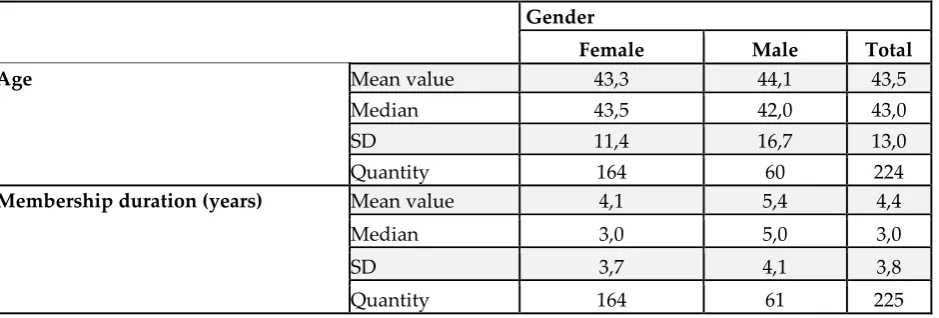
The sample consists of N=164 female respondents and of N=61 male respondents. The age range is between 16 and 74 years – 16 and 74 years for women, as well as between 20 and 74 years for men - with a respondents’ mean age of 43.5 years (43.5 women; 42.0 men) and a distribution of 13.0 years (11.4 women; 16.7 men).
Table 1: Sample distribution characteristic values
Gender
Female Male Total
Age Mean value 43,3 44,1 43,5
Median 43,5 42,0 43,0
SD 11,4 16,7 13,0
Quantity 164 60 224
Membership duration (years) Mean value 4,1 5,4 4,4
Median 3,0 5,0 3,0
SD 3,7 4,1 3,8
3.2 Descriptive Statistics
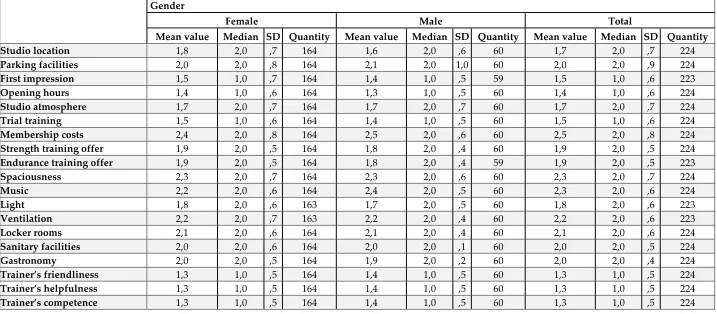
Table 2 shows the mean values, median and standard deviation of the 19 questions for the studio evaluation, both differentiated by gender as well as overall in the sample.
Table 2: Mean values, median and distribution of the quitting reasons
Gender
Female Male Total
Mean value Median SD Quantity Mean value Median SD Quantity Mean value Median SD Quantity
Studio location 1,8 2,0 ,7 164 1,6 2,0 ,6 60 1,7 2,0 ,7 224
Parking facilities 2,0 2,0 ,8 164 2,1 2,0 1,0 60 2,0 2,0 ,9 224
First impression 1,5 1,0 ,7 164 1,4 1,0 ,5 59 1,5 1,0 ,6 223
Opening hours 1,4 1,0 ,6 164 1,3 1,0 ,5 60 1,4 1,0 ,6 224
Studio atmosphere 1,7 2,0 ,7 164 1,7 2,0 ,7 60 1,7 2,0 ,7 224
Trial training 1,5 1,0 ,6 164 1,4 1,0 ,5 60 1,5 1,0 ,6 224
Membership costs 2,4 2,0 ,8 164 2,5 2,0 ,6 60 2,5 2,0 ,8 224
Strength training offer 1,9 2,0 ,5 164 1,8 2,0 ,4 60 1,9 2,0 ,5 224
Endurance training offer 1,9 2,0 ,5 164 1,8 2,0 ,4 59 1,9 2,0 ,5 223
Spaciousness 2,3 2,0 ,7 164 2,3 2,0 ,6 60 2,3 2,0 ,7 224
Music 2,2 2,0 ,6 164 2,4 2,0 ,5 60 2,3 2,0 ,6 224
Light 1,8 2,0 ,6 163 1,7 2,0 ,5 60 1,8 2,0 ,6 223
Ventilation 2,2 2,0 ,7 163 2,2 2,0 ,4 60 2,2 2,0 ,6 223
Locker rooms 2,1 2,0 ,6 164 2,1 2,0 ,4 60 2,1 2,0 ,6 224
Sanitary facilities 2,0 2,0 ,6 164 2,0 2,0 ,1 60 2,0 2,0 ,5 224
Gastronomy 2,0 2,0 ,5 164 1,9 2,0 ,2 60 2,0 2,0 ,4 224
Trainer’s friendliness 1,3 1,0 ,5 164 1,4 1,0 ,5 60 1,3 1,0 ,5 224
Trainer’s helpfulness 1,3 1,0 ,5 164 1,4 1,0 ,5 60 1,3 1,0 ,5 224
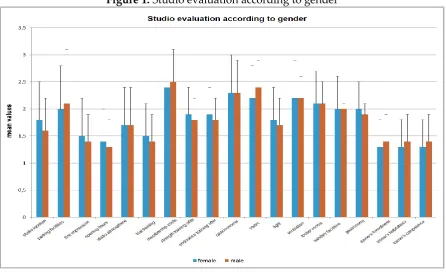
Figure 1, the mean values and distributions of the studio evaluations, differentiated according to gender, are depicted as grouped bar graphs.
Figure 1: Studio evaluation according to gender
3.3 Significance test of the differences between genders in studio evaluation
Table 3 shows the results of the significance tests of the differences in mean values between the genders. The difference of the mean values between the genders, the significance and the T-values, as well as the degrees of freedom (df) are reported, thus the test quantities.
Table 3: Mean value differences, significance and test quantities of the T tests
Independent samples test
T-Test for the mean value equality
t df Sig. Mean value difference
Studio location 2,113 222 ,036 ,218
Parking facilities -,949 222 ,344 -,123
First impression ,479 134,908 ,633ii ,040
Opening hours 1,232 120,906 ,22014 ,098
Studio atmosphere -,286 222 ,776 -,031
Trial training 1,440 123,703 ,15214 ,114
Membership costs -,748 140,337 ,45614 -,078
Strength training offer 1,171 222 ,243 ,087
Endurance training offer 1,063 221 ,289 ,083
Spaciousness -,193 222 ,847 -,020
Music -1,954 222 ,052 -,176
Light 1,359 221 ,176 ,118
Ventilation ,881 168,755 ,37914 ,066
Locker rooms ,291 173,805 ,77114 ,020
Sanitary facilities 1,176 197,167 ,24114 ,059
Gastronomy 1,262 222 ,208 ,080
Trainer’s friendliness -1,324 100,629 ,18814 -,097
Trainer’s helpfulness -1,065 222 ,288 -,078
Trainer’s competence -1,198 98,432 ,23414 -,086
4. Discussion
In general, the mean values of the evaluations vary between 1.3 and 2.5, i.e. all are consistently in the positive evaluation range of the scale. Most items are a little below or slightly above the value of 2, which is "good".
Clearly, the best scores are found in the last three items, in which the studio trainers are evaluated. Also, the items opening hours, trial training and first impression are in the mean value closer to the evaluation level "very good" than at the evaluation level "good." The - relatively speaking - worst ratings appear at the features of membership costs, spaciousness, music and ventilation.
In the research made by Rampf (1999) it becomes also evident that 19 % of the respondent group stated “too high cost for membership” as the main single reason for quitting the sports program. However, the real amount of cost is not the actual problem but rather the negative cost/benefit balance.
There is also evidence in other studies that financial aspects of dropout play an important role. In the survey by Breuer et al. (2013), even 45.1% of the 149 respondents cite as a reason "membership costs", which is why they discontinue fitness training.
Financial aspects are also mentioned in a study by the IHRSA (2012) as main arguments for the termination of membership in a fitness club. 52.2% of the 1,000 respondents surveyed said they were no longer able to afford their membership or rated them as expensive. Therefore, in future work, the collection of the income should be considered in order to assess its impact on the dropout.
It is important that the customer feels comfortable in the training area and in all other parts of the fitness-club. Comfortable feelings are for example guaranteed by not crowding the training area with training equipment. Sufficient space for movement during training, facilitates a positive training experience. Background music also creates a positive atmosphere. Sufficient ventilation is of special significance in that regard (Rampf 1999).
A concentration of negative aspects in terms of training will over time lead to an abandonment of the activity. Overall, these results confirm the assumption that drop-outs are more critical towards general conditions and thereby support the results of other studies released on this topic (Pahmeier 1994 & Brehm /Eberhardt 1995).
small extent of the differences, a detailed consideration of the difference direction is also not appropriate.
Only in the evaluation of the studio location is the gender difference slightly larger; the male respondents rate this aspect about 1/4 of a scale interval better than female respondents. This evaluation aspect is also the only one in which the gender difference can be secured against chance at the 5% level with p = .036 (t: 2.113; df: 222). In all other 18 aspects, the (minor) gender differences cannot be secured against chance and could thus be purely random variances of the concrete sampling.
5. Conclusions
On the whole, the various aspects of the studio offer and its surroundings were largely rated as "good". The respondents particularly expressed their appreciation for the coaches (friendliness, helpfulness, competence), followed by opening hours, trial training and the first impression. The membership costs and individual aspects such as space, music and ventilation are evaluated more critically, if not really badly.
In practice, there were no significant differences between the genders in the studio evaluation. Purely descriptive, both subgroups are very close to each other in their mean values in all 19 aspects of the studio evaluation.
The most significant difference lies in the evaluation of the studio location, which is also significant at the 5% level, but still remains small at the absolute level of the difference.
References
1. Brehm W., Eberhardt J. Drop-Out and adherence in Fitness-Studio. Sports
science. 1995; 25(2): 174-186.
2. Brehm W., Pahmeier I. Dropping out or remaining; Breakpoints of a broad sports
career and conditions of a withdrawal. Spectrum of Sports Science.1990; 2(2): 33-56.
3. Breuer, C., Wicker, P. & Nagel, N. (2013). A time-economic analysis of fitness
training. Cologne: German Sport University Cologne, Institute of Sport Economics and Sport Management.
4. Dishman R. K. Compliance/Adherence in Health-Related Exercise. Healthy
Psychology. 1982; 1: 237-267.
5. Dishman R. K. Exercise Adherence – Its Impact on Public Health. Champaign,
Human Kinetics Books 1988.
6. Homburg, Ch., Krohmer, H. (2008). The process of market research: definition of
7. IHRSA2. (May 2012). Why did you leave / quit your former health club? In Statista - The Statistics Portal. Retrieved January 05, 2015, from
http://www.statista.com/statistics/246978/reasons-for-quiting-healthclub membership/.
8. Malhotra, N. & Mukherjee, A. (2004). The relative influence of organisational
Commitment and job satisfaction on Service quality of customer contact employees in banking call centres. Journal of Services Marketing, 18 (3), 162-174.
9. Oldrige N.B. Compliance of Post Myocardial Infarction Patients to Exercise
Programs. Medicine and Science in Sports. 1979a; 11(4): 373-375.
10.Oldrige N.B. Dropout and Potential Compliance – Improving Strategies in
Exercise Rehabilitations, (in): Nagele F., Montoye H. (Ed.), Exercise in Health and Disease. Springfield 1981.
11.Oldrige N.B., Steiner D.L. The Health Belief Model: Predicting Compliance and
Dropout in Cardiac Rehabilitation. Medicine and Science in Sports and Exercise. 1990; 22(5): 678-683.
12.Pahmeier I. Drop-out and adherence in recreational and health sport. Favourable
and unfavourable conditions for sports participation. 1994; 24(2): 117-150.
13.Rampf J. Drop-out and adherence in fitness sports. Favourable and unfavourable
conditions for activities in the gym. Cwalina, Hamburg 1999.
14.Zarotis G. Goal Fitness-Club: Motivation in Fitness-Sport. Meyer & Meyer,
Aachen 1999.
15.Zarotis G., Tokarski W. Gender-specific differences for motivation in
health-oriented sports and fitness facilities. Spectrum free time. 2005; 28(2): 81-89.
16.Zarotis G., Athanailidis I., Arvanitidou V., Mourtzios Ch. Age-specific reasons
for dropping out of the Fitness-Sport. Journal of Physical Education and Sport. 2017; 17(2): 916-924.
17.Zarotis, G., Athanailidis, I., Arvanitidou, V., Mourtzios, Ch. Age-dependent
fitness centre evaluation by resigned members. Journal of Physical Education and Sport. 2017; 17(3): 1926-1933.
18.Zarotis G., Athanailidis I., Tosunidis A., Mastrogiannopoulos N. (2017).
Creative Commons licensing terms