Volume 50 (2011)
Recent Advances in Multi-paradigm Modeling
(MPM 2011)
Reusing Model Transformations across Heterogeneous Metamodels
Manuel Wimmer, Angelika Kusel, Werner Retschitzegger, Johannes Sch¨onb¨ock, Wieland Schwinger,
Jes´us S´anchez Cuadrado, Esther Guerra, and Juan de Lara
13 pages
Guest Editors: Vasco Amaral, C ´ecile Hardebolle, Hans Vangheluwe, L ´aszl ´o Lengyel, Peter Bunus
Managing Editors: Tiziana Margaria, Julia Padberg, Gabriele Taentzer
ECEASST
Reusing Model Transformations across Heterogeneous Metamodels
Manuel Wimmer1, Angelika Kusel3, Werner Retschitzegger3,
Johannes Sch¨onb¨ock2, Wieland Schwinger3,
Jes ´us S´anchez Cuadrado4, Esther Guerra4, and Juan de Lara4
1Universidad de M´alaga, Spain 2Vienna University of Technology, Austria 3Johannes Kepler University Linz, Austria 4Universidad Aut´onoma de Madrid, Spain
Abstract: Model transformations are key enablers for multi-paradigm modeling. However, currently there is little support for reusing transformations in different contexts since they are tightly coupled to the metamodels they are defined upon, and hence reusing them for other metamodels becomes challenging. Inspired from generic programming, we proposedgeneric model-to-model transformations, which are defined over so-called metamodel concepts, which are later bound to specific metamodels. Nevertheless, the current binding mechanism lacks automated reso-lution support for recurring structural heterogeneities between metamodels. There-fore, based on a systematic classification of heterogeneities, we propose a flexible binding mechanism being able toautomatically resolve recurring structural hetero-geneitiesbetween metamodels. For this, the binding model is analyzed and required adaptors are automatically added to the transformation.
Keywords:Transformation Reuse, Metamodel Heterogeneities
1
Introduction
Multi-paradigm modeling [MV02] fosters the description of systems using the most appropriate formalism and level of abstraction. Hence, transformations become key enablers in this ap-proach to transform models between different languages and abstraction levels. So far, transfor-mation development is a type-centric activity, because transfortransfor-mations are defined over and thus, tightly coupled to the types of specific metamodels (MMs). However, the defined transformation may apply to other MMs as well, which share similar characteristics, i.e., in case of metamodel evolution. The main obstacle in reusing model-to-model transformations are structural hetero-geneities between MMs, a well-known problem in database integration [LN07], which occur if semantically similar concepts are realized in different ways in different MMs. In particular, such structural heterogeneities may break existing transformations if applied to other MMs. Thus, an automatic resolution of these heterogeneities is desirable to increase reuse of transformations and thus, to avoid a tedious and error-prone manual adaptation.
the generic transformation reusable for specific MMs. If structural heterogeneities occur between the concept MMs and the specific MMs, adapters have to be manually defined for their resolution. To ease the burden of resolving recurring structural heterogeneities, we propose an approach to automatically derive adapters for generic transformations. These adapters realize a virtual view on the specific MM providing required features of the concept MM which are expressed struc-turally different in the specific MM. These adapters effectively establish asubtyperelationship [SJ07] between the concept MM and the specific MM. Please note that concept and the specific MM are assumed to correspond to a single meta-metamodel, e.g., Ecore. Based on our previous work for establishing a classification of MM heterogeneities [WKK+10b], we provide a compre-hensive set of adapters for resolving structural heterogeneities between Ecore1-based MMs. As a proof of concept we discuss an implementation on top of ATL [JABK08] where the reuse of generic transformations is achieved by means of a Higher Order Transformation (HOT) [TCJ10] by adding helper functions realizing the virtual view. However, our approach is applicable to other transformation languages offering a MM and supporting helper functions (e.g., QVT).
Outline. Section2 shortly reviews generic model transformations and highlights points for improvements. Whereas Section3presents obstacles for transformation reuse on the basis of a running example, the subsequent Section4introduces the approach for automatically deriving adapters. Finally, Section5elaborates on related work, and Section6concludes the paper.
2
Generic Model Transformations in a Nutshell
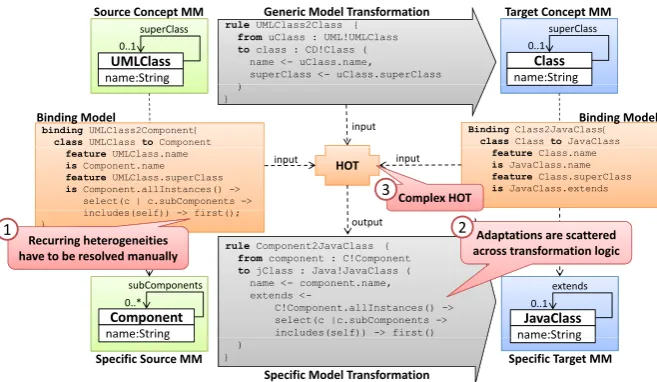
In our previous work [CGL11], the notion ofgeneric model transformations (i.e., decoupling of transformation logic and MMs) as a reuse mechanism has been presented which are defined between so-calledconcept MMs. Concept MMs specify the requirements (e.g., needed attributes and references etc.), which a specific MM must fulfill to qualify for the source domain or target domain of a transformation (cf. upper part of Fig.1for a simple example). The elements (classes, attributes, and references) of the concept MMs can be seen on a conceptual level as variables that have to be bound to the elements of specific MMs (cf. lower part of Fig.1) by means of a binding model (cf. middle part of Fig.1). The established bindings between concept MMs and specific MMs are used as input for a HOT, which rewrites the generic model transformation, i.e., the concept types are replaced by specific types, to obtain a specific model transformation.
As can be seen in Fig. 1, in the course of the binding not only naming differences but also more challenging structural heterogeneities have to be resolved between the source concept MM and the specific source MM. In our example, UMLClassexhibits a reference to an optional superclass whereasComponent exhibits theinverse reference to its subcomponents. Thus, a crucial issue to increase reuse of generic transformations is a flexible binding mechanism which is able to overcome structural heterogeneities automatically. Although the binding language we proposed in [CGL11] allows specifying OCL-based adapters to resolve heterogeneities, there exist three points for improvements. First, although heterogeneities are recurring,no automatic resolution thereof is supported by the binding language forcing the transformation reuser to specify complex OCL code manually (cf. 1 in Fig.1). Second, the adaptations for resolving heterogeneities between concept MMs and specific MMs arescattered acrossthe specific model
ECEASST
Source Concept MM Generic Model Transformation Target Concept MM
ruleUMLClass2Class {
fromuClass : UML!UMLClass
toclass : CD!Class ( name <- uClass.name,
superClass <- uClass.superClass ) Class name:String 0..1 superClass UMLClass name:String 0..1 superClass } ) } input bindingUMLClass2Component{
classUMLClasstoComponent
Binding Model
BindingClass2JavaClass{
classClasstoJavaClass
Binding Model
HOT
input input
featureUMLClass.name
is Component.name
featureUMLClass.superClass
isComponent.allInstances() -> select(c | c.subComponents -> i l d ( lf)) > fi t()
featureClass.name
is JavaClass.name
featureClass.superClass isJavaClass.extends } Complex HOT 3 output includes(self)) -> first();
}
ruleComponent2JavaClass {
fromcomponent : C!Component
tojClass : Java!JavaClass (
Recurring heterogeneities have to be resolved manually
1 Adaptations are scattered
across transformation logic 2 JavaClass name:String 0..1 extends Component name:String 0..* subComponents j (
name <- component.name, extends
<-C!Component.allInstances() -> select(c |c.subComponents ->
includes(self)) -> first() name:String name:String
Specific Source MM Specific Target MM
) }
Specific Model Transformation
Figure 1: Generic Model Transformations at a Glance
transformation leading to hardly maintainable transformations (cf. 2 in Fig.1). Finally, since the adaptation of the transformation code comprises the challenging rewriting of OCL expressions, acomplex HOT has to be developed (cf. 3 in Fig.1), which is still challenging [TCJ10].
In order to alleviate these problems, in this paper we propose an automated mechanism to resolve commonly occurring heterogeneities (cf. Section 3.2), based on a library of generic
andcomposableadapters. We also simplify the HOT proposed in [CGL11], leading to a simpler adaptation mechanism and more comprehensible specific transformations. We restrict to the case of generic transformations defined over a concept MM on the source domain, and a specific MM on the target. Supporting genericity on the target is left to future work.
3
Metamodel Heterogeneities: Obstacles for Transformation Reuse
In this section, first, a motivating example for transformation reuse is presented, and subse-quently, an overview on potentially arising heterogeneities between Ecore-based MMs is given.
3.1 Motivating Example
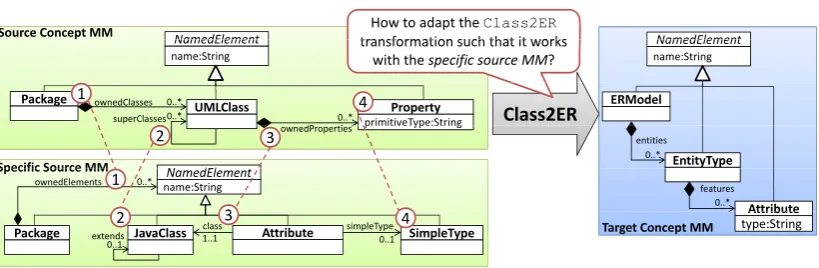
In order to motivate our approach, Fig.2depicts an example of a generic model transformation betweenClassDiagramsandERDiagramsfor demonstration purposes. Since our approach is independent of the concrete implementation of the generic transformation, we omit implemen-tation details thereof. Instead, the focus is on how to apply the existing transformation such that it works for a specific source MM (cf. bottom of Fig.2). In this respect, one can see that a major obstacle to reuse the existing transformation are the heterogeneities that exist between the source concept MM and the specific source MM (cf. 1 - 4 in Fig.2), as detailed in the following.
Concept Package. Although the conceptPackageserves in both MMs as a container for model elements, the containment hierarchies differ. Whereas in the source concept MM, the class
PackagenestsUMLClassesvia the referenceownedClasses, the specific classPackage
NamedElement
Source Concept MM How to adapt theClass2ER NamedElement
transformation such that it works NamedElement
name:String
NamedElement
name:String
transformation such that it works with thespecific source MM?
Property
primitiveType:String
UMLClass Package ownedClasses 0..*
0..* superClasses
dP ti0..*
ERModel
Class2ER
1 4
primitiveType:String
ownedProperties
N dEl t
Specific Source MM EntityType
entities 0..*
2 3
NamedElement
name:String
Specific Source MM
ownedElements 0..*
features 0..*
Attribute 1
3
Attribute JavaClass
Package extends class1..1 0..1 SimpleType
simpleType 0..1
Target Concept MM
Attribute type:String
2 3 4
Figure 2: Motivating Example with Exemplary Heterogeneities
Concept UMLClass. In the context of the conceptUMLClassseveral heterogeneities arise. Whereas the source concept MM supports multiple inheritance, the specific source MM supports single inheritance only (cf. 2 in Fig.2). Second, a difference in linking can be detected since in the source concept MM the classUMLClassowns its properties by means of the reference
UMLClass.ownedPropertieswhereas in the specific source MM, attributes refer to their owning class via the referenceAttribute.class(cf. 3 in Fig.2).
Concept Property. Finally, there is a heterogeneity in the context of the conceptProperty. Whereas the source concept MM allows to describe the primitive type of a property by means of a simple attribute value (cf. attributeProperty.primitiveType), the specific source MM explicates this fact by means of an object of typeSimpleType(cf. 4 in Fig.2).
Before delving into details about how to resolve these heterogeneities, a major question is, which heterogeneities between Ecore-based MMs might occur at all. For this, a summary on potential heterogeneities based on our previous work [WKK+10b] is provided in the following, allowing to clearly factor out the applicability but also the boundaries of our approach.
3.2 Metamodel Heterogeneities at a Glance
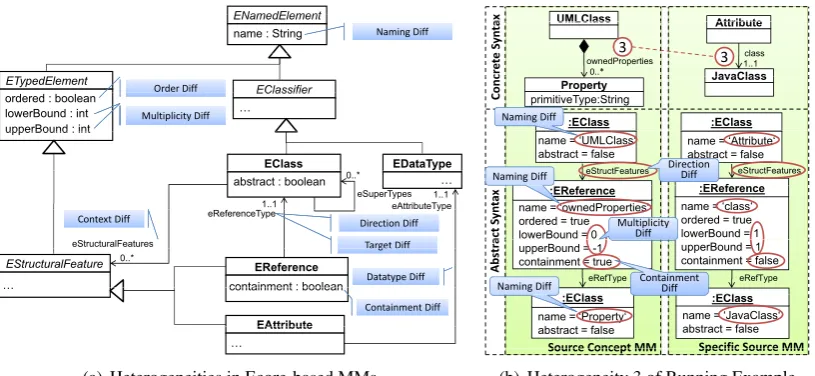
Heterogeneities occur if semantically similar concepts are realized in different ways leading to differently structured MMs [WKK+10a]. Since we focus on Ecore-based MMs, a systematic classification of different kinds of heterogeneities is obtained by investigating potential variation points [WKK+10b]. To shortly recall this classification for the purposes needed in this paper, Fig.3(a) depicts the relevant extract of the Ecore meta-metamodel which is used for defining MMs. Assuming that both, concept MM and specific MM use thesameEcore concept, differ-ences in all the ownedmeta-features may arise (cf. Fig.3(a)). The term meta-feature denotes features of Ecore elements, e.g., the featurenameofENamedElement. In this paper, we fo-cus on heterogeneities of meta-features ofEAttributesandEReferences, and leave the heterogeneities ofEClassesas future work except naming differences between classes.
ECEASST
ENamedElement ENamedElement
name : String Naming Diff
EClassifier ETypedElement
Order Diff EClassifier … ordered : boolean
lowerBound : int upperBound : int
Multiplicity Diff Multiplicity Diff
EClass upperBound : int
EDataType abstract : boolean
1..1 eAttributeType1..1 eSuperTypes
0..* …
eStructuralFeatures
eReferenceType yp
Context Diff Direction Diff
Target Diff
0..*
EStructuralFeature EReference
containment : boolean Datatype Diff
Target Diff
… containment : boolean
EAttribute
Containment Diff EAttribute
…
(a) Heterogeneities in Ecore-based MMs
UMLClass Attribute ax UMLClass ownedProperties 0..* Attribute JavaClass class 1..1 3 3 crete Sy nt a :EClass :EClass Property primitiveType:String JavaClass Con c Naming Diff
name = ‘UMLClass‘ abstract = false
eStructFeatures
name = ‘Attribute‘ abstract = false
ER f
eStructFeatures
Naming Diff
Direction Diff
name = ‘ownedProperties‘ ordered = true lowerBound = 0
:EReference
name = ‘class‘ ordered = true lowerBound = 1
:EReference act Sy nt ax Multiplicity Diff ECl upperBound = -1 containment = true
eRefType
ECl upperBound = 1 containment = false
eRefType Ab st ra Containment Containment Diff Naming Diff :EClass name = ‘Property‘ abstract = false
:EClass name = ‘JavaClass‘ abstract = false Source Concept MM Specific Source MM Source Concept MM Specific Source MM
(b) Heterogeneity 3 of Running Example
Figure 3: Heterogeneity Classification and Exemplary Application
4
Automatic Generation of Adapters
To resolve the afore presented heterogeneities, two approaches might be taken to allow the generic model transformation to work with the specific MM. First, the specific source MM might enforce a change of the generic transformation, whereby this idea is closely related toprogram transformation[Vis01]. Second, the specific source models might be transformed such that they conform to the source concept MM and thus, might act as input of the generic transformation definition. Thereby, the transformation definition remains unchanged, but the models get trans-formed by a preceding transformation, being closely related todata transformation[Len02].
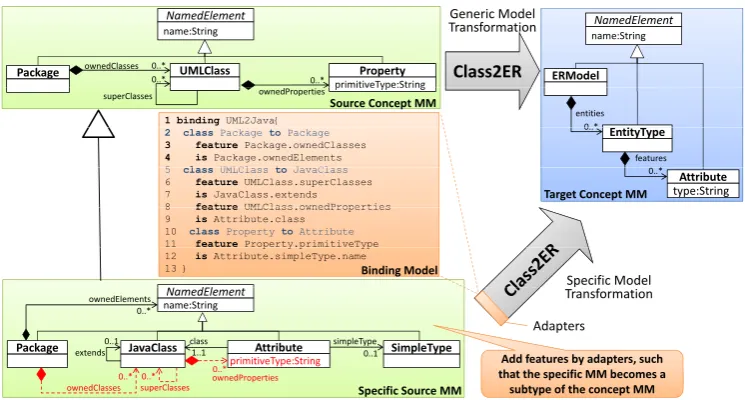
We follow a hybrid approach by combining the advantages of both ideas, namely (i) direct trace linksbetween specific source and target models, since the instantiation of a generic trans-formation leads to a single transtrans-formation (advantage of program transtrans-formation approach), and (ii) anlightweight adaptation process, since the generic transformation code does not have to be rewritten – except of renaming classes which is a trivial rewriting rule (advantage of data trans-formation approach). The core idea is to extend the generic model transtrans-formation by adapters which provide avirtual viewon the specific models such that they correspond to the interpreta-tion of the generic MM (cf. Fig.4). By this, asubtyperelationship between the concept MM and the specific MM is established, whereby a specific MM is a subtype of a concept MM if the specific MM provides at least the classes with features that the concept MM provides [SJ07]. By this, transformations depending on the concept MM may also work with any sub-MM.
Considering the example (cf. Fig.4), obviously, there is no subtype relationship between the concept MM and the specific MM so far, since the specific MM misses four features, which the concept MM defines, namelyPackage.ownedClasses, JavaClass.superClasses,
JavaClass.ownedProperties,Attribute.primitiveType(highlighted in dashed
NamedElement
name:String name:StringNamedElement
Generic Model Transformation
Property
primitiveType:String
UMLClass
Package ownedClasses 0..*0..* 0..* Class2ER ERModel Source Concept MM
primitiveType:String
superClasses ownedProperties
1 bindingUML2Java{
i
entities 0 *
2 classPackage toPackage
3 featurePackage.ownedClasses
4 is Package.ownedElements
5 l UMLCl t J Cl
EntityType
0..
features *
5 classUMLClasstoJavaClass
6 featureUMLClass.superClasses 7 isJavaClass.extends
8 featureUMLClass ownedProperties Target Concept MM
0..*
Attribute type:String 8 featureUMLClass.ownedProperties
9 isAttribute.class
10 classProperty toAttribute
11 featureProperty.primitiveType
d l
p y p yp
12 isAttribute.simpleType.name
13 } Binding Model
Specific Model
NamedElement name:String ownedElements 0..* Adapters p Transformation Attribute primitiveType:String JavaClass Package extends0..1
class
1..1 0..1 SimpleType simpleType
0 *
Adapters
Add features by adapters, such
Specific Source MM
ownedClasses 0..* 0..*
superClasses
ownedProperties
0..* that the specific MM becomes a
subtype of the concept MM
Figure 4: Exemplary Bindings between Heterogenous MMs
as described in the following subsection. This corresponds to the idea of keeping the bindings as simple as possible and derive information required to actually resolve the heterogeneities automatically [ABM05]. Since the adapters are merely added to a generic transformation, but do not change it, imperative and declarative code is supported.
4.1 Automatic Resolution of Heterogeneities by Reasoning
In order to obtain a heterogeneity model including the heterogeneities as classified in Fig.3(a)
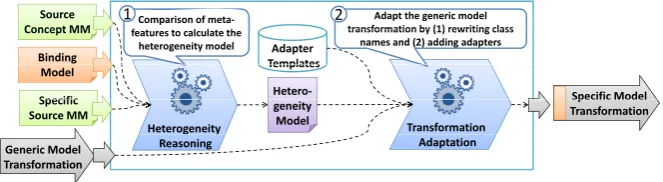
from the binding model, the values of the meta-features are compared (cf. Section3.2). With the help of this heterogeneity model, in the subsequent transformation adaptation, first, correspond-ing different class names are resolved by rewritcorrespond-ing uscorrespond-ing a HOT (cf. Fig.5). To exemplify this, lines 1-5 of List.1depict an exemplary rule of the generic model transformation of our running example as well as the rewritten rule in lines 1-5 of List.2. Second, requiredadapter templates
are instantiated in the HOT by calling predefined rules, which allow to resolve heterogeneities as described in Section3.2. Adapter templates define how to resolve recurring heterogeneities in a generic way by depending only on the input provided by the heterogeneity model. Thus, they can be instantiated, i.e., the variable parts are replaced by the entries of the binding model, to establish a subtype relationship between the source concept MM and the specific MM. These instantiated templates (representing the virtual view) are then added to the actual transforma-tions by means of helper functransforma-tions in ATL (so-called attribute helpers) by the HOT. These helper functions allow to extend the specific MM by missing features required by the source concept MM. Whenever a feature is invoked by the transformation, which is only available in the source concept MM, this invocation is intercepted by a helper function which provides the adapter to the specific MM. To exemplify this, List.2(cf. lines 7-9) includes the helper function generated for the referencePackage.ownedClassesof the MM concept. Thereby, a correspondingly named feature in terms of the specific MM concepts is introduced, thereby resolving naming dif-ferences. Without this adapter the transformation would break in line 4, since the classPackage
ECEASST
Transformation Adapter Heterogeneity Reasoner
G i M d l Source
Concept Generic Model 2
Transformation Concept
MM
Source Specific
Adapt the generic model transformation by (1) rewriting class names and (2) 2 Hetero‐ geneity Binding Model Concept MM Source MM
g ( )
adding adapters
Model HOT
ode
Compare meta‐features for each binding and 1 Adapter Templates Specific Source MM
for each binding and calculate the heterogeneity model MM
Source
Concept MM f tComparison of metat l l t th‐
1 Adapt the generic model
transformation by (1) rewriting class 2
Concept MM
Binding TemplatesAdapter features to calculate the
heterogeneity model
transformation by (1) rewriting class names and (2) adding adapters
Specific Model Specific
Model Templates
Hetero‐ Specific Model
Transformation Heterogeneity
Specific
Source MM geneityModel
Transformation g y
Reasoning Adaptation
Generic Model Transformation
Figure 5: Overview of Reasoning Process
Listing 1: Exemplary ATL Rule of Generic Model Transformation
1 -- Extract of generic transformation
2 r u l e Package2ERModel {
3 from s: UML!Package
4 t o t: ER!ERModel ( entities <- s.ownedClasses )
5 }
Listing 2: Exemplary ATL Rule of Specific Model Transformation
1 -- Extract of specific transformation -> only class names have been changed
2 r u l e Package2ERModel {
3 from s: Java!Package
4 t o t: ER!ERModel ( entities <- s.ownedClasses )
5 }
6
7 -- Added helper function to resolve the heterogeneity, realizing the adapter
8 h e l p e r c o n t e x t Java!Package d e f : ownedClasses : Sequence(Java!JavaClass) =
9 self.ownedElements -> select(x| x.oclIsKindOf(Java!JavaClass));
4.2 Heterogeneity Reasoning and Adapter Generation in Action
This section applies the proposed approach to the example by presenting the automatically gen-erated adapters for each binding of Fig.4. Due to space limitations, only for the first binding the
adapter templateis shown, while for the rest only the resultingconcrete adaptersare given.
4.2.1 BindingPackage.ownedClasses→Package.ownedElements
Discovered Differences: NamingDiff, TargetDiff
B ref A C Y ref‘ X Z B Y
Source Concept MM Specific Source MM
Corresponding Target class of concept
reference ref in the specific MM (Y)
reference ref in the specific MM (Y)
must be a subclass of the target class of
the specific reference ref‘ (X)
Figure 6: Target Difference Target Difference. A target difference arises if two
corresponding references as specified in the binding model point to different target classes. Such a binding is only valid iff the corresponding target class (cf. Yin Fig.6) of the concept reference (cf. ref in Fig.6) in the specific MM is a subclass of the target class (cf.
X in Fig. 6) of the specific reference (cf. ref’ in Fig. 6), since the set of elements re-ferred by ref is then a subset of the elements referred by ref’. Considering our running example, a target difference exists between the references Package.ownedClasses and
Listing 3: Adapter for Resolving the Naming Difference & Target Difference h e l p e r c o n t e x t Java!Package d e f : ownedClasses : Sequence(Java!JavaClass) =
self.ownedElements -> select(x| x.oclIsKindOf(Java!JavaClass));
List.4 shows the template for producing such adapters. Thereby the OCL context is set to the specific source class of the reference (<specificRef.owner>). The helper has to be named equally to the feature in the concept model (conceptRef.name>) and the return type has to correspond to the type in the specific MM. In order to get this return type we need to first get the target class of the reference in the concept model. This target class is then used to resolve the specific target class by means of the binding model (denoted in the template by
<conceptRef.type.resolve>). In order to select only elements of the corresponding subclass, we select those elements that are direct and indirect instances of the equivalent type in the specific MM.
Listing 4: Adapter Template for Target Difference
h e l p e r c o n t e x t <specificRef.owner> d e f : <conceptRef.name> : <conceptRef.type.resolve> = self.<specificRef.name> -> select(x| x.oclIsKindOf(<conceptRef.type.resolve>));
4.2.2 BindingUMLClass.superClasses→JavaClass.extends
Discovered Differences: NamingDiff, MultiplicityDiff
Multiplicity Difference. Multiplicity differences arise in case of different lower or upper bounds of features. To ensure a correct resolution of a multiplicity difference, several precondi-tions must hold. In particular, the lower bound of the specific feature must be greater or equal than the lower bound of the feature in the concept MM. This is since the generic transformation expects at least a certain number of elements (i.e., the lower bound), which could lead to an error if the lower bound is underrun. In the context of the running example, the lower bounds of the referencesUMLClass.superClassesandJavaClass.extendsare both 0, i.e., the condition is fulfilled and the binding is valid. To resolve a multiplicity difference, it is further-more of special interest if the upper bound is set to exactly one, i.e., only a single element might be returned, or to a value greater than one, i.e., a collection of elements might be returned. If a feature returning a single element in the specific model should be bound to a feature returning a collection, the element needs to be wrapped into a collection, excludingOclUndefinedin case the feature is unset. This resolution strategy is needed in the context of our running ex-ample to resolve the heterogeneity between the referencesUMLClass.superClasses and
JavaClass.extends as can be seen in List. 5. If a feature returning a collection in the specific MM should be bound to a feature returning a single element in the concept MM, it is possible to return, e.g., the first element of the collection to ensure syntactic correctness, although this does not reflect the full semantics of the specific MM’s feature, since elements are discarded.
Listing 5: Adapter for Multiplicity Difference
h e l p e r c o n t e x t Java!JavaClass d e f : superClasses : Sequence(Java!JavaClass) = Sequence{self.extends} -> excluding(OclUndefined);
4.2.3 BindingUMLClass.ownedProperties→Attribute.class
ECEASST
Direction Difference.A direction difference occurs, if a reference has the inverse direction of another one. In such situations, logic is needed to compute from one reference the corresponding inverse reference. In the context of our example the reference UMLClass.ownedPropert-iesof the concept MM has to be expressed by means of the referenceAttribute.classof the specific MM. SinceUMLClass.ownedPropertiesis assumed to return a set of referred
Properties, the corresponding set ofAttributeshas to be computed from the information provided by the referenceAttribute.class. For this purpose, firstallInstances()of
Attributes are queried, and then filtered by an appropriate OCL condition (select(a| a.class = self)) as shown in List.6. Please note, that in case that the inverse reference has an upper bound greater than 1, the object (i.e., self) has to be contained in the set of objects returned by the reference (e.g., select(a| a.classes->including(self)). Furthermore, since the multiplicity of the inverse end of the referenceAttribute.classis unknown, the multiplicity difference that occurred at first sight no longer has any effect.
Listing 6: Adapter for Direction Difference
h e l p e r c o n t e x t Java!JavaClass d e f : ownedProperties : Sequence(Java!Attribute) = Java!Attribute.allInstances() -> select(a| a.class = self);
Containment Difference. Ecore-based MMs allow to define a containment hierarchy of MM elements by corresponding references which may not only be accessed in the forward direction (i.e., parent→children), but also in the backward direction (i.e., children→parent). For this pur-pose, ATL provides access to the parent of an element by callingrefImmediateComposite. Thus, if there are differences in the containment hierarchies of the concept MM and the spe-cific MM, a corresponding attribute helper namedrefImmediateCompositehas to be de-fined. In the context of the running example an attribute helper has to be defined for the class
Attribute. To realize the parent access in the specific MM a corresponding path must exist in the binding model, enabling the derivation of the adapter as shown in List.7.
Listing 7: Adapter for Containment Difference
h e l p e r c o n t e x t Java!Attribute d e f : refImmediateComposite() : Java!JavaClass = self.class;
4.2.4 BindingProperty.primitiveType→Attribute.simpleType.name
Discovered Differences: NamingDiff, ContextDiff
Context Difference. A context difference arises if corresponding features are owned by different classes, e.g., the attribute Property.primitiveType in the concept MM cor-responds to the attribute SimpleType.name. Since the context of these attributes differs, the binding model has to specify how to find the attribute in the specific MM that corresponds to the attribute of the concept MM, i.e., a corresponding path specification is required (cf.
simpleType.name in the binding model). The resulting adapter code is shown in List.8. The example assumes only single-valued references, but in general also multi-valued references might occur on the specified path. In this case, suitablecollectoperations are needed.
Listing 8: Adapter for Context Difference h e l p e r c o n t e x t Java!Attribute d e f : primitiveType : String =
4.2.5 Remaining Classification Differences
In the following, we shortly elaborate on the resolution of the not yet discussed differences. Order Difference. Order Differences occur if one feature is defined to be ordered whereas the other one is not. Thus, the underlying implementation has to either maintain ordering infor-mation (e.g., OCL typeSequence) or omit it (OCL typeSet), whereby ATL uses sequences per default. Nevertheless, in general, to resolve order differences, corresponding collection casts (asSequence(),asSet()) might be introduced.
Datatype Difference. Finally, datatype differences occur if the datatypes of specified at-tributes differ. To resolve this kind of heterogeneity, appropriate datatype casts might be used, if the involved datatypes are compatible.
4.2.6 Composition of Adapters
After discussing the adapters in isolation, the resolution of more complex scenarios compris-ing several differences at once demands for a composition of adapters. This composition has to follow certain rules. For attributes, composition of adapters is only allowed in the follow-ing order (evaluation starts from right to left as detailed below): NamingDi f f ◦OrderDi f f◦
MultiplicityDi f f◦DatatypeDi f f◦ContextDi f f. To exemplify this, Fig.7shows a simple ex-ample requiring the composition of three adapters to resolve a naming, datatype and multiplicity difference. Following the order defined above, first the datatype difference (i.e., cast fromInt
toReal), followed by the multiplicity difference (i.e., wrapping a single element into a set) and finally, the naming difference is resolved.
Concerningreferences, the situation is slightly different:NamingDi f f◦((OrderDi f f◦Multi
-plicityDi f f◦TargetDi f f◦ContextDi f f)kDirectionDi f f)kContainmentDi f f. Although the corresponding differences (i.e., NamingDiff – ContextDiff) are resolved analogously, the resolu-tion of direcresolu-tion differences and containment differences is independent of any other difference and thus, require isolated adapters (cf. parallel composition operator).
h l t t X d f lLi t S (R l)
Resolution ofNaming Difference
Naming Difference o Multiplicity Difference o Datatype Difference 3
A
realList:Real [0..*]
Source Concept MM Specific Source MM
X
i:Int [0..1]
helper context X def : realList : Sequence(Real) =
Sequence{self.i.oclAsType(Real)} -> excluding(OclUndefined);
Resolution ofDatatype Difference
Resolution ofMultiplicity Difference 1
2 Resolution ofMultiplicity Difference 2
Figure 7: Composition of Adapters
5
Related Work
In this section, we relate our approach to existing transformation reutilization approaches, that either adapt the transformations, or adapt the MMs.
ECEASST
and [GD10] propose solutions for typical evolution scenarios (e.g., extract superclass). Both approaches assume the availability of a difference model, comprising the changes that occurred between two versions of a MM, which is used to semi-automatically derive potential adaptation rules for the model transformation. In contrast to our approach, their focus is on evolution-specific scenarios, e.g., renaming, add/delete of attributes or references, but they do not consider reusing transformations for independent MMs.
Adaptation of MMs. Instead of adapting the transformations, another possibility is to adapt the MMs, as done in [SMM+12], for reusing transformations. Although following the same idea of adapting the specific MMs making them subtypes of the concept MMs, the adaptation has to be done manually by providing aspects defined in Kermeta2. Therefore, the burden of resolving heterogeneities is entirely left to the transformation reuser. Furthermore, the approach of [SMM+12] fully depends on a transformation language’s capability to change the MM by aspect-orientation, which is specific to Kermeta.
6
Critical Discussion and Future Work
In this paper we have presented an automatic approach to resolve common heterogeneities when binding a concept MM to a specific MM for the purpose of reusing a generic transformation. On critically reflecting the presented approach, six main points remain for future work.
Handling Heterogeneities between Classes. The classification of Fig.3(a)presents hetero-geneities that might occur between features, for which we presented adapters. With the exception of naming differences, we did not deal with heterogeneities between classes. We omitted these heterogeneities since they currently result in complex rewriting rules for the transformation logic. For tackling these kinds of heterogeneities in the same way as heterogeneities between features, a way has to be found to express a virtual view on classes in ATL. Finally, resolution of semantic heterogeneities is totally left to the transformation designer.
Reusing Transformations for Specific Target MMs. Our approach focuses on adaptations concerning MMs in the source domain. The application to target MMs is not supported, since it is not possible to query the target model to provide virtual features. Thus, further mechanisms have to be explored for adapting the transformations regarding the target domain.
Specialization of Constraints.The focus of this paper was to adapt transformations specified for concept MMs such that they are also applicable to specific MMs. Nevertheless, not only the transformations have to be adapted, but also constraints on the concept MMs have to be translated for specific MMs. Imagine the case that there are stronger constraints on the source concept MM than on the specific MM. Thus, only a subset of the instances of the specific MM may be a valid input for the transformation. However, to exactly identify this subset, the constraints of the concept MMs have to be translated to constraints operating on the specific MMs.
Missing Concepts in Specific MMs. Our approach assumes that a subtype relationship be-tween the specific and generic MM may be established in order to assure that every concept used in the generic transformation is also accessible by the specific transformation. Nevertheless, in general, the problem may arise that the specific MM represents only a subset of the generic MM, i.e., not all concepts of the generic MM may be bound to concepts of the specific MM.
quently, means for pruning the generic transformation specification would be needed, i.e., those parts of the transformation specification that make use of unbound concepts should be excluded. Meta-Metamodel Heterogeneities. In order to resolve heterogeneities between a specific and a generic MM, our approach assumes that both correspond to a common meta-metamodel (MMM), i.e., Ecore. Nevertheless, if a specific and a generic MM conform to different MMMs, first this kind of heterogeneity has to be resolved. This may be achieved by transforming the MMs to MMs conforming to a common pivot MMM, being comparable to resolving datamodel heterogeneity in data engineering [ACT+08]. Afterwards the heterogeneities between the MMs may be resolved by means of our approach again.
Case Studies.In order to evaluate the automation potential and applicability of our approach, case studies are needed. In this respect, it has to be evaluated which kinds of heterogeneities occur in real world examples and in which way they can be resolved by our approach, i.e., semi-automatically by the proposed adapters or by means of custom OCL expressions contained in the binding model. Additionally, a comparison of our approach to other transformation reuse approaches has to be undertaken in order to determine the (dis)advantages of the approaches. Finally, it has to be evaluated in which way a generic MM should be designed, i.e., how many concepts may be included in generic MMs, in order to allow for a specification of meaningful reusable transformations.
Acknowledgements: This work has been partially funded by the Austrian Science Fund (FWF) under grant J3159-N23 and P21374-N13.
Bibliography
[ABM05] Y. An, A. Borgida, J. Mylopoulos. Inferring complex semantic mappings between relational tables and ontologies from simple correspondences. InProc. of OTM’05. Pp. 1152–1169. 2005.
[ACT+08] P. Atzeni, P. Cappellari, R. Torlone, P. A. Bernstein, G. Gianforme. Model-independent schema translation.VLDB Journal17(6):1347–1370, 2008.
[CGL11] J. S. Cuadrado, E. Guerra, J. de Lara. Generic Model Transformations: Write Once, Reuse Everywhere. InProc. of ICMT’11. Pp. 62–77. 2011.
[GD10] J. Garcia, O. D´ıaz. Adaptation of transformations to metamodel changes. In De-sarrollo de Software Dirigido por Modelos. Pp. 1–9. 2010.
[JABK08] F. Jouault, F. Allilaire, J. B´ezivin, I. Kurtev. ATL: A Model Transformation Tool.
Science of Computer Programming72(1-2):31–39, 2008.
ECEASST
[Len02] M. Lenzerini. Data integration: A theoretical perspective. InProc. of PODS’02. Pp. 233–246. 2002.
[LG10] J. de Lara, E. Guerra. Generic Meta-modelling with Concepts, Templates and Mixin Layers. InProc. of MoDELS’10. Pp. 16–30. 2010.
[LN07] F. Legler, F. Naumann. A Classification of Schema Mappings and Analysis of Mapping Tools. InProc. of BTW’07. Pp. 449–464. 2007.
[MEM10] D. M´endez, A. Etien, R. Muller, Alexis nad Casallas. Towards Transformation Migration After Metmodel Evolution. InProc. of Models and Evolution Workshop @ MoDELS’10. 2010.
[MV02] P. J. Mosterman, H. Vangheluwe. Guest editorial: Special issue on computer auto-mated multi-paradigm modeling.TOMACS Journal12(4):249–255, 2002.
[SJ07] J. Steel, J.-M. J´ez´equel. On model typing.SoSyM Journal6(4):401–413, 2007.
[SMM+12] S. Sen, N. Moha, V. Mah´e, O. Barais, B. Baudry, J.-M. J´ez´equel. Reusable model transformations.SoSyM Journal11(1):111–125, 2012.
[TCJ10] M. Tisi, J. Cabot, F. Jouault. Improving Higher-Order Transformations Support in ATL. InProc. of ICMT’10. Pp. 215–229. 2010.
[Vis01] E. Visser. A survey of rewriting strategies in program transformation systems.
Electronic Notes in Theoretical Computer Science57:109–143, 2001.
[WKK+10a] M. Wimmer, G. Kappel, A. Kusel, W. Retschitzegger, J. Sch¨onb¨ock, W. Schwinger. Surviving the Heterogeneity Jungle with Composite Mapping Op-erators. InProc. of ICMT’10. Pp. 260–275. 2010.