ISSN-L: 2501 - 1235 Available on-line at: www.oapub.org/edu
doi: 10.5281/zenodo.3381127 Volume 5 │ Issue 11 │ 2019
RELATIONSHIP BETWEEN REPEATED SPRINT
ABILITY AND ACCURACY OF SOCCER SHOOTING
PERFORMANCE IN YOUNG PLAYERS
Muhammad Shahidul Islam1i,
Brajanath Kundu2,
Sukanta Saha3
1Research Scholar, Department of Physical Education, Visva-Bharati, India 2Professor, Department of Physical Education, Visva-Bharati, India 3Assistant Professor Dr., Memari College,
Burdwan, India
Abstract:
Soccer is an intermittent sport in which players require an ultimate level of physical fitness. On the pitch, repeated sprint capability fulfills the physical fitness demands. Shooting accuracy is a significant attacking skill and occurs repeatedly in a match. The purpose of the present study was to know repeated sprint ability and its relationship with accuracy of soccer shooting performance of Bangladeshi young players. The study was carried out in 70 male soccer players aged between 16 to 19 years. Accuracy of soccer shooting and repeated sprint ability assessed using Loughbrough soccer shooting test and repeated sprint ability test. Data was analyzed using Pearson correlation of coefficient and multiple regression equation. The moderate relationship was found between repeated sprint ability and accuracy of soccer shooting except sprint decrement rate. It is recommended that a proper training schedule must be arranged and implemented to develop the accuracy of shooing performance. Therefore, while selecting soccer players for the team repeated sprint ability would also be taken into consideration along with the soccer technique and skills.
Keywords: soccer; accuracy; shooting; sprint; repeated
1. Introduction
Soccer is the only team sport that extends across the globe (John, 2018). The simplicity of the game and very few simple rules make the game popular. Soccer’s basic principle
is to achieve more goals than he opposing team (Ali et al., 2007). So, the accuracy of the shooting impacts the outcome of the match. However, soccer is a field sport that requires several motor skills, such as running, sprinting and jumping at different velocities (Attene et al., 2016). Players often have to alter the direction of their sprint during competitive match by suddenly accelerating with minimal braking time (Sheppard & Young, 2006). Repeated sprinting capabilities, however, resemble a major motor component in soccer matches (Buchheit, Mendez-Villanueva, Simpson, & Bourdon, 2010). In addition, Soccer match requires a short duration of maximal or near maximal sprints over an extended period of time (Fitzsimmons et al., 1993). On the other hand, shooting accuracy is one of the most important abilities linked to attacking skills of soccer and many motor movements. During a match running profiles contribute partly to performance in most team sports (Smith et al., 2016). Repeated sprinting ability could therefore have an impact on repeated shooting accuracy testing. However, shooting at the goal-post represents technique rather than skill from a static position (Ali et al., 2007). So, the present scholars are therefore examining the Loughbrough soccer shooting test (LSST) as this test represents dynamically the ability of soccer shooting accuracy (Stone & Oliver, 2009). Repeated high intensity sprinting is required for better soccer performance. Similarly, the ability of soccer players to perform repeated high-intensity activities is considered an important aspect of elite soccer (Ermanno Rampinini et al., 2009). Furthermore, in our knowledge, there is a lack of research concerning the relationships between the field tests of soccer shooting accuracy with repeated high intensity sprint test scores in Bangladesh, as the game is certainly very popular here.
1.1 Objective
The objective of this study was to examine the relationships between Loughbrough soccer shooting accuracy test (LSST) with repeated sprint ability (RSA) scores.
2. Methods and Procedures
right and left handed both. Upon evaluation, the exclusion criteria were, (1) the history of any neurological deficiency as described by the player that may influence the result of the study, (2) any history of the pathological status of the bones or joints as described by the player that may influence the result of the study, and (3) any history of musculoskeletal or traumatic status as described by the player that may influence the result of the study. Participants were notified verbally and in writing about the nature and requirements of the study. After completion of a health questionnaire, written informed consent was obtained from all participants. The “Board of Studies,” Department of Physical Education, Visva-Bharati University, went through this study’s entire procedure and forwarded it to the institutional (university) research board. Finally, the study was approved by the university research board.
2.1 Selection of Variables
Taking into account the feasibility criterion, the current research scholars were selected the following variables for the present study. All variables have been tested by three skilled, Asian Football Confederation (AFC) certified coaches.
A.Dependent variable
Loughbrough Soccer Shooting Test (LSST),
B.Independent variables
Repeated sprint ability mean time (RSAmean),
Repeated sprint ability best time (RSAbest),
Repeated sprint ability percentage decrement (RSAdec).
2.2 Loughborough Soccer Shooting Test (LSST)
Test (LSST) performance was evaluated as the total score achieved under the
circumstances indicated. 8 (eight) soccer balls (Cosco™, Model-Platina, COSCO India
Limited) have been used to carry out the test protocol.
2.3 Repeated Sprint Ability (RSA)
Repeated sprint ability (RSA) is a reliable and valid test to evaluate match related physical performance in team sports (Jones et al., 2013; Daneshfar et al., 2018; Ermanno Rampinini et al., 2009; Sánchez-Sánchez et al., 2019; Gabbett, 2010). The required data was collected by administering repeated sprint ability (RSA) test as proposed by Rampinini and his team (E. Rampinini et al., 2007).
2.4 Procedure for the RSA
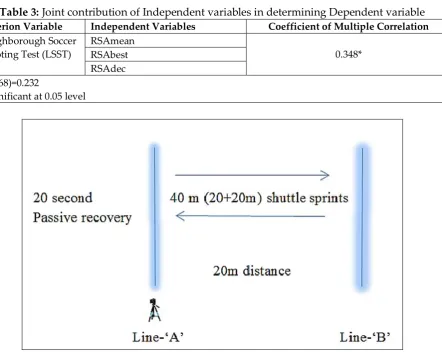
Prior to the RSA test, all the participants had a dynamic warm up of 10 minutes low-intensity running with dynamic stretches. The test was consisted of six 40m (20+20 m) shuttle sprints separated by 20s of passive recovery (Figure 1). The athletes started from a line ‘A’, and sprinted for 20m then touched a line ‘B’ marked on the other side with a foot of the player and returned to the starting line ‘A’ as fast as possible to cross the line. After 20s of passive recovery, the players had to perform the same for six times. The test protocol was recorded with a digital video camera (Powershot SX60 HS, Canon INC., Japan) which was placed over the line ‘A’ at 1.5 meter of height and 4 meter away from the line on sagittal plane on the left hand side of the participant. Later, the timing of sprints was analyzed by the motion analysis software Kinovea – 8.24. Scoring: Three
scores; RSAmean, RSAbest, RSAdec, were calculated from the RSA test and these scores were
counted as different variables in the study. RSAdec was calculated using the following
formula:
RSAdec = ([RSAmean]/[ RSAbest]×100)-100)
(E. Rampinini et al., 2007)
3. Statistical Analyses
All data are conveyed as mean and standard deviation. Before using parametric tests, the condition of normality of data was verified using the Shapiro-Wilk W-test. Pearson product-moment correlations were used to examine the relationship between LSST and RSA variables. To study the joint contribution of independent variables (RSAmean, RSAbest, RSAdec) and dependent variable (LSST), multiple correlation was used. Statistical analysis was performed using SPSS version 18.0 (SPSS Inc., Chicago, IL, USA). The level of significance was set at P<0.05.
4.Results
4.1 LSST performance and RSA scores
Current researchers revealed correlations between Loughborough Soccer Shooting Test (LSST) performance scores and repeated sprint ability (RSA) performances. The results show that the Correlation of Repeated sprint ability (RSA) mean time with shooting accuracy has a statistically significant negative correlation with an r value of -0.340** and a p-value of .004. The result also showed that Correlation of Repeated sprint ability (RSA) best time with shooting accuracy has a statistically significant negative correlation with a r value -0.306** and a p-value of .010. On the other hand, Correlation of Repeated sprint ability (RSA) percentage decrement rate with soccer shooting accuracy was not statistically significantly correlated with r value of -0.054 and p-value of .654 (Table 2). Table 2 clearly indicates a moderate level relationship (status determined using the modified scale by (Hopkins, n.d.) between LSST and repeated sprint ability mean and best time scores as the correlation coefficient value were found greater than the tabulated value at 0.05 level of significance while in case of repeated sprint ability percentage decrement rate no relationship were found.
4.2 Joint contribution of Independent variables in determining Dependent variable
Current researchers also revealed joint contribution of repeated sprint ability test scores in predicting soccer shooting accuracy in repeated manner (Table 3). Table 3 clearly indicates a moderate level relationship was found between Loughborough Soccer Shooting Test (LSST) and repeated sprint ability (RSA) variables as coefficient of
multiple correlations was found 0.348⃰ which is higher than the tabulated value.
5.Discussion
Repeated Sprint Ability (RSA) test has been shown to be a significant match-related fitness prerequisite for soccer players (Gabbett, 2010; “Fifa assistant referee fitness test for linesman,” n.d.; “FIFA Assistant Referee Fitness Test,” n.d.; Weston, Castagna, Helsen, & Impellizzeri, 2009). The soccer game is therefore defined not only by the ability of a player to perform repeated sprinting abilities, but also by the effective execution of skills (Stone & Oliver, 2009). So, the performance of shooting accuracy (repeatedly doing) is connected with fitness. In the same way, researchers found that fatigue is one of the reason for reducing shooting accuracy (Stone & Oliver, 2009). However, researchers Sánchez and his team found that physical performance and muscle response in soccer players can be supplementary factors in the management of fatigue by age group (Sánchez-Sánchez et al., 2019). Similarly, researcher can works on young amateur soccer players in different age categories and playing positions. His study revealed that the best time, average time and complete test time of repeated sprint ability test statistically significant differences depending on the playing position and age factor (Can, 2018). However, Investigators were found significant moderate
negative correlations between VO2max (mL·kg·min−1) and Repeated Sprint Ability (RSA)
2013). So, it is establish that aerobic capacity is one of the key factors that help soccer players to constantly conduct sprint with brief passive recovery. Ali et al., (2007) suggested that highly skilled players can carry out the attacking skills test without compromising their capacity to pass and control the ball accurately. Therefore, present study, it was hypothesized that there may be relationship between repeated sprint ability variables and Loughborough soccer shooting test of Bangladeshi youth soccer players. The hypothesis is partially accepted due to the reason because there was no relationship found between LSST and RSAdec whereas present study indicates a moderate level relationship between LSST and repeated sprint ability variables.
6. Conclusion
Based on the findings and within some limitation of the study the current researchers found that there were moderate level relationship between repeated sprint ability (RSA) and repeated shooting test in LSST, when the test evaluated the accuracy of shooting in Bangladeshi youth soccer players.
Acknowledgments
The researchers thankfully acknowledge the soccer players who participated in this study. The researchers are also grateful for their unconditional assistance to Mohammedan Sporting Club Ltd. (youth team), Saif Sporting Club Limited (Youth team), Arambagh Football academy and Tota Football Academy.
About the Author
Mr. Muhammad Shahidul Islam (Assistant Director), Office of the Physical Education, Shahjalal University of Science and Technology, Sylhet, Bangladesh currently pursuing PhD research in Department of Physical Education and Sports Science, Visva Bharati, Santiniketan, West Bengal, India. He completed Master of Physical Education (M.P.Ed) degree from the renowned Banaras Hindu University, Varanasi, India under Indian government’s ICCR scholarship and also did his Diploma in Sports Management Degree from Leipzig University, Germany on a scholarship scheme from German Federal Foreign Office. He also obtained ‘B’ licence on coaching from Asian Football Confederation (AFC), Malaysia and Club Manager Licence from German Olympic Sports Confederation (DOSB), Germany. He has been the topper of Banaras Hindu University (BHU), India. He has been a successful Assistant Coach with the prestigious Mohammedan Sporting Club Ltd., Dhaka, Bangladesh. He was awarded the best football player in National Sohrawardy Cup Football Tournament in 1999 at Rangpur, Bangladesh. In multiple International seminars and Conferences, he submitted several research papers. He has also published many articles in prestigious National and International journals.
He supervises a number of PhD students and also takes part in discovering fresh stuff about Physical Education and Sport Science.
References
Ali, A., Williams, C., Hulse, M., Strudwick, A., Reddin, J., Howarth, L., McGregor, S. (2007). Reliability and validity of two tests of soccer skill. Journal of Sports
Sciences, 25(13), 1461–1470. https://doi.org/10.1080/02640410601150470
Attene, G., Nikolaidis, P. T., Bragazzi, N. L., Dello Iacono, A., Pizzolato, F., Zagatto, A. M., Padulo, J. (2016). Repeated Sprint Ability in Young Basketball Players (Part 2): The Chronic Effects of Multidirection and of One Change of Direction Are
Comparable in Terms of Physiological and Performance Responses. Frontiers in
Physiology, 7, 262. https://doi.org/10.3389/fphys.2016.00262
Buchheit, M., Mendez-Villanueva, A., Simpson, B. M., & Bourdon, P. C. (2010).
Repeated-sprint sequences during youth soccer matches. International Journal of
Sports Medicine, 31(10), 709–716. https://doi.org/10.1055/s-0030-1261897
Can, I. (2018). Comparison of Repeated Sprint Ability of Amateur Football Players According to Age and Playing Positions. World Journal of Education, 8(2), 54. https://doi.org/10.5430/wje.v8n2p54
Daneshfar, A., Gahreman, D. E., Koozehchian, M. S., Amani Shalamzari, S., Hassanzadeh Sablouei, M., Rosemann, T., Nikolaidis, P. T. (2018). Multi Directional Repeated Sprint Is a Valid and Reliable Test for Assessment of Junior
Handball Players. Frontiers in Physiology, 9.
https://doi.org/10.3389/fphys.2018.00317
FIFA Assistant Referee Fitness Test. (n.d.). Retrieved April 24, 2019, from CNRA website: http://www.cnra.net/register/fifa-assistant-referee-fitness-test/
Fifa assistant referee fitness test for linesman. (n.d.). Retrieved April 24, 2019, from Dutch Referee Blog website: https://www.dutchreferee.com/assistant-referee-fitness-test/
Fitzsimmons, M., Dawson, B., Ward, D., Wilkinson, A., Dawson-Hughes, B., Ware, D.,
Fitzsimons, M. (1993). Cycling and running tests of repeated sprint ability. Retrieved
from
https://www.scienceopen.com/document?vid=e7b9664d-c14c-4f1d-a41f-aeb5a0c5f8bc
Gabbett, T. (2010). The Development of a Test of Repeated-Sprint Ability for Elite Womenʼs Soccer Players. Journal of Strength and Conditioning Research / National
Strength & Conditioning Association, 24, 1191–1194.
https://doi.org/10.1519/JSC.0b013e3181d1568c
John, B. (2018). Why Soccer Is the Most Popular Sport in the World. Retrieved June 15, 2019, from Stadium Talk website: https://www.stadiumtalk.com/s/why-soccer-most-popular-sport-in-world-8145f753db7242f6
Jones, R. M., Cook, C. C., Kilduff, L. P., Milanović, Z., James, N., Sporiš, G., Vučković, G. (2013). Relationship between Repeated Sprint Ability and Aerobic Capacity in
Professional Soccer Players. The Scientific World Journal, 2013.
https://doi.org/10.1155/2013/952350
Owen, J. A., Kehoe, S. J., & Oliver, S. J. (2013). Influence of fluid intake on soccer performance in a temperate environment. Journal of Sports Sciences, 31(1), 1–10. https://doi.org/10.1080/02640414.2012.720701
Rampinini, E., Bishop, D., Marcora, S. M., Ferrari Bravo, D., Sassi, R., & Impellizzeri, F. M. (2007). Validity of simple field tests as indicators of match-related physical
performance in top-level professional soccer players. International Journal of Sports
Medicine, 28(3), 228–235. https://doi.org/10.1055/s-2006-924340
Rampinini, Ermanno, Sassi, A., Morelli, A., Mazzoni, S., Fanchini, M., & Coutts, A. J. (2009). Repeated-sprint ability in professional and amateur soccer players. Applied Physiology, Nutrition, and Metabolism = Physiologie Appliquee, Nutrition Et
Metabolisme, 34(6), 1048–1054. https://doi.org/10.1139/H09-111
Sánchez-Sánchez, J., García-Unanue, J., Hernando, E., López-Fernández, J., Colino, E., León-Jiménez, M., & Gallardo, L. (2019). Repeated Sprint Ability and Muscular
Responses According to the Age Category in Elite Youth Soccer Players. Frontiers
in Physiology, 10. https://doi.org/10.3389/fphys.2019.00175
Sheppard, J. M., & Young, W. B. (2006). Agility literature review: Classifications,
training and testing. Journal of Sports Sciences, 24(9), 919–932.
https://doi.org/10.1080/02640410500457109
Smith, M. R., Coutts, A. J., Merlini, M., Deprez, D., Lenoir, M., & Marcora, S. M. (2016). Mental Fatigue Impairs Soccer-Specific Physical and Technical Performance.
Medicine and Science in Sports and Exercise, 48(2), 267–276.
https://doi.org/10.1249/MSS.0000000000000762
Stone, K. J., & Oliver, J. L. (2009). The effect of 45 minutes of soccer-specific exercise on the performance of soccer skills. International Journal of Sports Physiology and
Performance, 4(2), 163–175.
Weston, M., Castagna, C., Helsen, W., & Impellizzeri, F. (2009). Relationships among field-test measures and physical match performance in elite-standard soccer
referees. Journal of Sports Sciences, 27(11), 1177–1184.
Appendix
Table 1: The LSST and RSA characteristics of the soccer players
Test Protocol Mean Performance Standard Deviation (±SD)
Age (years) 16.4 1.05
Stature (cm) 168.3 5.7
Body mass (kg) 57.11 5.91
LSST (total points) 17.71 4.26
RSAmean (seconds) 7.58 0.25
RSAbest (seconds) 7.20 0.27
RSAdec (% decrement) 4.98 2.20
Table 2: Correlation between Independent variables and dependent variable
SN Independent Variables Correlation coefficient
1. RSAmean -0.340**
2. RSAbest -0.306**
3. RSAdec -0.054
r0.05 (68)=0.232
* significant at 0.05 level
Table 3: Joint contribution of Independent variables in determining Dependent variable
Criterion Variable Independent Variables Coefficient of Multiple Correlation Loughborough Soccer
Shooting Test (LSST)
RSAmean
0.348* RSAbest
RSAdec r0.05 (68)=0.232
* significant at 0.05 level
Creative Commons licensing terms