© 2019 by the Serbian Biological Society How to cite this article: Buntić AV, Stajković-Srbinović OS, Knežević MM, 379 Kuzmanović ĐŽ, Rasulić NV, Delić DI. Development of liquid rhizobial inoculants
and pre-inoculation of alfalfa seeds. Arch Biol Sci. 2019;71(2):379-87.
Development of liquid rhizobial inoculants and pre-inoculation of alfalfa seeds
Aneta V. Buntić*, Olivera S. Stajković-Srbinović, Magdalena M. Knežević, Đorđe Ž. Kuzmanović, Nataša V. Rasulić and Dušica I. Delić
Institute of Soil Science, Department of Microbiology, University of Belgrade, Teodora Drajzera 7, 11000, Belgrade, Serbia
*Corresponding author: [email protected]
Received: October 8, 2018; Revised: December 3, 2018; Accepted: December 20, 2018; Published online: December 27, 2018
Abstract: Application of liquid microbial inoculants on legume seeds is a sustainable agricultural practice that can improve plant nutrient uptake and increase crop productivity. Inoculants should provide long-term survival of rhizobia in the final product and after application, to legume seeds. Ten different medium formulations of microbial inoculants were examined (yeast mannitol broth with the addition of agar, sodium-alginate, calcium chloride, glycerol or ferric chloride and combina-tions thereof) for the survival of the efficient nitrogen-fixing rhizobium, Sinorhizobium (Ensifer) meliloti L3Si strain. The most suitable liquid inoculant for survival of L3Si during a storage time of 150 days was the medium formulation contain-ing glycerol in combination with agar or sodium-alginate. Alfalfa seeds were pre-inoculated with four formulations (yeast mannitol broth (YMB), YMB with agar (1 g L-1), YMB with 1 or 5 g L-1 sodium-alginate) for up to three months. Seeds
pre-inoculated and stored for one month produced successful alfalfa plants. The nitrogen content in alfalfa obtained from pre-inoculated seeds one month before sowing was adequate and ranged from 3.72-4.19%. Using S. meliloti-based liquid inoculants for alfalfa and application of the pre-inoculation technique can increase the quality of alfalfa crops and reduce cultivation cost.
Keywords: rhizobia; pre-inoculation; alfalfa seeds; liquid inoculants; Sinorhizobium meliloti
INTRODUCTION
Current agricultural practice worldwide gravitates to-wards environmental sustainability based on the use of microbiological inoculants instead of mineral fertilizers and pesticides [1]. Microbiological fertilizers containing nitrogen-fixing bacteria have been proven to be the cheapest source of nitrogen, especially for leguminous plants. This type of biofertilizer has the longest history of use in agriculture [2]. Nitrogen-fixing bacteria and other microorganisms that are capable of converting atmospheric nitrogen into compounds usable by plants are called diazotrophs, and the process is known as biological nitrogen fixation (BNF) [3]. Diazotrophs are either free-living (non-symbiotic) or symbiotic. Non-symbiotic microorganisms fix nitrogen as free-living organisms in the soil (Azotobacter, Beijerinckia,
Clostridium, etc.). Symbiotic nitrogen-fixing bacteria,
collectively called rhizobia, can establish symbiosis with plant roots from the family of Leguminosae and fix atmospheric nitrogen to the benefit of the plant
[4]. The inoculation of leguminous seeds is a well-known procedure in many agricultural systems and is a simple and beneficial way of introducing effective rhizobia to the rhizosphere of legumes. By establish-ing a symbiotic relationship and performestablish-ing nitrogen fixation, rhizobia improve the nitrogen content and crop yield [5-8].
For field applications, the liquid inoculant is required in an appropriate formulation and the viability of the inoculant for a certain prolonged time is important for commercialization of the technology [11,12].
Liquid inoculant formulations can include single or numerous rhizobia cultures amended with agents that promote cell survival in the commercial products during storage and after application to seed or soil. Legume seed inoculation can occur prior to sowing or prior to seed sale (pre-inoculation) [13]. Thus, the prolonged survival of rhizobia on pre-inoculated seeds should be provided. This is a gentle technique and works under ambient conditions when cell damage is reduced to a minimum [14]. Pre-inoculated seeds, prepared for days or months in advance of sowing [15,16], should have similar properties to the seeds treated prior to sowing. Application of pre-inoculated seeds contributes to simplification of the sowing process for farmers in the field.
Essentially, liquid inoculants are microbial cultures or suspensions, mainly in water, but also in mineral or organic oils, which are amended with various sub-stances. The roles of applied additives is to improve inoculant quality, such as increased stickiness, stabiliza-tion, and surfactant and dispersal abilities [11,17,18], as well as to provide a protective niche for microorganisms and ensure viability over a prolonged period of storage [14]. Applied supplements should also confer survival of rhizobia cells on pre-inoculated seeds in stressful conditions during storage [1,9]. Advantage should be given to nontoxic and biodegradable polymers in the soil [1]. Polymers soluble in the liquid inoculant formulation are also more convenient for batch pro-cessing of microbial inoculants. Different organic polymers for inoculant production have been tested, including chitin, chitosan, gellan gum and polyvinyl alcohol [14,19,20]. Using natural polymers such as agar, alginate, carrageenan and cellulose and its deriva-tives, collagen and gelatin, is becoming more frequent [14]. Polymers such as sodium-alginate, gum arabic and polyvinyl alcohol are normally used as adhesives when they are applied to seed [17].
Sinorhizobium (Ensifer) meliloti is a fast-growing
rhizobium capable of fixing atmospheric nitrogen in symbiosis with legumes from the genera Medicago,
Melilotus and Trigonella [21]. Symbiotic association
of alfalfa (Medicago sativa L.) with S. meliloti is one of the most efficient interactions between nitrogen-fixing bacteria and legume plants that usually fix 140-210 kg ha-1 of nitrogen per year in the field [22]. In this way, alfalfa contributes to the incorporation of nitrogen in the soil, with a consequent economic and ecologic benefit, helping to reduce the application of synthetic N fertilizers. The S. meliloti L3Si strain showed good nitrogen-fixing properties in alfalfa when used in a solid peat inoculant and for inoculation at the time of sowing [23,24]. In addition, this strain has not been previously used in liquid inoculant formulations.
The aim of this study was to develop liquid in-oculant formulations for alfalfa by adding various supplements to the rhizobium growth medium. In these liquid formulations, the growth and survival of
Sinorhizobium meliloti L3Si strain were evaluated during
a five month period, as well as their nitrogen fixation efficiency in alfalfa plants, observing parameters such as shoot dry weight (SDW) and nitrogen content. In addition, we examined the effects of pre-inoculation of alfalfa seeds with the L3Si strain on plant nodulation, nitrogen content and alfalfa shoot yield after a storage period of up to 3 months.
MATERIALS AND METHODS
Rhizobium culture
A working rhizobium culture was prepared using
Sinorhizobiummeliloti L3Si strain. This is the
nitrogen-fixing strain for alfalfa selected from the Collection of the Institute of Soil Science (ISS WDCM375-Collection of Bacteria, Institute of Soil Science, Department of Microbiology). The L3Si strain was grown in Erlen-meyer flasks in yeast mannitol broth (YMB) on a rotary shaker (125 rpm) at 28°C for 48 h [25].
Preparation of media formulation
The basal medium for liquid inoculant formulation contained: 0.5 g L-1 of K
2HPO4, 0.2 g L-1 of MgSO4 x 7H2O, 0.1 g L-1 of NaCl, 0.2 g L-1 of CaCO
L-1) and the following additives: agar, sodium-alginate, CaCl2, glycerol and FeCl3 (Supplementary Table S1). The additives were added separately or in combination. Liquid inoculant preparations and rhizobium survival evaluation after prolonged storage
Liquid inoculants were prepared by adding S. meliloti
L3Si (which was growing in YMB) to 50 mL of various media at a ratio 1:50 (v:v) and in duplicate. All liquid inoculants were placed in a rotary shaker (125 rpm) at 28°C for 48 h. All treatment samples were stored at 22°C for 150 days. The number of viable bacterial cells after the incubation and after each 30 days of storage was determined by dilution plating. Additionally, pH values were measured in all treatments after the expira-tion of storage time. The effects of time and medium formulation on rhizobium survival were evaluated by one- and two-way ANOVA followed by post-hoc
Duncan’s test to consider the differences between each treatment.
Testing the efficiency of S. meliloti L3Si-based liquid inoculants
After 120 days of storage, liquid inoculants were tested with host plant alfalfa (Medicago sativa variety K28) in a light chamber experiment. Alfalfa seed inoculation was prepared by adding 25 μL of particular inocu-lants to 0.2 g of seeds. After drying, the seeds were sown. The sowing was carried out in glass tubes (250 mm×20 mm) filled with 30 mL of Jensen’s medium agar [25]. Nodulation, plant height, shoot dry weight (SDW) and N content in SDW were determined in ten replicates (10 plants per treatment). The results were compared with two controls. One control represented non-inoculated seeds grown in Jensen’s medium agar (ØØ), and the second was a control with nitrogen (ØN), i.e. non-inoculated seeds grown in Jensen’s medium agar provided with 0.05% KNO3.
Testing pre-inoculation effects on alfalfa seed
The pre-inoculation of alfalfa seed was performed by adding 50 μL of selected treatment to 0.4 g of alfalfa seed. The selected fresh treatments (without storage) were: YMB, YMBA1, YMBSA, YMBSA* (10 times
concentrated treatment). Dried seeds were stored dur-ing a three month period (at 22°C) and 10 seeds were sown every month in glass tubes with Jensen’s medium agar. The pre-inoculation efficiency was evaluated by examination of nodulation, plant height, SDW and N content in SDW. The results were compared with the two controls described above. The effects of pre-inoculation of alfalfa seeds were evaluated by two-way ANOVA followed by post hoc Duncan’s test to examine the differences between each treatment.
RESULTS
Supplement influence on S. meliloti L3Si strain growth
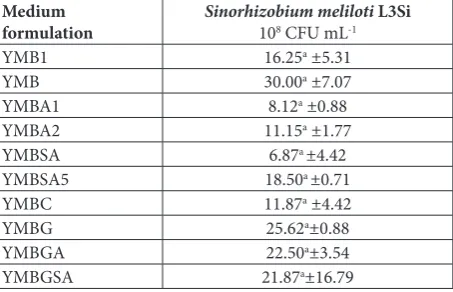
The effects of five additives (agar, sodium-alginate, CaCl2, glycerol and FeCl3) and of different concentra-tions of mannitol on the viable count of S. meliloti L3Si cells after 48 h of incubation were estimated (Table 1). There were only a few adverse effects of supplements on the number of viable cells in ten different media. The concentration of 1 g L-1 of agar and sodium-alginate in the medium (YMBA1 and YMBSA respectively) was slightly unfavorable for growth of the rhizobium. Their viable count was slightly below 1×10⁹ cell mL-1. In other treatments, the viable counts ranged from 1.12×10⁹ cell mL-1 (YMBA2) to 2.56×10⁹ cell mL-1 (YMBG) (Table 1). Statistical analysis also showed no significant differ-ences between the tested supplements and the growth of the L3Si strain (Table 1).
Table 1. The effect of medium formulation on rhizobium growth during 48 h.
Medium
formulation Sinorhizobium meliloti108 CFU mL-1 L3Si
YMB1 16.25a ±5.31
YMB 30.00a ±7.07
YMBA1 8.12a ±0.88
YMBA2 11.15a ±1.77
YMBSA 6.87a ±4.42
YMBSA5 18.50a ±0.71
YMBC 11.87a ±4.42
YMBG 25.62a±0.88
YMBGA 22.50a±3.54
YMBGSA 21.87a±16.79
Survival of S. meliloti L3Si strain in liquid media during storage
During storage from 30 to 150 days, the survival rate of rhizobium L3Si strain was monitored in ten dif-ferent treatments (liquid media), and the results are presented in Fig. 1. Compared to the initial number of viable cells in all formulations (Table 1), the number of viable L3Si significantly decreased after one month of storage (Fig. 1). After that period, the number of rhizobia during storage times between 30 and 150 days in each treatment was more or less constant. The number of viable rhizobia declined slightly in all treatments during storage times from 30 to 150 days and varied between 1.25×10⁸ (YMBSA medium) and 7.81×10⁸ cells mL-1 (YMBG medium) at the end of 150 days. Maximum cell survival ranged from 37.89% in the YMBC medium formulation to 4.06% for YMBSA5 (Fig. 1) after 150 days of storage.
Medium formulation and storage time had a very significant effect on L3Si stain survival (P<0.001). In-teraction between these parameters was not significant (Table 2). The YMBG, YMBGA and YMBSA treatments had the highest number of viable cells during the entire storage period and were significantly different compared to YMB, YMBA1, YMBA2, YMBSA and YMBSA5 (Fig.1). Therefore, these three treatments (YMBG, YMBGA and YMBSA) could be considered as the best formulations for cell survival during storage at 22°C. In YMB, YMBA1, YMBA2, YMBSA and YMBSA5, the number decreased below 1×10⁸ cells mL-1 (Fig.1).
After the expiration of storage time, the pH values were 7.9, 6.5, 8.1, 8.1, 8.3, 8.3, 7.9, 7.4, 7.2 and 7.3 for YMB1, YMB, YMBA1, YMBA2, YMBSA, YMBSA5, YMBC, YMBG, YMBGA and YMBGSA treatments, respectively.
S. meliloti L3Si-based liquid inoculant efficiency
in alfalfa plants
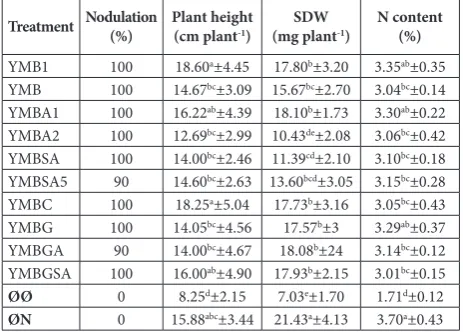
After 120 days of storage, liquid inoculants were ap-plied to alfalfa seeds and the effectiveness of microbial fertilizers was evaluated. The obtained values of nodu-lation, plant height, SDW and N content in SDW are presented in Table 3. Nodulation was 100% except in YMBSA5 and YMBGSA treatments. In all treatments, SDW and N content were higher when compared
Fig. 1. Survival of Sinorhizobium meliloti L3Si strain in ten differ-ent liquid media formulations during storage. Data are presdiffer-ented as the mean±SD of two independent experiments. The different colors of columns denote different storage times of the liquid inoculants. Values followed by the same letter in each treatment are not significantly different (Duncan’s test, P<0.01).
Table 2. Analysis of variance for the survival of Sinorhizobium meliloti L3Si strain during storage from 30 to 150 days.
Source of variance Survival of F-valuesS. meliloti L3Si
Medium formulation 6.921***
Storage time 10.406***
Interaction
Medium formulation
× Storage time 1.109ns
ns- not significant (P≥0.05); ***significant at P<0.001.
Table 3. Efficiency of liquid rhizobial inoculants in alfalfa plants: nodulation, plant height, SDW and N in SDW after inoculants storage of 120 days.
Treatment Nodulation (%) Plant height(cm plant-1) (mg plantSDW-1) N content (%)
YMB1 100 18.60a±4.45 17.80b±3.20 3.35ab±0.35
YMB 100 14.67bc±3.09 15.67bc±2.70 3.04bc±0.14
YMBA1 100 16.22ab±4.39 18.10b±1.73 3.30ab±0.22
YMBA2 100 12.69bc±2.99 10.43de±2.08 3.06bc±0.42
YMBSA 100 14.00bc±2.46 11.39cd±2.10 3.10bc±0.18
YMBSA5 90 14.60bc±2.63 13.60bcd±3.05 3.15bc±0.28
YMBC 100 18.25a±5.04 17.73b±3.16 3.05bc±0.43
YMBG 100 14.05bc±4.56 17.57b±3 3.29ab±0.37
YMBGA 90 14.00bc±4.67 18.08b±24 3.14bc±0.12
YMBGSA 100 16.00ab±4.90 17.93b±2.15 3.01bc±0.15
ØØ 0 8.25d±2.15 7.03e±1.70 1.71d±0.12
ØN 0 15.88abc±3.44 21.43a±4.13 3.70a±0.43
to the control without nitrogen (ØØ). SDW ranged from 10.43 to 18.10 mg plant-1, while the N content ranged from 3.01 to 3.35% in SDW, and in most of the inoculated treatments they were significantly higher compared to control plants (ØØ), indicating a good nitrogen-fixation efficiency of the stored liquid in-oculants (Table 3).
Pre-inoculation effects on alfalfa seed
In the nodulation test with stored pre-inoculated seeds, nodulation was detected in all tested treat-ments (YMB, YMBA1, YMBSA and YMBSA*) on alfalfa roots, except for the YMBSA treatment in the seed sample after 90 days of storage. The percentage of nodulation for the seeds inoculated on the day of sowing and pre-inoculated seeds stored for one month was 100%, all the sown seeds gave nodulated plants. After that period, the nodulation percentage decreased (Fig.2). Slightly higher nodulation (a higher number of nodules) after 60 days of storage was observed in the treatments with agar (YMBA1) and sodium-alginate (YMBSA*) as coating polymers (Fig. 2).
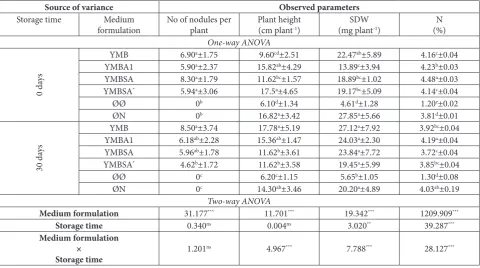
The effects of media formulations and 30-day stor-age of pre-inoculated seeds on the number of nodules, plant height, SDW and N content in SDW were
evalu-ated by one- and two-way ANOVA (Table 4). Media formulation and 30 days of storage time had a signifi-cant effect on SDW. Compared to the control (ØØ), all medium formulations used for seed pre-inoculation significantly increased SDW of pre-inoculated seeds stored for one month before sowing. The efficiency of applied treatments ranged from 3.33- to 4.96-fold higher than the control without N (ØØ) according to SDW (average for the both storage times).
The N percentage or N content in alfalfa SDW varied from 3.99% (YMBA1) to 4.21% (YMBSA*) (average values for both storage times, respectively; Table 4). Slightly higher N% was obtained in plants of the YMBA1 treatment in relation to the control with N (ØN, 3.92%). In addition, this medium formula-tion had the highest influence on N% in alfalfa plant (Table 4). On the other hand, the other three media formulations showed an equal impact on N%.
Seed pre-inoculation with the same medium for-mulation (YMBA1) showed that the N content was 4.23% and 4.19% when using seeds inoculation on the day of sowing and pre-inoculated seeds stored for one month, respectively. Thus, seed pre-inoculation provided an improvement of about 11% and 4% in N content when seeds were inoculated on the day of sow-ing and the pre-inoculated seeds were stored for one month, respectively. Bearing in mind all the observed parameters: plant height, SDW and in particular the N content, the YMBA1 medium formulation had the best effect over a one-month storage time on the pre-inoculated seeds (Table 4).
DISCUSSION
The appropriate material for maintaining microorgan-isms in liquid medium has to offer special proper-ties, such as lack of toxicity to microbes, and must be environmentally safe. Additionally, these materials should have near neutral or readily adjustable pH and be available locally at a reasonable cost.
Some media formulations such as YMB1, YMBGSA, YMBGA and YMBC, for potential normal culturing conditions of rhizobia had no adverse effect on rhizo-bium L3Si strain growth (Table 1) in comparison to the common YMB medium. Out of 10 different applied liquid media, only YMBA1 and YMBSA had a slightly
negative effect on L3Si strain growth. A negative effect of different sodium-alginate concentrations (1 to 5 g L-1) on the growth of various species of the rhizobium was also observed (Bradyrhizobium japonicum USDA110,
Azorhizobium caulinodans IRBG23, Rhizobium phaseoli
TAL1383, S. fredii HH103 and Mesorhizobium ciceri
USDA2429) [16]. According to statistical analysis that showed no significant differences between the tested supplements and growth of the L3Si strain, the selected additives in this research are suitable for the growing media of L3Si strain.
For the commercialization of liquid inoculants, the viability of the rhizobial inoculant in a prescribed for-mulation for a certain period with preservation of strain characteristics is required [27]. During storage time, the number of cells in the liquid inoculant must not drop below 1×10⁸ cells mL-1, according to the local legislation [28]. Fig. 1 represents the effects of the length of storage on the viability of Sinorhizobium meliloti L3Si in various formulations, the biggest reduction during 150 days of storage occurring in the YMBSA5 treatment, probably due to the negative effect of the high concentration of sodium-alginate on the growth of L3Si strain.
Storage time significantly influenced the survival of the L3Si strain. Besides storage time, there were statistically significant differences (P≥0.05) in the sur-vival of the rhizobium between medium formulations. Consequently, the number of rhizobia was significantly higher in the YMBGSA, YMBG, YMBGA, YMBC and YMB1 treatments, as compared to the remaining five treatments. Formulations containing glycerol demon-strated increased viability during storage, which was also previously mentioned in literature [14]. Also, using concentrations of sodium-alginate between 0.5 and 1 g L-1 showed good survival of Rhizobium sp G58 strain during 60 days of storage [29]. In addition, the pH value is important for rhizobia survival in inocu-lants. The optimal pH for L3Si strain growth ranged from 6 to 8.5, and was also optimal for other S. meliloti
strains [30]. In all treatments, the pH values were in the optimal range and therefore this parameter was not a limiting factor in rhizobia survival.
In addition, inoculant storage at low temperatures is generally more suitable for bacterial survival, but it is not practical [31-33]. Thus, the main disadvantage of liquid inoculants is that they cannot be stored at room
Table 4. Effects of seed pre-inoculation on alfalfa growth and its nitrogen-fixing efficiency.
Source of variance Observed parameters
Storage time Medium
formulation No of nodules per plant Plant height (cm plant-1) (mg plantSDW -1) (%)N
One-way ANOVA
0 d
ays
YMB 6.90a±1.75 9.60cd±2.51 22.47ab±5.89 4.16c±0.04
YMBA1 5.90a±2.37 15.82ab±4.29 13.89c±3.94 4.23b±0.03
YMBSA 8.30a±1.79 11.62bc±1.57 18.89bc±1.02 4.48a±0.03
YMBSA* 5.94a±3.06 17.5a±4.65 19.17bc±5.09 4.14c±0.04
ØØ 0b 6.10d±1.34 4.61d±1.28 1.20e±0.02
ØN 0b 16.82a±3.42 27.85a±5.66 3.81d±0.01
30 d
ays
YMB 8.50a±3.74 17.78a±5.19 27.12a±7.92 3.92bc±0.04
YMBA1 6.18ab±2.28 15.36ab±1.47 24.03a±2.30 4.19a±0.04
YMBSA 5.96ab±1.78 11.62b±3.61 23.84a±7.72 3.72c±0.04
YMBSA* 4.62b±1.72 11.62b±3.58 19.45a±5.99 3.85bc±0.04
ØØ 0c 6.20c±1.15 5.65b±1.05 1.30d±0.08
ØN 0c 14.30ab±3.46 20.20a±4.89 4.03ab±0.19
Two-way ANOVA
Medium formulation 31.177*** 11.701*** 19.342*** 1209.909***
Storage time 0.340ns 0.004ns 3.020** 39.287***
Medium formulation ×
Storage time 1.201
ns 4.967*** 7.788*** 28.127***
Values followed by the same letter in the column are not significantly different (Duncan test, P<0.05); ns- not significant (P≥0.05); ** Significant at
P<0.01, *** Significant at P<0.001, respectively; ØØ-control without nitrogen; ØN- control with nitrogen (0.05% KNO3); One-way ANOVA shows
temperature for a long time without compromising the viability of bacteria and their effectiveness. The physical and chemical properties of applied polymers should protect cells against desiccation, sedimentation and cell death [34]. In addition, the use of sodium-alginate (1 g L-1) in the inoculant formulation provided successful survival during 60 days of storage at 28°C [34]. Because of this, room temperature was selected and a satisfactory survival of rhizobia was obtained. In previous research, inconsistent results were obtained. Ben Rebah et al. [9] studied the survival of the S. meli-loti A2 strain on waste sludge, peat and sludge-peat-based carriers as substrates for growth of rhizobia. The temperatures of the storage period of 130 days were 4°C and 25°C. After 120 days of storage, the numbers of viable rhizobia declined and remained lower than 1×10⁸ cells g-1 in the following samples: sludge carrier at 25°C, peat and sludge-peat-based carriers at 4°C [9]. On the other hand, the survival of S. (Ensifer) fredii
SMH12 strain and B. japonicum USDA110 strain in mannitol-supplemented liquid inoculants stored at 25°C supported more than 5×10⁹ and 1×10⁸ cells mL-1 after 90 days of storage, respectively [35].
The formulation of inoculants, the method of ap-plication and storage for an extended time period are critical for the success of the biological product [36]. A short shelf life, lack of suitable carrier materials, sus-ceptibility to high temperature, transport and storage problems are bottlenecks in the manufacturing process of microbial fertilizers. After testing the media formula-tions during five months of storage on rhizobium L3Si survival, the effectiveness of the stored inoculants was examined. The 120-day-old liquid rhizobial inoculants were used to test their efficacy with alfalfa, since this is the optimal time that passes between production and use of an inoculant. In previous research, Sehrawat et al. [37,38] examined the efficiency of 90-day-old liquid rhizobial inoculants of Rhizobium sp. MB1503 strain
and Rhizobium sp. strain MB703, respectively.
All tested microbial fertilizers (applied after 120 days of storage) had a positive effect on all parameters of alfalfa growth (observed as nodulation, plant height, shoot dry weight (SDW) and N content in SDW). SDW and N content are the most important parameters for estimating liquid inoculant efficiency [39]. According to SDW, effective treatments were YMB1, YMBC,
YMBG, YMBGA and YMBGSA. One liquid inoculant is effective if a sample’s SDW shows 2.5-fold higher values compared to the control without nitrogen [40]. In addition, the N content was satisfactory in all tested treatments because it was higher than 3%.
The technique of seed pre-inoculation is carried out to avoid seed inoculation during sowing. In this way, the transport of seeds from producer to farmer is simplified and facilitates the work of farmers in the field. Pre-inoculation of alfalfa seeds with agar and sodium-alginate as coating polymers can be justified because they create a suitable microenvironment for the rhizobium. The nodule number per plant decreased with storage time and this reduction was connected to rhizobia survival. Nodulation was slightly higher than in the samples with YMB medium. The nodule number per plant decreased with storage time and this reduction was associated with rhizobia dying over time.
In addition, the protective nature of biopolymers, such as sodium-alginate, comes from its ability to limit heat transfer and it also has high water activities [31]. In this case, these might be mechanisms that improve the survival of rhizobium L3Si on pre-inoculated alfalfa seeds. The survival leads to nodulation and nitrogen fixation in the field, and liquid inoculants compete with peat-based inoculants [26]. On the other hand, the application of pre-inoculated seeds has benefits in terms of lower cost, the use of small amounts of liquid inoculants for pre-inoculation and an eco-friendly approach as compared to mineral N fertilizer application. In addition, adding mineral fertilizer in amounts that are in excess of the optimum does not increase yield and crop quality [39].
Based on two factorial variance analysis, we ob-served that medium formulation had a highly significant (P<0.001) effect on all tested parameters (number of nodules, plant height, SDW and N content). Interaction between the medium formulation and storage time had a highly significant effect on plant height, SDW and N content. The medium formulation had a highly significant effect on all tested parameters. On the other hand, stor-age time did not have a significant effect on the number of nodules and plant height, but had a significant effect on SDW (P<0.01) and N content (P<0.001).
in pre-inoculated seeds. Two months after storage of pre-inoculated seeds, the percentage of plant nodula-tion was less than 80%, and after three months it was about 20% and less. In addition, after the selected storage time of 30 days SDW did not change or was significantly increased (P<0.01). Plant SDW is the best parameter to evaluate the symbiotic nitrogen efficiency of legume-rhizobium associations [39]. All used liquid inoculates for pre-inoculation had a significant positive effect on SDW after one month of storage. In that period, the survival of L3Si strain was the highest according to plant nodulation. The percent-age of the N content in alfalfa SDW in all treatments was adequate or slightly higher according to Bergm-man [41], where the optimal content of N was 3-5%. Therefore, a large number of cells remained viable over time. Additionally, in the present study, the technique of seed pre-inoculation was equally efficient as a plant inoculation procedure with regard to N content. Delić et al. [42] reported an N content of 3.70% in the SDW of the same alfalfa cultivar (K-28) inoculated with the same strain (L3Si). This corresponded to an N content of 3.92% that was obtained in the YMB treatment in our study. The results indicate that the storage time of one month did not prevent the L3Si strain from providing an adequate percentage of N in the host plant in the process of nitrogen fixation.
CONCLUSION
The additives agar, sodium-alginate, calcium chloride, glycerol and ferric chloride did not affect the growth
of S. meliloti L3Si strain, but they showed a significant
positive effect on its survival during storage. Treat-ments with glycerol had the highest positive effect on survival of rhizobia in liquid inoculants during 150 days of storage, as well as on their efficiency after application of a 120-day-old liquid Sinorhizobium in-oculant. The pre-inoculation technique yielded good results with YMB, YMBA1, YMBSA and YMBSA* treatments. The alfalfa SDW significantly increased in pre-inoculated seeds stored for one month, and the content of nitrogen reached adequate values, ranging from 3.72 to 4.19% with the pre-inoculation technique. Therefore, application of pre-inoculated seeds could provide double benefits in agricultural production – easier application of seeds in the field and a higher N content in alfalfa plants.
Acknowledgments: Financial support for this investigation was provided by the Ministry of Education, Science and Technological Development of the Republic of Serbia, Projects TR 31035 and TR 37006, and is gratefully acknowledged.
Author contributions: A.B. and O.SS. designed the study, per-formed the statistical analyses, interpreted the results and wrote the manuscript. M.K., Đ.K., N.R., and D.D. performed the ex-perimental work.
Conflict of interest disclosure: None to declare.
REFERENCES
1. Young CC, Rekha PD, Lai WA, Arun AB. Encapsulation of plant growth‐promoting bacteria in alginate beads enriched with humic acid. Biotechnol Bioeng. 2006;95(1):76-83. 2. Li Z, Zhang H. Application of microbial fertilizers in
sustain-able agriculture. J Crop Prot. 2001:3(1):337-47.
3. Dresler-Nurmi A, Fewer DP, Räsänen LA, Lindström K. The Diversity and Evolution of Rhizobia. In: Pawlowski K, editor. Prokaryotic Symbionts in Plants. Vol 8. Berlin, Heidelberg: Springer; 2007. p. 3-41.
4. Biswas B, Gresshoff PM. The role of symbiotic nitrogen fixation in sustainable production of biofuels. Int J Mol Sci. 2014:15(5):7380-97.
5. Galleguillos C, Aguirre C, Barea JM, Azcon R. Growth promoting effect of two Sinorhizobium meliloti strains (a wild type and its genetically modified derivative) on a non-legume plant species in specific interaction with two arbus-cular mycorrhizal fungi. Plant Sci. 2000;159(1):57-63. 6. Singleton P, Keyser H, Sande E. Development and evaluation
of liquid inoculants. In: Herridge D, editor. Proceedings of a workshop held in Hanoi; 2001 Feb 17-18; Vietnam: Can-berra; 2002. p. 52-66.
7. Biswas PK, Bhowmick MK. Effect of liquid and carrier based Rhizobium inoculants on growth, nodulation and seed yield of urdbean. J Crop Weed. 2007;3(2):7-9.
8. Tlepov A, Dzhaparov R, Akhmetov E. Nitrogen accumula-tion in chickpea organs by isotope indicaaccumula-tion and influence of mineral fertilizers and biopreparates on its productivity in Ural region of Kazakhstan. Soil Plant. 2017;66(2):9-66. 9. Rebah FB, Tyagi RD, Prevost D. Wastewater sludge as a
substrate for growth and carrier for rhizobia: the effect of storage conditions on survival of Sinorhizobium meliloti. Bioresource Technol. 2002;83(2):145-51.
10. Buntić A, Stajković-Srbinović O, Rasulić N, Kuzmanović Dj, Delić D, Dimitrijević-Branković S. Influence of spray dry-ing technique on survival of Bradyrhizobium onto sodium alginate based carriers. Soil Plant. 2015;64(2):9-16. 11. Bashan Y, de-Bashan LE, Prabhu SR, Hernandez JP.
Advances in plant growth-promoting bacterial inoculant technology: formulations and practical perspectives (1998– 2013). Plant Soil. 2014:378(1-2):1-33.
14. Zommere Ž, Nikolajeva V. Immobilization of bacterial asso-ciation in alginate beads for bioremediation of oil-contami-nated lands. Environ Exp Bot. 2017:15:105-11.
15. Catroux G, Hartmann A, Revellin C. Trends in rhizobial inoculant production and use. Plant Soil. 2001;230(1):21-30. 16. Hartley EJ, Gemell LG, Deaker R. Some factors that con-tribute to poor survival of rhizobia on preinoculated legume seed. Crop Pasture Sci. 2013;63(9):858-65.
17. Leo-Daniel AE, Vanketeswarlu B. Suseelendra D. Praveen-Kumar G. Mirhassanahmad SK, Meenakshi T. Effect of poly-meric additives, adjuvants, surfactants on survival, stability and plant growth promoting ability of liquid bioinoculants. J Plant Physiol Pathol. 2013:1(2):1-5.
18. Lee SK, Lur HS, Lo KJ, Cheng KC, Chuang CC, Tang SJ, Yang ZW, Liu CT. Evaluation of the effects of different liquid inoculant formulations on the survival and plant-growth-promoting efficiency of Rhodopseudomonas palustris strain PS3. Appl Microbiol Biot. 2016:100(18):7977-87.
19. Temprano FJ, Albareda M, Camacho M, Daza A, Santama-ría C. Rodríguez-Navarro N. Survival of several Rhizobium/ Bradyrhizobium strains on different inoculant formulation and inoculated seed. Int Microbiol. 2002;5(2):81-6. 20. Namasivayam SKR, Saikia SL, Bharani ARS. Evaluation of
persistence and plant growth promoting effect of bioen-capsulated formulation of suitable bacterial bio-fertilizers. Biosci Biotech Res Asia. 2014;11(2):407-415.
21. Vance CP, Heichel GH, Phillips DA. Nodulation and sym-biotic nitrogen fixation. In: Hanson AA, Barnes DK, Hill RR, editors. Alfalfa and Alfalfa Improvement, Agronomy 29. Madison, Wisconsin: ASA-CSSA SSSA; 1988. p.229-57. 22. Provorov NA, Tikhonovich IA. Genetic resources for
improving nitrogen fixation in legume-rhizobia symbiosis. Genet Resour Crop Evol 2003:50:89-99.
23. Stajković-Srbinović O, Delić D, Nerandžić B, Andjelović S, Sikirić B, Kuzmanović Dj, Rasulić N. Alfalfa yield and nutri-ent uptake as influenced by co-inoculation with rhizobium and rhizobacteria. Rom Biotech Lett. 2017;22(4);12834-41. 24. Delić D, Stajković-Srbinović O, Radović J, Kuzmanović D,
Rasulić N, Simić A, Knežević-Vukčević J. Differences in symbiotic N2 fixation of alfalfa, Medicago sativa L. cultivars and Sinorhizobium spp. strains in field conditions. Rom Bio-tech Lett. 2013;18(6):8743-50.
25. Vincent JM. A manual for the practical study of the root nodule bacteria. Oxford: Blackwell Scientific Publications, 1970. 164 p. (IBP handbook; 15).
26. Tittabutr P, Payakapong W, Teaumroong N, Singleton PW, Boonkerd N. Growth, survival and field performance of bradyrhizobial liquid inoculant formulations with polymeric additives. Sci Asia. 2007;33(1):69-77.
27. Trivedi P, Pandey A, Palni LMS. Carrier-based preparations of plant growth-promoting bacterial inoculants suitable for use in cooler regions. World J Microb Biot. 2005:21(6-7):941-5.
28. Howieson JG, Dilworth MJ. Working with rhizobia. Can-berra: Australian Centre for International Agricultural Research; 2016.
29. Rivera D, Obando M, Barbosa H, Rojas Tapias D, Bonilla Buitrago R. Evaluation of polymers for the liquid rhizobial formulation and their influence in the Rhizobium-Cowpea interaction. Univ Sci. 2014:19(3):265-75.
30. Rinaudi L, Fujishige NA, Hirsch AM, Banchio E, Zorregui-eta A, Giordano W. Effects of nutritional and environmental conditions on Sinorhizobium meliloti biofilm formation. Res Microbial. 2006,157(9):867-75.
31. Deaker R, Roughley RJ, Kennedy IR. Legume seed inoculation technology - a review. Soil Biol Biochem. 2004;36(8):1275-88.
32. Biederbeck VO, Geissler HJ. Effect of storage temperatures on Rhizobium meliloti survival in peat-and clay-based inocu-lants. Can J Plant Sci. 1993;73(1):101-10.
33. Somasegaran P. Inoculant production with diluted liquid cultures of Rhizobium spp. and autoclaved peat: evaluation of diluents, Rhizobium spp., peats, sterility requirements, storage, and plant effectiveness. Appl Environ Microb. 1985;50(2):398-405.
34. Cortes-Patino SA, Bonilla RR. Polymers selection for a liquid inoculant of Azospirillumbrasilense based on the Arrhenius thermodynamic model. Afr J Biotechnol. 2005:14(33):2547-53.
35. Albareda M, Rodríguez-Navarro DN, Camacho M, Tem-prano FJ. Alternatives to peat as a carrier for rhizobia inoc-ulants: solid and liquid formulations. Soil Biol Biochem. 2008;40(11):2771-9.
36. Chen, JH. The combined use of chemical and organic fer-tilizers and/or biofertilizer for crop growth and soil fertil-ity. In: International workshop on sustained management of the soil-rhizosphere system for efficient crop production and fertilizer use; 2006 Oct 16-20. Bangkok, Thailand: Land Development Department; 2006. p. 1-11.
37. Sehrawat A, Suneja S, Yadav A, Anand RC. Influence of different additives on shelf life of rhizobial inoculants for mungbean (Vigna radiata L.). Int J Recent Scientific Res. 2015:6(5):4338-42.
38. Sehrawat A, Yadav A, Anand RC, Kukreja K, Suneja S. Enhancement of shelf life of liquid biofertilizer contain-ing Rhizobium sp. infecting mungbean (Vigna radiata L.). Legume Res. 2017:40(4):684-90.
39. Delić D, Stajković-Srbinović O, Kuzmanović D, Mrvić V, Knežević-Vukčević J. Effect of bradyrhizobial inoculation on growth and seed yield of mungbean in Fluvisol and Humo-fluvisol. Afr J Microbiol Res. 2011;5(23):3946-57.
40. Pochon J. Manuel technique D’Analyse microbiologique du sol. Paris : Masson et Cie, 1954.123p.
41. Bergmann W, Nutritional disorders of plants - development, visual and analytical diagnosis. Jena: Fischer; 1992. 347 p. 42. Delić D, Stajković O, Radović J, Stanojković A, Kuzmanović
Đ, Rasulić N, Miličić B. Genotypic differences in symbiotic N2 fixation of some alfalfa (Medicago sativa L.) Genotypes. In: Huyghe C, editor. Sustainable use of Genetic Diversity in Forage and Turf Breeding. Vol 16. Dordrecht: Springer; 2010. p.79-84.
Supplementary Data
Supplementary Table S1.