SILENCE IN RWANDA: RATIONALIZING INTERNATIONAL RESPONSE TWENTY YEARS LATER
By Jon Tostoe
Senior Honors Thesis Department of Sociology
University of North Carolina at Chapel Hill
April 24, 2015
Approved:
_______________________
ABSTRACT
The small, central African country of Rwanda was the scene for the most brutal genocide since the Holocaust. Over 800,000 people were killed in three months while the rest of the world stood idly by. Since the Genocide Convention of 1948 and the
subsequent international rally cry that Genocide would be “never again” the world has failed to stop genocide repeatedly. Looking back on Rwanda, it is now clear that the world knew about the killings, but failed to act to stop them. My research probes into the question of how genocide keeps occurring and points the blame towards the very
international organizations that are supposed to prevent them.
ACKNOWLEDGEMENTS
I would first like to thank my advisor, Dr. Neal Caren for assisting and mentoring me through this process, I would also like to thank Dr. Howard Aldrich, Dr. Andrew Perrin,
Jessica Pearlman, Kari Kozlowski, Dr. Kenneth Andrews, Jennifer Denning, Emily Smith, Erin Arizzi, Dr. Kathleen Harris, Penny and Charles Tostoe, Jeffrey and Brenna Blake, my beautiful Godson Jon Deaglan Blake, Randolph Community College, and the
Southern Sociological Society.
I also would like to thank the University of North Carolina at Chapel Hill Sociology Department, the Rachel Rosenfeld Fund for Teaching in the Department of Sociology, and the University of North Carolina at Chapel Hill Office of Undergraduate Research
TABLE OF CONTENTS
I. INTRODUCTION…...………...………….……...……..7
II. LITERATURE REVIEW………..………10
International Politics and Peacekeeping……….……….……12
Political Concerns………15
Rhetorical Aspects Connecting to Genocide………..………...………...16
Rhetorical Attributes Surrounding Rwanda…….………...……….18
III. METHODS………...………..……...20
IV. RESULTS………..………..……22
Distancing………..………..…………..……..23
Concerns Regarding Self-Interest and Political Motivations……….…...26
Deflection………..……….….…...29
Rhetorical Strategies: Repetition and Downplay……….…...…….30
V. DISCUSSION………..……….…….……...33
Implications Overview……….………...………….33
Limitations and Concerns………...……….………....34
VI. CONCLUSION………..………..………35
Significance and Future Research……….………...…………36
LIST OF TABLES
“I know there is a God because in Rwanda I shook hands with the devil. I have seen him, I have smelled him and I have touched him. I know the devil exists, and therefore I know there is a God. Peux ce que veux. Allons-y.”
– LGen Roméo Dallaire, July 2003
In late 1993, United Nations General Romeo Dallaire received orders for the mission of a lifetime. He was instructed to command and coordinate a small United Nations peacekeeping force in the tiny, little known, central-African country of Rwanda. A result of past Belgian colonization, Rwanda had been assumed to be boiling over again with the long-standing continuation of a violent civil war between the two central ethnic groups within the country, the Hutu and the Tutsi. General Dallaire’s mission, named the United Nations Assistance Mission In Rwanda (UNAMIR), would be to maintain a small United Nations peacekeeping force in and around the capital city of Kigali, as well as to remind the two warring parties about the supposed peace agreement recently laid out under the recent ceasefire agreements.1 Little did Dallaire know at the time, but there was a much more sinister plan unfolding. In January of 1994, a moderate Hutu informant approached General Dallaire with information reporting that the extremist Hutu group was planning to register and slaughter every Tutsi and moderate Hutu in Rwanda. Armed
1
with this information, Dallaire immediately faxed the U.N headquarters to inform them of the dire situation and to request more troops, along with the authority to begin a more active mission, aimed at preventing a mass killing. Dallaire’s request was all but ignored as he was commanded to just “stick to the mandate” that they were there for and most importantly to avoid any active engagement within Kigali or the surrounding areas. Dallaire was shocked at the apparent lack of interest concerning the informant’s news, but his orders had been given and it was his duty to follow them. Unfortunately, the informant was right and Gen. Dallaire, along with the small peacekeeping force at his side, were forced to sit idly by while nearly a million Rwandan civilians were slaughtered with machetes over the course of the next three months. Suffering extreme anxiety and remorse regarding his passivity during the genocide in Rwanda, Dallaire was ultimately relieved of his position and was left to deal with the deaths of a million people on his own as the weight of not stepping in to stop the killings crushed down on him. As General Dallaire knows and now, the rest of the world knows, the genocide in Rwanda could have and should have been prevented. The knowledge that was available to the international community was immense and fruitful, yet there was no official active intervention aimed at stopping the genocide.
intervention. The aftermath of the Holocaust brought genocide into public
knowledge…the international community was in need of answers, not only about the atrocities surrounding the Holocaust, but also regarding how such an event could unfold among such secrecy. These questions were addressed by the United Nations General Assembly (1951) in their “Convention on the Prevention and Punishment of the Crime of Genocide”, which outlined a formal definition of genocide and also assigned certain situations under which agreeing nations would be obligated to intervene in attempts to prevent future genocides. The assembly adopted the resolution on December 9th, 1948; three years after the end of World War II. The convention set a precedent for addressing crimes of genocide, and with the help of such phrases like “never again”, the international community had bound together to never let “another holocaust” happen.
Unfortunately, genocide would happen again, and had happened already on a devastating level in the early 20th century with the displacement and massacre of an estimated one million Armenian citizens at the hands of the Turks, but it had gone mostly unmentioned2. Then the 1970’s would see the largest genocide (in terms of percentage of a population killed) when the Khmer Rouge, under the leadership of Pol Pot, savagely murdered hundreds of thousands of innocent citizens in Cambodia. Then the 1990’s would see the breaking up of the Soviet Union and subsequently Yugoslavia, which would lead to the Bosnian genocide, committed by the majority Serbian population. These instances still do not cover all instances of mass murder, as Darfur, Sudan, Iraq, and most recently Yemen, should not go unnoticed. However, my research specifically
2
revolves around Rwanda, which was arguably one of the most savage and brutal
genocides committed yet, and according to Power (2013), the most efficient mass killing since the Atomic bombs were dropped on Japan. My research revolves around three months in the spring of 1994 and a genocide that took place without any outside intervention or help deep in the heart of central Africa.
REVIEW OF LITERATURE
Beginning in April of 1994, Rwanda was the scene of one of the most tragic mass killings since the Holocaust. Over the course of roughly 100 days, extremist Hutu
systematically slaughtered an estimated 800,000 Tutsi and moderate Hutu. As a result of more than a century of deeply-rooted ethnic distrust and distain for one another, which was largely the result of a Belgian colonization that arbitrarily assigned a higher “class status” to the Tutsi, the genocide in Rwanda serves as a reminder of the horrific ways in which ethnic differences can become dangerously polarized; thus creating a situation where genocide can arise. In the aftermath of the Rwandan genocide, many individuals began to question why there was no response from the international community, most importantly from the United States3 and the United Nations. Scholars now know that both the U.S and the U.N had substantial knowledge about the declining situation in Rwanda, including detailed reports of events as they unfolded from the few sources in Rwanda. (2013) The fact was that in the face of another horrific genocide, help had not come from the very places that could have (and many say should have) provided it, and the pleas for help from the Rwandan people were largely ignored. This fact has left people asking the
3
question: why did no one step in to stop the slaughter in Rwanda? Previous research on the act of genocide itself has substantial depth, and a great deal of effort has been given in developing a comprehensive understanding of why and how genocides occur.
Much less vigilant attention has been given in the realm of international responses (or lack thereof) to genocide, as many believe the Holocaust and the Cambodian genocide were, for the most part, out of the hands of the international community. However, the Rwandan genocide has seemed to ignite a new area of research into understanding how those outside of the genocide react and intervene. In her Pulitzer Prize winning book, “A Problem from Hell”, Samantha Power (2013) provides a powerful and in-depth review of the American responses to genocides and instances of ethnic cleansing. Power delivers a powerful review of U.S and U.N inaction, specifically citing concern over negative public opinion concerning failed past humanitarian efforts and a collective fear of “another Somalia”. The inaction on the part of the U.S and the U.N is examined in depth in an attempt to justify the decisions made by those involved, but ultimately, as explained in Eyewitness to a Genocide, bureaucratic interests prevailed over moral obligation. (Barnett, 2003) Moral obligation continued to be questioned regarding Rwanda and some researchers, such as Heinze (2007), placed responsibility almost directly in the hands of the United States, citing an obvious rhetorical avoidance regarding intervening.
creating such a collective memory. The problem, however, exists largely external to the genocide itself. The problem is a result of inaction on the part of the systems that were developed to aid in international crises (such as the United Nations) and nations that are capable, militarily and financially, of helping, but choose not to do so for certain reasons. It is the point of my research to illustrate, using the theories described below, how these institutions responded to the genocide in Rwanda and how those decisions drastically affected those in Rwanda that had no where else to turn.
International Politics and Peacekeeping
an unfortunate, but accurate, point surrounding the possibly of an international
intervention…the fact that global politics has an enormous amount of influence when it comes to international intervention. Kentish recalls the former Yugoslavian ambassador Warren Zimmerman who stressed that often, forces external to genocide, such as the United Nations, require pressure to intervene. In reviewing the outside pressures to intervene it is also important to review the factors that put pressure on the different parties to intervene, what factors can cause outside factors to not intervene, and then, drawing on examples surrounding Rwanda, show how these factors inhibited the response to the genocide.
The current body of literature surrounding the factors behind humanitarian intervention and peacekeeping strategies offer some deep explanations, but these
explanations are few in number and often call on theoretical viewpoints that are similar in nature. A substantial part of the research surrounding interventionist strategies comes out of the framework of International Relations (IR) theory, and it is in the IR theory
framework that I develop a connection to what is referred to as “relational
constructivism”. To provide a theoretical framework it is important to outline the areas of research outside of IR theories, and to bridge those to the IR theories that have been offered as of yet.
the western world has been largely influenced by a view of the world that is constructed from biases and preconceptions. Since organizations such as the United Nations and the U.S government rely heavily on western influence, Long and Mills argue that these organizations share the same biased lens; which has influenced decisions regarding international interventions. Furthermore, Long and Mills posit that, much like Edward Said’s theories surrounding Orientalism that they use as supporting evidence, the way in which the “other world” is seen through the western lens also drives a discursive
narrative that serves to inflate western hegemonic ideologies regarding the view of the “post-colonial” countries such as Rwanda. Where research such as the one mentioned above seeks to understand the ways in which cultural perceptions and ideologies affect the way the western world perceives the world as a binary, other research has focused on how the international community adopts peacekeeping strategies that are much more situation-based…understanding peacekeeping as problem-solving. Perhaps the most substantive research comes from Cox, (1981) who presents two different ways of viewing these global relations: problem-solving theory and critical theory. Problem-solving
theory, as Cox describes, views the world as being dependent on power-relations and social orders, providing different sectors that take the position of solving certain
present-day issues. For Cox, the state of international relations is no doubt dependent on outside forces as well as the internal, or organizational, viewpoints that align with them. Political Concerns
government. Other researchers, who also drew from background events impacting the ways in which governments intervened, support Barnett’s interest in the way the past has effected the situation in Rwanda. While great importance has been placed also on the idea of international diplomacy, some suggest however that such failures like the one in Rwanda may be attributable to diplomatic misfortune. The diplomatic contributions to inaction are not necessarily accidental, as I will describe later, but a complex system of rhetorical acrobatics that skew responsibility, thus creating great ambiguity in terms of a rhetorical response.
Rhetorical Aspects Connecting to Genocide
It is within the discourse surrounding the Rwandan genocide that the rhetorical strategies being used had a significant impact on international relations, especially when referring to international peacekeeping strategies. For the purpose of my study, it is important to outline the overall rhetorical strategies adopted under certain political circumstances and the theoretical approaches to these strategies that supply a background for the rhetorical interpretation in my study. Much research that has been done regarding the Rwandan genocide has in fact brought up the different rhetorical strategies employed by the U.S. government and the United Nations, and this is because the connection
shows that the term “genocide” itself is a commanding term and can, in itself, “invoke an obligation to act”. Woodard goes on to make the claim the rhetoric involved in genocide is political in itself, thus justifying political action of some kind. Woodard constructs an idea that the rhetoric behind genocide is, and has been, used by certain individuals surrounding such events to promote a specific political agenda. The idea that individuals use certain practices in their rhetoric is exactly what I will show as one of the issues surrounding the non-intervention strategy in Rwanda. General Romeo Dallaire’s’
correspondence with officials in Washington, D.C and New York, and also provide many of the primary sources I use, as they show the efforts that were taken to avoid entering into a conflict within Rwanda. Other documents, such as the Clinton administrations’ “Policy on Reforming Multilateral Peace Operations”, which came out in May of 1994, give a framework for drawing conclusions about the rhetorical practices. These
the failure of modern peacekeeping and intervention; largely occurring through speech and rhetoric. Lipson uses Rwanda as well as the genocide in Bosnia as examples of how organizations such as the U.N fail to deliver on the tenets by which they were developed, thus becoming hypocritical. Lipson offers an explanation defending the hypocrisy by suggesting it can sometimes be necessary to retain stability internationally, but in the end he fails to suggest that this can outweigh the detriments regarding the hypocrisy behind the organization.
Rhetorical Attributes Surrounding Rwanda
To create a framework for my analysis I use a Relational-Constructivist approach to explain why there was no intervention in Rwanda during the genocide. I then draw from primary documents to examine the rhetorical strategies used by those involved to support my argument. I suggest that socio-political frameworks do not entirely explain the lack of a response in Rwanda and I show how the rhetorical strategies, when added to socio-political factors give a more accurate interpretation of the situation in Rwanda. Lerstad (2013) provides a basic question regarding the process of viewing genocide under a relational-constructivist frame in asking how the responsibilities to protect other
countries plays out in terms of humanitarian responses. Lerstad’s view of Rwanda is of particular interest in my study as she takes into account the view that the United States had an “unprecedented” chance to take charge in the form of an international leader, both politically and morally. Michael Lipson’s work on peacekeeping will also provide
valuable insight into my analysis as he presents an argument for what he terms
“inconsistent rhetoric and inaction” resulting from “…conflicting material and normative pressures” (2007). Looking beyond the organization, to a more macro level of
understanding, is a crucial element in my research design, as I believe that many researchers have isolated only the micro or only the macro and not drawn the lines between the two that need to exist. Paris (2003) offers a view of understanding such efforts of peacekeeping and intervention as a “global” issue, depending on the global view of “world polity” theory by connecting the theory to peacekeeping in specific. Paris’s is similar in style to my research, but I hope to draw more clear connections with the “micro” processes through my analysis of rhetorical acts surrounding the crisis in Rwanda.
and strategies used to avoid “g word” to show how these relations were taking place. Leaning heavily on the research regarding international and peacekeeping theories as well as the great narratives provided by Power, Dallaire, and Barnett, I connect the lines between rhetoric and practice and ultimately offer theoretical insight into how the Rwandan genocide was faced with such complacency.
METHODS
For the purpose of this research I decided to conduct a qualitative research study, while also using a mixed methods approach with a focus on grounded theory and
qualitative data analysis. The resource(s) that I used to gather the data for my research were primary source documents originating within the United Nations Security Council (U.N.S.C) during the Rwandan Genocide and range from the dates January to June of 1994. For the sake of a comprehensive view, I used all of the documents regarding the situation in Rwanda and the United Nations Assistance Mission In Rwanda (UNAMIR). The documents used for my study are the entirety of the documents that originated within both the United Nations and the United States in that time span.4 There are documents that also exist as a part of the Rwandan Genocide from the other countries that were involved in the decision making process, mainly New Zealand, the United Kingdom, Nigeria and China, but these documents are out of the scope of the target of this study, which is to examine the United States and the United Nations role in the lack of an intervention in Rwanda.
4
All of these documents were copies of original faxes that were sent between the United Nations and the United States and they were originally collected and categorized by the 1995-2004 National Security Archives. I accessed the documents through the George Washington University National Security Archive website. The GWU website has all of the Security Council documents listed in order of date and addressee and, using this, I was able to order and collect all of the documents that I used for my project. I downloaded each facsimile from the site above and used Adobe to convert the documents from their original PDF format to a rich-text format (RTF) so that I could then import them into different qualitative data analysis software. Furthermore, I also have a printed out copy of each of the documents that I used to compare notes with and to help with sorting the documents.
United States so, my data set was initially controlled by document source. Currently, the Freedom of Information Act is being used to release many more documents pertaining to the genocide in Rwanda, but I do not think that any documents were withheld specifically from my source. During my data collection, I did notice that there were several faxes that I could not retrieve for unknown reasons…more specifically, these faxes were U.N cable number 1050 from April 8th by Kofi Annan, and U.S cables numbered 01503, 01607, and 01748 from Madeline Albright dated April 12th, 15th, and 21st, respectively. Almost all of the faxes were complete except for a couple that had redacted sections. Once I retrieved all of the documents that I wanted to use, I downloaded them and sorted them onto my computer for storage throughout the research process.
RESULTS
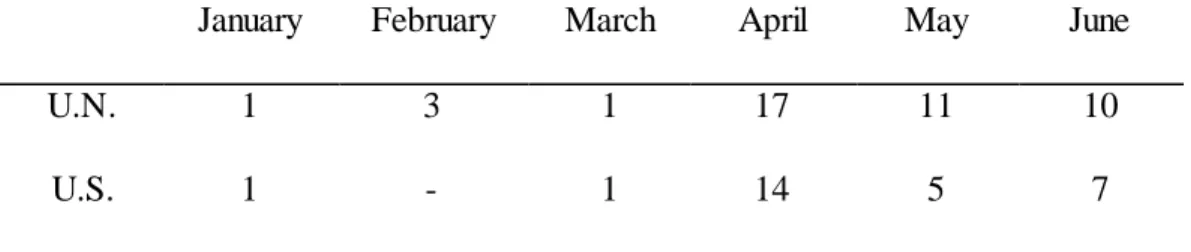
Table 1. Frequency of document by month and source, 1994.
January February March April May June
U.N. 1 3 1 17 11 10
U.S. 1 - 1 14 5 7
The measures upon which I analyzed my data were based off of an initial grounded theory coding and driven by an inquiry into the rhetorical strategies employed throughout the documents. The result of my coding and subsequent analysis was the emergence of several distinct themes within the data. The four themes that I identified are as follows: (1) Distancing efforts, (2) Concerns regarding self-interest and political motivations, (3) Deflection, and (4) Downplay. I will now further develop and clarify each theme, giving a more in-depth analysis of each one below.
Theme I: Distancing
umbrella term of distancing, that I chose for this, was named “logistical concerns”. Under this code, there were several descriptive codes that were used in choosing my various excerpts. Also among these were instances of talking about troop deployment, requests from other parties involved on certain political issues, and waiting on decisions from other parties involved before any action was taken on a specific subject. Codes that were chosen to represent distancing reflect a change in, or reversion to, bureaucratic elements that allowed the parties involved to get “bogged down in details” forcing a sense of detachment from the genocide. Here I will provide a couple examples of what I have coded as “distancing”.
First, we will look at an excerpt selected and coded under “distancing”. This is a document sent by the United States by the then U.N Ambassador Madeline Albright that was dated January 24th, 1994 where she discusses the financial concern shared by the U.N Department of Peacekeeping Operations Head Hedi Annabi over any assistance mission to Rwanda: “The timetable for political reconciliation is already behind schedule, and Annabi is concerned that further delays will only jeopardize the successful
who here is discussing the drawdown of the number of U.N troops in Rwanda and the logistics behind that:
In accordance with the new resolution, the remaining forces will support the SRSG in his mandate to monitor and report on developments in Rwanda. Also, the Secretariat will ask the council to keep the situation under close review to adjust remaining force levels (1994).
Here I have coded for use of the term “mandate”, which is vague in that it is not referring to a specific plan, and I also chose this passage because of the overall nonspecific way of speaking. One of the main parts of the use of distancing was not only the use of specific terms, but also the vagueness that, for example, can be found in the above excerpt. By remaining unclear about certain details in the documents, the involved parties were able to retain a certain level of non-commitment that proved detrimental to the overall
degradation of the situation in Rwanda. I will come back to this in the discussion as being part of what is called constructive ambiguity.
hand; namely, stopping a genocide. In fact, throughout that whole document dating from the 23rd, there is not mentioned one time any concern at all over the deteriorating problem in Rwanda, only a couple instances of her talking about logistical issues. When a
systematic effort that is aimed at avoiding entry into an international crisis is
operationalized in this manner, small recurrences such as avoiding certain words can have, as shown, enormous rhetorical impacts.
Theme II: Concerns Regarding Self-Interest and Political Motivations
The second major theme that stood out during my data analysis was one that did not immediately stand out in the text, partly because it is very broad, but it ended up becoming a major part of the linguistic structure of the documents…lending me to begin to code for it. This code was identified as “political/political concerns” and under this are several different sub codes and child codes that make up the parent code set under the umbrella of “political”. What I mean when I say “political concerns” is specifically any time that there was a stated motive of interest involving one of the sides or in one of the parties. So, under political concerns specifically, I split up into two categories: political interest of others (mainly the parties involved directly in the genocide), and political self-interest (meaning self-interest either in the U.S specifically or more broad self-self-interest
regarding the United Nations). For example, here is an excerpt from another Albright fax sent on April 13th regarding the future of UNAMIR under its current mandate:
The codes here, as far as self-interests are concerned, are clear as the Ambassador speaks about the UN’s credibility. Concerns over self-interests here are of importance because they begin to outline what others, namely Dallaire and Power, noticed during the genocide itself, which is that the parties that were in a position to step in and help were really not so much concerned with helping as they were with protecting their own image.5 This theme came up throughout the documents very frequently, however, mentions of the past U.N missions or other past conflicts barely came up in any of the documents, though I fully expected them to. Keeping with this trend, the next codes were also developed under this heading. The next sub-code that I developed was one that I titled “implications”, and this represented any case in which there was a clear concern over any implications regarding decisions made; meaning implications of self-interest. I did not include implications regarding the mission in Rwanda pertaining to the Rwandan mission in this code as it is brought up in a later code set. An example of “implications” is seen here, taken from an April 5th fax from Assistant Secretary of State Edward Walker regarding the UNSC’s vote to extend the UNAMIR mandate: “The
5
There is a very important detail here that must not go over looked, as it plays a major role in the decisions that the international community would make concerning the genocide. In 1993, the United Nations and the United States sent a peacekeeping mission into the heart of an embattled Somalia, which backfired on the United States and the United Nations with the end result being the deaths of 18 U.S soldiers and a downed helicopter in the capital city of Mogadishu. (The name of the mission was the United Nations Operation in Somalia I & II, or UNOSOM) The battle of Mogadishu and the subsequent attack of the U.S helicopter acted as a slap in the face as the United States treated it like a consequence of trying to help where it didn’t need to and the U.N faced embarrassment internationally for the same reasons. It is as a result of these reasons that, when only a few months later, the motivation to get involved in Rwanda (or also smugly referred to at the time ”another African country”) was lacking and this explains the great
prolonged delay in putting the transitional institutions in place … pose(s) a threat to the peace process.” (1994) This shows how concerns over implications regarding Rwanda served as a rhetorical device that could have possibly swayed political decisions. Of course political groups and organizations are always going to have a certain level of self-interest in mind, but major international institutions that are built on the foundation of human rights, such as the U.N, should operate under, and I would dare say are bound by, an altruistic duty.
Theme III: Deflection
The third theme that arose in my data analysis was one that was a constant topic throughout every document and every date. I titled this third theme “deflection” and though it shares some of the similar characteristics of “distancing”, it is different in the context. When I refer to deflection I am speaking of times where the speaker or author of the document is, in a way, trying to avoid addressing the genocide in Rwanda by pointing the discussion towards another topic or direction, effectively dodging commitment to any question regarding an international response. These organizations manage to do this in several ways and I have split up these different ways into separate sub-codes.
Similar to this, I also noted a recurring trend of referring back to the “agreement”, or what they also called the “peacekeeping mission” and/or the “Arusha Accords”. I am not saying here that referring to these is at all a negative, but once I saw a trend emerging of a constant deflecting pattern, I noted that this deflection was, in fact, an important rhetorical pattern. As you will see, there is a constant overall trend of using rhetoric to evade any responsibility to act in anyway that could be effective, and in the last section I will speak more to this and describe an even more serious trend that emerged within the document analysis.
Theme IV: Word Repetition and Direct Linguistic & Rhetorical Strategies of Downplay The final theme that I noted is perhaps the most important theme in my research, in fact so important that I could probably write a whole research project based off of this one theme. This theme I defined in several ways, but it describes the use of single word-repetition, word-avoidance, and the direct and indirect rhetorical and linguistic strategies employed throughout the documents. I set this final theme to fit under an overarching umbrella of what is referred to in communication studies as downplay. There were several forms of downplaying going on throughout the documents and they are each equally important.
concerning the safety of Rwandan civilians: “According to the UN HQ, fighting
continues in the city and they are reluctant to declare the civilians “safe” – but they are not in any immediate danger.” (1994) During this same time, Dallaire was reporting back widespread conflict and killings in and around Kigali and requesting more troops to combat the killings, so not knowing about the genocide was not the issue here. This was clearly a direct move to avoid discussing Rwanda at that time by Ambassador Albright.
The other part of downplay that I recorded as recurring in the data was a direct avoidance in using the term “genocide” by the discussing parties. Throughout the data, there was reference to the genocide more than 100 times in the documents, but not until the genocide was almost over did they ever actually refer to it as “genocide”. Table 2 below shows the frequency of avoiding the usage of “genocide”. The table shows how there was a distinct trend with regards to the word, with the most avoiding occurring in April and early May and a drop-off in frequency towards the beginning of June.
Table 2. Frequency by month and source of using distancing terms in effort to avoid using the word “genocide”.
January February March April May June Total
U.N 1 3 10 73 69 21 177
In fact, the length that was gone to in an effort to avoid this word was remarkable and damning. Here is an example from one of the outside “supplemental” documents6 from the Office of the Deputy Assistant for Middle East/Africa Region, Department of Defense dated May 1st, 1994 discussing Rwanda and the legal implications of the use of the term “genocide”, under the sub-heading “Issues for Discussion”: Genocide
Investigation: Language that calls for an international investigation of human rights abuses and possible violations of the genocide convention. Be Careful. Legal at State was worried about this yesterday—Genocide finding could commit USG to actually ‘do something’. This warning about using the word “genocide” did not go unnoticed either, as it was rarely used at all in the text throughout the course of the documents. I give, in Table 3 below, a month-by-month breakdown of how often the word “genocide” was actually used by each source.
Table 3. Frequency breakdown by source and month of using the term “genocide” to refer to the situation in Rwanda.
Jan – Mar April May June Total
U.N 0 3 3 8 14
U.S 0 5 4 4 13
As you can see in the table, the word was rarely used; in fact, it was only referred to as ”genocide” 27 times over the course of 6 months. This is a clear and powerful attempt to avoid getting involved in any direct action aimed at stopping the genocide and as you can
6
see in table 3, “genocide” was not even used until April and then there is a slow increase in the usage of the term, which coincides with the decrease of avoiding the term as seen in table 2.
This goal of avoiding “genocide” worked in terms of existing in the documents as a result. Throughout the documents, officials referred to the genocide in ways such as “killings”, “conflict”, and most often “situation in Rwanda”. It does not take much explanation here as to how this could impact any attempts at an intervention and no description of these is needed to show how awful this appears to be. When rhetoric is used in this way, it can be of incredibly bad results, but when downplay is intentionally used, it clearly undermines the goal of humanitarian groups such as the U.N and contradicts any semblance of international affairs directed at human rights and world justice.
DISCUSSION
small consequences, but when transferred to a global humanitarian crisis response, constructive ambiguity has devastating results.
Ultimately, these themes that I have provided above in no way account for all of the different rhetorical and otherwise interesting patterns that were in these documents, but I maintain that I have provided the most important trends for the context of my study. However, it is extremely important to understand what these trends mean in the larger context of genocide and humanitarian interventions, especially under the scope of
international politics. There was a broader question underlying my study and that was the question: why do these international agencies feel the reason to avoid getting involved in certain affairs in order to maintain some political agenda? I have shown above that these international agencies go through great rhetorical lengths to avoid getting involved in certain conflicts, but we must ask why this is. In my literature review I spoke about what is called relational constructivism, which the way that the international community, much like the social world of today, is constructed based on certain interactions and historical processes.
constructivism is not an idea that would be readily described or one that would show through brightly in the text, but that should not discount the idea that it did not indeed exist. Much like social construction, it is not an obvious and clear trend. There has been hundreds of years of sociology aimed at describing this phenomenon, so I must suggest that future research aim at delving deeper into studying relational construction, but more specifically there must be a closer look at the way the international community uses politics to make decisions. With the emergence of international agencies such as the United Nations and the sub-structure under the U.N, and great, leading countries like the United States, there is clearly a demand for some sort of global leadership. However, these communities are being shaped by politics in a way that contradicts their origin and goals. Unless there is a strong push to research and understand these institutions and their place in the world, we are doing a strong disservice to the people that depend on us for the restoration of basic human rights and for the future of global affairs.
CONCLUSION
There is so much that my research could not cover. The Rwandan genocide has produced over 5,000 documents to date and the FOIA keeps providing more and more. It would almost be an impossibility to analyze each of these documents, let alone the
As for General Dallaire, he now looks back on his time in Rwanda as being the most significant time of his life and one that plays a huge role in his life now. Although many scholars have connected with Dallaire, and twenty years later, there are many
different reports surfacing about the situation in Rwanda including a powerful insight into the political failures authored by now United States ambassador to the United Nations Samantha Power, Dallaire and many others still are left blank when it comes to the question so often asked in regards to Rwanda: How did we let this happen?
REFERENCES
Barnett, M. N. 2003. Eyewitness To a Genocide: the United Nations and Rwanda. Ithaca, NY: Cornell University Press.
Convention on the Prevention and Punishment of the Crime of Genocide. (1951). The
American Journal of International Law,45(1, Supplement: Official Documents),
Pp. 7-13. Retrieved Fall, 2014, from
http://www.oas.org/dil/1948_Convention_on_the_Prevention_and_ Punishment_of_the_Crime_of_Genocide.pdf
Cox, R. W. 1981. Social forces, states and world orders: beyond international relations
theory. Millennium: journal of international studies, 10(2), Pp. 126-155.
Dallaire, R A. Request for protection for informant. Facsimile from Maj. Gen. Romeo
Dallaire, Force Commander, United Nations Assistance Mission for Rwanda, to
Maj. Gen. Maurice Baril, United Nations Department of Peacekeeping
Operations. The US and the genocide in Rwanda. A national security archive
electronic briefing book. Retrieved 2014 (www.nsarchive.org)
Dallaire, R. A., 2003. Shake hands with the devil: The failure of humanity in Rwanda.
Toronto: Random House Canada.
Dallaire, R. A., & Poulin, B. 1995. UNAMIR: Mission to Rwanda. National Defense
University of Washington D.C Center For Counterproliferation Research
Dhaliwal, R. 2003. “Using English School Theory To Determine Legitimate
(http://www.e-
ir.info/2014/04/24/using-english-school-theory-to-determine-legitimate-humanitarian- intervention/)
Directive, P. D. 1994. 25. US Policy on Reforming Multilateral Peace Operations.
Heinze, E. A. 2007. The Rhetoric of genocide in US foreign policy: Rwanda and Darfur
compared. Political Science Quarterly, 122(3), Pp. 359-383.
Kentish, L. 2011. Genocide Prevention in the Modern Setting: Theory versus Practice.
Internet Journal of Criminology.
Lerstad, C. 2013. Moral Responsibility in International Relations: The US Response to
Rwanda. E-International Relations, system, society, & the world. Retrieved
October, 2014, from http://www.e- ir.info/2013/05/06/moral-responsibility-
in-international-relations-the- us-response-to-rwanda/
Lipson, M. 2007. Peacekeeping: organized hypocrisy?. European journal of international
relations, 13(1), Pp. 5-34.
Long, B. S., & Mills, A. J. 2008. Globalization, postcolonial theory, and organizational
analysis: Lessons from the Rwanda genocide. critical perspectives on
international business, 4(4), Pp. 389-409.
M Dobbs. 2014. National Security Archive Electronic Briefing Book No 472. edited by M. Dobbs. National Security Archive. Retrieved 2014
(http://nsarchive.gwu.edu/nsaebb/nsaebb472/).
Meierhenrich, J. 2014. Genocide: A reader. Ney York City, NY: Oxford University Press.
Oberschall, A. 2000 "Preventing genocide." Contemporary Sociology: 1-13.
Olesen, T. 2012. Global Injustice Memories: The 1994 Rwanda Genocide. International Political Sociology, 6(4), Pp. 373-389.
Paris, R. 2003. Peacekeeping and the constraints of global culture. European Journal of International Relations, 9(3), Pp. 441-473.
Power, S. 2013. “Rwanda: ‘Mostly In a Listening Mode.’” Pp. 328–89 in "A problem from hell": America and the age of genocide. New York, NY: Basic Books. Prunier, G. 1995. The Rwanda Crisis: History of a Genocide. New York: Columbia
University Press.
Scorgie, L. 2004. Rwanda’s Arusha Accords: A Missed Opportunity. Undercurrent, 1(1), Pp. 67-76.
U.N. Security Council. 1994. Draw-down of UNAMIR; Status of Civilians. Cable 01724. Retrieved 2014 (www.nsarchive.org)
U.N. Security Council. 1994. TFRWOL: Troop Contributors Discuss UNAMIR’s Future. Cable 01543. Retrieved 2014 (www.nsarchive.org)
U.N. Security Council. 1994. UN Concern over Rwanda. Cable 00312. Retrieved 2014 (www.nsarchive.org)
U.N. Security Council. 1994. WGRWOL: Update from UN 4/11. Cable 01491. Retrieved 2014 (www.nsarchive.org)
U.S. Department of Defense. Office of the Deputy Assistant Secretary of Defense for Middle East/Africa Region. 1994. Discussion Paper Rwanda. Retrieved 2014 (www.nsarchive.org).
Weiss, T. G. 2007. Halting Genocide: Rhetoric versus Reality. Genocide Studies and Prevention, 2(1), 7-30.