Julian
Benjamin,
Ph.D.
Abstract
Traditional
congestion
pricing strategies aremeant
toreduce
demand
on
heavily
congested
roads
by
charging
every user
a tollduring times
when
the facilityexperiences congestion.
Value
pricingrefers tothepractice
of
requiring driverstopay
therighttoll forthe firstclass serviceof
aguaran-teed
congestion-free
lane.This
articledescribes
thesuccessful
implementation
of
four
such
pro-grams
launched
inCaliforniaand
Texas:
StateRoute-91
inOrange
County,
CA,
1-15 inSan
Diego,
CA,
and
the I-10Katy
Freeway
and
US
290
Northwest
Freeway
inHouston,
TX.
The
article alsodescribes
a currentongoing
effort toresearch value
pricing projects inNorth
Carolina.Introduction
Traditionalcongestionpricingstrategicsare intended
to reduce
demand
on
heavilycongested
roadsby
charging everyuseratollduring timeswhen
thefacilityexperiencescongestion.
When
properly implemented,High
Occupancy
Toll(HOT)
lanesprovidealesscongestedlane,which
helpsreduce travel time
and
increase driving ease.Such
schemes
are intended to better balance the privatebenefits
of automobile
usewith
its socialand
environmentalcosts. Research
shows
thatcongestionpricingcanserveto persuade peopletocarpool.vary
the times they travel, altertheir routes,
choose
otherdestinations,
change
thedeparture timeand
avoid orcombine
trips(TRB,
1994). In several cases, valuepricinghas
been
appliedtoHigh
Occupancy
Vehicle(HOV)
lanes in ordertoincrease theirusageand
theoverall throughput
on
theroadway
without reducingtheincentive torideshare.
Four
originalHOT
lane facilities are currently inoperation.
These
includeSR-91
inOrange County
California, 1-15 in
San
Diego,and
the I-10Katy
Freeway and
US
290 Northwest Freeway
inHouston.This article describes the successful implementation
of
eachof
these four projectsand
describes acurrentongoing
effort to research the feasibilityof
a valuepricing projectalong1-40 inNorthCarolina.
Legal Authority
forValue
PricingLegal authority forexemplary projects is provided at
theFederallevel
by
theValuePricingProgram
includedby Congress
in the1998
TEA-21
legislation. Inreauthorizing the
program
(originally specified in theISTEA
legislationof199
1 )asapilotprogram.Congressrecognized value pricing as a
new
and
innovative approachtocongestionreliefand
notedtheneedto forJulianBenjamin u-orksin theDepartmentotEconomics and
Transportation/Logistics at North Carolina
A&T
State University.more
informationon
itseffectivenessindifferenturbansettings.Bothtechnicalandfinancialsupportisprovided
to support state
and
local efforts to plan, implement,manage,evaluate,andreport
on
value pricinginitiatives(FHWA,
1998). State legislationmay
be needed, foroneor
more
ofthefollowing:( 1 )topermitconversionof
existingHOV
lanes toHOT
lanes, (2) to permitcharginga feetouseastatehighway,
and
(3) topermitenforcementviavideo
and
electronicmeans.The
implementationofa value pricingprogram
may
entail
numerous
benefitsand
costs,asdescribedinthenextsections.
Benefitsof
Value
PricingReduction
of
new
constructioninconversionof
existingHOV
lanes—
Conversion of
existingHOV
lanes toHOT
lanes requiresmuch
less road infrastructureinvestment than building to
meet demand, by
usingexistingcapacity
more
efficiently.Provision
of
a
lesscongested
path
for transitand
emergency
vehicles—
Under
value pricing, transitvehicles gain access to a faster-moving lane, giving
them
a competitive advantage over auto use in theregularlanes.Thispossibly
may
leadtoashift intravelmode
choice,away
from
theautomobileand
towardpublic transit.
Emergency
services benefitfrom
theimplementation
of
value pricing, as it allowsthem
accesstoa lesscongestedpath.
Reduced
congestion ingeneralpurpose
lanes—
The
impactof
HOT
lanesupon
trafficcongestionwilldifferdepending
on
local conditions, particularly the leveloflatent
demand
and
the availabilityofalternate routes.Overalloptimization
of
facilityusage—
Valuepricing lane projectshaveresultedinoverallimprovements
inspeed
and
throughput.Value
pricing spreadspeak
demand
overa longer period, therebysmoothing
theflowoftraffic.
A
shiftinarelativelysmall proportionof peak-periodtripscanleadto substantialreductions
inoverallcongestion.
Easily fine-tuned user
charges
presei~vefi~ee flowconditions
—
Under
valuepricing,userchargesareset atalevel thatisexpectedtoproducethedesiredeffectof congestionreliefwhile maintainingsufficientusage
ofthefacility
(Hyman
and
Mayhew,
2002). Variablepricingbasedon time of
day
(SR-91)orbothtime ofday and
volume
hasproveneffectiveinshiftingdemand
and
maintainingfreeflowon
thevaluepricedlanes.Additional
revenue
topay
for
transportation
improvements
—
Experienceshows
thatHOT
lanesarecapable
of providing adequate
revenue
tofund
operations,
and
possiblypay
for a portion ofcapitalexpenses.
The
Inland Breeze bus service alongSan
Diego's1-15exemplifies
how
HOT
lanescangeneraterevenueto
improve
alternatemodes
oftransportation.Reduction
of
harmfulexternalities—
Improved
trafficflow reducesairpollution,incidents,noiselevels,
and
fuelconsumption.
Costsrelating to
Value
PricingSignificant
investment
intechnology
—
Tollinfrastructurerequiressignificantup-frontinvestment
inelectronicequipment,communications, accounting
software
and
personnel, public information,and
management.
Enforcement
—
Enforcementisneeded
ateachentranceand
cost-effectivemethod
of addressingtollviolationsundercurrent conditions.
However,
ifcarpoolswere
allowed touse the facilityfor free orat adiscount,
manual
"credit"would
needtobe providedviaa
manned
facility atsome
locationin the corridor because
camera
technology does notexistforaccuratelydeterminingthe
number
of
personsinavehicle.
Safety
concerns
—
Implementation of
HOT
lanes without barrier separationmay
pose a safetyhazard,as it results in
more
traffic in the inside laneand
increases thepropensity
of
driverstoweave
inand
outoflanesat will. Concretebarriershelpto
improve
safetyby
eliminatingrandom
ingress/egressproblems
butmay
also limit accessby
policeand emergency
vehicles.
Politicaloppositiontotollsorvariablepricing
—
Those
seeking toimplement
value pricing policies oftenencounter
intense politicalopposition, as the policy
adds
aprice to
something
thatwas
previouslyregardedasafree
good
(Hau. 1992).
Equity
—
One
major
concern
surrounding
HOT
lanes is thatlower
income
populationswill notbeabletoaffordtousetheselanes.
An
Overview
ofNew
ProjectsA
listof
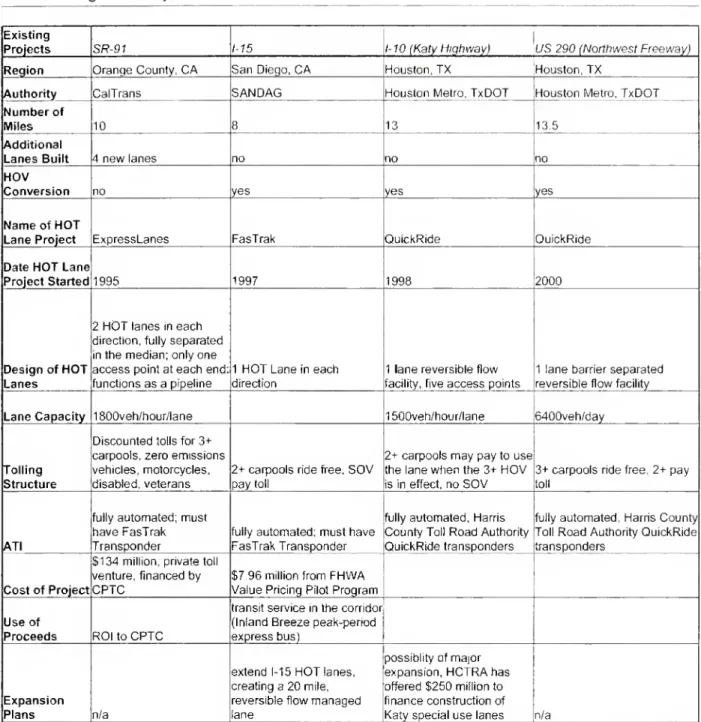
current value pricingprojectsispresented inTable 1
on
the followingpage. Inaddition to
traditional
HOT
lanes,other
<P
conceptsbeing demonstrated include "cordon tolls."
which
arechargedwhen
vehicles enter the perimeterof
arestricted area. Inaddition,"fairlanes" areHOT
lanesthatinclude a
method
ofincome
transfer tomake
the tolled lanes available to people
who
have low
incomes.Also
included are existing facilities withcongestionpricing variations in thetoll rate.
Usage-basedtollsarebased
on
thedistancetraveled.Existing
HOT
Lane
ProjectsCurrently,
HOT
lanes are in operation in four areasaround
theUnited
States.The
following sectionprovidesa descriptionofeach.
StateRoute-91,
Orange
County,CA
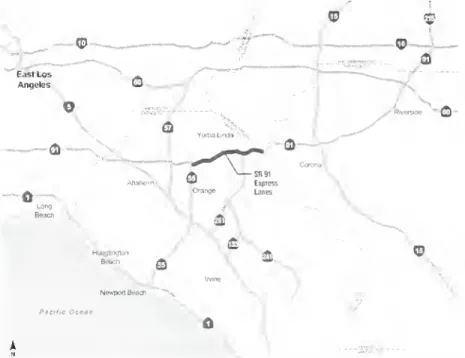
The
State Route-91 ExpressLanes
projectadded
fournew
lanes for ten miles to thewide median of
theRiverside
Freeway
atatotalcapitalcostof S130
million(see Figure 1).
The
project is unique because itwas
©
©
a
EastLos
&
Angeles
D
a
-' Yorto Linda" e
c3
U
Long Beach
fy
V—
SB91Anaheim *•" Express
Orange Lanes
4
Hungbngton
Beach gj
Irvine
Pazifi
Nff*portBeach
cOcean
Q
'
©
Existing
Projects SR-91 1-15 /-10(KatyHighway)
US
290(NorthwestFreeway)Region OrangeCounty,
CA
SanDiego,CA
Houston,TX Houston,TX
Authority CalTrans
SAN
DAG
HoustonMetro,TxDOT
HoustonMetro,TxDOT
Number
ofMiles 10 8 13 13.5
Additional
LanesBuilt 4newlanes no no no
HOV
Conversion no yes yes yes
Name
ofHOT
LaneProject ExpressLanes FasTrak QuickRide QuickRide
Date
HOT
LaneProjectStarted1995 1997 1998 2000
Designof
HOT
Lanes
2
HOT
lanesineachdirection,fullyseparated
inthemedian;onlyone accesspointateachend: functionsas apipeline
1
HOT
Laneineachdirection
1 lanereversibleflow
facility,fiveaccesspoints
1 lanebarrierseparated reversibleflowfacility
LaneCapacity 1800veh/hour/lane 1500veh/hour/lane 6400veh/day
Tolling Structure
Discountedtollsfor3+
carpools,zeroemissions vehicles,motorcycles, disabled,veterans
2+carpoolsride free,
SOV
paytoll2+carpools
may
paytousethelanewhenthe3+
HOV
is ineffect,no
SOV
3+carpoolsride free,2+ pay
toll
ATI
fullyautomated;must have FasTrak
Transponder
fullyautomated;must have FasTrakTransponder
fullyautomated,Harris
CountyTollRoadAuthority
QuickRidetransponders
fullyautomated. HarrisCounty Toll RoadAuthorityQuickRide
transponders
Costof Project
$134million;privatetoll
venture, financedby
CPTC
$7.96millionfrom
FHWA
ValuePricingPilotProgram
Useof
Proceeds ROIto
CPTC
transitserviceinthe corridor
(InlandBreezepeak-period express bus)
Expansion
Plans n/a
extend 1-15
HOT
lanes, creatinga20mile,reversible flowmanaged
lane
possiblity ofmajor expansion,
HCTRA
has offered$250millionto financeconstruction of Katyspecialuselanes n/aTable
1.Current
value
pricingroadway
projects.the result ofa franchise agreement that
was
signedbetween CalTrans and
the California PrivateTransportation
Corporation
(CPTC)
in1990
forconstruction,operation,
and
maintenance oftwo
ten-miletolllanes.
Demand
forcongestion reliefin this corridorwas
sostrong that the
company
announced
the projecthad
paidforitself
by
theend of
its thirdyearin 1998. Inotherwords,tollrevenuespaid
by
driverschoosingtousethe
HOT
lanesratherthantheadjacent regular lanes arenow
highenough
tocovertheproject'sannual debtservice as wellasalloperating
and
maintenancecosts,An
extensive four-yearstudyby
CalTransand
theU.S.Department
ofTransportation(USDOT)
evaluated theimpacts ofthe variable-toll express lanes, exploring
overallchanges in traffic
and
travelbehavior, vehicleoccupancy, traveler demographics, alternative travel
modes,
operationsand
safety,and
public opinions.The
resulting researchshows
that the express lanesprovidedan average timesavingsofnearly 13minutes.
Other perceivedbenefitsincludeincreasedreliability,
greatersafety,
and
better predictability(Pooleand Orski2002). It
was
foundthatabout20
percentof commuters
in
each
income
category
used
theHOT
lanes,suggestingthat
income
isunrelatedtowhether
personschanged
theirridesharingbehaviorafterthetoll lanesopened.
Those
commuting
towork
aremore
likely totravelin the
HOV
lanethanin theSingleOccupancy
Vehicle
(SOV)
lanes.Roughly
75 percentof
HOV-3
work
commuters
reporttobe frequenttoll lane usersas
compared
to26
percentand
16percent,respectively.fornon-work-related
HOV-3
and
SOV
users(ARDFA,
1998).The
research alsoshows
thattherewas
no
significantassociation
between
theopeningof
themanaged
laneson SR-91 and
changes in theHOV
trafficon SR-57/
60
freewaycorridor 15 miles to the north. Thus, thetoll lane exerted a local influence but did not affect
travelerrouteshiftsattheregionalscale.
Interstate-15,
San
Diego,CA
In 1988,
two
underutilizedHOV
laneswere
convertedtoreversible
HOT
lanesalongI-15inSan
Diego,C
A,and
overseenby
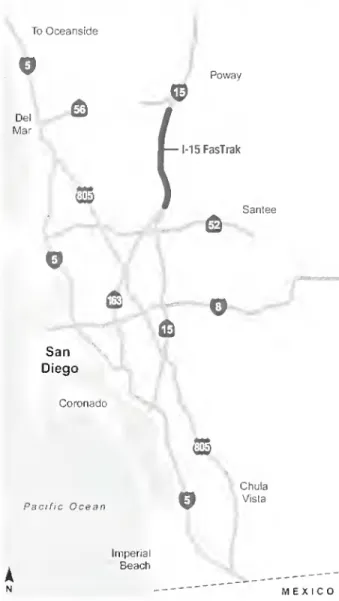
atollauthority.The
systemconsistsoftwo
reversiblelanesconstructedalonganeight-milestretchofI-15 (seeFigure2).
The
program
was
initiallyproposed
by
theSan
Diego
Association
of
Governments
(SANDAG).
Nearly
S8 millionof
Federalfundingfromthe
USDOT's
Value
PricingPilotProgram
was
provided,matched by
S2 millionfrom
thestateto
implement
firstapermitsystemon
the lanes.The
FasTrakElectronic Toll Collection(ETC)
system
was
installed,which
chargedusersoftheHOT
laneaper-trip toll based
on
congestion levels. Tolls rangeToOceanside
Del Mar
£
©
Poway
1-15FasTrak
&
Santee
$
£
San
Diego
Coronado
Pacific Ocean
Chula
Visla
Imperial
Beach
MEXICO
Figure
2.Map
of Interstate-15. Source:A
Guide
for
HOT
Lane Development
(Perez. 2003).between
S0.50 during non-peaktimesand S8.00 duringlevelsof severecongestion. Electronic signsplacedin
front
of
HOT
lane entrancesprovideadvance
noticeValue
PricingRoadways
21Daily traffic
volumes on
theexpress lanes averaged18,500 vehieles in
November
2001. a 102 percentincrease
from
thepre-projectlevelof9,200.whilestillmaintainingthe desired high level ofservice.
Under
worsttrafficconditions. FasTrak userssaveabout
20
minutesof delay overtheten-mile corridor(
DeCorla-Souza,2002).
The
typicalHOT
lane userwas
amiddle-aged female of high income,highly educated,and from
ahouseholdwith
two
ormore
vehicles.An
important feature ofthe 1-15 lanes is that carpooling increased since the
conversion ofthe
HOV
lanes, despite fears that theHOT
optionwould
discourage carpooling (Pooleand
Orski. 2002).
The
project is self-sufficient, with the conversionrequiringSI.85millionincapitalcosts (not including
the transponders paidfor
by
individual drivers),and
isgenerating revenueat the rateof approximately S millionperyear.
Interstate-10
Katy
Freeway
and
theUS
Route-290,Northwest
Freeway, Houston,TX
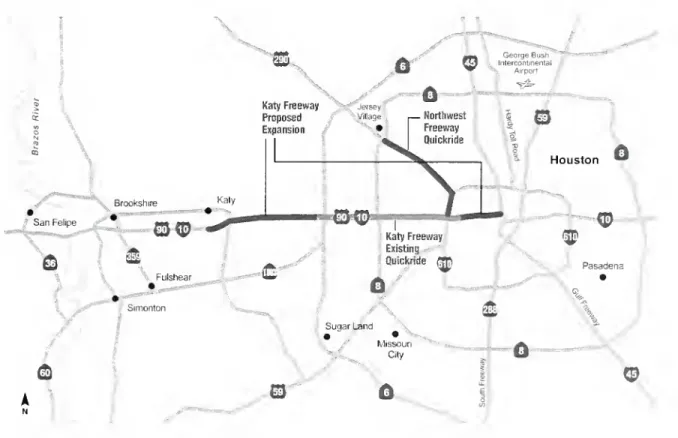
In 1998,a 13-mile
HOV
lanealongacentralarteryofwestern
Houston
was
convertedintoasingle, reversibleHOT
lane (see Figure3).Designed
to carry79,200vehicles perday,the
Katy Freeway
now
carriesover207,000
vehiclesper day.and
it isconsideredone
ofthe
most
congested stretchesof freeway
in Texas.Congestion
may
bepresentfor 11 hours ormore
eachday.
Some
estimatesplace the costof
theKaty'strafficdelaysto
commuters,
residentsand
businesses,atS85
million ayear.
SanFelipe
QSjj
M
Simonton
KatyFreeway
Existing
Quickride flft
George Bush
Intercontinental Airport
Sugar Land
Q
Missouri
City
d
i
o
Houston
^F
®
Pasadena
'
Figure
3.Map
of Interstate-10and
U.S.Route-290.
Source:A
Guide
forHOT
Lane Development
As
currentlyconfigured, theKaty Freeway
has threegeneral-purposelanes
and two
frontage-road lanes formost
of its length in each direction. Situated in thecenter
of
thefreeway
is a barrier-separatedHigh
Occupancy
Vehicle/Toll laneforcarpoolsand
buses,making
atotalof11 throughlanes.A
single reversiblelane, the
HOT
facility handlesinbound
traffic in themorning and outbound
traffic inthe evening.When
theKaty
HOV
lanefirstbegan
operating,onlybuses
and
authorizedvanpoolswere
allowedtouseit.The
resultingunderutilizationgraduallyencouraged
alooseningofthe
HOV
entryrules:gradually, registeredcarpools of
HOV-4.
thenHOV-3,
thenHOV-2
were
allowedintothelane.
(HOV-4.
-3and
-2 refer tolanesrequiringa
minimum
of
tour,three,and two
passengers,respectively.)
As
restrictionswere
relaxed,trafficgrew,and
more
restrictive carpool ruleswere
eventuallyreinstated to
HOV-3
atpeak hours.With
two-personcarpools
no
longer allowed, thenumber
of personsmoved
by
the lane duringpeak
hours declined30
percent.
Most
of
theHOV
lane users arecommuters
who
formerly used the general-purpose lanes (Poole
and
Orski, 2002). Before
and
after studiesof
theKaty
Freeway
showed
thatitsHOT
lane applicationhad
thefollowingpositiveresults:
•
The
number
of
3+
carpools increasedduring thepeak;
•
2+
carpools redistributed to beforeand
afterthepeak hour;
•
Average
traffic speeds increasedand
theHOV's
level
of
serviceimproved;and
•
The same number
of passengerswas
transportedmore
efficiently.While
theevolutionoftheQuiekRide
systemisa usefulcasestudy in itself, the
number
of paying users thatthese
two
facilities couldaccommodate
is limited.Expansion
plans for theKaty Freeway
are currentlyunderconsideration and could significantly increase
the scale
and
scope ofHOT
laneoperationsintheKaty
Corridor.
The
1-40 ProjectinNorth
Carolina
In
August
of2004
ateam
ofresearchersand
engineersbeganinvestigatingthefeasibilityof an
HOT
lanealong1-40 in North Carolina.
The
research efforthasbeen
supported
by
fundingfromtheNorth CarolinaDepart-ment
of Transportation(NCDOT)
and
the FederalHighway
Administration(FHWA).
The
projectteam
consistedofprofessors
from
NC
A&T
StateUniver-sity.
UNC-Chapel
Hill, and the director ofthePied-mont
AuthorityforRegionalTransportation.The
team
isresearchingthe feasibility ofa reversible,managed
lane (eastbound in themorning and
west-bound
in the evening) along 1-40.The
lane will beseparated
from
the general-purpose lanesby
candle-stickmarkers. Driverscanusethelanefor freeiftheir
caris
HOV-3,
or theycanpayatoll.The
tollwillvaryby
the time ofday
so that there will be a higher tollduringrush hour.
The
tollwillbecollectedautomati-callysothattherewillbe
no
tollbooths.Figure
4 shows
how
themanaged
lanemay
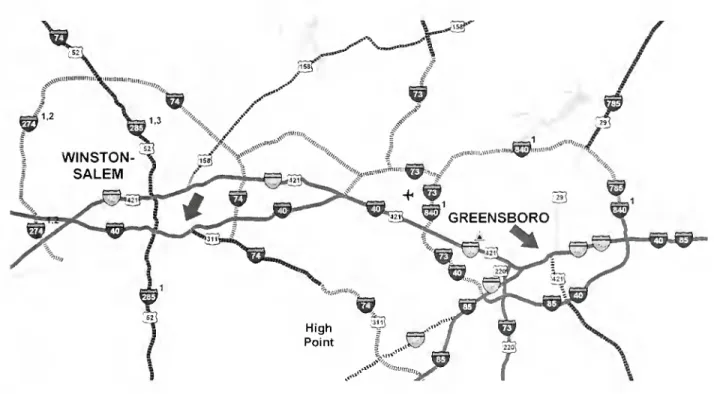
appearonceit isbuilt. Figure5 presents a
map
of where
theman-aged
laneisplanned,between
the1-40Businessand
I-40
interchange,and where
1-40and
1-85 merge.Researchersarecurrently collectingsurveydata
on
theopinionsof
commuters
livingincloseproximitytothesurvey-. V./touopomhirRANSPONOCR CNc OFOKC&ENTAREA
LOCATVOOOWWTKEAU
or TOLLREMMN
Figure
4.Sketch
of possible design forHOT
lane
on
1-40. Source:Parsons
Brinkerhqff, 1998.ingstakeholdersintheprojecttodeterminetheirlevel
of
support forthe project.The
questionsof bothstud-ies dealwiththeconcept of using
managed
lanes forvaluepricing. This abstract
approach
was
necessarybecause state legislation has not yet been adopted to
supportthisform oftolling
and
enforcement.Sugges-tions for such legislationwill be
one
outcome
oftheoverallstudy.
Other
Value
PricingProjectsThe
secondstageof value pricingisunderway
eitherin the planning or
implementation
stage.Newly
implemented
projectsincludecongestiontollson
PortAuthoritybridgesandtunnels
between
New
York
and
New
JerseyandtheFloridabarrierislandvaluepricingproject.
Value
pricing lanes are alsoplanned
forMinnesota. Otherplans
have been
investigated forMaryland. Thereare additional plansto
expand
theFigure
5.Location
of possibleHOT
laneon
1-40.Image
adapted from
NCDOT
StrategicHighway
networks. There
have even been
sketch planproposalsfor
HOT
lanesystemsinthetwenty largestAmerican
cities.A
Diagrammatic
Approach."
World
Bank
PolicyResearch
Working Paper
SeriesWPS
1070.The
World
Bank:
Washington
D.C.,December
1992: 1-96.Concluding
Remarks
Inrecentyears,valuepricinghas
become
a frequentlyused element of design in areasofthe United States
thatexperiencecongestion, asitpromisestoencourage ride-sharing
and higher
occupancy
rateswhile
providing
drivers the optionof avoiding
trafficbottlenecks.
Hyman,
G. andMayhew
L."Optimizingthe Benefitsof
Urban
Road
User
Charging." TransportPolicy.No
9(2002): 189-207.
Perez.
Benjamin
G..and
Gian-ClaudiaSciara.A
Guide
for
HOT
Lane
Development.
Repo
.1 No.FHWA-OP-03-009. Federal
Highway
Administration:Washington.D.C..
March
2003.Acknowledgement
This
paper
made
useof
materialsfrom
theNorth
CarolinaValue
Pricing Program. Iwant
to thank inparticular Dr. Daniel
Rodriguez and
theteam
of
researchers
from
theDepartment of
Cityand
RegionalPlanningat
UNC-Chapel
Hill.References
Applied Research and
Development
Facilitiesand
Activities
(ARDFA).
"ContinuationStudytoEvaluatetheImpactsofthe
SR
91 Value-Priced ExpressLanes
Final Report."CalPoly StateUniversity. 2000.
DeCorla-Souza.
P."The
Priceof Congestion."
Transportation
Management
and
Engineering
Magazine. Vol. 7,
No. 4 (August/September
2002).Poole. Robert
W.
and
C.K. Orski. "Building aCase
for
HOT
Lanes:A
New
Approach
toReducing
Urban
Highway
Congestion." PolicyStudyNo. 257.Reason
Public Policy Institute,
2002,
available online at<www.rppi.org/257.html>. accessed
December
2004.Small, K.A.
and
J.Yan,
200
1."The Value of
'ValuePricing' of Roads:
Second-Best
Pricingand
ProductDifferentiation."
Journal
ofUrban
Economics, No. 49
(2001):
310-336.
Transportation Research Board.
"Curbing
Gridlock:Peak-Period
Fees to Relieve Traffic Congestion."National
Research Council
Special Report 242, Vol.1 (1994).
Value
PricingProgram
Office,Program
Update.
Washington.
D.C.. 2004.DeCorla-Souza. P.
"The
Long-Term
Value of Value
Pricing in
Metropolitan Areas."
Transportation
Quarterly. Vol. 56,