Prevention of Unintentional Injuries in the First Two Years of Life
By Claire Teigland
A Master’s Paper submitted to the faculty of the University of North Carolina at Chapel Hill
in partial fulfillment of the requirements for the degree of Master of Public Health in
the Public Health Leadership Program
Chapel Hill 2012
First Reader
Date
Second Reader
Abstract
Introduction: Unintentional injuries are a leading cause of morbidity and mortality in early
childhood. One of the mainstays of injury prevention is anticipatory guidance delivered to families during well-child visits. The Injury Prevention Program (TIPP) is a developmentally tailored package of injury prevention counseling developed by the American Academy of Pediatrics widely used in primary care.
Methods: A systematic review of the literature on anticipatory guidance for injury prevention
was performed through a Medline search in February of 2012. Also included in this Master’s paper are some preliminary and early stage results of a multi-site randomized controlled trial examining the efficacy of TIPP at promoting strategies to prevent childhood injuries in the first 6 months of life.
Results: In our systematic review of the literature, we found that 8 of 9 articles addressing the
efficacy of injury prevention counseling in the first two years showed positive changes in safety related behaviors, beliefs, or injury rates. The preliminary results of the TIPP trial revealed that families receiving TIPP were significantly more likely to improve from 2 to 6 month interval in their compliance with lowering hot water temperatures (OR 7.7 95% CI: 1.11-53.38).
Discussion: The results of the TIPP trial confirm the findings of the systematic review:
Counseling for Early Childhood Injury Prevention: An Updated Critical Review of the Literature
Abstract
Introduction: Unintentional injuries are a leading cause of morbidity and mortality in early
childhood. Anticipatory guidance has been the mainstay of prevention in primary care for decades. However, given increasing community wide injury prevention and education
campaigns, the benefit of anticipatory guidance may be diminishing. The last critical review of the literature on this topic was published in 1993.
Methods: A Medline search was performed in February of 2012 to update the 1993 review that
examined primary care counseling for injury prevention. The search was limited to include children during the first two years of life and primary research articles that reported injury related behaviors, beliefs, or rates. Articles were excluded if they were not in English or if they were included in the previous review. One author then scored the included articles using the same criteria as used in the 1993 review.
Results: The Medline search revealed 395 potential articles. Nine met criteria for inclusion.
Eight of nine demonstrated positive changes in injury related beliefs, behaviors, or rates. Discussion: This review confirms earlier work and demonstrates that primary-care based
Introduction
Injury is a leading cause of morbidity and mortality in the first two years of life.1 Among children under 2 years of age there were 2,069 unintentional injury related deaths and 1.5 million unintentional non-fatal injuries in 2009.1,2 While the childhood unintentional injury death rate decreased 29% between 2000-2009, deaths from unintentional injuries increased among infants less than 1 year of age from 23.1 to 27.7 per 100,000.3 One thousand injuries are treated for every death from injury, but the overall number of and morbidity from unintentional injuries is likely much greater as many children may not receive medical care for minor injuries.3 Strategies to reduce childhood injuries include population-based strategies such as legislative efforts, product regulations, community wide educational campaigns, and individual-level strategies such as clinical anticipatory guidance. The American Academy of Pediatrics (AAP) has emphasized that medical providers caring for young children have a primary role in injury prevention though delivery of anticipatory guidance to families during well-child visits.4-6 In 1984, the AAP developed a comprehensive counseling program, The Injury Prevention Program (TIPP), to facilitate effective delivery of age-appropriate injury prevention information.7
In 1993, members of the AAP Committee and AAP Section on Injury and Poison
or other clinical setting in which injury-prevention counseling could be delivered and thus the efficacy of anticipatory guidance in primary care deserves special attention. This is an updated review of the literature examining the effectiveness of injury prevention counseling provided to parents and guardians of children two years and younger in primary care. This update is
essential in an era when other public health efforts are stronger11-13 so the role of counseling on injury prevention by the primary care physician may be diminished in this context. Given the amount of counseling primary care physicians are expected to do,14 it is important to know whether injury prevention counseling should be included in order to prioritize valuable
counseling time. Finally, this review was conducted in preparation for analysis of a randomized controlled trial of an injury prevention intervention in primary care practice.
Methods
We performed a Medline search in February of 2012 using a limit of 0-23 months of age and the search terms: “("Wounds and Injuries"[mesh] OR injury[tw] OR injuries[tw]) AND ("Counseling"[Mesh] OR counseling[tw] OR health education[mesh]) AND prevent*[tw] AND (infant [mesh] OR infant* [tw] OR baby [tw] OR babies [tw] OR newborn [tw] OR neonate* [tw] OR toddler [tw] ).” To determine whether an article was eligible for inclusion, we reviewed title, then abstract, then full text as necessary. A single author (CT) performed the reviews.
review, i.e., those published before July 26, 1991, and those not available in English, were excluded.
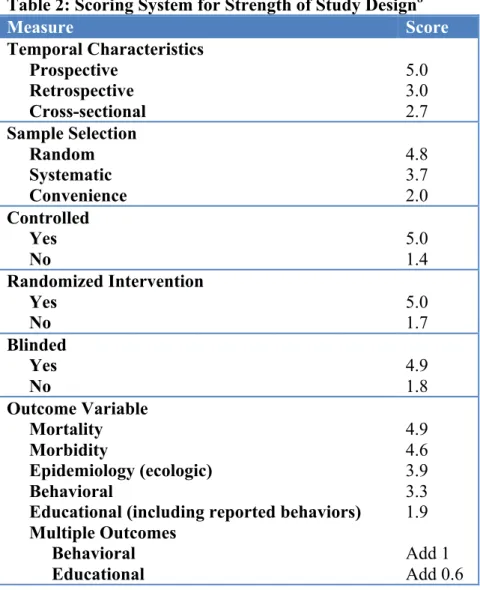
One author (CT) evaluated the quality of each included article. In order to maintain comparability, the same scoring system and decision rules used in the 1993 review were used for this review.8 Decision rules are found in Table 1, and the scoring system in Table 2. Scores were then used to rank included articles by strength of study design. Strength of study design score could range from 11.2 to 31.2, with a higher score indicating better quality. Because of the heterogeneity of study design, outcomes, and populations, a meta-analysis was not performed.
Results
The Medline search identified 395 potential articles. Nine articles met criteria for inclusion in this review.15-23 Figure 1 shows reasons for exclusion at each review level. One of the studies was cross-sectional,16 and one additional study was designed as a prospective cohort study, but the portion addressing counseling in primary care was cross-sectional. The study addressed this topic as part of a baseline questionnaire for study participants.19 For the remainder of the review, we will consider this study a cross-sectional study. Of the seven prospective studies, six were randomized controlled trials,15,17,18,20,21,23 and one was a cohort study.22 Only three of the nine had non-physicians delivering the anticipatory guidance intervention, though sometimes these other providers were used in addition to physician counseling.20,21,23
The results of the studies are reported in Tables 3 and 4 ranked by their strength of study design score (SDS). Table 3 lists the two cross-sectional studies,16,19 and Table 4 lists the
The median strength of study design (SSD) score for the cross sectional studies was 12.9 with a standard deviation of 3.92 and a range of 11.4 to 14.3. Two studies reported that
counseling was associated with safer practices or beliefs for at least one outcome.16,19 The median SSD score for the prospective studies was 22.4 with a standard deviation of 5.42 and a range of 18.2 to 24.4. Six of the seven prospective studies reported that counseling had a beneficial effect on at least one outcome.
Discussion
This literature review was conducted in order to update the work published by Bass and colleagues in 19938 since many new studies of injury prevention will inform the field and the public health landscape with respect to early childhood injury prevention has blossomed,
potentially diminishing the role of primary care efforts . Bass, et al reported that18 of 20 articles on primary care based counseling for injury prevention were associated with reduced injuries or improved safety practices, knowledge or beliefs. In this update to that review, we found that 8 of 9 articles published since 1991 reported improvement in safety behaviors, knowledge, or beliefs. The one that did not find improvement compared TIPP to TIPP plus SAFE, a program of injury prevention counseling training. Both arms of the study had access to TIPP materials, and thus the lack of difference between the arms in parental knowledge, beliefs, or behaviors cannot
It is clear that anticipatory guidance delivered by physicians in primary care is effective at improving injury prevention related knowledge, beliefs, and behaviors. While the study by Quinlan and colleagues16 as well as the study by Claudius and colleagues19 demonstrated that the care pediatricians are currently providing has a positive effect on injury prevention knowledge and practice, the randomized controlled trials of more formalized programs showed increased knowledge and practice of injury prevention techniques when compared to usual care.15,18,20,21,23 Given the heterogeneity of these more formalized programs, it is unclear which specific aspects of the programs accounted for the positive effect, and further research could work to determine these.
Handouts were used in five of the seven prospective trials, 15,17,18,20,23 and all but one of these demonstrated positive results. The one that did not, as discussed previously, compared TIPP to TIPP plus SAFE, a program of injury prevention counseling training.17 It seems then, that handouts maybe a critical component of a successful injury prevention program. Research should be done to develop materials that are effective and at a literacy level appropriate to target the widest audience.
analysis by Simon and colleagues showed a dose-response relationship between the amount of injury prevention guidance received and the likelihood of subsequent injury-related visit.22 In fact, receiving <25% of recommended guidance was associated with an adjusted odds ratio of 6.6 for subsequent injury when compared to those who had received all recommended injury
prevention counseling.
Lack of time has been cited as one of the major barriers to delivery of effective
anticipatory guidance.24,25 As such, more research is needed to determine if less expensive (i.e. non-physician) providers can be relied upon to effectively deliver some of this counseling. Three of the studies in this review utilized non-physician providers to deliver some, if not all, of the intervention.20,21,23 All of these studies had a positive effect, suggesting that non-physician counseling could be an effective adjuvant to physician delivered anticipatory guidance in a primary care setting.
primary care visits that occur for children between 0-2 years of age, the first 2 years of life represents an important opportunity for primary care based injury prevention.
Research on counseling for injury prevention in primary care has thus far largely supported guidelines from the AAP and other public health entities recommending the service. Research should now focus on the optimal way to deliver this information to parents and caregivers. Future studies should work to address which aspects of anticipatory guidance
References
1. Prevention CFDCa. Web-Based Injuty Statistics Query and Reporting System
(WISQARS). Fatal Injury Reports http://www.cdc.gov/injury/wisqars/index.html, 2012. 2. Prevention CfDCa. Nonfatal Injury Report.
http://www.cdc.gov/injury/wisqars/nonfatal.html, 2012.
3. Vital signs: Unintentional injury deaths among persons aged 0-19 years - United States, 2000-2009. MMWR. Morbidity and mortality weekly report. Apr 20 2012;61:270-276. 4. Strain JE. AAP periodicity guidelines: a framework for educating patients. Pediatrics.
1984;74(5):924-927.
5. Office-based counseling for injury prevention. American Academy of Pediatrics Committee on Injury and Poison Prevention. Pediatrics. Oct 1994;94(4 Pt 1):566-567. 6. American Academy of Pediatrics Committee on Psychosocial Aspects of Child and
Family Health: Pediatrics and the psychosocial aspects of child and family health. Pediatrics. Jul 1982;70(1):126-127.
7. Krassner L. TIPP usage. Pediatrics. Nov 1984;74(5 Pt 2):976-980.
8. Bass JL, Christoffel KK, Widome M, et al. Childhood injury prevention counseling in primary care settings: a critical review of the literature. Pediatrics. Oct 1993;92(4):544-550.
9. DiGuiseppi C, Roberts IG. Individual-level injury prevention strategies in the clinical setting. The Future of children / Center for the Future of Children, the David and Lucile Packard Foundation. Spring-Summer 2000;10(1):53-82.
10. Roberts I, Kramer MS, Suissa S. Does home visiting prevent childhood injury? A systematic review of randomised controlled trials. BMJ (Clinical research ed.). Jan 6 1996;312(7022):29-33.
11. Towner E, Dowswell T, Jarvis S. Updating the evidence. A systematic review of what works in preventing childhood unintentional injuries: part 1. Injury prevention : journal of the International Society for Child and Adolescent Injury Prevention. Jun
2001;7(2):161-164.
12. Towner E, Dowswell T, Jarvis S. Updating the evidence. A systemic review of what works in preventing childhood unintentional injuries: Part 2. Injury prevention : journal of the International Society for Child and Adolescent Injury Prevention. Sep
2001;7(3):249-253.
13. Klassen TP, MacKay JM, Moher D, Walker A, Jones AL. Community-based injury prevention interventions. The Future of children / Center for the Future of Children, the David and Lucile Packard Foundation. Spring-Summer 2000;10(1):83-110.
14. Belamarich PF, Gandica R, Stein RE, Racine AD. Drowning in a sea of advice: pediatricians and American Academy of Pediatrics policy statements. Pediatrics. Oct 2006;118(4):e964-978.
15. Clamp M, Kendrick D. A randomised controlled trial of general practitioner safety advice for families with children under 5 years. BMJ (Clinical research ed.). May 23
1998;316(7144):1576-1579.
17. Gielen AC, Wilson ME, McDonald EM, et al. Randomized trial of enhanced anticipatory guidance for injury prevention. Archives of pediatrics & adolescent medicine. Jan
2001;155(1):42-49.
18. Mock C, Arreola-Risa C, Trevino-Perez R, et al. Injury prevention counselling to improve safety practices by parents in Mexico. Bulletin of the World Health Organization. 2003;81(8):591-598.
19. Claudius IA, Nager AL. The utility of safety counseling in a pediatric emergency department. Pediatrics. Apr 2005;115(4):e423-427.
20. Kendrick D, Illingworth R, Woods A, et al. Promoting child safety in primary care: a cluster randomised controlled trial to reduce baby walker use. The British journal of general practice : the journal of the Royal College of General Practitioners. Aug 2005;55(517):582-588.
21. Johnston BD, Huebner CE, Anderson ML, Tyll LT, Thompson RS. Healthy steps in an integrated delivery system: child and parent outcomes at 30 months. Archives of pediatrics & adolescent medicine. Aug 2006;160(8):793-800.
22. Simon TD, Phibbs S, Dickinson LM, et al. Less anticipatory guidance is associated with more subsequent injury visits among infants. Ambulatory pediatrics : the official journal of the Ambulatory Pediatric Association. Nov-Dec 2006;6(6):318-325.
23. Sangvai S, Cipriani L, Colborn DK, Wald ER. Studying injury prevention: practices, problems, and pitfalls in implementation. Clinical pediatrics. Apr 2007;46(3):228-235. 24. Cohen LR, Runyan CW. Barriers to pediatric injury prevention counseling. Injury
prevention. 1999;5(1):36-40.
Table 1: Decision Rules8
1. When it is unclear whether or not a study characteristic is present, (e.g. blind vs. not blind), the study is scored as if it is absent.
2. “Blind” from the parents perspective is defined as: an unannounced home visit assessment of an outcome or a visit in which the parents were unaware of the purpose of the visit. If an outcome was assessed based upon an interview (phone or in-person) and the purpose was not concealed it was not considered blind.
3. When change in behavior is the outcome of interest, and it was measured though self-report rather than by observation, it was classified as an “educational” change rather than a behavior change.
Table 2: Scoring System for Strength of Study Design8
Measure Score
Temporal Characteristics Prospective Retrospective Cross-sectional 5.0 3.0 2.7 Sample Selection Random Systematic Convenience 4.8 3.7 2.0 Controlled Yes No 5.0 1.4 Randomized Intervention Yes
No 5.0 1.7
Blinded Yes No 4.9 1.8 Outcome Variable Mortality Morbidity Epidemiology (ecologic) Behavioral