A Study of Art Integration at an Inner City Magnet Arts-Integrated Elementary School
Hannah Godat
Senior Honors Thesis
School of Education, Human Development and Family Studies
The University of North Carolina at Chapel Hill
Fall 2018
Approved by:
________________________________________
Keith Sawyer, Ph.D. – Thesis Advisor
________________________________________
Dan Huff, Ph.D. – Thesis Second Reader
________________________________________
Sharon Palsha, Ph.D. – Thesis Class Professor
________________________________________
Abstract
The purpose of the study was to determine which of the four types of art integration
described by Giles and Frego (2004) are used within the school and in what ways, as well as the
perceived benefits and limitations of using art integration according to teachers and faculty at the
school. Participants were teachers recruited from an inner-city art integrated magnet elementary
school utilizing the Dillman (2000) Total Survey Design Method, which allowed for five emails
asking for voluntary participation to be sent to every teacher at the school. Twelve teachers
responded to a survey, which included educational history, demographics, and May &
Robinson’s (2015) 12-item scale regarding perception of art integration. In addition, a dance and
a music specials class were observed to determine the types of art integration used within the
classroom. The teachers of these two classes were also interviewed to further determine
perceptions of the benefits and limitations of art integration. Examples of affective, subservient,
and social art integration are present within the specials classrooms at the school and there was
evidence of co-equal art integration, but there were not complete examples of this form of art
integration. The main perceived benefits of art integration determined were a lack of time for
collaboration and a lack of preparedness for classroom teachers to integrate the art. The main
perceived limitations of art integration determined were promotion of an inclusive and active
Table of Contents
Abstract 2
Introduction 6
A Brief History of Art Integration in North Carolina 8
A+ Schools 10
The Theory of Multiple Intelligences 10
Approaches to Art Integration 11
Research Focus and Questions 12
Literature Review 13
Critical Links 13
Benefits to Art Integration 17
Limitations to Art Integration 18
Teacher Perception of Art Integration 20
Theory of Multiple Intelligences 21
Why Art Integration is Worth Researching 22
Methods 23
Participants 24
Measures 24
Procedure 25
Results 27
General Structure of the School/Classroom 28
Survey Participants 28
Survey Participant Education 29
Perception of Art Integration 30
Interview Participants 34
Observation Setting 34
Dance Narrative 35
Music Narrative 41
Discussion 45
Evaluation of the Participants 45
Teacher Perception of Benefits to Art Integration 46
Teacher Perception to Limitations to Art Integration 46
Student Engagement 47
A Potential Perceptual Problem 48
A One-Sided Integration Program 48
Why Art Integration is Controversial 49
Limitations to Study 50
Implications 50
Future Research 51
Conclusion 52
References 53
Appendices 56
Appendix A: Survey 56
Appendix B: Interview Guide 67
Appendix D: Email to Principal for Consent/Email Recruitment 70
Appendix E: Dillman Style Emails 71
Appendix F: Recruitment Follow-up Email 75
Appendix G: Consent Form for Observation 76
Appendix H: Consent Form for Interview 77
Tables 78
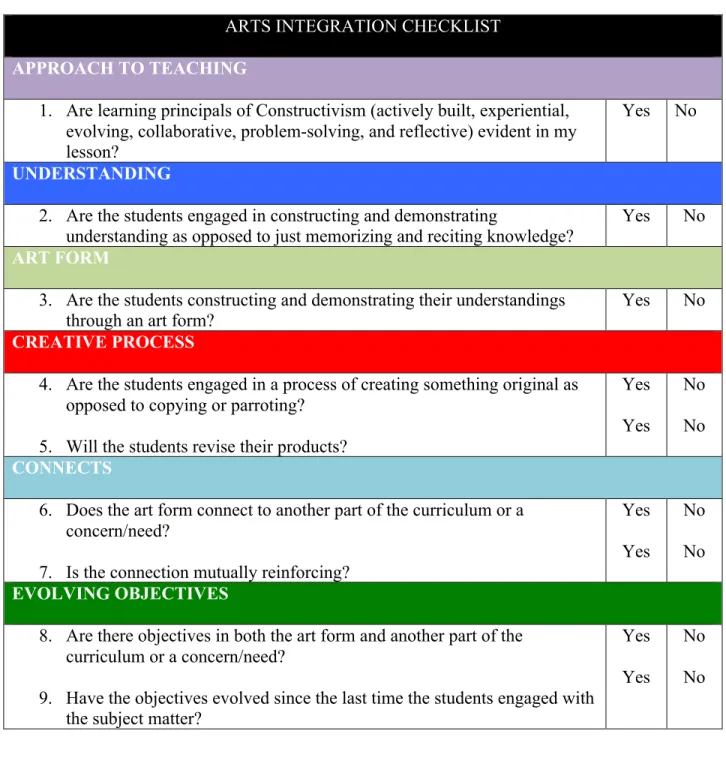
1.1 “Art Integration Checklist” 78
4.1 Educational Information about Teacher Perception 79
A Study of Art Integration at an Inner City Magnet
Art Integrated Elementary School
Art integration is defined by Silverstein & Layne (2010) as “an approach to teaching in
which students conduct and demonstrate understanding through an art form. Students engage in a
creative process which connect an art form and another subject area and meets evolving objects
in both” (p. 1). Within an art integrated education, the curriculum is centered on the balance
between learning an art form, such as dance, music, or visual art, and learning a traditional
subject such as math, science, history or English. Art integration differs from traditional learning
in that it helps students to visualize taught information in a tactile and tangible way and it
encourages creative innovation and originality, which are not often included or emphasized in
classrooms where rote memory or repetition are the main focus of common core curriculum
(Silverstein & Layne, 2010).
Integrating the arts into common core subjects would be useful according to Silverstein &
Layne (2010), who said: learning should be “actively built, experiential, evolving, collaborative,
[full of] problem-solving, and reflective” (p. 2). In most cases, educators who simply recited
material to be memorized, rather than focusing on a more holistic integration of arts, have often
overlooked this style of learning. Silverstein & Layne (2010) made an important distinction that
arts integration is not the same as “inclusion of the arts in the classroom” or “arts-based
instruction” (p. 8), and for a program to be considered art integrated, there are six requirements
(Table 1.1) that must be present:
2). Therefore, it is not just an activity, but “an approach to teaching that is
embedded in one’s daily practice (Silverstein & Layne, 2010, p.1).
2. Understanding. For something to be art integration, “information must be mentally acted upon in order to have a meaning” (p. 3). This demonstration of
understanding shows teachers that the students have learned something and it
further guides the teachers’ instruction (p. 4).
3. Art Form. Art integration must include an art form, because “arts engage students in learning through observing, listening, and moving and offer
learners various ways to acquire information and act on it to build
understanding” (p. 5).
4. Creative Process. The creative process allows students to do more than simply “repeat [ ], copy [ ], or follow directions [ ]” (p. 5). Instead, it allows
students to imagine, examine, perceive, explore, experiment, develop, create,
reflect, assess, revise, and share. In addition, teachers must learn to accept the
messiness of the creative process and not attempt to control everything for the
students (p. 6).
5. Connects. The art form must be connected to either the curriculum or to a specific concern or need of the school (p. 6). In order for it to be art
integration, learning of the one subject should reinforce and increase learning
of the other subject (p. 6).
6. Evolving Objects. Art integration should “set objectives in both the art form and the other subject area” (p. 7) in order to increase learning equally in both
According to Marshall (2014), integration is defined as “the fusion of disciplines” (p.
106). In practice, art forms are embedded within traditional subjects such that the two subjects
become intertwined for the learner, rather than serving a distinct complementary role.
Additionally, art integration specifically is believed to be part of a “new paradigm of education
built on a more dynamic, creative, organic, and realistic vision of how the world works…”
(Marshall, 2014, p. 105). Under this paradigm, art integration allows learning to expand beyond
memorization and recapitulation to creative and applicative subject learning. Furthermore,
Marshall (2014) argues that art integration should be considered “Transdisciplinary” because it
reaches beyond simple collaboration and connection and “rises above disciplines and dissolves
their boundaries to create a new social and cognitive space” (p. 106). Thus, an art-integrated
classroom fosters a learning environment in which the combined study of both arts and a
traditional subject is emphasized over the study of either separately.
Art integration is not without limits, which can include a lack of quality communication
or collaboration between teachers and music experts, as well as the quantity of time required to
create integrated lesson plans (May, 2012). However, in spite of these challenges, May (2012)
argues that art integration is beneficial, stating: “arts integration provides students with
opportunities to express themselves while actively engaging in the material they are learning,
thus enhancing their creative problem-solving processes” (p. 5). Over the years, different
programs and policies have been created and enacted in order to encourage and implement art
integration in educational settings.
A Brief History of Arts Integration in North Carolina
In 1976, the John F. Kennedy Center for Performing Arts began partnering with different
1995, the JFK Center initiated the Changing Education Through the Arts (CETA) program to
better equip teachers to integrate the arts into their curriculum. The CETA program includes
workshops, various classes and coaching, as well as study groups. Various research studies
within the CETA program concluded that art integration impacts the learning, engagement, and
attitudes of the students, increases professional development of teachers, and creates a
collaborative environment within the school (Duma, 2014, p. 15).
Historically, arts have been a part of public education’s core curriculum as distinct
subjects, not as integrated tools to guide and improve other traditional subjects. In 1985, the
North Carolina General Assembly passed the “Basic Education Program,” which stated,
“Instruction shall be offered in the areas of arts, communication skills, physical education and
personal health and safety, mathematics, media and computer skills, science, second languages,
social studies, and vocational and technical education” (115-C-81). Thus, NC required art to be a
part of its basic curriculum, but proposed no methods nor set any guidelines for integrating art
with the other disciplines mentioned.
In 2010, the NC General Assembly passed Senate Bill 66, “An Act to Provide a
Comprehensive Arts Education Plan,” which stated that students in K-5 are required to
participate in an arts class and students in Middle School are “required to take at least one arts
discipline each school year.” This Bill enforced arts education, but perhaps more importantly, it
defined the terms “arts-education,” “arts-integration,” and “arts-exposure.” Arts-education is
defined as “a comprehensive and sequential education in four separate and distinct disciplines:
dance, music, theater arts, and visual arts” (Comprehensive Arts Education Plan, 2010, p. 17).
Art integration is defined as “using the arts as a catalyst for learning across the curriculum and in
either as a creator, participant, or audience member” in order to “learn about themselves and the
complex world around them” (p. 18). A turning point for arts education in NC, these distinctions
provided more understanding for educators to craft curricula where arts are essential in the
learning of many subjects.
In 2012, Senate Bill 724, “An Act to Implement Various Education Reforms,” was
enacted to ensure that teachers were “prepared to integrate arts education across the curriculum.”
This legislation was one of the first to actually require teachers to know how to integrate art into
core curriculum. However, it did not give much detail about the specific programs and trainings
that would be used to achieve this goal.
A+ Schools
One particular type of art integration school that has become more common in recent
years is the A+ School. According to the A+ Schools of North Carolina Website, “the A+
Schools Program is a whole-school reform model that views the arts as fundamental to teaching
and learning in all subjects” (2018, About A+, para. 1). These schools were developed in 1995
and were initiated by the Kenan Institute for the Arts. In the early states of the A+ School
Program, there were 25 Pre-K – 12 public schools that were evaluated over a four-year period.
Then in 2003, the program moved to the University of North Carolina at Greensboro. Finally, in
2010, the A+ Schools Program moved to the N.C. Arts Council and includes over 40 A+ Schools
in the state of NC as well as additional schools in other states across the country (2018, Brief
History).
The Theory of Multiple Intelligences
An aspect of A+ Schools that is incorporated into the curriculum is Multiple
and he published his theory in his novel Frames of Mind in 1983. Rather than being defined by a
single general factor (g), Gardner believes that intelligence is “the ability to solve problems or
create products of value in a culture or community” (Shearer & Karanian, 2017, p. 211) and can
be defined in in multiple ways. In his theory, he outlines eight intelligences: Linguistic, Musical,
Logical-Mathematical, Spatial, Bodily-Kinesthetic, Interpersonal, Intrapersonal, and Naturalistic.
Linguistic intelligence includes language comprehension, spoken language, writing, and
reading. Musical intelligence includes perceiving pitch, melody, harmony, timbre, and rhythm,
vocal singing, emotional aspects of music, instrumental music, and perception of both music and
the sounds of human language. Logical-mathematical intelligence includes calculations, logical
reasoning, and problem solving. Spatial intelligence includes spatial awareness, working with
objects, art perception, and art production. Bodily-Kinesthetic intelligence includes fine motor
movements, large motor movements, expressive movements, and motor memory. Interpersonal
intelligence includes empathy, understanding others, leadership and caregiving. Intrapersonal
intelligence includes self-understanding, metacognition, and emotional management. And
finally, naturalist intelligence includes understanding animals, understanding plants, pattern
recognition and science (Shearer & Karanian, 2017).
Approaches of Art Integration
According to Giles & Frego (2004), there are four approaches to art integration:
subservient, affective, social, and co-equal.
In the subservient approach, the most common approach, the arts are a tool to teach the
other subjects. An example of the subservient approach would be “The Planets” song, which
helps students learn the solar system, or the “Fifty Nifty United States” song that helps students
arts-integration usually include “technical and simple activities of coloring, cutting, and pasting”
or “memorizing lyrics to an approximation of a melody and a rhythmic pattern” (Bresler, 1995,
p.33).
The affective approach is used for “changing the overall mood in the classroom” (Giles &
Frego, 2004, p. 13) and interacts more with the student’s emotions. Activities within the affective
approach are used “for self-expression and the manifestation of individuality and uniqueness”
(Bresler, 1995, p. 35). In some cases, music is used to help students relax or focus during class
lessons or art might be presented to “[invite the students] to be responsive to their own feelings
and rhythms as triggered by the arts” (Bresler, 1995, p. 34).
A social approach to art integration encourages involvement in programs within the
school and throughout the community. This approach is concerned with uniting the community
with the use of art forms (Giles & Frego, 2004). For example, students might perform songs,
dances, or skits at events during the year in order to present the arts as “public, celebrated, and
appreciated” (Bresler, 1995, p. 35).
Finally, the co-equal approach connects “cognitive skills” with “aesthetic principles” and
emphasizes the equity between art and other academia (Giles & Frego, 2004, p. 2). This
approach is most similar to the definition of art integration that Silverstein & Layne describe. In
addition to the four approaches, art integration programs can be organized into forms based on
their chosen method of artistic expression such as: painting, drawing, dancing, singing, acting, or
playing a musical instrument.
Research Focus and Questions
This study of an inner city art integrated magnet elementary school attempts to answer
integration described by Giles & Frego are used within the school? 2) In what ways are each of
these four types used within the school? 3) What are the perceived benefits of using art
integration according to teachers and faculty at the school? 4) What are the perceived limitations
or challenges according to teachers and faculty at the school?
Literature Review
The literature review reveals the benefits and limitations of art integration identified in
previous research. Several of the benefits identified include: more engagement, motivation,
creativity, collaboration, parental involvement, as well as better social behavioral skills, spatial
skills and self-esteem. Additionally, art integration allows for application of material rather than
rote memory. Juxtaposed, some criticisms of art integration include poorly conceived programs
and the contamination of the purity of music. The literature in the following review represents
the conflicting research regarding whether or not art integration is beneficial. The purpose of the
review is to present both sides of the research and compare the research to the perceptions of the
teachers to be interviewed.
Critical Links: Learning in the Arts and Student Academic and Social Development Critical Links: Learning in the Arts and Student Academic and Social Development was published in 2002 and developed by Richard Deasy. A compendium, Critical Links is a
compilation of articles from various years and authors that relate to art integration. As stated in
the Abstract, Critical Links has two purposes:
(1) To recommend to researchers and funders of research promising lines of inquiry and
study suggested by recent, strong studies of the academic and social effects of
(2) To provide designers of art education curriculum and instruction with insights found
in the research that suggest strategies for deepening the arts learning experiences and
are required to achieve the academic and social effects
The document is organized according to the category of art: dance, drama, multi-arts, music, and
visual arts. The purpose of including articles from Critical Links is to give a general overview of
the benefits and limitations of art integration found in various research studies. The following
authors are all cited within Critical Links (Deasy, 2002).
In a research study conducted by Mentzer & Boswell (1995), it was determined that art
integrated programs can “contribute to engagement, development of creativity, and social and/or
motor learning in children with behavioral disorders” (p. 18). The study was conducted with
seven to ten year-old boys who were selected from a group of children living at a residential
treatment home. There were sixteen fifty-minute sessions over ten weeks, which included
reading a poem aloud and creating a movement sequence to match the poem. Later in the
program the boys were asked to develop the movement sequences to their own poetry. After the
program, it was reported that the boys enjoyed the program, and improved in social behavioral
skills and in motor coordination. The study also encouraged further research in the following
measures: independent thinking skills, body and spatial awareness, verbal and physical
expression of thoughts and feelings, willingness to participate in new activities, positive group
participation, and overcoming inhibited expression (p. 17).
According to research conducted by Andrews (1998), music integration is positively
correlated with better attitudes towards music, but is not significantly correlated with greater
achievement in school. Subjects in this study were fifty-eight 5th grade male and female students
and music instruction twice a week for eleven weeks. The control group did not receive any
music integration instruction. However, both groups participated in a music class led by the
researcher. Tests on four different scales were given to participants before and after the
experiment. A 2 (instructional approach) x 2 (gender) x 2 (music background) multivariate
analysis of variance was conducted. Both groups improved in reading and music skills, and there
was no significant difference in these skills between the two groups. However, positive attitude
towards music increased in the experimental group and decreased in the control group. Overall,
girls demonstrated a better attitude towards reading and boys made improvement in music skill.
While an increase in positive attitude towards music is good, the goal of music integration is to
“advance learning in both the art and the target discipline” (Andrews, 1998, p.114). Music
integration positively correlated with better attitudes towards music, but did not significantly
correlate with greater achievement.
A study by Seaman (1999) revealed that focusing more on art subjects in educational
settings neither increased nor decreased student performance in other academic subjects. This
study was conducted by interviewing principles, teachers, and students in the Arts in the Basic
Curriculum (ABC) schools. In addition, observations of these participants were collected, as well
as standardized test scores from the students. There was no statistical significance in the results,
such that an increase in focus on art in the classroom does not correlate with a decrease in test
scores. This result combats the argument that is often made against increasing art subjects in
education due to the belief that it will create less of a focus on traditional subjects of math,
English, and science and will decrease student’s academic performance in these subjects.
Although this study did not give evidence to suggest that arts being incorporated into the
immersion” programs had “more collaboration between teachers, better student behavior, and
more parent involvement” (Seaman, 1999, p. 102), which suggests a better overall atmosphere
and functioning within the school.
A study by Graziano et al. (1999) suggests that there is a positive correlation between
music instruction and spatial abilities. A spatial-temporal math video game was designed by the
researcher and included mental manipulation of images and spatial presentations of fractions and
proportions. One hundred thirty-six second-graders from an inner-city school participated in the
study. One group was asked to play the video game and participate in piano training. The other
group played the video game but participated in English training. A third group played the video
game but did not participate in any special training. The control group received no training and
did not play the video game. A pre- and post-test were given using the Wechsler Intelligence
Scale for Children ages 6-16 (WISC-III). The video game and piano training group performed
the highest out of the four groups on the spatial ability test, suggesting that the piano training, in
conjunction with playing the video game, was correlated to the increase in spatial skills. In
contrast, according to a study done by Bilhartz et al. (2000), there is not a strong correlation
between music instruction and spatial abilities. The study participants were 71 preschool students
from low and high-income families. Two visual tests, two verbal tests, and one math test were
given to the students at the beginning of the study. The experimental group participated in a 30
week Kindermusic program for 75 minutes every week, in which children received “weekly
instruction and home assignments including singing, instruments, exploring, and notating
rhythms, learning to read and write music, composing, and movement” (Billhartz et al., 2000, p.
115). The control group did not receive any of these instructions. After 30 weeks, the tests were
performed better on one of the visual tests. Therefore, this study did not provide much evidence
that integrating music into educational settings is beneficial to student’s academic achievement.
However, children who received music instruction did perform better on the Bead Memory
section of the Stanford-Binet Intelligence Scale; therefore, this study does reveal a “general
causal connection between music and aspects of cognitive development,” such as “reasoning
abilities, visual memory, imagery and sequencing” (Billhartz et al., p. 115).
Benefits to Art Integration
Sawyer (2015) conducted a literature review with a meta-analysis of creative training,
arts education, and learning sciences. The review indicates a concern that students and society as
a whole are becoming “a population of uncreative, identical conformists” (Sawyer, 2015, p. 1).
Therefore, Sawyer suggests that educational programs should teach students how to use the
information they learn daily in a creative way. He argues that creativity is beneficial to the
economy, the political system, and “human fulfillment” (Sawyer, 2015, p. 2). With the rise of
technology and artificial intelligence, occupations that are not immersed in creative thinking and
making will become less valuable and less available in the workplace. Furthermore, Sawyer
differentiates between old and new definitions of knowledge and learning. While Instructionsism
would say that knowledge is “a collection of facts about the world and procedures for how to
solve problems” and learning is “to get these facts and procedures into the student’s head”
(Sawyer, 2015, p. 13), new sciences are saying that knowledge is a “deeper conceptual
understanding” and learning involves application and modification of knowledge.
According to Hartle et al. (2014), art integration increases a student’s ability to learn and
their interest in learning. Art integrated education inspires pedagogy for teaching children in a
teachers as well by equipping them to attend to the specific needs of each child. The emphasis of
arts integration should be a “both/and approach” (p. 289) meaning that arts infused learning to
teach a specific art form and integrated learning to teach other skills and subjects are equally
present within the curriculum. Overall, “arts afford ways to organize, communicate, and
understand information, and most critically provide humans with what is needed in order to learn
and thrive in a changing, global world (Hartle et al., 2014, p. 290).
Indeed, art integration “shape[s] a new paradigm of education built on a more dynamic,
creative, organic, and realistic vision of how the world works, how young people learn, and how
the mind understands its experience and the world” (Marshall, 2014, p. 105). This allows for a
change in the overall goals of education to progress from rote memory to conceptual and
procedural skills. Furthermore, arts integration has been identified as transdisciplinary, meaning
that the “disciplines reside as separate yet connected and permeable entities” (Marshall, 2014, p.
106). Overall, art integration is “propelled by imagination and invention” (Marshall, 2014, p.
108) and allows for the focus of education to expand past memorizing information to
understanding and applying concepts.
Limitations to Art Integration
According to Hetland & Winner (2001) there is some correlation between arts and spatial
reasoning and verbal skills, but not between arts and mathematics or reading. A comprehensive
search of research studies conducted within a 50-year range on how arts impact academic
achievement was completed. Effect sizes were calculated for 275 students and a meta-analysis
was conducted to compare the effect sizes. The research reveals a significant conflict in that “the
arts offer a way of thinking unavailable in other disciplines” (Hetland & Winner, 2001, p. 5), but
improvement, then the arts will quickly lose their position if academic improvement does not
result” (Hetland & Winner, 2001, p. 3). The solution to this problem is to not allow the arts to
“be justified in terms of anything else” (Hetland & Winner, 2001, p. 5), but to study and value
them because they are “time-honored ways of learning, knowing, and expressing” (Hetland &
Winner, 2001, p. 5).
Society is divided on whether direct instruction of arts or arts integration is more valuable
in education. According to Aprill (2010), this false dichotomy discourages many people from
implementing art integration into the curriculum. Most people believe that arts are important and
need to be included in educational settings, but what often results from this belief is a “poorly
conceived” program that has only a basic understanding of art integration and lack the
infrastructure and leadership capacity to properly implement art-integration to its fullest effect
(Aprill, 2010). These programs are referred to as “Gobbledygook,” which claim to be art
integration programs without actually integrating the arts and which make trivial connections just
for the sake of it. In order to prevent this situation, art integration programs should follow a strict
definition and should continuously be improving through planning and assessment. Aprill (2010)
emphasizes that “arts integration is not about ‘jazzing up’ other content with arts activities to
make it more palatable for students” (p. 7), but is “teaching and learning in which arts learning
and other academic learning are connected in ways in which the arts learning AND the other
academic learning are both deepened (p. 7). The solution to this false dichotomy, according to
Aprill (2010), is collaboration between classroom teachers and art teachers and knowledgeable
artists in the community who can plan both effective direct instruction in arts education and
Additionally, recent opposition to art integration has included: protecting the purity of
music in that music should only be taught for music education, the amount of unqualified
classroom teachers who are attempting to teach art topics, and the dilution of arts when trying to
teach core subjects alongside it (Scripp & Gilbert, 2016). Some music teachers don’t always
want to integrate traditional subjects and “be accountable for school academic performance”
(Scripp & Gilbert, 2016, p. 187). However, most classroom teachers are excited to integrate
music into their curriculum;
Therefore, there is a growing need for 21st century music teachers trained to provide more
diverse forms of musical instruction, to contribute to a school-wide music-infused
interdisciplinary curriculum, and to provide professional development for teachers to take
responsibility for authentic arts integration projects and lessons design to enhance both
music and academic student learning. (Scripp & Gilbert, 2016, p. 187)
According to Scripp and Gilbert (2016), in order to combat the limitations of arts-integrated
programs, the arts must be taught both “for its own sake” and “as a means of enhancing learning
in other disciplines” (p. 186).
Teacher Perception of Art Integration
In a study by Pumell (2004), teachers were asked through an electronic survey to respond
to specific questions regarding their perceptions of art integration. Of the participants, 100%
reported that art integration helped them to meet the needs of students with different multiple
learning styles. Additionally, 96% reported that art integration helped them teach students with
special needs to students at high risk. Furthermore, 94% perceive art integration to improve
overall academic achievement and 53% perceive art integration to increase attendance (Pumell,
need to stop thinking of art as a pleasant diversion, devoid of content, and learn to see the arts as
an important, dynamic intellectual tool for exploring, experiencing and understanding ourselves
and the world in which we live” (p. 160). Therefore, according to the research in this study,
majority of teachers perceive art to be beneficial, but Pumell believes that in order for it to truly
be effective in society and in education, other people must see its value as well
According to May & Robinson (2015), “implementation of arts integration increased
academic learning, promoted student engagement, and provided valuable social benefits such as
improved behavior, self-esteem, interpersonal skills, and classroom community” (p. 21). As part
of the Beverly Taylor Sorenson Arts Learning Program, a study was done in which 50 Art
specialists completed a 20-item survey. The purpose of the study was to determine the perceived
benefits and limitations of the arts-integrated program according to the teachers. As a result of
the study, it was determined that 98% of specialists believed that arts integration could support
arts and non-arts subjects, 96% believed that they could integrate art and non-art equally in
curriculum, and 90% say collaboration is important. However, only 40% reported that there was
enough time for planning and collaboration. Overall, it was reported that arts integration leads to
higher motivation, more interest in arts, and a better atmosphere for the school (May &
Robinson, 2015).
Theory of Multiple Intelligences
Gardner’s theory has been criticized over the years for various reasons, including that it
has not received much support from research studies or experiments and also that the eight
intelligences defined are “simply different manifestations of general intelligence” (Shearer &
Karanian, 2017, p. 211). However, Adcock (2014) suggests that the Theory of Multiple
students. In response to a survey question, teachers reported, “MI theory was imperative in
meeting the diversity of the students and gave teachers a variety of instructional methods to use”
(Adcock, 2014, p. 53). Therefore, there is little research to support the benefits of Multiple
Intelligences Theory, but teachers definitely perceive it to be beneficial.
Why Art Integration Is Worth Researching
In the Music Plus Music Integration Framework (Scripp & Gilbert, 2016, p.190), there
are six links that are identified for music and human functions:
Link 1: The human brain is predisposed to musical development.
Link 2: Musical experience, unlike anything else, engages the entire brain.
Link 3: Musical training changes the structure, function, and growth of the brain
Link 4: Musical training builds brain capacity directly related to cognitive functions…
Link 5: Musical training is highly associated with learning outcomes in other disciplines
Link 6: School-based MCMI programs demonstrate an increasingly strong association
between teacher professional development, arts learning, academic achievement, and
positive school culture over time
Furthermore, the learning process for music is similar to other disciplines in that it includes steps
such as: listen, question, create, perform, and reflect (Scripp & Gilbert, 2016, p. 194). There are
also significant connections between concepts of music and other disciplines:
Language and music – words, theme, syntax, dialogue, expression, character, narrative…
Math and Music – number, unit, sequence, patterns, proportion, hierarchy, duration…
Science and Music – measurement, categorization, systems thinking, experimentation…
History and Music – timeline, cultural studies, historical events, figures…
Visual Art and Music – composition, abstraction, color, shape, design, perspective…
Digital Media and Music – composition, tone color, balance, orchestration, multimedia…
Social-Emotional Development and Music – risk taking, empathy, collaboration, pursuit
self-assessment, respect for others, dealing with frustration, delayed gratification…
Finally, Lynch (2007) reveals that within an art integrated program, “what we typically
‘shush’ (voices) or ask to keep still (hands and bodies) become tools for learning” (p. 36). Art
integration requires more critical thinking, decision-making, attention to detail, and allows for
more interaction and collaboration with peers. According to Lynch (2007), “when the arts
become a vehicle for learning classroom content, the whole child is involved. Children are
immersed intellectually, emotionally, physically, and therefore rigorously, in the learning
experience” (p. 37). Students have the opportunity to become more independent and the
curriculum is also more inclusive, because their knowledge can be presented in various ways,
rather than solely through the completion of a test.
Methods
This study researched the specific ways that teachers at the art integration elementary
school integrate arts into classroom curriculum and the perceptions that teachers have about the
benefits and limitations of art integration. The basis of the research design was developed from
the research discussed in the literature review. For this study, art integration was defined as “an
approach to teaching in which students conduct and demonstrate understanding through an art
form. Students engage in a creative process which connect an art form and another subject area
and meets evolving objects in both” (Silverstein & Layne, 2010, p. 1). Furthermore, four
approaches to arts-integration are investigated: subservient, affective, social, and co-equal
The purpose of the study was to determine which of the four types of arts integration
described by Giles and Frego (2004) are used within the school and in what ways, as well as the
perceived benefits and limitations of using art integration according to teachers and faculty at the
school.
Participants
Twelve teachers at an inner-city art integrated magnet elementary school participated in
the study. As defined by the Merriam-Webster Dictionary (1968), a magnet school is “a school
with superior facilities and staff and often a specialized curriculum designed to attract pupils
from throughout a city or school district.” In addition to being a magnet school, it is also part of
the A+ Schools Program; therefore, the school focuses on integrating the arts (drama, dance,
music, visual arts, and creative writing) into common core curriculum. In addition, the school
adopts the theory of multiple intelligences, suggesting that students do not vary in degree of
intelligence, but rather in types of intelligences. This school was chosen from a recommendation
given by a music educator at UNC Chapel Hill.
Measures
The measures used in this research study were acquired from previous studies reported in
the literature cited. Survey measures were taken from May & Robinson (2015) and observation
measures were taken from Silverstein & Layne (2010).
Survey. In order to gather information about teachers’ perceptions of the benefits and limitations of an art integrated program, teachers completed an adapted version of May &
Robinson’s (2015) 12-item scale. The scale covers three categories regarding art integration:
1. The role of art integration and the ability for it to support learning in art and non-art
2. The effectiveness of implementing art integration (five questions)
3. The preparedness of art integration educators (five questions)
Observation. An observation guide (Appendix C) was used to identify the four approaches to art integration in the classroom. Furthermore, a checklist developed by Silverstein and Layne
(2010) was also used to identify the Co-equal Art Integration approach (Table 1.1). The checklist
includes the six aspects of the art integration definition:
1. The instruction should be an approach to teaching that is “actively built, experiential,
evolving, collaborative, problem solving, and reflective” (Silverstein & Layne, 2010, p.
2)
2. Students should be able to construct and demonstrate understanding of the material as
opposed to rote memorization
3. There should be an art form present as part of the learning process
4. The students should be developing and revising creative projects
5. The art form and the other subject should connect such that the one enforces the other
and visa versa.
6. There should be objectives in both the art form and the other subject that evolve
throughout the school year
Procedure
The principal of the school was contacted by email (Appendix D) in order to obtain
consent to conduct research about the school. When the principal gave his consent, teacher and
administrator emails were obtained from the public records on the school’s website.
Participants received five emails as outlined by Dillman’s (2000) Total Survey Design
participants with the link to the electronic survey, and the third and fourth served as reminders or
as expressions of gratitude for those who participated. The fifth email was a final reminder and
included a message thanking participants (Appendix E).
All teachers, as well as the principal and assistant principal, at the inner-city
arts-integrated magnet elementary school received the link to the electronic survey (Appendix A)
including a consent form, three demographic questions, six questions about the participant’s
educational history, and twelve questions pertaining to the participant’s perceptions of the
arts-integrated program. Participation in the survey was voluntary and participants could choose to
remove themselves from the study at any time. At the completion of the survey, a prompt
provided participants the opportunity to share their email if they agreed to participate in a
follow-up interview.
Participants who provided their contact information received an email (Appendix F) to
organize a 30-minute in-person interview in order to gain more detailed information about their
experiences in the art integration program. Only five participants provided their email on the
survey and of these five participants only one responded to the follow-up email. About a week
after the initial follow-up email, a second follow-up email was sent to the four participants who
hadn’t responded. Only one more participant responded and set up an interview. Therefore, the
principal and assistant principal were contacted to ask for suggestions and to ask for assistance in
finding participants who are voluntarily willing to be interviewed. However, neither responded;
therefore, the two participants for the interview were a dance teacher and a music teacher. The
author utilized the outline method of note taking during the interviews (Appendix B).
In addition, the study included observations in a dance and a music classroom.
integration (subservient, affective, social, or co-equal) being used within the classroom and the
methods of implementation. At the completion of the survey, a prompt also gave participants the
opportunity to provide their email if they were willing to allow observation in their classroom.
The consenting participants received an email (Appendix F) to organize a 30-45 minute
observation in order to gain more detailed information related to arts integration in the
classroom. Only four participants provided their email on the survey and of these four only one
responded to the follow-up email. About a week after the initial follow-up email, a second
follow-up email was sent to the three participants who hadn’t responded, but only one of them
responded to schedule an observation. Therefore, the principal and assistant principal were
contacted to ask for suggestions and to ask for assistance in finding participants who are
voluntarily willing to allow classroom observation. However, neither responded; therefore, the
two observations were of the dance and the music classroom. The author utilized the charting
method of note taking on an electronic device during observations (Appendix C).
Results
From the survey it was determined that on average teachers agree that art has the capacity
to serve as a support for art and non-art subjects and that they are able to equally integrate art
with non-art subjects and can successfully meet objectives in both subjects. Furthermore, on
average, teachers agree that collaboration and professional development are important, but data
also reveals that there may not be enough time for collaboration or enough opportunities for
professional development. Finally, teachers neither agreed nor disagreed that classroom teachers
integrate art into the classrooms, so there might be single-sided art integration occurring within
the specials teachers’ classroom in the school. In addition, it was determined from observation
Finally, the main limitations of art integration reported by teachers in interviews are a lack of
time for collaboration and a lack of preparedness for classroom teachers to integrate the arts. The
main benefits as perceived reported by teachers in interviews are promotion of an inclusive and
active learning environment and a deeper understanding of material.
General Structure of the School/Classrooms
In addition to grade teachers (math, science, history, English), the school has six specials
teachers: dance, drama, visual arts, P.E., science, and music. The curriculum in these specials
classes depends on the grade of the class. The specials teachers meet on Tuesday mornings to
collaborate, but the specials teachers only collaborate twice a year with grade teachers to
determine their curriculum and connect their material with the material in the art classes.
Furthermore, the music, visual art, dance, and drama teacher, in addition to the librarian, all
collaborate once a year to produce a musical that reflects both the students’ interests, and
character traits valued by the school. Additionally, each staff member has a club, for example,
the dance teacher is in charge of the Hip-Hop club, which meets during the school day once a
week in order to accommodate students who are unable to stay after school.
Survey Participants
The survey was sent to 43 total educators. Of the 43 individuals, 41 were teachers at the
art-integration elementary school and other two individuals were the principal and assistant
principal. Of the 43 educators, fourteen individuals responded to the survey. However, two of the
participants did not fully complete the survey; therefore, the total number of participants for the
Survey Participant Demographics
Of the twelve participants, nine (75%) were White; two (17%) were African American,
and one (8%) reported “prefer not to respond.” The average age of the participants was 40.7
years old. The oldest participant was 58 years old and the youngest participant was 27 years old;
therefore, there was a wide range of age for the teachers. Of the twelve participants, ten (83%) of
them were female, one (8%) of them was male, and one (8%) chose not to respond.
Survey Participant Education
The highest degree obtained by the twelve participants was a Bachelors degree for six
(50%) participants and a Masters degree for the other six (50%) participants. The average
number of years that the teachers have taught was 13.5 years. However, the most reported
number of years teaching was six years. The maximum number of years teaching was 28 years
and the minimum number of years teaching was three years. Therefore, there is a large range of
teaching experience among the participants. Furthermore, the average number of years teaching
at the arts-integrated elementary school was 9.6 years (n = 11). The maximum number of years
teaching at the school was 18 years and the minimum was two. And the most reported number of
years teaching at the school was four years (n =2) and 13 years (n = 2). Additional educational
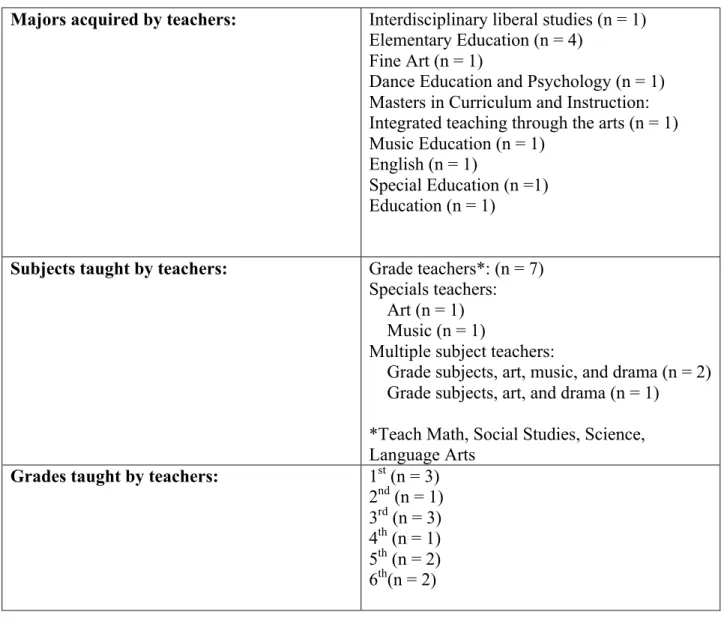
information about the teachers, including majors acquired, subjects taught, and grades taught, are
represented in Table 4.1 below.
Table 4.1: Educational Information about Teacher Participants (n = 12)
Majors acquired by teachers: Interdisciplinary liberal studies (n = 1) Elementary Education (n = 4)
Fine Art (n = 1)
Dance Education and Psychology (n = 1) Masters in Curriculum and Instruction: Integrated teaching through the arts (n = 1) Music Education (n = 1)
Perception of Art Integration
After answering the previous demographic questions, the participants were asked to
answer a twelve-question scale regarding their perception of arts-integration in education (May
and Robinson’s, 2015). Participants were asked to rate to which degree the agreed or disagreed
with the statements provided (1 = strongly disagree, 5 = strongly agree). The descriptive
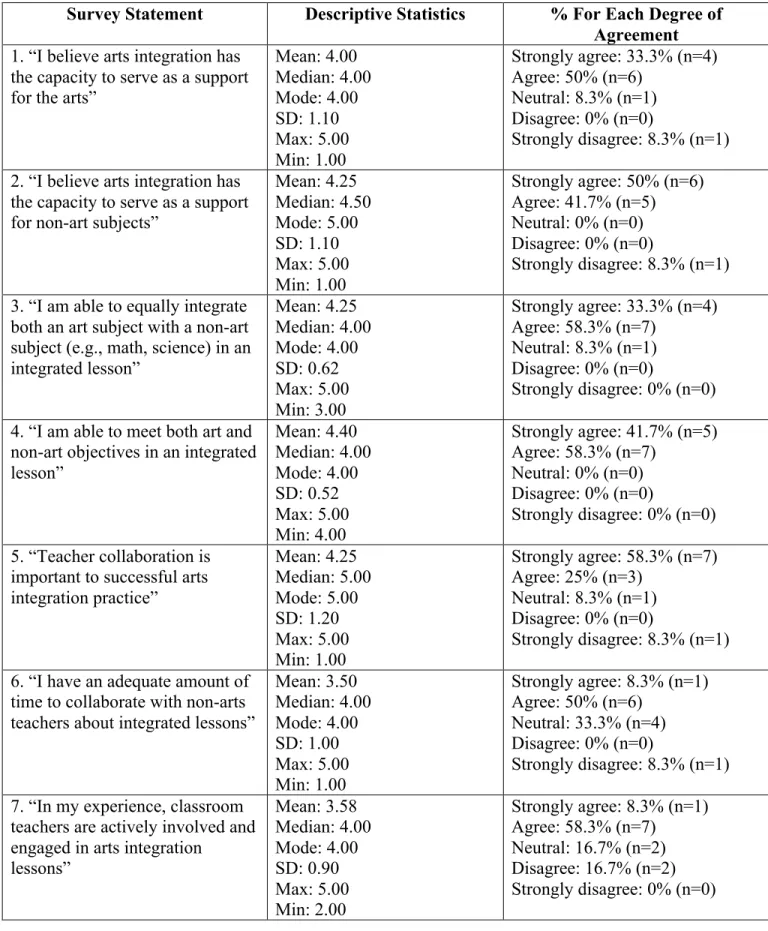
statistics for each survey question are represented in Table 4.2 below.
Table 4.2: Statistics of teacher perception statements
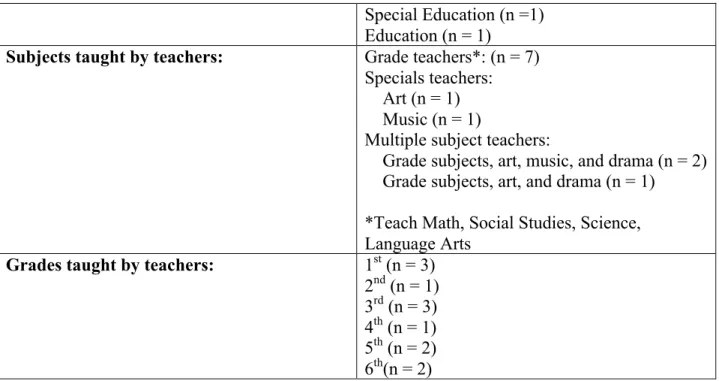
Special Education (n =1) Education (n = 1)
Subjects taught by teachers: Grade teachers*: (n = 7) Specials teachers: Art (n = 1) Music (n = 1)
Multiple subject teachers:
Grade subjects, art, music, and drama (n = 2) Grade subjects, art, and drama (n = 1)
*Teach Math, Social Studies, Science, Language Arts
Grades taught by teachers: 1st (n = 3) 2nd (n = 1) 3rd (n = 3) 4th (n = 1) 5th (n = 2) 6th(n = 2)
Survey Statement Descriptive Statistics % For Each Degree of Agreement 1. “I believe arts integration has
the capacity to serve as a support for the arts”
Mean: 4.00 Median: 4.00 Mode: 4.00 SD: 1.10 Max: 5.00 Min: 1.00
Strongly agree: 33.3% (n=4) Agree: 50% (n=6)
Neutral: 8.3% (n=1) Disagree: 0% (n=0)
Strongly disagree: 8.3% (n=1)
2. “I believe arts integration has the capacity to serve as a support for non-art subjects”
Mean: 4.25 Median: 4.50 Mode: 5.00
SD: 1.10 Max: 5.00 Min: 1.00
Disagree: 0% (n=0)
Strongly disagree: 8.3% (n=1)
3. “I am able to equally integrate both an art subject with a non-art subject (e.g., math, science) in an integrated lesson” Mean: 4.25 Median: 4.00 Mode: 4.00 SD: 0.62 Max: 5.00 Min: 3.00
Strongly agree: 33.3% (n=4) Agree: 58.3% (n=7)
Neutral: 8.3% (n=1) Disagree: 0% (n=0)
Strongly disagree: 0% (n=0)
4. “I am able to meet both art and non-art objectives in an integrated lesson” Mean: 4.40 Median: 4.00 Mode: 4.00 SD: 0.52 Max: 5.00 Min: 4.00
Strongly agree: 41.7% (n=5) Agree: 58.3% (n=7)
Neutral: 0% (n=0) Disagree: 0% (n=0)
Strongly disagree: 0% (n=0)
5. “Teacher collaboration is important to successful arts integration practice” Mean: 4.25 Median: 5.00 Mode: 5.00 SD: 1.20 Max: 5.00 Min: 1.00
Strongly agree: 58.3% (n=7) Agree: 25% (n=3)
Neutral: 8.3% (n=1) Disagree: 0% (n=0)
Strongly disagree: 8.3% (n=1)
6. “I have an adequate amount of time to collaborate with non-arts teachers about integrated lessons”
Mean: 3.50 Median: 4.00 Mode: 4.00 SD: 1.00 Max: 5.00 Min: 1.00
Strongly agree: 8.3% (n=1) Agree: 50% (n=6)
Neutral: 33.3% (n=4) Disagree: 0% (n=0)
Strongly disagree: 8.3% (n=1)
7. “In my experience, classroom teachers are actively involved and engaged in arts integration
lessons” Mean: 3.58 Median: 4.00 Mode: 4.00 SD: 0.90 Max: 5.00 Min: 2.00
Strongly agree: 8.3% (n=1) Agree: 58.3% (n=7)
Neutral: 16.7% (n=2) Disagree: 16.7% (n=2) Strongly disagree: 0% (n=0)
8. “I believe it is important that undergraduate arts education majors (i.e., music, visual, art, theater, dance) are knowledgeable about arts integration”
Mean: 4.75 Median: 5.00 Mode: 5.00 SD: 0.45 Max: 5.00 Min: 4.00
Strongly agree: 75% (n=9) Agree: 25% (n=3)
Neutral: 0% (n=0) Disagree: 0% (n=0)
Strongly disagree: 0% (n=0)
9. “I believe it is important that undergraduate arts education majors (i.e., music, visual, art, theater, dance) are taught how to plan and implement arts
integration lessons” Mean: 4.75 Median: 5.00 Mode: 5.00 SD: 0.45 Max: 5.00 Min: 4.00
Strongly agree: 75% (n=9) Agree: 25% (n=3)
Neutral: 0% (n=0) Disagree: 0% (n=0)
Strongly disagree: 0% (n=0)
On average, the teachers agreed that art integration has the capacity to serve as a support
for the arts (M=4.00, SD=1.10). Similarly, on average, teachers agree art integration has the
capacity to serve as a support for non-art subjects (M=4.25, SD=1.10). Although most teachers
agreed, one teacher reported he/she strongly disagrees that art integration is able to support art or
non-art subjects. Unfortunately, this teacher did not report why they perceive this to be true so it
is unclear what has led this teacher to perceive art integration to be unsupportive to art and
non-art subjects.
Furthermore, on average, teachers agree that they are able to equally integrate art with
non-art subjects (M=4.40, SD=0.62) and can successfully meet objectives in both subjects
(M=4.40, SD=0.52). None of the participants disagreed that they were able to complete both
these tasks. What is interesting is that although majority of the teachers agreed they could
effectively integrate the arts, only two of the twelve participants who completed the survey undergraduate degree program
adequately prepared me to teach arts integrated curricula
effectively” Median: 2.50 Mode: 3.00 SD: 0.90 Max: 4.00 Min: 1.00
Agree: 8.3% (n=1) Neutral: 41.7% (n=5) Disagree: 33.3% (n=4)
Strongly disagree: 16.7% (n=2)
11. “I believe that my participation in continuing education opportunities (e.g., teacher workshops, professional development) following my undergraduate degree program adequately prepared me to teach arts integrated curricula
effectively” Mean: 4.08 Median: 4.00 Mode: 4.00 SD: 0.80 Max: 5.00 Min: 3.00
Strongly agree: 33.3% (n=4) Agree: 41.7% (n=5)
Neutral: 25% (n=3) Disagree: 0% (n=0)
Strongly disagree: 0% (n=0)
12. “I believe there are sufficient numbers of arts integration professional development opportunities”
Mean: 3.17 Median: 3.50 Mode: 2.00, 4.00 SD: 1.1
Max: 5.00 Min: 2.00
Strongly agree: 8.3% (n=1) Agree: 41.7% (n=5)
allowed observation in the classroom. Furthermore, the two participants who did allow
observation were the music and the dance teacher, which are traditional performance arts. It is
interesting because it could be deduced that the other teachers did not allow observation because
they were not comfortable with an outsider objectively scrutinizing their teaching methods,
despite them reporting that they teach art integration well.
Teachers agreed that collaboration is important (M=4.25, SD=1.20), but neither agreed
nor disagreed that they had an adequate amount of time to collaborate (M=3.50, SD=1.00).
Aprill (2010) stated that extensive collaboration between art teachers and classroom teachers was
the solution to the problem of many “poorly conceived” programs. It is clear that teachers from
the school agree with Aprill that collaboration is important. However, May & Robinson (2015)
revealed through a similar survey that only 40% of teachers believed there was enough time for
collaboration when 90% believed collaboration is important. Therefore, the data from the survey
aligns well with research that people perceive collaboration to be important, but aren’t
intentionally making it happen.
Furthermore, on average teachers neither agreed nor disagreed that classroom teachers
are actively involved and engaged in arts integration (M=3.58, SD=0.90). The two interview
participants I spoke with agreed with this statement that often times classroom teachers do not
integrate the arts because they do not have a full understanding or mastery of the arts.
On average, teachers strongly agreed (M=4.75, SD=0.45) that undergraduate arts
education majors should be educated and prepared to teach art integration, but on average they
disagreed (M=2.47, SD=0.90) that their undergraduate degree prepared them to teach art
integration lessons effectively. Therefore, despite the wide range of knowledge and educational
On average, teachers agreed that professional development is beneficial to art integration
programs (M=4.08, SD=0.80), but on average they neither agreed nor disagreed that there were
enough opportunities for professional development (M=3.17, SD=1.10). The music teacher
revealed that professional development is necessary because administration often assumes that
new teachers entering the program already know what art integration is and how to implement it
in the classroom. However, according to the teacher, this is often not the case, which results in a
more “poorly conceived” program (Aprill, 2010). Additionally, Scripp & Gilbert (2016) stated
that professional development is necessary and that art teachers must take the lead in initiating
the programs so that classroom teachers can learn about the arts. However, a more
comprehensive professional development program, which includes instruction for art teachers on
how to do certain arts and how to integrate them into curriculum, as well as instruction from
classroom teachers on what they are actually teaching in their curriculum would be more
beneficial.
Interview Participants
Two participants were interviewed for this study: a dance teacher and a music teacher.
The dance teacher reported that she decided to teach at an arts integrated school because “she
wanted to connect dance to curriculum.” The music teacher did not realize that the school was an
art integration school beforehand because she was recommended to replace the retiring music
teacher by a former colleague. However, she did express that adapting to the model of art
integration was not very difficult because she had already been teaching this way.
Observation setting
The two classrooms that were observed were also the dance classroom and the music
afternoon and the class that was observed was 5th grade students. The observation of the music
classroom took place on October 8th in late afternoon and the class that was observed was 3rd
grade students. Both observations lasted about 45 minutes.
Both classes had diverse student populations. There were multiple minority populations
represented as well as several English Language Learners. The dance classroom was more
unstructured and loud. The music class was much calm, but the students were still engaged in the
activities.
Dance Narrative
I entered the classroom a few minutes late and the students were already completing their
warm-up, which the teacher informed me is led by two new students each day. The students
participated in the warm-up with energetic background music, which I noted as a form of
affective art integration because it allowed the students to get excited and ready to dance. I was immediately intrigued by the structure of the class, which allowed for more student
independence and initiation. The teacher was not leading the warm-up, but instead was following
the lead of the two students. I also noticed that I was the only student in the classroom who was
wearing shoes. Evidently, all the students remove their shoes before entering the classroom. The
classroom itself was more of a dance room than a traditional classroom; there were wood dance
floors and mirrors on the wall. After only being in the classroom for several minutes, I already
recognized how different it was from my elementary education. I started to see the classroom
less as a classroom and more as a learning space that produced experimentation, innovation,
creativity, and fun. For me, a classroom has always been a place where I listen to a teacher’s
instruction, memorize that information and then eventually reproduce that information on a test.
However, this environment allowed for students to express learning through personalized and
creative means, which stewarded enjoyment of learning activities. The environment was similar
to that described by Lynch (2007) where voices and hand, which are usually asked to be kept
quiet and still were being used as “tools for learning” (p. 36).
On the day that I observed, it was a 5th grade class in the room. The students were
working on an assignment regarding human rights and social justice. After the students
completed their warm-up, the teachers asked the students to think of how they would feel if their
human rights were taken away or abused or how they would feel if this happened to someone
they knew. This was the objective of the traditional subject aspect of the lesson. Then the teacher
asked the students to portray those feelings through a series of three dance movements, which the
students completed in groups of three of four. The students created their dance sequences
including dance technique that they had previously studied in the class, which was the objective
of the dance aspect of the lesson. I was speechless at how engaged the students were and how
enthusiastic they were about completing this assignment. It appeared to me that the students
understood the subject of human rights and I was amazed by their ability to put that knowledge
in dance form. One of the first things I said to the dance teacher when she approached me was, “I
wish this had been my educational experience; I would be a very different person today if it had
been.” What I meant is that if I had had the opportunity to learn and express knowledge through
a form such as dance, I probably would have learned more because I would have been more
motivated and more enthusiastic about learning the information. After about fifteen minutes the
teacher played a triangle in order to gain the student’s attention. Later, in my interview with the
teacher, she reported that she choses between a triangle and a drum to get the students’ attention,
to art integration. The groups then performed their sequence all at the same time while the
teacher and I observed them. The students performed their dance multiple times, sometimes with
music and sometimes without. The students also performed their dance to various tempos, which
were set by the teacher or occasionally were determined by the students.
The dance teacher then shared with the students of the second objective for the human
rights aspect of the lesson. She asked the students to create a series of three dance movements to
represent the actions and reactions that would be involved in a situation where someone’s human
rights were being taken away or abused. The goal of this portion of the task was to have the
students represent a way that they could change the situation for the better. Although the students
did have ample freedom within the class structure, there were areas that the teacher censored; for
example, the teacher asked the students to be appropriate and non-violent. Therefore, the
students were asked to be creative, but within certain limits.
During the class period, I saw students collaborate with each other, which was
encouraged by the teacher who told the students to “work as a team.” In addition, she reminded
the groups to let everyone have an opportunity to speak. Furthermore, something I noticed was
that the teacher did not ask students why they chose certain movements. It is possible that she
will do this in a future class, but I found it interesting that she did not provoke the thought
process of the students’ creativity and innovation. Near the end of the class, the teacher asked a
student, “how do you say it with movement” and the student replied, “you can’t” to which the
teacher stated, “You can; it’s a challenge.” This reveals that the students are most likely
encouraged to apply the ideas they have learned in new and sometimes difficult ways. The
teacher informed me that the students would continue to work on these dance sequences for the
In addition to projects being filmed, the students participate in a performance for the school
body, as well as family and friends, which is an example of the social approach to art integration.
In addition to the activity I observed, the dance teacher reported that she integrates dance
in the classroom through videos, Presi presentations, dance combinations, and other activities.
There is a focus on learning vocabulary terms through these art mediums. One activity the class
completed was studying vocabulary terms related to Force and Motion and then the students
watched videos of professional dancers and noted which movements represented which terms.
Then the students had the opportunity to create their own dances and evaluate their peers’ dance
in the same way as the professional videos. According to the teacher, “students are challenged to
find their own connections between dance and subject material” and are often required to make
their own creative representation of those connections. Examples of this include: a group dance
to learn about the Pilgrim Rye Harvest Dance, Sun/Moon/Sky poems and folk tales portrayed
through dance movements, and an American history timeline with each small group representing
events in a specific time period of history.
The dance teacher identified that the best part of her job is that she is able to teach all of
the students and she has the opportunity to see most students grow from when they are in
Kindergarten to when they are in 5th grade. In addition, she believes that art integration “gives
the opportunity to test without all the information, be inclusive, and allow for exciting and active
participation and learning for everyone.”
In regards to Multiple Intelligences, the dance teacher stated that it is important not to
have fixed thinking and to teach in ways that include all students because some students might be
stronger in different areas. One year she had students write on cards what they did over the
The dance teacher revealed that a challenging part of her job is the new block schedule
for 2nd through 5th grade because she only sees certain students for a couple weeks, but she still
sees the Kindergarten and 1st grade students the entire year. This is a challenge because she does
not have the ability to build strong relationships with the students and the students also only
practice the specific art for a couple weeks before moving on to the next one. The other
challenging part of her job is the balance of teaching dance and teaching another subject and
making both an equal focus in her classroom. By stating this, she simply affirmed what is already
known to be true: art integration is difficult to define and difficult to implement. In addition,
when asked if the grade teachers integrate art into the classroom as well, she responded, “they
are supposed to, but most use ‘art-based activities’.” Furthermore, in regards to art integration,
she stated, “sometimes it works and sometimes it doesn't.” Although she stated, “collaboration is
important to help people,” she also mentioned that she does not collaborate very often with the
grade teachers. However, she also reported that she does not perceive there to be any limitations
to art integration. This is interesting because it could be that her high value perception of art
integration itself is preventing her from perceiving clear limitations to the program as actual
limitations.
The following compares the art integration activity of the human rights dance series
observed in the dance classroom with the requirements for co-equal art integration defined by
Silverstein & Layne (2010).
Approach to teaching. There were examples of Constructivism in the lesson. The
students were asked to reflect on how they would feel if their human rights or the human
rights of someone they knew were taken away. Then they were asked to reflect on in